

Mina the Hollower Review: Yacht Club Games Delivers a Retro Masterpiece
Yacht Club Games built their reputation on a shovel. Now, they’ve taken that same meticulous passion and poured it into a mouse with a burrow mechanic – and somehow, it hits even harder. Mina the Hollower is the studio’s most ambitious game yet, a top-down 2D action-adventure wrapped in a gorgeous Game Boy Color aesthetic that draws clear inspiration from classic Zelda titles, Castlevania, and even a sprinkle of Dark Souls. It sounds like a recipe for something derivative. It’s anything but.
After a wildly successful Kickstarter campaign back in 2022 and several delays that had fans anxious, Mina the Hollower arrived on May 29, 2026. Worth the wait? Emphatically, yes.
A Victorian Island Full of Secrets
The story takes place in a world filled with goblins, talking skeletons, and every kind of fantasy you can imagine. At the center is Ossex, a city ruled by Baron Lionel and powered by six generators – until Thorne, one of Lionel’s closest allies, betrays him and destroys them all. You step into the role of Mina, a Hollower – part engineer, part warrior – tasked with repairing the generators and stopping the chaos unfolding across Tenebrous Isle.

On paper, it sounds like a classic save-the-world setup. Familiar, almost predictable. But the narrative does something clever: it looks shallow at first glance, but once you step closer, it turns out to be far deeper than expected, with unusual and unexpected developments happening all the time, both in the main plot and in side stories – all delivered with writing and humor that regularly catches you off guard. I genuinely laughed out loud at several NPC interactions. Not a polite chuckle – actual laughter.
The character writing is a standout. Mina, several major characters, NPCs, and even bosses all have memorable personalities. Even minor characters with familiar tropes somehow make you root for them, and none of it feels forced. The world feels lived-in. That matters more than people give it credit for.
Burrowing, Bones, and Build Variety
This is where Mina the Hollower separates itself from nearly every other retro-inspired title on the market. The core burrowing mechanic – “Hollowing” – is brilliant in its simplicity and staggering in its depth.
The burrowing lets Mina tunnel through the ground. It’s used for bypassing enemies, digging up hidden items, uncovering secret passages, activating explosions, solving platforming sections, and much more. What makes the mechanic so enjoyable is how naturally integrated it feels – it never comes across as a gimmick, but becomes an essential tool that eventually feels second nature.
The Trinket System
With over 60 trinkets to choose from, the variety is staggering, though you can only use a select few at once. You’ll unlock slots to carry more, but ultimately you’re limited, so choose wisely – though you can swap them at specific checkpoints. The builds you can construct feel genuinely personal. My go-to combination leaned heavily into extended burrowing range and wall-traversal, turning movement into something fluid and almost rhythmic. Others will find entirely different combinations that suit their style.
Combat, Weapons, and the Soulslike Twist
Besides trinkets, you’ll use one of five weapons, unlockable and swappable throughout the adventure. There are three available at the start – the balanced Nightstar, the quick-striking daggers called Whisper and Vesper, and the heavy Blaststrike Maul. Two more technical options, the Hollower’s Shield (built around parrying) and the Battery Buster, round out the arsenal.
Sidearms add another layer entirely. Some are more dual-purpose, like the Iron Steed – a bicycle with a spike at the front, useful for both movement and attacking. The Drill Diver acts as a shield that propels Mina forward, great for bridging larger gaps.
Death is not the end – you drop a “Spark” that can be recovered. Bones, the in-game currency, can also be converted into Bone Gems, which bank your resources into an item that can’t be lost on death. It’s a smart twist on the Soulslike formula. I haven’t seen any other game handle it quite this way, and it removes a lot of the pure frustration that genre is notorious for.
A small criticism worth noting: the opening hours can be genuinely punishing. Most areas immediately throw irritating foes your way – the kind that swarm you like flies and refuse to go down in a single hit. The difficulty curve flattens out considerably as your build comes together, but early on, expect some friction. It’s the kind of friction that feels intentional rather than poorly calibrated, though newcomers to action-heavy games might want to explore the modifier system from the start.
Six Zones, Seventeen Areas, Zero Filler
The game spans roughly 17 distinct areas, each built around its own visual theme and gameplay mechanics. Some areas focus on burrowing, while others focus on railing, platforming, enemy variety, or entirely different gimmicks that keep exploration fresh throughout the journey.
What’s remarkable is how the non-linear structure actually works. You can tackle the six main generators in any order. Yacht Club Games nudges players in certain directions through the in-game newspaper, which records Mina’s exploits and hints at the next objective through its pages. NPC dialogue offers similar guidance, though these are merely suggestions, not requirements.
Practically every environment hides secrets that lead to hidden paths, chests, and optional bosses. The game uses the level design itself to hint at secrets, whether through subtle visual cues like a slightly cracked stone or an object sitting in a specific place that just looks a bit off, or through more obvious signs like a conspicuous coffin or holes in the ground marked with an “X”.
Does it always feel completely balanced in terms of difficulty across zones? Not entirely – some areas feel noticeably steeper than others depending on the order you approach them. But that’s part of the charm, honestly. Exploring somewhere and realizing you’re in over your head, then returning later with better gear, produces a specific kind of satisfaction that’s hard to manufacture artificially.
Pixel Art and a Soundtrack Worth Owning
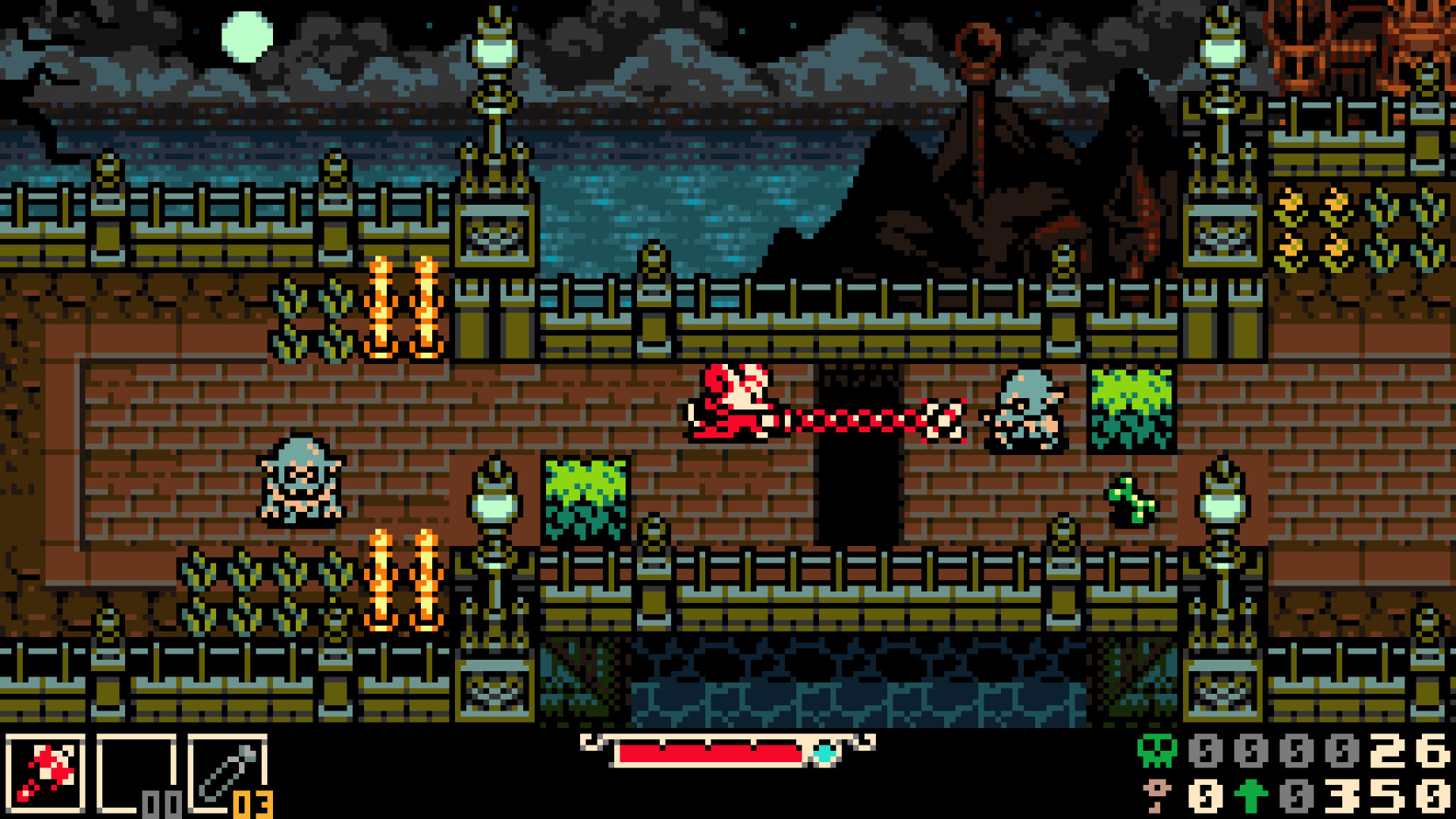
Yacht Club Games deliberately used the Game Boy Color as inspiration to create an 8-bit style reminiscent of classic pixel-art handheld games from the 90s and early 2000s. Some character designs even evoke older Legend of Zelda titles, though they are wrapped in a Gothic horror atmosphere that gives the game its own distinct identity.
Every zone has its own visual identity. The city of Ossex alone is stunning – dense with characters, secrets tucked into corners, and a sense of genuine scale that feels rare in pixel art games.
Composer Jake Kaufman creates an authentic, chunky, old-school soundtrack befitting the darker Victorian aesthetic of Mina the Hollower. The City of Ossex’s theme carries a regal air while also coming across as dreary and dark at times. Each zone gets its own musical personality. The soundtrack doesn’t just complement the visuals – it amplifies them. I keep finding myself humming tracks hours after putting the controller down.
Final Verdict
From start to finish, Mina the Hollower is enthralling – a first playthrough runs about 18 hours, and the exploration, story, art style, and the myriad ways the developers pull surprises on you makes this an all-timer and an easy recommendation for anyone who enjoys video games.
Replayability is exceptional. With seven different New Game+ modes and a staggering number of modifiers – altering anything from difficulty to color palette to the way characters speak – there’s a compelling reason to dive back in after the credits roll. And at $19.99, the value proposition is almost unreasonably good.
Mina the Hollower is the kind of game that reminds you why retro-inspired titles matter – not because nostalgia is inherently valuable, but because the design principles of that era, when executed with modern care and craft, produce something genuinely special. Yacht Club Games has made their best work yet. It’s that simple.
