Normální zobrazení

Received before yesterday

Clair Obscur: Expedition 33 Story and Characters – Complete Belle Époque World Guide

7. Leden 2026 v 14:52

Clair Obscur: Expedition 33 transports players into a haunting Belle Époque fantasy world where an ancient entity called the Paintress condemns humanity to slow extinction through an annual ritual known as the Gommage. This award-winning narrative, which earned Best Narrative and Best Game Direction at The Game Awards 2025, weaves together themes of loss, hope, sacrifice, and human connection against the backdrop of turn-of-the-century France.

The game’s title carries profound meaning – “Clair Obscur” translates to “light and dark,” perfectly encapsulating the story’s core themes of hope and despair, life and loss, courage and fear. Set in the isolated city of Lumière, the narrative follows a desperate band of volunteers who risk everything to break the Paintress’ deadly cycle and reclaim humanity’s future.

This comprehensive guide explores the complete Clair Obscur story, from the Fracture disaster that started it all to the complex character journeys that earned Jennifer English the Best Performance award. Understanding these narrative elements enriches your experience while exploring this visually stunning world inspired by Belle Époque France and the Art Deco movement.

The World of Clair Obscur – Understanding the Belle Époque Setting

The world of Clair Obscur takes place in a dark fantasy interpretation of Belle Époque France, a period that literally means “the beautiful age” and spans from 1871 to 1914. This specific historical period provides more than aesthetic window dressing – it serves as the thematic foundation for the entire narrative experience.

Director Guillaume Broche and his Montpellier-based team at Sandfall Interactive chose this setting deliberately. After initially exploring a steampunk Victorian setting with science fiction elements including zombies and aliens, potential investors encouraged Broche to “think bigger” about six months into development. This led to a complete narrative reset.

The Belle Époque represents a period of peace, progress, and hope in French history – characteristics that seem almost antithetical to Clair Obscur’s world defined by stagnation and never-ending loss. This juxtaposition creates powerful narrative tension, as the expedition fights to reclaim the very ideals this historical period represents.

The City of Lumière

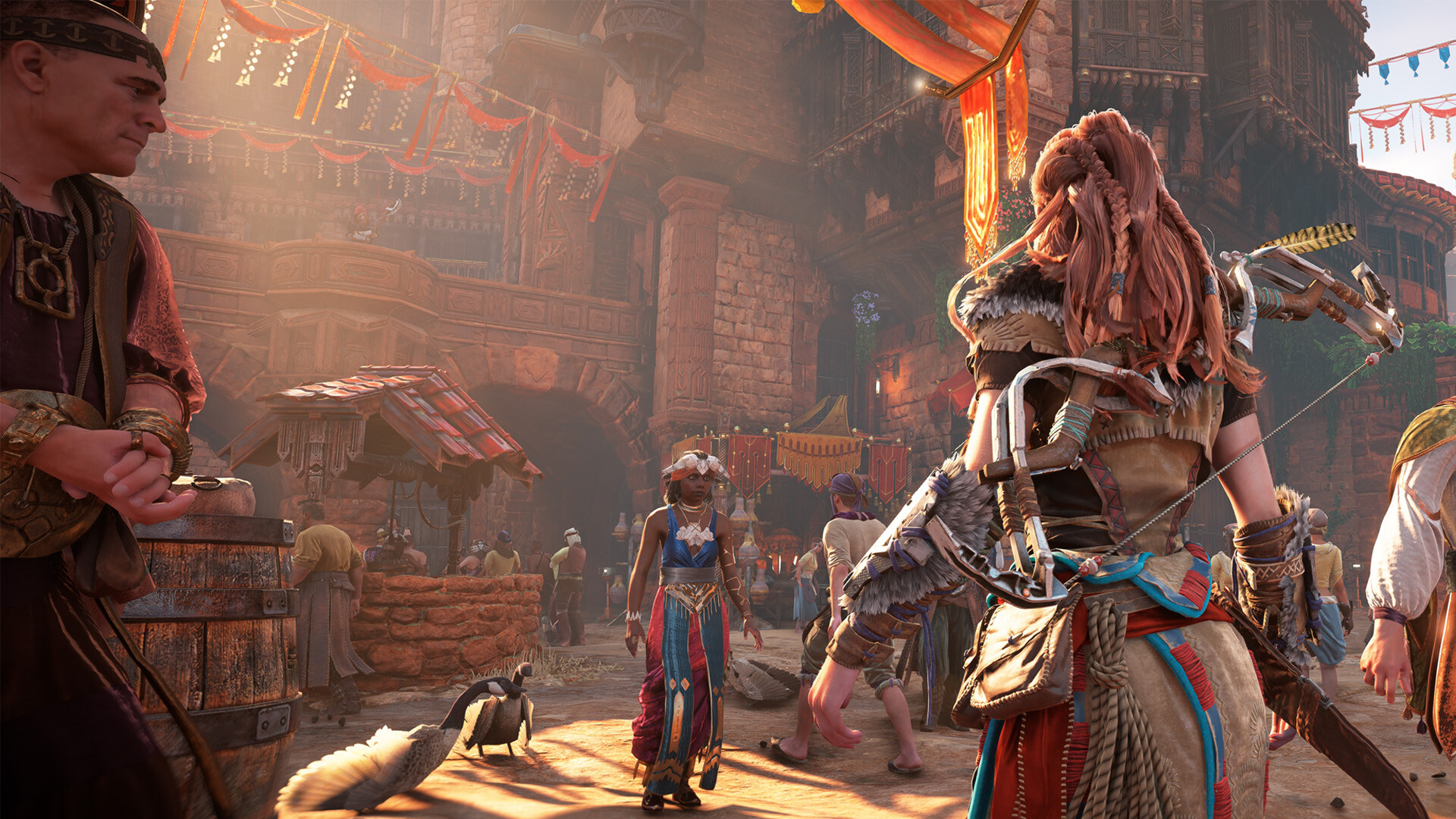
Lumière serves as humanity’s final refuge, isolated amidst an ocean and scarred by decades of the Gommage. The city features iconic landmarks like the Eiffel Tower and Arc de Triomphe, placing its timeline roughly at the turn of the 20th century based on architectural details and period-accurate costuming.

City streets blend Art Nouveau and Neoclassical architecture, creating a visually distinctive environment that honors real Parisian history while establishing its own identity. Men wear narrow suiting while women sport shirtwaist and skirt ensembles characteristic of the late 1890s, grounding the fantasy elements in historical authenticity.

The Art Deco movement heavily influenced the game’s visual design, creating a unique aesthetic that blends classic beauty with haunting surrealism. Every character, environment, and enemy showcases meticulous attention to detail, immersing players in an emotionally charged adventure where style becomes substance rather than surface decoration.

The Gommage – Understanding the Central Threat

The Gommage represents the existential horror at the heart of Clair Obscur’s narrative. Every year, the mysterious Paintress awakens and paints an ever-decreasing number on an enormous rock formation called the Monolith. All humans whose age matches or exceeds that number immediately disappear, turning to smoke and fading from existence without explanation or pattern.

This annual event threatens humanity with eventual extinction as the number ticks downward year after year. The Paintress first appeared 67 years before the game’s events during a catastrophic disaster known as the Fracture, which isolated Lumière from the rest of the continent and began the cycle of death.

The inevitability of the Gommage shapes every aspect of society in Lumière. Characters live under constant temporal pressure, knowing their final year approaches when their age matches the current number. This creates a culture simultaneously resilient and fatalistic, where people cherish each day while accepting the brutal reality of their world.

Previous Expeditions

After each yearly Gommage, Lumière sends an expedition of volunteers to head to the mainland in an effort to slay the Paintress before she can paint a new number. These expeditions rarely succeed – most are decimated by hostile monsters called Nevrons that populate the fractured continent.

Expedition 33 represents the latest attempt to break the cycle. The group’s name reflects that the Paintress painted “33” on the Monolith, meaning everyone aged 33 was erased. This expedition carries the hopes of everyone remaining in Lumière, who understand that time runs out faster with each passing year.

The remnants of past expeditions scatter across the continent – journal entries, abandoned equipment, and ruined camps tell stories of courage, desperation, and ultimate failure. These discoveries provide context for your journey while honoring those who attempted the mission before you.

Main Characters – The Heroes of Expedition 33

The core cast of Clair Obscur: Expedition 33 features six playable characters, each bringing unique abilities, personalities, and narrative significance to the journey. Their relationships, personal struggles, and character development form the emotional backbone of the experience.

Gustave, voiced by Charlie Cox (Daredevil: Born Again), serves as the initial protagonist. This resourceful and dedicated engineer spent his life developing technology to protect Lumière, including the revolutionary Lumina converter that gives Expedition 33 advantages previous groups lacked. With his final year ticking away after reaching age 33, Gustave risks everything to defeat the Paintress and reclaim a future for Lumière’s children.

Gustave wields a mechanical arm that charges through combat actions and unleashes devastating damage when fully powered. His engineering background translates into gadget-based abilities offering both offensive pressure and utility support. As the foster brother and father figure to Maelle, his protective instincts drive many crucial story decisions.

Maelle – The Heart of the Expedition

Maelle, voiced by Jennifer English in an award-winning performance, represents the youngest member of Expedition 33 at just 16 years old. Orphaned at age 3, she’s never felt at home in Lumière and has difficulty connecting with and trusting others beyond her foster brother Gustave.

Unlike other Expeditioners motivated by duty or desperation, Maelle views the expedition as her chance to explore the world beyond Lumière and finally forge her own destiny. Her character arc contains major spoilers, but Jennifer English’s nuanced portrayal captures both vulnerability and strength, earning her the Best Performance award at The Game Awards 2025.

Maelle wields a rapier and employs dynamic swordfighting stances that alter her available abilities and stat distributions. Switching between Defensive, Offensive, and Virtuose stances mid-combat allows tactical adaptation to changing battlefield conditions, making her extremely versatile in skilled hands.

Lune – The Brilliant Scholar

Lune, voiced by Kirsty Rider (Sandman), brings intellectual prowess and magical expertise to Expedition 33. As the daughter of prominent researchers, she possesses a deep thirst for knowledge and has sacrificed everything to complete her parents’ work. Her singular goal focuses on unraveling the mystery of the Paintress.

Entrusted with charting the expedition’s path, Lune feels the weight of responsibility and the stakes involved keenly. She cannot and will not allow this expedition to fail. Her magical abilities create elemental stains through spellcasting that can be consumed for additional effects, rewarding thoughtful spell sequencing and strategic resource management.

Lune’s elemental magic exploits enemy weaknesses through four affinities: Weakness (50% increased damage), Resistance (50% reduced damage), Nullify (no damage), and Absorb (heals instead of damages). Understanding and exploiting these mechanics becomes crucial for combat efficiency.

Sciel – The Calm Warrior

Sciel, voiced by Shala Nyx (The Old Guard), represents wisdom, warmth, and acceptance in a world defined by loss. A former farmer turned teacher, she embraces life day by day with genuine joy, masking the pain of a tragic past. Despite accepting the brutality of their world, her commitment to the expedition’s success never wavers.

Sciel’s philosophical nature and resourceful creativity help herself and others navigate difficult situations. Her calm demeanor and playful spirit provide emotional balance for the team during dark moments, while her combat prowess proves she’s more than capable of handling threats.

At ease with death after years of witnessing the Gommage, Sciel approaches each day with gratitude and wonder. This positive outlook contrasts sharply with the grim reality surrounding them, making her an invaluable emotional anchor for the expedition.

Supporting Characters and Their Significance

Beyond the main expedition members, several key characters shape the narrative trajectory and provide crucial context for understanding the world’s mysteries. These individuals each carry their own burdens, secrets, and motivations that intersect with Expedition 33’s journey.

Renoir, voiced by Andy Serkis in a powerful performance, initially appears as a mysterious old man attacking expeditions. His true identity and motivations reveal themselves gradually, connecting deeply to the Paintress’ origins and the Fracture disaster that started everything. Serkis brings gravitas and emotional complexity to this conflicted character.

Renoir’s ruthless determination stems from protecting his family and preserving what remains of his world. As a member of the first expedition who received immortality from the Paintress, he guards her not out of malice but from a twisted form of love and duty. Understanding his perspective adds moral complexity to what initially seems like straightforward antagonism.

Verso – The Mysterious Stranger

Verso, voiced by Ben Starr (Final Fantasy XVI), tracks Expedition 33’s every move with unclear motives. His dangerous aura and moral ambiguity create tension throughout the early acts. Ben Starr describes the role’s appeal: “The moral ambiguity of Verso was so immediately enticing. He’s such a darkly mysterious character.”

Verso eventually joins the expedition after revealing shocking connections to both Renoir and the Paintress’ history. As Renoir’s son and a fellow immortal from the first expedition, Verso has grown tired of eternal life and wishes to kill the Paintress to finally end his existence. This death wish drives his willingness to help despite the risks.

His friendship with Monoco adds another dimension to his character. The bond between immortal human and ancient Gestral creature demonstrates that meaningful connections persist even across centuries of existence and suffering.

Monoco and Esquie

Monoco, voiced by Rich Keeble, represents the Gestrals – mysterious creatures untouched by the Paintress’ Gommage. As a Gestral warrior associated with Verso, his specialized skillset offers unique combat options unavailable to other party members. Rich Keeble describes voicing a “Loyal, eloquent, terrifying” character.

Esquie, voiced by Maxence Cazorla, belongs to another category of mythical creatures inhabiting the mainland called Grandis. This local creature aids the expedition during their journey, showcasing that not all inhabitants of the fractured continent oppose humanity’s survival. Esquie’s underwater swimming ability unlocks new areas during exploration.

These non-human allies demonstrate the expedition’s willingness to forge alliances across species boundaries when fighting existential threats. Their unique perspectives and abilities prove invaluable for overcoming challenges human expeditions couldn’t handle alone.

The Paintress and the Fracture

The Paintress, voiced by Tracy Wiles, serves as the central antagonist whose annual rituals condemn humanity to gradual extinction. Understanding her true nature, motivations, and origins requires piecing together clues scattered throughout your journey. The complete picture reveals a tragedy far more complex than simple villainy.

The Fracture occurred 67 years before the game’s events, isolating Lumière from the rest of the continent and beginning the Gommage cycle. This catastrophic disaster fundamentally altered reality in ways that become clearer as you progress through the narrative’s three acts.

The Paintress’ connection to Aline Dessendre and the Dessendre family forms the emotional core of the narrative’s final revelations. Without spoiling specifics, the story explores how grief, loss, and desperate attempts to preserve loved ones can twist into something monstrous that threatens everyone.

The Monolith and Its Significance

The Monolith represents more than just a canvas for the Paintress’ numbers – it stands as a physical manifestation of the curse affecting humanity. This enormous rock formation visible across the continent serves as a constant reminder of mortality and the ticking clock counting down to extinction.

Each year when the Paintress awakens and paints her cursed number, the Monolith becomes the focal point of humanity’s fear and despair. Its presence dominates the psychological landscape as much as the physical one, shaping how people view their limited futures.

Narrative Structure – Acts and Story Progression

The narrative unfolds across a prologue and three acts, each shifting focus to different expedition members as protagonists. This rotating perspective approach allows deeper exploration of individual character arcs while maintaining overall narrative cohesion.

The prologue introduces the main cast and establishes the world’s stakes efficiently. Within an hour, players understand the Gommage threat, meet key characters, and witness the expedition’s departure from Lumière. This compressed introduction creates immediate investment before the journey truly begins.

Act I centers on Gustave as the primary protagonist, establishing his relationships, engineering expertise, and protective instincts toward Maelle. The act concludes with a shocking development that writers Jennifer Svedberg-Yen and Guillaume Broche planned from the earliest stages as part of the emotional journey they envisioned.

Acts II and III

Act II shifts focus to Verso following Act I’s conclusion. This perspective change allows exploration of immortality’s burden, complicated family dynamics, and moral ambiguity surrounding the Paintress conflict. The act expands understanding of the world’s history while introducing new locations and challenges.

Act III centers on Maelle following major revelations about her true identity and connection to the overarching narrative. This final act brings together all story threads, forces difficult choices with lasting consequences, and delivers the emotional catharsis the journey builds toward.

The story offers multiple endings based on player choices, with the final decision between Maelle’s path and Verso’s path determining the fate of Lumière, the expedition, and the painted world itself. Each ending provides satisfying resolution while honoring the themes explored throughout.

Themes and Narrative Depth

Clair Obscur: Expedition 33 explores profound themes that resonate beyond its fantasy setting. The core theme of loss of loved ones originated with director Guillaume Broche’s mother. When stuck on the narrative draft, Broche asked what would be the worst thing that could happen to her – she answered losing any of her children.

This answer became the foundation for Aline’s character and the catalyst for her decision to dwell in her departed son’s canvas. The entire narrative spirals outward from this central trauma, examining how grief can consume individuals and societies when left unresolved.

Hope versus despair creates constant tension throughout the journey. The Belle Époque aesthetic represents humanity’s dreams of peace and progress, while the harsh reality of the Gommage embodies crushing despair. The expedition fights not just for survival but to reclaim the possibility of hope itself.

Sacrifice and Human Connection

Sacrifice defines the expedition experience. Every volunteer knows the likely outcome – most won’t survive the journey. Yet they embark anyway, driven by duty, love, desperation, or the simple recognition that someone must try. This willingness to sacrifice for others’ futures provides the emotional weight behind combat encounters and exploration.

Human connection emerges as the antidote to isolation and despair. Characters who open themselves to relationships – Gustave and Maelle’s bond, the growing trust between expedition members, alliances with Gestrals and Grandis – find strength unavailable to isolated individuals. The narrative rewards emotional vulnerability alongside tactical skill.

The Relationship Interactions system mechanically reinforces this theme. Building connections between characters through camp conversations unlocks Gradient Attacks, powerful combination moves impossible for individuals alone. This design choice elegantly ties gameplay benefits to narrative themes of cooperation and trust.

Voice Acting and Performance Capture

The exceptional voice performances in Clair Obscur significantly contributed to the game’s narrative impact and critical acclaim. Recording took place at Side UK under voice director Joanna Green, with motion capture and performance capture bringing additional authenticity to character expressions and movements.

Jennifer English’s portrayal of Maelle earned universal praise and the Best Performance award at The Game Awards 2025. Her ability to convey Maelle’s emotional complexity – vulnerability, determination, fear, and growing confidence – resonated deeply with players. English described Maelle as “the epitome of a dream character for me – captivating, intricately layered, exquisitely written.”

Charlie Cox brings warmth and paternal protectiveness to Gustave while maintaining the character’s technical expertise and tactical mindset. Cox’s previous work as Daredevil prepared him for portraying heroes carrying heavy responsibilities, making Gustave’s leadership feel authentic and grounded.

Star-Studded Supporting Cast

Andy Serkis delivers a haunting performance as Renoir, bringing decades of motion capture expertise to the role. His ability to convey complex emotions through subtle facial expressions and body language enriches Renoir’s conflicted motivations. Serkis’ involvement raised the production’s profile significantly.

Ben Starr portrays Verso with appropriate moral ambiguity and dangerous charisma. Fresh from his acclaimed work as Clive Rosfield in Final Fantasy XVI, Starr brings similar intensity and emotional depth to this mysterious character. His chemistry with other cast members enhances ensemble scenes.

Kirsty Rider (Lune) and Shala Nyx (Sciel) round out the core expedition with distinct personalities that complement rather than compete with each other. Rider emphasizes Lune’s intellectual drive and vulnerability beneath confidence, while Nyx captures Sciel’s philosophical warmth and hidden melancholy perfectly.

Exploring the Continent – Key Locations

Leaving Lumière’s relative safety, the expedition ventures across the Continent – a monster-infested mainland featuring diverse environments each hiding secrets, enemies, and journal entries from past expeditions. These locations progressively reveal the world’s history and the true nature of the Paintress’ curse.

Spring Meadows provides early exploration opportunities with relatively manageable enemy encounters. The area’s deceptive beauty contrasts with lurking dangers, establishing the pattern of environments that seem peaceful until hostile Nevrons appear. Collectible journals here establish context for failed past attempts.

Flying Waters showcases the game’s visual artistry with surreal landscapes that challenge normal physics and spatial understanding. This location exemplifies how the Fracture distorted reality across the continent, creating areas where normal rules don’t apply. Navigation requires attention to environmental storytelling and careful observation.

Ancient Sanctuary and Beyond

The Ancient Sanctuary holds crucial lore about the world before the Fracture. Ancient texts, preserved artifacts, and architectural details provide clues about how society functioned when the continent remained whole. This historical context makes the current tragedy feel more profound.

Renoir’s Mansion represents a pivotal location where major narrative revelations occur. The mansion’s preservation amidst continental decay raises questions about its occupants and their relationship to the Paintress. Exploring this location triggers irreversible story progression, so thorough exploration beforehand proves wise.

The Thank You Update added Verso’s Drafts, a new area accessible during Act III once players acquire Esquie’s swimming ability. This colorful, whimsical environment contrasts with the typically serious tone, offering fresh experiences for completionists and late-game challenge seekers.

Narrative Inspirations and Creative Influences

Director Guillaume Broche drew inspiration from multiple sources when crafting Clair Obscur’s narrative. The French fantasy novel “La Horde du Contrevent” by Alain Damasio influenced the core concept of explorers traveling through hostile territory on a crucial mission. The novel’s focus on group dynamics under extreme pressure resonates throughout the expedition’s journey.

The initial concept originated from a painting Broche admired, which led him to envision a giantess and a doomsday clock. This visual starting point shaped the Paintress’ design and the Monolith’s role as a literal countdown to extinction. Translating this striking image into interactive narrative required building an entire world around the central concept.

Final Fantasy, Persona series, Lost Odyssey, and Blue Dragon provided gameplay and narrative structure inspiration. These JRPGs demonstrated how turn-based combat could coexist with cinematic presentation and emotional storytelling. Clair Obscur builds on these traditions while establishing its own identity through unique mechanics and themes.

Belle Époque as Narrative Fiction

Understanding the Belle Époque’s historical context enriches appreciation for Clair Obscur’s narrative choices. Historian Dominique Kalifa explains that “the term was adopted by public opinion after the First World War” as “a generation that had known terrible suffering tried to forget the blood and mud from 1914-1918 by exalting the long period of peace and stability that had preceded it.”

The Belle Époque represents nostalgia for a time before suffering – a fiction created by those who experienced horror and desperately wanted to believe something better existed before. This perfectly mirrors how Clair Obscur’s world views its own past before the Fracture, creating thematic resonance between historical reality and fantasy narrative.

Collectibles and Lore Discovery

Expedition Journals scattered across the continent provide crucial backstory about previous attempts to defeat the Paintress. These written accounts offer perspectives from doomed expeditions, revealing their discoveries, struggles, and final moments. Collecting journals creates a more complete understanding of the world’s history.

Nevron Quests involve tracking down and defeating specific monsters while uncovering their origins and connection to the Fracture. These optional challenges provide both combat variety and lore expansion. Understanding Nevrons’ true nature becomes important for comprehending the continental transformation.

Gestral Games and Lost Gestrals encourage thorough exploration while revealing information about these mysterious creatures unaffected by the Gommage. Their existence raises questions about why the Paintress’ curse only affects humans and what makes Gestrals immune to this existential threat.

Environmental Storytelling

Beyond explicit collectibles, environmental storytelling communicates narrative details through visual design and world layout. Ruined buildings, abandoned camps, and scarred landscapes tell stories without words. Attentive players discover additional context by observing how different areas changed after the Fracture.

Paint Cages and Paint Spikes represent physical manifestations of the Paintress’ influence across the continent. These mysterious structures hint at how her power extends beyond annual Monolith paintings to actively shape and corrupt the physical world. Their distribution patterns provide clues about her true nature.

FAQ: Frequently Asked Questions About Clair Obscur’s Story

Q: What is the Gommage in Clair Obscur: Expedition 33?

A: The Gommage is an annual event where the Paintress awakens and paints a descending number on a massive rock formation called the Monolith. Everyone whose age matches or exceeds that number immediately turns to smoke and disappears from existence.

Q: Who is the Paintress in Clair Obscur?

A: The Paintress is the central antagonist responsible for the annual Gommage. Her true identity, motivations, and connection to the Dessendre family are revealed gradually throughout the three-act narrative. Tracy Wiles provides her voice performance.

Q: How long is the Clair Obscur story?

A: The main story takes approximately 25-30 hours to complete, with an additional 30 hours available for side content, collectibles, and optional activities. Completionists can expect 50-60 hours of total gameplay.

Q: What happened during the Fracture?

A: The Fracture was a catastrophic disaster that occurred 67 years before the game begins. It isolated the city of Lumière from the rest of the continent and began the annual Gommage cycle. The complete story behind this event unfolds throughout the narrative.

Q: Who are the main playable characters?

A: Six characters become playable: Gustave (Charlie Cox), Maelle (Jennifer English), Lune (Kirsty Rider), Sciel (Shala Nyx), Verso (Ben Starr), and Monoco (Rich Keeble). Each brings unique abilities and perspective to the expedition.

Q: Does Clair Obscur have multiple endings?

A: Yes, the game features different endings based on player choices. The final decision between supporting Maelle’s path or Verso’s path determines the fate of Lumière, the expedition members, and the painted world itself.

Q: What is Belle Époque and why is it important?

A: Belle Époque means “the beautiful age” and refers to a French historical period from 1871-1914 characterized by peace, progress, and hope. The game uses this setting to create thematic contrast between humanity’s dreams and the harsh reality of the Gommage.

Q: What are Gestrals and Nevrons?

A: Gestrals are mysterious creatures untouched by the Paintress’ Gommage who inhabit the continent. Nevrons are hostile monsters that populate the fractured mainland and are the primary cause of failed past expeditions.


Clair Obscur: Expedition 33 delivers a masterclass in video game storytelling that honors JRPG traditions while establishing its own narrative identity. The Belle Époque setting provides more than aesthetic appeal – it creates meaningful thematic resonance between historical nostalgia and the story’s exploration of loss, hope, and human resilience.

The character-driven narrative earned universal critical acclaim for good reason. From Gustave’s protective determination to Maelle’s emotional journey and Jennifer English’s award-winning performance, every expedition member contributes meaningfully to the story’s emotional impact. Their relationships, sacrifices, and growth create investment that transforms combat encounters into personally meaningful moments.

Understanding the complete lore and world-building enriches every aspect of gameplay. The Paintress’ true nature, the Fracture’s aftermath, the expedition’s desperate mission, and the moral complexity surrounding potential solutions all reward players who engage deeply with narrative elements. This depth contributed significantly to the game’s historic Best Narrative award at The Game Awards 2025.

Whether experiencing the story for the first time or replaying to discover hidden details, Clair Obscur offers narrative rewards that match its acclaimed gameplay mechanics. The fusion of turn-based combat, reactive real-time elements, and emotional storytelling creates an unforgettable journey through a world where light and dark, hope and despair, constantly struggle for dominance.
Clair Obscur: Expedition 33 Combat System Mastery – Revolutionary Turn-Based Combat Guide

29. Prosinec 2025 v 16:19

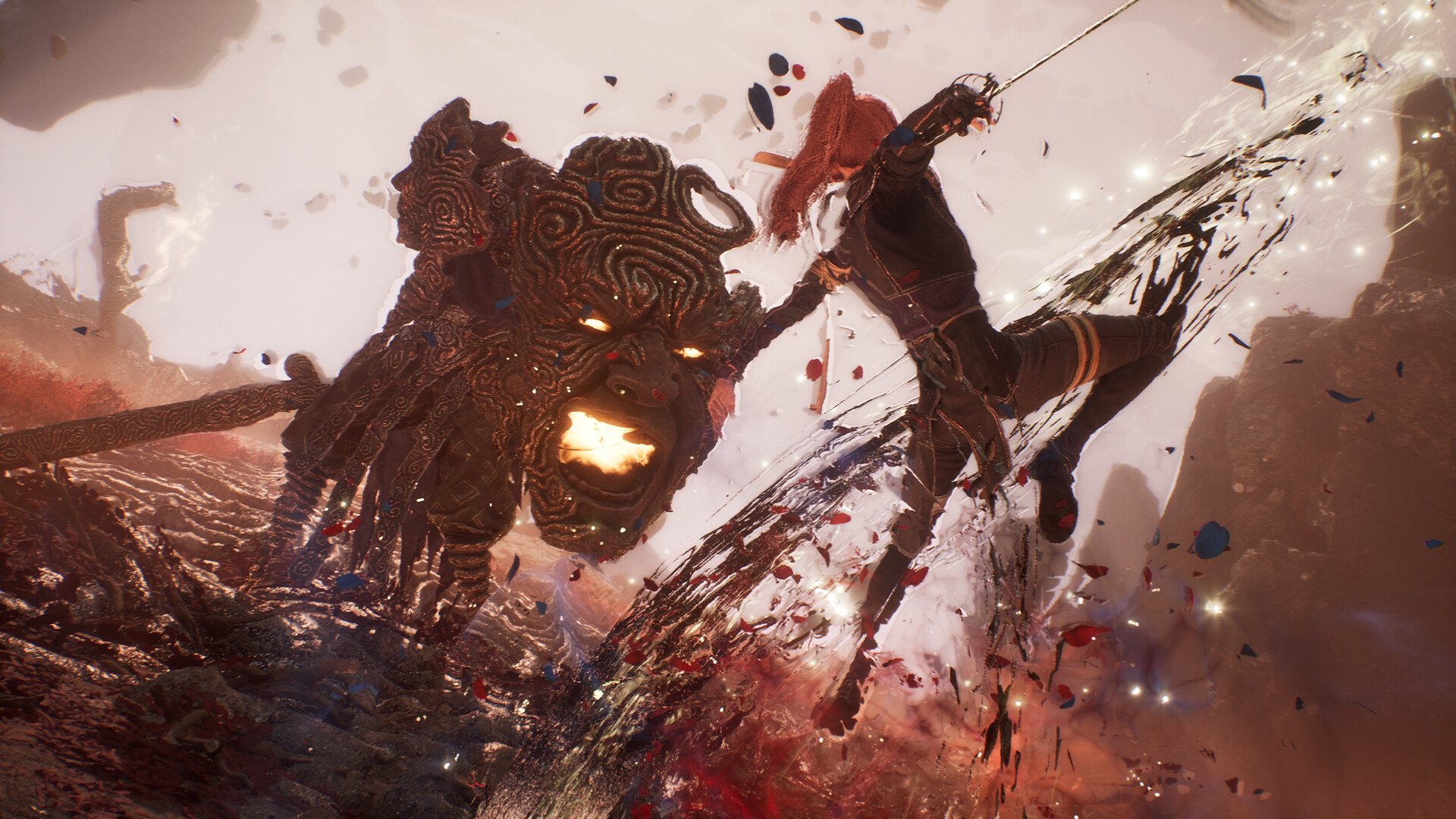
Clair Obscur: Expedition 33 has revolutionized the turn-based RPG genre with its innovative Reactive Turn-Based Combat System that seamlessly blends traditional strategy with real-time action elements. This groundbreaking approach earned the game its Best RPG award and contributed significantly to its historic Game of the Year victory at The Game Awards 2025.

The combat mechanics in this Belle Époque fantasy masterpiece challenge everything players thought they knew about turn-based battles. By incorporating real-time parrying, dodge mechanics, and free-aim targeting, Sandfall Interactive created a system that keeps players engaged during every moment of combat. The result is an addictive battle experience that feels fresh and dynamic while honoring classic JRPG traditions.

This comprehensive combat guide breaks down every mechanic, strategy, and technique you need to master Clair Obscur’s battle system. From understanding Action Points and Break mechanics to perfecting your parry timing and utilizing Gradient Attacks, you’ll learn how to dominate even the toughest encounters in Expedition 33.

Understanding Reactive Turn-Based Combat Fundamentals

The Reactive Turn-Based Combat System represents Clair Obscur’s most significant innovation in RPG design. Unlike traditional turn-based games where players simply select commands and watch animations play out, this system demands constant attention and precise timing throughout every battle encounter.

Director Guillaume Broche designed the battle system around a specific vision of creating a game that could be cleared without taking a single hit. This philosophy shaped every combat decision during development, ensuring that player skill and pattern recognition always provide a path to victory rather than relying solely on level grinding or statistical advantages.

The combat timeline displays prominently on the left side of your screen, showing exactly when each character and enemy will act. This transparency allows for strategic planning and helps players anticipate dangerous attack sequences before they happen. Understanding turn order becomes crucial for setting up combos and defensive positioning.

The Action Points Economy

Action Points serve as the primary resource management system during battles. Every character action beyond basic attacks consumes AP, making efficient resource usage the difference between quick victories and drawn-out struggles. Your party shares a pool of AP that slowly regenerates, with successful defensive maneuvers providing additional points.

AP generation strategies become increasingly important in longer battles. Perfect parries reward players with bonus AP, while certain character abilities can manipulate AP gain rates. Managing this resource effectively allows you to unleash powerful skill combinations when opportunities present themselves.

The Battle Wheel interface provides quick access to your combat options: Attack, Skills, Items, and Free Aim. Each option serves distinct purposes, and learning when to use each creates dynamic combat flow. Later in the game, Gradient Attacks join your Battle Wheel, adding another layer of tactical depth.

Mastering Real-Time Defensive Mechanics

Real-time defensive actions define what makes Clair Obscur’s combat system special. During enemy turns, players must actively defend by executing perfectly timed parries, dodges, or jumps to avoid damage. This constant engagement eliminates the passive waiting that plagues many turn-based RPGs.

Parry timing revolves around reading audiovisual cues rather than reacting to raw speed alone, with distinct animation peaks, weapon flashes, or sound effects occurring fractions of seconds before hits land. These consistent markers provide repeatable reference points that players can learn and master through practice.

Parrying mechanics offer the highest reward but require precise timing. Successfully parrying an attack not only negates damage but grants bonus AP and triggers a powerful counterattack. This risk-reward balance encourages aggressive defensive play and rewards players who study enemy attack patterns.

Dodge and Jump Mechanics

Dodging provides a safer defensive option when parry timing feels uncertain. While dodges don’t generate AP or trigger counterattacks, they reliably avoid damage with more forgiving timing windows. Smart players know when to play safe versus when to risk parries for greater rewards.

Jump mechanics handle specific attack types that can’t be parried or dodged. Certain enemy moves require vertical evasion, adding variety to defensive patterns. Reading enemy animations helps identify which defensive action each attack requires.

Expedition Counters represent the ultimate defensive challenge. When enemies launch attacks targeting your entire party, all active characters must execute a synchronized parry to successfully counter. These coordinated defenses create spectacular moments and substantial AP gains when executed perfectly.

Pattern Recognition and Audio Cues

Training against slower early enemies allows new players to internalize patterns before facing faster bosses with complex multi-hit strings where parry timing becomes more demanding. This gradual difficulty curve helps players build skills naturally without overwhelming them early on.

Audio design plays a crucial role in combat success. Attack whooshes, impact chimes, and other sound effects provide reliable timing indicators. Players struggling with visual clutter often benefit from raising sound effect volumes relative to music, making these crucial audio cues more prominent.

Break Mechanics and Vulnerability Windows

Break mechanics introduce a posture system where sustained pressure forces enemies into vulnerable states. Similar to games like Sekiro: Shadows Die Twice, depleting an enemy’s Break gauge creates openings for devastating damage that can turn the tide of challenging battles.

Break bars require players to understand which attacks, elements, or weak points accelerate Break buildup, creating combat rhythm where players alternate between survival-focused defense and aggressive Break setups. This dynamic flow prevents battles from becoming repetitive or predictable.

Efficiently building Break requires strategic coordination between party members. Certain characters specialize in Break damage even when their raw HP damage appears lower. Understanding these specializations and building your party composition accordingly maximizes your Break potential.

Exploiting Vulnerable States

When enemies enter Break states, they become temporarily defenseless and take significantly increased damage. This window presents the perfect opportunity to unleash your most powerful skills and Gradient Attacks for maximum effect. Timing your big damage abilities around Break windows optimizes your damage output.

Free-aim targeting accelerates Break buildup dramatically when focusing on enemy weak points. Large bosses with exposed limbs or cores take substantial Break damage when players accurately target these vulnerable areas. The precision required adds skill expression to what could otherwise be automatic targeting.

Shield mechanics protect enemies from all damage types until broken. Anti-shield skills, multi-hit attacks, and free-aim shots excel at shattering defensive barriers. Always prioritize shield removal before attempting major damage combos to avoid wasted resources.

Character-Specific Combat Systems

The game features six playable characters, each bringing unique mechanics and playstyles to combat encounters. Understanding how each character functions allows you to build synergistic party compositions and leverage specific character strengths against particular enemy types.

Gustave wields a mechanical arm that charges through combat actions and unleashes devastating damage when fully powered. His engineering background translates into gadget-based abilities that offer both offensive pressure and utility support. Managing arm charge timing becomes crucial for maximizing his damage potential.

Maelle employs dynamic swordfighting stances that alter her available abilities and stat distributions. Switching stances mid-combat allows her to adapt to changing battlefield conditions, making her extremely versatile. Mastering stance management separates good Maelle players from great ones.

Advanced Character Mechanics

Lune creates elemental stains through spellcasting that can be consumed for additional effects. This combo system rewards thoughtful spell sequencing and strategic resource management. Planning multi-turn combinations with Lune opens up powerful damage opportunities unavailable to other characters.

Monoco, a Gestral warrior untouched by the Paintress’ Gommage, brings combat expertise and unique abilities tied to his non-human nature. His specialized skillset offers options that other party members can’t replicate, making him valuable for specific encounter types.

Each character can equip up to six active skills at any time, chosen from their complete learned ability pool. This loadout system encourages players to customize characters for specific challenges rather than using one-size-fits-all builds. Experimenting with different skill combinations reveals powerful synergies.

Free Aim System and Weak Point Targeting

Free-aim targeting adds an active skill element to traditional turn-based combat. Instead of automatic targeting, players manually aim pistols or magic at enemies, dealing bonus damage for accuracy. This mechanic rewards player skill independent of character statistics.

Free-aim can provide added benefits beyond damage – shooting environmental objects like floating mines can trigger explosions affecting multiple enemies and creating tactical advantages. Observant players discover creative uses for the aiming system beyond simple damage dealing.

Weak point targeting using free aim accelerates both damage and Break buildup significantly. Learning enemy vulnerable spots and consistently hitting them drastically improves combat efficiency. Boss encounters especially reward players who identify and exploit weak points throughout fights.

Environmental Combat Opportunities

The free-aim system enables environmental interactions during battles. Explosive objects, destructible cover, and interactive elements provide tactical options beyond direct damage. Smart players scan environments before engagements to identify potential advantages.

Demineur enemies demonstrate environmental combat perfectly – shooting the mines they’re attached to triggers explosions that damage nearby foes and makes evasive enemies vulnerable to follow-up attacks. These contextual opportunities add strategic depth to seemingly straightforward encounters.

Gradient Attack System and Shared Resources

Gradient Attacks represent the most powerful offensive options in your arsenal, dealing massive damage when properly utilized. These special abilities use a shared party gauge that fills through regular skill usage, creating interesting resource management decisions during extended battles.

The Gradient gauge fills slowly as party members execute skills, encouraging active combat participation rather than defensive turtling. This design philosophy keeps battles dynamic and rewards aggressive play while still requiring defensive skill during enemy turns.

Gradient Counters and Gradient Skills provide additional options within this system. Counters offer powerful defensive responses to specific enemy actions, while Skills deliver devastating offensive combinations. Learning when to spend Gradient resources versus saving them creates meaningful tactical choices.

Coordination and Timing

Coordinating Gradient Attacks between party members creates spectacular battle moments. Chaining these powerful abilities at crucial moments – like during enemy Break states – multiplies their effectiveness. Team composition directly impacts Gradient strategy effectiveness.

The shared resource system encourages players to maintain balanced party participation rather than overrelying on single characters. Every party member contributes to Gradient generation, making even support-focused characters valuable for enabling powerful attacks.

Status Effects and Combat Buffs

Status effects significantly influence combat outcomes in Clair Obscur. Buffs like Powerful (increased damage), Shell (reduced damage taken), and Rush (increased speed) create temporary advantages worth fighting for. Understanding status management becomes crucial in difficult encounters.

Debuffs turn the status system into a strategic weapon. Applying negative effects to enemies while maintaining positive buffs on your party creates substantial power differentials. Many challenging encounters become manageable once you master status manipulation.

Elemental affinities add another strategic layer. Enemies exhibit strengths and weaknesses against different elemental damage types. Ineffective elements deal minimal damage, while exploiting weaknesses dramatically increases your offensive pressure. Always check enemy resistances when struggling.

Strategic Status Application

Certain boss encounters practically require specific status applications to succeed reasonably. These fights test whether players understand the full depth of Clair Obscur’s combat systems beyond simple damage dealing. Status effects often provide more value than raw damage in these scenarios.

Duration management matters for both buffs and debuffs. Short-duration effects require frequent reapplication, while long-lasting statuses allow focus on other tactics. Party composition should account for status maintenance requirements alongside damage needs.

Difficulty Settings and Accessibility Options

Clair Obscur offers three difficulty settings that dramatically alter combat challenges: Story mode, Expeditioner mode, and Expert mode. These settings can be changed anytime, allowing players to adjust challenge levels without commitment penalties.

Story mode weakens enemies and provides generous timing windows for defensive actions. This accessibility option lets players experience the narrative and world without mastering complex combat mechanics. No judgment exists for choosing the difficulty that maximizes your enjoyment.

Expeditioner mode offers balanced challenge designed for typical RPG players. Enemy stats remain fair while defensive timing requires reasonable precision. This represents the intended baseline experience for most players.

Expert Mode Challenges

Expert mode demands perfect execution and deep system mastery. Enemies hit harder, defensive timing windows shrink dramatically, and mistakes prove costly. This difficulty rewards players who’ve thoroughly learned combat mechanics and pattern recognition.

The design philosophy allows technically skilled players to beat the final boss at Level 1, as the system was built around the vision of clearing the game without taking hits. This skill-based approach means dedicated players can overcome statistical disadvantages through pure mechanical execution.

New Game Plus mode allows replaying the game with increased difficulty while retaining character progression from previous playthroughs. This mode satisfies completionists and players seeking greater challenges after mastering the base game.

Equipment and Build Optimization

Pictos serve as Clair Obscur’s equipment system, providing stat boosts that increase as they level up. Strategic Picto selection allows you to emphasize character strengths or shore up weaknesses depending on your preferred playstyle and party composition needs.

Build diversity enables dramatically different approaches to identical encounters. Damage-focused builds prioritize offensive stats and Break generation, while defensive builds emphasize survivability and support capabilities. Experimentation reveals powerful synergies unavailable to single-minded builds.

Weapon variety adds another customization layer. Each character can use multiple weapon types with distinct stat distributions and special properties. Matching weapons to specific challenges optimizes performance in ways that transcend simple damage numbers.

Synergy and Party Composition

Effective party composition considers how character abilities interact. Some combinations create powerful synergies that multiply effectiveness, while poor compositions waste potential. Understanding these interactions separates average players from combat masters.

Skill trees provide long-term progression and specialization options. Characters learn new abilities through skill point investment, with branching paths allowing different specializations. Planning skill progression around your intended playstyle and party role maximizes effectiveness.

Boss Battle Strategies and Tips

Boss encounters represent the ultimate test of combat mastery. These fights combine all mechanics – defensive timing, Break exploitation, status management, and resource efficiency – into comprehensive challenges requiring both preparation and execution skill.

Sandfall Interactive designed Expedition 33 so players only die from not taking advantage of patterns correctly, something they can learn and overcome, making victories feel rewarding. This design philosophy means every boss has learnable patterns and strategies that guarantee success for prepared players.

Multi-phase bosses escalate challenge throughout fights. Later phases introduce new attacks, faster patterns, and additional mechanics. Staying calm and adapting to these changes while maintaining defensive discipline determines success or failure.

Preparation and Adaptation

Pre-battle preparation significantly impacts boss difficulty. Ensuring proper skill loadouts, equipment optimization, and item stocks before engaging gives you every advantage. Taking time to prepare prevents frustrating defeats to avoidable problems.

Pattern learning requires patience and observation. Most players need multiple attempts against difficult bosses to fully internalize attack patterns and optimal responses. Treat early attempts as learning experiences rather than failed runs.

Reserve characters can be called in if your active party falls, providing a second chance at victory. This safety net prevents total wipes in close fights but requires maintaining progression on backup characters to remain effective.

Common Combat Mistakes to Avoid

New players often make predictable mistakes that hamper their combat effectiveness. Over-reliance on basic attacks wastes opportunities for more impactful actions. Skills generally provide better damage and utility than standard attacks despite AP costs.

Ignoring defensive mechanics leads to taking unnecessary damage. Even perfectly built characters struggle when absorbing hits rather than parrying or dodging. Defensive skill development matters as much as offensive optimization.

Poor AP management leaves players unable to act effectively during crucial moments. Spending all AP immediately often means having no resources when important opportunities arise. Maintaining an AP reserve for emergencies prevents avoidable defeats.

Resource Management Errors

Item hoarding represents a common player tendency that reduces effectiveness. Clair Obscur replenishes items at Expedition Flags (the game’s checkpoint system), meaning conservative item usage wastes potential power. Use consumables freely when they’d help.

Neglecting Break mechanics significantly reduces damage output. Players who ignore Break bars miss substantial damage windows and extend fights unnecessarily. Actively working toward Break states makes even difficult encounters manageable.

JRPG Influences and Combat Design Philosophy

Expedition 33 drew inspiration from Final Fantasy, Persona series, Lost Odyssey, and Blue Dragon, particularly their use of quick time events during combat and cinematic presentation. These influences created a combat system that honors JRPG traditions while pushing the genre forward.

Director Broche praised Persona 5’s user interface and camera work during battles, aiming to create the feeling of watching a movie. This cinematic approach manifests in dynamic camera angles, stylish animations, and seamless transitions that maintain visual engagement throughout battles.

The dodge and parry mechanics took specific inspiration from FromSoftware’s Sekiro: Shadows Die Twice. This influence brought precision timing and pattern recognition into turn-based framework, creating unique gameplay that stands apart from both traditional JRPGs and action games.

Design Constraints and Philosophy

During design phases, developers asked whether bosses using specific mechanics could be defeated without taking damage – if the answer was no, they didn’t use that mechanic. This constraint-driven design ensured every combat element served player skill expression rather than creating artificial difficulty.

The resulting system rewards player learning and improvement over statistical grinding. While character progression matters, skill development provides more dramatic power increases than level gains alone. This philosophy makes combat consistently engaging throughout the entire game.

FAQ: Frequently Asked Questions About Clair Obscur Combat

Q: What is Reactive Turn-Based Combat in Clair Obscur: Expedition 33?

A: Reactive Turn-Based Combat blends traditional turn-based RPG mechanics with real-time defensive actions. Players select actions during their turns like classic JRPGs, but must actively dodge, parry, or jump to avoid enemy attacks in real-time during enemy turns.

Q: How important is parrying in Clair Obscur combat?

A: Parrying is extremely important as it not only negates damage but also generates bonus Action Points and triggers powerful counterattacks. Mastering parry timing is key to combat efficiency, though dodging provides a safer alternative when timing feels uncertain.

Q: Can you beat Clair Obscur: Expedition 33 without taking damage?

A: Yes, the combat system was specifically designed around the vision of creating a game that can be cleared without taking a single hit. Director Guillaume Broche confirmed players can technically beat the final boss at Level 1 through perfect execution.

Q: What are Break mechanics in Clair Obscur?

A: Break mechanics refer to an enemy-specific stability gauge that, when depleted, forces targets into vulnerable states. Broken enemies take significantly increased damage and become temporarily defenseless, creating windows for devastating attacks.

Q: How does the free-aim system work?

A: The free-aim system lets players manually aim pistols or magic at enemies instead of using automatic targeting. Accurately hitting enemies deals bonus damage, while targeting weak points dramatically accelerates both damage and Break buildup.

Q: What difficulty should I choose?

A: Choose Story mode for relaxed narrative focus, Expeditioner mode for balanced standard challenge, or Expert mode for demanding precision gameplay. Difficulty can be changed anytime without penalties, so experiment to find your preferred experience.

Q: How many characters can be in combat at once?

A: Six characters can be recruited to your party, but only three can be used in battle simultaneously. Reserve characters can be called in if your active party is defeated, providing a second chance at victory.

Q: What are Gradient Attacks?

A: Gradient Attacks are powerful special abilities that use a shared party gauge. This gauge fills slowly through regular skill usage during combat, and Gradient Attacks deal massive damage when unleashed at optimal moments like during enemy Break states.


Mastering Clair Obscur: Expedition 33’s combat system requires dedication, practice, and strategic thinking. The Reactive Turn-Based Combat represents one of the most innovative evolutions of traditional JRPG mechanics in recent years, successfully bridging turn-based strategy with real-time action skill.

The depth of combat mechanics rewards players who invest time learning enemy patterns, perfecting defensive timing, and understanding strategic systems like Break mechanics and status effects. Every encounter offers opportunities to improve execution and discover new tactical approaches that make challenging fights manageable.

Whether you’re playing on Story difficulty for narrative enjoyment or tackling Expert mode for ultimate challenge, Clair Obscur’s combat system adapts to your preferred experience. The skill-based design philosophy ensures that player improvement always provides paths to victory, making defeats feel like learning opportunities rather than frustrating roadblocks.

This revolutionary combat system contributed significantly to the game’s critical acclaim and historic Game of the Year victory. By respecting player intelligence and rewarding skill development, Sandfall Interactive created a battle system that sets new standards for what turn-based RPGs can achieve.

Steam Winter Sale 2025 Guide: Must-Buy Games at Unbeatable Prices

19. Prosinec 2025 v 10:34

The annual Steam Winter Sale has arrived, and this year’s offerings deliver some genuinely impressive discounts across a broad spectrum of titles. Whether you’re hunting for recent AAA releases or hidden gems that slipped under your radar, this sale presents opportunities worth exploring.

Premium Titles at Unprecedented Prices

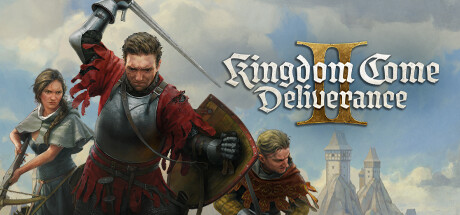
Kingdom Come: Deliverance 2 leads the charge at $29.99, representing a 50% discount on one of this year’s most ambitious RPGs. The medieval simulator impressed critics with its commitment to historical accuracy and immersive storytelling. If you haven’t experienced the original, it’s now available for just $5.99, making this the perfect moment to dive into the series.

Warhammer 40,000: Space Marine 2 drops to $23.99, marking one of its lowest prices since launch. The third-person shooter captures the brutal essence of the Warhammer universe, delivering visceral combat that fans have been craving. With several major Warhammer titles on the horizon, including Total War: 40K and Dawn of War 4, now’s an ideal entry point into this expanding gaming universe.

Classics That Define Their Genres

Cyberpunk 2077 hits $20.99, a notable reduction for a game that’s undergone remarkable transformation since its troubled launch. CD Projekt Red’s dystopian masterpiece now stands as arguably the definitive cyberpunk experience in gaming. The Phantom Liberty DLC also sits at $20.99, though you might consider waiting for a deeper discount on that expansion.

Red Dead Redemption 2: Ultimate Edition reaches $19.99, which represents exceptional value. Rockstar’s Western epic rarely dips this low, and the Ultimate Edition includes additional content beyond the base game. This pricing strategy offers more bang for your buck than waiting for the standard edition to discount further.

Mid-Tier Treasures

Resident Evil 4 Remake at $15.99 showcases Capcom’s mastery of the survival horror genre. The remake strips away the original’s campier elements, grounding the experience in tension and atmosphere. It’s arguably the strongest entry in the entire Resident Evil catalog.

Marvel’s Guardians of the Galaxy surprises at $8.99. This single-player adventure flew under many players’ radars, overshadowed by the disappointing Avengers title. Unlike that failed experiment, Guardians delivers solid storytelling and entertaining gameplay that honors the source material.

Absolute Steals

The Tomb Raider Definitive Survivor Trilogy at $7.19 might be this sale’s crown jewel. Three complete games with all DLC for less than the cost of lunch represents incredible value. The reboot trilogy follows Lara Croft’s evolution from survivor to hardened adventurer across stunning locations.

Frostpunk at $2.99 delivers a unique city-builder experience set in a frozen post-apocalypse. You’re not just building – you’re making impossible choices to keep your society functioning under extreme conditions.

Final Thoughts

The 2025 Steam Winter Sale offers something for every type of gamer. From sprawling RPGs to compact puzzle experiences, these deals represent genuine savings on quality titles. The sale runs through early January, giving you time to carefully consider your purchases. Just remember – your backlog probably doesn’t need more games, but at these prices, resistance might be futile.

Path of Exile 2 Fate of the Vaal League Guide

16. Prosinec 2025 v 07:06

Path of Exile 2’s Patch 0.4 drops players into something familiar yet fresh. The Fate of the Vaal league mechanic brings back memories of PoE1’s Incursion system, but don’t let that fool you – this isn’t just a nostalgia trip. Grinding Gear Games took what worked and amplified it, creating a league mechanic that rewards strategic thinking and high-risk crafting decisions.

How the Fate of the Vaal League Mechanic Works

The system starts simple enough. You’re mapping through zones when you spot a Vaal Beacon – marked clearly on your minimap with a triangular temple icon. These beacons corrupt nearby monster packs, and your job is straightforward: kill everything.

Each beacon you clear lights up one of six crystals. Fill all six, and you unlock access to the Temple of Atziri. But here’s where it gets interesting – at endgame, you can stack up to 10 temple runs before actually diving in. This means you can grind Waystones without interruption, then dedicate a session purely to temple exploration.

The beacon encounters themselves pack some surprises. Sometimes you’ll face wave after wave of corrupted enemies. Other times, a unique monster rises up on the beacon itself, dropping a satisfying pile of loot when defeated. Just remember to physically step on the beacon after clearing – it won’t register completion otherwise.

Building Your Perfect Temple Layout

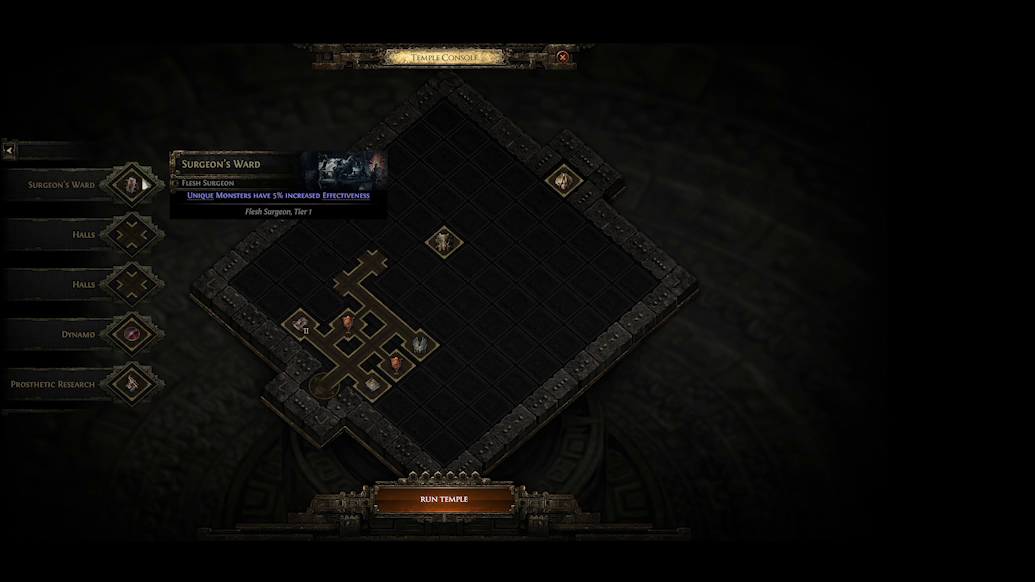
This is where Fate of the Vaal separates itself from typical league mechanics. When you enter the temple’s antechamber, you’ll find a console that lets you construct your own dungeon. You’re handed six room cards each visit, and these cards determine everything – monster types, rewards, even modifiers that affect the entire temple.

Path placement follows specific rules. You can only place paths if they connect to existing paths. Named rooms can only touch paths or rooms they upgrade. It sounds restrictive, but the system highlights valid placements in bright green, making optimization intuitive rather than frustrating.

Room upgrades are the real prize here. Each room starts at Tier 1, but meeting certain conditions – usually placing specific adjacent rooms – bumps them up. Tier 3 rooms unlock the league’s most powerful rewards, so planning your layout around these upgrades becomes critical. The system even shows you exactly where to place rooms for upgrades, removing guesswork without eliminating strategy.

Temple Decay and Medallion Management

Here’s the catch that keeps you coming back. Every time you close your temple after a run, random rooms decay and disappear. Your carefully constructed layout? It might survive intact, or it might lose your best reward rooms. This randomness creates genuine tension.

Medallions offer some control over chaos. These special items drop from room bosses and function as extra room cards with unique effects. Some upgrade room tiers directly. Others lock rooms to prevent decay. Your medallion inventory caps at three, so decision-making matters – use them early for immediate gains, or hoard them for crucial moments?

The medallion system adds a layer of resource management that feels rewarding rather than tedious. You can apply medallions before or after running the temple, giving you flexibility to react to both good drops and bad decay luck.

High-Risk Crafting That Actually Matters

Tier 3 rooms contain crafting devices that can fundamentally change your gear. These aren’t minor stat tweaks – they’re build-defining modifications.

The Locus of Corruption stands out as the most dangerous option. Double-corrupting already corrupted items carries a 50% chance to destroy the item entirely. But landing two powerful corruption implicits on the same piece? That’s the kind of power spike that defines entire builds. The risk-reward calculation here is brutal and exciting in equal measure.

Juatalotli’s Triumph lets you reroll modifiers on corrupted Vaal uniques. Up to two modifiers get replaced with random alternatives from a special pool. This crafting method can create truly broken items by removing downsides and adding powerful new stats. It can also brick valuable uniques by removing their signature modifier. The randomness cuts both ways.

Other Tier 3 crafting options include the Transcension Device, which replaces your limbs with mechanical versions granting passive bonuses (lost on death), and the Corrupted Precursor Machine, which corrupts tablets to potentially add extra modifiers or uses. Each crafting device can be converted into a tradeable currency orb, creating a new economy around these high-risk modifications.

Fighting Atziri and the Royal Architect

The Royal Architect boss room comes pre-placed in every temple. Defeating this boss in level 75+ temples drops a medallion that places the Royal Access Chamber – your gateway to fighting Atziri herself.

Atziri represents the league’s pinnacle challenge. As the last Queen of the Vaal, she wields power corrupted by communing with The Beast. Her exclusive drops include items like Atziri’s Rule, which grants the Mirror of Refraction skill. This skill creates mirrors around your character that projectiles can fire into, creating nova explosions. It’s the kind of build-enabling unique that makes the endgame grind worthwhile.

Both boss fights cause significant temple decay afterward, resetting your progress and forcing you to rebuild. This creates a natural gameplay loop – construct your temple, push for the Architect, decide whether to fight Atziri or preserve other reward rooms, then rebuild from the decay.

Campaign vs Endgame Temples

Acts 1-3 offer a streamlined introduction. You’ll explore the temple in its present-day form, with limited room variety and toned-down rewards. No pinnacle bosses appear here.

Everything changes in Act 4. The temple shifts to its past incarnation, unlocking the full roster of rooms, crafting options, and boss encounters. This progression feels natural – new players get time to understand the core systems before facing the full complexity.

Strategic Considerations and Final Thoughts

The Fate of the Vaal mechanic rewards planning over pure speed. Rushing through beacons without considering room placement leaves rewards on the table. The most valuable temples require deliberate construction – identifying which Tier 3 rooms you’re targeting, planning upgrade paths, and managing medallions to protect key rooms from decay.

The mechanic also scales well with player knowledge. Beginners can place rooms randomly and still get reasonable rewards. Veterans can optimize layouts to consistently access multiple Tier 3 crafting stations or stack modifiers for maximum difficulty and loot.

Xipocado’s Console in the Royal Architect’s room offers one final twist. This special console places exclusive room cards with unique placement rules, requiring you to work toward distant reward rooms. Accessing it causes massive temple decay, forcing you to choose between immediate powerful rewards and your existing temple construction.

Path of Exile 2’s Fate of the Vaal league takes a proven concept and executes it with enough new systems to feel fresh. The combination of strategic temple building, high-risk crafting, and meaningful boss encounters creates a league mechanic that respects player time while offering genuine depth for those who engage with its systems fully.

The Rise of Interactive Gaming at Events: What Gamers Can Expect in 2025

2. Prosinec 2025 v 07:59

The gaming landscape is evolving faster than ever, and nowhere is this transformation more visible than in live events, expos, conventions, and entertainment gatherings. What used to be simple showcases of upcoming titles or esports tournaments have now become immersive, multi-sensory, hyper-interactive experiences. As technology advances and gamer expectations rise, 2025 is shaping up to be a defining year for interactive gaming at events—bridging the gap between physical and digital worlds and giving players more ways to participate than ever before.

Below is a deep dive into the trends, innovations, and formats reshaping gaming events—and what gamers can look forward to in 2025.

1. Why Interactive Gaming Is Booming at Events

The global gaming market is projected to push past $200 billion by 2025, largely due to unprecedented growth across mobile, PC, console, cloud gaming, and VR/AR sectors. But beyond raw numbers, another major factor is shaping the industry: the shift toward experiential entertainment.

People don’t just want to watch games anymore; they want to experience them.

Event organizers—whether gaming conventions, esports tournaments, or tech expos—have taken notice. In recent years, interactive features such as hands-on demos, augmented reality (AR) quests, themed escape rooms, VR worlds, and interactive LED experiences have become standard attractions. This trend will only accelerate in 2025 as technology becomes more accessible and as gamers crave more participation-driven events.

Three major forces are pushing this rise:

A. Technology Is Finally Catching Up

Next-gen hardware, real-time rendering, 5G connectivity, and more powerful mobile devices are making interactive experiences smoother and more immersive. What once required bulky setups can now be achieved with sleek gear or even smartphones.

B. Hybrid Online–Offline Culture

The pandemic normalized virtual events; however, instead of replacing physical gatherings, it expanded them. Now players expect events to offer both:

  • Physical experiences for those attending in person
  • Interactive digital participation for remote gamers

Hybrid events allow global participation—and in 2025, this hybrid model is becoming standard.

C. Gamers Want Social, Community-Driven Experiences

Today’s audience cares just as much about community as gameplay. That’s why events are evolving into social hubs, filled with:

  • Collaborative challenges
  • Player-driven content
  • Interactive livestreams
  • Community games and quests
  • Meet-ups, creator panels, and IRL co-op experiences

In short: 2025 events are becoming playgrounds, not just showcases.

2. What Interactive Gaming Will Look Like at 2025 Events

Here are the biggest features and formats gamers can expect to see dominate events throughout 2025.

A. Full-Scale VR and AR Zones Become Main Attractions

Virtual and augmented reality are moving from “cool side attractions” to major pillars of gaming events. Thanks to more powerful headsets and lightweight tech, VR and AR integrations are becoming smoother, more responsive, and safer for public use.

Expect:

1. VR Arenas and Free-Roam Experiences

Immersive experiences will allow players to move freely through massive digital worlds using:

  • Haptic vests
  • Motion trackers
  • Wireless high-refresh displays

Imagine battling zombies with teammates in a warehouse-sized VR arena—that’s the new norm.

2. AR Treasure Hunts and Event-Wide Quests

Using phones or AR glasses, events may feature:

  • Hidden collectibles
  • AR monsters roaming the venue
  • Interactive puzzles
  • Real-world map challenges

These encourage attendees to explore and engage.

3. Mixed-Reality Creator Stages

Creators can engage in MR (mixed reality) demos where the audience sees them inside the game environment.

B. Highly Gamified Events with Rewards, XP and Progression

In 2025, events aren’t just events—they’re games themselves.

Gamified systems allow attendees to earn:

  • XP
  • Badges
  • Leaderboard placements
  • Digital collectibles
  • Real prizes like merch or game codes

Every action becomes interactable.

One major example of this expanding trend is the rise of companies offering plug-and-play exhibition games. Exhibition Games (https://exhibition-games.com/) is one such provider that supplies ready-made mini-games for event booths, trade shows, and activations. Their arcade-style challenges, trivia, and digital skill games make it easy for event organizers to add gamification without needing complex setups or technical teams—showing how accessible interactive gaming has become for events of any size.

C. Hybrid Events: Participate Anywhere in the World

Covid-era virtual events transformed the industry, and now hybrids have perfected it.

In 2025, hybrid gaming events offer:

1. Virtual Booths and Livestream Demos

Remote viewers can:

  • Explore booths via virtual avatars
  • Talk to developers via live chat
  • Watch live gameplay showcases

2. Cloud-Based Global Tournaments

Competitors from different countries can join instantly—no high-end hardware needed.

3. Real-Time Viewer Interactions

Remote audiences can control:

  • Boss modifiers
  • In-game weather
  • Character challenges

Spectators become participants.

D. Creator-Driven Experiences and Fan Interactivity

With the creator economy booming, 2025 events are built around direct engagement.

Expect:

1. Live “Play With the Streamer” Sessions

Fans join creators on stage or online.

2. Interactive Meet-and-Greets

These now include:

  • Mini-games
  • Reaction challenges
  • Speed-run duos
  • AR selfie zones

3. Creator Workshops

Fans can learn:

  • Streaming techniques
  • Content creation skills
  • Game development basics

Events become educational hubs too.

E. Esports Events Become Full-Scale Entertainment Shows

Esports continues evolving beyond competition into full-blown entertainment.

Expect:

  • Concert integrations
  • AR effects layered over the arena
  • Immersive LED walls
  • Holographic overlays
  • Crowd-driven vote mechanics

Tournaments will feel more like festivals than competitions.

F. Multisensory Gaming Zones

2025 events will incorporate:

  • Haptic floors
  • Scent emitters
  • Wind tunnels
  • Surround sound chambers
  • Responsive lighting

These simulate environments so deeply that players feel truly inside the experience.

3. How Interactive Gaming Providers Are Changing Events

A major driver behind the rise in interactive gaming is the availability of professional providers who deliver plug-and-play game systems for events. This shift has made high-quality gaming accessible even for smaller exhibitions, trade shows, or non-gaming corporate events.

Exhibition Games is one of the standout companies in this space. By offering customizable exhibition games—ranging from memory challenges to fast-paced reaction games—they help:

  • Boost booth traffic
  • Increase brand engagement
  • Keep attendees entertained
  • Encourage competition through leaderboards

Their services show how interactive gaming is no longer exclusive to gaming conventions—but is being integrated into business expos, product launches, and marketing activations across the UK and beyond.

4. What Gamers Personally Will Experience in 2025

Whether you attend physically or virtually, expect these improvements:

A. More Ways to Participate

Gamers can:

  • Influence live gameplay
  • Join interactive polls
  • Enter mini-tournaments
  • Talk directly with developers
  • Participate in hybrid fan events

B. Higher Immersion Than Ever

VR, AR, haptics, LED walls, and multisensory setups create multi-dimensional experiences not possible in past decades.

C. Stronger Social and Community Connection

Events focus heavily on:

  • Team-based quests
  • Social lounges
  • Multiplayer challenges
  • Creator meet-ups
  • Community tournaments

2025 is all about shared experiences.

D. Accessibility and Inclusion

Hybrid models ensure:

  • Lower travel costs
  • Mobile-friendly participation
  • Multiple language options
  • Ability to join from anywhere

Everyone can be part of the event—regardless of geography.

5. What This Means for the Gaming Industry

The shift toward interactive experiences leads to major industry benefits:

1. Events Become Content Engines

Livestreams, highlight reels, and behind-the-scenes experiences fuel social media.

2. Developers Get Real-Time Feedback

Playtests and interactive demos help shape final game builds.

3. Brands Move Toward Experiential Marketing

Instead of traditional ads, they invest in interactive zones and gamified booths—including those provided by companies like Exhibition Games, which offer quick, professional solutions for attracting and engaging event attendees.

4. Esports Grows Into Mainstream Entertainment

Integrated visuals and sensory effects expand its reach far beyond gamers.

Conclusion: A New Era of Gaming Events Begins

2025 marks the beginning of a new era where gaming events become fully immersive, interactive, and community-driven. From AR treasure hunts and VR arenas to multisensory gaming zones, global hybrid tournaments, and gamified exhibition booths powered by companies like Exhibition Games, the future of events is more engaging and accessible than ever.

Gamers won’t just attend events—they’ll shape them.

Steam Awards 2025: Complete Nomination Guide and Categories Explained

1. Prosinec 2025 v 08:03

The Steam Awards 2025 nomination period is officially open, giving PC gamers everywhere the chance to recognize their favorite titles from the past year. Whether you’re a competitive FPS player, an indie game enthusiast, or a VR devotee, this year’s awards feature 11 diverse categories that celebrate every corner of the gaming landscape.

Running until December 1st at 10AM Pacific, the nomination phase kicks off what has become one of gaming’s most community-driven award shows. Unlike industry-led events, the Steam Awards puts all the power in your hands, letting you decide which games deserve recognition for their creativity, innovation, and pure entertainment value.

How to Nominate Games for Steam Awards 2025

Getting started with Steam Awards nominations is straightforward. Head to the Steam store page dedicated to the awards, where you’ll find all 11 categories waiting for your input. You can nominate games you’ve personally played or search for titles you believe deserve recognition.

The nomination process respects your gaming preferences. If you don’t feel qualified to vote in a particular category, you can skip it without penalty. Each nomination or skip counts toward leveling up your exclusive Nomination Committee Badge, which rewards participation with XP for your Steam profile.

Steam has implemented anti-abuse measures to ensure fair voting. Only non-limited Steam accounts can participate in nominations and voting, preventing bot manipulation while keeping the process accessible to genuine community members.

Steam Awards 2025 Categories and Eligibility Rules

Understanding which games qualify for each category helps you make informed nominations. Most categories accept games released after the previous year’s Autumn Sale, ensuring only recent titles compete for glory.

Game of the Year Award

The ultimate honor recognizes instant classics that defined 2024’s gaming landscape. Whether through immersive gameplay, gripping narratives, memorable characters, or addictive multiplayer, Game of the Year nominees represent the cream of the crop. This category typically sees fierce competition between AAA blockbusters and breakout indie hits.

VR Game of the Year Award

Virtual reality continues pushing boundaries, and this category celebrates titles that fully embrace the medium’s potential. VR Game of the Year nominees don’t just port traditional gameplay into headsets – they reimagine what gaming can be when you step inside virtual worlds.

Labor of Love Award

This special category operates under different eligibility rules. Games must have released before last year’s Autumn Sale, giving developers time to demonstrate ongoing commitment through updates, expansions, and community support. Previous winners including Warframe, GTA V, CS2, Terraria, Cyberpunk 2077, Red Dead Redemption 2, and Elden Ring are excluded from future nominations.

The Labor of Love Award recognizes development teams that treat their games as living projects rather than finished products, continuously adding content and improvements long after launch.

Best Game on Steam Deck Award

Valve’s handheld powerhouse has changed how we game, and this category honors titles that shine on portable hardware. The best Steam Deck games maintain their appeal whether you’re at your desk or on the go, with controls, performance, and gameplay that translate perfectly to handheld play.

Better With Friends Award

Some experiences just hit differently when shared with others. This category celebrates games that come alive through cooperation or competition with friends. Whether you need backup in intense firefights or someone to betray in social deduction games, these titles prove gaming is better together.

Outstanding Visual Style Award

Graphics aren’t just about polygon counts and ray tracing. This award recognizes games with distinctive artistic visions that create memorable visual identities. From striking minimalist designs to elaborate fantasy worlds, Outstanding Visual Style nominees prove that art direction matters more than raw technical specs.

Most Innovative Gameplay Award

Innovation drives the industry forward. This category spotlights games that break conventions, experiment with mechanics, and deliver experiences you’ve never played before. Most Innovative Gameplay winners surprise players with fresh perspectives and brain-breaking design choices that expand what games can be.

Best Game You Suck At Award

Sometimes the best games are the ones that kick your ass repeatedly. This category celebrates punishing difficulty done right – games that test your limits but keep you coming back for one more attempt. These titles reward persistence, pattern recognition, and the satisfaction of finally overcoming seemingly impossible challenges.

Best Soundtrack Award

Great music elevates good games into unforgettable experiences. The Best Soundtrack Award recognizes composers and audio teams who create musical scores that enhance immersion, amplify emotions, and get stuck in your head long after you’ve quit playing.

Outstanding Story-Rich Game Award

When you need a narrative-heavy experience, these games deliver. Outstanding Story-Rich Game nominees feature writing quality that rivals prestige television and cinema, with character development, plot twists, and emotional moments that stay with you. These are games you play for the journey as much as the gameplay.

Sit Back and Relax Award

Not every game needs to be intense. This category celebrates titles that provide chill vibes and stress-free experiences. Perfect for unwinding after difficult days, these games let you zone out, explore at your own pace, and find your moment of zen.

Steam Awards Nomination Committee Badge Rewards

Participating in nominations earns you the exclusive Nomination Committee Badge, which levels up as you complete additional tasks. Each badge level grants 25 XP toward your Steam profile, and the badge serves as proof of your community involvement.

The badge progression system includes four milestone levels:

  • Level 1: Nominate at least one game
  • Level 2: Complete two nomination tasks
  • Level 3: Complete three nomination tasks
  • Level 4: Complete four nomination tasks

Tasks include nominating games across different categories, posting or updating reviews for nominated titles, and engaging with the Steam Awards community features.

Important Steam Awards 2025 Dates and Timeline

Mark your calendar with these key dates for the Steam Awards cycle:

Nominations close on December 1st, 2025 at 10AM Pacific Time. After the nomination period ends, Steam compiles the five most-nominated games in each category as finalists.

The Steam Winter Sale brings the voting phase, where community members choose winners from the finalist selections. Voting remains open throughout the sale period until January 3rd, 2026 at 10AM Pacific.

Winners are announced immediately after voting closes on January 3rd, giving the gaming community a celebratory start to the new year.

Steam Awards Nomination Strategy and Tips

You can nominate the same game across multiple categories if it fits. A title might excel in both Outstanding Visual Style and Best Soundtrack, for example. Don’t limit yourself to one category per game.

Updating existing reviews counts toward badge progression, but you must nominate the game first. Use reviews to explain why your nomination deserves community support, helping persuade other voters during the finals.

Sharing your nominations with friends creates discussion and helps build consensus around deserving titles. Generate a shareable link below the category list to broadcast your picks across social media and gaming communities.

Frequently Asked Questions About Steam Awards

Can I change my nominations after submitting them?

Yes, you can edit nominations anytime before December 1st deadline. Click the Edit button above your current selection to swap in different games.

Do I need to own a game to nominate it?

No, you can nominate any eligible Steam game regardless of ownership status. However, you’ll see personalized suggestions based on your play history.

What makes a Steam account “non-limited”?

Limited accounts have spending restrictions and reduced features. Making a purchase of $5 or more removes limited status and enables Steam Awards participation.

Can free-to-play games win Steam Awards?

Absolutely. Free-to-play titles compete alongside paid games in every category where they meet eligibility requirements.

How many games reach the finals in each category?

The five most-nominated games in each category become finalists that the community votes on during the Winter Sale.

The Steam Awards 2025 represents your opportunity to shape gaming’s biggest community-driven recognition event. With nominations open until December 1st, take time to celebrate the games that defined your year and help worthy titles reach the finals.

Steam Black Friday Sale 2025: Your Ultimate Guide to Epic Gaming Deals and Massive Discounts

28. Listopad 2025 v 16:49

Valve launched its first-ever official Black Friday sale in 2025, marking a historic shift in the company’s seasonal sales strategy. The Steam Black Friday Sale 2025 runs until December 1, giving gamers a full week to score incredible deals on thousands of titles across every genre imaginable.

Whether you’re hunting for AAA blockbusters like Battlefield 6, indie gems like Blue Prince, or looking to snag hardware discounts on the Steam Deck, this year’s event delivers unprecedented value for PC gamers. From massive publisher sales to deep cuts on 2025’s biggest releases, we’re breaking down everything you need to maximize your savings during this limited-time shopping extravaganza.

What Makes the Steam Black Friday 2025 Sale Special

The sale features a large list of games across basically every genre and sub-genre you can imagine, with a lot of the discounted games including titles that launched in 2025. This year’s event represents a significant milestone for Valve’s digital distribution platform, as it’s the first time the company has specifically branded a sale around the Black Friday shopping holiday.

The 2025 Steam Autumn Sale shifted earlier than usual, separated from the Winter Sale by several weeks, creating space for this new Black Friday event. Gamers can expect discounts ranging from modest 15-20% cuts on recent November releases to jaw-dropping 80-95% price slashes on classic titles and beloved franchises.

Top Publisher Deals During the Steam Black Friday Sale 2025

SEGA Black Friday Gaming Deals

SEGA is offering up to 80% off select games, with franchises like Sonic, Yakuza, Total War, and Persona all receiving substantial markdowns. Persona 5 Royal sits at 65% off, while the tactical spin-off Persona 5 Tactica drops 70%. Soul Hackers 2 reaches its lowest-ever Steam price at just $11.99.

PlayStation PC Exclusives on Steam

Several former PlayStation exclusives have received never-before-seen prices, with games available at up to 80% off. Marvel’s Spider-Man Remastered and Miles Morales both hit 60% off for the first time directly on Steam. Horizon Zero Dawn Remastered offers another excellent entry point into Sony’s acclaimed franchises at competitive pricing.

Xbox Black Friday 2025 Sale

Popular Microsoft games are now up to 80% off. Gears of War: Reloaded drops to $25.99 despite launching just three months ago, while Halo: The Master Chief Collection hits $9.99. Senua’s Saga: Hellblade II is available for $17.49, and ReCore: Definitive Edition costs just $3.99.

Warhammer, EA, and Other Major Publishers

Warhammer 40,000: Space Marine 2 is available for $23.99 with a 60% discount, representing the lowest price the game has ever been on Steam. Electronic Arts titles continue offering deep discounts, while Bethesda features more than 150 games and DLC at reduced prices. CD Projekt Red’s catalog, including Cyberpunk 2077 and The Witcher series, sees discounts up to 90% off.

Best Steam Deck Black Friday Deals 2025

Valve has marked down the Steam Deck, with the base LCD model getting $80 less than usual. The LCD 256GB version drops to just $319.20, the lowest price ever recorded, with this deal beating any previous sale by $50.

While the premium Steam Deck OLED models aren’t receiving Black Friday discounts, the LCD versions still offer incredible value for gamers looking to enter the handheld PC gaming space. The Steam Deck remains one of the most affordable ways to access your entire Steam library on the go, with performance capable of running most indie games and smaller titles smoothly in 2025.

For those seeking alternatives, competing handhelds like the Lenovo Legion Go S with SteamOS have dropped to $449 for the Ryzen Z2 Go model at Best Buy, making handheld gaming more accessible than ever.

Top Steam Black Friday Game Deals You Can’t Miss

2025’s Biggest Releases on Sale

Battlefield 6 is on sale for $59.49, which is 15% off the regular price, notable given that it’s one of the biggest games of 2025 and has only been out for a little more than a month. Other major 2025 releases seeing discounts include Arc Raiders, which maintains its reputation as one of the best games you can buy for $40.

The Oblivion remaster is currently on sale for its lowest-ever price on Steam at 33% off, letting Elder Scrolls fans return to Cyrodiil with enhanced graphics and updated mechanics. Tales of the Shire, the cozy Lord of the Rings game, hits 30% off, making it the cheapest it’s ever been.

Deep Discount Gaming Recommendations

Blue Prince, this year’s roguelite mystery game hit, is reaching its lowest-ever price on Steam at 34% off, blending strategy, mystery, and puzzles for a unique gameplay experience. Dave the Diver sits at 45% off, combining restaurant management with light RPG mechanics and achieving an Overwhelmingly Positive rating on Steam.

Red Dead Redemption 2 is down 75% from its original price of $59.99 to only $14.99, representing one of the best deals during the entire sale. Resident Evil Village Gold Edition drops 70%, taking it from $49.99 to $14.99, including the base game, Winters’ Expansion, and Trauma Pack DLC.

Budget-Friendly Gaming Under $15

Games under specific price points make browsing for affordable deals easier during the Steam Black Friday Sale 2025. Smart shoppers should explore:

  • Games under $5 – Perfect for building your backlog, including titles like The Surge 2 at 90% off ($2.99) and FEAR with DLC for just $2
  • Games under $10 – Premium indie titles like Hogwarts Legacy at $8.99 (85% off) and classic franchises at historical lows
  • Games under $20 – Recent AAA releases with 60-75% discounts, including Warhammer 40K: Space Marine 2 and Red Dead Redemption 2

When Does the Steam Black Friday Sale 2025 End?

The first-ever Steam Black Friday Sale runs until December 1, providing gamers with a full week to browse thousands of discounts. Individual publisher promotions may end on different dates, so don’t wait until the final hours to make your purchases.

Black Friday Steam Deck deals sell out quickly, with the LCD 20% discount typically disappearing by Friday afternoon. Set notifications for wishlist items to catch price drops before they expire.

Steam Sale Shopping Tips and Strategies for 2025

Wishlist Management: Add games to your Steam wishlist before the sale begins. Steam will notify you when wishlist items go on discount, helping you track price drops across your most-wanted titles without missing opportunities.

Compare Prices Across Retailers: While Steam offers great deals, authorized key retailers like Humble Bundle, Fanatical, and Green Man Gaming sometimes beat Steam’s official pricing. Many competing PC game stores are running Black Friday sales on Steam codes, meaning you can still add games to your Steam library while spending even less.

Check Review Scores: Don’t let deep discounts blind you to mediocre games. Filter searches by positive review ratings to ensure quality purchases. Games with Overwhelmingly Positive or Very Positive ratings generally indicate solid experiences worth your money.

Refund Policy Awareness: Steam offers refunds on games with less than 2 hours of playtime within 14 days of purchase. If a game doesn’t meet expectations, you’re covered, making it safer to take chances on discounted titles.

Consider Multi-Game Bundles: Complete editions and multi-game collections often provide the best value during major sales. Look for Gold Editions, Ultimate Editions, and franchise bundles that package DLC, expansions, and multiple games together at steep discounts.

Hardware Price Warnings for December 2025

Memory prices have surged by 500% and SSD prices have risen by 100%, with retailers warning that prices on gaming PCs, GPUs, laptops, and SSDs will increase after December 7, 2025. This makes the Black Friday sale potentially the last opportunity for affordable gaming hardware purchases before significant price increases take effect.

If you’re considering upgrading your gaming PC, buying additional RAM, or adding storage capacity, act before early December. The Black Friday window represents a critical opportunity to lock in current pricing before the hardware market shifts dramatically.

Alternative Steam Key Retailers During Black Friday 2025

Many competing PC game stores are running Black Friday sales featuring Steam activation codes. Legitimate third-party sellers offering additional discounts include:

  • Humble Bundle – Features convenient price category filtering and supports charity with every purchase
  • Fanatical – Rotating flash sales with franchise bundles and mystery game offers
  • Green Man Gaming – Stacking discount codes and VIP pricing for frequent shoppers
  • GOG – DRM-free classics with competitive pricing and no activation requirements

Always verify you’re buying from authorized retailers to avoid key revocation issues. Stick with well-known, reputable sellers that have established relationships with game publishers.

Upcoming Steam Sales After Black Friday 2025

The Steam Winter Sale 2025 kicks off on December 18, giving budget-conscious gamers another opportunity to score deals before the year ends. The Winter Sale typically runs for approximately two weeks, often featuring similar discount percentages to the Black Friday event.

Steam also hosts seasonal sales throughout the year, including Spring Sale, Summer Sale, and genre-specific “Fest” events focusing on RPGs, strategy games, horror titles, racing sims, and more. These focused events often highlight indie developers and niche genres that might get overlooked during major seasonal sales.

Frequently Asked Questions About Steam Black Friday Sale 2025

Q: Is this really Steam’s first official Black Friday sale?

A: Yes, this is the first time Valve has specifically branded and marketed a sale as a “Black Friday” event. Previously, the Steam Autumn Sale served as an unofficial Black Friday alternative, but the company has now embraced the shopping holiday directly.

Q: Can I use coupons or promo codes during the Steam Black Friday sale?

A: Steam does not allow stacking coupons on already-discounted products. Sale prices are final, with no additional promotional codes accepted during major seasonal events. However, third-party retailers may offer their own promo codes on Steam keys.

Q: Will newer 2025 releases like Battlefield 6 be on sale?

A: Yes, many games released throughout 2025 are receiving discounts. However, the newest November releases may only receive modest 10-20% discounts, while games from earlier in the year see deeper cuts of 30-70% off.

Q: Are Steam Deck OLED models on sale for Black Friday 2025?

A: No, only the LCD Steam Deck models received Black Friday discounts in 2025. The OLED versions maintain their standard pricing, making the LCD models an even better value proposition for budget-conscious buyers.

Q: How long does the Steam Black Friday sale 2025 last?

A: The sale runs from November 25 through December 1, 2025, giving you a full week to make purchasing decisions. Individual publisher sales may have different end dates, so check specific game pages for exact timing.

Q: Should I wait for the Winter Sale or buy during Black Friday?

A: Discounts during Black Friday and Winter Sales are typically similar, though not identical. If you see a game at a historical low price during Black Friday, there’s no guarantee it will match or beat that price during the Winter Sale. Buy what you want now if the price feels right.

Q: What’s the biggest discount available during the Steam Black Friday 2025 sale?

A: Discounts reach up to 95% off on select titles, with many classic games and complete editions seeing 80-90% price reductions. The deepest discounts typically apply to older titles and complete franchise collections.

Maximizing Your Steam Wallet During Black Friday 2025

Consider purchasing Steam gift cards from retailers offering their own promotions. While Steam itself doesn’t discount wallet funds, some third-party sellers provide bonus value or cashback rewards when buying Steam credit during the holiday shopping season.

Budget-conscious gamers should prioritize building their wishlist with deliberate intent. Focus on games you’ll actually play rather than accumulating a massive backlog of unplayed titles. The average Steam user owns hundreds of games they’ve never launched, a common pitfall during major sales events when everything seems like an irresistible bargain.

Set spending limits before browsing the sale. It’s easy to justify multiple small purchases that add up to significant money. Decide your budget in advance and stick to it, prioritizing your most-wanted titles over impulse buys that might sit unplayed for years.

Final Thoughts on the Steam Black Friday 2025 Sale

This year’s Steam Black Friday sale represents exceptional value across every gaming category. Whether you’re a hardcore enthusiast with a massive library or a newcomer exploring PC gaming for the first time, the combination of deep discounts, hardware deals, and publisher participation creates a perfect storm for savvy shoppers.

The week-long duration eliminates FOMO pressure, allowing you to research purchases, read reviews, compare prices across retailers, and make informed decisions. Take advantage of Steam’s generous refund policy to test games risk-free, and don’t hesitate to explore alternative retailers for even better pricing on Steam keys.

With thousands of titles discounted across every genre, playstyle, and budget level, and hardware prices set to increase dramatically in December, the Steam Black Friday sale 2025 delivers gaming’s best value proposition before the holiday season shifts into high gear. Whether you’re clearing your wishlist or discovering new favorites, this historic first-ever Steam Black Friday event won’t disappoint.

Happy hunting, gamers. Your backlog is about to get a whole lot bigger, and your wallet might actually thank you for waiting until this sale to make your moves.

❌