Normální zobrazení

Received before yesterday

Review: Revolgear Zero (Nintendo Switch)

22. Únor 2026 v 17:25

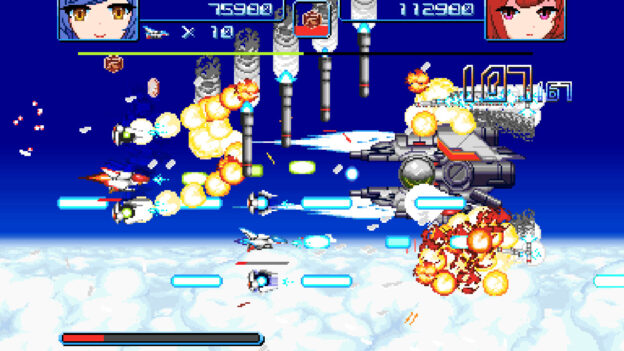
If you’re looking for speedy shmup action, Revolgear Zero has you covered. It offers a solid variety of enemies and weapons in which to take them down effectively. Co-op play makes the game even more fun, but glitches prevent me from giving as broad a recommendation as I first thought.

What little story there is doesn’t really get a proper mention until the closing credits (evidently, there are six endings). All you have until then is the cryptic “Grant a new legend to the cosmic warriors who survived the fiercest  battles.” But when I was asking myself what was happening, I also had to remind myself that this genre doesn’t need a coherent tale attached to it.

Revolgear Zero has four levels of difficulty, covering a wide range of gamers. Whether you’re looking to ease your way in or you want threats to the extreme, the game has you covered. As somebody who was reaching for his glasses and pausing to crack his knuckles, after a few minutes of play, guess which difficulty I started with?

Difficulty assistance comes in the form of co-op. I appreciate this, as a surprising number of shmup games overlook co-op for unknown reasons. But beyond an aid to the challenge, it’s just so much more fun flying, shooting, and strategizing with a buddy. So much that I’d add or subtract half a point to my final score depending on whether you’re going solo or with a friend.

I touched on enemy variety briefly in my introduction. You’ll see mechanical ones (large and small), organic threats, and even the stages themselves, soon proving a potential danger. Some scroll both vertically and horizontally, with portions of the background damaging you with a touch. At certain points, you will be less focused on shooting than on finding a safe spot to camp out and wait for your opening.

As far as the weapons, I won’t waste time trying to describe each in my limited word count. Firstly, because many are variants that most shmup fans are already familiar with. Secondly, because half the fun is experimenting with different combinations and loadouts. It’s one of the game’s strengths, figuring out your own favorite combos, which likely will differ if you’re playing alone or with a friend. They also change depending on the stage, whether you’re in more open areas or tight spaces. Earning weapon upgrades (collect every coin you can) and being able to flip between them on the fly can be the difference between victory and a game over.

Visually, Revolgear Zero starts a tad bland in the sky, but gets much better the further you advance. It introduces a much greater variety of colors, different effects, parallax, and more. It’s not a cutting-edge look by any means, but it is a pleasing one. The music rocks, complementing the graphics to deliver an aesthetically pleasing audio/visual package. There’s no slowdown either, even when the screen is filled with bullets and coins.

Unfortunately, there are game-crashing bugs. More than once, the game shut down after finishing a stage. Once, I was prompted to share the info with Nintendo. The second one was the generic “There was a problem, and the software needed to close.” Revolgear Zero is still a good release, but my recommendation comes with caveats. It’s not a must-own.

Revolgear Zero goes beyond the token shoot’ em up in many ways. Its weapon system has depth, and what it lacks in length, it makes up for in replayability. It’s a fun game to play solo, and even more fun in co-op. I’ll keep an eye on Bikkuri Software and hope their next Nintendo release will have its glitches ironed out.

The post Review: Revolgear Zero (Nintendo Switch) appeared first on Pure Nintendo.

Review: Broken Sword – Shadow of the Templars: Reforged (Nintendo Switch)

19. Únor 2026 v 12:01

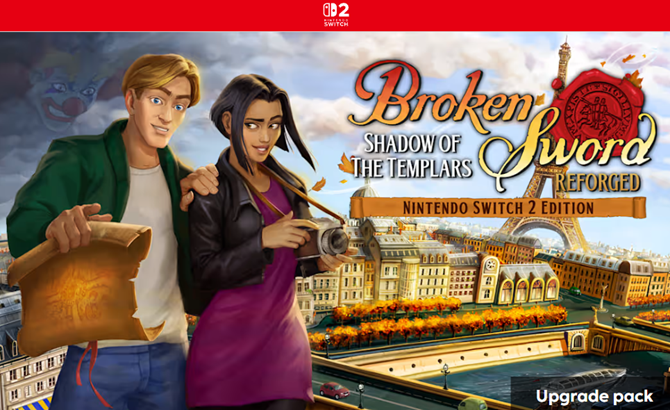
Late ’90s Paris—an auspicious time and starting point for my all-time favorite globetrotting graphic adventure: Broken Sword. This Reforged version is “substantially enhanced,” with improvements varying in quality, especially for purists like myself. But with options to play the original (and, in my eyes, virtually flawless) game, it makes any of my gripes inconsequential. Reforged offers the best of both worlds.

I readily disclaim my nostalgia for this game, having first played it in my late teens on the Sony PlayStation. Despite some long load times, that 1998 port introduced me (and other console gamers) to what would become a long-running series. Nintendo players may know the game from even later ports on the GBA (see my retro review in PNM Issue #32) or the Director’s Cut versions on DS and Wii. The latter were popular with those unfamiliar with the original game and just getting into the genre. That’s much less so with existing fans (for reasons too numerous to discuss here), but Revolution Software has acknowledged this, excising those weaker updates to focus on the superlative original.

Broken Sword is a story-driven game with an explosive start, literally. There is a bomb blast at a sidewalk cafe, and American tourist George Stobbart gets caught in it. His early motivations may seem limited (not unheard of for this genre). Is it a sense of justice stemming from his law studies and/or survivor’s guilt? More likely, he’s just an inquisitive man on vacation looking for adventure without an itinerary or restrictions on his time and expenses. Being able to partner with a pretty photojournalist certainly helps, too.

Nicole Collard is your non-playable support—a shutterbug George admires and builds chemistry with as the adventure progresses. While she may seem passive (especially compared to George, who is actively traveling historical and cultural crossroads), she has some fun surprises up her sleeve that I won’t dare spoil for first-time players. The relationship between her and George builds organically.

Their initial search to learn more about the deceased cafe victim and his killer (disguised as a clown) soon leads to a mystery whose origins lie in the Middle Ages, the scope and threat of which are hard to imagine. The Knights Templar make for a popular topic in books, movies, and more now (and rightly so), but decades ago, not as much. Broken Sword was a pioneer that encouraged many gamers to learn more about history.

Truly tying all these threads together is the plethora of side characters (and George’s interactions with them). There is no such thing as a lesser NPC in Broken Sword, as even those of limited importance still leave a positive impression. Even seemingly mundane exchanges lead to entertaining, often funny, and memorable results. It’s one of the reasons the Director’s Cut faded after its honeymoon period, as gamers let the devs know these nonessential interactions were, in fact, essential insofar as their contribution to the game’s charm and challenge. Are you showing the greasy tissue you found in the sewer to every character you meet? If not, you’re missing out.

The character vocals impressed the heck out of me in my younger years. Now I better recognize some voice actors in dual roles and their stereotypical accents. Nonetheless, I’m still impressed. Highlights include Rolph Saxon as George and most of the Irish dialects. Modulation stands out, and with subtitles on, you won’t miss a beat. Of course, the vocals are only part of the audio package. The late Australian composer Barrington Pheloung’s orchestral score lives on, chiming in at leading points during the cinematic adventure, making it even more music for your ears. My lone musical issue (though small enough to have no impact on my score) is that the fiddle player in the Irish pub seems slightly off, with overly loud music and choppy transitions between tunes. Some of this may simply stem from growing up with the PlayStation version, where the character got removed (he gives no dialogue). You can do a quick settings adjustment, though, and perhaps a patch will polish this or grant the option to remove it entirely.

But beyond the audio, it’s the game’s visual presentation likely to attract the attention of most players (as well as the most in this review). The original Don Buth Studios art has been redrawn in high definition, and you can flip between both styles instantly with the tap of a button. The joy I get from combing through each screen and studying every change, no matter how small, might be hard for many to understand, but it’s real all the same. Reforged is at its best when staying faithful to the timeless beauty of the original, making subtle enhancements feel natural. A few of the earliest examples are the animated intro, which has never looked better. Now, some cars travel along the city streets, which feels right. Another is the cafe where the explosion took place. While always appearing blown up, it now has even more damage at the site where the bomb sat. Again, it feels right. One more is the character of Flap, described by George as a “gorilla” gangster. He’s gained a few inches to better match his brawny description.

Reforged is less successful when it deviates more than is needed from the original. For example, while I appreciate the autumn foliage lining the block of Nico’s apartment, other color choices in the redrawn scenes feel more like “Paris in the Spring.” The lighting can also be too much or too little—the Hotel Ubu chandelier in one instance and the sewers in another. In the effort to create realism, some details and grittiness that shone through in the original get lost. The redrawn Crune Museum (a singular instance, thankfully) barely resembles the original, especially during the daytime scenes. Warm colors and textures are replaced by something best described as if Sam’s Club built a museum in their Tire & Battery Center; it’s an odd choice. 

Thankfully, these gripes are ultimately nullified with the inclusion of the original presentation accessible on the fly (something the Director’s Cut predecessor lacked on Nintendo hardware). Of course, less experienced Broken Sword players, like my wife, might prefer the new version, and I understand that. Heck, I often prefer the new version myself. But don’t hesitate to compare and tinker with settings, especially if playing in handheld mode, where the original shines brightest.

The puzzles reflect the time of the original release. In 1996, the percentage of the global population having cell phones and Internet access was small enough to be counted on one hand. Calling from public telephones and getting info from print is George’s way. You’ll manage a good-sized inventory and talk to everyone you meet about everything you can think of. Those coming from the Director’s Cut version may find it jarring to have more options to work with, but the extra challenge also brings extra charm. However, I’d think long and hard about picking the “Story” experience over “Classic,” at least at the start. Broken Sword – Shadow of the Templars: Reforged having the option is great, but will you soon regret the hints and hotspots? 

You can die attempting to solve certain puzzles, but autosaves (and manual ones) lessen having to replay too much. Thankfully, the cursor works very well, even at the default setting, which is paramount for some puzzles that require quick timing or can lead to death. You can also play in handheld mode with a capacitive stylus. Impatient gamers may welcome the option for speedier movement. That said, except for the previously mentioned puzzles built around quickness, Broken Sword isn’t a fast-paced game and is best enjoyed at a pace to savor everything it offers. Oh, and did I mention among point-and-click games, Broken Sword has a puzzle that is the GOAT?

Broken Sword – Shadow of the Templars: Reforged respects the fans who helped make it a commercial success. But it also invites new players to discover the game (and, by extension, the franchise) that, for many, has become the genre leader. Don’t be turned off by the awful menu icon, the spoiler screenshot in the listing, or any other marketing blunders. The game itself is outstanding.

It’s the compelling interplay of thrilling story, memorable characters, enjoyable puzzles, and stunning presentation that ensures Broken Sword – Shadow of the Templars: Reforged will become a top choice for a new generation of players. Let’s hope the sequel (and the rest of the series) finds a home on Nintendo hardware. It’s 2024, and my game of the year is a graphic adventure first released in 1996. Go figure.

Switch 2 version notes:

Peruse the eShop, and you’ll also see Broken Sword – Shadow of the Templars: Reforged – Nintendo Switch 2 Edition. The full game is $29.99, which remains a fair deal. But, if you already own the original, the DLC is just $4.99 ($2.99 on sale). Hard to complain about that.

But what are you actually getting if you go the Switch 2 route? Well, you’re getting an already great-looking game, now 4K docked or 1080p in handheld mode. These are pretty sweet upgrades, and I was able to pick out some new details that I overlooked last time.

The other new addition is mouse controls. Given that’s how Broken Sword was first conceived, these are natural. Comfortable and working as expected, their integration serves as an example for other Switch 2 games.

The post Review: Broken Sword – Shadow of the Templars: Reforged (Nintendo Switch) appeared first on Pure Nintendo.

Review: Pinball FX – Williams Pinball: Elvira and the Party Monsters (Nintendo Switch)

24. Listopad 2025 v 17:16

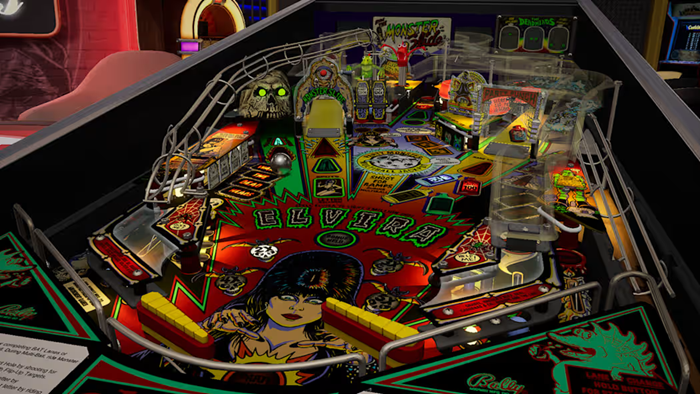
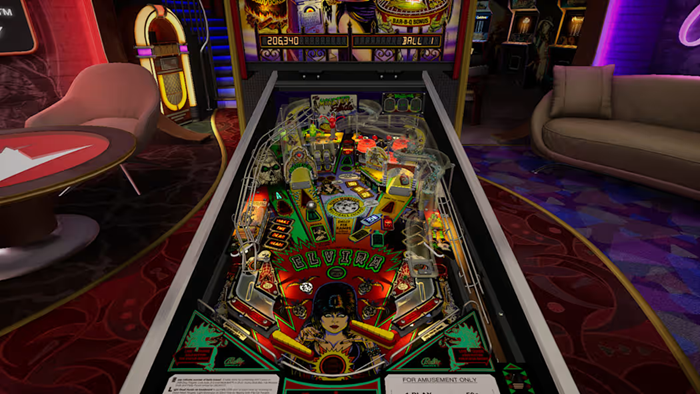
It’s time to party like it’s 1989, with Elvira and the Party Monsters. It’s a year I look back on fondly, even if I was too young to appreciate it at the time. Of course, I remember it more for summer blockbusters and the start of the peak NES era, not this “Mistress of the Dark.” But that doesn’t mean I’m not nostalgic for the Party Monsters, because I am.

And nostalgia is a very good thing in this case, because this is the fourth Pinball FX DLC I’ve reviewed this year alone. Memories keep me from feeling burnt out. I first experienced Party Monsters a few years after its release, in video form on my Atari Lynx. Many years later, I’d own a much closer approximation of the real deal via the Pinball Arcade. Now with Pinball FX, I can experience the most “faithful recreation” yet.

Party Monsters promises players “a frightful evening packed with creepy creatures.” In reality, it’s more of a fun-filled evening packed with campy creatures. Ghastly this is not, with its bright and colorful presentation. The boogie man, Frankenstein, and the wolfman are at their wackiest. There’s even Dracula, arriving via “Taxi” from Williams Pinball Volume 9, perhaps? And this is just to name a few; it is a party after all. The remaining monstrous guests I’ll leave as a surprise.

I was rusty, but muscle memory must’ve quickly come back. Party Monsters is one of the easier tables to achieve multiball on, as you only need to get a trio of balls into the skull cave, accessible via the far left.  Of course, I don’t mind, as this game lacks any ball saver. So, don’t hesitate to check out the “Practice” mode (the only one with a default ball save) and focus on the scoring areas you need to. Things have a way of evening out at this party, advantageous for players who were dropping 50 cents all those decades ago.

Music (typically a focus of mine) tends to stand out less when I’m playing pinball games due to all the table sound effects. Party Monsters is an exception, with highly memorable tunes. You could say some of that stems from my youth and the unique sound of the Atari Lynx, and that’d be fair. Still, Party Monsters sounds great on the Nintendo Switch, with tracks that really complement the visual presentation. Various vocal clips from Elvira augment the audio package and the game as a whole.

Earlier, I joked about the 50-cent cost, but “Elvira is no cheap date,” even all these years later. At $9.99 for a single table, this doesn’t mesh with Zen Studios’ recent pricing structure. I get licensing and all. But Tomb Raider Pinball would’ve had the same issue, but gave you two tables for the same price. It’s something to consider moving forward. Because, unless you have nostalgia, Party Monsters is easy to wishlist for a future sale (along with its follow-up, Scared Stiff), while you play some other DLC that offers more bang for your buck.

Elvira and the Party Monsters embraces its campy theme, with a bright and vivid presentation, backed up by an impressive audio package. This table offers plenty to keep you busy, with a range of scoring challenges. It’s arguable if it’s worth the launch price of $9.99. But if and when you pick this up, don’t be surprised if your thoughts line up with Elviras’ invitation, “How ’bout another ball”?

The post Review: Pinball FX – Williams Pinball: Elvira and the Party Monsters (Nintendo Switch) appeared first on Pure Nintendo.

Review: Hyrule Warriors: Age of Imprisonment (Nintendo Switch 2)

20. Listopad 2025 v 20:41

Hyrule Warriors: Age of Imprisonment raises a similar thought I had with its predecessor, Age of Calamity. While the latter’s enjoyment depended, in part, on having played Breath of the Wild, this latest entry has a similar relationship with Tears of the Kingdom. And if you haven’t played that game on the original Switch in 2023, you’ve probably played it on Switch 2 in 2025. In which case, you’re not only prepped for Age of Imprisonment, but probably looking for Zelda content that’s genuinely new.

This time, the Musou formula (1 vs. 1,000 battles) is applied to the Imprisoning War. While alluded to previously, the overall story of this has remained a mystery. So, lore enthusiasts should eat this all up, as it introduces a narrative to replace fan theories. Age of Imprisonment is similar to Age of Calamity in ways. Instead of the time-traveling guardian of its predecessor, now we have Zelda herself going to the past. Which means that, among other things, short memory cutscenes from Tears of the Kingdom get expanded on. Zelda’s loss of consciousness at the start may explain any seeming lapses in her recollections.

However, for every player who puts the plot at the forefront, there’s another who is more focused on gameplay—gameplay that can be comfortingly familiar or seemingly overwhelming, depending on your familiarity with this style. Smartly, Age of Imprisonment retains four difficulty options. Even wiser, you aren’t locked into one. I found myself bumping the challenge up or down depending on the mission and if I was working solo or not. Inexperienced solo players may want to start playing on easy mode to get a feel for things. Meanwhile, a duo of veterans will definitely find more enjoyment playing on hard mode. Each difficulty setting has its own local leaderboard, which can incentivize replay as you further level up allies. 

As the roster of playable characters grows, you discover unique Sync Strikes between the various combinations. These powerful attacks can turn the tide of battle, and it’s a lot of fun finding your favorites and unleashing them at ideal times to drive back Ganondorf’s forces. With this emphasis on “two allies working together,” it does seem odd that a handful of missions force you to play them in single-player mode only. Frankly, the game doesn’t do an effective job in explaining why these instances occur, and it’s a valid criticism in a sea otherwise filled with compliments.

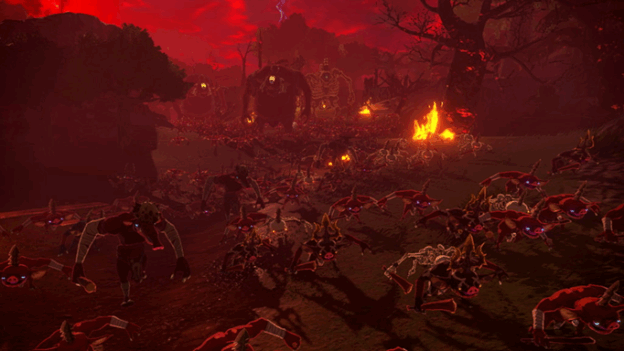
Besides Sync Strikes, Zonai devices are another new battle addition that prove to be a lot of fun. It gives you more ways to take down Ganondorf’s monster hordes in your fight to reclaim Hylian territory. (Yes, unlike this game’s cast, I’ll never dignify him with the title of “King.”) Certain ones are even helpful beyond battle. The flame emitter and cannon, for instance, can light up the shadowy depths. Just make sure you have a battery charge.

Speaking of, besides battling in Hyrule, the depths and the skies will also be your playground in the ever-growing maps. While it’s exciting to watch these fill and change over time, it does look a bit sloppy. I prefer the straightforward map of the original Hyrule Warriors to these later icon-filled ones. But the locales above and below bring some appreciated graphical diversity, with the gloomy darkness of the depths contrasting with the bright sky.

But for me, it’s the audio, not the graphics, that’s the real highlight. You can access a music player in the game’s gallery (dozens upon dozens of tracks), and guess what I’m listening to as I type this? The compositions can be beautiful, dramatic, tense, and more, depending on where you’re at. Not to be neglected are this game’s vocal performances. The cast is bigger than ever, and the standout is Patricia Summersett as Princess Zelda. I’ve been mixed on her past performances, but here she shows a wide range of curiosity and excitement in her new (yet familiar) environment. I’m not sure how much of this stems from the direction and having more awareness of context, and how much comes from her simply growing into the character after all these years. But kudos.

Going back to the visuals for a minute, I want to be clear, I don’t think this game looks bad by any means. After all, how could it? It’s based on Tears of the Kingdom. But it’s clear that, with so many recent Zelda games triggering vocal complaints, the emphasis here was on a smooth experience. There are no performance versus quality options, as we’ll see in Metroid Prime 4. It can take a hit if playing two-player split screen. Our preferred way was playing co-op via game share sessions. Nintendo needs to stop burying this feature and bring it to the forefront. Playing this game with a friend on individual screens is what bumps this game from good to great.

Extras include familiar amiibo bonuses (even non-Zelda ones), save data bonuses, and collectible Korok seeds. There’s plenty to keep completionists going here, especially if you enjoy both Zelda and Musou gameplay. While you might be able to beat the main game in 20 hours, you can easily double that if you take advantage of everything that Age of Imprisonment has to offer. It’s content-filled, and if past entries are any indicator, don’t be surprised if DLC follows at some point.

Who knows how much longer this version of Hyrule (that started in Breath of the Wild) will continue? If this is the end, it goes out on a high note, especially when enjoyed cooperatively. Hyrule Warriors: Age of Imprisonment is an entertaining entry that will keep you busy during the first holiday season of the Switch 2. Heck, packed with content and surprises, it’s one you’ll likely return to when the mood strikes as well.

The post Review: Hyrule Warriors: Age of Imprisonment (Nintendo Switch 2) appeared first on Pure Nintendo.

Review: Everybody’s Golf Hot Shots (Nintendo Switch)

6. Listopad 2025 v 20:45

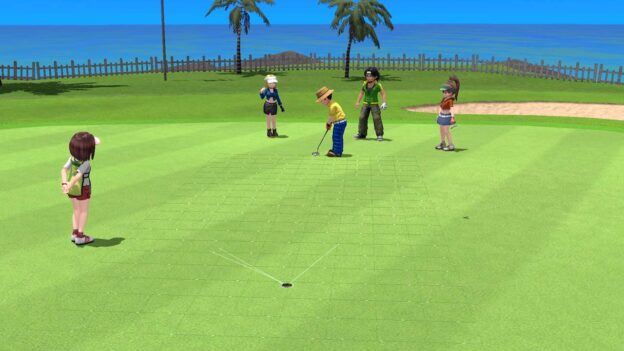
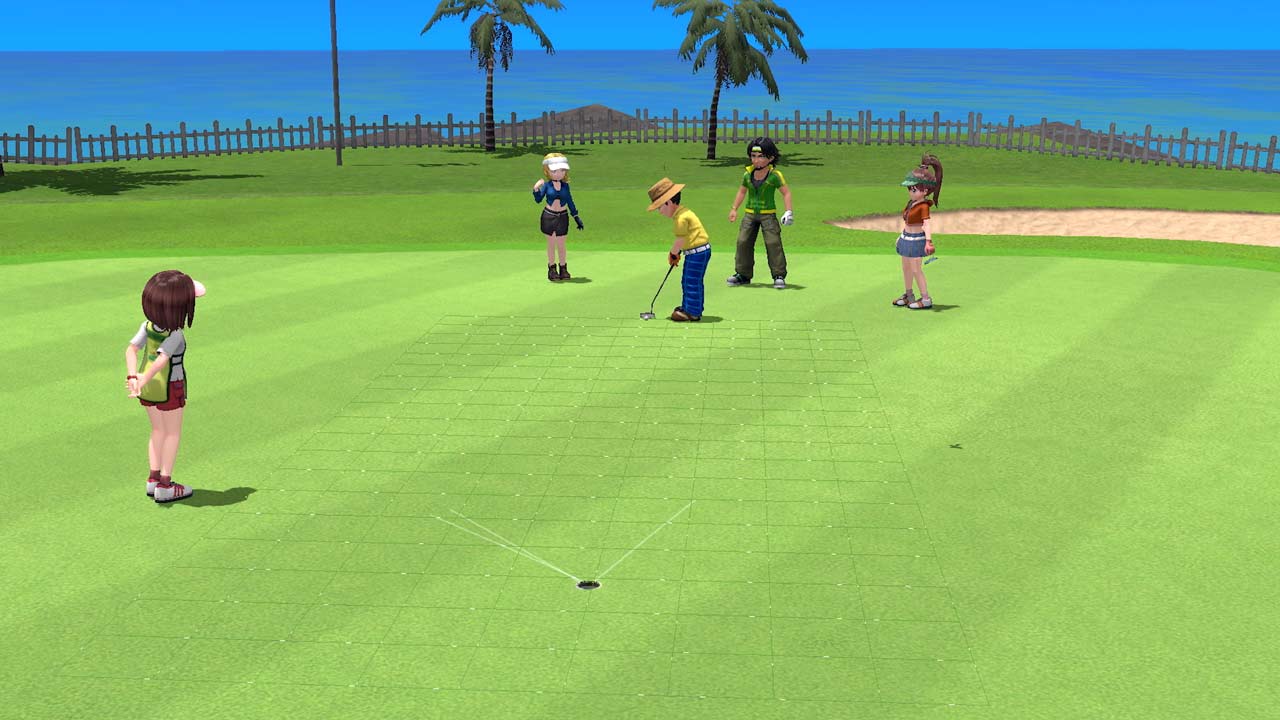
Everybody’s Golf Hot Shots is the first entry I’ve played in the long-running, if sporadic series. I do remember reading reviews of the original, which was developed by Camelot, later of Mario Golf fame.  Despite being a video golf fan, early Hot Shots releases (as they’ve been known in North America) escaped me—blame the PSX hosting the late ’90s PGA Tour Games, as a guy can only own so many golf titles per console. Anyway, how does Everybody’s Golf Hot Shots (an odd blend of the European and North American names) fare to someone who’s not new to golf video games, but is new to this series? When it was first launched, it started “rough”. 

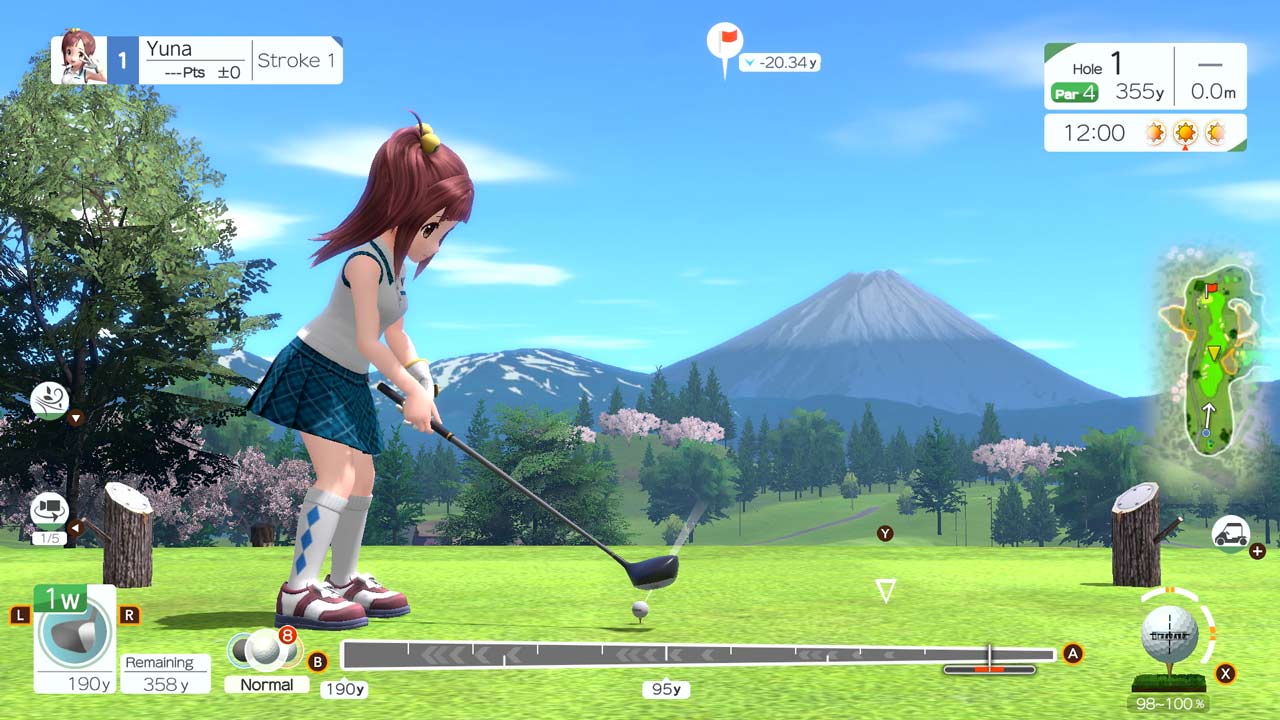
For a game that heavily boasts about its accessibility, I found it surprisingly difficult, at least initially. Mastering “simple and intuitive” controls sounds super on paper. But in practice, I began to question my decades of experience with dozens of golf video games. There was a seeming delay in my reflexes that I couldn’t account for, even with three variations of the familiar three-click setup, which dates back to the early days of the NES. In all of them, I struggled to time my shots in the admittedly small sweet spot with consistency. It was no mere trivial irritation.

Patience was a virtue, though, and thanks to a couple of patches, the game has improved since launch to become much more playable. I should’ve been suspicious when there were no pre-launch press codes available for the Switch version. I also should’ve checked that I was running the most up-to-date version much sooner. Still, I went from thoroughly unimpressed to pleasantly intrigued. I could finally adjust properly to see the genuinely good game buried in the bunker.

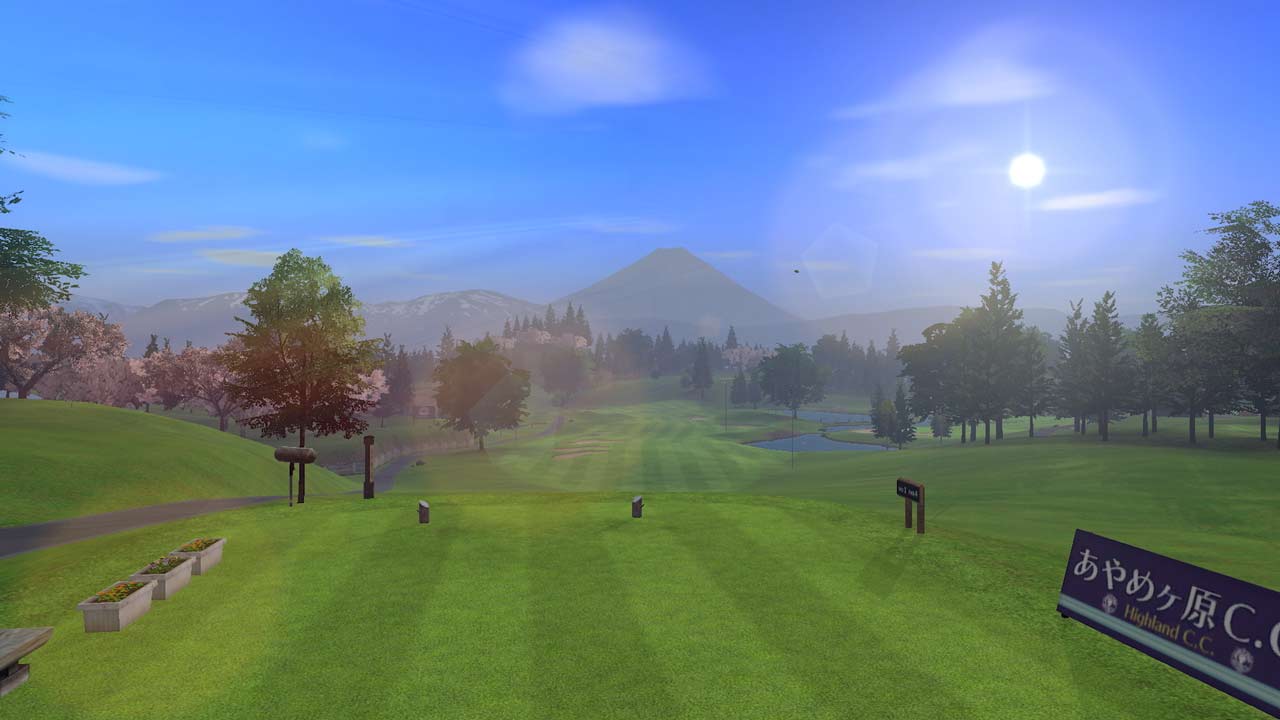
Still, I did the whole “Virtual Game Card” thing, and eventually played it on my Switch 2. Perhaps it’s my middle-aged eyes, but I recommend players who plan to play this game at length try it this way, if possible. Not that the game looks bad on older hardware, but some blurred images look a little less washed out, among other things. Colors fare better, too, and I’m not just talking about Wacky Golf’s colorful mode.

On that note, this game promises a cast of “colorful characters,” and I don’t mean vividness. Unfortunately, the first girl, Aile, is annoying, to put it charitably. I originally planned to pen this entire paragraph in her manner of speech, but couldn’t bring myself to endure the pain.  She might look “totes adorbs” in her skimpy outfit, but she speaks like nobody I’ve ever heard in real life. Did AI write this dialogue? Smartly, you can mute them.

While more characters can be unlocked in the world tour to experience their stories, it involves a lot of repetitive gameplay. Still, I couldn’t wait to have an option to pick beyond the annoying Aile, so I powered through her seven chapters, admittedly not complete 18-hole courses for each one. I disagree with this unlock setup and suspect it will disappoint many, a frustration for those seeking more diversity straight away. Still, it adds some long-term goals to reward committed players.

Fortunately, there are plenty of other modes. The usual solo round, match play, and stroke play modes are included. There’s also a challenge mode where you earn prize money and rewards in various tournaments. My highlight is probably “Wacky Golf,” with four different variants—including the previously mentioned Colorful mode—beyond the traditional gameplay. Scramble is my favorite among these, with an emphasis on teamwork as players alternate their shots.

Everybody’s Golf Hot Shots clearly needed more practice before teeing off on the Nintendo Switch. Thankfully, some necessary updates have significantly improved the game; however, one could argue that even more improvements are desired. I’m glad I held off on this review, because now (as a fan of video golf), I can appreciate it as a pretty good and content-rich title. Those less forgiving of its restrictive unlockable structure might bump it down a point, and wait to grab the game on sale.

The post Review: Everybody’s Golf Hot Shots (Nintendo Switch) appeared first on Pure Nintendo.
❌