

The Prisoning: Fletcher’s Quest Review
You can tell that a medium has reached some form of maturity once things start getting meta and titles appear that draw attention to the process of being constructed and the dilemmas that are faced by their creators. Countless great modern novels and films that are as lauded as Citizen Kane are clear examples of this and, whilst not in the same league as these, The Prisoning: Fletcher’s Quest is of a similar vein. You play as a burned out developer who undergoes hypnotism in a therapy session only to find himself trapped inside his own creation, a search adventure game with procedurally generated layouts.
The pixel-art aesthetic in Fletcher’s Quest is really nicely done and the various areas of the game look distinct whilst enemies and characters are well designed. Bosses are particularly memorable and everything benefits from a bright and colourful approach. Music is solid enough with a few standout tracks, again often in boss fights.
The game’s narrative is clearly nonsense and is all presented in a suitably tongue-in-cheek fashion. This is perhaps most obviously seen by the fact that the early rooms of the game have to be traversed not just devoid of weapons or skills but also of clothing. The pixel graphics mean that you are saved the detail of such nudity, whether you’d like it or not, but characters do comment on it. Your first mission, therefore, is to find clothes and a means of defending yourself.
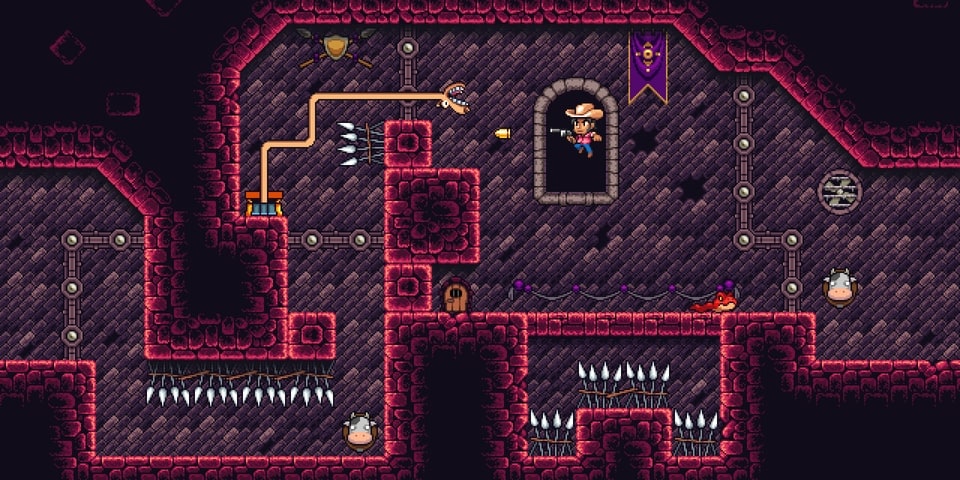
While billed as a Metroidvania (I prefer ‘search adventure’ myself) the game actually reminded me more of classic home computer titles such as Jet Set Willy and Manic Miner. The flip-screen traversal and assortment of ludicrous enemy types brought me right back to my earliest days of gaming in the mid to late-1980s, but without the extreme frustration that accompanied those often nigh-on-impossible games. The main difference, however, is actually an unintended consequence of the choice to use procedural generation – rooms and areas are relatively forgettable, lacking the intricate design that the genre really requires to succeed.
The generated layout is completely functional with areas blocked until you beat bosses and unlock new skills, but many rooms feel interchangeable and the extreme frequency of save and travel points mean that backtracking is rarely required. Indeed, on the default difficulty it was generally quicker to collect items and then die to return to the last save point. As collection progress is maintained, the game seems to actively encourage you to avoid playing it. If I’m being generous this might be a deliberate move in keeping with the meta view of the genre, but I think it’s just another result of the use of procedural generation.
In terms of skills, you play through the whole game with just a pistol, and one that initially is a real pea-shooter. You can fire one bullet at a time and if you miss then you have to wait until the bullet disappears from view before you can fire another. This adds a level of strategy and reward for accuracy that does help to keep things interesting. As you defeat each boss you’ll be granted an additional bullet (a fact that I forgot, which made the second main boss unnecessarily difficult) as well as a traversal skill like double-jump and butt bounce.

As well as standard single screen platforming challenges, The Prisoning occasionally breaks things up with horizontal shooter sections and the final boss is an auto-runner minigame that treads a fine line between challenging and downright annoying. That said, given my first playthrough was under three hours, the variety is restricted by the short length of the game. This, again, helps to make the game feel like a lost retro title.
The four boss fights are the most memorable part of the game, not coincidentally because they are clearly the most hand-crafted moments. You’ll find yourself up against a giant robot, a skateboarding shark and more, with all offering distinct challenges and necessitating different approaches. The one that stood out for me was the shark, both because of the uniqueness of the antagonist, but also the slippery slope of forced humour it introduced.

The whole game has a lot of lol random’ humour that is very hit or miss. The nudity is the most obvious example but the shark boss features a lot of dialogue about how badly it is designed and frustratingly difficult it is. This kind of meta-joke is so often undermined by the content being as annoying as the joke pokes fun at. Admittedly this boss was rendered more challenging by my forgetfulness, but the battle goes on for a long time with you only having two hits before death.