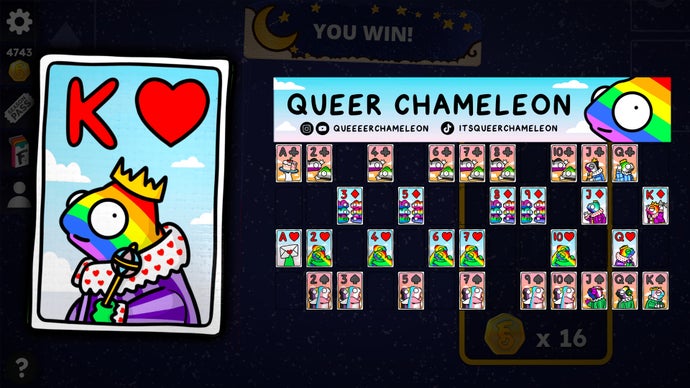
Valve have blocked card game Flick Solitaire from the Russian version of Steam, after federal censorship body Roskomnadzor contacted the platform holder to order its removal for "promoting non-traditional sexualities".
In a letter, Valve have also reproached developers Flick Games for failing "to do your due diligence regarding where your game is allowed to be distributed, and to inform us of any territory where it cannot be". Flick Solitaire is still available in Russia via the iOS and Android storefronts, however, despite Roskomnadzor sending similar notes to Apple and Google. As of writing, Valve appear to be the only platform who have caved to Russian state requests to censor the game.
It’s weird, really weird. Visa, Mastercard, and PayPal have quietly cracked
down on legal adult games sold on Steam. Yet these same
payment giants keep supporting Roblox, a site that’s
currently facing shocking numbers of child predator cases. What’s going on?
Let’s unpack this.
1. What happened on Steam?
In July 2025, Valve changed its rules. It now bans any content that "may
violate the rules and standards" of its payment partners, specifically
targeting "certain kinds of adult‑only content" (Ars Technica,
GamesRadar+). As a result, hundreds of games, many with titles containing words like
“incest” or “slave” were quietly removed from Steam in just a couple of days
(Newstarget.com). Valve admitted that this was to avoid losing payment methods entirely (PC Gamer,
GamingOnLinux).
Valve tried reaching out to ask which games were problematic but learned that
Mastercard’s acquiring banks cited rules like “Rule 5.12.7,” which bans
anything that could "damage the goodwill" of Mastercard (PC Gamer,
Wikipedia). Meanwhile, Mastercard states it only enforces “rule of law” measures and
doesn’t censor lawful purchases (GameSpot). Visa echoed similar sentiments, saying it doesn’t make moral judgments on
legal purchases (GameSpot).
So yes, if a paying adult tries to legally buy an adult‑only game on Steam,
the transaction might get blocked not because it’s illegal, but because a
payment processor thinks it’s too edgy.
2. Now, look at Roblox.
By contrast, Roblox is a platform aimed at kids and it’s currently under fire.
Lawsuits are piling up. One filed in California tells the story of a
10‑year‑old girl groomed via Roblox and later abducted. Across the U.S.,
hundreds of lawsuits are accusing Roblox of failing to protect children (People.com,
That Park Place,
WIRED).
Reporter data shows Roblox’s self‑reported child exploitation cases
exploded from 675 in 2019 to over 24,000 in 2024 (WIRED). Even sting‑operation YouTubers hunting predators on Roblox have been
banned or hit with cease‑and‑desist from the platform (Wikipedia). Yet, Visa, Mastercard, and PayPal continue to process billions of dollars
in transactions on Roblox as if nothing’s wrong (That Park Place).
3. A painfully obvious double standard.
On one hand, adult gamers buying adult content get cut
off because of moral brand concerns.
On the other, a child‑focused platform with
real and documented predator dangers gets a pass.
It’s not because Roblox is safer. It’s because Roblox is
hugely profitable, and cutting ties would hit Visa/Mastercard’s bottom
line whereas blocking niche Steam games doesn’t really cost them much (That Park Place).
4. So… are the payment companies protecting predators?
No. But their inaction and inconsistency looks suspicious. If you censor
consenting adults while continuing to fund a platform accused of enabling
child exploitation, it doesn’t matter if the lack of reaction is
profit‑driven. The result is the same: children remain at
risk while adult expression is restricted.
Anything less than enforcing the same safety standards across platforms feels
hypocritical.
Quick Takeaways:
Yep, Visa/Mastercard (and PayPal) have effectively
censored some legal adult games on Steam even though
they’re not illegal.
Roblox has serious, real child‑safety issues, but big
payment systems still support it without hesitation.
The contrast is weird, confusing and feels deeply unfair.