Zobrazení pro čtení

Review: RANDOMAX (Nintendo Switch)

RANDOMAX is a vertical shoot ‘em up developed by ASTRO PORT and published by Sanuk Inc. It’s a brief roguelite where no two playthroughs are the same between the weapons you receive and the bosses you face. This title is easily addictive, though it is on the short side.
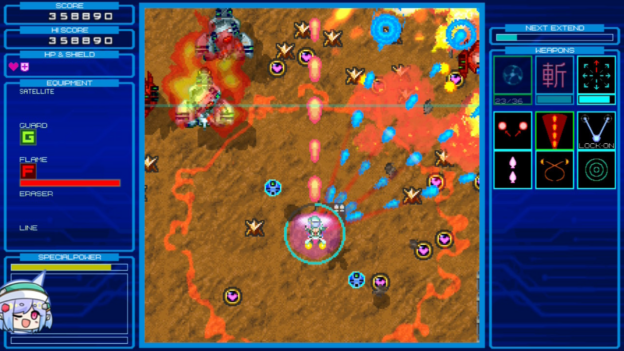
Also acting as a visual novel, RANDOMAX does have a storyline, though I didn’t find it important. I enjoyed this game more as an arcade title than anything else due to the high score features, fast-paced gameplay, and quick stages. I got through all stages within twenty minutes (give or take) each time I played.

In the year 2050, the Sepulch Space Archipelago galaxy is attacked by Randomax Pirates. Three women–Cosmi, Urara, and Dariha–hop in their respective ships (along with a shipping company, ARGO EXPRESS) to fight against these marauders. The character you chose to play during that run and the boss have a quick conversation before and after the fight. Everything about the story is the same no matter who you play as. Since the game is so short, I didn’t think the story element was needed. After playing through it once, I skipped all the dialogue boxes during each run. I found the dialogue to be a bit annoying, but it’s a minor complaint.

The gameplay is where RANDOMAX truly shines. It’s bullet hell at its finest, with each ship being able to equip up to three types of weapons at once. The controls are easy enough, using the L-stick to move and holding down the X, A, and B buttons to shoot their respective weapon. There are more than seventy types of weapons you can get, ranging from homing missiles, lasers, shuriken, bubbles, and even balloons. Some weapons shoot forward, others in multiple directions, and some will shoot in the opposite direction from which you’re moving. My favorite weapons to get were the heat seeking ones (which were great for boss battles) and full-screen weapons so there was little aiming involved. I could shoot to my heart’s content and focus on collecting the items.

When defeating enemy ships, they’ll drop items that’ll help fill your health meter to give you an extra hit, your ship’s shield (for a free hit), or the extend meter (which will help give you an extra boost). To be honest, the game is so fast-paced—with the screen covered in bullets and explosions—that I didn’t often notice these meters. I shot my weapons, collected the items, and, when something good happened, I praised myself and kept going.
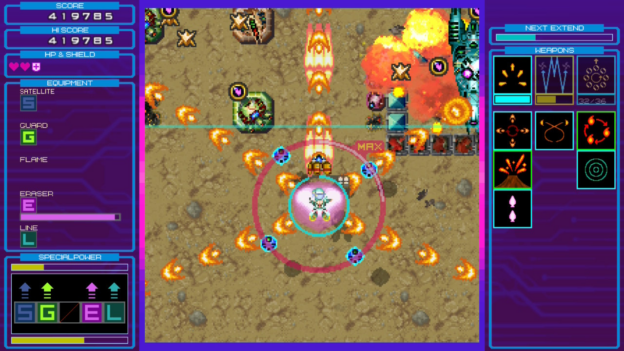
RANDOMAX does have some strategy involved, though. After each enemy wave, you’ll visit the ARGO EXPRESS ship which will give you the option of choosing one, two, or three new weapons at random. You can reject a weapon or assign it to one of your buttons. When assigning a new weapon, it’ll stack on top of the existing weapon in that spot. It won’t replace it, though you’ll need to use up all the bullets of the weapon on top in order to use the next in that slot.

The ship will also sometimes give you the chance to add a ship upgrade, such as a flame wall around your ship, adding extra guards around you to deflect bullets, and more. I found the guard to be the most useful since I often didn’t pay attention to the enemies’ bullets, but the enemies themselves. Or, I had my homing bullets do the work so I could aimlessly fly around the screen.

RANDOMAX has five difficulty settings, too: easy, normal, hard, insane, and ultra. I started the game on normal and promptly got my butt kicked. Once I learned more of how the game worked through the easy setting, I worked my way up each challenge. Despite the enemies’ increase in bullets, I found the game got easier as I worked my way up and improved my strategy, despite the randomness of the weapons.

After completing the easy mode for the first time in twenty minutes, I thought the game was just alright. Then I blinked and realized I had put roughly five to six hours into it. I got through all five difficulty modes with all three characters. With over seventy weapons and forty bosses to find, I didn’t quite complete the game. Otherwise, it’s a matter of beating your own high scores. There’s no online leaderboard, multiplayer, or anything like that.

So, in terms of replayability, you’ll get your money’s worth out of this title. But it is short. I can see myself going back to RANDOMAX here and there to play a quick round or two. It’s certainly a fun time and, even though I wasn’t impressed by it at first, it quickly sucked me in. Despite the story not being needed, and some brief lag when there are tons of explosions on screen, this game is addictive. 

The post Review: RANDOMAX (Nintendo Switch) appeared first on Pure Nintendo.
  •  

Review: Hero Seekers (Nintendo Switch)

Hero Seekers is a JRPG developed by Vanguard and published by KEMCO. This title contains a linear gameplay path, a decent story with interesting character backgrounds, and turn-based strategy combat. It looks great on the outside, but does it really stand out compared to other games in the genre? Well, the answer is yes and no.

I think the strongest part of Hero Seekers is the story. Over time, many Heroes have stepped up to defeat the Demon King. All succeed, but the Demon King gets resurrected each time and erases the previous Heroes from everyone’s memory, trapping said Heroes in a loop of their worst nightmare.

The game begins with a trio of Heroes—Lunette, Ramsar, and Ruwan—defeating the Demon King, only for them to get separated. Lunette awakes in a strange town where humans are being enslaved by demons. Only she remembers her party defeating the enemy, with Ramsar and Ruwan nowhere to be found. Thus, her quest begins to bring back lost history by freeing lost Heroes from their nightmares.

Overall, I found the narrative covered themes of hope, loss, and the importance of history in a unique way that was engaging with its characters. However, the gameplay wasn’t strong enough to help back up the story. There were too many characters with stories that ended up getting thrown away. There are twenty-four Heroes to find and add to your party, but you can only have five party members at a time. Four fight in your party and one is in reserve, earning experience from the party’s battles, but ultimately not contributing and just being there for backup.

I assume the developers created many characters to help with replayability so you can mix and match party members. Once you’ve completed Hero Seekers once, there’s no real need to go back and play it again anytime soon since the story is as straight as an arrow and the combat gets stale after a while.

I also didn’t want to swap out the main characters. Lunette is the playable character, and even though you can switch her out, it felt wrong to. She meets Nyla and Zalesh along the way, and they are also important, and in every conversation and cutscene. It felt weird to swap them out, too, when they’re still being addressed by NPCs. Every other Hero was simply there as an extra. They all had their own backstory, which was great, but once you unlock them, that’s it. They have no dialogue or interaction with anyone else for the rest of the game. I used Lilione as my fourth party member and Maximillion as my fifth on reserve. Other than aiding in battles, there was no reason to have more than the three main party members.

The gameplay of Hero Seekers is rinse and repeat. You go from one town to another, talk to an NPC or two, and they’ll tell you where to go next. So, back to the overworld you go, heading to a dungeon. The dungeons are more or less all the same. There are no puzzles or obstacles in the dungeons. It’s simply a matter of finding where the stairs are to move to the next level. Essentially, each dungeon is a large maze with long corridors, some dead ends with or without chests, and eventually you stumble upon the stairs.

And when I say large, I mean it. Every area in Hero Seekers—the dungeons, the overworld map, the towns—is huge with a lot of empty space. I can’t begin to describe how much space is wasted in every area. The towns in particular are needlessly large with tons of buildings with no doors. The only buildings you can go into are the town’s castle or the shop. There is a town or two where you can go into an NPC’s home, but there’s no reason to. No matter where I was, I basically wandered around until the game stopped me to tell me I was either going in the wrong direction or I triggered a cutscene.

There are no maps in this game, so I couldn’t look at the overworld to get a sense of direction to make it to the next area. Instead, I wandered until something appeared on screen. Or, again, the game stopped me for going too far in the wrong direction.

Overall, the gameplay in between combat was going through the motions for the sake of moving the story along. There are no side quests or mini games, nothing.

The combat in Hero Seekers was fun for a little while. On the overworld and in dungeons, you’ll get into random battles with wild enemies ranging from jellyfish and goblins to dragons and the undead. Every character can use physical attacks with melee weapons or use SP for magic attacks.

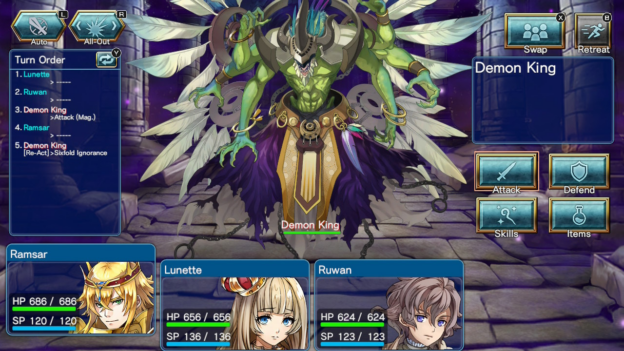
On the left side of the screen, you’ll see the turn order listing your party and the enemies, based on everyone’s speed. I’m not sure if my party was overpowered or not, but in pretty much every battle my whole party was faster and would basically one-shot the enemy team before they could even attack. I did grind a little bit in the beginning to get money so I could buy upgraded weapons and armor, so I’m not sure if I accidentally boosted my team too much. Thus, the battles were monotonous for me.

There is an auto feature for battles, though. If you’re grinding or simply just don’t feel like getting into wild battles when traveling to the next area, you can use the auto feature. The party will either go “all-out” using their strong attacks, or you can set the auto feature to “healing” or “no special” meaning they’ll only use physical attacks.

The boss battles could be tricky. Again, my party was usually faster than the boss so I had a good advantage. Also, there wasn’t much variety in the bosses. Many of them were main enemies from the story, so I battled them a couple of times. Many of the enemies, including some of the bosses, seemed weak to wind attacks. Nyla and Zalesh both have wind magic attacks, so they carried a lot of battles on their shoulders.

So, the story in Hero Seekers was great, but it could have been better if the gameplay supported it and had a little more variety and less of a linear feel to it. Yes, I know RPGs are typically linear, but this game didn’t allow me to do anything unless I was moving forward with the plot and gave me nothing else to explore in the towns or dungeons.

The music, graphics, and backgrounds in this game were amazing, though. The backdrops to the battles were gorgeous, and the music gave me Final Fantasy and Castlevania vibes with enough variation in tunes for the wild battles, boss battles, cutscenes, and general wandering.

Overall, Hero Seekers is a solid JRPG. The story is strong, though the gameplay doesn’t quite match its energy and feels bland after a while. With enough characters to try, replayability is present, but the linear way of playing doesn’t leave much desire for me to start over. I got through the main story within ten to eleven hours, so I did spend a good amount of time with this game. Despite some of its flaws, it is worth checking out if you enjoy RPGs.

The post Review: Hero Seekers (Nintendo Switch) appeared first on Pure Nintendo.

  •  

Review: Absolum (Nintendo Switch)

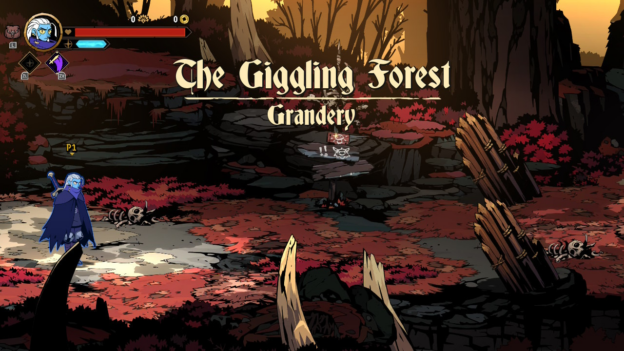
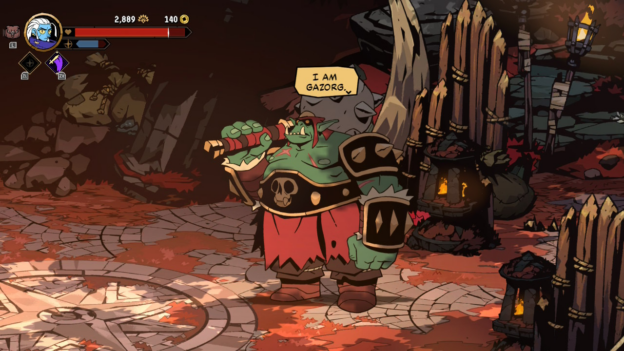
Absolum is a roguelite beat ‘em up developed by Supamonks and DotEmu and published by DotEmu. With multiple characters to choose from, local and online co-op, and multiple paths to explore, this title will keep your attention for quite a while.

The objective is to take down the Sun King Azra. As with most baddies, he’s conquering lands and has enslaved wizards as if they’re the bad guys all because some wizards made a mistake with magic that created a cataclysm. (Yeah, it’s a pretty big mistake.) Regardless, the Sun King takes advantage of the commonfolk’s panic and uses it as an opportunity to take over the world. It’s up to you, with the help of some friends, to defeat the Sun King.

Absolum begins with a lot of exposition and backstory. Through this, it walks you through a light tutorial—from walking to jumping to attacking. It also introduces the two main characters: Galandra the Elf and Karl the Dwarf. Going forward, you choose one of these two characters to play as during your current run. Or, if you have a friend to play with, you can go through a run together.

There are two other characters to unlock: Brome and Cider. It’s a shame the game doesn’t offer four-player co-op, but I can understand why because it may take you some time to unlock the other two playable characters.

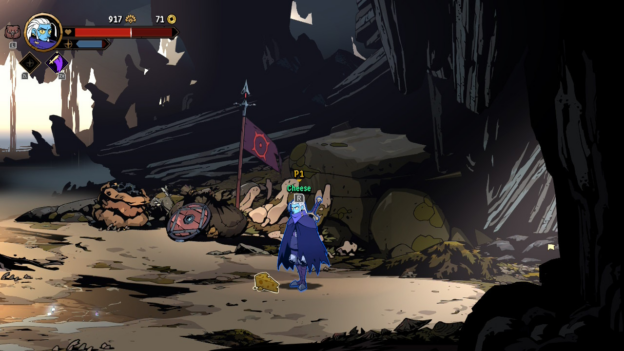
Being a roguelite, Absolum is one of those games where you see how far you can go in one run. Expect to die. A lot. Yet, with each new run, you’ll find yourself getting farther. During each run, as you defeat enemies, you’ll earn gemstones. Upon dying, you’ll appear back at The Hearth, the hubworld, and use those gemstones to get upgrades such as increased health, new attacks, and the like. You’ll be that much stronger beginning your next run.

You’ll also earn money, which is helpful in The Hearth and in the middle of your runs. The map has certain checkpoints, especially after defeating a boss. Here, you’ll be able to heal some of your health, buy upgrades that will only last throughout the remainder of your current run, and even hire an NPC to help along. They’ll fight alongside you until they run out of HP.

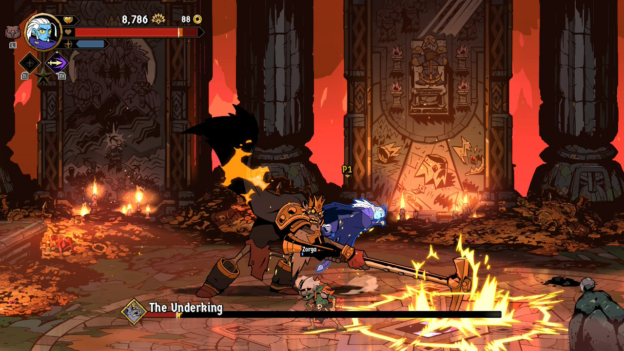
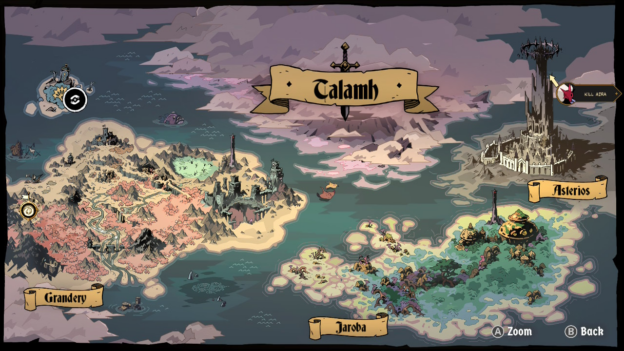
You’ll get familiar with the map in Absolum relatively quickly, especially the first areas. It’s a linear path, but there are some branching areas across four different lands, each with its own set of bosses. The boss battles are difficult. After losing to the first boss I encountered so many times, I chose a different path and, because I was stronger at that point, I was able to defeat the other boss in one go. After dying, I went back to the first boss believing I was some hot-shot and still got my butt kicked. Such is the nature of this genre, though. This game keeps you playing without getting too frustrated. At some points, when I had little health left, I wanted to die just so I could go back to The Hearth, get some upgrades, and try again.

Absolum provides just the right amount of challenge, but if it’s too tricky for you, it has unique difficulty settings. At any point during your run, you can hit pause and increase or decrease the amount of damage you take from enemies or you deal to enemies ranging from 100%, 75%, 50%, 25%, to 0%. Remember that boss battle I struggled with? I kept my damage to him at 100% and decreased his damage to me to 50% to help me get through it.

I really liked the way they handled the difficulty settings so you don’t feel frustrated if you get stuck. Since you can change it at any point in the game, you can make a boss easier if you need to and then bump it back to normal for the next area. Or, you can make the game more challenging by decreasing the strength of your attacks to enemies. If you’re playing with a younger sibling, you can change it so they take zero damage from enemies so they can mash buttons alongside you without the consequences. It adds so much more replayability despite the game already having a high replayability rate.

Speaking of button mashing, that’s exactly what I like to see from my beat ‘em ups. I don’t even think, I just push buttons and whack enemies with accidental combos. That said, the hack ‘n’ slash wasn’t as fluid as I would have liked. The game did not lag or anything, I believe it’s just the style the developers chose for fighting. It looks great, but I didn’t care for the way it felt. My depth perception was also off a lot of the time, and I missed big slashes more times than I’d care to admit. Now, this isn’t an issue with the game itself, it’s just my personal preference. I still thoroughly enjoyed my time with the title, regardless.

Absolum is a strong roguelite with enough content to keep you busy for hours and always wanting to try one more time. If you’re a fan of beat ‘em up games and want fun characters to play as with challenging bosses, then certainly pick this game up.

The post Review: Absolum (Nintendo Switch) appeared first on Pure Nintendo.

  •  

Review: Truck Driving (Nintendo Switch)

Truck Driving is a title developed by Tap Nation and published by Ultimate Games. It’s marketed as an action game, according to its Nintendo page, but it’s a driving simulation at best. Out of so many driving sims in the world, how does this particular game compare? Spoiler alert: it doesn’t.

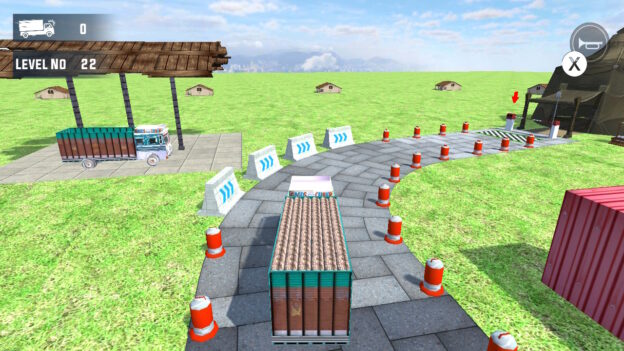
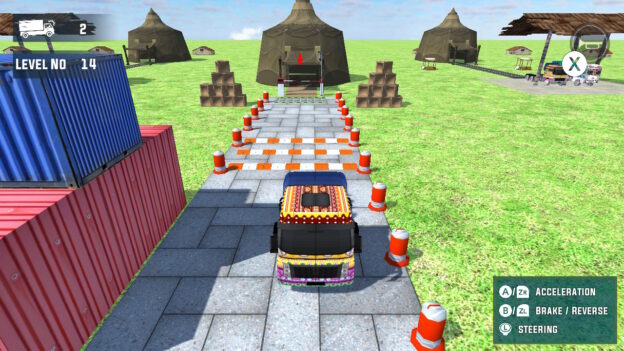
The premise of Truck Driving is to learn how to drive a truck, though there is no story. It’s simply a simulation to see if you can handle the physics of driving heavy loads between three different trucks, two of which you have to unlock. You do this through various levels of small driving exercises.

What type of exercises? Well, the first few levels involves driving in a straight line. Then come small turns, then bigger turns. Some levels include you driving backwards, going up and down ramps, and… that’s about it. Each level took seconds. And, no, that’s not an exaggeration. Overall, Truck Driving took me twenty minutes to complete all fifty levels.

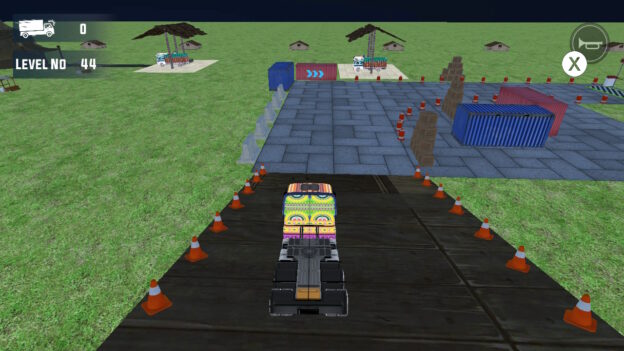
These levels are broken into two segments: day and night. The first twenty-five levels occur during the day, and the final twenty-five levels occur at night, meaning the graphics are darker and your headlights are on. It took me two of the night levels to realize those are exactly the same as the other batch. So, instead of fifty unique driving exercises, you’re repeating the same twenty-five you just completed five minutes ago.

When you complete a level, you’ll earn coins, and that’s what you use to unlock the remaining two trucks. Each truck has a heavier load than the last, and I could feel a difference with the physics. However, that didn’t make the game any more difficult. I still got through the levels with no problem. I even tried to purposely drive off the road to see if it would “fail” me, but it didn’t. I was able to drive back on the road, make it to the parking spot, and still earn my coins as a reward. There were no consequences and nothing else to do in the game.

Even after completing all fifty levels and unlocking all trucks, I have 5,000 coins left over that I can’t do anything with. I can’t customize my trucks, I can’t buy more, I can’t even buy cool horns… although the trucks do have a horn that does nothing but give you aesthetics, it was delightful to play around with it.

Part of the reason the horn was fun to play with was because Truck Driving has no music, only sound effects. Fifty levels of nothing but the truck’s engine whirring, non-existent people cheering for me when I complete the levels, and me continuously booping the horn.

And that’s all there is to it. Truck Driving is not a groundbreaking title by any means, though I can see younger kids having a good time with it. I think it’d be a fun short and sweet title for little kids to get a feel for playing video games, especially if they have a fascination with trucks. The levels aren’t difficult, controls are easy, there are no consequences, and it’s not overstimulating. Plus, you can honk the horn as many times as you want.

The post Review: Truck Driving (Nintendo Switch) appeared first on Pure Nintendo.

  •