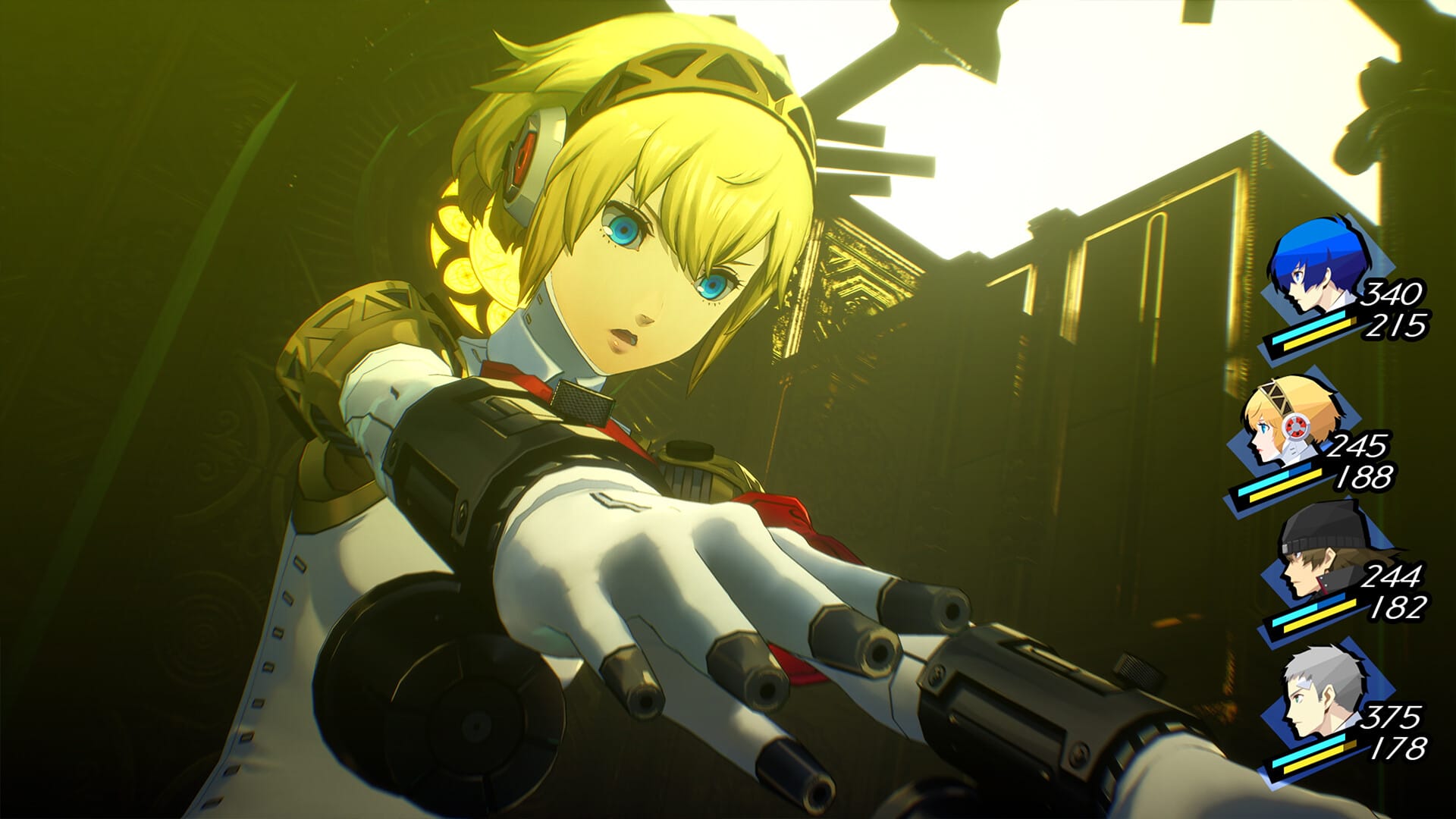
A couple years ago, the Persona 3 Reload soundtrack was uploaded to Spotify. The issue? Developer Atlus hadn't released the album digitally. That album, and Shin Megami Tensei: Strange Journey's soundtrack, were uploaded by a random guy and quickly removed—likely from a DMCA request—in 2024. Now, Sega is suing over it.
In a lawsuit filed Thursday in Florida, Sega said it discovered in March 2024 that a person with the username Ziodyne (a reference to a skill in Shin Megami Tensei) uploaded the two soundtracks to different music platforms, like Apple Music, Spotify, and Amazon. That person used a music distribution service called DistroKid to get the soundtracks on the platforms, offering them for sale and streaming. Sega says the person "received significant revenue and profits from the unauthorized sales," and that the person used the Persona 3 Reload logo to "deceive or mislead consumers concerning the source of the sound recordings."
DistroKid is a distribution service that advertises itself as an easy way to get music on all different platforms—Instagram, Spotify, Amazon, Tidal, and more. It charges a yearly fee, collects payments from streaming and sales, then pays out the artist. The company has been sued at least nine times for how it handles DMCA takedown requests, failing to pay out artists, and other reasons. Many of these cases are pendings, but a few have been dismissed.
Sega wasn't offering these soundtracks digitally yet, but people were looking for them. People immediately noticed them, according to several different Reddit posts, which showed the Persona 3 Reload soundtrack as having more than 26,000 monthly listens on Spotify. On Reddit, another screenshot of Ziodyne's page showed more than 134,000 monthly listens, including the popular Burning Men's Soul from the Persona Trinity Soul anime. Sega says in its lawsuit that it subpoenaed Apple, Spotify, and DistroKid to determine Ziodyne’s identity.
"Defendant has taken advantage of a set of circumstances, including the anonymity and mass reach afforded by the Internet and social media, coupled with the cover afforded by international borders, to violate Sega’s intellectual property rights with impunity," Sega's lawyers wrote in the complaint.
Sega is looking for "at least $60,000" in monetary damages, according to the complaint. The counts listed in the complaint include copyright infringement, trademark infringement, false designation of origin, and unfair competition.
Since the unauthorized version was removed, Sega and Atlus have uploaded their own digital version of the Persona 3 Reload soundtrack to music platforms. Strange Journey's soundtrack doesn't appear to be available digitally.
Aftermath has reached out to Sega of America and Ziodyne for comment.
Ubisoft announced Wednesday it will close its Ubisoft Halifax studio and lay off 71 people. Ubisoft's closure of the Assassin's Creed: Rebellion and Rainbow Six Mobile studio comes just weeks after a group of 60 employees voted to unionize with Communications Workers of America's Canadian affiliate, CWA Canada. Seventy-four percent of the staff voted yes to unionize and create a wall-to-wall union including producers, designers, artists, testers, and researchers.
CWA Canada Local 30111, the chapter the Ubisoft Halifax workers joined, also includes more than a hundred workers at Bethesda Game Studios.
"Over the past 24 months, Ubisoft has undertaken company-wide actions to streamline operations, improve efficiency, and reduce costs," a Ubisoft spokesperson said in a statement to Aftermath. "As part of this, Ubisoft has made the difficult decision to close its Halifax studio. 71 positions will be affected. We are committed to supporting all impacted team members during this transition with resources, including comprehensive severance packages and additional career assistance."
The Ubisoft spokesperson did not specifically address the closure's relation—or not—to the recent union vote.
CWA Canada president Carmel Smyth said in a statement to Aftermath the union will "pursue every legal recourse to ensure that the rights of these workers are respected and not infringed in any way." The union said in a news release that it's illegal in Canada for companies to close businesses because of unionization. That’s not necessarily what happened here, according to the news release, but the union is "demanding information from Ubisoft about the reason for the sudden decision to close."
"We will be looking for Ubisoft to show us that this had nothing to do with the employees joining a union," former Ubisoft Halifax programmer and bargaining committee member Jon Huffman said in a statement. "The workers, their families, the people of Nova Scotia, and all of us who love video games made in Canada, deserve nothing less."
Ubisoft has been cutting costs over the past several years: laying off staff, canceling games, and shutting down studios. In November, Ubisoft shared in its earnings report that it intends to continue to reduce its fixed costs—to reduce costs by an additional €100 million by the 2027 fiscal year—on top of the €200 million reduction it had already enacted. Part of that reduction was a decrease of roughly 1,500 employees in the 12 months prior to the November earnings report. Not all of those departures were layoffs, however.
Ubisoft required a $1.25 billion investment from Tencent last year, too, to spin off the company's most successful franchises: Rainbow Six Siege, Far Cry, and Assassin's Creed. That initiative is called Vantage Studios, led by Charlie Guillemot and Christophe Derennes. "Vantage Studios represents a first step in Ubisoft's ongoing transformation," Ubisoft said in a news release from October.
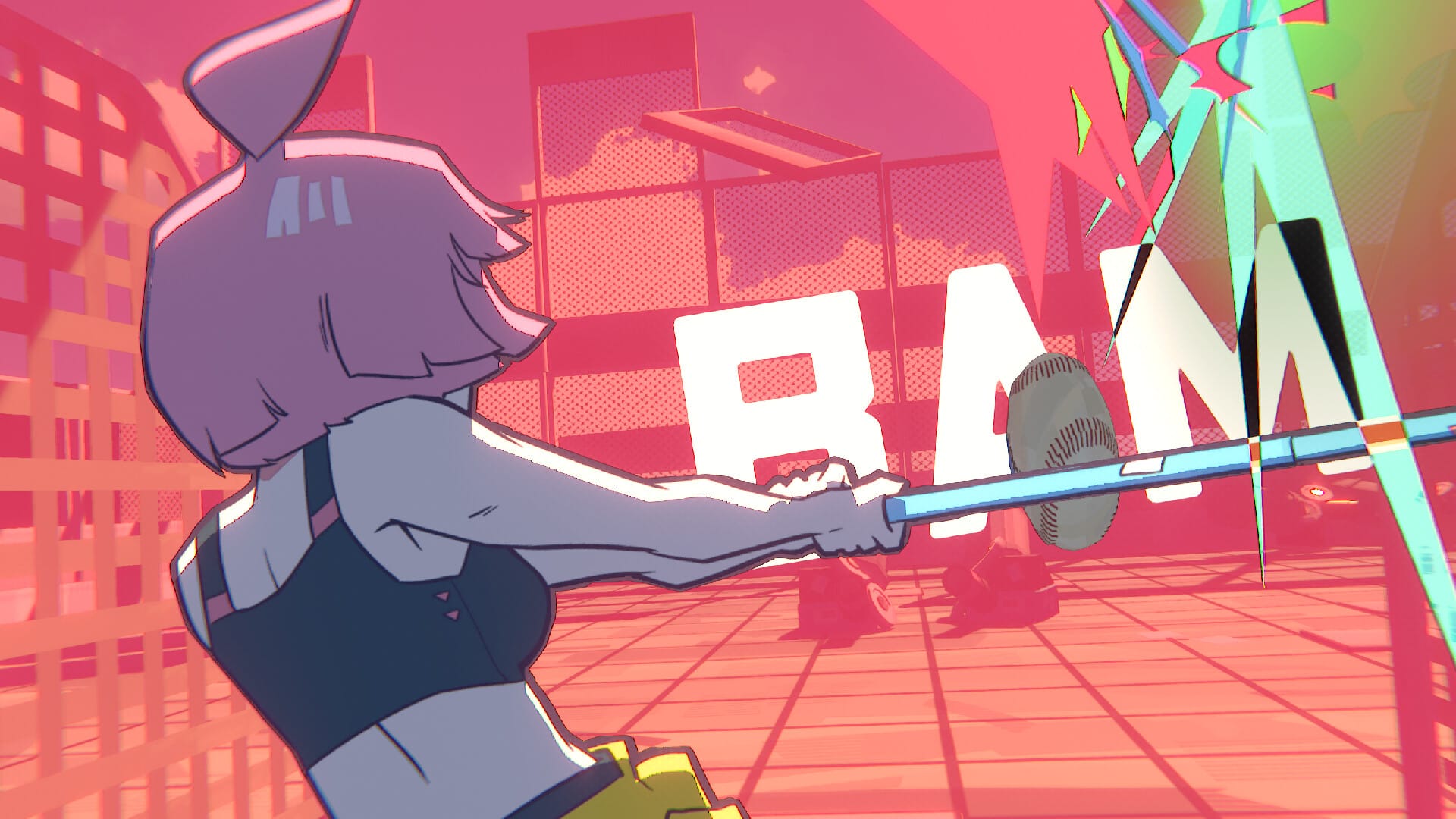
To steal a line from Unbeatable, I could feel the game's last chapter in the space between my eyes. It's the place where tension builds before you're about to cry—a unique feeling of feelings that manifests through pain. Played in episodes, the sixth of which is the culmination of it all, Unbeatable is set in a world where music is illegal. So illegal, in fact, that the world's become a fascist police state; musicians and music lovers still exist, but they’re pushed to the margins of society. Music is the key theme here both narratively and mechanically; the story is centered around it, tied to traditional rhythm-based gameplay where you push buttons to a beat.
Storywise, where Unbeatable lands is the idea that music and art are not only "amplifiers" of feelings, as Unbeatable's characters put it, but are feelings. The last chapter is where all of this becomes clear, and the game's rhythm gameplay, stylish animation, incredible music, and high-stakes story work together to reinforce that.
The problem is that it takes five episodes to get there. When Unbeatable is good, it's really good, but there's just too much time where it's not. Up until the last episode, I couldn't tell you why music is illegal, how the main character Beat was dropped into this world, or even who she really is. After the last episode, I still can't answer some of those questions, but it doesn't really matter. Unbeatable feels like the sort of game that's supposed to be a bit messy. This ending section of Unbeatable, though, is where the game gets to the heart of its characters, what drives it all—not the overly complicated story and slow pacing. For most of Unbeatable, the game gets in its own way.
Image: D-Cell Games/Playstack
Unbeatable is about music, but it's also about grief. It's about making mistakes, creating good and bad art, about feeling things. There's one scene, at the end, where the main character, Beat, is talking to her much younger companion, Quaver, about loss. The circumstances of their losses are different—from each others' and my own–but the feeling is universal. Just last night, I was talking about this: It's too painful to remember what I've lost. If I don't think about it, I don't feel it—that tension between my eyes. But in refusing to remember, I lose the overwhelming love that makes the loss much too painful. Beat and Quaver don't necessarily have the answers, and I don't either.
From this conversation, the screen cuts to white. Quaver starts to sing. The instruments come in, and I can start hitting stuff on beat—the perfect emotional release after the game's most poignant moment.
But the rest of the game, aside from several other moments here and there, move too slowly, with too many extraneous details, and way too much walking around. There's one section, early on, where the crew is trying to escape from prison. There's some rhythm elements, and it works as a sort of tutorial. There's a part where you get a prison job. A baseball minigame. A lot of walking around with bad camera work. It's so painfully slow, while also somehow moving way too fast—narratively, I have so many questions. Later, there's a random platforming part to restore power to an arcade that never comes back up in the story. The problem with these sections and several of the others is that the material within doesn't necessarily point towards the core of the story, what's at the center of the last chapter. Unbeatable is shrouded in a mystery that makes this feel intentional. I haven't mentioned this yet, but there's also a supernatural element: Cops are arrested musicians and music lovers, but there's also a big black hole that's threatening to engulf the whole world. You're kind of fighting both at the same time, but it's not until the last few chapters where Unbeatable reveals why. (I still don't entirely get it.)
There were a lot of times during Unbeatable when I wanted to quit the game's story mode. And right when I was thinking that, I hit one of the moments where the visuals, music, and writing really work. Those moments do a lot of work in forgiving the bad parts. It's easy to see the vision of developer D-Cell; the game drips both heart and an undeniable cool. But you can also see where the focus was—rightfully on these big, key moments—and where everything went off the rails.
Yet, by the end, I found myself shrugging off its failures. That's kind of the takeaway of Unbeatable, no? It's messy. Sometimes bad. And yet it still made me feel.
For months after Tiny Bookshop was released on Nintendo Switch in August, the indie game remained on the platform's bestseller list, hovering around the likes of Hades 2 and Hollow Knight: Silksong. But in late November, Tiny Bookshop dropped off the list—and off the Nintendo Switch eShop entirely—due to a discrepancy between its digital age and content rating and the rating tied to its upcoming physical version. Tiny Bookshop originally had an "E" rating—for everyone—but was upgraded to a "T for teens" rating.
The reason for the ratings upgrade? One word: "Arsehole," said Neoludic Games.
Tiny Bookshop remained off the Nintendo Switch store in all regions for nearly two weeks, cutting into sales on what Neoludic Games says is its most prolific platform. "The impact was immediate and severe," Neoludic co-CEO and creative director David Zapfe-Wildemann told Aftermath.
"We noticed [the game wasn’t on the store] when people started reaching out via DM asking what was going on," he said. "Because there is a small delay between the Switch backend and the public web version, we didn't understand what was happening at first."
Neoludic Games wasn't notified that Tiny Bookshop was removed from the eShop until after it was taken down. "The process was completely opaque," Skystone Games (which published Tiny Bookshop) publishing head Dmitry Muratov said.
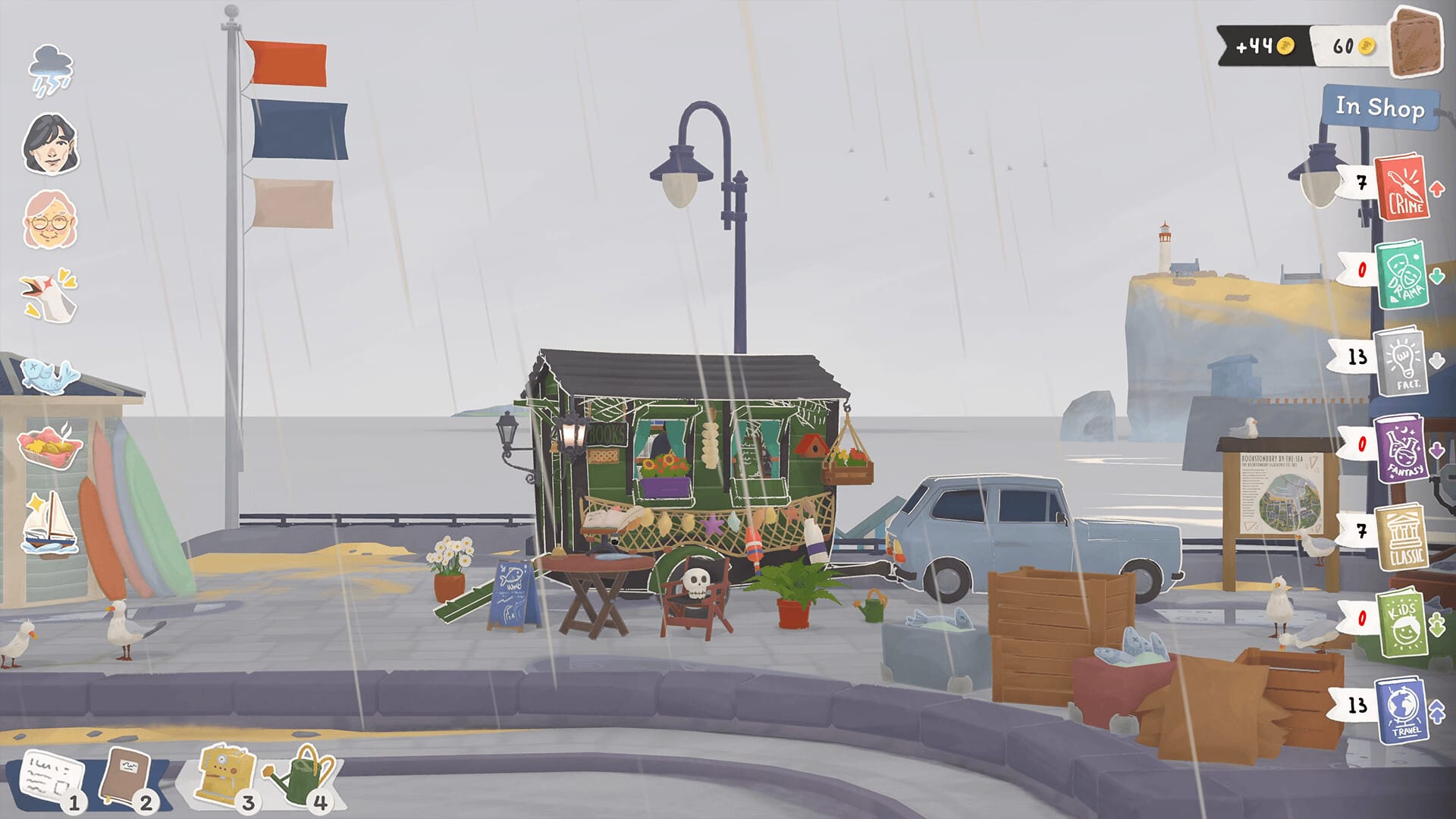
Tiny Bookshop is a management simulator set in a mobile bookshop by a beach. Acting as the bookseller, players design the little shop and then sell books to customers; the puzzles are in finding the right real-world and fictional books to recommend. Neoludic Games describes Tiny Bookshop as "cozy," and it certainly is. The quaint bookshop is the epitome of the word, and the low-stakes gameplay makes the game very chilled out.
Muratov called the ratings process that caused the eShop removal a "black box" that the studio and publisher got caught up in. Most games have a rating, but games that are sold physically have a more "official" rating than those that are only sold digitally. The digital ratings system is handled through an automated system with the International Age Rating Coalition (IARC), which works with the different ratings agencies, like the ESRB. Developers fill out a survey through the IARC system to self-evaluate their game, which spits out an automated rating based on the answers. Developers then provide a certification of that rating to storefronts to be able to sell digitally.
Image: Neoludic Games/Skystone Games
Zapfe-Wildemann said the digital certification through the IARC required very little detail and had "a lack of clear guidelines." Other developers who spoke to Aftermath about the IARC said the system can feel subjective—something that's especially relevant following the ratings debacle regarding Santa Ragione's Horses. Horses has been in the spotlight over the past several weeks after it was removed from the Epic Games Store for its rating; using the IARC process, Santa Ragione received a Mature rating. Epic Games filed its own IARC questionnaire and found the game to be ranked as Adults Only, therefore not publishable on its storefront. (Several developers and industry experts told Aftermath that they'd never heard of a platform filing for its own IARC rating.)
The IARC rating allows for games to display, for instance, an ESRB on a digital storefront. Crucially, it's a free-to-use tool that allows developers to get their games rated without much friction—and keeps rating bodies from being overwhelmed by having to have humans go through the hundreds of games released each month. IARC spits out a rating that's adaptable for the different regions a game is released in. One video game industry expert told Aftermath that rating bodies, like ESRB and PEGI, do run checks on IARC ratings to ensure accuracy, be it popular games or ones that get complaints.
Physical editions require a more detailed rating to be sold in stores, however, which made the ESRB and other countries' ratings processes necessary for Tiny Bookshop. That process is more robust and requires developers to submit footage, builds, and marketing materials, the expert said. The result is a formal rating from a thorough assessment of a game by a human.
"We started working together with a UK-based publisher for a physical release of Tiny Bookshop," Zapfe-Wildemann said. "That process mandated getting a detailed review by each target region's rating agency. In that re-review, the ESRB flagged the word 'Arsehole' in one of the 300+ book descriptions as severe enough to warrant a 'T' rating."
Neoludic Games only learned of the upgraded rating after Nintendo delisted the game and the process was completed. "It would have been five minutes of work to replace the word had we been informed, or had we had a way to track which swear word is considered severe in the IARC system," Zapfe-Wildemann said.
"A single word in more than 100,000 words of localization was caught and scrutinized without a chance for us to fix it pre-release," Muratov said. "It’s frustrating when you see massive AAA games with much more mature themes, while a cozy bookshop game gets pulled over a single instance of text."
The upgraded T rating triggered a "mandatory update to the digital store," Zapfe-Wildemann said, which resulted in the "immediate delisting" of Tiny Bookshop. On Oct. 17, which is the last date the best-sellers page was recorded by the Wayback Machine, Tiny Bookshop was in the ninth row of the U.S. bestsellers. (In September, it was listed 12th on the page, and in August, it was the second game. In the first month alone, Neoludic Games sold more than 300,000 copies of Tiny Bookshop. By December, that number surpassed 500,000.) Being removed from the Nintendo Switch eShop dropped Tiny Bookshop from the list, Neoludic Games said. Now, after being re-added in early December, it's much further down the page in the U.S. region. Neoludic Games estimated that it lost 10,000 sales due to the removal from the eShop and its subsequent absence from the bestsellers list.
"On Switch, the bestseller list is one of the most critical discoverability tools the platform has," Zapfe-Wildemann said. "Our release momentum was still carrying us in the charts of some regions when the incident happened. It is incredibly difficult to re-enter those charts once that momentum is broken."
Muratov said that getting back into the bestsellers list is "very hard or impossible," but that the studio managed to get back into the top 30 recently. "That couldn't have happened without an amazing worldwide community rallying behind us," he said.
Santa Ragione's Horses, the unsettling horror game in which horses are naked human slaves wearing horse masks, won't be released on the Epic Games Store after all. Horses was previously banned from release on Valve Software's Steam platform, too. Publisher Santa Ragione, which released survival horror game Saturnalia in 2022, announced on Monday that Epic Games alerted the company just 24 hours ahead of its release that the game wouldn't be published on Tuesday.
Epic Games told Santa Ragione that Horses violates its content guidelines—"specifically the ‘Inappropriate Content’ and ‘Hateful or Abusive Content’ policies," according to a reprint of the message published on the Horses website. Epic Games communications director Jake Jones confirmed that the platform "found violations of those guidelines during our extensive review," and pointed Aftermath towards the correspondence published on the Horses website. Santa Ragione "immediately" appealed the decision, it said, but that appeal was rejected.
Epic Games specifically said it prohibits content that “contains explicit or frequent depictions of sexual behavior or not appropriately labeled, rated, or age-gated" and "promotes abuse and animal abuse." Santa Ragione denies that Horses includes these things.
Horses is described on its GOG storefront as a "first-person game with live-action sequences." It takes place over the span of fourteen days in-game and will test a player's "obedience, complicity, and restraint" as they play as a college student working on a weird-as-fuck farm. Horses is currently listed on GOG's recent best-selling games page, after only S.T.A.L.K.E.R.: Call of Prypiat's enhanced edition.
Horses has a pretty lengthy content warning, which certainly provides a better understanding of the sort of imagery in the game:
"This game contains scenes of physical violence, psychological abuse, gory imagery (mutilation, blood), depictions of slavery, physical and psychological torture, domestic abuse, sexual assault, suicide, and misogyny. The inclusion of these elements is intended to depict and characterize a fictional world and its fictional inhabitants. The presence of these elements is not an endorsement of them, nor do they reflect the beliefs or values of the creators. Some scenes also feature unsettling sounds, such as chewing and swallowing, which may be disturbing for players with sound sensitivities or related phobias. Character dialogue also includes references to psychological trauma that may be upsetting, especially for those who may have had similar experiences in their pasts. Player discretion is advised. If you feel uncomfortable or upset while playing, please consider stepping away and reaching out to someone you trust."
Epic Games claimed in its email to Santa Ragione that the game received an Adult's Only (AO) rating from the International Age Rating Coalition. Santa Ragione said that when it filled out the IARC questionnaire, it received a PEGI 18 or ESRB M rating. AO rated games aren't allowed on the Epic Games Store—except games that received that rating for the inclusion of NFTs or blockchain—but mature or 18+ games are. Aftermath has reached out to IARC for clarification on Horses' rating. Santa Ragione said it submitted its certification of its rating to the Epic Games Store ahead of its release.
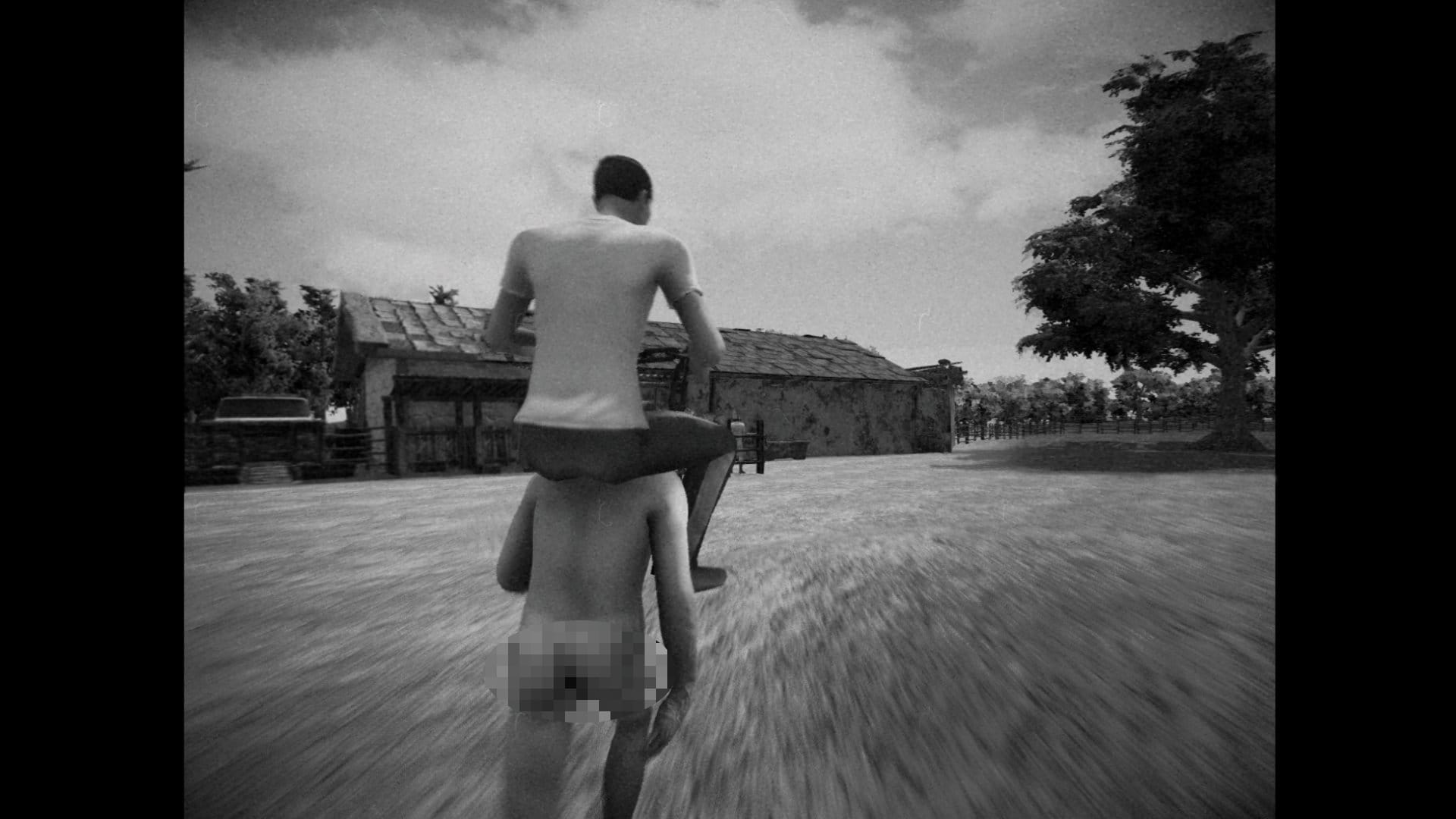
Epic Games wasn't specific about what caused the ban, and neither was Valve when it originally rejected the game from being published on its platform in 2023. Santa Ragione said in late November that the game was banned in 2023 after the company had to upload an early build of the game—a requirement to getting a Steam storefront page up and running. Valve rejected the build without comment, and Santa Ragione said on its website it was likely due to a scene in which a "young girl" rides on the shoulders of a naked adult woman with a horse head. Santa Ragione said it has since changed all characters in the game to be in their 20s or older.
"Regardless of a developer’s intentions with their product, we will not distribute content that appears, in our judgment, to depict sexual conduct involving a minor," Valve wrote in an automated review sent to the studio, according to the FAQ on the Horses website.
Santa Ragione said in its FAQ that the Steam ban isn't related to the recent restrictions on adult content that caused a major "deindexing" of NSFW games on Itch.io and the outright removal of others there and on Steam. That's because Valve's rejection of the game happened in 2023, before conservative activist group Collective Shout's campaign to harass game platforms into removing anything it deemed objectionable. The group went after game platforms by harnessing the power of payment processors—with payment processors determining what's acceptable sexual content and what's not, platforms like itch.io and Steam complied or risked having access to the processors removed.
This sort of censorship-by-payment-processor can have a chilling impact on the industry; in an effort to protect children, these restrictions can end up restricting free expression of even mildly-uncomfortable ideas. Horses certainly seems to push up against these restrictions, but its developers said it doesn't cross them: the game is supposed to be "challenging, adult storytelling," the publisher said on its website.
Guidelines for platforms like Steam and the Epic Games Store are often written in such a way that leaves some grey area for certain content—platforms then can apply these restrictions however they'd like, and in ways that often feel confusing to players. Both Epic Games Store and Steam sell sex games and games with graphic violence. For instance, there are a lot of "anime boob games," as Nathan put it in 2016, but not many gay sex games. He spoke to game developer Robert Yang about getting his games on the platform: Dicks can be used for "exploitation or titillation," but not in the context of sex.
"We respect players enough to present the game as intended and to let adults choose what to play; lawful works should not be made unreachable by a monopolistic storefront’s opaque decisions," Santa Ragione said. "Steam publicly downplays human curation in favor of algorithmic sales optimization, yet intervenes with censorship when a game’s artistic vision does not align with what the platform owners considers acceptable art. Steam’s behavior passively shapes which titles developers feel safe creating, pushing preemptive censorship."
Update, Dec. 3 at 11:44 a.m.: Humble Bundle has delisted Horses, too, according to IGN. Codes for Horses, distributed through Humble Bundle, originally required players to have an Epic Games Store account. Aftermath has reached out to Humble Bundle for comment.
You don't see a lot of coin pusher arcade machines anymore. Raccoin: Coin Pusher Roguelike, from developer Doracoon and Balatro publisher Playstack, is played within one.
The decline of coin pusher arcade machines came with increased restrictions on real-money prizes for largely luck-based games—i.e., gambling—and the closure of arcades themselves. A child of the '90s, I spent a lot of time in arcades putting tokens into coin pushers. The one at my local arcade was brightly lit with lots of vibrant colors, set up with six different stations so multiple people could play at once. No strategy in mind, I'd bounce between setups tossing coins into the machine at entirely random intervals, hoping one would eventually pay off.
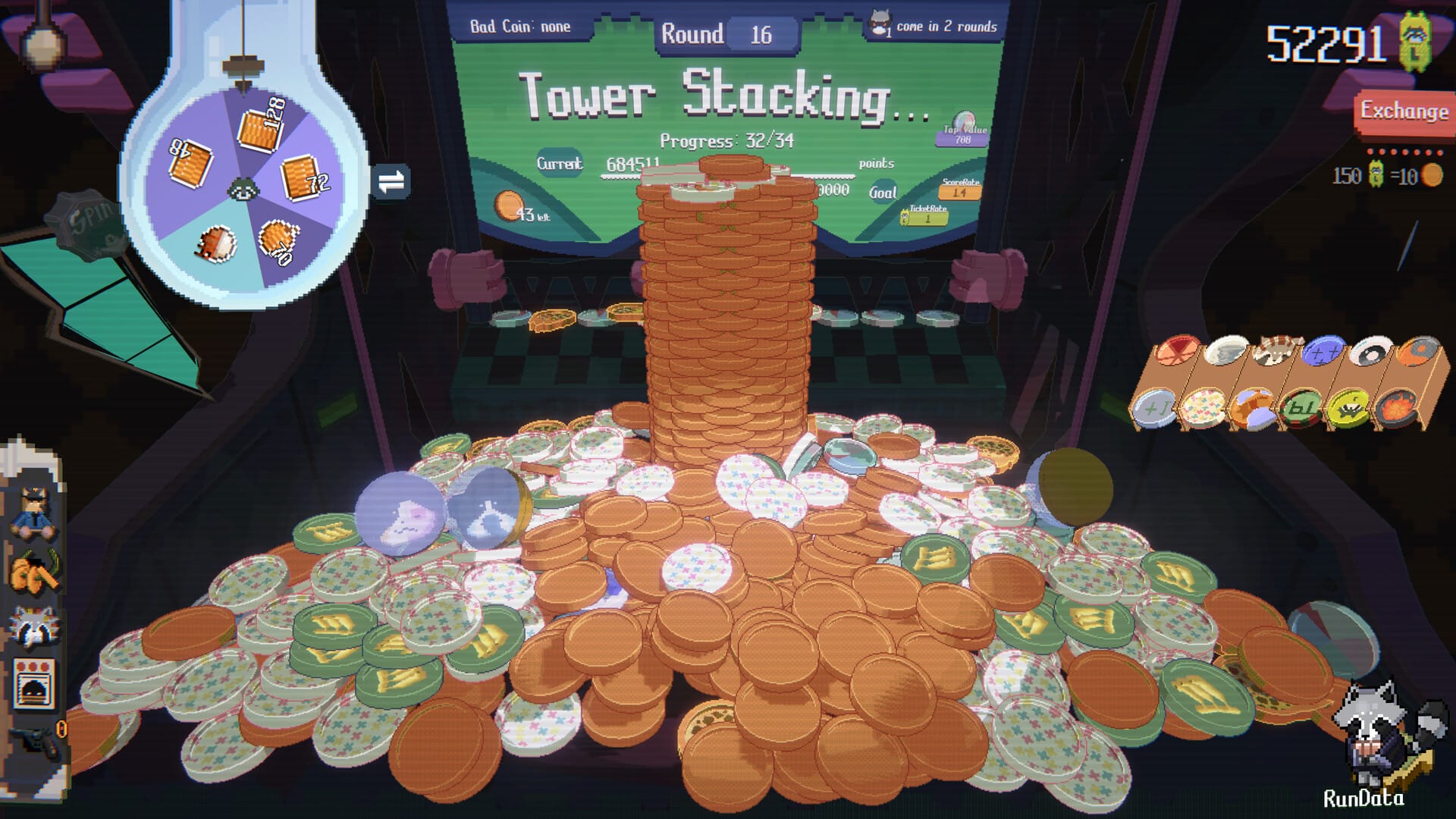
The thing about the coin pusher is that its prizes—largely more coins, which equal tickets—always look tantalizingly close to the edge. Just one more coin! Coins or tokens are inserted into the machine and slide onto a moving shelf. The idea is that the new coins, laid flat behind the mess of coins in front, cause a chain reaction when the shelf moves. The coins closest to the edge fall off the shelf, onto another playing field with more coins. And then newly fallen coins then continue the cycle: When the shelf moves, coins at the edge of the machine fall into the prize slot. If you do it right, perhaps, you'll win a ton of coins—an avalanche of coins.
Credit: Doraccoon/Playstack
A demo version of the game is playable now on Steam, and it's exactly the experience I'd always hoped a coin pusher would be. There are lots of coins—so, so many—and with a little strategy, you'll be raining coins into the prize slot repeatedly. Doraccoon lays it out quite plainly in its Steam description: "It's a nonstop dopamine rush packed into one unpredictable, coin dropping ride."
From a moving chute, you'll drop coins into the game quickly and generously. Where Raccoin strays away from the traditional coin pusher is that it's also a roguelike with lots of different modifiers designed to create huge payouts. The different items, abilities, and coins combine to shift the playing field and enhance effects. These are unlocked gradually, as the goals of your runs get higher. You're able to get through the first levels of the demo without much strategy, but you'll need one in the later levels. Some coins do things like create an explosion. One item creates a black hole that sucks coins in.
But Raccoin's strategy can get pretty complicated when you start thinking about the ways coins can interact with each other, much like a Balatro run with its different joker cards. So, for instance, you can combine coins that represent seeds with water coins or with a fertilizer item to create coin trees. Spam that even more by using a special prize that rains down your most purchased coin—if you've done things right, that should be the seed coin—to take it even further.
Credit: Doraccoon/Playstack
What you end up with is an absolutely constant cascade of coins overflowing into the prize slot, lighting up the machine with the satisfying sound of coins clinking around. Shaking the arcade machine won't get you kicked out of the arcade, either: It's just another way to hear that gratifying sound.
Raccoin's demo is available now on Steam, but there's no release date announced just yet. The demo is just a fraction of what will be available in the full game, allowing you to unlock two separate characters, 50 different coins, and 60 ability items. It's more than enough to keep me busy until the game's out; it's got the same sort of feel as Balatro in that it's hard to step away. Just like the coin pushers of my youth, I find myself saying: just one more coin.