Normální zobrazení

Received before yesterday

Cthulhu: The Cosmic Abyss brings investigation to the fore in a way that you’ll love(craft) to see

23. Únor 2026 v 10:00

His many personal faults notwithstanding, H.P. Lovecraft’s writings continue to cast a profound shadow over the horror genre. While his own views were reprehensible (even by the standard of his time) the continuing fascination with cosmic horror can be seen across many media. Big Bad Wolf are the latest developers to take influence from this mythos in their upcoming horror adventure game Cthulhu: The Cosmic Abyss, but have moved away from the beaches of Innsmouth and out to sea to take advantage of the thalassophobia (fear of deep water) that underlines much of Lovecraft’s work.

Cthulhu: The Cosmic Abyss begins in 2053 with you playing as Noah, an investigator charged with following the trail of a missing colleague who finds that an occult cosmic threat is spreading across the world. His investigations lead him to a mining facility located deep within the Pacific Ocean wherein he discovers that the missing miners have stumbled upon a passage to R’lyeh. So far, so Lovecraftian, and I was impressed by how well the content I played in the preview build slotted into the wider Mythos whilst also maintaining an identity of its own.

The Cosmic Abyss is played out through a first-person perspective, but this is no action shooter and combat plays no real role in this game. There were no direct engagements with enemies during the section I got to play, though there was still plenty of threat and dread. The full version promises some confrontations with unknown horrors that will require quickness of thought rather than trigger finger to survive. This fits perfectly with cosmic horror as no small part of the terror comes from your insignificance in the face of the unknowable.

Cthulhu: The Cosmic Abyss – station investigation

With no combat to speak of, the gameplay mechanics instead revolve around investigation and puzzle solving, with a focus on a mind palace method of connecting clues that is reminiscent of Frogwares’ Sherlock Holmes games. In order to interact with the environment you can call on your AI companion, Key, who can scan, assess, and record the information that you acquire. This digital compendium can be called up in order to make connections between clues and objects that you scan, reveal deeper insights and even give you the direct solution to riddles.

The Unreal Engine 5 powered graphics are breathtaking at times, with the scale of the underwater environment being overwhelming. Relatively early on you have to venture outside of the submersed facility to explore a mysterious labyrinth and even though there was no pressure of oxygen limits in place I found the whole section almost unbearably tense. This wasn’t helped by my stubbornness in trying to brute force my way through when a more direct route via further investigations was the more efficient solution.

Cthulhu: The Cosmic Abyss – object observation with Key

Major puzzles and obstacles in the world of The Cosmic Abyss will often have more than one solution with the main division between each being the effect they have on your sanity. Leaning into the world of R’lyeh for answers will drive you further into madness whereas presumably more rational and scientific solutions will help keep you sane. This mechanic was hinted at in the preview but I look forward to seeing its full effects in the full game.

As is often the case with early preview builds, there were a few small bugs and glitches, but these were refreshingly infrequent with the game just a couple months from release in April. One that took me a while to work out was that the controls would occasionally revert to AZERTY (to match the Big Bad Wolf’s keyboards as a French studio) so I couldn’t move forward. For a while I thought this was a deliberate effect in keeping with the classic Eternal Darkness’ manipulation of your controls, but checking with the team, it became clear that this was just a bug. Rebranding it as a feature wouldn’t be the worst idea, though!

Cthulhu: The Cosmic Abyss – strange growth

The world of Cthulhu: The Cosmic Abyss has certainly got its claws into me and I’m eagerly awaiting getting stuck into the full version when it launches in April. What I’ve seen so far promises a twisting and tense narrative that will challenge the grey cells rather than the trigger fingers and, as such, should be a truly cosmic horror experience.

Something for the Weekend – 21/02/26

21. Únor 2026 v 13:03

After a few weeks of major showcases, this week brought with it some big industry changes. What will the future hold for Xbox with Phil Spencer departing and a new CEO coming in who has little to no experience of the gaming market? It’s been a downward trend for Xbox through this generation as a platform, and we’ll have to see if Microsoft is intent to accelerate this for their broader gaming approach, or if they’ll turn things around.

In the News This Week

Support TheSixthAxis with Ko-fi

With the current landscape of the games media, we’re exploring more direct reader-funding so we can continue to invest in the site, and support our writers, allowing them to continue to pen the news, features, and reviews that you visit us for. To that end, we have launched a Ko-fi page earlier this month.

Support TheSixthAxis on Ko-fi

Games in Review & Featured Articles

Another pretty heavy reviews week is behind us, but there was little that managed to stand out, unfortunately.

We also had some scored hardware reviews for the Corsair Vanguard Pro 96 keyboard and the enhanced Gamesir G7 Pro Wuchang Edition gamepad, before I delved back into the highs, lows and weirdness of 90s VR with the Virtual Boy for Nintendo Switch.

For upcoming games, I had the chance to checkout Milestone’s anime racer revival, Screamer, as well as the latest tycoon sim, Transport Fever 3, and Dom opined that Battle Vision Network will be the culmination of Capybara’s puzzle game craft, and called Arkheron the battle royale lovechild of Diablo and Hades. Intriguing!

We also had an interview with the developers of Abide, to talk about its new style of horror experience

Rounding out the week, What We Played featured Sons of Sparta, Planet of Lana 2 & Overwatch.

Trailer Park

Slay the Spire 2 is dropping into Early Access in March

Battle Robo-Betty in the latest Mouse PI for Hire trailer

Surprise! Xenoblade Chronicles X just got a Switch 2 upgrade with up to 4K 60fps performance

Your Achievements

Checking in with your gaming, Andrewww has got a few more runs into Blue Prince, but is yet to have it really “click”.


That’s all for the round up this week. Enjoy the weekend and we’ll carry on carrying on on Monday.

Arkheron Preview – The glorious battle royale lovechild of Diablo and Hades

20. Únor 2026 v 16:05

Arkheron is doing something we all love in gaming, putting a fresh twist on something familiar. Coming from Bonfire Studios, a team founded by ex-Blizzard Creative Officer Rob Pardo, and whose influence runs through World of Warcraft, Diablo III and Overwatch, Arkheron is a PvP multiplayer dungeon crawler, with teams of three attempting to make it to the top of the tower, slicing their way through enemies and opposing teams, as the playable space shrinks. A team-based, dungeon-crawling battle royale? It’s a brilliant mix.

Arkheron centres around the relics. Each player has four empty slots: two weapons, a Crown and an Amulet, and you fill these by looting treasure chests as you climb the tower. Each relic has its own unique powers, or individual weapon types, and while there are common-level versions, what you’re really looking for are Relics that belong to an Eternal.

There are eight Eternals in the game right now, each with four unique Relics and corresponding abilities. If you collect all four from the same Eternal, you can transform into them, gaining a fifth, ultra-powerful special move as well, giving you a distinct advantage, and, as an added bonus, making you look incredibly cool too.

What it does mean, however, is that you’re stuck as that Eternal for the rest of the match, and that might not be the best choice. There are literally thousands of possible combinations for the gear here, and that includes further bonuses for carrying a split pair of same-type equipment. It’s a dizzying level of customisation, and I can see players really digging into the swirling range of possibilities when Arkheron launches.

You have to get to the top of the Tower first. Every team is dropped into the bottom floor with an expanding field of view letting you see other team drops and enemies, giving you a decent picture of where you want to join the battle. Our team – led by the exceptionally cool Bonfire Studios team member, Raph, – was consistently patient, waiting to see how the map was panning out before making the leap, and that seemed to work well in terms of giving us time to start building up an armoury.

Each floor of the tower is filled with CPU-controlled enemies for you to work your way through, clearing areas so that you’re free to ransack the heady assortment of treasure chests. There’s different levels of chest, so you’ll find plenty of mundane, run-of-the-mill weapons, amulets and crowns, in the lowest level, while the Eternal gear tends to be tucked away in the rare ones that you’ve really had to work for.

As you’re decimating the various enemies on each floor, you’re earning currency to use in the shop. These contain consumables and a selection of gear, too, but they’re also focal points for all of the other teams, and you can suddenly find yourself embroiled in a melee, just because you wanted to pick up some health. We found that a hasty retreat wasn’t so much cowardly as efficient, and we repeatedly lived to fight through another few floors after spying an enemy team and legging it in the other direction.

You can hear enemy footsteps ringing out through the gothic halls, so there’s a nice and clear audible indicator of which way you want to go, much like in other Battle Royales. Running and hiding remains my favourite tactic in PUBG, and I can do that here too, so I was well at home.

I loved the hack-and-slash combat here, though. A mix of Diablo and Hades-esque weaponry and movesets, makes this feel like a multiplayer version of those incredible games, and that is as enjoyable as it sounds. The weight and variety of different weapons and abilities has been tuned really well, and while things definitely become chaotic when you’re facing off against an enemy team, it never felt unwieldy. There’s a few quirks to playing with a controller – there’s not quite the expected level of control, with the controller replicating the way you move with a mouse and keyboard – but I still found myself having a whale of a time.

The battle royale element really comes into play when it starts funnelling the fifteen teams together. At points you have to retreat to the safety of a nearby Beacon, the only thing that will protect you from the Abyssal Storm. Lower floors have plenty of Beacons, but as you climb higher, there are fewer and fewer, leading to an inevitable brawl at the top with a final remaining team.

There’s plenty of customisation too, though thanks to the isometric view during each round, the best view you’ll have of your character, and your teammates, is on the prep screen before you head to the tower. Still, the art direction is really strong throughout, and the Eternals in particular are particularly characterful.

Our hands-on time gave a tantalising glimpse of Arkheron’s possibilities. If you’ve got a steady team of friends to party up with, enjoy the action of games like Hades and Diablo, and love the competition and gameplay loop of a battle royale, you should definitely keep an eye on Bonfire Studios’ first game.

What We Played – Overwatch, Sons of Sparta & Planet of Lana 2

20. Únor 2026 v 12:30

I’ve had a great week of gaming this week. I’ve just really enjoyed myself, and a lot of that seems to come down to my returning addiction to Overwatch. The community has blossomed with the introduction of the five new characters, and everything feels somehow fresh and new, while also being reassuringly locked down. I know I enjoyed my time with Highguard, but, with limited competitive gaming time, it’s got to be Overwatch for me. I, perhaps, shouldn’t still be playing it at 1AM, but, what are you going to do? Sleep?

Jason has been playing Skyrim, which he’s playing with mods for the first time. He says, “I’m enjoying the mix of nostalgia and cool new spells a lot. I’ve also been playing more Lort, which is an excellent roguelike which might have broken the balance with the latest character, but I’m not complaining.”

Aran finished The Man Who Erased His Name, which he says, “Was a great Yakuza spin-off. I enjoyed playing as Kiryu and wandering around Osaka playing through a standard over the top Yakuza storyline. The ending was great and very emotional.

Gamoc has been played Styx for review. He also started NG+ in Spidey 2 since it’s on PS+, while also starting Phantom Doctrine, “Because it was £1-odd on Switch.”

Jim has been glued to Red Dead Redemption all week, again. He said, “For the past several hours, I’ve been roaming Mexico, crossing off side quests and challenges before heading back up north. I remember finding this middle act fairly boring during my initial playthrough many years ago though now I have a much greater appreciation for it and clever shift in tone/setting. I’m unsure whether I’ll go for the platinum trophy though I intend to at least finish the main story and Undead Nightmares.”

Laura has been trying out Planet of Lana 2 for review this week – she says, “So far I’ve “squee-ed” (I’m pretty sure that’s a word) at least nine times at how adorable Mui is and “flargh-ed” (yep, that’s a word too) several times at how perfectly tricky the puzzles are! I’ve also been enjoying all the new updated content and improvements to Absolum with Ade – it’s now even better than before!”

Ade confirmed, “Oh yes! Let me tell you, the Absolum devs have clearly been working hard post-launch and have now fixed all of the roguelike related issues I brought up in my review. As a result, Absolum is now more than likely the best side-scrolling beat ’em up I’ve ever played!”

Steve has been writing a heck of a lot this week, while also fitting in some of his own gaming too. He said, ” I managed to spend some quality time playing through Lost Records: Bloom and Rage in an effort to clear some space on my PS5 for a big download which I ended up installing on PC instead. That big download is my current play but I am not allowed to speak of it. I also made a start on Son of Sparta, which is  a perfectly solid search adventure game but hasn’t really got going yet. Aesthetically, it reminds me of a dialled-down Prince of Persia but doesn’t have the fluidity or innovation (especially the map screenshot feature) of Ubi’s most recent iteration. Whilst commuting, I enjoyed finishing Gumball in Trick or Treat Land, a modern GBC JRPG that I’ll have the review up for soon.”

Tef has swanned off to Munich to check out the latest updates to Rennsport, though he’s also spent a lot of this week squinting into the Nintendo Virtual Boy. Fancy!

What about you? What have you played?

The Prisoning: Fletcher’s Quest Review

20. Únor 2026 v 10:00

You can tell that a medium has reached some form of maturity once things start getting meta and titles appear that draw attention to the process of being constructed and the dilemmas that are faced by their creators. Countless great modern novels and films that are as lauded as Citizen Kane are clear examples of this and, whilst not in the same league as these, The Prisoning: Fletcher’s Quest is of a similar vein. You play as a burned out developer who undergoes hypnotism in a therapy session only to find himself trapped inside his own creation, a search adventure game with procedurally generated layouts.

The pixel-art aesthetic in Fletcher’s Quest is really nicely done and the various areas of the game look distinct whilst enemies and characters are well designed. Bosses are particularly memorable and everything benefits from a bright and colourful approach. Music is solid enough with a few standout tracks, again often in boss fights.

The game’s narrative is clearly nonsense and is all presented in a suitably tongue-in-cheek fashion. This is perhaps most obviously seen by the fact that the early rooms of the game have to be traversed not just devoid of weapons or skills but also of clothing. The pixel graphics mean that you are saved the detail of such nudity, whether you’d like it or not, but characters do comment on it. Your first mission, therefore, is to find clothes and a means of defending yourself.

The Prisoning exploration

While billed as a Metroidvania (I prefer ‘search adventure’ myself) the game actually reminded me more of classic home computer titles such as Jet Set Willy and Manic Miner. The flip-screen traversal and assortment of ludicrous enemy types brought me right back to my earliest days of gaming in the mid to late-1980s, but without the extreme frustration that accompanied those often nigh-on-impossible games. The main difference, however, is actually an unintended consequence of the choice to use procedural generation – rooms and areas are relatively forgettable, lacking the intricate design that the genre really requires to succeed.

The generated layout is completely functional with areas blocked until you beat bosses and unlock new skills, but many rooms feel interchangeable and the extreme frequency of save and travel points mean that backtracking is rarely required. Indeed, on the default difficulty it was generally quicker to collect items and then die to return to the last save point. As collection progress is maintained, the game seems to actively encourage you to avoid playing it. If I’m being generous this might be a deliberate move in keeping with the meta view of the genre, but I think it’s just another result of the use of procedural generation.

In terms of skills, you play through the whole game with just a pistol, and one that initially is a real pea-shooter. You can fire one bullet at a time and if you miss then you have to wait until the bullet disappears from view before you can fire another. This adds a level of strategy and reward for accuracy that does help to keep things interesting. As you defeat each boss you’ll be granted an additional bullet (a fact that I forgot, which made the second main boss unnecessarily difficult) as well as a traversal skill like double-jump and butt bounce.

The Prisoning side-scrolling shoot 'em up section

As well as standard single screen platforming challenges, The Prisoning occasionally breaks things up with horizontal shooter sections and the final boss is an auto-runner minigame that treads a fine line between challenging and downright annoying. That said, given my first playthrough was under three hours, the variety is restricted by the short length of the game. This, again, helps to make the game feel like a lost retro title.

The four boss fights are the most memorable part of the game, not coincidentally because they are clearly the most hand-crafted moments. You’ll find yourself up against a giant robot, a skateboarding shark and more, with all offering distinct challenges and necessitating different approaches. The one that stood out for me was the shark, both because of the uniqueness of the antagonist, but also the slippery slope of forced humour it introduced.

The Prisoning shark boss battle

The whole game has a lot of lol random’ humour that is very hit or miss. The nudity is the most obvious example but the shark boss features a lot of dialogue about how badly it is designed and frustratingly difficult it is. This kind of meta-joke is so often undermined by the content being as annoying as the joke pokes fun at. Admittedly this boss was rendered more challenging by my forgetfulness, but the battle goes on for a long time with you only having two hits before death.

Battle Vision Network Preview – The culmination of Capybara’s puzzling craft

19. Únor 2026 v 17:00

Any conversation about the best indie developers must include Capybara Games. With a catalogue that stems from Might & Magic: Clash of Heroes, through Superbrothers: Sword & Sworcery EP, to Don’t Starve: Shipwrecked, they consistently turn out the kind of games that stay with you long after you’ve finished playing. Battle Vision Network is set to be their latest, continuing in the vein of previous puzzle-infused games like Clash of Heroes, Critter Crunch, and Grindstone, and just like everything that’s gone before, it looks like it’s going to sink its way into your synapses and have you playing out moves while you’re trying to drift off to sleep.

Battle Vision Network is a tactical puzzle Roguelike battler, with teams competing in an intergalactic contest for glory. Dan Vader, Capy’s Creative Director tells us, “A Roguelike run of the game is framed as a season of this sport, and of this spectacle that is the BVN show.” He continues, “At the start of the game there’s only one team available, but as you progress you unlock more teams and more captains, each with their own playstyle and abilities.”

You can see that play out in the gameplay trailer, where a piece of toast shaped like a cowboy faces off against a skeleton in a rainbow cape – that’s Texas Toast vs. Rainbow Sparkle, obviously. It’s not just extremely bright and vibrant, but there’s the same sense of humour and quirky art direction that made Grindstone so memorable.

Dan tells us that Battle Vision Network is a spiritual successor to Might & Magic: Clash of Heroes, and anyone who’s played that classic title will be able to see the same gameplay threads running through BVN, with two teams made up of different units facing off in turn-based combat.

Different units have unique abilities and uses, such as Todd Thumb. This little finger fella can be stacked into a row of three, which sends a large thumb-based attack straight at the opposition. As you progress through a run, you draft more and more units into your team, until you’ve got a full roster, with a host of different abilities that will give you a variety of tactical options to choose from.

As you complete rounds, you’ll earn Bucks, which you can spend on upgrades for your team, or to upgrade specific units. You’ll also gain a Penant Flag through each round, choosing between three enhancements for your team, and leaning into that Roguelike structure and the random factor that can turn a mediocre run into a mammoth success.

Battle Vision Network began life as a mobile-first, PvP, season-based concept, and Capybara were originally working with Netflix to bring it to their mobile game library. However, in 2024, it became clear that Battle Vision Network wasn’t fitting into Netflix’s overarching plan, and Capy were thankfully able to reassess and rework the game, altering how players progress, shifting the focus to a single-player campaign, more like Grindstone and Might & Magic: Clash of Heroes.

Dan honed in on some of the key changes when coming from a mobile title, saying, “OK, we’re going to make a PC widescreen game, and we know that kind of audience soaks up complexity and depth, and experimentation and optimisation, and we can lean into that. And for us, we’re getting older, I have a family, I have a very demanding job, I don’t get to play as many 100-hour RPGs as I used to, so it’s emerged over the years that I really love run-based games, because they’re bite-sized. I can pick them up, I can play a little bit, have a little run, or pause a run, and I don’t feel that I haven’t made a dent in the game. So, we were really enthusiastic to explore our mechanics in that format that we were loving, anyway.”

One of the main differences over Clash of Heroes is that your Captain isn’t just an icon in the corner of the screen, they’re a physical unit with their own abilities, effects and place on the board. They can make the difference between failure and success, but you’ll need to know when and how to utilise them to maximise their impact.

Beyond the gameplay, fans of previous Capybara Games will be delighted to learn that the soundtrack is a collaboration between two of their previous composers: Jim Guthrie, who penned the soundtrack for Superbrothers: Sword & Sworcery EP and Below, and Sam Webster, who wrote the soundtrack for Grindstone. BVN could well be amongst the best-sounding games of 2026, just on that legacy alone.

Battle Vision Network is set to launch initially on PC and the team are targeting being Steam Deck Verified, which seems like the perfect way to experience the puzzling action. As a huge fan of their previous games, BVN has dropped its way straight into my most-wanted list.

Heretical Early Access Review – The best Roguelike take on a Soulslike

19. Únor 2026 v 14:30

Heretical is a game that wasn’t on my radar at all until TSA’s Reviews Editor, Dom, put me onto it, and I thought, “Oh yeah, that looks cool!” It’s one that I hadn’t noticed, despite the fact that it’s so specifically built for me that Steam not recommending it to me is a total failing of the system designed to promote games to me. Seriously people, what are we doing if this doesn’t end up on my recommended games list?

My Steam-related woes aside, Heretical is an action roguelike with some seriously Soulsy vibes in both setting and the feel of combat. Death is everywhere, one of the NPCs is a skeleton with an eldritch horror for legs that’s praying a lot, and everyone is sad. This game is incredibly hard, and while progression is constant, it’s not immediately obvious. Each character you can play as has their own stats and a special skill, along with equipment preferences.

Combat is generally just you attacking, using an alternate weapon, or dodging, and all of your skills will be going off as you go. Some of those will be on a timer, some will be a set number of attacks, and some might be passive buffs. You can upgrade those as you level up, and along with that, new equipment drops constantly, so you get to pick between what you have and what you’ve picked up, with the loser of that competition immediately turning into gold.

It’s all very simple theoretically, but the reality is that you’re making builds that need to work together with each skill coming together as one, and ideally matching your character as well. You also get stat points to spend which you permanently unlock, and can apply at the beginning of each run to each character. That’s a lot of fun, because you can try out different builds pretty comfortably.

Combat isn’t complex, but it is a lot of fun, with most enemies being more than capable of ruining a run in an instant, especially as things get harder the longer a run goes on. For every 50 kills you manage, the difficulty goes up, and you get some special currencies to spend on shrines that will give you buffs and debuffs, but you can usually work off the debuffs. It makes for a constant stream of risk and reward, and while getting stronger is nearly always a good thing, it sure can come back to bite you in the butt if your build can’t keep up.

On top of all of that though, you get prophecies to complete. Each of these is a mission of sorts which will unlock something. Some of those are new skill slots, new skills, new characters, new items, and just about anything else. It means that every run, even the failed ones, often end up leading you towards something a little bit cooler. Not only that, but while it is a roguelike, the world itself is pretty set in stone. Bosses are always in the same place, and your progression speeds up as you learn the layout, but also as you unlock new shortcuts by kicking down ladders, or killing a boss enough times to permanently unlock a magical gate or something.

It just feels fantastic, and while it’s undoubtedly very punishing, every little unlock is a joy to achieve, and the enemies are wonderfully varied, and the starting characters feel meaningfully different. It also looks amazing, I really like the music, and I just think that if any of this sounds appealing to you, you should probably play it, because it’s a damn good game.

The 9th Charnel Review – A Less than Divine Comedy

19. Únor 2026 v 12:00

Another week, another indie horror game and once again, it’s from a solo developer. Fortunately, this one feels less derivative and phoned in than Ebola Village, but it still suffers from optimisation issues and a story that takes a turn into the weird, albeit not in a good way. As a first game from a solo developer, there is promise, however, so hopefully the criticism here can be taken as constructive.

The 9th Charnel takes its name from a mysterious cult that is trying to connect with their idea of God in order to find out the hidden truths of the universe. This is slowly revealed to the player through multiple protagonists in an interesting design choice that doesn’t quite work out. The main player character, Michael, has sections that involve puzzle-solving and exploration (and eventually combat), but Jacques is stuck wandering around a familiar-looking Unreal 5 house, waiting for doors to open on cutscene triggers. I think the game would have been better if the Jaques parts were removed completely, although it’s clear that the developer, Saikat Deb, has ambitions to be a film director in the lengthy and unskippable cutscenes.

Graphically, the 9th Charnel is inconsistent. Player models have that uncanny Unreal sheen, and there is little to no attempt to make lip sync match the dialogue. The close-up focus on character faces only serves to exacerbate this, and it is often difficult to take the story seriously due to the visual style. Levels are a little more successful, even if a lot of the game defaults to different corridors. Enemies are relatively varied, but I don’t know if they are original designs or assets, as is often the case with low-budget Unreal Engine games.

There is little in the way of audio to comment on. No memorable tunes, enemy screams that are horrific for all the wrong reasons, footsteps that don’t seem to match your movement and voice acting that ranges from functional to downright awful. The script doesn’t give the actors a lot to work with, to be honest, but some of the performances are comical rather than dramatic.

Midway through the game, the two protagonists meet, with an interesting twist to the tale when they do. Unfortunately, the narrative takes a nosedive from that point on. Once combat becomes an option, the game turns into one long corridor until the end. The Charnels are in fact the genetically enhanced individuals that the cult uses to further their search for God, and there was potential for an interesting critique of the lengths that people will go to in order to assuage their guilt and despair. Instead, the final act of the game seems to turn into a Christian sermon on forgiveness and repentance. I mean, all power to those who will benefit from such a tale, but it doesn’t really flow from the story itself.

The first two-thirds of the game involve a mixture of environmental puzzles and hiding from dangerous enemies. Medpacks are relatively common but only restore 15% of your health, and the various stalker types hit hard. This would make for a tense experience were it not for the fact that the stalkers have all had lobotomies, as they will stand there and let you enter a hiding space right in front of them before wandering off. It is still possible to get killed if you get stuck in a corner, but it never feels like you’ve been outwitted rather than made a mistake.

A high point are the puzzles, which are well-designed and range from finding keys and levers to more developed logic puzzles and looking for clues. A couple of tile-based puzzles were genuinely enjoyable, and I think the game would have benefited from leaning into this aspect more than the flawed stealth. Once combat becomes an option, then sadly the game abandons puzzles and morphs into a janky action game. Enemies take an inconsistent number of shots to go down, but tend towards being bullet sponges, ruining the good work elsewhere. The noise they make when dying is horrific and jarring, which doesn’t help matters.

Interview: A whole new style of horror beckons in Abide, from the team behind Judero

19. Únor 2026 v 10:00

The stop-motion aesthetics of previous games by two-man dev team Talha and Jack have always been uniquely striking, with 2024’s Judero being the title that really gained critics’ and players’ attention. Judero’s take on Scottish folklore combined the handcrafted art of Jack King-Spooner with the coding prowess of Talha Kaya to produce a title that was brimming with humour and style. The duo followed this up with the fun mining game, Mashina, last year, and are now back with a Kickstarter campaign for a surreal and disturbing horror game called Abide. I had the opportunity to sit down and share a virtual coffee and conversation with the pair to find out more.

TSA – Thanks for talking to us. I’m not used to these virtual interviews, but how are you doing?

Talha – Good, good, very excited, very anxious (all of the things) about our new game.

TSA – How is the Kickstarter going so far?

Jack – It’s tracking very closely with the timelimit. Midway point we were midway, and now 64% through we’re 64% funded so it’s going to be tight. It’s different every time; there tends to be a slight flurry towards the end as people who have wishlisted it will get notifications towards the end ‘hey this is finishing’, but it’s not something I want to bank on or anything like that.

TSA – Is the Kickstarter an all or nothing situation for the game?

Jack – It’s all or nothing basically. The other options are work on it part-time and get a zero-hour contract job or try getting a publisher but there’s a whole kind of smorgasbord of things that go along with that and a lot of publishers would just not consider this kind of game at all.

TSA – That’s the problem with being actually original in a way. Also some of the more challenging aspects of the game given the current climate with titles like Horses and Vile: Exhumed

Jack – Yeah, with both of those games it’s kind of baffling that they should be deplatformed from marketplaces.

TSA – What’s your background interest in horror, Jack? I see your dissertation was on extreme horror?

Jack – It was on Kristeva’s idea of the abject and how it ties to visual media and also lots of Lacanian writing about the cinema screen.

[Jack and I went on for quite a while about these psycho-analytical approaches to horror which I’ll spare you here!]

I’ve always had this thing about storytelling and horror and what that says about the present culture and how it can be seen in retrospect. Violence was so in vogue with things like Saw and Hostel.  Does this media desensitise you? Are people trying to be desensitised?

TSA – That all tracks with the tangible nature of your art and games. It’s uncanny as it’s very unreal but also uses real handmade materials. With Judero I’m constantly moving between appreciating the beauty of the models and being repulsed by some of the more grotesque aspects.

Your Kickstarter highlights that you’ve consulted with clinical therapists to make sure that the difficult topics you’re including are treated correctly. This speaks to wanting to engage with horror more deeply rather than use it just as an aesthetic.

Jack – I think this is a conversation to be had, an aspect of shock is the unexpected but there’s another type of shock that Abide is about, like the splash of cold water. The horror of the truth which is getting parsed through some of the conversations I’m having with psychologists who have worked with offenders and people who have been in controversial situations. Sometime being honest to these things can amplify the horror.

[Jack and I now went on another long tangent about the history of psychology…]

Lots of horror is just big men with knives are scary – oooh but one of the ways that Abide feels so fresh is that it has a really strong metatext that is coming through as I’m researching it and writing it.

TSA – It’s interesting to hear that you’re digging deeper than the basic jumpscare tropes of so much horror gaming.

Jack – I wouldn’t dismiss the importance of jumpscares though. They are an important tool and can be really interesting in the way they build up with the music and atmosphere etc.

Talha – When it comes to the whole mechanical game design of a horror game there is a lot of stuff that is very animalistic. This whole conversation is making me think that when there is an intellectual base to it than that jumpscare can have more meaning behind it. But when you’re making the game it is just a tool, to keep the player entertained.

 TSA – I’m interested in your creative process. Do you make the models etc first or do you have the game outline in mind?

Jack – The game idea comes first and then the artstyle doesn’t necessarily make the game better or worse, it’s just the artstyle. There’s an interpretable element to the art – I mean, with a horror game it’s really fun to make it out of dolls because that’s a trope. Spooky dolls. When you’re making it, everything kind of feeds into itself and becomes part of the creative practice.

Talha – It is trickier to prototype this game because you already need a really well made and decorated house and you need the characters so there is a huge time budget for art and assets.

TSA – This has been a fascinating and wide-ranging conversation. Thank you both for taking the time to talk to me about all of this. Good luck with the Kickstarter and I can’t wait to get hands on with Abide!

The Kickstarter for Abide runs until the 28th February with digital copies of the game being available from the £12 pledge. Speaking to Jack and Talha highlights to me just how crucial these kinds of genuine artistic approaches to gaming and horror are in a world that is becoming increasingly commodified and handed over to Generative AI. I would urge you to check out the Kickstarter and pledge if you are able.

Transport Fever 3 Preview – Getting the goods from Mardi Gras to Woodstock

18. Únor 2026 v 18:00

Coming up on a decade since the debut of Transport Fever, Urban Games have figured a few things out about their transport simulation series. Years of post-launch support, added features and working with their community is leading to their most ambitious game yet, when Transport Fever 3 launches this year.

Sticking with their in-house game engine, they’re able to roll a bunch of features and ideals from where Transport Fever 2 has ended up into Transport Fever 3 on day one. That means that this will be a fully synchronous release across PC, PS5 and Xbox Series X|S, when TF2 rolled into the console station a few years after PC, and it also means that cross-platform modding, which was only added to TF2 in 2024, will also be there on day one.

If you’re in it for the economic simulation, then Transport Fever 3 promises even greater depths than before. There’s over a century of transportation history here, starting in 1900 with the city, buildings and cars you see all changing and evolving as you carry on through to 2030. That means there’s over 290 vehicles, ranging from buses and trucks, through ships, planes, trains and even new cargo trams and helicopters. Cargo trams are a particularly interesting one, having been used in Eastern Europe to bring cargo into city centres instead of noisy, smelly trucks – something you’ll need to keep tabs on now, as every citizen in the map is fully simulated with places to work, shop and live, and their happiness will depend on pollution, noise levels and traffic jams.

And you’ll have a fresh appreciation for cargo in this game, as there are now 35 cargo types and it is now no longer handled automatically. If TF2 was all about money, then in TF3 it’s just one of many things to manage.

Transport Fever 3 New Orleans

All of this will add new depths to the transport simulation sandbox, but TF3 will lean further into the tycoon gameplay and story objectives to overcome through a campaign of eight maps. Each one picks a particular period in history and takes inspiration from real events, using these missions as a way to introduce new concepts and keep things varied – there could be competition against an AI, a countdown mission with a timer, and more.

We sampled two of the levels, first heading to Mardi Gras in 1906, but finding that the city has been partially flooded and ruined by a storm. This is purely a narrative conceit here – while this game now has a day/night cycle and weather effects, they are purely cosmetic so as not to add crazy variables to the simulation – but it means that Mayor LaFontaine, the helpful Andrew and Miss Baker are banding together to rescue this year’s festival. LaFontaine wants a new hotel, while Miss Baker pushes him and you to help represent the black community and less wealthy, and Andrew’s just happy to be helpful.

Transport Fever 3 Mardi Gras

Setting up transport routes, repairing roads and bridges and shuffling the good around that each objective needs gradually gets you used to the user interface, though it’s initially a little unclear how to go about certain tasks. I accidentally clicked through and sold off a couple horse and carts when cancelling an unneeded line, instead of having them sent back to the depot, and when I wanted a ship to go between collecting fish and shrimp, returning to dock between each, it took me a moment to realise I couldn’t drag the stops into a different order and had to set things up a different way.

But with Mardi Gras rescued, I could turn my attention to another festival in need, some sixty years later, with a somewhat legally distinct rendition of Woodstock. Now it’s a local sheriff and an enthusiastic rock organiser who will have to put aside any of the very surface level differences to make this a success, oh and Andrew’s still there to help out, though he’s now a bit of an old-timer.

Transport Fever 3 Festival camper

The objectives have grown in scale by this point, so you need a bunch more wood to construct the stage, and the growing encampment needs plenty of food (and veggie food too, please) which is over on the other end of the map. Do you just get a truck to drive it across, or use the port nearby to ship it to the nearest town for trucks to pick up? It all builds up to a festival that’s as successful as you can make it accommodate people.

I feel that these narrative missions and tycoon gameplay will really help make Transport Fever 3 more accessible. I often find myself at a bit of a loose end when simply presented with a sandbox, so while that absolutely remains, having both a way to ease players into the simulation, and to give objectives in an intelligent way that keeps you more engaged will be great.

Virtual Boy for Nintendo Switch brings back the highs, lows and weirdness of 90s VR

18. Únor 2026 v 13:30

There’s a lot of people wishing that the mid-2020s were more like the mid-1990s, but I don’t expect many were doing so for a chance to experience the Virtual Boy’s brief heyday. Yet here we are, with Nintendo releasing both a plastic recreation and a jazzed up cardboard edition of the Virtual Boy to go alongside the console’s addition to Nintendo Switch Online + Expansion Pack. It’s playable with Switch, Switch OLED and Switch 2, so we’ve done just that.

The plastic shell of the Virtual Boy has been recreated in a charmingly accurate fashion from a distance, but you see plenty of fakery when you pay closer attention. All of the physical controls, sockets and sliders of the original Virtual Boy – the IPD slider, the volume wheel, controller port and all the rest – are now just surface details, and like a treasure chest that reveals itself to be a Mimic in a D&D campaign, the red shell at the top of the body now opens up to reveal a cavernous maw, eager to consume your console.

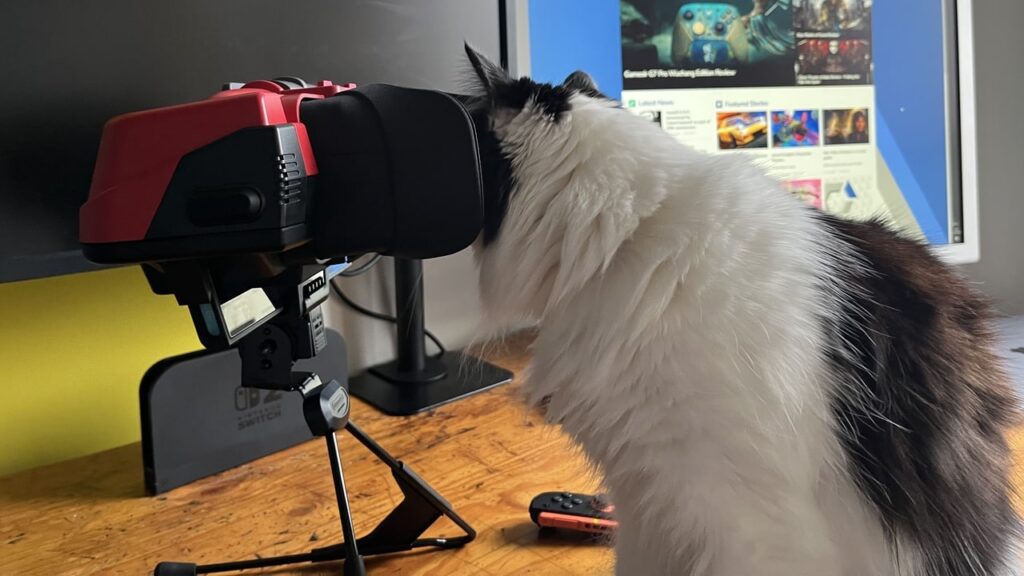
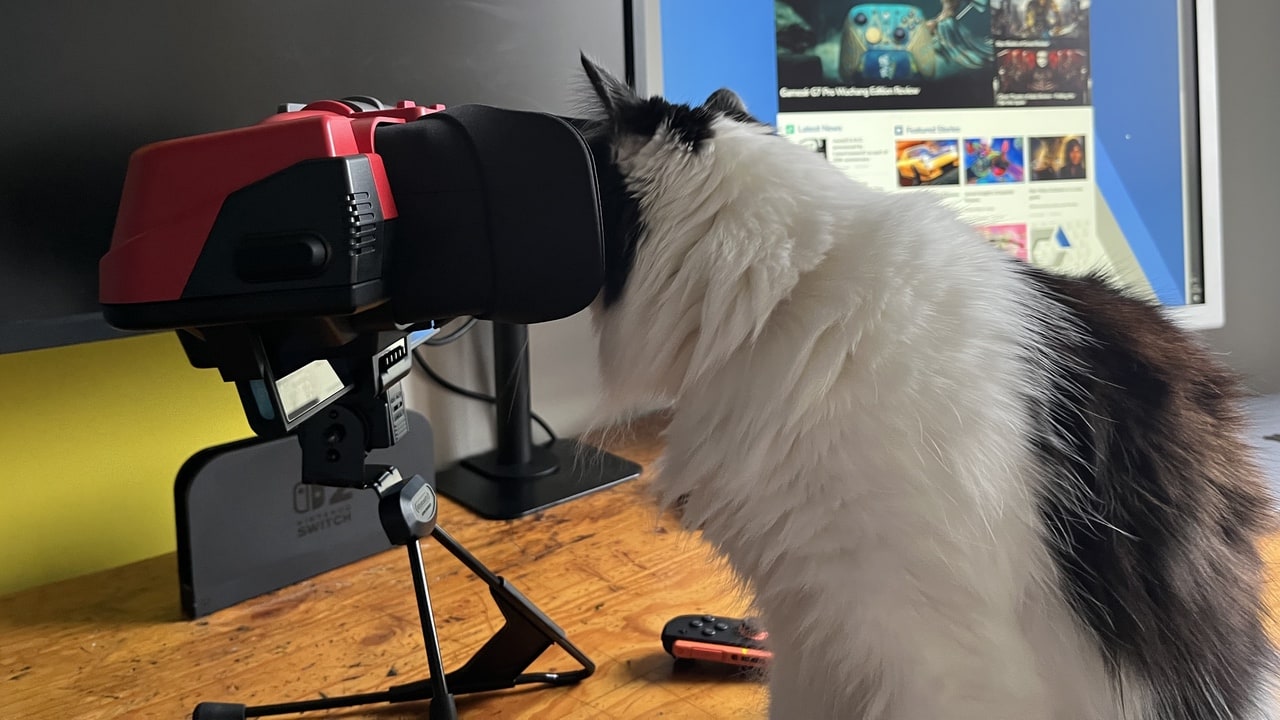
Far more accurate are the backward tilted legs, sturdily holding the headset in place, and stubbornly allowing just a single adjustment. There’s no up or down here, just a tilt back and forward, and it means that you have to really lean in to get your Virtual Boy on. If potential eye strain weren’t enough reason for Nintendo to suggest regular breaks, then bad posture and possible back pain were another. While remaining authentic to the original is admirable in some ways, it means this remains an annoyance for anyone that isn’t my cat. I found that the box the Virtual Boy came in brought the headset up to a sensible viewing height for me.

Virtual Boy cat inspection

The Virtual Boy is for ages 7+, but my cat is 3, so it was not turned on at this time.

Another slight disappointing element is the inelegance of Nintendo’s solution to the difference in shape and size of the Switch and Switch 2. Another detail on the underside of the Virtual Boy is that the protuberance that the stand grabs onto is also a basket to catch and support the console, the inside having a funnel and hinged flap to ensure it’s in roughly the right place, with a little bit of wiggle room. The basket is screwed onto the body of the Virtual Boy, and it’s sized for the Switch 2 by default, with a separate plate for the original Switch and Switch OLED included in the box.

I’d argue that’s overkill, and a needless faff for Switch 1 owners, when really a plastic insert would have done the trick. Heck, in a pinch when wanting to swap back and forth and compare screens, I just shoved my little finger in to give a modicum of support, and a plastic wedge could have made this more easily universal, in my opinion.

Virtual Boy Switch 1 basket.

The Virtual Boy Switch 1 support is a bit of a basket case.

Another problem with the baskets? There’s no space for a USB-C charging cable or any kind of power pass through. Switch 2 could, I suppose, play with the top lid cocked open for the top charging port, letting outside light leak in more easily. In general, now you’re playing with (battery) power.

What really matters is what’s happening inside the headset, and you’ll have to peer into this mysterious box to see it. Back in 1995, Nintendo had to pull some remarkable mirror-waggling tricks to get the single-colour LED strips to trick your eyes into seeing images, but in 2026, it’s the standard VR headset method of viewing a screen through distorting lenses. In both case, however, you look through a thick red filter, cutting out all of the other colours that the screen can display.

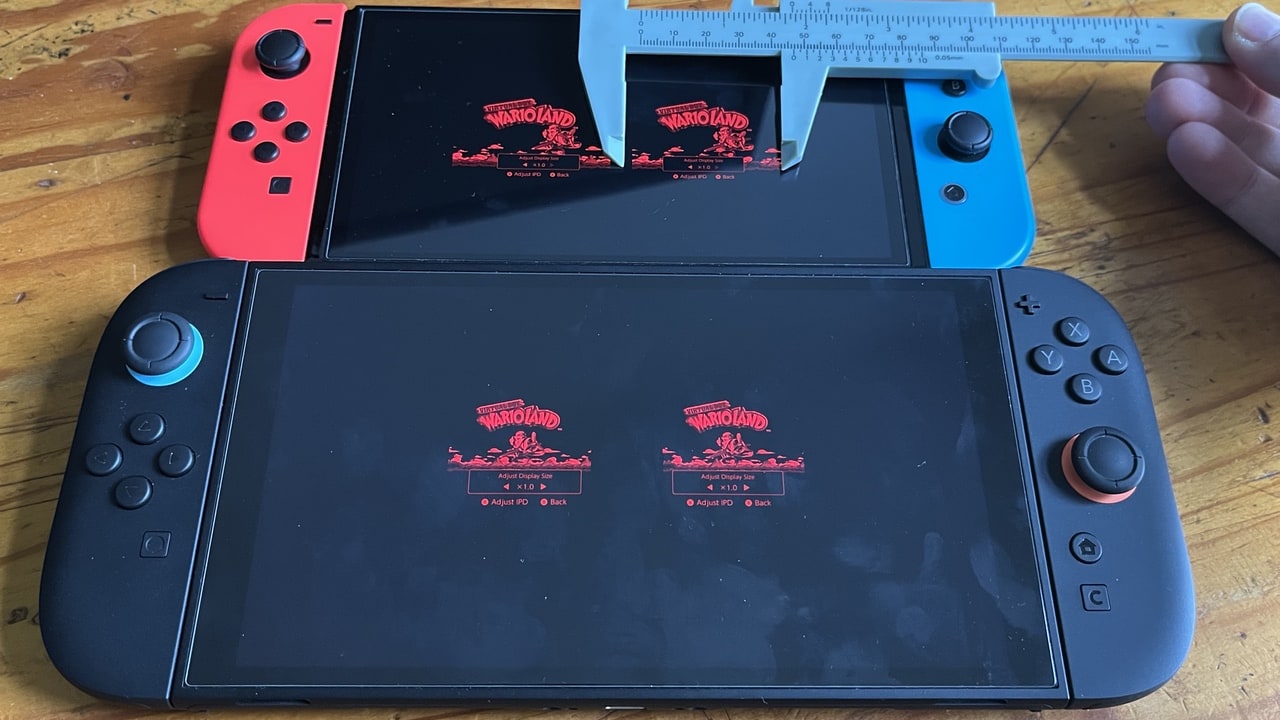
So, between Switch, Switch OLED and Switch 2, which console gives the best Virtual Boy experience? With this plastic Virtual Boy? I’d have to say the Switch 2. The simple fact is that it’s a higher resolution screen, allowing it to display the 384×224 of a Virtual Boy screen in a smaller space, so you can take in the full image more easily as it appears further away. Each console displays at 1:1 by default, and I feel that with the Switch and Switch OLED in particular, this makes it too large within the headset so that I’m occasionally moving my viewing angle to see if I’m missing something in the corners – and when this is a 3D effect, messing around like this and shifting focus can give you a real headache.

Virtual Boy – App render size comparison Switch 2 and OLED

The Switch OLED renders the Virtual Boy much larger than on Switch 2.

It’s a big difference. The Switch 2 puts Wario Land into a 35mm wide postage stamp per eye, before passing through the lenses, while the Switch comes in at 41.5mm and the Switch OLED at 46.5mm. It’s a huge difference, and it makes the pixel grid much, much more visible. You can adjust the zoom within the emulation, to at least shrink the image size, if not the pixels on the Switch OLED – Switch 2, meanwhile, has a wider zoom range and can go up to 1.3x in size to effectively match the Switch OLED at 45mm. I’ve never used an original Virtual Boy, so cannot say what is most authentic, but I’d personally rather see more of the game view than less.

OLED does have its advantages, though, with the cardboard edition in mind. With an OLED panel, any pixel on the screen that’s not in use is off. It’s pitch black. Meanwhile, the backlights of the Switch 2 and Switch bleed through the black and make it a dark blue, to my eyes. The red lenses cut out all but the red light, helping to even the playing field with the plastic Virtual Boy, but the cardboard one doesn’t have the red filter, which can make the Switch OLED king in this scenario.

Virtual Boy red filter

And so we come to the games. The game selection menu passes through the filter in an ominous red hue, but this is actually a bit of a lie, as it’s rendered in full colour by the console. The games themselves are all-red all of the time, though. Seven games are featured on day one, from 3D Tetris to Golf, Red Alarm, Teleroboxer, and the most noteworthy by far, Virtual Boy Wario Land.

Coming a year after his debut as a protagonist on the Game Boy, Virtual Boy Wario Land pioneered multi-plane platforming, with Wario able to use jump pads to bounce to parts of the world further away from the camera, and really pushed the number of parallax layers featured to give the environments its 3D depth. There’s smaller details too, like blocks having multiple layers to them, even little grassy fronds on the ground having a couple layers, giving added depth here, and the sprite scaling as things move in and out of the screen is really nicely done. Practically the first thing you encounter are spiked balls swinging towards your view, and it shows the smoothness of this.

Virtual Boy Wario Land – Wario jumping between planes in 3D

Teleroboxer does a similarly good job with the boxing robots you fight having lots of layered sprites to create a canny 3D effect, and The Mansion of Innsmouth has the classic first person 3D dungeon crawling aesthetic as you move through corridors, while blasting monsters with an on-screen cursor. But for true 3D, you’ve really got to look to Red Alarm, a Star Fox style rail shooter with the world rendered in red wireframe – with just a single colour, this was probably the best path to take, but does mean you can see enemies through obstacles.

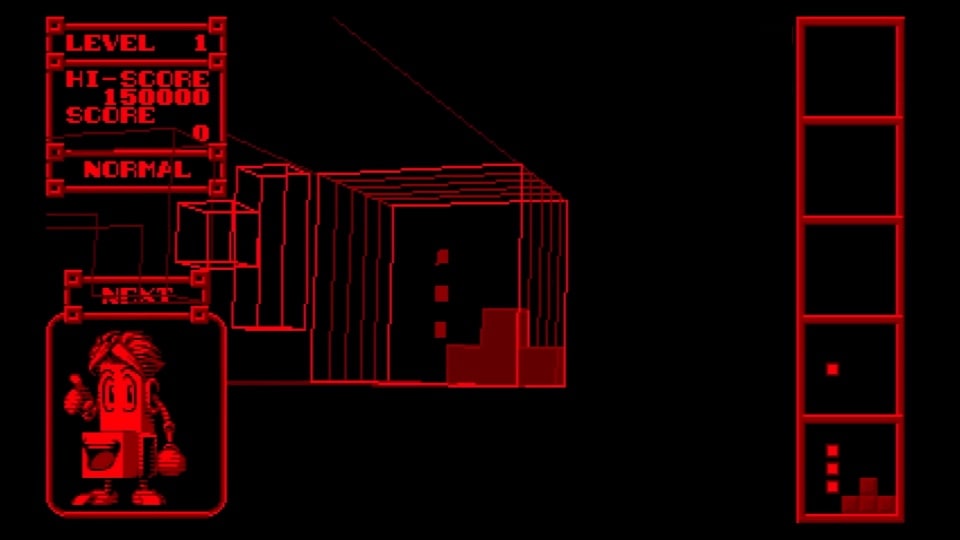
And then there’s 3D Tetris, which takes the notion of the block-dropping puzzle and makes it feel like Star Trek’s 3D chess. The classic tetromino shapes are put to one side, and you’re instead given other blocky assortments, layering them down on multiple flat layers. It can be tricky to make out how things are being placed with the shifting 3D view of the Tetris lasagna you’re making, and it’s odd to have split blocks to drop as well. Thankfully the right of your view has a simple 2D representation of the layers and where each block will land. It’s a bit of a cheat, but makes this more playable.

Virtual Boy 3D Tetris

The main problem with the Virtual Boy’s game line up is that it never had the chance to mature. 1995 means that we were still getting experiences and ideas from the SNES or Game Boy, in part thanks to the single colour displays, and it was a time when sports games like Golf and Mario’s Tennis were… well, they were just fairly standard golf and tennis games. Neat to see, but not exactly ground-breaking.

All in all, the Virtual Boy for Nintendo Switch feels authentic (even if closer inspection does make it appear more toylike), and does a solid job of rendering the console’s small selection of games. It is a shame that, when this costs £67, Nintendo didn’t push on to remake the Virtual Boy controller, improve the ergonomics of using the headset, or even build in the ability to charge and play at the same time. That high price means that Virtual Boy will remain a retro curio for Switch owners and gaming history enthusiasts.

Screamer Preview – How Milestone built their arcade racer for combat

17. Únor 2026 v 17:00

You probably know Milestone best for their long lineup of motorcycle racing games, from MotoGP through Ride and on to Motocross, but that’s not where the studio started. No, the studio’s big break came in 1995 with the arcade-style racing game Screamer, which went toe-to-toe with Ridge Racer as a PC alternative. Over a trio of games in the 90s, the series drifted towards more rally racing, before petering out at another studio, but now in 2026? Screamer’s back, and it’s a refreshing new take on the arcade street racer.

The immediate and most obvious shift from the 90s is that the graphics are so very different. Obviously, they are massively higher fidelity, there’s none of the early 3D polygon wibble, and the gameplay is built around more nuanced physics and handling models… but the art direction has shifted towards anime cutscenes, and there’s a drama-filled story to sink into alongside.

Michele Caletti Creative and Development Director discussed the game’s blend of visual styles: “We took inspiration from things like Akira, from Ghost in the Shell, from Bubblegum Crisis, from Cyber City Oedo, from Cowboy Bebop, and many more, but one of the things that we had to take a very strong decision was not to make the game cel shaded.

It would have been the easy choice – 
It’s an anime, so you make the game cel shaded – but if you do so, you have to oversimplify some details, you cannot go into fine details with cel shading. So the art direction was bold enough to try to blend the anime and the realistic or quite realistic rendition of the world. And then take some other moves like that there’s not onlythe city setting, there are many other settings that try to portray a different but familiar world.”

Screamer – anime cutscene

You know it’s anime sci-fi when you have a dog that can drive a car.

The Tournament is a long-running illegal street racing competition, but this latest edition is for a huge $1 billion prize, drawing in teams from all kinds of backgrounds. For the Banshee PMC, Hiroshi, Roisin and Frederick are looking for revenge on Anaconda Corp and their distinctly fascist-coded leader, Gabriel. The best way to get close is to enter the same tournament, with the possibility that Gabriel’s demise could be made to look like an accident… But it’s also a story that won’t take itself too seriously. I mean, there’s a dog that can drive a car, and whose owner has fitted it with the same universal translator that everyone else uses to communicate using their native tongues – “This is another choice that we made early,” Michele said, “because we wanted to have cultural melting pot of different characters, of different ethnicities and this was important to convey the fact that in this near future the culture is something like what we have today, but even more diverse, even more varied.”

They won’t be the only team that you race as, though, with five teams competing and the story hopping back and forth, putting you in control of various racers, cars and their specific abilities. Even in the opening few story chapters, there’s races where you just need to finish, where you’re driving as a team, where you’re regularly jumping via cutscenes between different cars.

“We wanted to go away from the pure racing focus and jargon and dialogue and always thinking, always about [winning].” Michele explained. “So you see the characters are not even dressed like drivers, because they are something else, then they are drivers. So their goal is to win, yes, but everyone has also another goal. So you will see that during the story, they’re focus shifts towards their inner goal. Then you’ll be playing in the role of all the characters of the game. So everyone has the goal to be first, yes, but from different perspectives.”

What’s particularly striking about the racing is how it reimagines the controls. The right and left trigger make you go and stop, of course, and the left stick is for turning, but drifting is on the right stick, you have a timing minigame for upshifts to give you boost charges, and those feed into a bull-rushing attack to destroy other competitor cars.

Screamer side swiping in racing

It’s quite a lot to get a handle on, and the way you can counter-steer while drifting felt a bit like rubbing my head and patting my tummy at the same time, so it makes sense that the story mode adds these concepts one at a time. When you wrap that around the mix of lavishly produced anime cutscenes and the character portrait dialogue scenes, though, that does lead to a pretty slow feeling rollout over the course of the opening hour or two. I was really waiting for it to give me all of the gadgets and toys to play with.

Michele admitted “The story takes you that slowly, yeah. It takes hours to get to all the mechanics in place, and the point is, you’re never thrown multiple things together to you.”

He continued, “We thought and we discussed a lot about how to lay out the default controls, how to favour the most intricate actions, because you might want to do strange stuff and we want to allow you to do so. I think we’ve reached the balance where it’s not overwhelming. Give yourself some time to get into the mechanics and it’s not about much about the fingers, but the strategy in order to understand and being in control of when to do things, not to overuse the systems.”

Screamer strike attack

The macguffin that makes all of this possible is the ECHO, a device fitted to each and every car like a super sci-fi MGU-K from Formula 1. Fitted by Gage on behalf of the tournament’s enigmatic host Mr. A, it gradually accumulates Sync, both passively over time and when tapping the Active Shift to shift up a gear in time with the rev limiter – don’t worry, it’s still an arcade game and you won’t be asked to downshift at all. This builds up to grant you boost charges, which you can then deploy, and even strengthen by holding and releasing with another mini timing challenge.

As you Boost, this takes that energy and transfers it over to the second meter of the ECHO device, building up Entropy. This gives you charges to use defensively, to create a temporary shield for a few moments, or to unleash as a Strike, boosting forward again and destroying any car that you hit from behind. Save up the Entropy to fill out the meter, and you can enter into Overdrive, putting you in a much longer-lasting Strike boost that can blast multiple rivals into smithereens, and eventually leaves you vulnerable to destruction just from hitting a wall. You can technically outlast the Overdrive, but I would explode my car every time…

That’s where the ECHO’s final trick comes in, as destruction just respawns your car and body, and gets you racing again. There’s no moral quandary over whether or not this new car and person is the same as the one that died – Milestone seem to be leaving that philosophical debate to the Ship of Theseus and the Star Trek teleporter – and instead it’s just a canny way of keeping the action rampaging along.

“We didn’t want to have this pattern of side-striking the cars,” Michele said. “We tried different things like because the hot part is that it’s easy to strike on a straight, it’s harder to strike into a corner, so the more the intricate the trucks, the more it’s complicated to strike. But we experimented with many things like a semi-automatic strike that drives you toward your opponent, but it didn’t work. We tried something like a seeking missile, but it didn’t work. So we ended up with this where you’re still in control, so you if you hit, you feel like you’ve done it. If you miss, you understand what you have done wrong.”

Screamer overdrive

It all blends into a rather unique take on the arcade racer. Combat is direct and to the point, with just the Strike as your only option for attack – no side-swiping and no missiles or energy abilities like in Wipeout or Blur – and there’s a technical depth to master with the drifting and boost timing, not to mention juggling energy.

In one race, I was able to break away in the lead, conserving my boosts in a way that meant I couldn’t be caught, but it felt much more likely to be caught in the middle of the pack and really have to scrap and fight. That ties in very well with the team race mode, with duos or trios battling for victory. This isn’t about the first across the line, and it’s not even just the combined finishing positions that determine the winning team, as every KO also awards points, so that the highest-placed racer might have finished eighth and outscore the winner that didn’t have a single KO to their name.

After adapting to its style of racing, Screamer really started to speak to me. I’m definitely curious to see how the game will blend together its anime narrative and single-player racing scenarios, but that combination of racing and combat? Well, it makes perfect sense for anyone who watched the F1 movie.

Gamesir G7 Pro Wuchang Edition Review

17. Únor 2026 v 13:30

Self-improvement, growth, development. Ideally, these are tenets to live life by. Whether that’s setting aside time to train and exercise in some weird sport you’ve seen online, learn a new language with a pushy owl, or expand your horizons through travel, though only if you’re not just there for the sake of the ‘gram. Gamesir are a company with this same outlook. They started out with some peripherals of questionable quality, but have spent the following years crafting a wealth of incredible devices that tend to feature cutting-edge technology with seriously competitive pricing.

The G7 Pro was one of 2025’s best peripherals. One so good, it was fractions away from being perfect. Gamesir seem to have known that, and with the Wuchang Fallen Feathers Edition of the G7, they’ve made what is arguably the pro controller to beat, at least if you’re an Xbox or PC gamer.

The G7 already had a spec list to die for – well, if you lust after extra controller inputs, mechanical buttons, trigger lockouts and frictionless TMR sticks – but the one omission was a wireless connection to Xbox consoles. That’s the main addition for this release, thanks to the included 2.4Ghz dongle, and it completes the feature set perfectly.

This gamepad is also stunning. The Wuchang edition is boldly decked out in blue and gold, a colour scheme that’s carried through to the charging base as well, with Chinese iconography and artistic brush strokes sweeping between the two. There’s gold feathering – matching with Wuchang- Fallen Feathers’ malady that affects protagonist Bai Wuchang – that runs across both of the controller feet, doubling up as a textured grip. It immediately feels like a well thought out and intentional collaboration, rather than just a different colourway, and every time you reach for it, there’s a sense of occasion and impact that you’re definitely not getting elsewhere.

In the hand, the G7 Pro Wuchang Edition’ 272g has just the right heft to feel premium and purposeful, but it’s not wearying like the Xbox Elite line can be. Its mechanical microswitch-equipped D-pad is also one of the best out there at the moment, and I love the definition, speed, and the corresponding click that comes with every press.

TMR sticks are the newest frontier in analogue stick tech, and they’re the next step after Hall Effect. Just like Hall Effect, they operate without physical components rubbing together, avoiding the wear and tear that old-school potentiometer sticks could develop, and stopping controller-killing stick drift. TMR sticks use electromagnetic technology, making them more precise than Hall Effect, and they’re tuned to feel closer to traditional analogue sticks. Gamesir’s versions in the G7 Pro feel awesome, and through multiple rounds of Overwatch, they’ve proved blindingly responsive.

A couple of months ago, there was a clear audio lag when using wired headphones via the G7 Pro wirelessly with Xbox Series X|S. The most recent firmware has definitely improved matters, but it still feels like there’s a small measure of latency between the on-screen action and the audio being delivered to you. That can be a dealbreaker for a committed competitive gamer, but if you’re that committed, then you’re going to have your controller wired up too, making it a non-issue. Even so, we hope that Gamesir can squash latency down further for those wireless gamepad folks.

There are other amazing pro controllers out there, but the G7 Pro Wuchang Edition has them absolutely trounced on price. I love the Nacon Revolution X Unlimited, but its list price is £70 more than the G7 Pro (or even more, with the G7 Pro’s regular appearance on AliExpress) While it does have features that Gamesir’s offering doesn’t, I’m not sold that the OLED information screen is worth the sizeable premium.

Styx: Blades of Greed Review

17. Únor 2026 v 11:45

When it comes to stealth games, Styx has a winning formula. You play as a goblin, a perfect character for sneaking around. Short in stature, he can slink through vents and under tables, he’s got lockpicks, arrows and mines to help out, and then he can vomit poison, create clones and has magic powers on top of that!  Then there’s the enemies, ranging from humans and elves through to roaches, all of them a threat to little Styx if he’s caught out. It is a great foundation for a stealth game, and yet the games can’t quite nail the landing, resulting in Styx: Blades of Greed feeling less than the sum of its parts.

It picks up after the rather abrupt ending of the previous game, and Styx is now looking for Quartz, a glowing blue crystal that he can absorb to gain more powers. Naturally, he wants to get more of it and, after meeting up with some returning characters from the previous game and stealing a zeppelin, they set off to get some.

The opening feels almost like a different game to everything that follows it. It has regular cutscenes whilst you’re still getting everyone together, and feels like the set up for a story-led game set across various locations. However, shortly after escaping the blockade and being given access to three locations, including the one you just left, you’re simply told to find Quartz in each of them. The next actual cutscene is eight whole quartz pieces away, which is hours of gameplay, and that’s just for one mission before it dumps you back to another Quartz hunt across the same maps.

Styx: Blades of Greed –Quartz abilities

It’s a real shame, because as far as thieving games go, Styx: Blades of Greed is still one my favourites for quite a while. To start with, the locations are huge and many levelled – seriously, the verticality, to use a late 2000s term, is off the scale. More important than all that map, however, is that there are tonnes of holes in walls to find, climbable pathways, rafters to skulk over, just an embarrassment of riches when it comes to infiltrating places really. They’re packed full of enemies, sure, but there’s plenty of routes around them, boxes to hide in, and cracks in their patrols to slip through.

You won’t be earning money to upgrade your tools, or have a shop to replenish your resources. Instead you’ll steal blueprints to upgrade your equipment, level up from completing objectives and looting resources, and after absorbing a certain number of Quartz crystals you’ll get a point to unlock a power. You start with cloning abilities and invisibility, which can be very helpful on their own, but you’ll be able to unlock the ability to possess enemies, or move ultra fast, for example. They’re very useful, but limited by Amber, which they cost to use and must be refilled using potions that can be crafted, found, or pickpocketed. In addition to these are a few standard open world/metroidvania additions including a grappling hook, a glider and claws for climbing certain walls, but by far the coolest is the ability to dash through grids. It doesn’t sound big, but it is exceptionally useful.

Unfortunately, a lot of the voice acting isn’t very convincing. Many of the lines don’t match the intensity of the situation they’re in, like there was minimal direction, or the context of the line changed through development but it wasn’t re-recorded. One voice actor in particular doesn’t give a bad performance exactly, but simply doesn’t match the character – an orc with a higher pitched voice that just never sounds right . Styx fares the best, but everyone else is a bit off. The cutscenes have issues as well, specifically that every single time there is a cut all the background and textures stream in, really marring what can be some pretty nicely “shot” cutscenes otherwise. “Can” is the operative word, as there are a couple that don’t really make sense, especially in regards to stealing a zeppelin.

Speaking of not making sense, you steal that zeppelin and are immediately free to return to where you stole it from. It will just float there unmolested by authorities as if it wasn’t a big deal, even though it should have been. There are a few things like this throughout the story that make things feel inconsistent, and one supposed twist that was so obvious enough to me that I will be truly shocked if anyone doesn’t see it coming. The story, despite a pretty promising start, didn’t manage to keep me invested as it doesn’t really explain or show things very well. I know that Styx is supposed to be getting negative effects from the quartz because it tells me, but it barely ever shows outside of some blue colouring his palms. If it’s bad for him why isn’t any of his crew trying to stop him, why is Styx so blase about it? Why not just steal it instead of absorbing it?

Styx Blades of Greed assassination

Much like with the previous games, I get the feeling that Styx was originally envisaged as a goblin thief, but without a solid story or character arc to wrap around that. Styx has a few characteristics, but they’re shallow; he’s a smart arse, he’s sneaky, he laughs when he pushes people off ledges, and he wants power. That’s it, and I can count them on the fingers of one hand. All of the characters are like that, but with even fewer fingers required. The result is that a functional story that can lead you between things, but doesn’t leave much of an impression. It’s a shame, not just because there’s plenty of potential here, but because the opening gives a different impression and some of the cutscenes could capture your imagination, if the delivery were better. It carries through the quest design as well. So much of it is not just to go find a key, but to basically go find multiple keys. The game wants you to steal things but can’t think of a compelling reason, so here’s five seeds to find and steal that will open this door. It just feels like busywork and padding instead of a thrilling heist.

Then there are the technical issues and bugs. I’ve only experienced frame drops on PS5 after moving quickly on the glider, and this only on a couple of occasions, but there are other issues. There’s some minor platforming awkwardness with ledges that can’t be grabbed or can be, but not how you would expect. Styx also isn’t built for combat, which is good because it’s a bit unresponsive and feels ropey whilst you’re doing it. Again, there are a few crafting resources that could do with being a bit more accessible, as you can go for extended periods without being able to use your toys because you’re just missing one particular, and supposedly common resource. It’s usually iron. There are also areas that are so dark you literally can’t see anything at all, making it practically impossible to find your way through.

Crisol: Theater of Idols Review – Putting the Pain Into Spain

16. Únor 2026 v 16:00

I play a lot of horror demos during each and every Steam Next Fest, and more often than not, games that I am unaware of make their way into my Wishlist. Crisol: Theater of Idols was a strange case that went the other way as Blumhouse’s latest game looked superb, but the demo emphasised an unkillable stalker enemy that felt at odds with the gunplay and atmosphere of the game. I kind of took my eyes off Crisol after that, but I am very happy to declare that I was wrong to do so. Having now spent the past few days absolutely immersed in the world of Crisol, I consider it to be one of my favourite action horror games in years, and one that feels an absolute steal at its bargain retail price.

The story and world-building of Crisol is absolutely superb, and genuinely feels up there with the best of Resident Evil and FromSoft. You begin as Gabriel, a stranded captain on a mysterious shore, entrusted with a mission by the God of the Sun to seal the evil power of the God of the Sea. Gabriel is a devout soldier but one who seems tormented by the conflicting voices of doubt and conviction – conveyed through some fabulous audio design that rewards wearing headphones. Soon after beginning his adventure, Gabriel is confronted by automaton mannequins that seem invulnerable to his pistol and he is swiftly dealt with.

What should be the end, however, proves to just be the beginning as the God of Sun offers his power to Gabriel in the form of a grotesque link between his blood and his weapons. Normal firearms become magical guns when they are absorbed by his magical blood and can hurt the uncanny foes that stalk the streets and buildings of Hispania. It is not just the nature of the weapons that is transformed, though, as the ammunition they fire is manifested from your blood as well. What follows is a unique twist on the conventional risk and reward of survival horror as you must manage your health and ammo from one pool.

Cristol – Theatre of Idols bull headed enemy

Hispania is a darkly beautiful setting, with ruined streets and interiors that defy periodisation as the game could be taking place any time from the late 19th century to the current day (the only clear nod to a more modern date being a radio that you use to communicate with friends and sometimes antagonists). The architecture evokes the timeless splendour of Spanish cities, whilst reminding me a lot of the world of Resident Evil 4 – a game that is a clear influence here. Voice acting is mostly very strong – although I will be playing again in Spanish to really set the mood. There have been some complaints about your companion Mediodia being too upbeat for the tone but I quite liked the contrast this enables. Music is excellent and songs can be unlocked by collecting hidden vinyl records in the game.

Your starting pistol is relatively underpowered even when bloodily enhanced but you can level it up as you progress. In the middle of the game it was my primary weapon with a great balance between power and blood cost for ammunition. A shotgun and a rifle are found later in the game and are hugely effective but come at a much higher blood cost. You also have a knife which can be used to parry attacks but has a limited durability to manage. I struggled to time the parry in my playthrough but will practice in future ones – hopefully the window is patched to be a bit more forgiving.

Cristol – Theatre of Idols mannequins

Combat is brutal and visceral as the mannequin enemies are unrelenting in their attacks. Their rigid, inhuman movements are terrifying in the gloom of many areas, and their horrifying appearance is exacerbated by the fact that they keep on coming even when decapitated or dismembered. Managing your ammo and targets when multiple foes are lurching, crawling or even firing ranged weapons at you is truly thrilling in a way that few games manage aside from Leon Kennedy’s best adventures. There is some welcome variety in enemy as the game progresses, with a later crystal/glass foe being particularly difficult to counter.

The aforementioned invincible stalker is far more cohesive in the full game than I found in the early demo. Delores is a twisted mix of robot and statue with a tendency to taunt you as she stomps unerringly towards you. The stealth sections featuring her are not my favourite parts of the game but they were not frequent enough to disrupt my enjoyment and actually offered a great change of pace from the more action-orientated moments.

Cristol – Theatre of Idols Delores

The final aspect of the game is a focus on puzzles that goes even beyond the influence of Capcom’s legendary series. Aside from finding key items and environmental puzzles involving gears and timed gates, there are regular logic puzzles that range from enjoyable to truly infuriating without ever being too frustrating. Some of these are takes on the familiar but all benefit from fitting the unique aesthetic to perfection. I will admit that one particular late game example involving making up an image from two concentric circles made me pause the game and take a break for a while.

Gear.Club Unlimited 3 Review

16. Únor 2026 v 13:00

The Nintendo Switch was not home to many great racing games, especially ones that didn’t feature karts and moustachioed drivers. So far, that’s continued to play out for the Switch 2, but there are some key signs of change with the arrival of GRID Legends last month. Drafting directly behind it is Gear Club Unlimited 3, an arcade/sim-cade racer that also boasts its own storyline, licensed vehicles and updated visuals, hoping to snatch its own place on the podium. While it puts up a valiant effort, it feels like it’ll remain firmly in the middle of the pack.

As we’re seeing more and more on Switch 2, Gear.Club Unlimited 3 gives you the choice between a 30fps Graphics option and a considerably smoother Performance mode with a 60fps refresh rate. Ideally, racing games need to be 60fps – though 30fps is fine if its stable – and it’s definitely snappier and more responsive. The Graphics option here targets 30fps, but it does not manage it by quite some margin. Stutters and lag happen throughout races in this setting, so much so, that I’d say it’s currently unusable. It doesn’t really seem to make all that much difference to the visuals, either, other than the quality of tyre smoke at the start of races.

In the world of Gear.Club, winning is everything. The story mode sees you joining the organisation as a rookie, before trouncing one of the old pros and stealing his slot on the tour to Japan. Thankfully, everyone is thoroughly amiable, and he comes along as your mentor instead, narrowly avoiding some genuinely interesting conflict and drama. All the story dialogue is told via text boxes and static character art, which serves to emphasise the game’s budget leanings, while the suit and shirt-wearing bigwigs feel completely out of place in a tournament of underground racers. The story is, at best, a fairly forgettable frame to the racing action. At worst, it’s just explaining the next menu you’ve unlocked.

Gear.Club Unlimited 3 Japan

The cars make a better first impression. They are extremely well modelled, shining and glistening in their metallic glory, and striking a tone that will have you feeling pretty positive about Gear.Club Unlimited 3’s chances, though with a roster of 39 cars, it’s relatively slim pickings.

Actually racing them isn’t so positive. Gear.Club Unlimited 3 offers a couple of options to tailor your experience, with different levels of brake assist and anti-skid. Whichever option you go for, the cars are relatively well grounded, and pretty reliable in the way they manoeuvre, if a bit lifeless, though there’s still a nagging sense of worry and uncertainty if you go for Expert settings and turn off anti-skid.

Where it comes unstuck is drifting. At no point does this become natural, easy, or enjoyable, and you’ll find you can launch it around curves like a terrible NASCAR driver without losing too much time. That’s all exacerbated by the lack of analogue triggers. We can lay some of that at Nintendo’s door, but when GRID Legends gives you right analogue stick throttle control, and supports the Gamecube controller’s analogue triggers, there’s little excuse for not having it in place.

It just doesn’t come together very well. Rubber banding in races sees you fly past the entire pack, only to have them inexplicably reappear in your mirrors and pass you at the last moment. There’s a Kudos-like scoring system for keeping it clean, and achieving various other feats of vehicular control, but it feels pretty perfunctory and uninvolved.

Gear.Club Unlimited 3 is at its best when it’s trying to emulate Tokyo Xtreme Racer. Battles and duels that take place on packed Japanese highways are the most fun events here, and nipping your way through traffic is a blast. Well, it’s a blast till you clip somebody and invariably end up facing the wrong way.

Gear.Club Unlimited 3 night race

Upgrading your Club is a pleasant little diversion. You’ve got a massive garage to work with, filling it with technicians as well as designing areas to relax in, and stuffing them full of arcade machines. Upgrading your cars is tied to which workshops you’ve unlocked, and then adding engineers to unlock higher tiers within each one, and that’s interesting enough, giving you a reason to take part in an additional race or two, to fill things out.

The problem is that the engineers and upgrades dry up at points, with little to do but persevere with the ‘story’ mode, and just keep on racing across a map that you can barely tell has changed.

Gear.Club Unlimited 3 is a largely solo experience, with the main story mode taking you from a rookie to the leader of the Gear Club Japan arm of the racing company, while taking in time racing across the roads of France. It’s a shame that progress feels so slow, and the upgrade system so lacklustre, because there are elements of the game that work pretty well.

There is a Free-Roam mode too, which I hoped might suddenly turn Unlimited 3 into an open-world racer. Unfortunately, it just lets you – or you and a friend – drive the tracks without any constraints, or you can do some two-player racing, which is a nice thing to have. Being able to explore the world might have been more impactful if there were more sights to see, beyond the occasional train racing by.

Gear.Club Unlimited 3 garage

On top of everything else, the music is horrendously repetitive. I managed about an hour before I turned it off in the races, and maybe a couple more before wanting to cull it in the menus too. Besides that, the game hard-crashed at points too, dumping you back to the Switch 2’s main menu. It’s just another thing to chip away at Gear.Club Unlimited 3’s potential.

Aerial Knight’s Dropshot Review

16. Únor 2026 v 11:36

The core concept of Aerial Knight’s Dropshot is utterly bonkers. You and your opponents leap from a plane, circling hundreds of miles above the ground. None of you have parachutes though, and instead you willingly freefall to your doom. As you plummet, you must shoot your fellow plummeters with your magic finger gun – yes, really. Your objective is to kill them all before you hit the ground. Oh, and your player character is called Smoke Wallace. He has purple skin and magical powers because he was bitten by the same radioactive dragon that ate all of his family. You see? Bonkers.

Bright and garish, the visuals are all acid-soaked kaleidoscopic weirdness. It’s not my kind of thing, but this game certainly has a striking and attention-grabbing look. Gameplay is structured around small levels that last for sixty seconds, Dropshot is gaming for the TikTok generation. Each level is intended as a dopamine hit but to be quickly forgotten. As you fall from a first-person perspective, you’ll need to dodge floating islands, laser traps and your opponents’ return fire to stay alive, and with only two lives, this can be challenging. Kill efficiently and stylishly and you’ll rack up points and a high grade, the idea being to return to each level numerous times to hit a high score and achieve a perfect run. The problem is, that despite the bonkers premise and over the top visuals, the gameplay itself is rather pedestrian, leaving me with little interest in returning to a level once it was done.

Aerial Knight's Dropshot free falling gameplay

The biggest issue is speed; there’s little sense of any. As you hurtle through the sky, it should be an adrenaline rush, like knee-sliding in Platinum Games’ Vanquish, or hurtling round a tight corner far too fast in F-Zero. Instead, it’s more akin to strolling to the shops to buy some bread. This is an oddly muted experience, rather than dodging floating islands and traps by the skin of your teeth, you seem to have a veritable age to gently steer yourself out of the way.

Achieving a high score amounts to little more than the eye-straining task of having to spot your tiny freefalling opponents in the distance, slowly line up a shot, and take them out. You’ll likely fail to spot them all on the first attempt, forcing you to attempt the level numerous times to catch them. Often your foes will kill you first, but you’ll have little idea that a bullet is coming. One moment you’re alive, the next you’re dead, with little to no visual clues that an attack is incoming. Worse, the collision detection isn’t great – possibly due to the challenges of basing the game around a first-person view – meaning sometimes you die, sometimes you survive, and you’re really not sure why.

There are two other game modes. The first is a boss battle that sees you fighting an enormous dragon, a nasty fella who can absorb a whole lot of damage, forcing you to conserve your ammo and keep a look out for ammunition drops to fall through. This is certainly more enjoyable than the main game. Primarily because it resolves the issue of the irritating unseen enemy attacks, as the dragon blasts you with big obvious fireballs that must be quickly shot from the sky, bringing some old-school light gun game shenanigans to proceedings.

Aerial Knight's Dropshot dragon boss battle

The final mode is a straight up race between you and your rival to catch a golden egg before you hit the ground. This does, finally, get the pulse racing, as due to numerous speed boosters things end up fast and frantic. Darting through arrays of laser beams, narrowly avoiding chunks of rock, finally I can see what the development team were going for. If these thrills and spills could be replicated throughout the rest of the game, then Aerial Knight’s Dropshot would be an absolute indie banger. As it is, there’s just too many of the boring levels getting in the way of the good stuff.

Every State of Play Feb 2026 trailer and announcement – God of War, Silent Hill, John Wick & more!

Last night’s State of Play stream felt like E3 in February, absolutely stuffed with fan-pleasing announcements and games coming to PlayStation 5.

Let’s not waste any time and round up all of the announcements starting with…

Kena: Scars of Kosmora has been revealed for PS5 and PC

Ghost of Yotei Legends release date has been set for March

Death Stranding 2 is coming to PC in March

Sony shared a 4:Loop gameplay deep dive for the co-op shooter

Pragmata had a “World View” trailer, and Resident Evil Requiem got another new Leon trailer.

Legacy of Kain Defiance Remastered is coming in March with a new game, Legacy of Kain: Ascendance, also announced

Brigandine Abyss, the latest in the fantasy war strategy RPG series, is coming in 2026.

Dead or Alive 6 Last Round announced, but there’s also a new Dead or Alive project in the works!


Remedy shared a Control Resonant gameplay reveal

The Nephilim are fighting to save humanity in Crimson Moon, coming Fall 2026

Beast of Reincarnation release date has been set for 4th August

Neva: Prologue reveals how Alba met her wolf friend in DLC next week

Yakoh Shinobi Ops announced, a 4-player co-op stealth ’em up with top-down tactical gameplay. Coming in 2027.

Project Windless revealed

Star Wars: Galactic Racer gameplay shared in the new trailer

IO share a fresh 007 First Light story trailer

Metal Gear Solid Master Collection Volume 2 features MGS4 and Peace Walker. Huzzah!

Castlevania: Belmont’s Curse announced, in partnership with Evil Empire and Motion Twin

Silent Hill: Townfall takes the psychological horror series to the cold isolated backdrop of Scotland

Rev. Noir teased by Konami, an all-new RPG in development for PlayStation 5

There’s an untitled John Wick game in development

Marathon’s launch trailer is here, with server slam announced

Big Walk is strolling to PS5 as well as PC later this year

Saros gets a new gameplay overview trailer

Marvel Tokon: Fighting Souls brings the Unbreakable X-Men into the fight and it has a release date

God of War’s original trilogy is getting a remake!

And here’s a surprise: a side-scrolling God of War spin-off Sons of Sparta.

Something for the Weekend – 10/01/26

10. Leden 2026 v 18:40

The first full week of the year is in the books, and if this is means to carry on… well let’s just say that video games will continue to provide a good bit of escapism. So let’s continue escaping with a quick look at how this week in the games industry has gone.

In the News This Week

Most Wanted 2026

We’ve blazed a trail through our Most Wanted Games of 2026 lists. Here’s everything from #50 down to #6:

Games in Review & Featured Articles

It’s still pretty lean right now for the start of the year, but alongside Most Wanted we did have a handful of features.

Dom also strapped a big rumbly Woojer Strap 4 to his chest. Again. He quite likes these things.

Beyond that, I previewed Code Vein 2, and its time-hopping soulslike adventure, and I had an early look at how The Elder Scrolls Online is changing with a new seasonal roadmap.

Rounding out the week, What We Played featured the Dragon Quest VII Reimagined demo, Warhammer 40K Darktide and Avatar: Frontiers of Pandora.

Trailer Park

Orks get the perfect cinematic trailer for Dawn of War 4

Nintendo serves up a Mario Tennis Fever gameplay deep dive and Baby Waluigi

Romeo Is a Dead Man’s new trailer gives us a bonkers taste of what Grasshopper Manufacture are cooking up

Sneakily watch this 9 minute gameplay video for Styx: Blades of Greed

That’s all for the round up this week. Enjoy the weekend, check in on Most Wanted, and we’ll carry on carrying on on Monday.

Our Most Wanted Games of 2026 – #10 to #6

10. Leden 2026 v 18:22

We’re entering the hallowed ground of the Top 10, the territory of listicles across countless topics, as we search for our very most desired games of 2026. This batch of games has some galactic and not so galactic racing, a bit of revolution in the air, a much wanted sequel, and an experience that might leave you shaken but not stirred.

10 – Star Wars: Galactic Racer

PS5, XSX|S, PC – 2026

In a galaxy far, far away an Empire has fallen and a New Republic is forming. However, this is a time of great upheaval and uncertainty, which means there is space for some sci-fi motor racing. A spiritual successor to Star Wars: Episode I: Racer, Star Wars: Galactic Racer introduces us to the undergroung Galactic League, where racers from different backgrounds and disciplines come together to prove who the best pilot is in the galaxy. Podracer Sebulba is just one of those characters.

There is also a new character called Shade, and that is who players embody. Shade is a racer starting at the bottom who has two goals; glory and revenge. Glory in becoming the best racer in the league, and revenge against rival Kestar who wants to run the league in his own way. Racing just makes up one part of Star Wars Galactic Racer, as players will have to navigate alliances and rivalries with other racers to come out on top. There will be race tracks across familiar planets as well as new ones being added to the Star Wars universe.

9 –  Clockwork Revolution

XSX|S, PC – TBA

inXile Entertainment has steadily built itself up as a studio that can deliver fun and interesting RPGs, from The Bard’s Tale series, through Torment: Tides of Numenera and most recently Wasteland 3 each showing depth in ideas and execution. But since their acquisition by Microsoft they’ve been able to push on towards full AAA territory. Clockwork Revolution is the time-bending RPG coming out of this ambition, and it’s high on our list following a great looking gameplay reveal that showcased fun gameplay, comedy, and a world that can be changed by player actions.

Clockwork Revolution is set in the year 1895 in the steam powered city of Avalon where humans and clockwork people live and work together side by side. It is also a world filled with criminals and a powerful ruling class that can time travel to craft Avalon in their image. Unfortunately for them, your character has also found a way to time travel and shape the city to their own ends. We know the main character is a scoundrel who appears they will do anything to get ahead. The character creation alone is integrated into the game as someone giving the police a description of you after you have robbed them.

8 – Forza Horizon 6

XSX|S, PC (and possibly PS5) – 2026

The announcement for Forza Horizon 6 had some of its impact taken away after the Forza Horizon social media accounts posted the teaser ahead of the official reveal at Tokyo Game Show. The teaser pans across items from different parts of the world before settling on a Japanese license plate and a white Neko figure. It then pans up to show Mount Fuji, confirming Forza Horizon 6 will be taking place in Japan.

Not much is known about Forza Horizon 6 right now, beyond the fact that it will carry on in the traditions of the open world series. Seasons will be returning, and the map will have be landmark-filled approximation of Japan, including Mount Fuji, Tokyo, and rural areas. This map is being developed with Japanese consultants so more is shown of the country than just the touristy bits. Expect to see an awful lot more of this game, and likely a release date announcement during the Developer_Direct stream on 22nd January.

7 – 007: First Light

PS5, XSX|S, NSW2, PC – 27th May 2026

While we still wait on the news on who will be the next James Bond for the films, we don’t have to wait much longer for IO Interactive’s take on the most famous of spies, even if the game has been delayed to May. 007: First Light is IO Interactive’s most ambitious games, taking on the mantle of crafting a new Bond story while using lessons learned from its highly acclaimed Hitman games.

Bond is not yet the globe trotting super spy we all know, but a young agent still earning his reputation and having to work as part of a team. The mission is to take down 009 who has gone rogue, using MI6’s own tactics against them. Bond is a loose cannon who will do things his own way to get the job done, even if it doesn’t please others in the organisation. The game will feature spycraft, shootouts, and driving ( a first for IO Interactive) with each taking inspiration from the 007 books and movies.

You can read more about the game in our very own preview.

6 – Warhammer 40,000: Boltgun 2

PS5, XSX|S, PC – 2026

Warhammer 40,000: Boltgun was heralded as a great return to form for the boomer shooter form, getting critical acclaim and commercial success. Warhammer 40,000: Boltgun 2 has already got high expectations placed upon its shoulders, and what we know of it so far seems to promise a lot more action without sacrificing much of what made Boltgun great.

Warhammer 40,000: Boltgun 2 gives us two protagonists to play as, Sternguard Veteran Malum Caedo and Sister of Battle, Nyra Veyrath. Each has their own playstyle so you can try new ways of taking on enemies as you travel through a hive city and mangrove swamps. The story will also have a branching narrative with each choice taking you to different levels, meaning you may have to play through a few times to see everything. On top of that there are new enemy units to engage in combat with including Bloodletters ,Juggernauts and other new enemies from different factions. Boltgun 2 is going to be a bigger and louder experience than its predecessor, but we will have to wait and see if it is better.


That’s it for today, and we’re going to take a day off tomorrow to catch our breath and then blitz through out top five with daily posts. What’s going to come out on top?

❌