I know I’m a bit late to the party, but I was lucky enough to get hold of a copy of the new Jurassic World Evolution 3 Wetlands DLC pack for Jurassic World Evolution 3. The Jurassic World Evolution series has always been at its best when it leans into ecological complexity rather than pure…
When Eldegarde exited Early Access in January 2026, it was clear this wasn’t chasing the Soulslike crowd or trying to be the next cinematic, story-heavy RPG. Instead, Notorious Studios set its sights on something far more niche — a third-person fantasy action RPG built around PvE, competitive PvP, and tense, high-risk extraction gameplay where every…
It’s quite hard to believe that Nioh 1 released almost a whole decade ago in 2017. The sequel Nioh 2 was released in 2020, and it’s been long enough that Koei Tecmo have decided to release a third entry into the franchise. Nioh 3 enters the fray with a revamped battle system and touts enough…
Note: This is an in-progress review after one week of playtime. I’m still discovering online multiplayer dynamics and will continue to update as I spend more time in the arena.
Growing up, my little brother (and my mates) used to play Speedball 2 on the Amiga absolutely religiously. They’d gather around the screen for hours, screaming at each other as they battered through matches with the kind of intensity usually reserved for actual sports. That game was legendary, and honestly, after a run of attempts (Speedball Tournament, Speedball 2100 and even Speedball 2 HD which was just weird), I never thought we’d see a proper return to the arena. HOWEVER… Speedball has arrived, and it’s doing something genuinely promising.
The Soul Is Still There
Speedball’s return isn’t some diluted modern interpretation. This is brutal, uncompromising, and unapologetically violent. Two cybernetically enhanced teams clash in enclosed arenas packed with hazards, traps, and environmental chaos. The crowd roars, mega-corporations run the show, and victory is earned through speed, precision, and raw aggression.
From a top-down perspective reminiscent of the original, you’re immediately thrust into fast-paced matches where split-second decisions matter. Passing, tackling, shooting, dodging—it all feels responsive on the controller. That “flow state” moment where you’re chaining hits, ricocheting the ball off multipliers, and steamrolling toward the goal is satisfying in the way only Speedball can be.
The visual style updates the franchise for modern hardware whilst keeping the industrial, sci-fi brutality that made the original special. It’s loud, relentless, and designed to keep your heart rate elevated from kickoff to final buzzer. There is a certain Fortnite influence here in the character style.
Multiple Ways To Play
There’s genuine variety here. League Mode lets you tackle a full season against AI opponents. Online multiplayer pits you against other players worldwide. Prefer the classic approach? Couch multiplayer is here for settling scores the traditional way, with local co-operative options as well. For a game launching at £24.99, the range of modes is impressive.
The tactical layer sits beneath the arcade action. Team composition matters. Player traits matter. Whether you build an aggressive wrecking crew or a disciplined defensive unit impacts how you’ll perform. Each player has strengths and weaknesses based on their cybernetic augmentations. Understanding your squad and exploiting opponent weaknesses creates strategic depth that transcends the immediate chaos.
The Early Access Reality
Here’s where complete honesty is essential: Speedball is still evolving. The game launched following a lengthy Early Access period on PC, and whilst Rebellion has clearly listened to community feedback, there’s still content coming. Arena variety is somewhat limited currently, which can make matches feel repetitive after extended sessions. The level of team customisation will expand further in future updates.
This isn’t a criticism, more an observation. Rebellion has committed to ongoing development, gradually introducing new features, improved progression systems, and expanded content. Early adopters literally watch the game evolve as it develops, which is either genuinely exciting or frustrating depending on your patience for “works in progress.”
The community has been integral to development. Rebellion set up a dedicated Discord server where players share ideas, report bugs, and contribute to shaping the game. That collaborative approach avoided previous Speedball revival missteps. This time, it genuinely feels like the developers are listening.
What Currently Shines
The core gameplay is absolutely solid. Matches are short, chaotic bursts of action that demand your full attention. The control scheme is intuitive enough that you can dive straight in without excessive tutorials. The “Slam Cam” slow-motion moments capturing bone-rattling hits, crunching tackles, and medical bots carting off injured players add theatrical brutality that celebrates impact.
Online multiplayer latency has been smooth in my early sessions. Arena hazards like flamethrowers, ice shotguns, grind rails, and environmental traps keep matches unpredictable. No two games play out identically, which is crucial for long-term engagement.
The soundtrack and sound design capture the industrial sci-fi atmosphere perfectly. The crowd noise, the crunch of impacts, the roaring intensity—it all reinforces that you’re in a corporate-controlled future sport where violence is entertainment.
Some Growing Pains
With only a week of playtime under my belt, I’m still learning matchmaking nuances and online dynamics. Initial matchmaking can occasionally feel imbalanced, pairing new players against experienced ones, though this may settle as the playerbase stabilises. The limited arena variety is noticeable but not gamebreaking at this stage.
Learning the optimal team compositions and player positioning requires more time than I’ve had. Some mechanics still feel like they need explanation—the instruction manual could be more comprehensive for newcomers unfamiliar with the original series.
Visually, the game is solid without being stunning. Character models are clear and functional, arenas are detailed enough, but it’s not pushing graphical boundaries. That’s absolutely fine for a sports game where clarity matters more than cinematic fidelity.
A Genuine Revival With Potential
After years of failed Speedball revivals, Speedball 2100’s awkwardness, and various half-hearted attempts, this feels different. Rebellion has treated the franchise with respect, understanding what made the original special whilst delivering the speed and spectacle modern players expect.
This isn’t a nostalgia cash-grab. It’s a confident revival that recognises the original’s legacy whilst building something that works today. The commitment to ongoing development based on community feedback is genuinely encouraging.
First Thoughts (not Final)
My early verdict is that Speedball is a promising return to the arena that captures the brutal essence of its heritage. The core gameplay is solid, the multiple play modes offer genuine variety, and the commitment to ongoing development feels authentic. Yes, it’s still evolving. Yes, there’s limited arena variety currently. But what’s here is genuinely fun, and the trajectory is heading in the right direction. I’m continuing to play daily, and I’ll likely revisit this review after more online multiplayer time.
For fans of the original, this is a genuine homecoming. For newcomers, it’s an excellent entry point into a unique brand of brutal, fast-paced sports action. At £24.99, it’s reasonably priced for the content on offer, especially considering Xbox Play Anywhere means you’re getting console and PC versions.
Whether you’re reliving old rivalries or stepping into the arena for the first time, Speedball hits hard. I’m genuinely excited to see where it goes.
There’s something instantly appealing about the promise of running your own tavern. That age-old fantasy of starting in a run-down establishment and building it into a thriving hub for adventurers and townsfolk? Tavern Manager Simulator delivers exactly that. It’s a cosy management sim wrapped in fantasy charm, and despite some minor rough edges, it’s a genuinely satisfying experience that captures the essence of hospitality work without the actual exhaustion.
The Charm Is Immediate
Tavern Manager (we’ll drop the “Simulator” part, as it feels somewhat bolted on) starts you in a crumbling shack that you’ll need to clean and restore. The visual style is whimsical and vibrant, reminiscent of classic fantasy illustrations. Everything has a hand-crafted quality that makes the world feel lived-in and inviting. The developers have leaned into fantasy aesthetics brilliantly, creating an atmosphere where you actually want to spend time.
The game respects your time by letting you set the pace. You can open your tavern when you’re ready, work at your own speed, and close up whenever you’ve had enough. There’s no Kitchen Nightmares-style pressure where you’re failing if you’re not constantly busy. This flexibility is genuinely refreshing.
The Management Loop Actually Works
The core gameplay revolves around multitasking. You’ll be cooking meals, pouring ale, serving customers, maintaining cleanliness, ordering stock, and managing your finances. Each task is represented by a minigame with varying complexity. Some are simple point-and-click actions, whilst others feature moving-target gauges that reward precision with higher quality items and better tips.
Pouring ale is a perfect example. You hold a tankard beneath a keg, turn the handle, and stop in the sweet spot. Get it right, and you’ll have a beautifully crafted pint with a perfect golden body and frothy head. Get it wrong, and you’ll either have an underfilled glass or an overflowing mess. These minigames are satisfying enough that you won’t mind repeating them dozens of times, and there’s a genuine skill element that keeps things engaging.
As your tavern grows, you hire adorable fairy assistants who gradually improve their skills at assigned tasks. This is brilliantly designed because the fairies retain their expertise even when reassigned to different duties. Early on you’re doing everything yourself, which teaches you all the systems. Once fairies arrive, you can choose your playstyle. Do you want to focus on cooking whilst fairies handle service? Or would you prefer to work the floor, greeting customers and building relationships?
The Simulation Has Real Substance
Customer satisfaction matters. Greet guests warmly, seat them promptly, and anticipate their needs. Conversations with patrons earn polite customer points and build your reputation. Your tavern’s cleanliness and decoration directly impact customer satisfaction. A filthy establishment with cobwebs and scattered crates won’t attract quality clientele, whilst a well-maintained tavern with thoughtful décor becomes a destination.
Stock management adds strategic depth. Run out of ingredients mid-service, and customers will leave unhappy. Overstocking ties up capital you could use for upgrades. There’s a balance to strike between preparation and financial efficiency.
The narrative unfolds gradually through quests and interactions with quirky characters. It’s a slow burn, but that suits the game’s pacing. You’re uncovering the tavern’s history, forging alliances, and building a reputation that genuinely matters within the game world.
Some Minor Roughness
Tavern Manager isn’t without its issues. Some aspects can feel repetitive after extended play sessions. The lack of energy consumption mechanics, whilst allowing for seamless night-time preparation, does feel slightly at odds with the “simulator” branding. You can prep through entire nights without fatigue, which is convenient but not particularly realistic.
Visually, there’s some jankiness. The delivery cart sometimes drifts into position oddly, and conversation text could be significantly larger within its oversized text box. These are minor presentation issues rather than gameplay problems, but they’re noticeable.
The sound design, whilst mostly excellent with satisfying audio for pouring drinks and sweeping floors, does have one repeating element that becomes mildly annoying. The whirling cogs of the well, when you’re grinding through water collection, can feel tedious after the hundredth time.
The Hospitality Authenticity
Having worked various hospitality jobs from university bars to proper establishments, Tavern Manager captures something genuine about the work. It’s the rhythm of service: prep during quiet periods, execute when customers arrive, clean and reset afterwards. That cycle of building a station, delivering service, then breaking it down for the next shift is authentically represented.
It’s satisfying in a way that real hospitality work often isn’t. You get all the satisfaction of managing a busy service without the actual aching feet, stress-induced headaches, or genuinely rude customers. The game removes the suffering whilst keeping the accomplishment.
Creative Freedom and Replayability
You can decorate and expand your tavern however you wish. Place tables at multiple angles, buy decorations that reflect your personality, and shape the aesthetic to match your vision. Experiment with different management styles, prioritise different aspects of the business, and create a truly unique establishment. The depth here ensures no two playthroughs feel identical.
Worth a Pint!
Tavern Manager Simulator is a charming, engaging management experience that delivers genuine satisfaction through its well-designed systems and cosy atmosphere. The minigames are satisfying, the progression feels meaningful, and the flexibility to play at your own pace is genuinely refreshing. Yes, it has minor rough edges and some aspects can feel repetitive, but these don’t significantly diminish what is fundamentally a delightful game. If you’re drawn to management sims, fantasy settings, or simply enjoy the idea of building something meaningful, Tavern Manager deserves your attention. It’s a warm, inviting experience that respects your time and rewards your effort.
You are Korvald, an old scribe who lives in a Nordic village. When crusaders come and invade, you are kidnapped and tortured to near death. But then a demon comes and gives you strength to fight back in this 2D action hack and slash platformer. It kind of reminds me of a mix between Odin […]
In this game you play as Nia, a teenager who just moved temporarily to a remote island with her parents. She’s not too thrilled about being away from civilization, but after accidentally touching a shrine and falling down a pit, she is tasked with collecting four gears that’ll activate the island, which is actually a […]
This game reminds me a bit of one of my favorite classic puzzlers: Pipe Dream. Make the water (or lava) flow through all the destinations by rotating pieces of pipe in three biomes: Forest, Volcano, and Winter, with 50 levels in each biome. Tiny Biomes is available on all current consoles and PC, but reviewed […]
There’s a particular charm in games that know exactly what they are. Cakey’s Twisted Bakery is a short, focused stealth survival horror experience that takes the twisted-mascot concept and runs with it. At around £10 on Xbox, this is a lean package thats short and sweet (lol), and honestly, that’s precisely what makes it work so well.
The Concept Is Genuinely Unsettling
The premise is wonderfully odd. You’re a lost child searching for your missing brother inside a bakery where children are apparently the secret ingredient. Rather than relying on gore and graphic horror, Cakey’s Twisted Bakery uses something far more effective: the contrast between cute and creepy.
The mascot monsters, Cakey, Frostina, and Candy Bane, have family-friendly appearances with damaged, decaying details that make them genuinely unsettling. They’re reminiscent of Five Nights at Freddy’s in the best possible way. These candy-eyed abominations with far too many teeth create a specific kind of dread. When they hunt you, their high-pitched screams and the deep bass music getting progressively louder as they close in creates real tension. It’s effective stuff.
The visual design of the bakery itself reinforces this perfectly. Pastel-coloured corridors, smiling signs, and child-friendly aesthetics twisted into something genuinely nightmarish. You’re constantly aware that this was once innocent and is now very much not.
Stealth and Strategy Over Action
The core gameplay loop is straightforward. You sneak through the bakery, collect colour-coded ingredients scattered throughout the environment, and craft pies that act as weapons against the monsters. Different pies work better against different enemies, so you need to learn which recipe defeats which creature.
The stealth mechanics work well. Hiding under tables and in open crates actually hides you, as long as you don’t do something silly like shining your torch directly at a pursuing monster. Timing matters. Patience matters. It’s about reading patrol patterns and moving only when it’s safe.
Gathering ingredients adds genuine tension to every step. You’re out in the open, vulnerable, whilst simultaneously looking for scattered items. The knowledge that a monster could round a corner at any moment forces you to be efficient. Do you grab just what you need and risk making runs? Or do you stockpile ingredients for future use?
Once you’ve defeated a monster, a key drops that unlocks the next area, but also unleashes the next threat. The sense of dread builds naturally as you progress.
The Catch: Limited Scope
Here’s where complete honesty is necessary. Cakey’s Twisted Bakery is a two-hour experience, give or take. There’s essentially one level with three enemies, and once you’ve learned the layout and memorised the recipes, the challenge diminishes significantly. Experienced horror game players might find themselves breezing through it.
The game doesn’t explain itself well. Trial and error teaches you what you need to know, which is fine but occasionally frustrating. A slightly stronger tutorial would have helped. The limited content also means replay value relies entirely on the two different endings, which might not be enough for everyone.
The story, whilst intriguing, barely scratches the surface. Handwritten notes scattered throughout add atmosphere but remain too vague to meaningfully expand the lore. There’s potential here for something deeper, but it’s not realised in this version.
What Makes It Special Anyway
Despite these limitations, Cakey’s Twisted Bakery works because it’s honest about what it is. It’s not trying to be a sprawling horror epic. It’s a focused, bite-sized experience that delivers genuine scares and creative gameplay for a reasonable price.
The audio design is excellent. Rather than relying on constant musical accompaniment, silence becomes the primary tool. Occasional noises, the deep bass of approaching monsters, and those unsettling screams create more tension than many full-length horror games manage.
The mechanics are simple but cleverly designed. The concept of baking pies as weapons is bizarre enough to feel fresh. The colour-coding system makes the puzzle element intuitive without feeling condescending. Hide, gather, craft, defeat, progress—it’s a satisfying loop even if it doesn’t evolve significantly.
For the price point, this is excellent value. You’re getting a complete, polished experience, not a half-finished concept. The jump scares land, the atmosphere genuinely unsettles, and the ending feels earned.
Short & Sweet… & Horrid
Cakey’s Twisted Bakery is a short but effective stealth survival horror that proves you don’t need hundreds of hours of content to create something memorable. Yes, it’s limited in scope and won’t challenge experienced horror gamers for long. Yes, it could do more with its story and setting. But what it does, it does brilliantly. At £10 (usually less), it’s an easy recommendation for horror fans looking for something different.
There’s imitating a game, and then there’s downright ripping off a game. Which do you think Heroes Battle Awakening is? This is pretty much just the same game as Plants vs. Zombies, with a new coat of paint. It now just has a cartoony medieval fantasy theme. It’s available on all current consoles, but reviewed […]
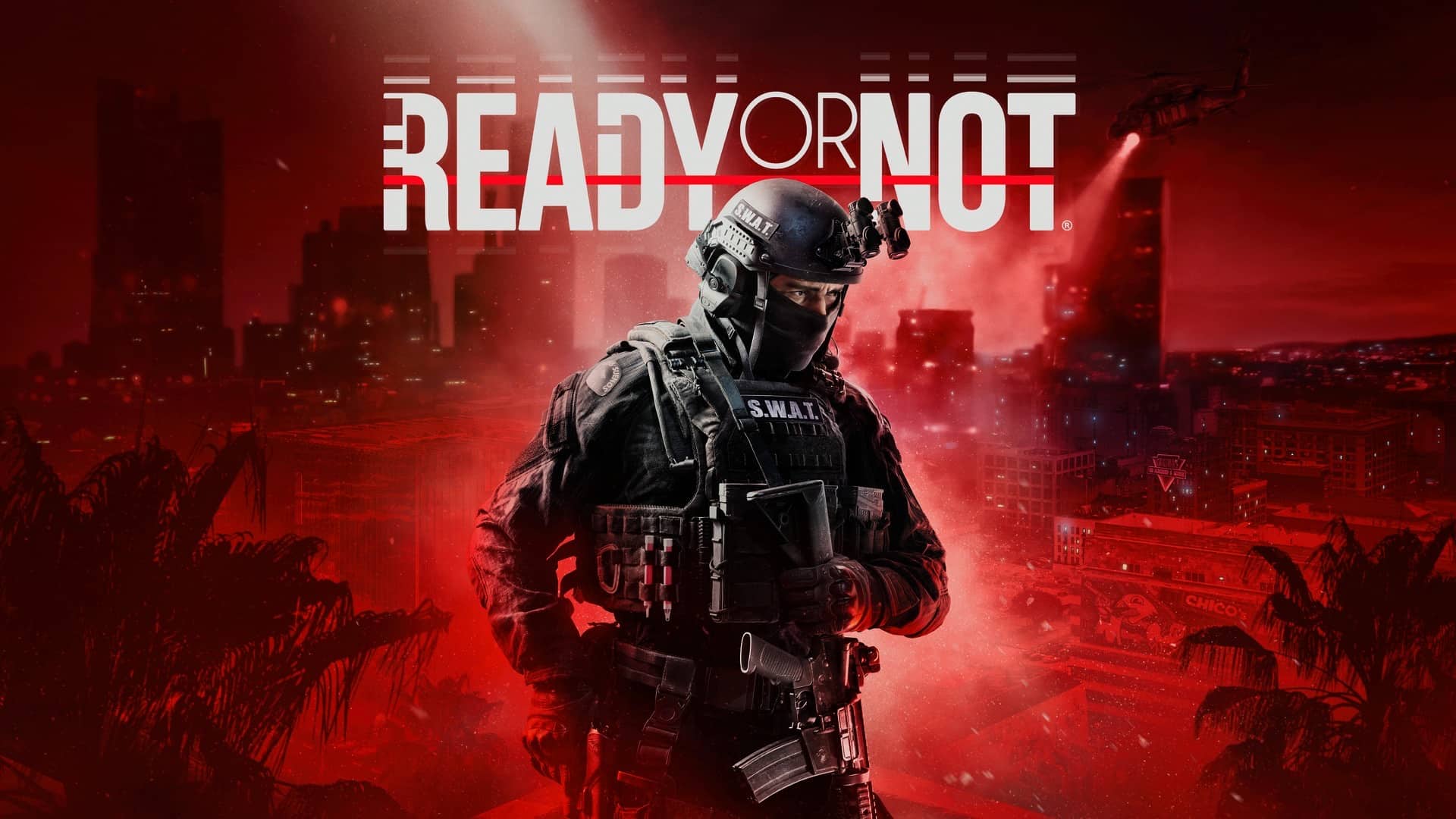
The work of security forces ranks among the most important in our society, and there’s no doubt that without their operations, it would descend into absolute chaos. The sight of a soldier, police officer, or even a member of special forces has always stirred in me not only respect but also curiosity. You probably won’t be surprised that I spent a substantial part of my childhood playing soldiers with a friend. Fortunately, I never came even remotely close to the kind of danger this work entails. Thanks to Ready or Not, I got to experience firsthand that wearing such a uniform conceals not only incredibly brave labor but also some pretty nasty stuff.
Weplaygames Youtube Channel: Ready or Not tactical FPS gameplay
Command Weight
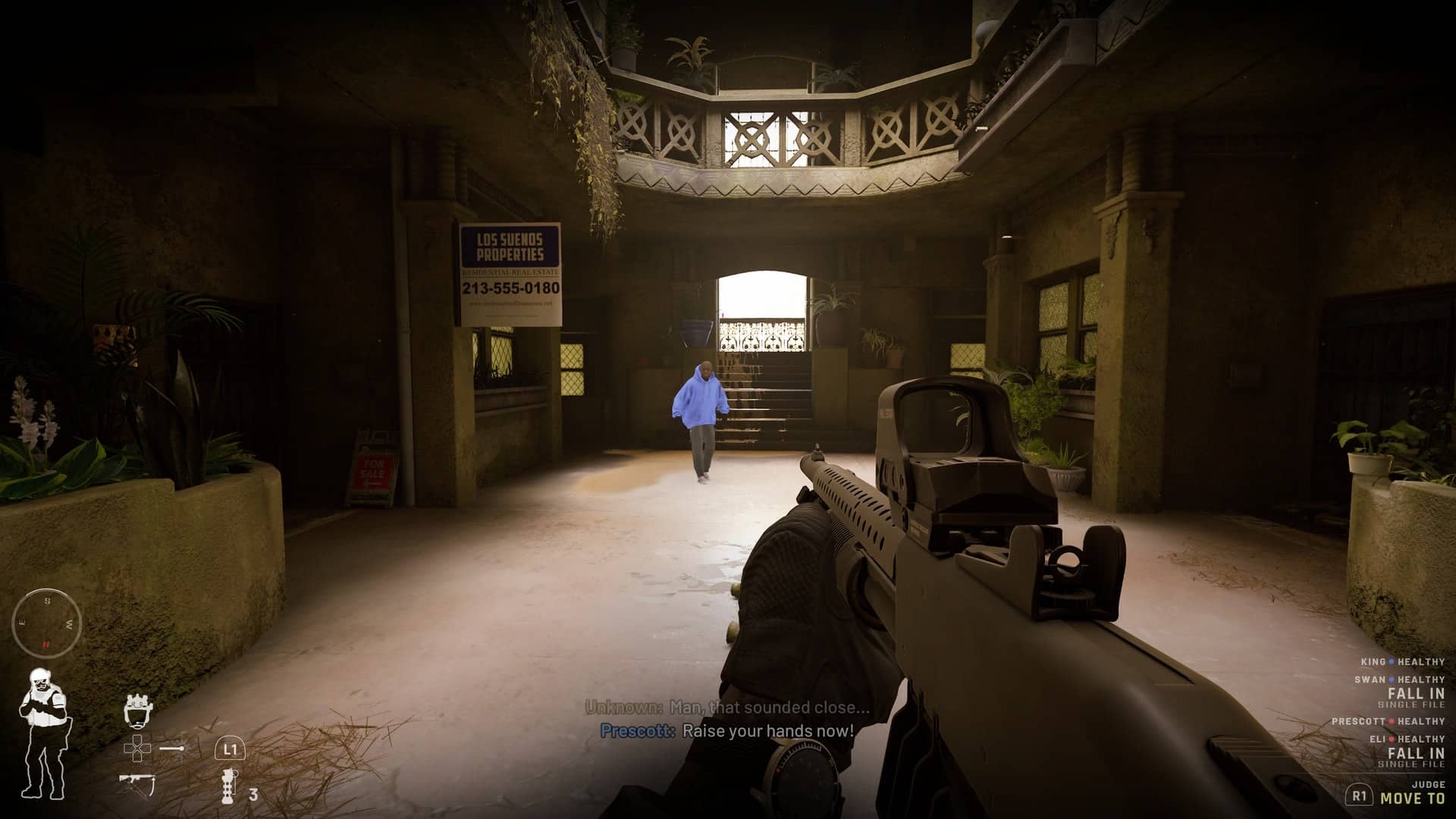
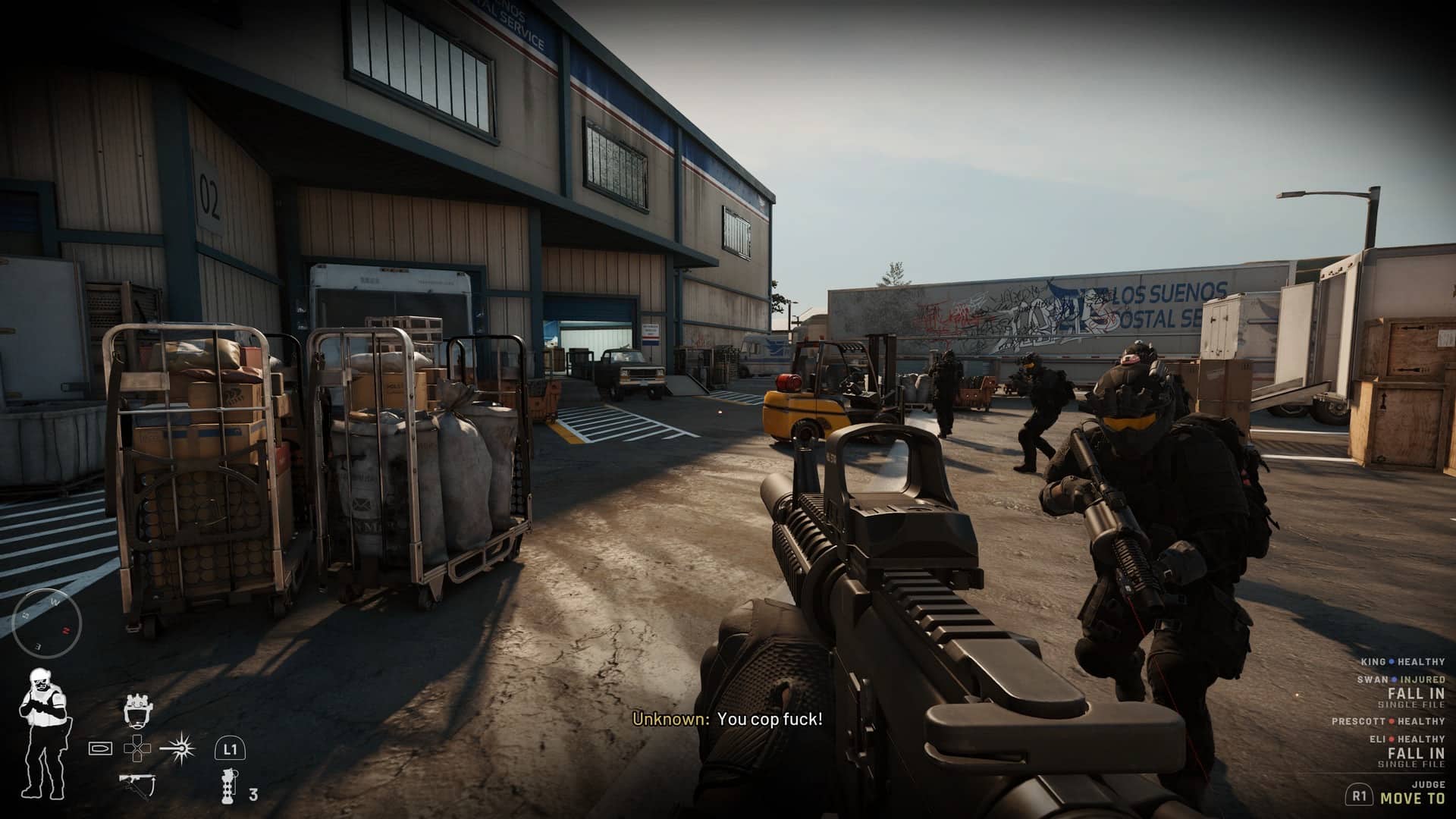
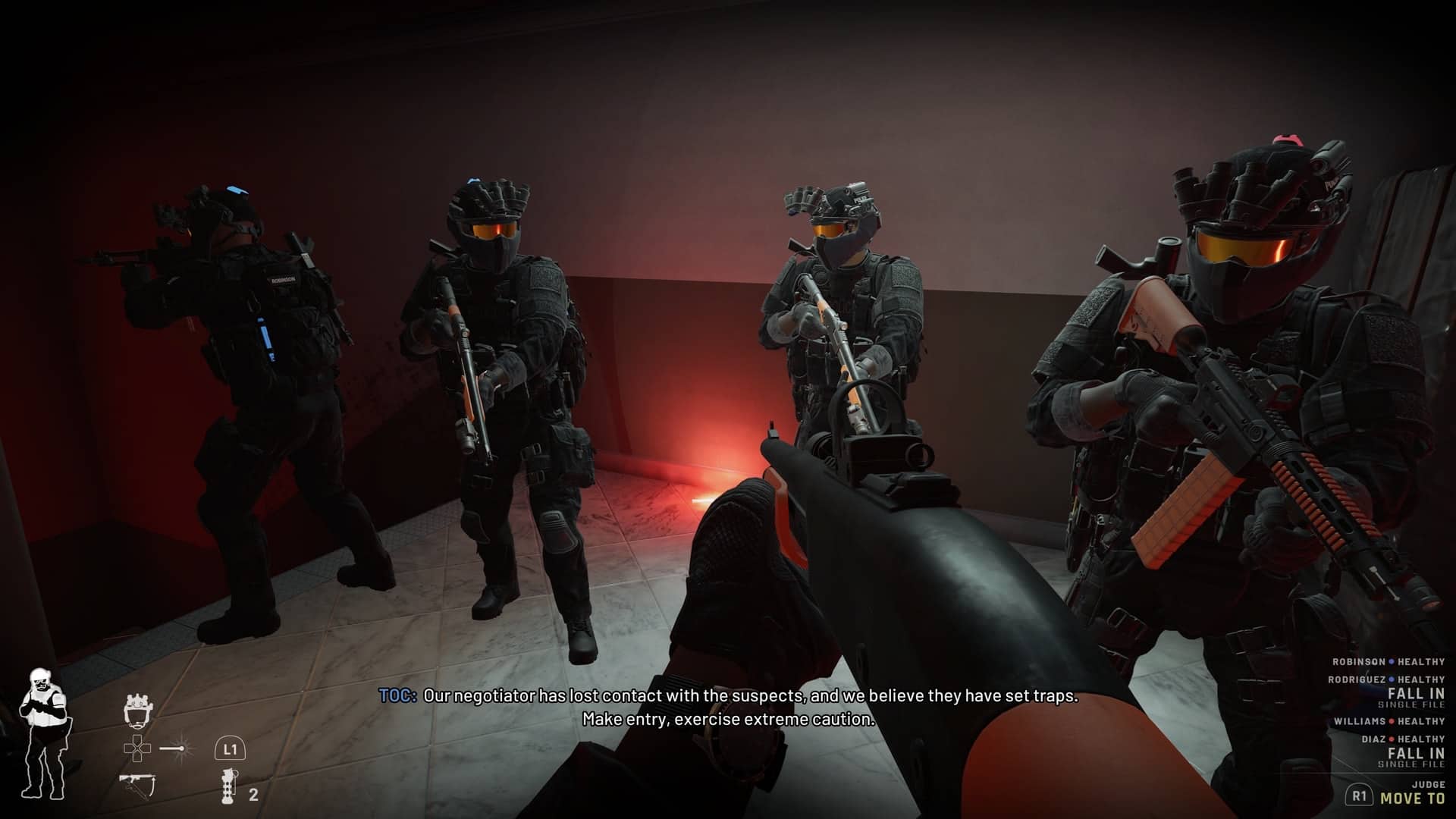
You’re wondering what could be harder than doing the job of a special forces member? Well, the job of their commander. That’s exactly the role the creators of this tactical hardcore shooter put you in. In the singleplayer portion, which doesn’t hide any deeper story, you’re put in charge of several officers who will accompany you on various missions. You’ll primarily be eliminating terrorists, attempting to arrest wanted individuals, protecting civilians, or defusing explosives. That doesn’t mean, however, that you’ll only be barking orders, as was the case in the SWAT game series.
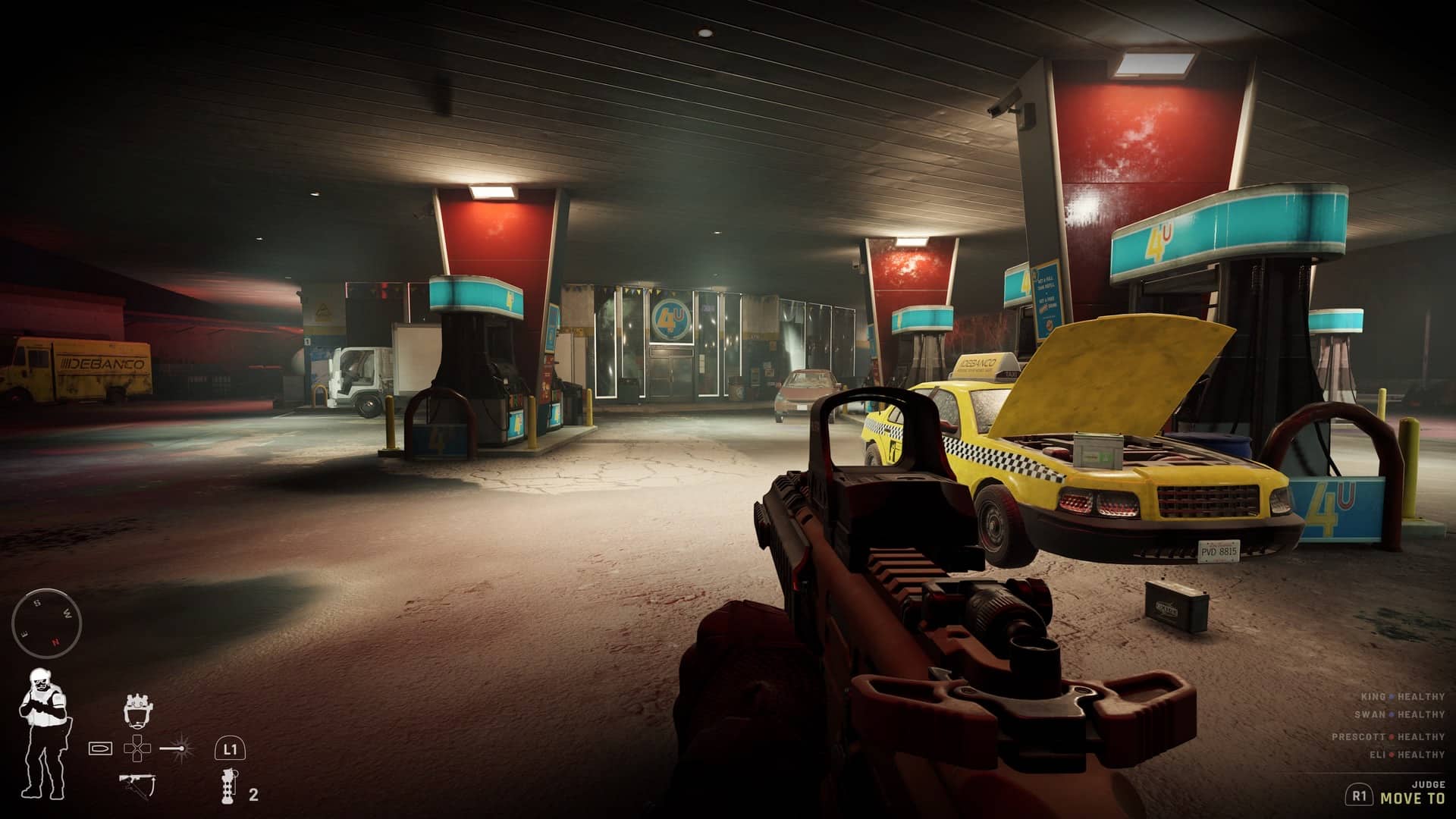
Ready or Not – Gas station mission 2
You’ll also be monitoring the mental state of your unit members. Officers are psychologically affected by injuries sustained in combat, the death of a colleague, or difficult situations where civilian casualties occurred. They can gradually find themselves stressed or depressed, which can also mean their complete departure from the team. It’s up to you whether you decide to be a good commander, care for them and send team members to therapy—which means their temporary removal from the squad—or be ruthless, firing them at the first opportunity and replacing them with new ones.
The stress system thus only functions as long as you want it to. In practice, this means that if instead of sending your officers to therapy you fire them and subsequently hire one after another, you won’t be penalized in any way. Hiring new officers costs nothing, and for many, this can mean an easy way to circumvent the system. If you don’t really immerse yourself in the game, you’ll miss out on a rather essential element revealing the issues of this profession. Although… it depends how you look at it. It’s still a game where massacre follows massacre, but while I wouldn’t want to in any way dishonor the work of these forces, the truth is that their deaths are rather rare. After all, these are trained unit members who are prepared for almost anything.
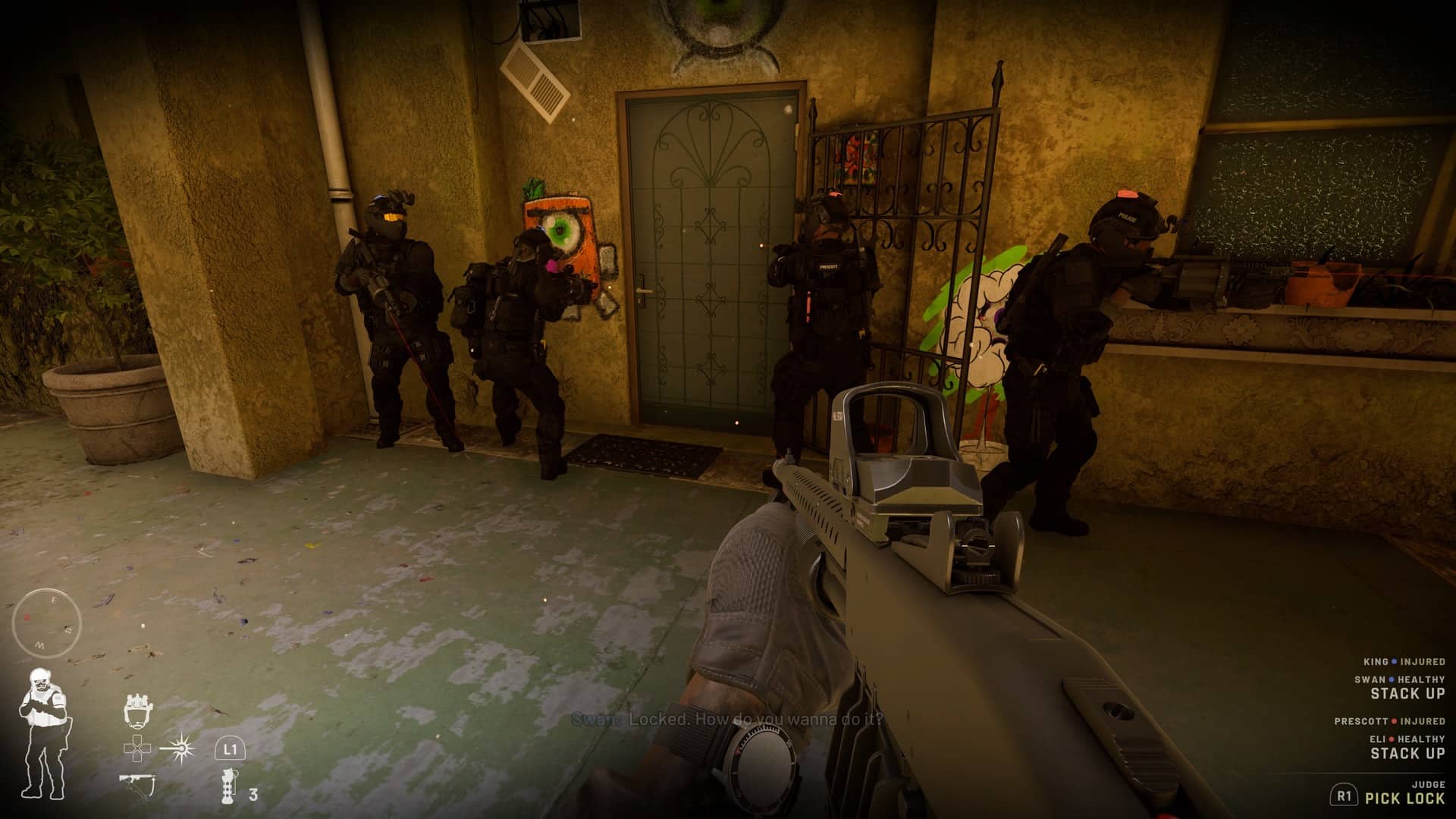
Ready or Not – Ready for breach
Missions That Stick
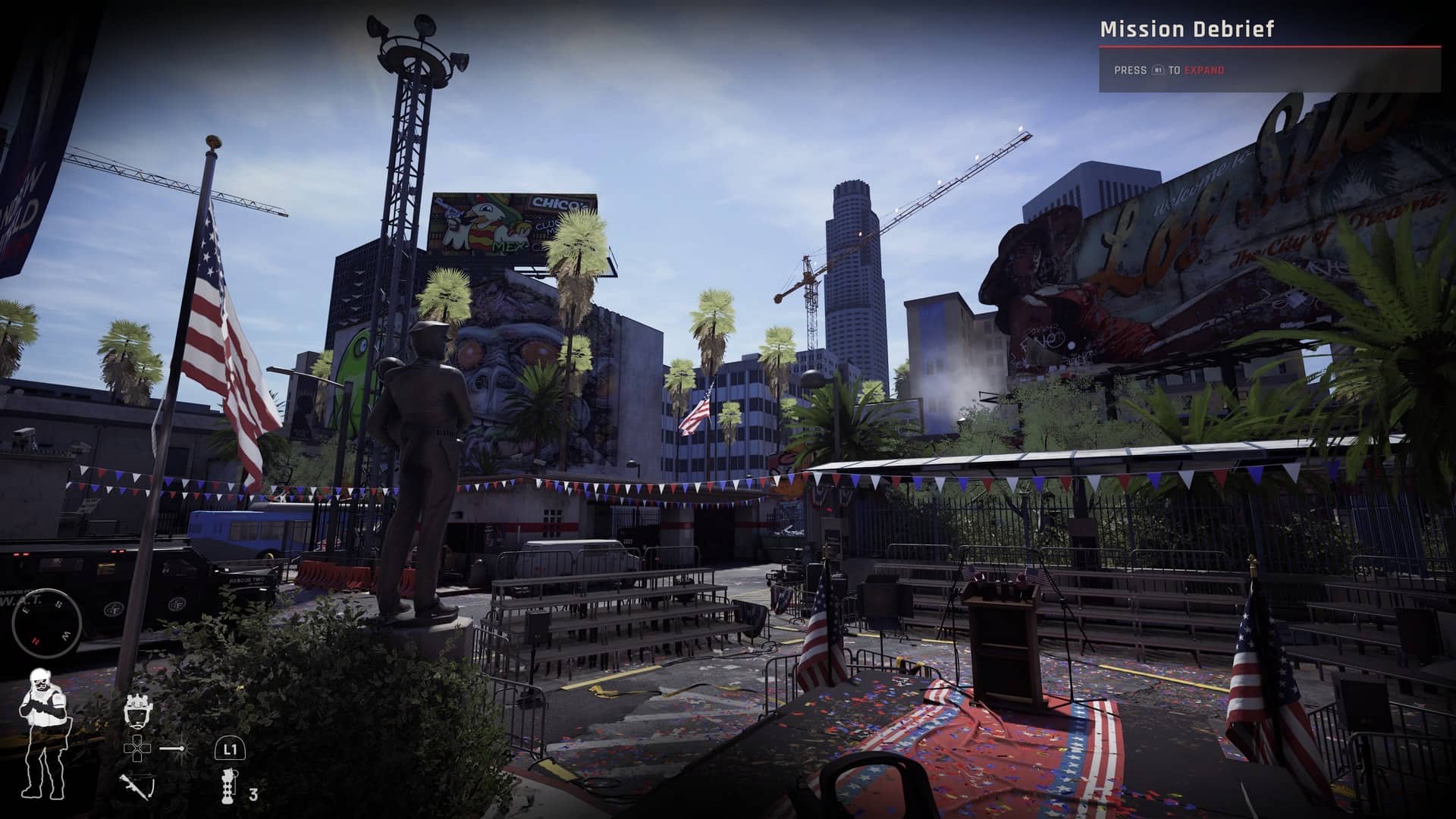
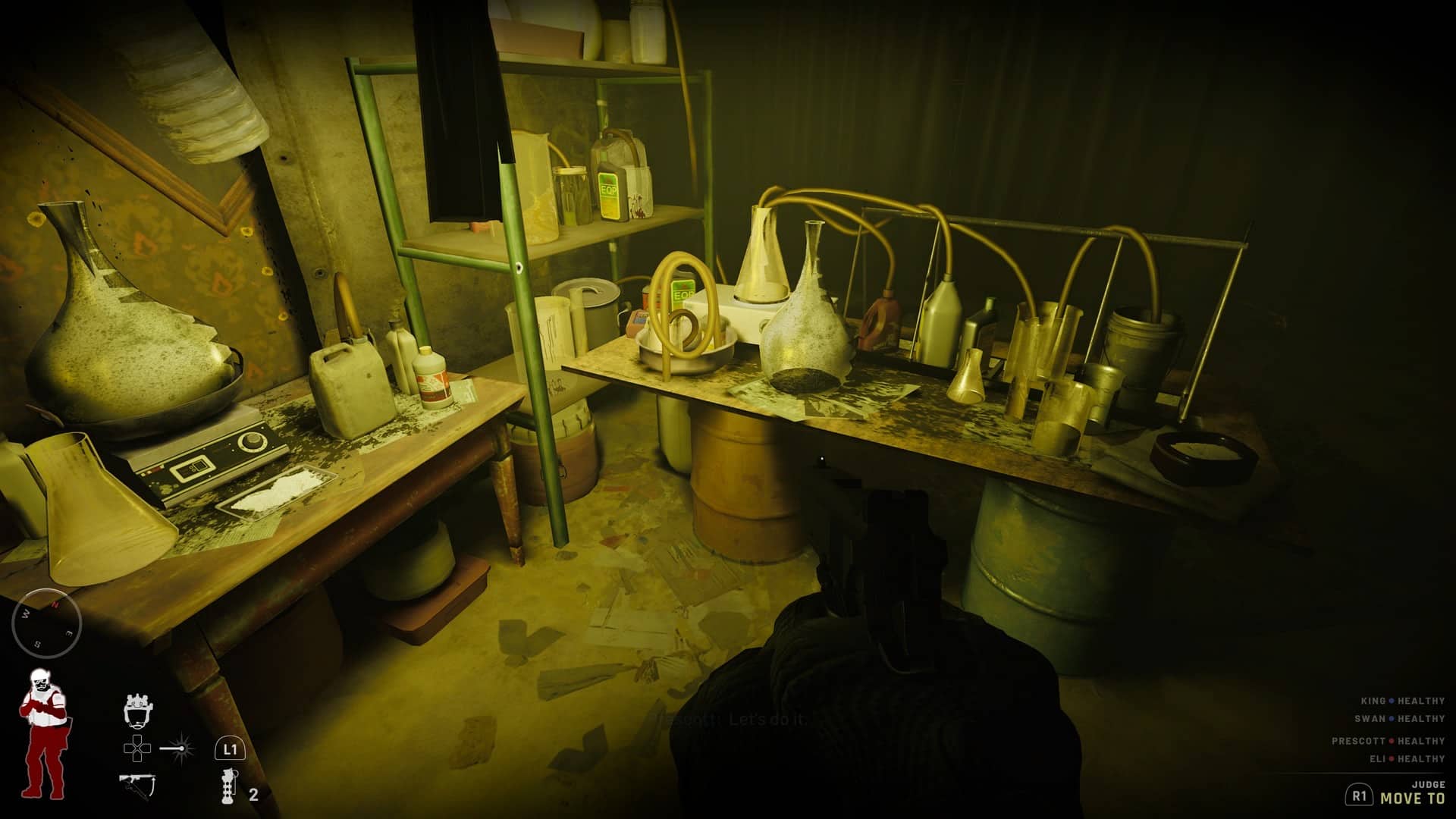
With my own eyes, I was deployed with my team against a gas station robbery, a hospital massacre, a village full of cultists with an atmosphere reminiscent of the horror game Resident Evil Village, a nightclub seemingly inspired by the John Wick films, or the lair of a crazed streamer. The believability of the levels is enhanced by meticulously crafted environments full of thematic elements that, upon closer examination, excellently connect the given cases. These aren’t just mere backdrops, quite the opposite. Each mission has a unique atmosphere that I’ll probably associate with this game forever. Ready or Not simply succeeds in showing an undistorted reality where in one second you can make a mistake that will mean lots of blood and unnecessary loss of life. And when I say unnecessary, I mean truly unnecessary. Among the terrorists and criminals move civilians whose survival is just as crucial as the actual neutralization of the enemy.
Ready or Not – Police station outside
Split-Second Calls
And here comes the risk factor. Correctly assessing a situation where it’s just an unarmed civilian is often complicated by their very behavior. Imagine, for example, a situation where part of your unit gets into a firefight and you, in haste and trying to support them, encounter a person who doesn’t comply with repeated commands to raise their hands and instead pulls out a phone. Even in relative calm, this is a situation that’s difficult to resolve. Let alone in chaos, during which your colleagues are dying nearby.
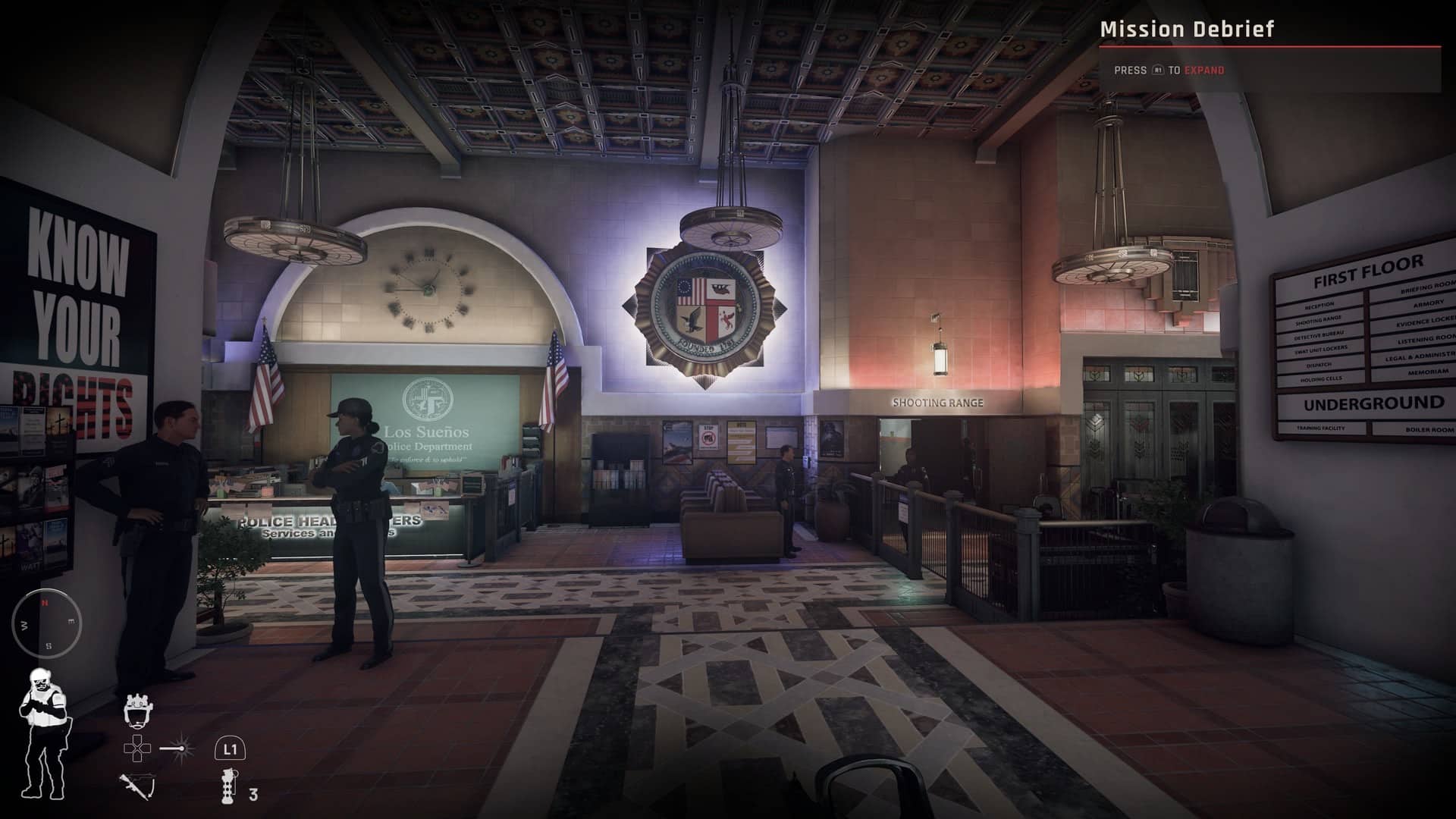
Even though the game is primarily designed as a cooperative title, the singleplayer portion can bring you at least a partially realistic view of the effort these forces put in, which most of us can’t even initially imagine. On the other hand, the game would be much better suited to dialogue cutscenes and perhaps the opportunity to peek behind the curtain of the daily lives of these forces, who must cope with the loss of their colleagues in addition to their own duties. Unfortunately, that didn’t make it in. Instead, I could only examine the unused detailed station environment and local characters who just stare at you without a single line of dialogue or mind their own business. The storyline, if it can be called that, is spread only across briefings that I could replay via audio track before deployment, yet I still felt that the story didn’t make it into the full version.
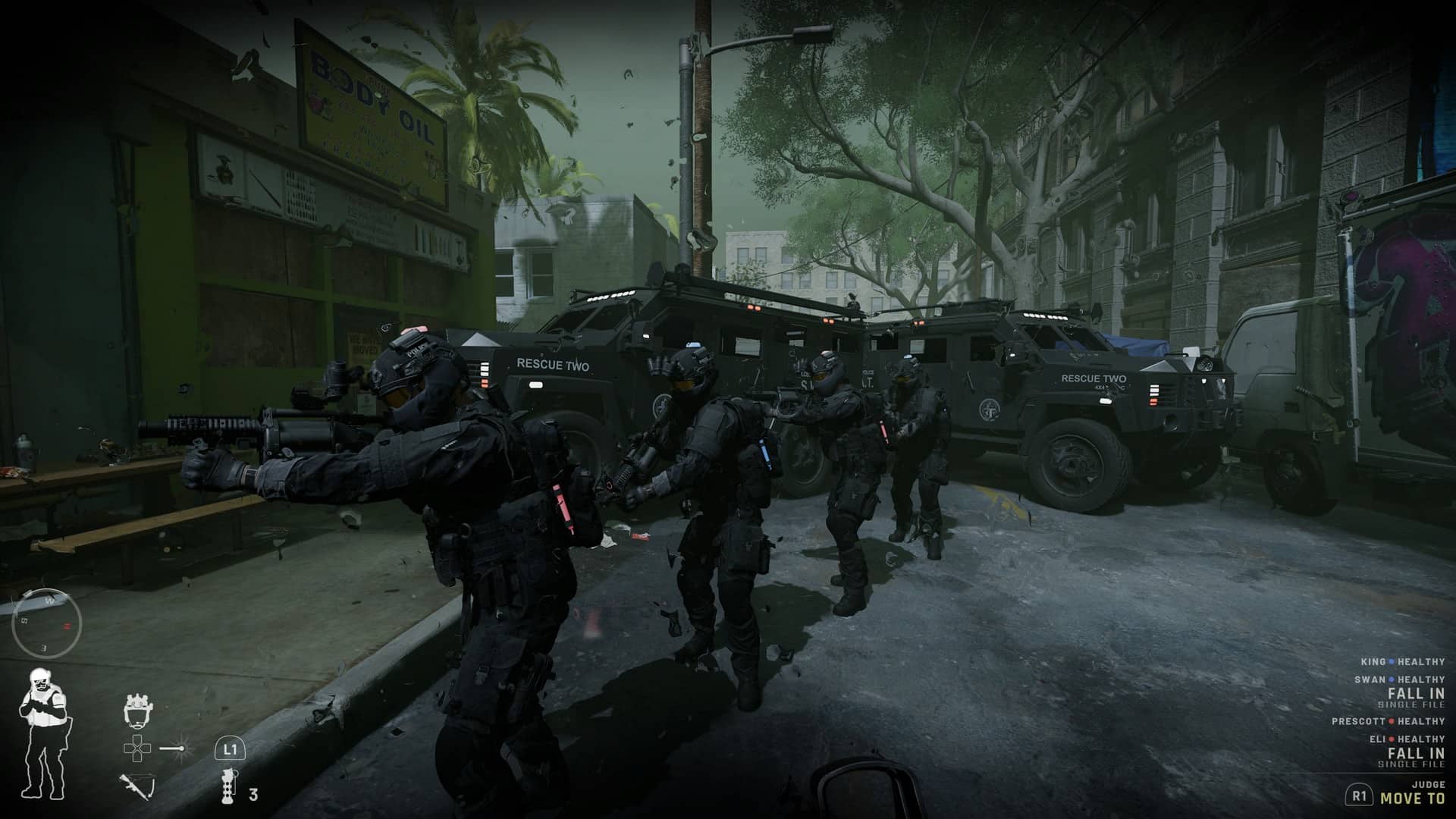
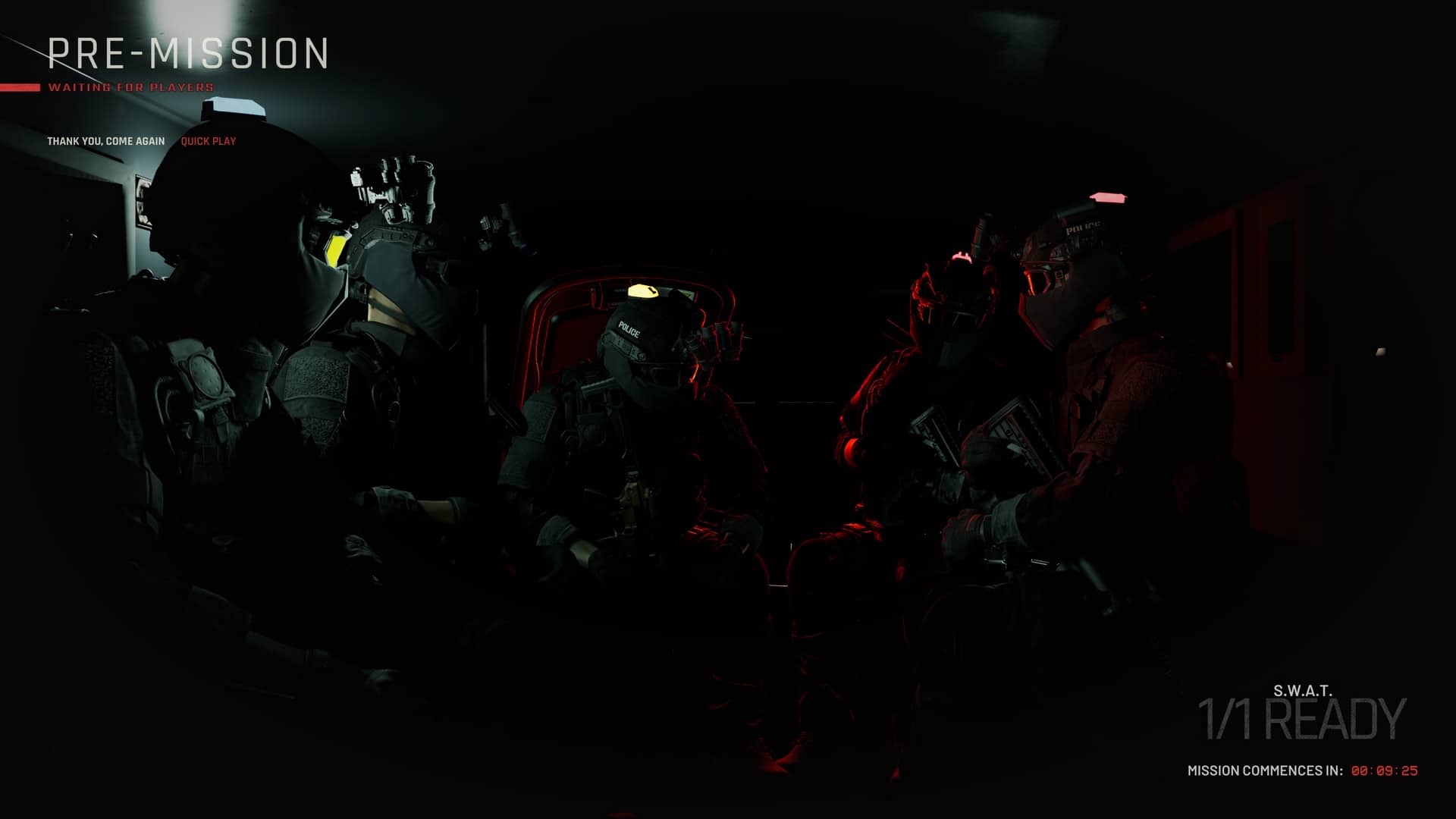
Ready or Not – Team ready
SWAT’s Heir
That doesn’t mean, however, that you won’t enjoy the singleplayer with AI colleagues playing through the same missions as in co-op. If you were a fan of the SWAT series, I wouldn’t be ashamed to call Ready or Not its spiritual successor, offering you more extensive options. You don’t necessarily have to kill enemies but can first incapacitate them with a flashbang and thus force them to surrender. In these cases, however, speed plays a major role, because if you don’t pacify the gunman in time, even after securing the firearm, they can pull out a backup weapon and make a big mess. But it’s not just the enemy who can do this—there are also non-lethal means like pepper spray or a taser in the arsenal, so completing the sub-task of arrest instead of killing doesn’t have to be necessarily unrealistic.
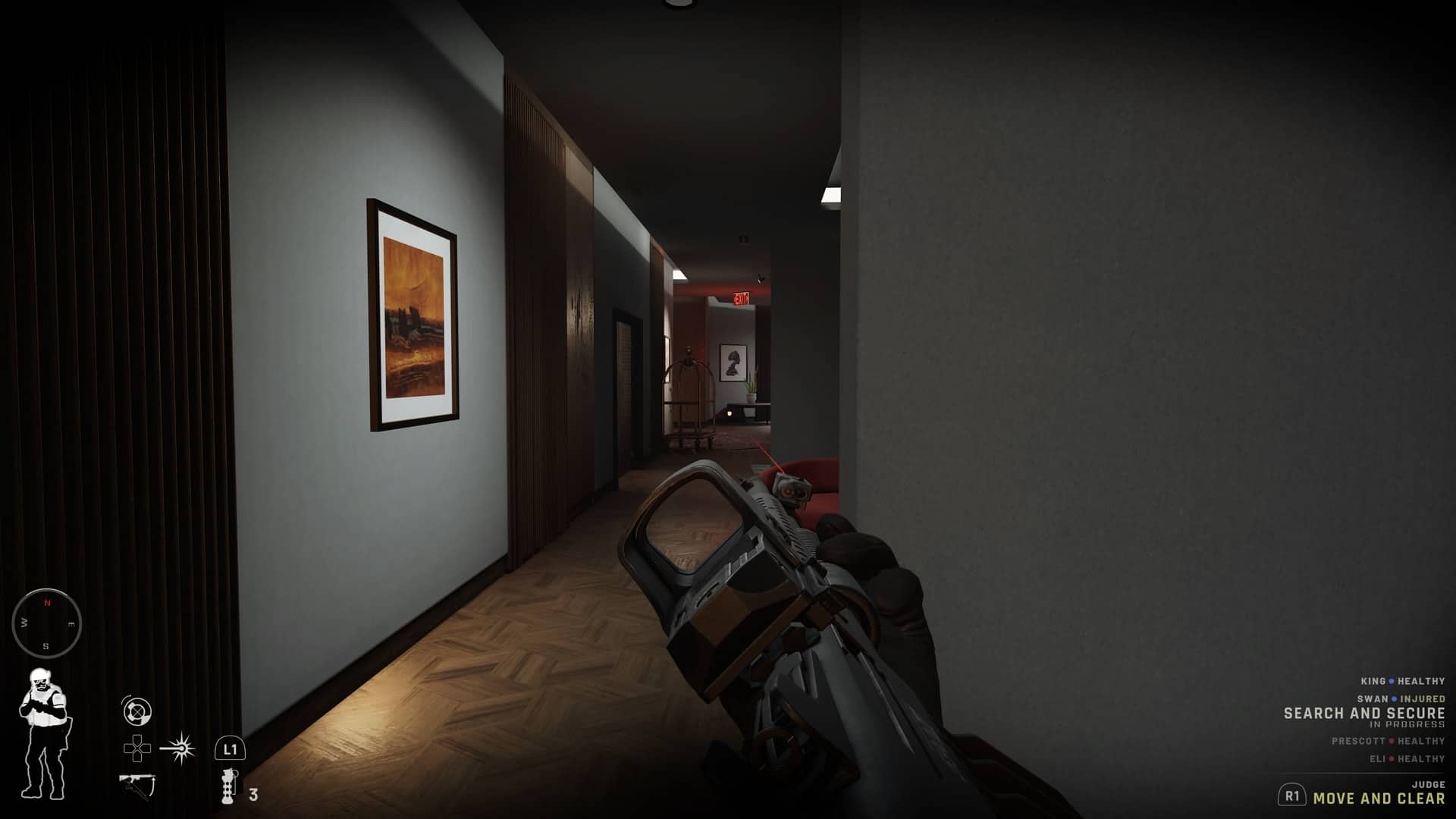
Ready or Not – Hotel hallway
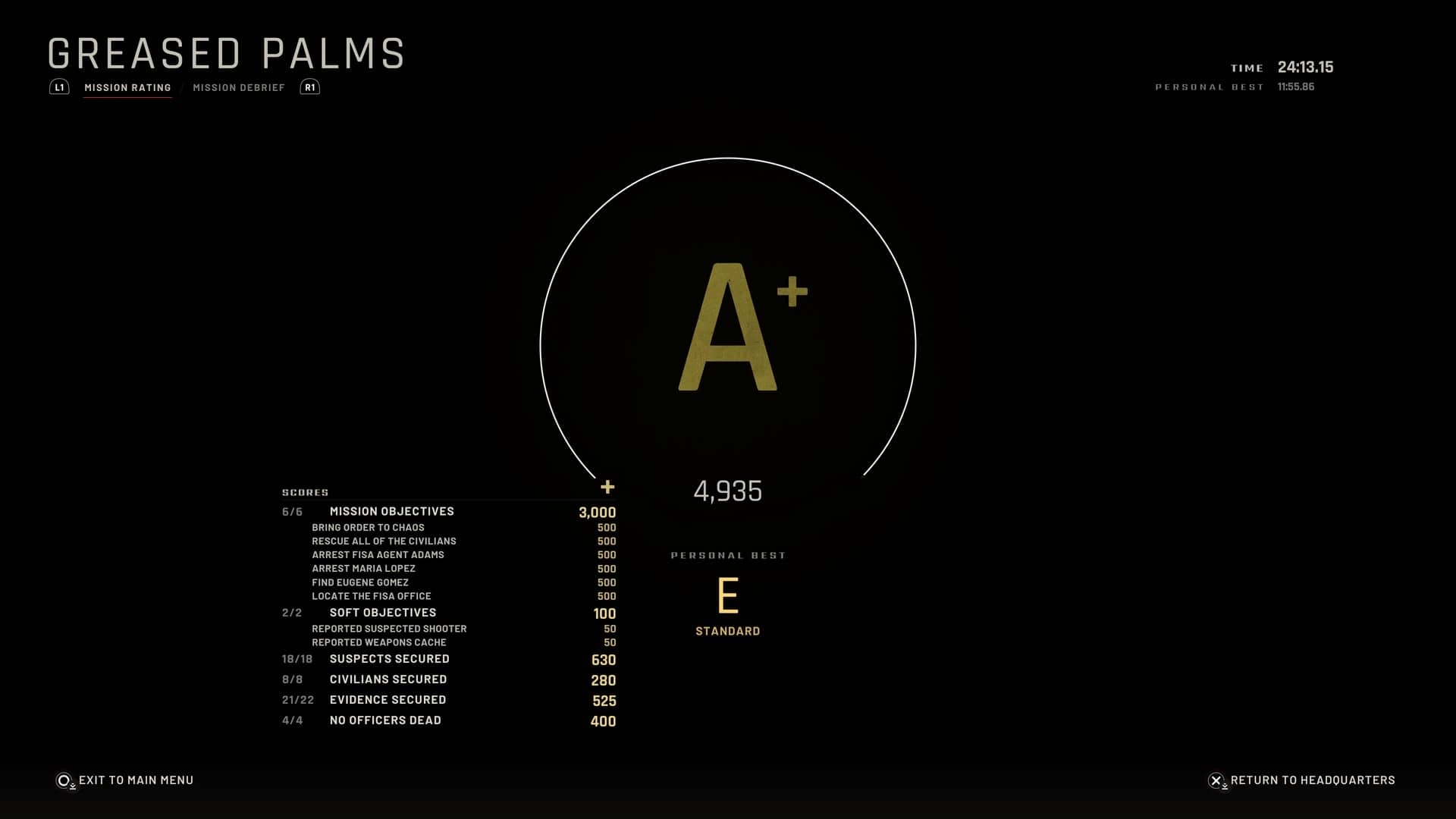
You’d be hard-pressed to find a better opportunity to try out the work of special forces. Still, I regret how close VOID Interactive studio came to perfection, yet some refinement is still needed even after the PS5 release that came later. I’m curious myself whether other types of rewards will be added beyond what’s currently available. Those are only cosmetic and exclusively clothing, not weapons, which are open from the start along with all other accessories. Each playthrough earns a grade at the end based on meeting certain criteria, such as whether your colleagues and all civilians survived. If you achieve the required grade, you’ll unlock, for example, a new tattoo or perhaps boots. But it won’t add any bonuses.
Where Co-op Lives
If you’re getting this title primarily for co-op and you actually have people to play with, I dare say you’re not looking at dozens but easily hundreds of hours of fun. I myself already have over 80 hours in the game and enjoyed most of them. Coordination of your team is key, and if you opt for anarchy and a solo approach, you’ll die. All of you, to the last man.
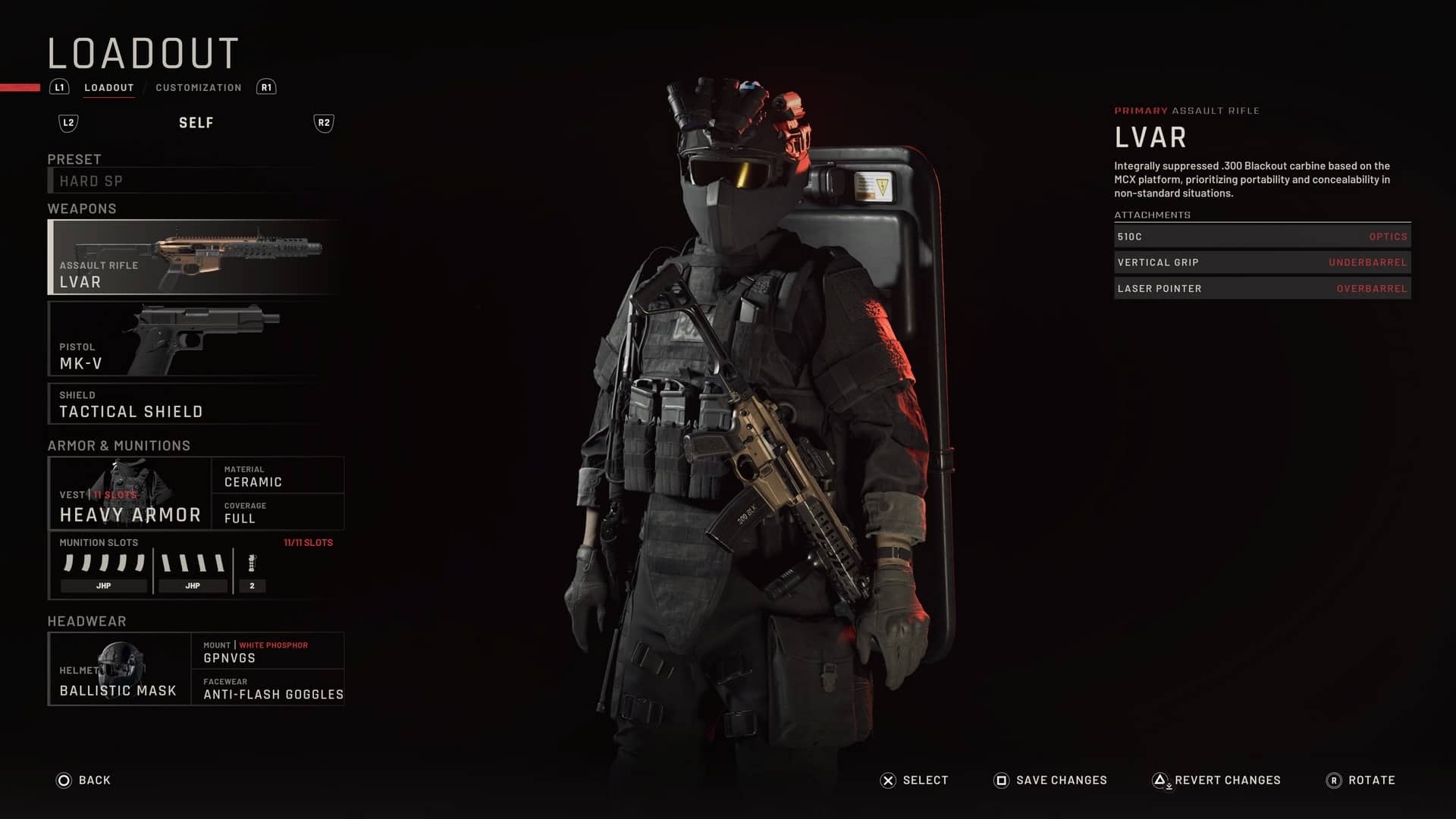
Ready or Not – Heavy armor loadout
Now it’s time to move on for a moment to the negatives. I can say right away that the enemy AI is sometimes simply unfair and equally demanding regardless of how many players you’re currently playing co-op with. It often happened to me that I carefully checked a room corner by corner and the strike came through a window. I admit, it’s realistic and I could indeed lose my life that way. However, any passage through the same level by the window often meant instant death or serious injury and absolutely perfect enemy accuracy. But it’s not just predetermined locations—for example, peeking through a hole in a fence. I barely glimpsed anything and took a bullet to the head. And that’s something that after 20 minutes of walking through the level really started to bother me, although we’re talking more about the higher difficulty.
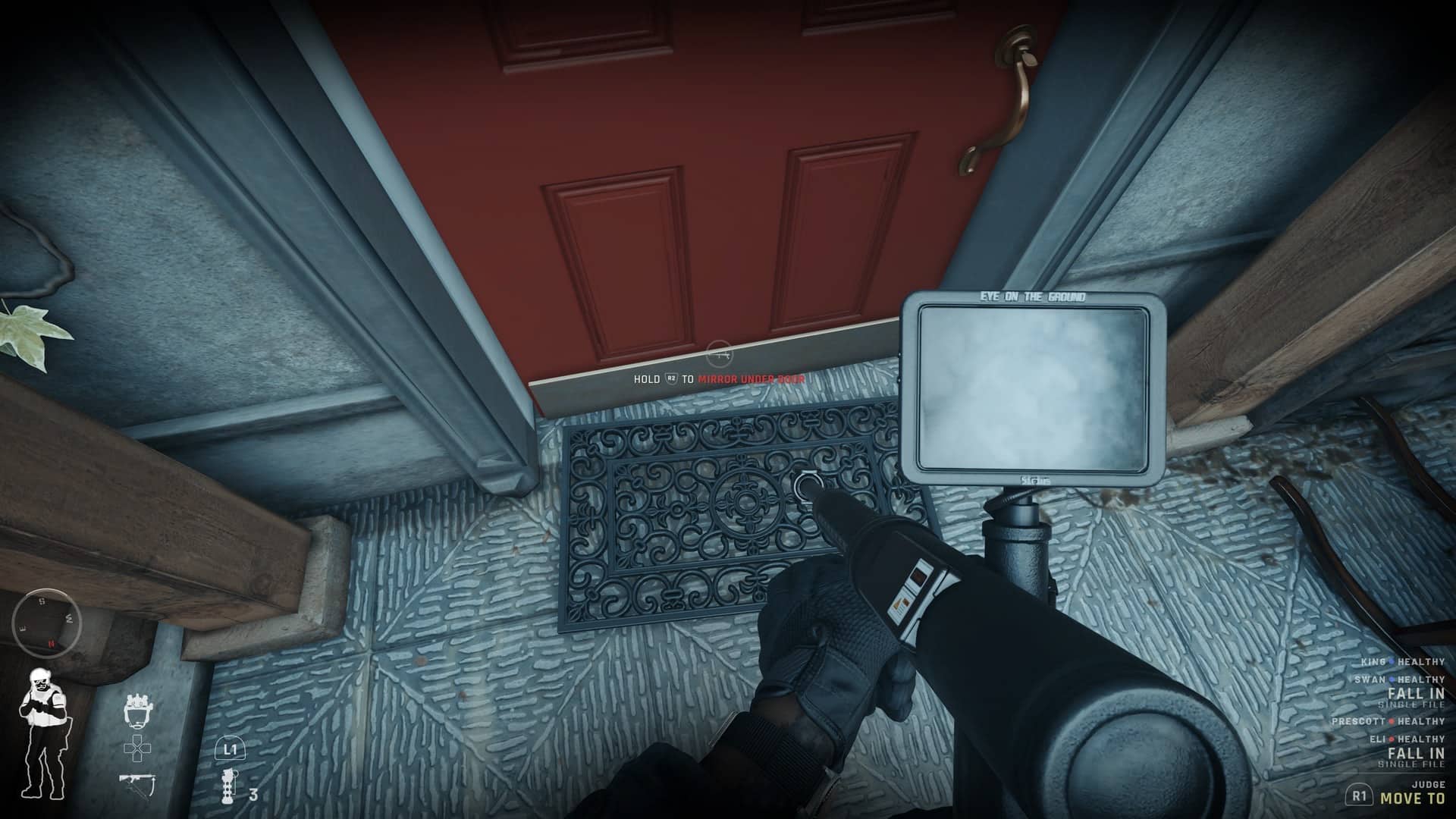
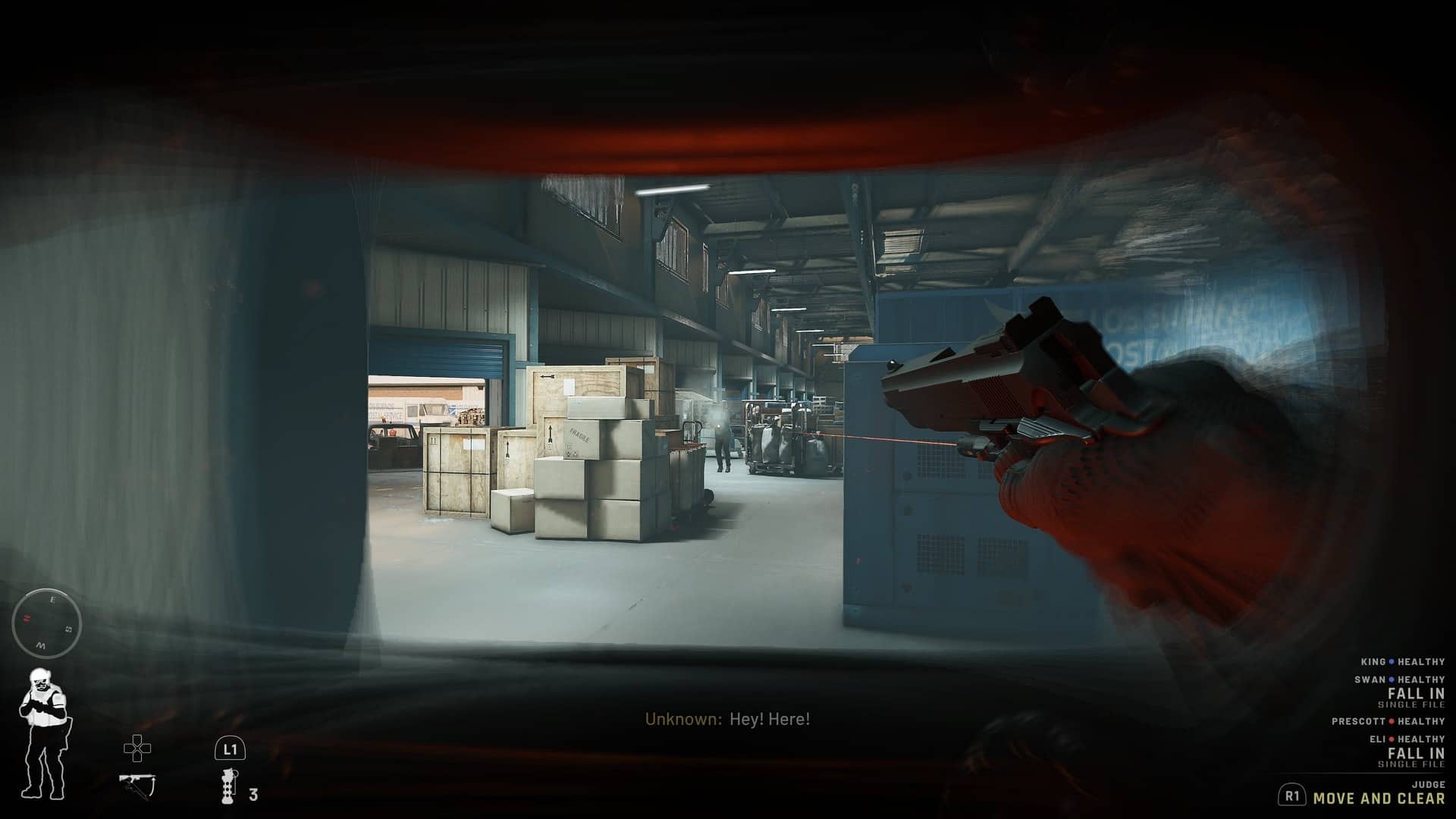
Fortunately, similar situations don’t happen that often, and in practice it means that while you won’t avoid the occasional cursing, the playthrough with your friends will still be really fun. Especially if you surround yourself with a team that strives for professionalism. If you really want to enjoy co-op, you should determine right at the start who will be breaching doors with a ram, checking under them with a mirror, covering with a shield… And most importantly—who will take on the role of commander. Uncoordinated movement through the level primarily means failure. Unlike a progression where you report the status room by room. And maybe in retrospect I’d recommend going through at least part of the aforementioned singleplayer, which can adequately prepare you for potential command.
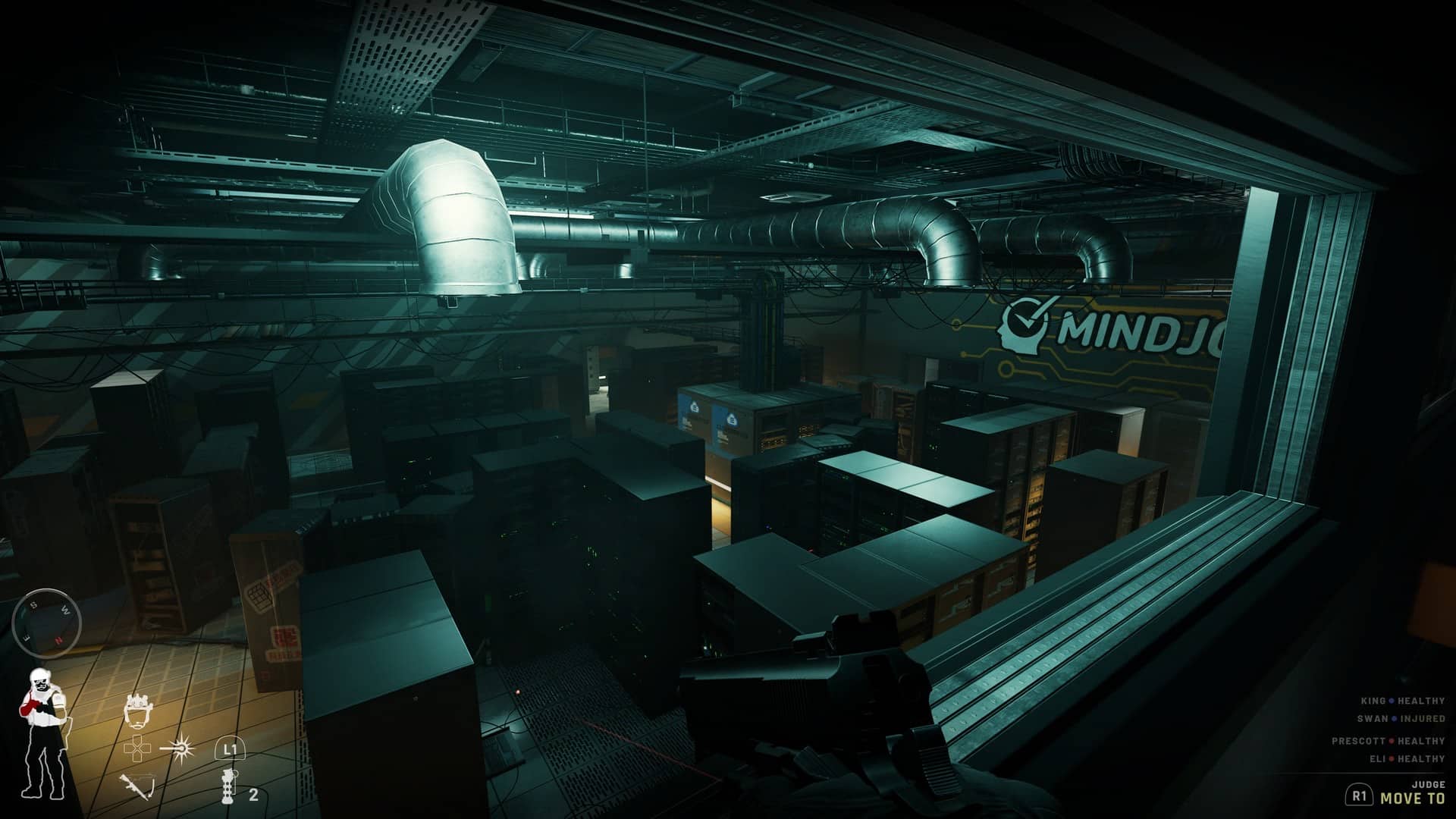
Ready or Not – Server room
Loadout Depth
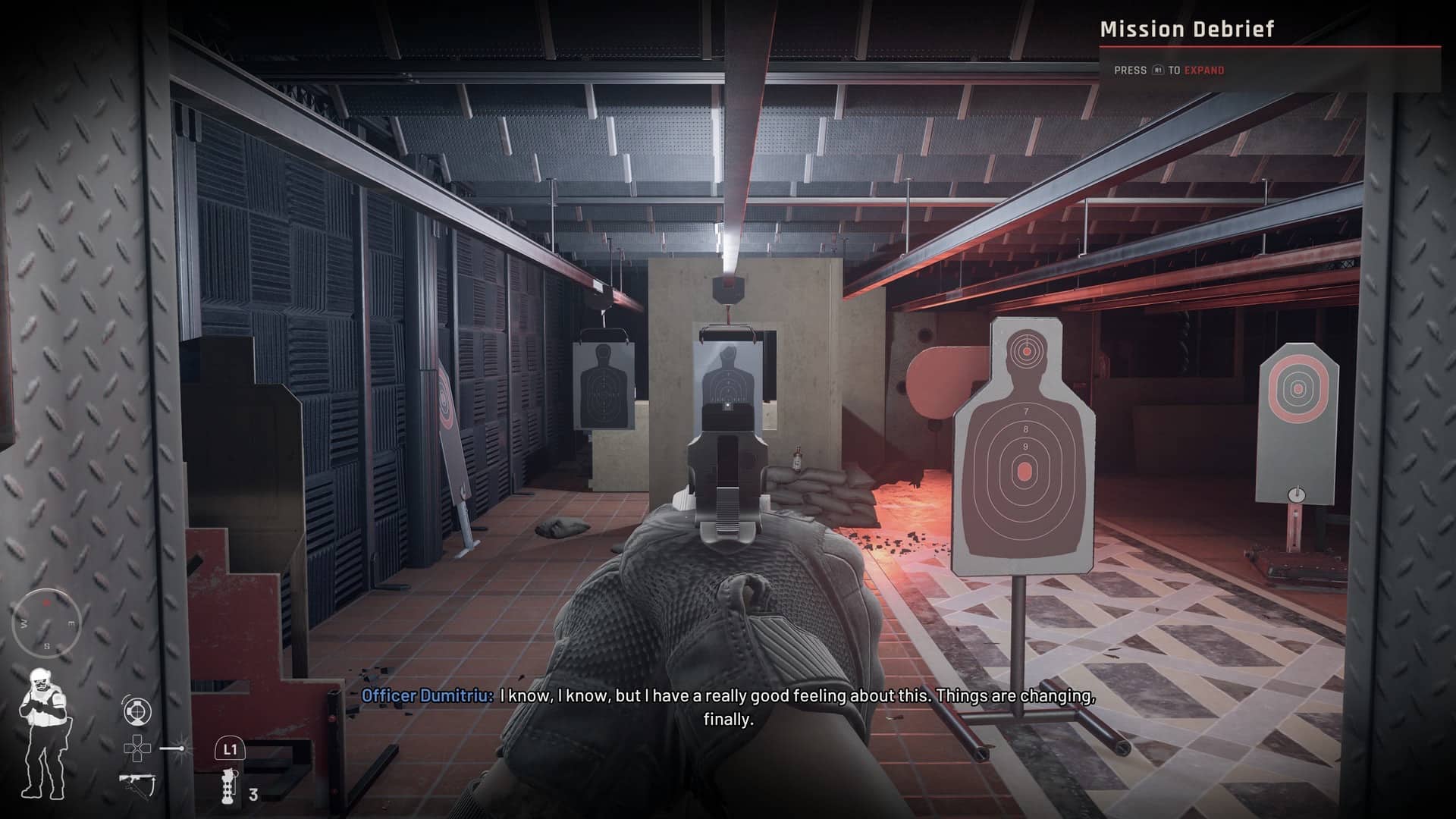
The selection of equipment is rich. Besides specialization in carrying a shield, ram, or mirror, you can choose between different types of explosives and stunning devices. The type of armor and bulletproof vest is also important. While in lighter gear I could carry more ammunition, in heavy gear I could withstand more but had to conserve bullets. So everything depends on what playstyle suits you best. Personally, I preferred to choose more durable armor with fewer magazines for a more cautious approach than light armor with more ammunition. And this goes hand in hand with the arsenal of weapons. It’s rich and offers submachine guns, assault rifles, shotguns, and pistols. The feel of shooting is different for each weapon. They differ in recoil, animations, sound, and you simply know which weapon you’re currently using. You don’t need any colored skin or print to recognize the given weapon. A single shot is enough. And if Ready or Not excels at anything, it’s definitely the awareness of what power each of your rounds represents.
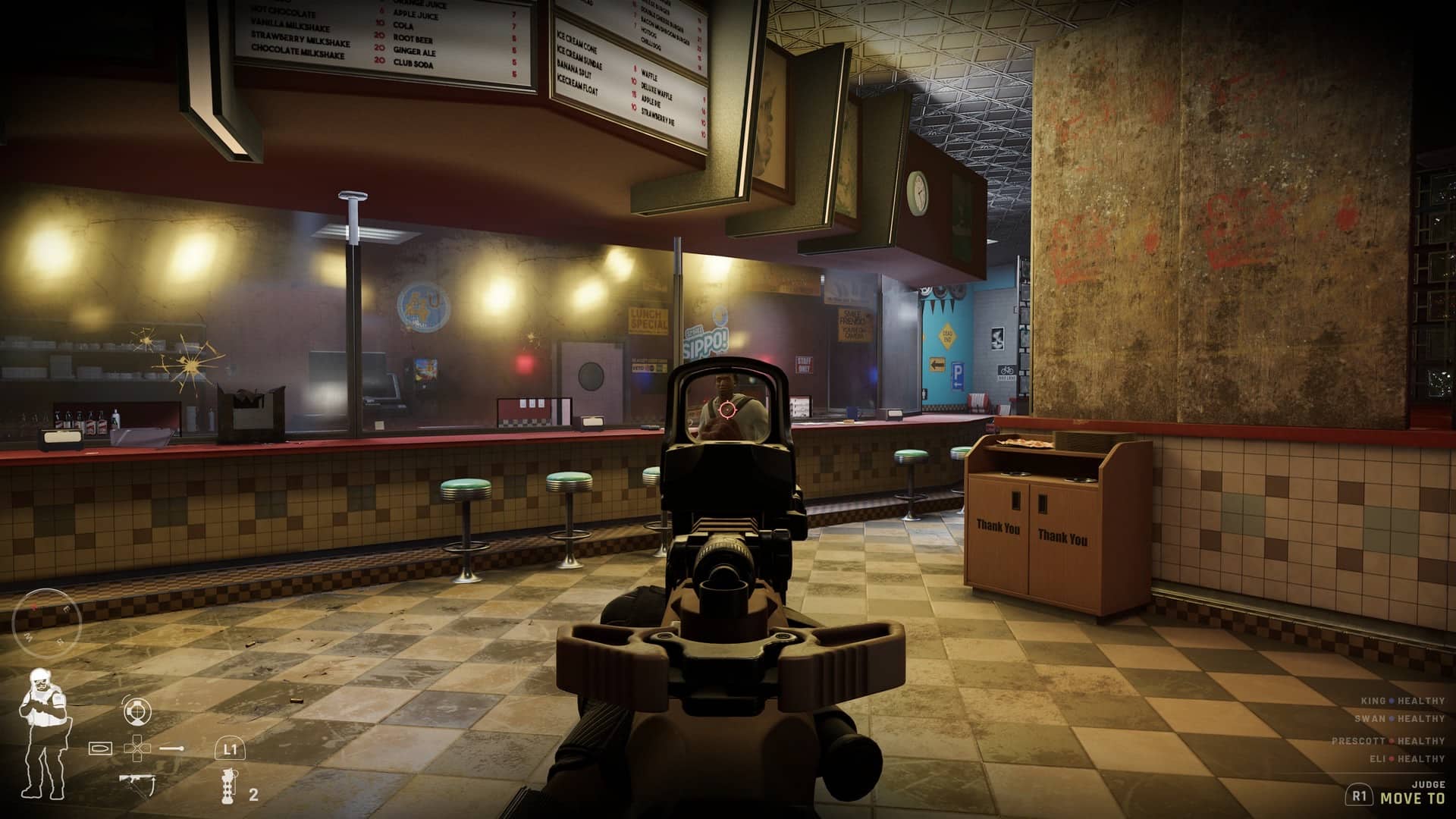
Ready or Not – Gas station mission
Tactical Pace
This is also aided by the slower pace. Ready or Not is first and foremost a tactical shooter that isn’t characterized by sprinting and frenzied shooting across the entire map. The freedom of movement is quite verified for players. Such common leaning left and right from around corners can be done smoothly and in increments here. Just as you can move your body up and down from standing to crouching. Thanks to this, you can examine each room and space to the smallest angle and thus avoid overlooking a possible enemy. Furthermore, immersion is characterized not only by magazine check options but also quick reloading, which although you’ll lose a half-empty magazine, you’ll load a new one into the weapon much faster. Or you can just swap the half-empty one for a full one when you know a bigger firefight awaits and you don’t want to get into a situation where you have to reload during combat chaos. I mustn’t forget the alternative aiming when hip-firing. The implementation of lasers when hip-firing deserves praise. They don’t serve here merely as a cool accessory that only shines where you’re aiming, but I actually achieved more accurate close-range hits with it than when using traditional sights.
Ready or Not – Securing a civilian
Your Rules, Your Mistakes
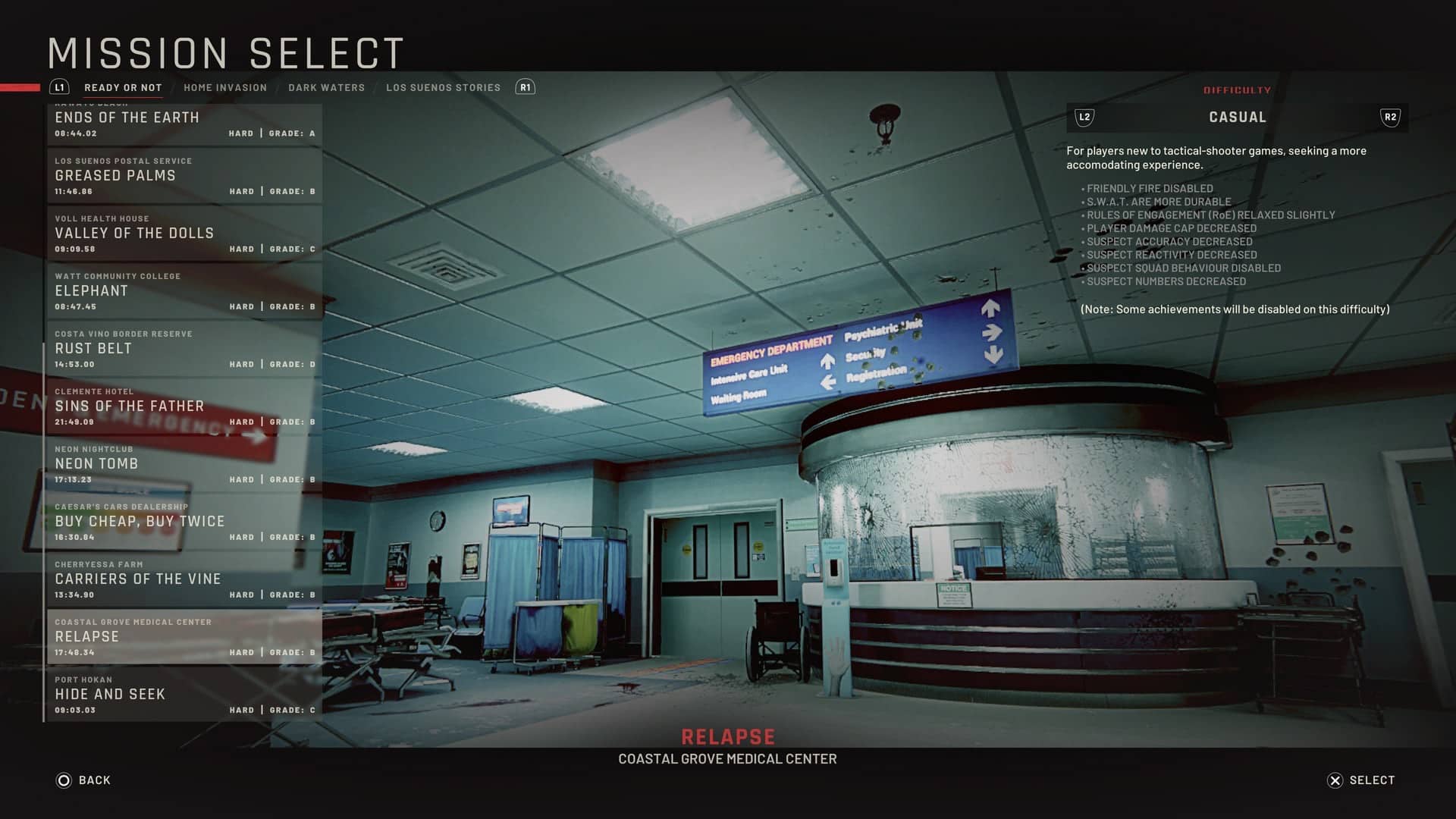
And it’s precisely in the absolute freedom and options of what and how you do things that the real fun lies. You find out that an armed enemy is standing right behind the door? You can get them by shooting through the door. Want to attack from the side? Or send each team through a different entrance? It’s entirely up to you. Even if it’s a stupid idea, you can go and kick down every door you encounter. Or first pry them open or shoot out the hinges with a shotgun. But without prior checking whether someone is standing behind the door or whether there’s a trap set right behind it, you can lose everything. You hold your life, including your unit’s, only in your own hands. So it happened to me a few times that I didn’t have time to think about potential danger and while clearing a hallway of residential units, I didn’t think to check the upper staircase, which resulted in one member after another starting to die, and if I hadn’t run upstairs, I would have been left completely alone. And in the case of scarier missions like Relapse, that wasn’t exactly what I was looking for.
Ready or Not – Using mirrorgun under the door
In case you maintain a cautious yet smooth pace of movement for your or other units, it will have an almost cinematic impression. I often even caught myself deliberately stopping in passage and examining individual environmental details. This is sometimes processed excellently to an absurd degree. You can see all sorts of inscriptions, flyers, objects hiding references to various game series or jokes. Although the game looks really great for the most part, some compromises that are occasionally an unwelcome thorn in the side are disappointing. Light bulbs cannot be shot out. Maybe that’s to some extent good, because the lighting across the entire game is more than solid. When I was admiring from a window overlooking the sea, I saw how it was divided by boundaries of repeating textures. Not a nice sight. On the other hand, it’s hard to estimate what’s behind this shortcoming. After all, it’s a background element and no title gets by without limitations.
Technical Rough Edges
It’s also too noticeable when members of my crew look identical to each other. The game offers customization of your character’s appearance, so there should be something to choose from. I wouldn’t be surprised, however, if the developers didn’t have time.
Ready or Not – Taking cover behind a shield
This suspicion is also manifested in insufficient optimization and overall technical state. Constantly disappearing random loadouts, enemies loading in at higher distances from which they can immediately shoot at you and often even hit, or unnecessarily long loading screens. I believe this will still be fixed; it’s clear that certain sacrifices had to be made for some aspects of the game before release. And speaking of those sacrifices, their screaming is unforgettable. Surprisingly, it’s not the civilians but mainly the shot enemies. These are often accompanied by screams that would wake the dead. Nice long screams…
Sound Design That Matters
Even though there’s no storyline and cutscenes in the game, the character dialogues and for example the audio recording of the briefing really do listen well and partially awaken a desire for the presence of a real story. Besides music, ambient sound also adds to the atmosphere, when for example after hitting a car its alarm goes off, in tunnels there’s an absolute echo, and each step of your colleague or enemy is distinctly audible. The musical backdrop is chosen differently for each level, but primarily it’s electronic music called breakbeat, which characterizes the given location more. What amused me most was the use of Bach, during which I as commander fell in battle while a string orchestra played. Simply classic. The weapons are also excellent sonically, which I’ve already raved about.
Ready or Not – Post-game rating
Despite obvious shortcomings such as balancing and bugginess of the AI or unfinished mechanics, this is a title that brings a unique experience. At the moment, it’s even the best tactical co-op game where you and your friends will have fun for more than a few dozen hours. You’ll simply melt over the sounds of gunfire or fallen enemies and won’t even have to use several hundred rounds to do so. The variety of levels is helped by the use of different color palettes and detailed environments, thanks to which you’ll feel as if you’re really deployed in a different place each time. All this is wrapped in an immersive execution in which each piece of equipment isn’t just a nice accessory but an actually functioning piece of gear that corresponds to reality
Final Words
Ready or Not offers the opportunity to taste the work of special forces, thanks to which some may create a much better picture of just how complex and underappreciated labor it truly is. Risking one’s own life to save civilians shows not only immense courage but also a dark side where the slightest mistake can turn into absolute catastrophe. Although it’s not the only title that has managed to at least partially approach the extreme conditions of this profession, I’m convinced that Ready or Not has succeeded in getting by far the closest so far. Poor coordination and leadership can put you in situations where you won’t be sure whether you’ve gotten lost. And once you lose control of your surroundings, you’ll barely have time to pull the trigger.
About the Game
Title: Ready or Not
Type of Game: Tactical First-Person Shooter
Developer: VOID Interactive
Publisher: VOID Interactive
Release Date: December 13, 2023 (PC Full Release); July 15, 2025 (Console Release)
Platforms: PC (Windows), PlayStation 5, Xbox Series X|S
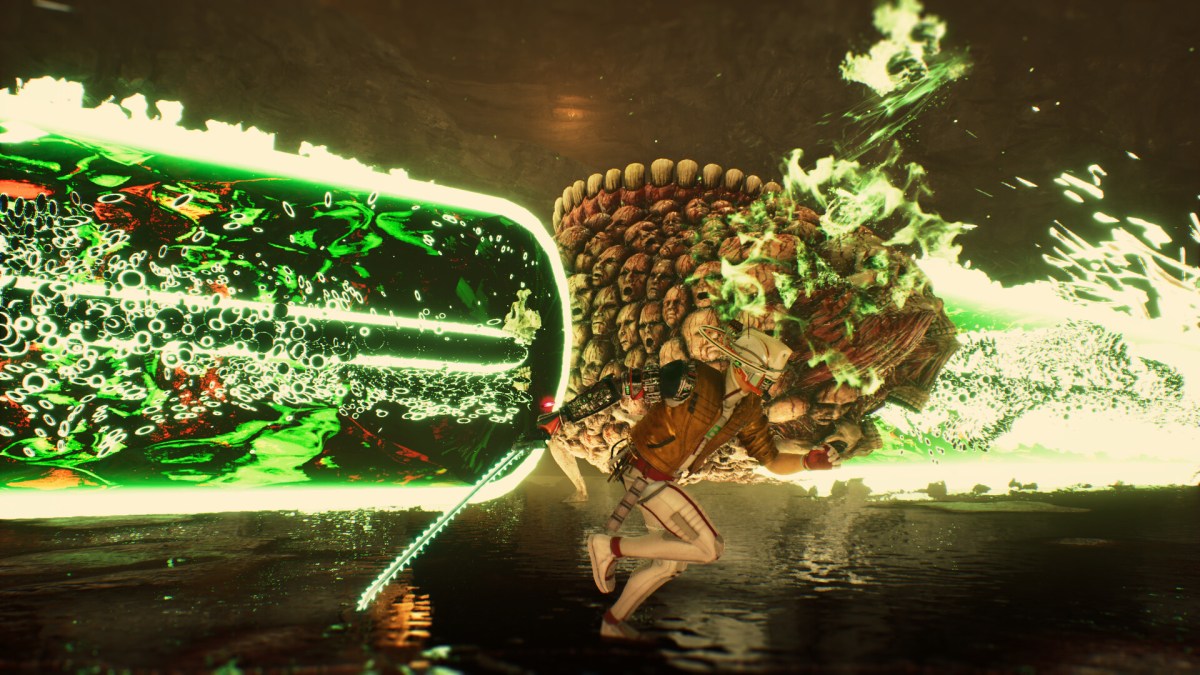
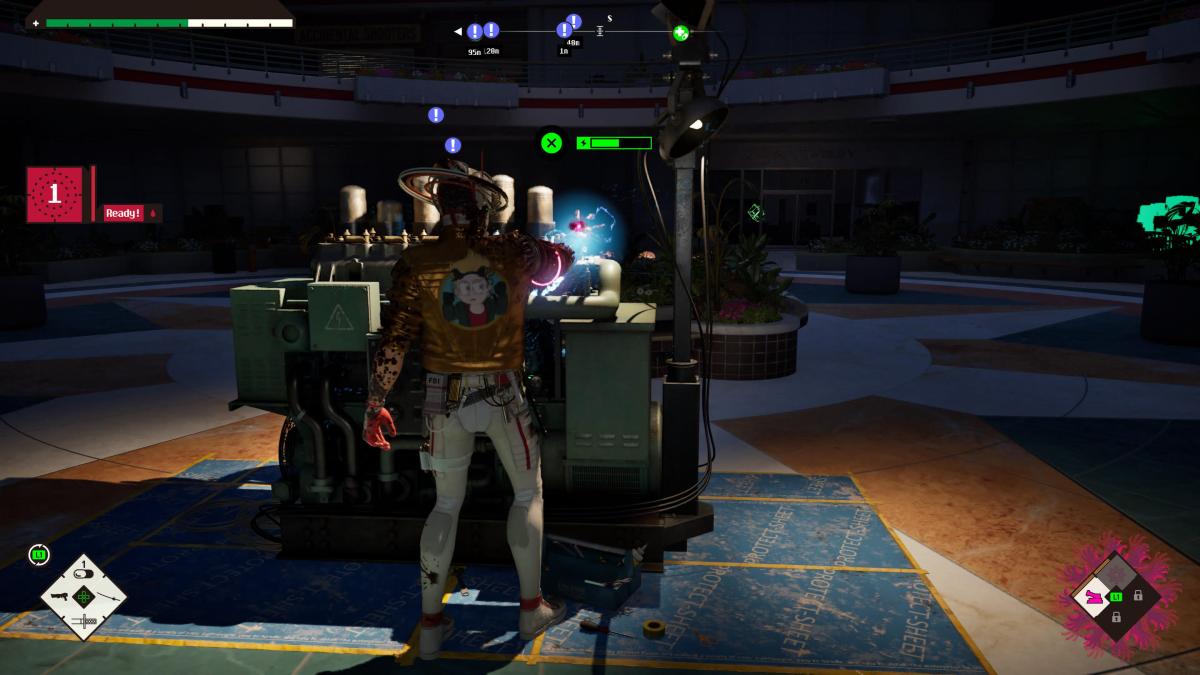
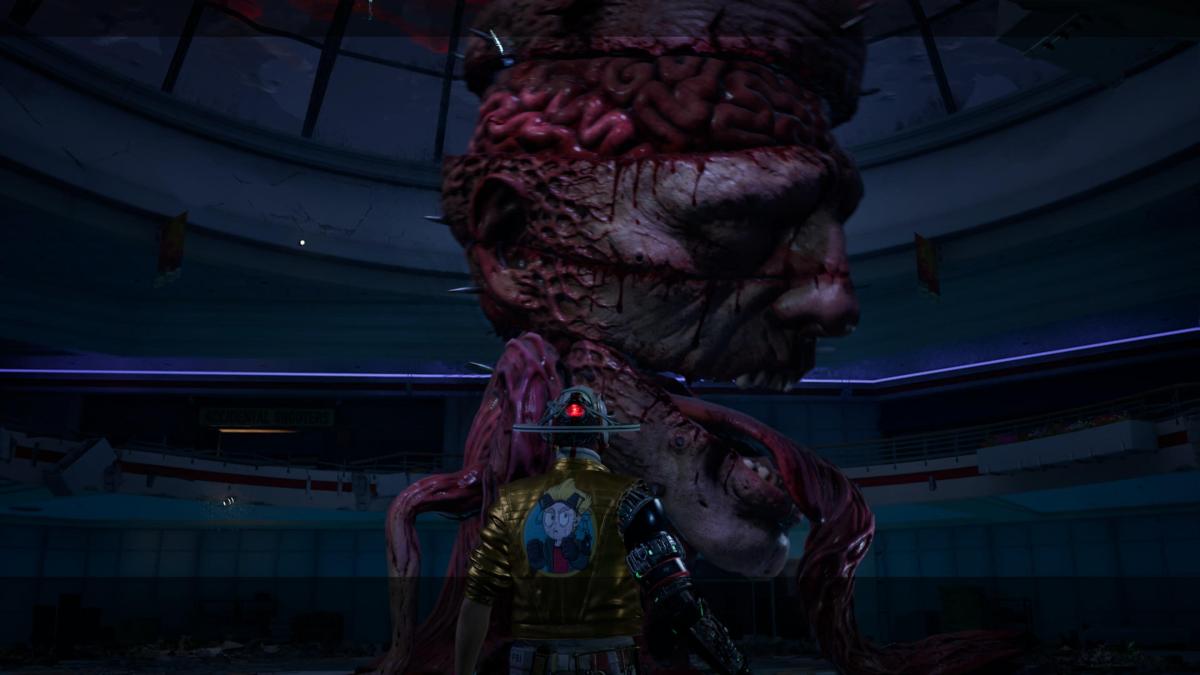
Time-travel, space FBI, floating TVs, zombie seeds, Pac-Man stat upgrades, and katsu curry. Romeo Is a Dead Man is pure Suda51 chaos — inventive, exhausting, occasionally brilliant, and just as often infuriating.
Escaping the Chaos: Why Lobby Racing Just Isn’t Enough
I started doing simracing a couple of years ago, and after some rocky days of learning where I was basically just trying to keep the car on the black stuff and not end up in the grass every second corner, I found myself playing Assetto Corsa Competizione the most. Eventually, you get tired of the AI. They are predictable and they don’t make the kind of human mistakes that make racing exciting, so you start to play online. And yeah, that’s a big difference, especially in ACC, playing the AI and playing the people. It’s much more unpredictable, much more fun, and much more crashes, which is the darker part of it.
Low Fuel Motosport – Total LFM registered users and currently racing
But yeah, this is very good overall. Assetto Corsa Competizione provides competition races within the game itself, but this service doesn’t have much deeper something in it. It’s quite boring after a while because there is only one option in one time, and sometimes when you don’t have all the stars for the given track, you cannot even join at all. But there is another option, the lobby service, which is where most people start their e-racing career – Low Fuel Motosport independent racing portal.
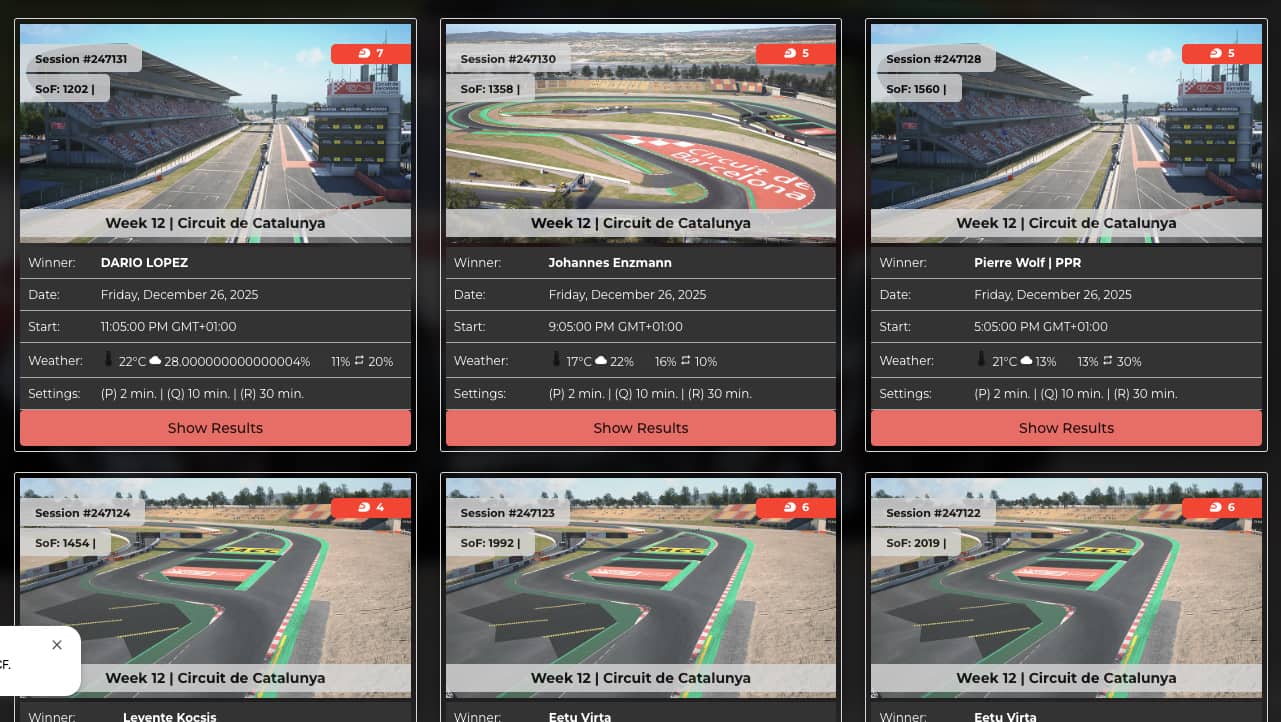
There is always around 900 active servers where you can race at any given moment. A lot of them have a pretty full list of people racing, so it’s a big fun when you get a good grid, but it’s dangerous, especially when you are not experienced enough. You will lose your safety rating very quickly because people are crashing like crazy over there. You have to build up the good SA and go to the lobby server where you have to have some amount of SA to join it. Those servers are much, much better than without any restriction, which is basically like Destruction Derby and killing your rating in ACC.
Low Fuel Motosport – Racing statistics
The Independent Powerhouse: Choosing LFM on PC
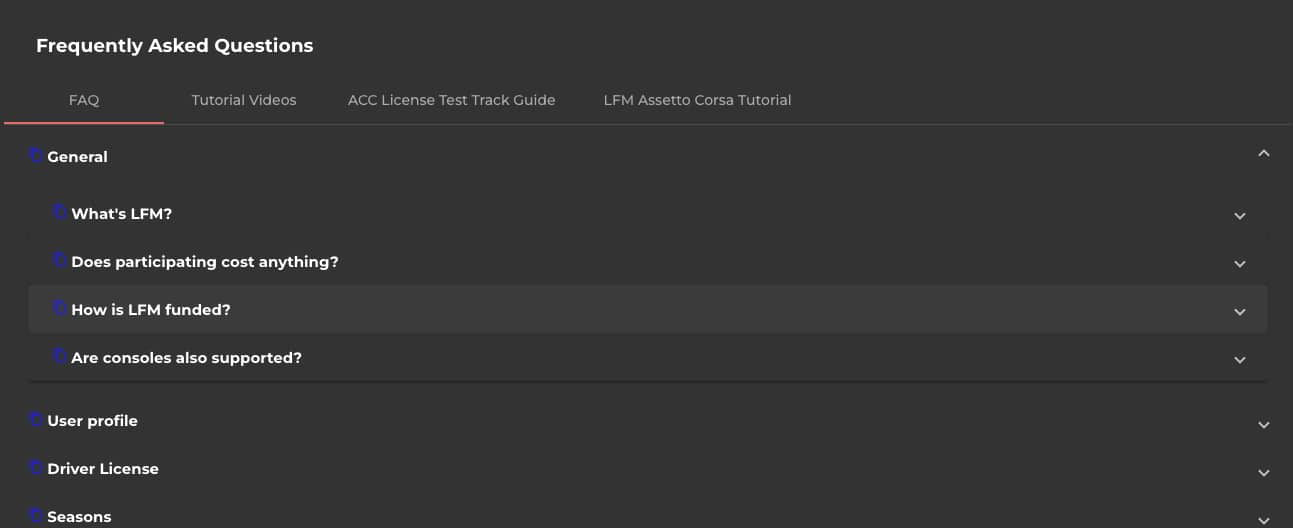
So after a lot of crashes, a lot of yeeting discussions in the chat where people are just screaming, and quite a lot of races actually on the lobby, I started to look around for even better option to race. And I came across Low Fuel Motorsport as the leading independent platform for racing. Low Fuel Motorsport is mostly focused on ACC, which is excellent for me, and it’s a big service. There are huge amount of organized races, they have a system when and how to join, and so forth. I chose another option on the market. This is for PC players only. If you have a PlayStation or Xbox, you would probably choose SimGrid, which goes for the consoles as well. Another option, similar, is Pitskill.io, but Low Fuel Motorsport is the largest sim racing platform at this very moment in 2025, by far. So this should be your first option, probably, if you are on PC and you want to race a lot with kind of the same quality persons like you on daily races. So I opted out for Low Fuel Motorsport like two years ago, and here is my experience with it.
Low Fuel Motosport – FAQ is collabsible list, no search possible
The License Hurdle: Proving You Belong on the Grid
To join Low Fuel Motorsport and be able to race, you have to prove yourself as a kind of experienced driver, although you don’t need to be that super fast as the top of the race, but you have to be reasonably good. I like the system to join because it makes the good selection and those destruction derby players are filtered out with this system and this is a very good system. So if you want to join races, they have a practice server which is reachable via internet. You can find it within the free lobby servers. Just type in Low Fuel Motorsport LFM into the server selection and you got it. You have to find which is it on the server. To register you can use Steam or Discord. Then you have to go to the race and try to make 7 clean rounds and be within the range of the best times, maximum 5% on the top of the best times. This is the 107% rule they use to keep the pace consistent. After 2 or 3 attempts I was able to reach and I obtained the license to race. So my journey begins here. If you want to race Nordschleife, you have to make a similar license, but I didn’t go for Nordschleife yet. I just like shorter tracks and Nordschleife still has to wait for me. I’m not that interested to get into that.
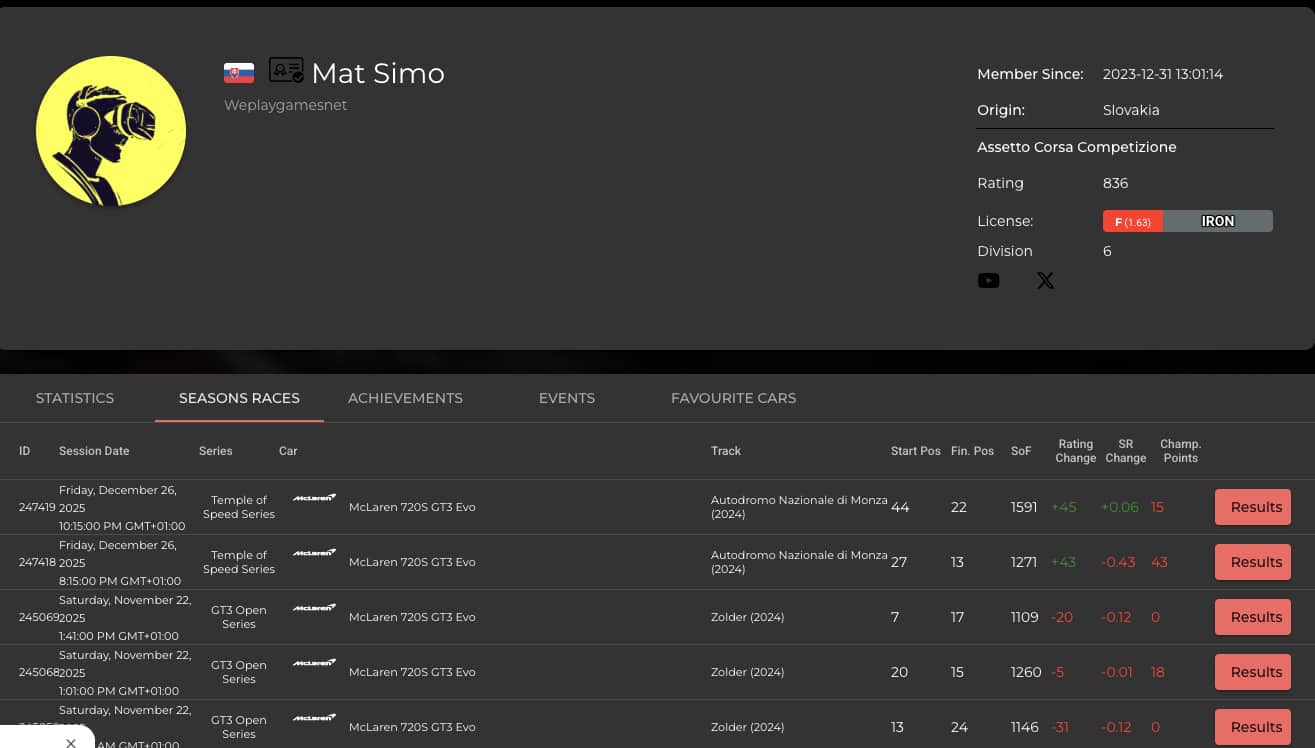
Low Fuel Motosport – History of my races
Tools of the Trade: Technical Requirements for Serious Racing
To join the races you have to obviously sign up for the specific race in time and the other thing you must have is to download the utility which is called ACC connector which somehow translate the IP address of the server to your local IP address and then you have to go to local servers like on the LAN and the server when it goes online it will appear there. This is one extra tool you have to have when you want to race on the Low Fuel Motorsport and well this is a decision they made because you know the ACC had some outages and actually they still have the outages of the network. Low Fuel Motorsport didn’t want to rely on the public multiplayer service of the game and they are building like local servers independent of the race so when the ACC multiplayer is down you can still play Low Fuel Motorsport. This is sometimes problem because when the network is down you cannot even load your LAN server somehow so sometimes it’s struggle but it’s better. It’s more stable the servers especially those which are located in European area has a great ping and technically the servers are very good. Another thing you may want is the LFM Livery Tool.
If you don’t have this, everyone is just driving around in a plain white or carbon car and you can’t see the cool designs that teams put together. It makes the grid look much more professional when you can actually see the sponsors and the colors of the other cars. You also have to get used to their custom Balance of Performance, or BoP. LFM adds weight or restrictors to certain cars to make sure the field is even. So even if the game developers made one car too fast, LFM balances it out so you can still drive an older car and not be totally out of the race. This keeps the variety high which is good.
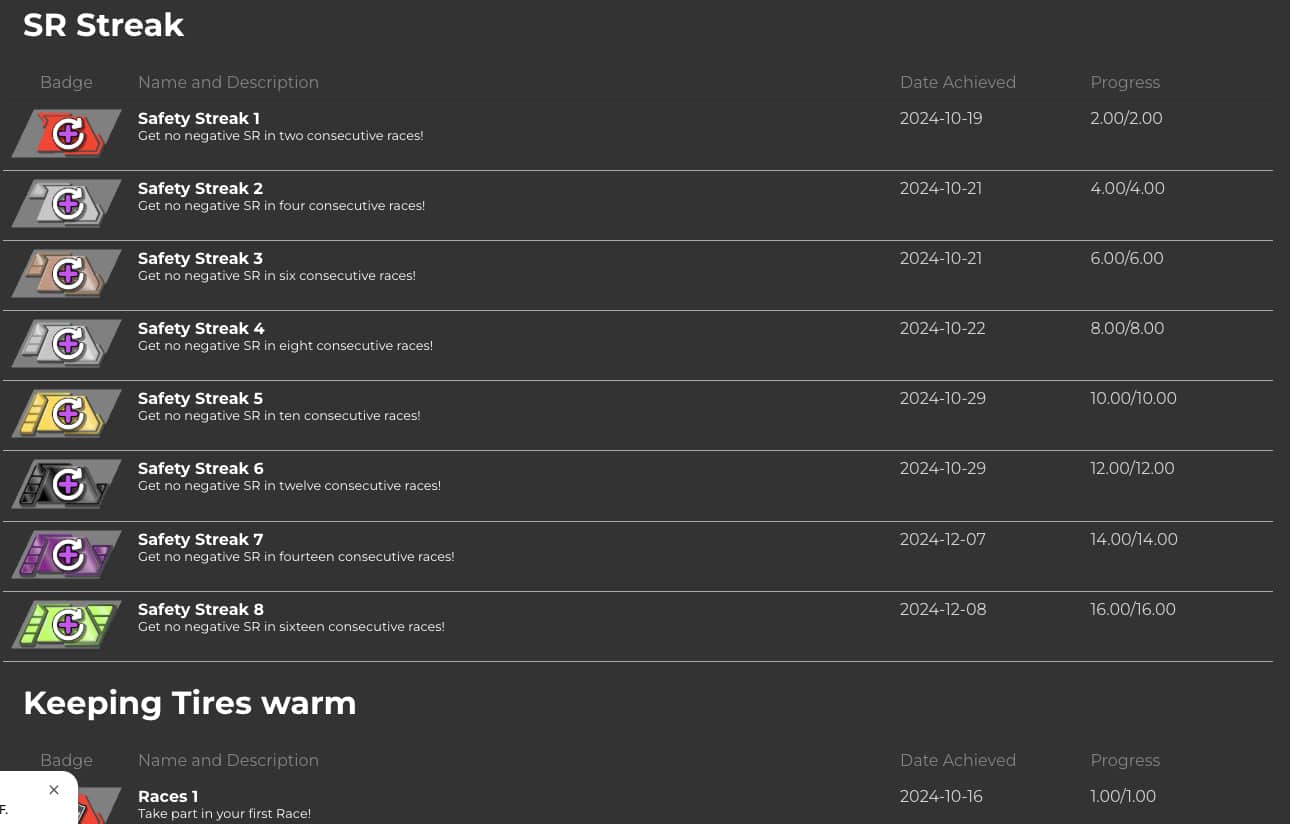
Low Fuel Motosport – Gamification is her as well . I got some trophies
The Daily Grind: Sprints and the Rating Struggle
So I did this basic license and I started to race. The options were to race, it’s quite big, but at the end you don’t have that much when you start. You can only race the 15 minute sprint races at the moment and that’s it because you are not building up your safety rating and your ELO enough yet. So you are doing these 15 minute races. Last year it was 20 minutes, now they push it to the 15 minutes. Well, that’s how they decided. So when you start to race you have to join the race. Every 45 minutes there is another 15 minute race. So you have plentiful options to race during the day, as much as you want, you don’t have any restrictions. You just click and wait a bit and you can join the races. So once you do that you go to practice. There is not allowed to race in the practice, it’s just to prepare your setups and so on. Then you go to qualification which is usually 7 minutes and then 15 minutes race. Races are much better than lobbies. This is the best advantage of Low Fuel Motorsport.
Low Fuel Motosport – Support via patreon
Here the races have its quality, even though when you are on the low tier the people are not trying to hit you as crazy and there are not that many accidents as there are on the ACC lobbies, especially those without SA filter. Here your journey starts, you are building up your ELO and you are building up your SA. When you reach the threshold you can join another races which are only filtered for the people with the higher ELO and higher safety rating. So ELO and safety rating decide everything. I’m not the greatest racer, so I was kind of struggling and stagnating because the ELO and SA rise slower than it falls. So you can build up for several clean races and then you have one wrong race where you get caught in someone else’s mess and it falls down instantly. But this is a fair play system which makes you focus on the safety first and then on the speed. This is the way how you should really learn driving in general. So you know your car, you know the spatial awareness and everything is much more important when racing here than when doing lobbies. So this really makes a big distinction and for those people who want real racing, they will like it a lot.
The Problem with Variety: GT4s and DLC Barriers
You are building up, and once you reach some threshold you can do the endurance racing 45 minutes or a higher league of 20-25 minutes races. They provide even the races for the GT4 cars or like specific BMW M2 races. But I don’t do that because especially those are the GT4 cars. You have to have the DLC and let’s be honest, how many people really do have this DLC? It’s a fraction of those having the base game. So if you really want to play all the races during the whole season, you have to have the DLCs actually because some tracks, some cars are not allowed in the base game so you have to pay for those DLCs of the base game. So here GT4 races are pretty empty. So if nobody is racing, it’s boring.
Low Fuel Motosport – Nobody much racing GT4 due to DLC restriction
I tried a couple of times but only a few players joined so I think this is almost useless category on the Low Fuel Motorsport. Endurance is good because and I really love to do the low tier endurance races last year. Because you have to make some tactics, there is always a pit stop so you don’t need to be the fastest but you have to think more strategically because of the pit stop and amount of fuel and it makes it really good. There is not that much players playing 45 minutes but quite enough to enjoy the race. Actually here I’m pretty angry on the Low Fuel Motorsport. They wanted to tweak it up for the ongoing season which is ending by the new year and they made a feedback and forum what to improve. I told them my way, what I want and actually everything happened was the opposite. So instead of 25 minutes like spring race, now we have only 15 minutes spring race and the 45 minutes endurance race is not yet reachable for me because I don’t have enough SA and ELO. So actually I can only do 15 minutes races right now which is ok but I was trying 45 minutes sprints and endurance like almost the same amount of races I did. So now it’s not possible for me. Yes, if I reach the level of SA, of the safety, I can join it but I’m not yet there. As I told you it’s quite tricky to improve but I’m not the best racer. What happened is that the options for me to race narrowed down pretty steeply and especially considering they were asking what to improve and they did the opposite, I’m not that happy with it.
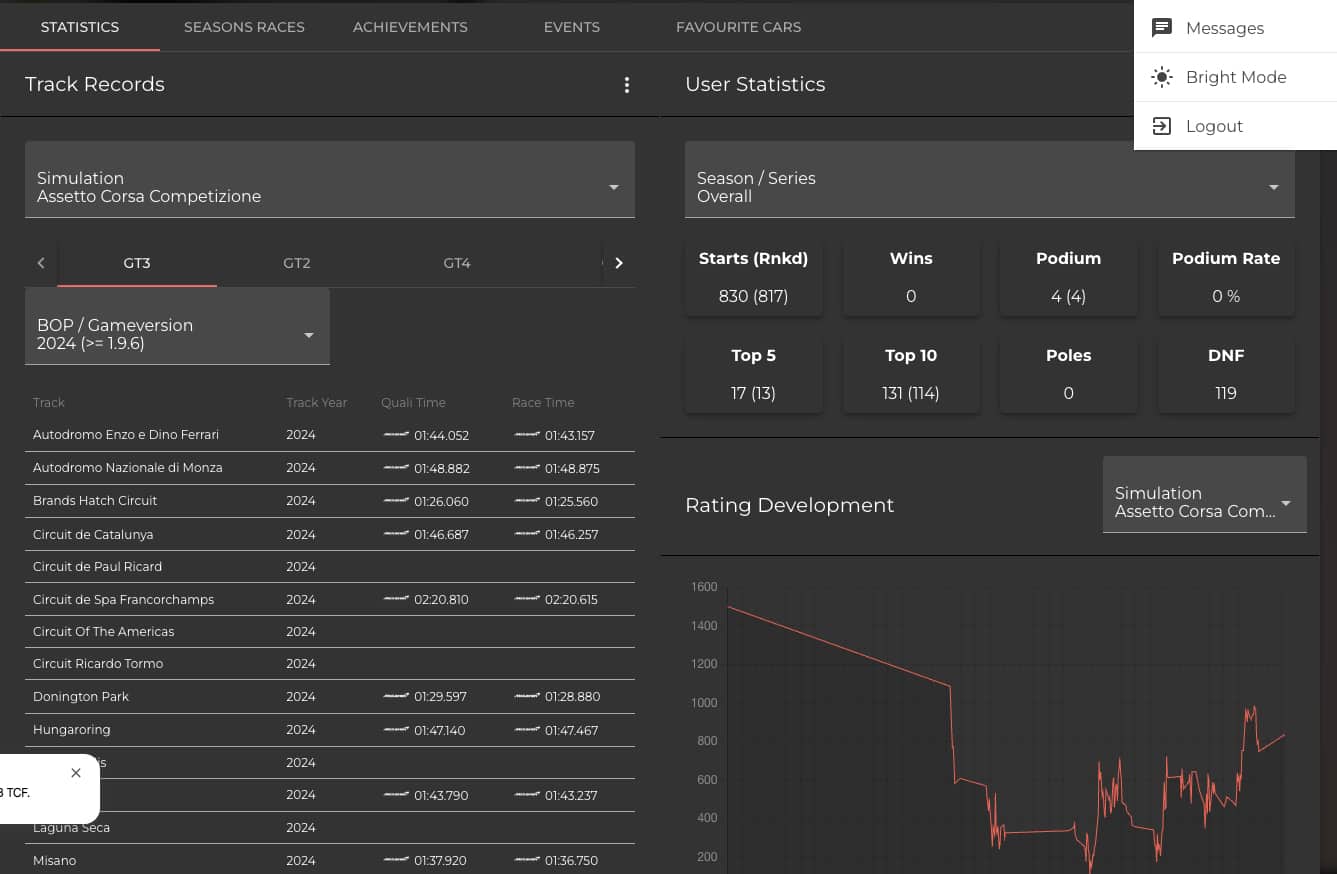
Low Fuel Motosport – Track records and ELO evolution graph
Climbing the Ranks: Licenses and Tier Divisions
Even though the sprint races are short, the system behind them is very deep. When you join for example the 15 minutes sprint, there are a lot of people really in the tables, so it’s divided to even six divisions. So you’re usually playing the lowest tier division and as your indexes go up you are joining the higher divisions in the tier, like tier one, tier two. So there are six divisions for example. So you are not just attending more professional races, but even within those races you are divided to the division, so it’s pretty complex and you are racing against people on the similar skill set that you have and comparing to them. This leads to the actual License Tiers which are the backbone of the whole thing. You start as a Rookie and you have to grind your way through Iron, Bronze, Silver, Gold, Platinum, and eventually the Alien tier if you are fast enough. Each of these tiers has specific Safety Rating (SR) and ELO requirements. It’s a proper hierarchy that keeps the racing clean because nobody wants to lose their hard-earned indexes. But like I said, when they change the rules and lock you out of the endurance races you used to love because your ELO isn’t high enough yet, it feels like the goalposts are moving.
The Frustrating Reality of the Appeal System
Now, how to handle all these situations like accidents, appeals, and penalties. This is something which works technically, but I have to say I don’t like it very much. If you think somebody crashed you, you can appeal, but you have to make a video on YouTube, you have to put some specific information into that video, and then you can place an appeal. You spend a lot of time doing videos and stuff, and then the appeal might go wrong anyway. I didn’t do this yet because it’s a pretty time-consuming process to appeal, so I don’t appeal when I’m being crashed by people, but other people do appeal against you. I had some penalties where you have to agree with the decision of the arbiter who said that you did a mistake. Usually, you get some deduction of your Elo and you lose some seconds in the race results. But when they decide that you hit someone by purpose, like a retaliatory accident, you can get even 28 days of ban, and I actually got one. The situation looked like I really did it on purpose, but I know myself and I know what really happened. The guy who went against me in this appeal made the video in a way that looks like I was the one at fault, but actually, it was his fault. Because I didn’t make my own video, I couldn’t prove anything. What really hurts me is that there is no easy possibility to appeal against these big ban penalties. For small penalties, you can appeal right away from the form, but for a 28-day ban, you have to go to some hidden menu, create a ticket, and it really sucks. They don’t give you any guidance or a simple button to click, so they really don’t care much about this process or hearing your side.
Assetto Corsa Competizione – New Liveries for Haas RT on Audi R8 LMS evo II
Utility Over Community: The Patreon Model
The communication with the creators and the arbiters is very weak in my opinion. Even though they have a sophisticated website and a Discord server, the feedback feels read-only. You make a question, they reply, and that’s it. If the reply isn’t good enough, you have to create a whole new thread. It makes Low Fuel Motorsport feel more like a utility or a tool rather than a community-building service. They will likely have a problem with this at some point because there is no emotional attachment. They are even very strict about the in-game chat; if you say “sorry” to someone you crashed by mistake, they might penalize you for chatting, which is crazy to me. This cold environment is visible in how they handle the business side too. There are premium options where you can become a Patreon donator. This gives you things like deeper statistics and the ability to sign up for races sooner. I think the early sign-up is pretty useless because the servers usually only get full right before the race starts anyway. They probably make a couple of ten thousand euros per month from these donations and affiliations with brands like Fanatec or Syncmesh, but it’s a donation model. I don’t donate yet, especially after being angry about how they handled my ban. Most people don’t donate, and since the communication is so weak, you don’t feel like you are part of something you want to support with money.
The Road Ahead: ACC Stagnation and Future Sim Titles
The system is super reliant on ACC, and as we know, ACC is getting less focus from the developers because of the new games they are building. This might be the end of the road at some point. LFM is trying to move into games like Le Mans Ultimate or the original Assetto Corsa, but those races are often empty or feel like a beta. 90% of the players are on ACC. They are scared that the game is at the end of its life cycle and they are making petitions like the #SaveACC one to the developers, but it feels like they are just trying to save their own business model rather than the community. Everyone is waiting to see if they will move to Assetto Corsa EVO in 2026. If you are looking at this from a global perspective, it is mostly a European service. During the day, the European servers are packed, but the US servers during the night are pretty empty. I estimate only 10-15% of the players are from outside of Europe. You can still join with a higher ping and it’s playable, but it’s not the same experience. To conclude, the racing on Low Fuel Motorsport is unmatched in the current environment—only iRacing is on this level. It’s a great service for the racing itself, but do not expect to join a community. It is a utility to get clean races, and the moment a better option comes along, people will probably just jump off to that. If you want real racing, go for it, but keep your expectations low for the social side.
LOW Readability issues. Some elements seem too random.
WTF Why is the Mafia so mean to me? : (
Having devoured Thomas Pynchon’s Shadow Ticket last month (it’s excellent, of course, you should read it, of course) I’ve been thinking that early 20th century America gets short shrift in terms of artistic representation. I’m talking about, say, 1900 – 1938.
World War I ushered in an armada of modern horrors and casts a long historical shadow, but it’s a murky, chimerical conflict — it doesn’t have the obvious Good vs. Evil resonances of World War II. The Depression is, well, depressing, and being an economic and societal failure, it’s inherently less sexy and marketable to the masses. Not to mention, also, the awkward fact that we’ve learned little, if anything, from it. Worst of all, the vibrant music of the era has been co-opted into that most aberrant of modern pseudo-genre slop, electroswing.
Things really aren’t any better in the gaming scene. There aren’t any heavy hitters – across any genre – that truly embrace the era. None that I know of, at least. However, this could change with the 1.0 release of News Tower, a sweet and compelling strategy hybrid of colony manager and tycoon game whose mechanics put players into a vanished (but still relevant) place and time.
News Tower presents players with a side-on, ant colony-style view of a tower – initially squat and lowly, eventually grand and bustling – in which, believe it or not, news will be made. That means finding stories via telegraph, sending out reporters, typesetting their articles, and arranging them for production. All of this takes time – a lot of it, actually – with the Sunday print deadline always looming like a war-zeppelin on the horizon. Every story comes with content tags – crime, drama, sports, many more – and publishing multiple stories with the same tags gives big boosts to sales and subscribers.
When talking about mechanics-laden games, there’s always the risk of simply listing all the different mechanics, so to avoid that just know this is an interdisciplinary strategy experience, both macro and micro, demanding equal playerly attention to the high drama of Scoop Pursuit, as well as to the granular fiddliness of deciding where exactly on each reporter’s desk a fern plant should be placed to keep them happy. The primary sensation that News Tower evokes is of spinning about a dozen plates while standing on one foot, like some kind of big-top circus sideshow between the headliners.
These concerns converge like a swarm of militant hornets on the ol’ brainpan, and, while it is overwhelming in a way, it also creates an impressively compelling gameplay loop that slaps iron shackles on a player’s focus. Like many of the greats in the strategy space, it’s hard to find a good stopping place for a play session: there’s always something that needs attention, another goal to pursue, a new variety of potted plant to place tastefully upon a disgruntled employee’s desk.
It ain’t all sunshine and roses in the big city, though. The biggest musca domestica in the otherwise unctuous News Tower ointment is the UI and general visual clarity. Each reporter has three types of story they can cover, each with its own related icon. I’d like some additional visual cueing on the reporters, because it’s hard to remember who does what in the heat of a busy newsweek. This isn’t like X-COM, where each member of the team has a pronounced identity and specialty — even a small newsroom will have four or six reporters, all relatively anonymous in their matching fedorae and mackintosh coats.
Knowing exactly when a story will be ready to print, probably the most crucial thing to keep track of, is also harder to find than it should be. It’s easy to know when an individual step in the publishing process will be done, but the actual Ready-to-Print time is hidden away in a tooltip in a sub-menu. This means that unless a player does a lot of preparatory menu-perusing, it’s easy to queue up a story and discover it won’t be ready in time for Sunday. It’s frustrating.
There’s also just a damn lot to look after, dozens of menus and buttons and tabs – so much of it important at some point or another. The tutorial is actually a scripted campaign, and it does a good job highlighting a portion of this stuff (but not all of it) and not everybody is going to be down with a tutorial that can take longer than some whole games take to complete. After a few hours I dipped out and jumped into the deep end of the classic mode.
I want to end on a high note, though, so I’m going to return to the question of theming. A lot of management titles can have a sort of Excellian abstractness to them — a whiff of spreadsheet seeping out around their ostensible settings. Not so with News Tower. No, it evokes the golden age of paper news across its entire mechanical suite, bolstered further by an absolutely wonderful, period-appropriate live jazz soundtrack from Dutch ensemble New Cool Collective. To quote legendary schlock-peddler, Xanadu denizen, and all around freak William Randolph Hearst — it’s immersive as hell.
And from me? It’s an enthusiastic recommend.
Score: 8 out of 10
Disclosures: This game is developed by Sparrow Night and published by Twin Sails Interactive. It is available on PC. This copy of the game was obtained via publisher. Approximately 20 hours of play were devoted to the game, and it was not completed. There are no multiplayer modes.
Parents: This game is not yet rated by the ESRB. Obviously, a lot of the stories that crop up (many based on real historical facts) concern tragic events, and municipal corruption plays a big part. It’s all handled with a cartoony, light touch, however — lighter than what any kid would see on any news site or social media app on any given day. Not sure if younger gamers would cotton to the theme but, if they do, there isn’t anything here to worry about.
Colorblind Modes: There are no colorblind modes present.
Deaf & Hard of Hearing Gamers: All of the dialogue is text-based, but it, as well as the menu text, cannot be resized. (See in-game examples above) An important sound cue occurs whenever a story comes in on the telegraph. It’s accompanied by an icon on the menu screen, but it’s a pretty small icon. Other than that, all important events are conveyed visually.
Remappable Controls: The game supports keyboard + mouse, but not controller. The keyboard controls are fully remappable.
There’s something genuinely appealing about a game that doesn’t pretend to be something it’s not. Everdark: Undead Apocalypse is a first-person survival horror shooter that wears its B-movie inspirations proudly, and honestly, that’s exactly what makes it work. This is a lean, mean vampire-hunting experience that understands tension, resource scarcity, and the raw satisfaction of driving a stake through a bloodsucker’s heart. It’s got rough edges, but the core experience is genuinely fun.
The 80s Horror Atmosphere Actually Lands
Everdark commits fully to its retro-horror aesthetic, and you feel it immediately. The 80s vibes aren’t just window dressing—they permeate everything from the synth-inspired soundtrack to the neon-lit streets and fog-drenched environments. Built on Unreal Engine 5 and running at native 4K and 60 FPS on Xbox Series X|S, the game leverages dynamic lighting and volumetric fog to create atmosphere that actually feels threatening. Shadows stretch across alleyways, flames flicker in abandoned churches, and moonlit streets feel genuinely unsettling.
The developers, a small team of fewer than twenty people, clearly grew up loving this genre, and that passion shows. Every environment from ruined cities to desolate cathedrals has been crafted to evoke genuine dread. This isn’t a AAA production with a massive budget, but the artistic direction more than compensates for any technical limitations.
The Combat Loop Works Better Than It Has Any Right To
Here’s where Everdark surprises you: the gunplay is actually solid. You’ve got an arsenal of rifles, shotguns, and melee weapons, and the action flows nicely. But the real genius is the staking mechanic. Vampires don’t die from bullets alone. You need to stagger them, close the distance, and drive a stake through their heart. It’s a risk-reward dance that makes every encounter feel like a genuine hunt rather than just another shooter.
This creates brilliant moments where you’re desperately managing limited ammo, strategically choosing which enemies to confront and which to avoid. The survival horror elements kick in here—you can’t just run in guns blazing. Sometimes you have to be smart, bait enemies away, sneak through areas. The garlic safe zones become literal sanctuaries where you catch your breath and plan your next move.
The adrenaline rush when you narrowly escape a pack of vampires and make it to safety never gets old. Neither does the satisfaction of perfectly executing a stagger-and-stake combo. It’s simple on paper, but the execution feels rewarding.
Where It Stumbles Slightly
Everdark isn’t perfect, and it’s worth being honest about its limitations. The difficulty curve is genuinely punishing, and some players will find checkpoints frustratingly short. Dying can feel abrupt, especially early on when you’re learning the systems. The health bar isn’t always crystal clear, and there’s no death animation, which means you can be retaliating one moment and back at a checkpoint the next.
The core FPS mechanics, whilst functional, aren’t strong enough to carry the game alone. Without the survival horror elements and the staking mechanic, this would feel like a fairly standard shooter. Some areas, particularly longer levels like the sewer section, can wear on you with repetitive encounter design.
There are also occasional visual glitches and some rough dialogue that, whilst charming in a B-movie way, occasionally undermines the atmosphere. But here’s the thing—these issues don’t significantly detract from what Everdark does well.
A Lean Experience That Respects Your Time
At its core, Everdark respects the player’s time. It doesn’t overstay its welcome with bloat. You get a focused campaign, a clear premise, and solid gunplay loop that doesn’t drag on forever. For a £19.99 title, that’s genuinely good value.
The game is aware of its budget limitations, and rather than pretending to be something it’s not, it doubles down on atmosphere and focused gameplay. That’s the right call.
High Stakes!
Everdark: Undead Apocalypse is a stylish, atmospheric vampire shooter that punches well above its weight. Yes, it has rough edges and occasional technical hiccups, but the core experience—managing resources, planning encounters, and executing perfectly timed stake kills—is genuinely satisfying. If you love 80s horror, survival mechanics, and don’t mind a challenging shooter that demands smart play alongside quick reflexes, this is absolutely worth your time. Small team, big vision, and a game that knows exactly what it wants to be.
There’s something wonderfully appealing about a game that knows it’s ridiculous. Folly of the Wizards, this colourful roguelike adventure on Xbox, absolutely embraces the idea of playing as a catastrophically unqualified wizard apprentice trying to save the world. The premise is silly, the characters are quirky, and the whole thing has this tongue-in-cheek charm that makes you want to keep plugging away at “just one more run.” But, and I say this with genuine affection for what’s here, there are some significant bumps in the road that prevent this from being the magical experience it could be.
A World Worth Exploring (Visually, At Least)
Let’s start with what Folly of the Wizards absolutely nails. The art direction is gorgeous. Each biome feels distinct and alive, from the demonic worms erupting in the desert to the noxious clouds lurking in forests. The character designs are whimsical without being cutesy to the point of annoyance, and there’s real personality in how every NPC is written. When you meet characters between runs, they feel like they belong in this weird wizarding world.
The humour is genuinely decent too. The game doesn’t take itself seriously, and it actively mocks you when you fail. There’s something oddly motivating about your wizard getting roasted after a bad run. It’s self-aware in the best way possible.
The Gameplay Loop: Familiar But Stretched Thin
The core gameplay is straightforward. You jump into procedurally generated dungeons, clear rooms, collect upgrades, and face bosses across multiple floors. You’ve got your basic spell attack, a double jump, a dash, and access to elemental spells. On paper, this is solid roguelike stuff, and to be honest, the structure works fine for the first few runs.
Having spent the last few weeks building my own platformer, I genuinely appreciate how difficult it is to nail movement mechanics and responsive controls. Folly of the Wizards gets some things right. The shooting is twin-stick style, which feels intuitive, and the platforming sections aren’t overly demanding. But here’s where things get messy.
The controls on console are genuinely bizarre. Jump is bound to LB/L1. LB! In a game where jumping and dashing are absolutely vital to survival. I understand why this bothers people so much because, frankly, it’s weird. The game doesn’t feel natural to play on controller, and what makes this even more frustrating is that X/A is just sitting there, unused. At minimum, letting players remap controls would have solved this entirely.
The System Confusion Problem
Beyond the controls, Folly of the Wizards suffers from what I’d call “system inflation without explanation.” You can grab from a pool of 130 relics, tomes, and scrolls during a run. That’s a lot of variety, and theoretically, that’s brilliant. In practice? You’ll often pick something up and have absolutely no idea what it does.
The in-game catalogue offers visual descriptions but almost nothing about actual functionality. You might grab something that accidentally replaces your favourite weapon, and there’s no way to get it back. It’s frustrating not because the systems don’t exist, but because they’re never explained. A simple tooltip system would have changed everything.
The affinity system with NPCs has similar problems. Depending on your conversations, you’ll build relationships that apparently determine what items become available. But here’s the thing: it’s never explained how this actually works. You’re largely guessing, and whilst the writing is charming, the systems behind it remain opaque.
The Grind Against Repetition
Here’s my honest assessment after several runs: Folly of the Wizards is engaging in shorter bursts, but it doesn’t quite have that addictive “one more run” feeling that roguelikes need to survive. The visuals carry the experience initially, but after a couple of longer sessions, the repetition starts to wear on you. The bosses help break things up, but the room-to-room combat loop doesn’t vary enough to keep pulling you back.
The game is perfectly playable in 30-minute chunks, but it doesn’t inspire marathon sessions. And when the roguelike genre is absolutely packed with options, that’s a significant problem. You need something special to keep players invested, and Folly of the Wizards relies too heavily on its charm rather than its mechanics.
What Actually Works
Don’t get me wrong: there’s real fun to be had here. The moment-to-moment gameplay feels good when things click. Learning which enemies are vulnerable to specific elements creates actual strategy. The boss fights are creative and memorable. And honestly, the writing throughout is consistently entertaining.
For players who genuinely love roguelikes and don’t mind the steep difficulty curve, there’s absolutely something worth exploring. The 22 unique bosses, 9 biomes, and multiple endings give you reason to keep going. It’s just that these good elements sit alongside genuine frustrations.
Folly of the Wizards is a charming roguelike let down by unintuitive controls, poor system explanation, and repetitive gameplay loops that wear thin after a few hours. There’s real magic buried here, but it’s weighed down by mechanical clunk. Worth trying if you’re a roguelike enthusiast, but casual players will likely bounce off quickly.
Help Bob the Brick Breaker (as opposed to Bob the Builder), break bricks by bouncing a wrecking ball with a girder. Yup, it’s a BreakOut or Arkanoid clone. But is it as good as those classics? You’ll just have to read on to find out! The game is available on Switch and PlayStation consoles, but […]
My two favorite video game consoles are the Super Nintendo and PlayStation. I played so many great games on those systems, and there were so many more that never came out overseas! That’s why I like when a company snags a Japan only classic and brings it over here. Such is the case with Milano’s […]
Seeing as though I’m old enough to have experienced Pac-Man when it first came out, I’m pretty familiar with most retro games. However, sometimes one comes along that just flew under the radar for me. Montezuma’s Revenge was one such game. I remember seeing it back then, but never playing it. Many years later, at […]
Paws of Fury was a movie released in theaters a couple of years ago. I never bothered with it then, as it looked like a Kung-Fu Panda rip-off. But before writing this review, I did manage to watch the movie on Netflix. I found it interesting that Mel Brooks did one of the voices and […]