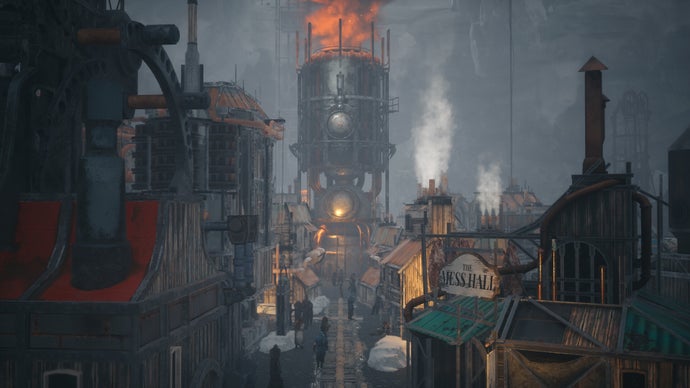
It’s always a pleasure to write about Frostpunk, but I’m glum that Frostpunk has boarded the Great Videogame Remaking Train. I don’t think the original Frostpunk is beyond improvement, but I do find it very complete. Chilly finitude, obsessive symmetry are its narrative ethos and aesthetic. It’s a three-act story in a genre that tends to be exhaustingly open-ended. Its dramatic stakes are stark and inescapable – who and what will you sacrifice so that everybody else can survive? In place of the hopelessly indulgent, always-extendable gridiron of SimCity it gives you an Omelasian foxhole, with construction rigorously defined by distance from the coal burner at the heart. The Last City's inner configuration may vary, but it must describe a perfect circle, because it has to dissipate heat evenly against the apocalyptic winter. It can’t afford to sprawl.
But sprawl Frostpunk has - firstly in the form of DLC expansions, and then in the shape of Frostpunk 2: a looser, fragmented game of expansionism, bickering council members, tangled ideologies, and petrol politics. And now here’s Frostpunk: 1886, an Unreal Engine “remake plus plus”, as game director Maciej Sułecki puts it, in a sector saturated with boutique revivals, some of them landing a handful of years after the original game - a forcing of embryonic nostalgia, huffing on embers, that suggests an industry running out of fuel, giving itself over to cycles of regeneration.
Still, perhaps I’m being too gloomy. I’m definitely being melodramatic. As you’d expect, Sułecki has a more hopeful analysis.
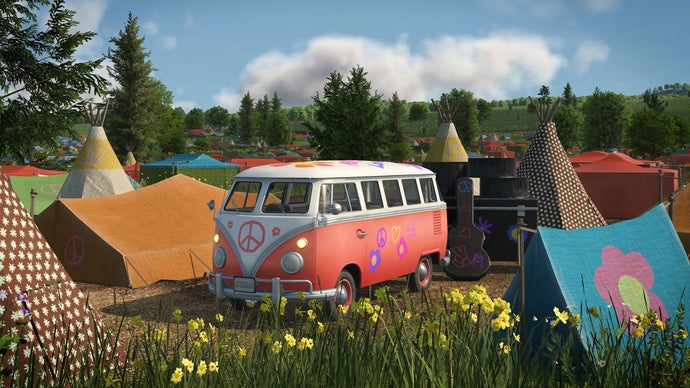
Ironically, considering the rampant dysentery moving through my campground in brown, sputtering waves, the problem I'm facing in Transport Fever 3 is a blockage. The trucks I've loaded with antibiotics are stuck in a traffic jam that stretches all the way to the pharmacy in the next city over. If I'm to save the inaugural Woodstock festival, I must find a way to get traffic flowing again before the timer runs out.
One of the best racing horses in the modern era of the sport will be coming to Umamusume: Pretty Derby, according to a statement from the horse's owner.
Arknights: Endfield developer Gryphline has a good reason to celebrate, as the upcoming free-to-play action RPG has achieved yet another milestone. The developer announced today that Endfield already has over 35 million pre-registrations.
The Game Awards 2025 ceremony brought us yet more gacha game news, this time a big announcement for Arknights: Endfield. The free-to-play game set in the the universe of Arknights has been in various forms of closed tests for a while, but it finally has a release date.
Cygames, the Japanese video game developer responsible for a variety of popular games including Umamusume: Pretty Derby, has announced its intention to create an AI-focused subsidiary company.
It's been another strange, difficult, and yet somehow also brilliant year for video games in 2025. Triple-A releases have been sparse again, compared to the boom times of old, with a great big GTA 6-shaped hole left in the final few months of the year. And yet once again, every gap left by the established order has been filled twice over with something brilliantly new.
Of all the games released this year, all the triple-A blockbusters and genre-defining smash hits, nothing shook me as much as Umamusume: Pretty Derby. I won't deny that it was once a game I was embarrassed to be playing. But now? I'm all in, dude. I'm an English 27-year-old who is invested in Japanese horse racing. And if you too can push past your misgivings, you'll find one of the better strategy games released this year.
LOW Readability issues. Some elements seem too random.
WTF Why is the Mafia so mean to me? : (
Having devoured Thomas Pynchon’s Shadow Ticket last month (it’s excellent, of course, you should read it, of course) I’ve been thinking that early 20th century America gets short shrift in terms of artistic representation. I’m talking about, say, 1900 – 1938.
World War I ushered in an armada of modern horrors and casts a long historical shadow, but it’s a murky, chimerical conflict — it doesn’t have the obvious Good vs. Evil resonances of World War II. The Depression is, well, depressing, and being an economic and societal failure, it’s inherently less sexy and marketable to the masses. Not to mention, also, the awkward fact that we’ve learned little, if anything, from it. Worst of all, the vibrant music of the era has been co-opted into that most aberrant of modern pseudo-genre slop, electroswing.
Things really aren’t any better in the gaming scene. There aren’t any heavy hitters – across any genre – that truly embrace the era. None that I know of, at least. However, this could change with the 1.0 release of News Tower, a sweet and compelling strategy hybrid of colony manager and tycoon game whose mechanics put players into a vanished (but still relevant) place and time.
News Tower presents players with a side-on, ant colony-style view of a tower – initially squat and lowly, eventually grand and bustling – in which, believe it or not, news will be made. That means finding stories via telegraph, sending out reporters, typesetting their articles, and arranging them for production. All of this takes time – a lot of it, actually – with the Sunday print deadline always looming like a war-zeppelin on the horizon. Every story comes with content tags – crime, drama, sports, many more – and publishing multiple stories with the same tags gives big boosts to sales and subscribers.
When talking about mechanics-laden games, there’s always the risk of simply listing all the different mechanics, so to avoid that just know this is an interdisciplinary strategy experience, both macro and micro, demanding equal playerly attention to the high drama of Scoop Pursuit, as well as to the granular fiddliness of deciding where exactly on each reporter’s desk a fern plant should be placed to keep them happy. The primary sensation that News Tower evokes is of spinning about a dozen plates while standing on one foot, like some kind of big-top circus sideshow between the headliners.
These concerns converge like a swarm of militant hornets on the ol’ brainpan, and, while it is overwhelming in a way, it also creates an impressively compelling gameplay loop that slaps iron shackles on a player’s focus. Like many of the greats in the strategy space, it’s hard to find a good stopping place for a play session: there’s always something that needs attention, another goal to pursue, a new variety of potted plant to place tastefully upon a disgruntled employee’s desk.
It ain’t all sunshine and roses in the big city, though. The biggest musca domestica in the otherwise unctuous News Tower ointment is the UI and general visual clarity. Each reporter has three types of story they can cover, each with its own related icon. I’d like some additional visual cueing on the reporters, because it’s hard to remember who does what in the heat of a busy newsweek. This isn’t like X-COM, where each member of the team has a pronounced identity and specialty — even a small newsroom will have four or six reporters, all relatively anonymous in their matching fedorae and mackintosh coats.
Knowing exactly when a story will be ready to print, probably the most crucial thing to keep track of, is also harder to find than it should be. It’s easy to know when an individual step in the publishing process will be done, but the actual Ready-to-Print time is hidden away in a tooltip in a sub-menu. This means that unless a player does a lot of preparatory menu-perusing, it’s easy to queue up a story and discover it won’t be ready in time for Sunday. It’s frustrating.
There’s also just a damn lot to look after, dozens of menus and buttons and tabs – so much of it important at some point or another. The tutorial is actually a scripted campaign, and it does a good job highlighting a portion of this stuff (but not all of it) and not everybody is going to be down with a tutorial that can take longer than some whole games take to complete. After a few hours I dipped out and jumped into the deep end of the classic mode.
I want to end on a high note, though, so I’m going to return to the question of theming. A lot of management titles can have a sort of Excellian abstractness to them — a whiff of spreadsheet seeping out around their ostensible settings. Not so with News Tower. No, it evokes the golden age of paper news across its entire mechanical suite, bolstered further by an absolutely wonderful, period-appropriate live jazz soundtrack from Dutch ensemble New Cool Collective. To quote legendary schlock-peddler, Xanadu denizen, and all around freak William Randolph Hearst — it’s immersive as hell.
And from me? It’s an enthusiastic recommend.
Score: 8 out of 10
Disclosures: This game is developed by Sparrow Night and published by Twin Sails Interactive. It is available on PC. This copy of the game was obtained via publisher. Approximately 20 hours of play were devoted to the game, and it was not completed. There are no multiplayer modes.
Parents: This game is not yet rated by the ESRB. Obviously, a lot of the stories that crop up (many based on real historical facts) concern tragic events, and municipal corruption plays a big part. It’s all handled with a cartoony, light touch, however — lighter than what any kid would see on any news site or social media app on any given day. Not sure if younger gamers would cotton to the theme but, if they do, there isn’t anything here to worry about.
Colorblind Modes: There are no colorblind modes present.
Deaf & Hard of Hearing Gamers: All of the dialogue is text-based, but it, as well as the menu text, cannot be resized. (See in-game examples above) An important sound cue occurs whenever a story comes in on the telegraph. It’s accompanied by an icon on the menu screen, but it’s a pretty small icon. Other than that, all important events are conveyed visually.
Remappable Controls: The game supports keyboard + mouse, but not controller. The keyboard controls are fully remappable.
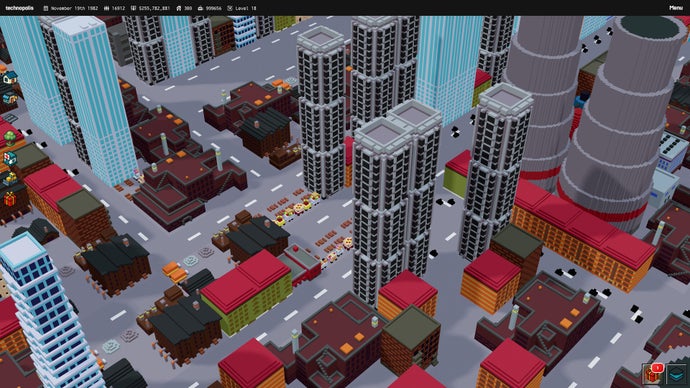
Microlandia deserves a much longer article, preferably written by our resident virtual metropolis judger Sin Vega. For the moment, I will only say that it’s a work-in-progress city-builder fuelled by a poetical mixture of admiration and terror for cities.
Here we go. The picks of mine which made it into the advent calendar weren’t embarrassing enough, so now I get to flick a few extras at you like discarded bits of liquorice I’ve found down the back of the sofa. Open wide.
Most anticipated? Oh reader, you gentle, innocent child. Hark at you, ambling in here with supple joints, eyes clear as springwater, and the scent of hope in your hair. I have grown old, dear reader. I no longer feel this emotion called "anticipation", anymore than I remember the taste of strawberries in the Shire. Years of waiting for another Legacy of Kain game have broken my spirit. My heart is a sponge of sorrow. My beard coils round my ankles like a listless cat. All has become grey.
Keep Driving captures the dream of a road trip, a coming of age experience where you’re finally able to start motoring around the world in your own set of wheels. Your sense of wonder’s still intact and each place you visit on brings fresh surprises.
But the game isn't a schmaltzy dip into wanderlust, or a blinkered memory of youth and a lack of responsibilities. Lurking in the background is the nervousness of inexperience, which transforms mundane tasks into nightmares you must overcome.
Hooded Horse have just announced that they're publishing it, which is lovely because it means I can write about a horse game this week that hasn't been banned from Steam for infringing upon Valve's ever-elastic content policies. There are no scenes of iniquity so far in Roaming Blades, just good, wholesome disembowelment and the chance to blow up lingering balls of lightning. Here's the trailer.
Did you happen to miss out the time when EVE Online took over a lava tunnel tourist attraction to talk about its recently released Catalyst update? Do you yearn for the rocks and the dark? Well you’re in luck because CCP Games made sure that this distinct broadcast location was saved to its YouTube channel […]
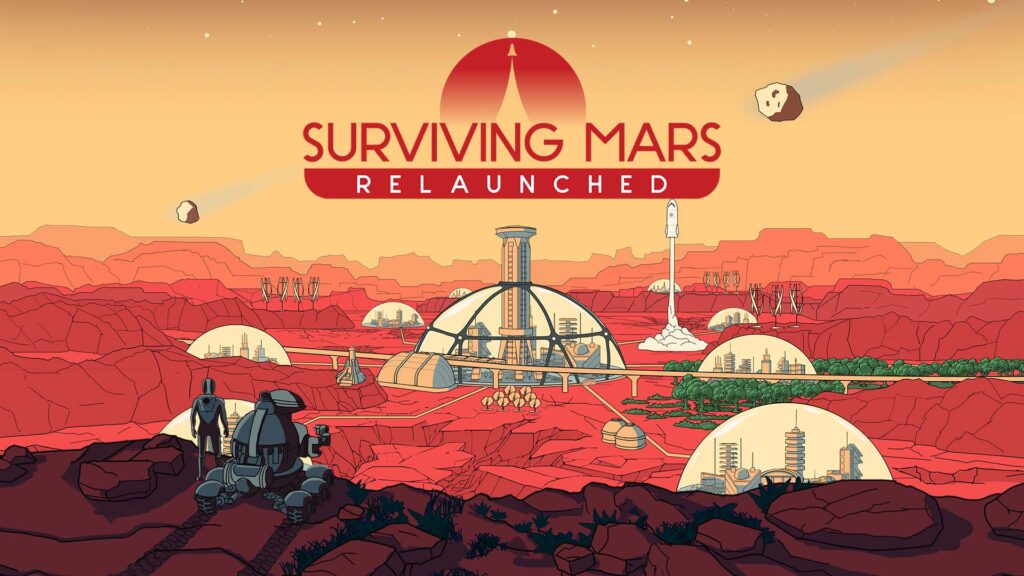
Surviving Mars: Relaunched Isn’t Just A Rework, It’s A Whole New Experience
Gabriel DobrevFounder, Haemimont Games
Summary
Surviving Mars: Relaunchedis a re-introduction to our colony builder, withupgraded graphics, a reworked UI, and more.
The game includes previous Surviving Mars expansions as base content for all players.
Surviving Mars: Relaunched launches today on Xbox Series X|S.
Are you ready to set foot on Mars for the very first time – again? Welcome to Surviving Mars: Relaunched, a new way to play our colony-building management game for a new generation of spacefaring strategists!
When we launched Surviving Mars originally, we wanted to give gamers an experience that was grounded in reality and science, easy to understand, and built towards an ambitious future, and that was what we delivered. The heart of the game remains the same as always: from initial surface scans and deployment of drones, you will start building the critical infrastructure needed to support human colonists, including water systems, supply extraction, and environmental domes.
Once people start showing up, you can undertake more complicated tasks and developments to expand and maintain your colony, until your colony is sustainable without aid from Earth.
Since then, Surviving Mars has explored a number of new ways to bring efficiency, change, and even cute animals to the red planet. We released expansions that added Terraforming (Green Planet), Subterranean Mining (Below and Beyond), and Rival Colonies (Space Race) to the game. When we made the decision to come back to Surviving Mars and begin developing even more ways to play, we realized that there was an opportunity not just to share our ideas with our original commanders, but with a whole new crew as well!
That’s what brought us to Surviving Mars: Relaunched, a new version of our game that gives everyone lots of new features to try. For starters, we’ve upgraded the graphics, reworked the UI, and improved controller support, all to ensure the game looks and plays its best, especially now that it’s coming to Xbox Series X|S.
Next, we’ve included everything that was ever added to the original game – so players of Relaunched get access to features like Terraforming and Trains that were originally DLC with the base game, which means we can deliver updates and content based around those features, going forward. We’re also adding new features that have never been included in any version of the game before now, including factions and political management for your colonies!
We’re also giving all Martian Managers access to new ways to expand and play our game created by other players, with in-game mod support. You’ll be able to browse and install mods without leaving the game, allowing you to add community-made buildings to your planet, or explore new end-game mysteries.
With the most comprehensive version of Surviving Mars in your hands, all of us at Haemimont will have an ideal launch pad to bring more new content to the game from here on out. We’re already working on a new expansion for early next year, “Feeding the Future,” which will add new production systems and food options for your colonists to help add to their comfort – and sanity! We have another expansion, “Machine Utopia,” in the works after that one as well, which will allow you to colonize, optimize, and industrialize. It’s exciting to get to work on what feels like an all-new game for us, and start bringing life to all the ideas we’ve had, and still have!
Whether you’re about to experience Surviving Mars for the first time or whether Relaunched is the next chapter in your journey to the stars, we’re excited to keep growing alongside you and your colony, starting today. See you on board the rockets!
See the Red Planet like never before, land for the first time all over again, and discover some brand-new secrets.
Welcome home! The award-winning sci-fi city builder is back – remastered, expanded, and more stunning than ever. Your mission: colonize Mars and survive the process, from exploration and infrastructure to welcoming human colonists and achieving long-term stability. There are new challenges to overcome, new strategies to plan, and now with an upgraded look and feel for a new generation of explorers.
All you need for this relaunched mission to create a thriving Martian settlement is a steady supply of resources, oxygen, decades of training, experience with sandstorms… and a curious attitude to discover the purpose of those weird black cubes that appeared out of nowhere. With a bit of sprucing up, this place is going to be awesome!
Surviving Mars: Relaunched brings together the original colony management game from Haemimont Games, its entire catalogue of expansions, improved and reworked, from major expansions to cosmetics and radio stations, as well as the all-new Martian Assembly update. Upgraded graphics together with updated UI will give veteran players the definitive Surviving Mars experience, and provide an ideal launch point for new commanders as well.
Are you ready? Mars is waiting for you.
The Dream of Martian Independence
The new Martian Assembly brings an expanded endgame challenge never seen in the original. Shape your Martian society through laws. Balance the needs and demands of your colonists, keep the peace and develop a long-term plan for Mars – up to and including independence from Earth!
Realistic Sci-Fi City Building
Building a thriving colony on a planet not fit for human life brings its own challenges. Construct life-support systems, power grids, domes, and supply chains, and keep them running, because blackouts on a planet without oxygen are never a good idea. And you’re not alone. With the included ‘Space Race’ expansion, rival colonies backed by competing sponsors add even more pressure as you fight for resources and the future of Mars.
Manage Resources, Survive Mars
Balance critical resources like oxygen, water, power, and food to keep your colony alive. Drones build and maintain your infrastructure, while the revamped ‘Martian Express’ adds trains that move people and supplies across longer distances. Every colonist has their own needs and behaviors and smart management is essential for their survival.
Discover, Research, Expand
Advance your colony through a deep research system that unlocks new buildings, production methods, and essential upgrades. Discover breakthroughs, resources, and hidden secrets reaching ‘Below & Beyond’ the Martian surface. With randomized maps, varied sponsors, and unpredictable Mysteries, every playthrough offers new challenges, and every decision shapes your story of survival and growth on Mars.
The Future of the Red Planet is Green
Terraforming is no longer a distant dream, it’s your next challenge. With the included ‘Green Planet’ expansion, you can engineer Mars into a more habitable world. As the environment transforms, introduce animal life with ‘Project Laika’, bringing the first creatures to thrive alongside your colonists. The future of Mars isn’t just survival, it’s building a self-sustaining, living planet.
I never thought I'd catch myself missing Mars Base, those flickering red hallways and synth-wave beats, yet here I am feeling nostalgic for the greasy gearwork and hellfire that framed the modern saga, for the reassuring growl of the BFG muffled over a comm link. And still, as I carve through Doom: The Dark Ages, blade singing in a flickering torch-lit keep, a stupid grin spreads across my face. It's a brand-new monster: less cyberpunk, more spellbook; fewer tetrahedral demons, more horned warlords; less speed-metal, more mournful chants that cling to the walls like mildew. And that head-spinning tonal swap is the double-edged blade I keep attempting to tame.
The Forge of Worlds Awakens
Fire up Doom: The Dark Ages, and, sure, you think you know the ride ahead. You strap on virtual leather, grip the chainsaw, and leap into arenas bristling with howling demons. Except now those arenas are moss-covered crypts, wind-slashed castle keeps, and flagstone courtyards draped in shadow. The big guns have been scrapped for crooked crossbows and snorting hand cannons, and your old pals Pinky and the Cacodemon- have traded their skin for armored bastards and flame-breathing sentinels.
Yeah, it sounds wild. Still, the moment the first brutal guitar riff kicks in, soaring over thunderous drums, I feel that same electric tremor in my bones. The Dark Ages swapped out cyborg guts for glowing runes, but at heart, it's still DOOM: pure violence bottled up in sweaty palms and thundering heartbeats.
DOOM: The Dark Ages - A Genre Mash-Up That Defies Expectations
Scan the medieval FPS shelf, and Dark Ages slides into a strange little gap:
Chivalry 2 vs Mordhau: big-multiplayer brawls where every swing is a planned tango. Perfect for duelists and drunken tavern scraps, yet none deliver the stool-pushing single-player jolt.
Hellish Reign, a doomed wannabe, slotted Doom-style combat into a medieval world and fell flat-boring puzzles, copy-and-paste arenas, zero snap.
Doom: The Dark Ages doesn't just slap a helmet on the Slayer; it tweaks everything. Your shotgun shrinks to a hand cannon that punctures steel. The chainsaw becomes a greatsword that coats the floor in black ichor when you tear a foe in half. Movement feels heavy, yet quick-wall runs become vaults over barricades, and electric dashes swap for bright magic bursts from your gauntlets.
Medieval-fighting fans will love the way Dark Ages grafts DOOMs speed onto their favorite weapons, finally sending heavy swings flying instead of waiting for wonky timers. Die-hard DOOM addicts who started their shooter life with DOOM (2016) still eye it warily: where is my glory kill on that Mancubus?
Why a Classic DOOM Fan Should Care
The Ritual of Violence
DOOM is kinetic; you charge, you mow down, you glory kill, and Dark Ages keeps that rhythm inside fire-lit stone halls. Every dash, vault, or slice has the same snap as strafing and rocket-jumping. Combat flows like lava, dousing enemies before they can catch their breath.
The Weight Behind the Blade
There is a rare kind of thrill that rolls up your spine the moment you grip a sword so heavy it looks like it could bisect a golem. Each swing rattles your controller, while the crisp, clear ring of metal followed by the meaty crack of bone- gives every pixel of blood a reason to spill.
A New Kind of Arsenal
Think back to the agony of cornering an Archvile in classic DOOM made for players who buy PS5 shooter games. Now imagine that same foe dressed as a necromancer in tattered robes, calling skeletons to block your path while you nail him with burning crossbow bolts. Then you pull out the rune cannon: a semi-auto pistol that swaps fire, frost, or lightning with a flick of the thumb. Picture the Devil’s shotgun rebuilt for this age, and you'll have roughly the right idea.
Fresh Level Design Dreams
Instead of rusted labs and magma chasms, DOOM: The Dark Ages drops you into twisting citadels, skyward spires, and hidden sunken shrines. Chase down rune shards and unlock new moves-wall-slams, ground-shock waves, and even a brief takeover by your own summoned demon. That single question lies behind that crumbling arch?-is answered far more satisfyingly here than in any sterile research complex.
A Soundtrack That Haunts the Rampage
Mick Gordon's gritty industrial riffs have been traded for booming orchestral layers -thundering drums, roaring horns, and eerie chants. The guitars remain, yet they twist into a sound primal and tribal. It's less headbanging and more war dance, but my fists still pump in time.
Creative Leap or Risky Sidestep?
I'll admit part of me felt betrayed. I booted the game expecting DOOM, but more medieval yet landed on DOOM meets The Witcher, complete with side quests about peasant witches and demon-haunted villages. Where are the infinite ammo codes? The litanies of skull tokens? And why am I rescuing villagers instead of smashing everything in my path?
Yet, as the hours rolled on, I grew hooked. DOOM: The Dark Ages pauses its relentless assault to let quiet dread creep into a single torch-lit corridor, the distant howl of a demon hound. Those brief lulls make the next outbreak of violence feel electric.
Is it flawless? Far from it. The plot stumbles into a familiar territory-betrayed prince, vengeful cleric, lost artifact-and I found myself missing the bare-bones charm of the original DOOM lore. A few hunts drag on: grab three totems so I can call up the Demon Lord's anger. Several boss encounters lean hard on predictable scripts, melting the open, chaotic violence DOOM fans live for.
Yet for every slip, a glory moment arrives: finding a hidden vault and dropping a dragon-red demon with nothing but gauntlet uppercuts or clearing a moonlit courtyard while a ghostly choir screams overhead. Those scenes loop in my mind, pure DOOM, even as they bring fresh ideas.
Feature
Chivalry 2 / Mordhau
Warhammer 40K: Space Marine
Doom: The Dark Ages
Combat Fluidity
Medium
High
Very High
Weapon Variety
Swords, Spears, Bows
Bolter, Power Sword
Runes, Hand Cannons, Swords
Pacing
Tactical duels
Action set pieces
Non-stop brutality
Single-Player Focus
Low
Medium
Very High
Level Design
Arena / Open maps
Corridor + Battlefield
Organic castles + Catacombs
Soundtrack
Authentic medieval
Orchestral rock
Hybrid choir + riff assault
A Conflicted Heart Finds Its Beat
Look, just because I still spin Dark Force's vinyl doesn't mean I'll skip a DOOM night to learn about The Dark Ages. At their cores, both games feed the same wild hunger: sidestepping hell teeth, nailing that split-second glory kill, and roaring forward like an armored freight train.
Still, I wince at the shiny new skin-it feels like swapping a beat-up leather jacket for a polished suit of plate. All that clean sci-fi slaughter now wears scrollwork and capes, and the cold corridors I loved have given way to torchlit halls. I miss them, yet the heavier foes are a blast demon knight who splinters your block with one cut and an undead archer showering bone bolts from the rafters.
So yeah, part of me craves a lean sword-and-sorcery sim with real RPG weight, while the other half just wants to blast imp skulls at point-blank range. Dark Ages tries to sit between those stools, often lingering on lore and then retreating to chaos too quick. Yet every time I complain, I end up charging back in, blades humming and groans bouncing off stone walls.
Conclusion
At the end of the day, Doom: The Dark Ages isn't quite a straight DOOM title, and it's definitely not your usual sword-and-bow shooter; it's a fresh twist that grabs bits from both worlds. As with any mash-up, the mix can get sloppy, yet on rare occasions, it turns into something unforgettable. If you love DOOM, you'll spot familiar speed, blood, and a hurricane of motion- but they're layered over ruins, secrets, and a pace that pushes you to stop and breathe. Instead of floating hallways, this time, you wander castles, trade spells, and collect rusty lore that makes the air feel colder and older than any spaceship corridor.
So, if you're ready to drop one setting and yet carry its spirit forward, Dark Ages will probably grab you by the helm and drag you uphill. You're not losing a legacy; you're folding a new route into it, and that climb carries its own rewards. Gunpowder and magic collide, your name will echo off the stone, and you'll discover that sometimes the sweetest brand of hell looks a lot like a weather-beaten keep.
Imagine a cozy village in the British countryside, with flower gardens,
workshops, friendly neighbors, and peaceful days. That is the world of The Home County, a new village‑management game inspired by Edwardian Britain. It
mixes the fun of building a community with the simple pleasures of daily life,
and gives you plenty to do.
Here is what makes The Home County special, and why you might want to try it
out.
A Village Simulation with Heart
At its core, The Home County is a village management game. What does that
mean? It means you guide a small community, helping it grow and flourish. Each
villager has their own special skills. Maybe one is a gardener, another a
blacksmith, another an artisan. As the player, you assign tasks, build
production lines, and figure out how to use your villagers’ abilities in the
best way.
You will watch your gardener harvesting flowers, your artisan creating goods,
or your blacksmith forging tools. But that is not all. You also have to take
care of the villagers themselves. Make sure their needs are met, their morale
stays high, and the village runs smoothly. It’s a balancing act between
productivity and happiness.
Living the Countryside Life: Hobbies, Rest, and Relaxation
Unlike many “build and manage” games, The Home County also gives you freedom
to enjoy charming, relaxing activities.
Do you like painting? You can do that. Prefer fishing? Head to a river or
pond. Want to explore underground? Dive into mines, dig for treasure, and
uncover hidden history. Along the way you might get dirty and yes, there is a
tub to wash in.
Need downtime? You can:
Listen to the radio
Take a restorative nap
Just wander through your gardens
This mix of work and rest helps the game feel less like a checklist and more
like a life unfolding.
A World Rich with Stories and Secrets
One of the things many players love is that the world of The Home County is
full of characters and stories. There are 16 villagers, each with their own
personality, daily routine, and storyline. As you interact with them, you’ll
learn more about who they are and what they hope for.
A major goal in the game is to restore the Crystal Garden, which acts like the
symbolic heart of your village. As you do this, the village's beauty and
connections grow. The mines are not just tunnels either they contain history,
treasures, and adventure that help you understand more of the game’s setting.
You also get to choose how you lead. Will you become a Lord or Lady? Or will
you lead the village more equally, as one among many? Your choice affects your
relationships and how people see you.
Where The Home County Stands Now
As of September 22, 2025, The Home County is in Early Access on Steam. This
means the core game is playable now, but more features, stories, and polish
will come in future updates.
The developer is Swanworth. According to Steam listings, the price is $13.99
USD, and the game supports both full controller input and Steam Deck play.
Because it is in Early Access, players may see ongoing changes. Some future
additions are expected to include romance mechanics, more decorative options,
expanded hobby systems, and even multiplayer.
PC Requirements: What You Need to Run It
If you want to try The Home County, here are the minimum system requirements:
OS: Windows 10 64‑bit, version 1903 or later
Processor: Intel i5 or Ryzen 1700
Memory (RAM): 12 GB
Graphics: Nvidia GeForce GTX 960
DirectX: Version 10
Storage: At least 8 GB of free space
If your PC meets or exceeds these specs, you should be able to play it
smoothly.
Why You Might Love It (and What to Watch Out For)
Here are some advantages and possible challenges:
What you’ll likely enjoy:
Charming setting and slow paced gameplay
Deep village management mixed with personal stories
Freedom to explore hobbies, nature, and underground adventures
Atmosphere inspired by Edwardian Britain
Promising roadmap of new features and content
What to keep in mind:
It is still Early Access, so some features might be missing or have bugs
Learning to balance tasks, resources, and villager needs may take time
Some loops (production, chores, tasks) could feel repetitive eventually
Your leadership style choice (Lord/Lady vs equal leadership) is more
thematic—its full impact may develop over time
If you enjoy games like Stardew Valley or Animal Crossing but also like deeper
management systems and storytelling, The Home County is a strong candidate.
Its British countryside charm adds uniqueness.
Final Thoughts
The Home County is a warm, relaxing combination of village simulation and
life‑style gameplay. It gives you a rich canvas: growing your village,
exploring hobbies and adventure, connecting with characters, and restoring
beauty to a special place. Because it is in Early Access, you get to
experience it while it’s still evolving—and your feedback might help it grow.







.jpg?width=690&quality=85&format=jpg&auto=webp)