The botanical puzzles of Botany Manor have officially rotated out as the Epic Games Store shifts into a much darker, rain-soaked atmosphere for mid-February. From today, February 12, until February 19 at 11:00 AM ET, you can permanently add the cinematic thriller Nobody Wants to Die and the comedic mystery The Darkside Detective: A Fumble in the Dark to your library for zero dollars. This week’s rotation is a resourceful haul for fans of narrative-driven investigation, providing a high-quality double-feature that would otherwise cost you $40 at retail.
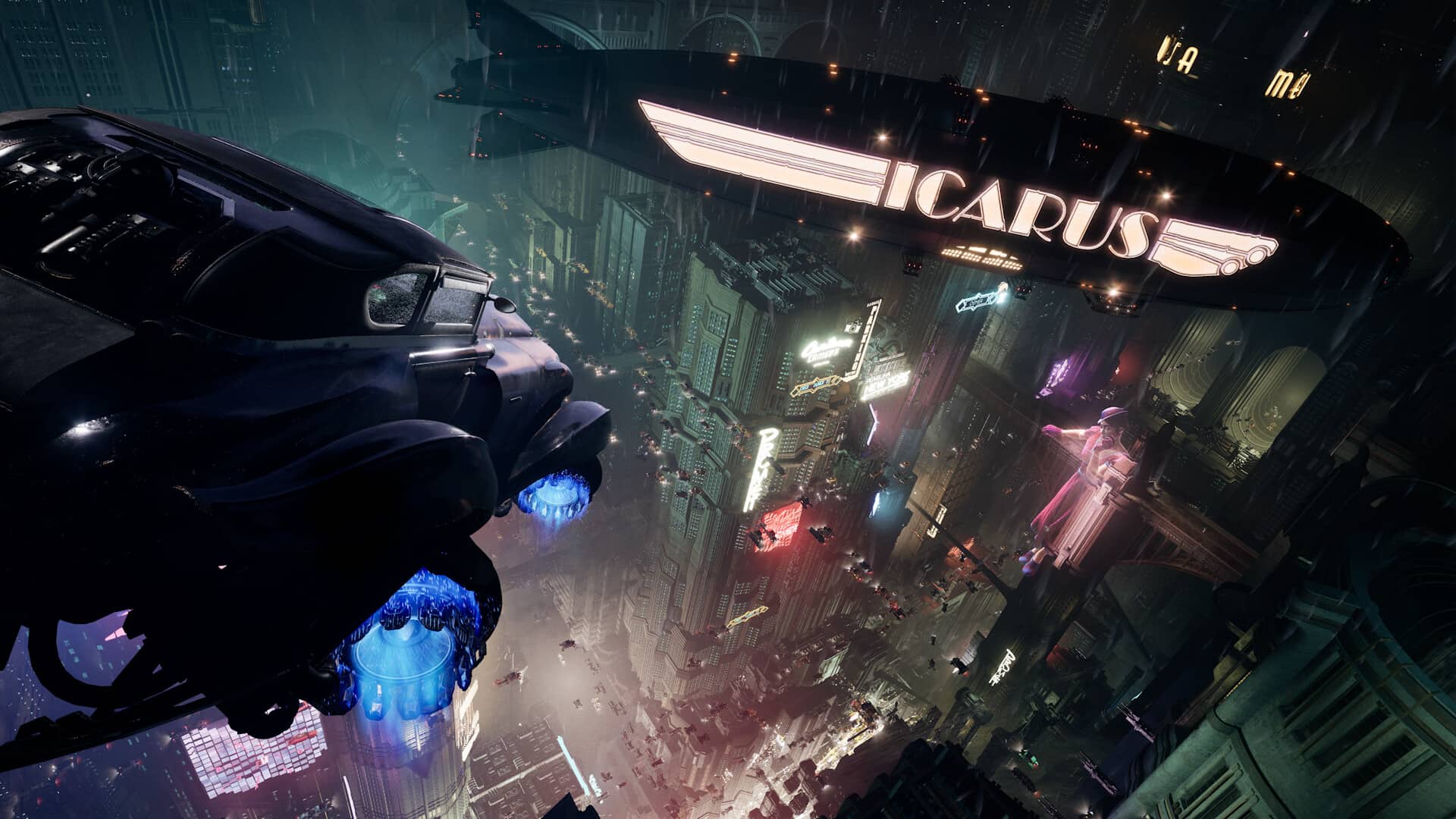
Nobody Wants to Die – Icarus zeppelin
Dystopian Reconstruction in ‘Nobody Wants to Die’
Nobody Wants to Die is a photorealistic, noir-inspired adventure built in Unreal Engine 5 that drops you into a futuristic New York City in the year 2329. You step into the role of Detective James Karra, a man using high-tech time manipulation tools to reconstruct crime scenes and hunt a serial killer targeting the city’s immortal elite. It handles heavy themes like transhumanism and class divide with a thick, atmospheric tone that makes it an essential pick for narrative junkies. While the Steam Store currently lists the game at its standard $24.99 price, it is a massive value-add to any library right now. If you happen to miss the 7-day window, you can typically find global keys on the G2A Marketplace (affiliate) for roughly $2.30 to $5.00 during major sale events.
Nobody Wants to Die – Cab driver with a gun
Supernatural Wit in ‘The Darkside Detective’
Providing a sharp contrast to the grit of NYC, The Darkside Detective: A Fumble in the Dark is a pixel-art point-and-click adventure that prioritizes humor over horror. You follow Detective Francis McQueen through nine paranormal cases in the “mildly cursed” town of Twin Lakes, solving mysteries that range from ghostly disruptions to full-blown demonic urban legends. It relies on self-aware writing and classic adventure logic, currently holding an “Overwhelmingly Positive” rating on the Steam Store where it retails for $14.99. For a resourceful backup later on, the G2A Marketplace usually has keys for approximately $1.90 to $2.50, making it one of the most accessible cult hits in the genre.
The Darkside Detective – Pixelart Twin Peaks Parody free on Epic Games Store
High-Scoring Winter Deals on the Epic Store
If you are looking to spend some actual cash while the Winter Sale is active, the storefront is currently hosting some of the highest-rated games in the industry at significant discounts. For fans of massive, cinematic storytelling, the 90+ Metascore hit God of War Ragnarök is currently 33% off, providing a sprawling Norse epic for around $40. For an even deeper discount on a legendary title, Red Dead Redemption 2 is sitting at 67% off, which is a resourceful way to grab a 93-rated masterpiece for less than $20. Strategy enthusiasts should look toward Total War: Three Kingdoms, which is currently slashed by 75%, a price point that makes the 85-rated campaign an easy recommendation. Finally, for a perfect cooperative experience, the 88-rated It Takes Two is currently 80% off, offering one of the most inventive puzzle-platformers ever made for just a few dollars.
When Mega Cat Studios sat down to dream big, one name sat at the very top of their wishlist: God of War. Years later, that long-shot ambition has become God of War Sons of Sparta, a newly released prequel developed in collaboration with Santa Monica Studio (SMS). Set at the earliest point in the series timeline, the game casts players as a young, devout Kratos before he knows his true nature as a demi-god, weaving a story about brotherhood and the meaning of being Spartan. Sons of Sparta pairs retro action-adventure design with an emotional God of War story.
PlayStation Blog: What can you share about the origins of this collaboration with Santa Monica Studio?
James Deighan: So one of the things we’ve always done at Mega Cat are these leadership retreats where we talk about what we want to do… what we want to be known for… what inspired us to join the games industry. And one of the things that we’ve maintained, kind of ceremonially, is this “wishlist” of franchises we wish we could collaborate on. And we’ve had God of War listed as number one since the very beginning. And part of that wishlist is also the probability of us being able to do that, which we’ve always had listed very low. And as we continued to grow and make bigger, better games, and got a lot more confidence we started taking bigger swings, and eventually we just made a pitch and reached out and got really lucky that somebody read it, and they were open to having a conversation about what our idea was for a prequel and some kind of pixel art treatment extension of the franchise that we all adore.
…so it really is just on multiple layers, a dream come true, working with such a talented team [at Santa Monica Studio], with a franchise we adore.
How is Kratos’ relationship with the Greek gods at this point in his life?
Zack Manko: This is Kratos as a boy. So it’s pre-god powers. He doesn’t even know he’s a god. But that also means he has a very different relationship with the gods. He’s very devout. He has this faith that he leans on and turns to when things look darkest. And in Sons of Sparta, you see how that pays off. You get Gifts of Olympus, these artifacts blessed by the gods, that allow you to do all these crazy puzzles, exploration, and combat. Ultimately, seeing Kratos as this devout, faith-filled figure, and knowing what comes later with his relationship with the gods…adds a new dimension as well.
What went into the decision to set the game at the earliest point in the series’ timeline?
Manko: I think there are two reasons, really. First, like you said, it’s a prequel. Our initial pitch was, you know, imagine what God of War would have looked like on [the original PlayStation], you know, what a God of War zero, if you will, would look like. So I think with that in mind the narrative team at SMS thought this time period you know, Kratos as a boy, his formative years, would be interesting to explore, because the events here and what he goes through and what he experiences, it really adds a texture to his character that kind of you can see throughout the rest of the saga. It certainly adds a new lens onto him [when looking back at the Greek games].
Early on, we did think about maybe [making the story] a little bit closer to the events of the Greek saga games that fans are familiar with. But again, I think the writers at SMS thought this is what we need to go to, because seeing Kratos as a boy here resonates throughout the rest of the series, not only with the Greek games, but also, you know, the Norse saga, where you see Kratos as a father with Atreus, and how the events in Sons of Sparta may influence that. And the same sort of, same sort of context, the influences on Kratos as a boy, how that lines up with Kratos’ parenting style in the Norse saga. These formative years of Kratos, this character, seeing all these things that happen and these influences on him. It just adds so much to this character that fans are familiar with throughout the rest of the games.
Meet Mega Cat, the feline the God of War: Sons of Sparta studio is named after.
What can you tell us about the origins of the game’s title and name of the studio itself?
Manko: James wanted to name it something Greek yogurt themed, you know, high protein, fitting for Kratos [laughs]. But, um, no, in all seriousness, God of War Sons of Sparta was chosen because it just encapsulates the main themes in the game so well. You know, Kratos and Deimos are the sons of Sparta, and they’re discovering what that means. What it means to be a Spartan, what are the demands there, what’s the cost?
Deighan: [Regarding the studio name Mega Cat Studios] we had a beloved cat that I had as a pet that passed. One of our [team members’ now-wife] volunteers at a local animal shelter here, and she was serving a few bottle babies. [Bottle babies] are whenever the shelters are completely overburdened with animals, the trained [certified] volunteers can take [cats] home and help raise them. I was dealing with some pet-loss heartbreak, as you do, and [the shelter had] this one, really aggressive runt in the litter that we ended up taking home and bottle feeding and spending some time with. That was Mega Cat.
So when we first came up with a list of many ideas and names for the company, we included [“Mega Cat”] on the list and started voting and sharing it around with our friends, family, and colleagues. And there was this really overwhelmingly positive response [to the name]… which kind of rolls off the tongue. Early years, it really worked to our advantage, because people confused us with Mad Catz [laughs].
We had all these names that we really went deep on, and we added a Mega Cat at the end of the list. Even our UPS driver was like, “that one’s awesome, man.”
HIGH Charming. Nostalgic aesthetic, fresh mechanics.
LOW Rookie mistakes. Uninspired combat, stale boss fights.
WTF Did they really need to make that dude’s butt jiggle sound like that?
When I first saw the email from Tastie Games with “bossavania” in the subject line, I cocked my head in puzzlement and was curious to know what that meant exactly, so I took a look.
The press release included stills, accolades and a brief description of the new genre, stating “It combines the strategic, puzzle-like boss fights of games like Punch-Out!! with the freedom and exploration of a metroidvania.”
While there aren’t quite enough novel ideas to say that it truly did establish a new genre, the devs clearly put a lot of love into it, and I enjoyed many aspects of their work.
The premise is centered around a girl who belongs to an underground-dwelling society and must endure a rite of passage which involves collecting medals from four area captains. Along the way she’ll encounter a plethora of curious life forms in different biomes and a colorful cast of idiosyncratic NPCs with authentic humor.
Tonally, it seems cheery, but underneath the charming retro aesthetics and upbeat chiptune soundtrack lies a darker social commentary regarding the reason why her people are living underground — they don’t have much of a choice, if there ever was a choice, and this situation is explained by unearthing intriguing lore nuggets that help fill in the blanks.
Gameplay-wise, I found Mole Maiden to be engaging thanks to tight controls and a novel approach to platforming. While some abilities and powerups will be familiar to platforming fans, its drilling mechanic is the most unique, as it allows the player to reach new areas by digging, flying around and leaving bombs in their wake.
There’s a bit of a learning curve to controlling it effectively, but once the player gets the hang of it, drilling through a section of sand or rock and then launching into another is a blast, especially as the level design becomes more elaborate and offers more opportunities to reach a previously-inaccessible upgrade or rare item.
I also liked how the devs tied this drilling to health — attacking hostile NPCs loads the player’s drill with fuel, which they can then use to replenish their life. However, while this reward mechanic worked for me, Mole Maiden‘s combat, as a whole, lost its charm quickly.
While it’s possible there were some abilities or powerups I hadn’t yet unlocked, most of my time in combat amounted to little more than dodging and mashing the attack button — and for a self-proclaimed “bossavania,” the bosses of Mole Maiden feel gimmicky and ultimately underwhelming.
During my first boss fight, I was frustrated by the sluggish pace as I exchanged blows with the enormous butt-jiggling King B. who I defeated simply by getting behind him and wailing on his rear end over and over until he had a tantrum, and then I would get out of the away until he was finished — wash, rinse and repeat.
Maybe I’ve played too many soulslikes, but I found the movesets of every boss or miniboss that I faced so predictable and easy to telegraph that I barely felt any satisfaction when I won and progressed to the next area.
I was also disappointed to find that the devs structured things so that there was a linear order to what bosses and areas needed to be cleared before advancing — although that’s essentially consistent with traditional metroidvanias, games like Hollow Knight have shaken up the formula in that they adopted a more open approach so that there are multiple avenues to acquiring different powerups needed to advance.
Finally, there were a few glitches that weren’t gamebreaking, but did feel a bit amateurish. The most glaring oversight that I came across early on was the “thank you for playing” message from the developer which appeared mid-boss fight and caused me to die.
I assume it exists because a demo version would let the player try for a certain amount of time before it triggered the message, but I was playing the full version of the game. Or maybe they kept it in intentionally? Either way, they shot themselves in the foot, as a message shouldn’t pop up and cause the player to be defeated because their view is obstructed.
Other glitches were fairly commonplace, like various camera issues, and there was one recurring miniboss who would sometimes start sliding across the screen and get stuck attacking into a corner, making it cake for me to beat him.
Some glitches were just plain weird, like the occasional sound effect that would sometimes linger following a defeat. Most memorably, it happened with the first boss whose squishy butt-jiggling sound effect persisted even after the screen faded to black.
Maybe after the devs squash the bugs and make a few other changes I’ll want to come back and dig some more, but in its current state, Mole Maiden doesn’t feel like it’s quite ready to surface.
Disclosures: This game was developed and published by Tastie Games LLC. The game is currently available on PC. It was obtained via publisher and reviewed for PC. Approximately 3.5 hours were devoted to the campaign mode. The game was not finished. There is no multiplayer functionality.
Parents: This game is not rated by the ESRB but has only cartoon violence and crude language, so the equivalent of a “T” may be appropriate.
Colorblind Modes: There are no colorblind modes available.
Deaf & Hard of Hearing Gamers: This game features text-based dialogue with some audio in Japanese or gibberish dialogue to give it flavor, but doesn’t have any audio cues that impact the gameplay in any significant way. As such, this game is fully accessible.
Remappable controls: The controls cannot be remapped.
When I was younger, I was always convinced that the first Tomb Raider game got a sort of remake on the Game Boy Color. It makes a lot of sense in my mind, since the title of the game was Tomb Raider. And in the same time period, Indiana Jones and the Infernal Machine also got a port to the Game Boy Color. That game was an interesting remake in 2D. Now, we are not here to discuss an Indiana Jones game, so let us focus on the Tomb Raider games.
I do not always do research before I start playing a game. This game is one perfect example. I just started the game up, expecting the story starting with a rendition of the Ice Caves. But, to my surprise, the game started up different.
The actual subtitle of the game is The Nightmare Stone. On the box-art, we just got Tomb Raider as a title. On the box-art, we see that Lara is running away from an erupting volcano and behind her, you see several skeleton enemies. The bottom section is reserved for company logo’s like Eidos, Core Dynamics, the licensor Nintendo, and the publisher THQ. We also got the “Only on Game Boy Color” triangle in the left corner.
The game was released in June 2000. On June 7th, North America, Europe got it on June 28th and the UK two days later. Only Australia got the game a little bit later. Their version got released on July 18th. Nowhere on the box-art, the game got the subtitle The Nightmare Stone. The game just released as “Tomb Raider” in North America and released as “Tomb Raider: starring Lara Croft” in all other regions. This is a practice also done with the other Tomb Raider games. It would have been easier if they just added the subtitle, to make conversation easier.
The critics gave Lara Croft is first entry on the Game Boy Color very high praise. Various gaming magazines and websites gave this title 8 or 9 out of ten. The average score of this title is 79% on the aggregator GameRankings. One of the lowest scores I could find was by a German magazine named 64 Power in their June issue, giving it a three out of 5 or 60%.
Since Core Design developed this game, it will not be a surprise that you find a lot of developers on this game also worked on the main Tomb Raider games. This game was developed by people who knew how a Tomb Raider game should play. In this title, Lara is hunting after the Nightmare Stone. This stone is in possession of a treasure hunting group who wants to use it to release the evil god Quaxet, a factious god in the Mayan mythology.
Playing through this game, you really want to play through a Tomb Raider game. Of course, there are some big differences since the game got released on a handheld. The most obvious difference is that the game is in 2D. There were only a handful of 3D Game Boy games, and most of them did not involve jumping.
Another significant difference with the main line Tomb Raider games is that this game plays a lot slower. The controls are more limited on the Game Boy Color, and more action-packed gameplay could not really be implemented, per se without it becoming really clunky.
Speaking about the controls, it takes some time to get used to. I mostly played platformers or adventure games on the Game Boy, and I was so used to push the A button to make my character jump. But Lara jumps with the up arrow in this game. Not only that, if you want to climb up ledges, you need to hold B. Which is the button you use to run. If you are moving left or right and press B, Lara starts running. When Lara is running, and you press the jump button, Lara jumps in the direction she is running. This gives you a hint how to jump a gap when standing still. You have to press B first before the jump button to jump over a gap.
This control scheme is quite ambitious since there is no real tutorial in game explaining the controls. You do not have a training or testing level in Lara’s home. The manual explains these things quite well, but if you bought your copy today from a garage sale without the manual, I would advise you to look for it online. The control scheme is something that you will not really expect from a Game Boy game.
Earlier, I mentioned that this game has a slower pace compared to the main line Tomb Raider games. That was intentional. If you start running everywhere, you will find that this game will be quite harsh and brutal. There are several pits and gaps that either eat a good chunk of your health or kills you right away. Enemies are also hidden everywhere, and their damage can be unforgiving.
You cannot save where you want in this game, since the save crystals from early Tomb Raider console games return in this game. Learning where the save crystals are important. It is the only way you can save, and it is you respawn spot when Lara losses all her health. The save crystals are not close to each other, either, so I was always happy to find one.
If you do not really know the controls, it can feel a bit like trial and error. For example, I did not know that when you are running and jump, Lara will land further than from a standing jump. I did not expect this mechanic to be in the Game Boy Color games as well. Other things like dynamite being able to use to explode walls, which is something I’d have loved to get explained to me.
Overall, visually, this game is extremely impressive. Once everything starts clicking together, and you get used to the controls, this game is a hidden gem on the Game Boy Color. When you know what you are doing, this game takes around 4 hours to play through. For a first playthrough, I would say that you can finish this game in roughly 15 hours.
The game must have been quite successful since a year later we got a new adventure in the same engine and style. Eidos tried to get this game released around the time the first Tomb Raider movie released. Tomb Raider – Curse of the Sword, released in late June in North America and in August in Europe.
This time, the game was not released by THQ, but by Activision. Most of the team who worked on the first Game Boy game also worked on this title. Because this game got a shorter development time, this game is shorter compared to the first Game Boy Color game. If you know what you are doing, this game can be beaten in two and a half hours. For a first playthrough, I estimate that it will take 8 to 10 hours.
The sequel got the same reception from critics when it released. This game still shows off impressive visuals for the Game Boy Color. Remember that the Game Boy Color is an 8-bit system, and these two Tomb Raider games had such fluid animations that it looked next-generation. Did you know that there are over two thousand animation frames per game to make the animation work? Lara’s model is also forty-eight pixels, making her one of the most detailed characters on the Game Boy Color.
Personally, I feel like both games are amazing entries into the Tomb Raider series. While they play quite different from their console and PC counterparts, both are an amazing adventure through various locations. You still must solve various puzzles and platform your way around. In Curse of the Sword, you even have a chase sequence on the rooftops.
When I look with a critical eye at these two games in 2024, I would say that the lack of a tutorial for the controls really hurts the game. Also, some people might be put off from the difficulty level of this game. These games have some really difficult sections. Use the save crystals well! Otherwise, you might lose a lot of progress. And if I am really nitpicky, I could say that some areas would benefit from a map screen. But the levels are a bit too complex for those and with the small Game Boy Color screen, the map might not be even readable. Thankfully, there are various sources online, like Stella’s Tomb Raider site (tombraiders.net) that have amazingly drawn maps.
When you read this, you might think that beating these games without a walkthrough is almost impossible. But do not worry. These games are quite linear and straight forward. I rarely got stuck in these games by not knowing what to do next. Most of the time, I did not know I was able to perform a certain action or how to solve a certain puzzle.
The streak of releasing a new game every year continues in November 2002. The Game Boy Color was on its way out, and the next title was released on the Nintendo Game Boy Advance. For this title, Ubisoft Milan was tasked with creating a new game. That is because the main team was working on the sixth main title, Angel of Darkness. Tomb Raider – The Prophecy was released to mixed reviews. It released in early December in Japan.
This game played quite different compared to the Game Boy Color titles and played more as a top-down isometric puzzle platformer. If I am very honest, this is the gameplay style I expected more of the Tomb Raider series on the Game Boy. It is mainly because I associate Tomb Raider more as a top-down game on handhelds than it being a 2D side view game. The Game Boy Color version of Indiana Jones and the Infernal Machine showed me it was possible to have a game like that on Game Boy Color.
The story of this title is about the Tome of Ezekiel. In this tome, a story is told about three magical stones that bring great power. She faces a big cult by the name of Teg-du-Bhorez. The game takes about 6 hours to complete on a first playthrough. If you really know what you are doing, this game can be beaten in 2 hours and a half.
Honestly, for a portable Tomb Raider adventure, I really enjoyed this one. It is a rather underrated gem in my opinion and really can be quite exciting to play. Especially since the formula really works this way on the Game Boy Advance. The big issue is that reviewers compared it too much to the mainline series, which is quite unfair to do. What I can agree with, is that this game can feel a bit repetitive at times in terms of puzzles and level mechanics. But it is way less repetitive compared to the Game Boy Color titles, since a lot more puzzle solving like statue placing is used.
The final Tomb Raider title on the Game Boy line of platforms came in 2006. After the very mixed reception to Angel of Darkness, the IP was given to Crystal Dynamics and Tomb Raider Legend was born. Talking about that, can be an entire article in itself. But, to close off this article, I want to quickly focus on Tomb Raider Legend on the Game Boy Advance. I know there is a port to the Nintendo DS, but I do not have any nostalgic memories for that one. I do have nostalgic memories for the Game Boy Advance port.
Now, let me tell you, the Game Boy Advance port was rough. The game went back to the style in like the Game Boy Color games. Yet, it also tried to do intractable doors. I can totally understand why reviewers back in the day were extremely negative about this game. Especially, since the console and PC versions of this game were such a blast of fresh air in the series.
Still, why did I beat this title 100% three times? Because, it had a certain charm. You could find various secrets in the game to unlock secrets like concept art or even cheat codes. But you were not able to see if you got all treasures in a level. The jumping and swinging controls were a bit awkward, yet you had very forgiving checkpoints.
There are a few things that stick with me to this day, the fact that the final boss is rendered a joke in this version. Just mash the attack button and you easily win. No matter the difficulty. Also, the mini-games and exploring Lara’s home were fun distractions as well. Moreover, I want to thank all the pizza boys who delivered me pizza during the writing of this article, like in the credits of this game.
And with that, I want to wrap up this brief nostalgic look into the 4 Tomb Raider titles on the Game Boy Color and Advance. My name is NekoJonez and if you enjoyed my writing and want to read more of my work, you can find me over at: https://arpegi.wordpress.com. I want to thank you all for reading my article, and I hope you enjoy the work of the other writers in this magazine. But for now, I am out! I hope to welcome you in another article but until then, have a great rest of your day and take care!
Editorial note: This article has been written for a gaming magazine. Did you find this article interesting? Then you should read the other articles right here. Thank you so much Dominus for letting me publish an article. There are various articles about Ultimate Underworld Retrospective – Sin God – The Making of the Wipeout logo design – …