
Zobrazení pro čtení

Virtual Boy for Nintendo Switch brings back the highs, lows and weirdness of 90s VR

There’s a lot of people wishing that the mid-2020s were more like the mid-1990s, but I don’t expect many were doing so for a chance to experience the Virtual Boy’s brief heyday. Yet here we are, with Nintendo releasing both a plastic recreation and a jazzed up cardboard edition of the Virtual Boy to go alongside the console’s addition to Nintendo Switch Online + Expansion Pack. It’s playable with Switch, Switch OLED and Switch 2, so we’ve done just that.

The plastic shell of the Virtual Boy has been recreated in a charmingly accurate fashion from a distance, but you see plenty of fakery when you pay closer attention. All of the physical controls, sockets and sliders of the original Virtual Boy – the IPD slider, the volume wheel, controller port and all the rest – are now just surface details, and like a treasure chest that reveals itself to be a Mimic in a D&D campaign, the red shell at the top of the body now opens up to reveal a cavernous maw, eager to consume your console.

Far more accurate are the backward tilted legs, sturdily holding the headset in place, and stubbornly allowing just a single adjustment. There’s no up or down here, just a tilt back and forward, and it means that you have to really lean in to get your Virtual Boy on. If potential eye strain weren’t enough reason for Nintendo to suggest regular breaks, then bad posture and possible back pain were another. While remaining authentic to the original is admirable in some ways, it means this remains an annoyance for anyone that isn’t my cat. I found that the box the Virtual Boy came in brought the headset up to a sensible viewing height for me.
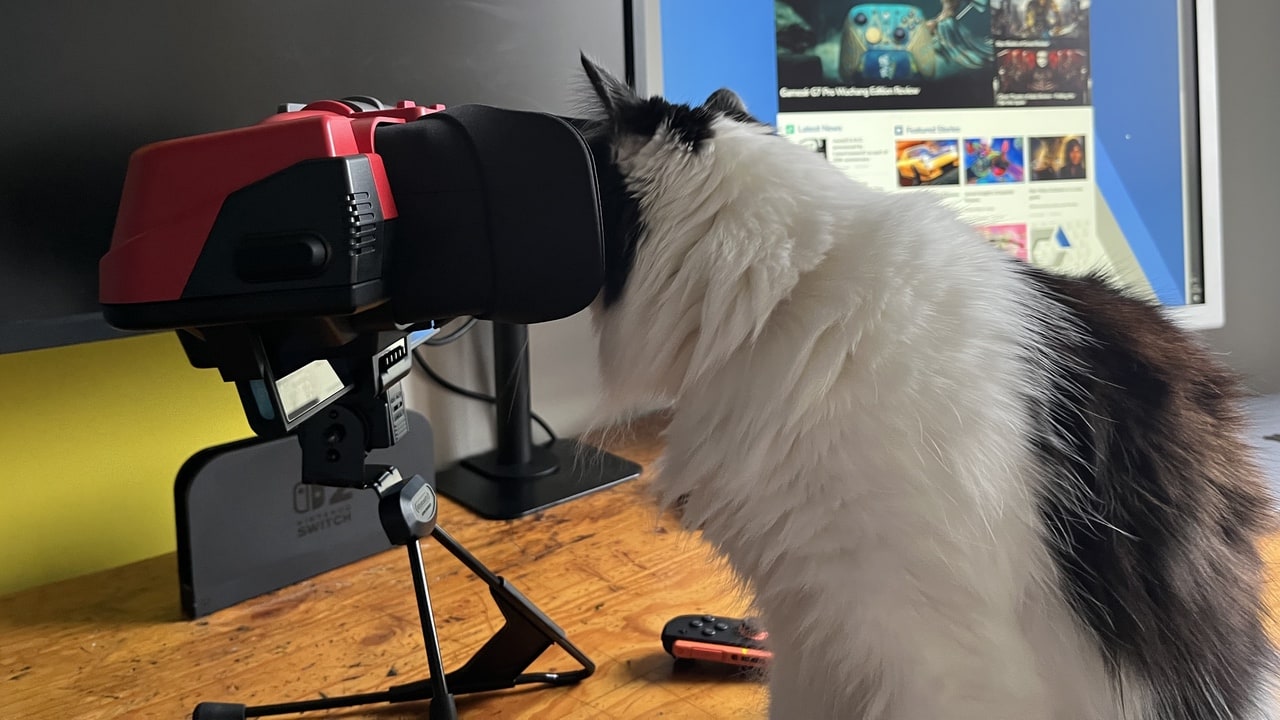
Virtual Boy cat inspection

The Virtual Boy is for ages 7+, but my cat is 3, so it was not turned on at this time.

Another slight disappointing element is the inelegance of Nintendo’s solution to the difference in shape and size of the Switch and Switch 2. Another detail on the underside of the Virtual Boy is that the protuberance that the stand grabs onto is also a basket to catch and support the console, the inside having a funnel and hinged flap to ensure it’s in roughly the right place, with a little bit of wiggle room. The basket is screwed onto the body of the Virtual Boy, and it’s sized for the Switch 2 by default, with a separate plate for the original Switch and Switch OLED included in the box.

I’d argue that’s overkill, and a needless faff for Switch 1 owners, when really a plastic insert would have done the trick. Heck, in a pinch when wanting to swap back and forth and compare screens, I just shoved my little finger in to give a modicum of support, and a plastic wedge could have made this more easily universal, in my opinion.

Virtual Boy Switch 1 basket.

The Virtual Boy Switch 1 support is a bit of a basket case.

Another problem with the baskets? There’s no space for a USB-C charging cable or any kind of power pass through. Switch 2 could, I suppose, play with the top lid cocked open for the top charging port, letting outside light leak in more easily. In general, now you’re playing with (battery) power.

What really matters is what’s happening inside the headset, and you’ll have to peer into this mysterious box to see it. Back in 1995, Nintendo had to pull some remarkable mirror-waggling tricks to get the single-colour LED strips to trick your eyes into seeing images, but in 2026, it’s the standard VR headset method of viewing a screen through distorting lenses. In both case, however, you look through a thick red filter, cutting out all of the other colours that the screen can display.

So, between Switch, Switch OLED and Switch 2, which console gives the best Virtual Boy experience? With this plastic Virtual Boy? I’d have to say the Switch 2. The simple fact is that it’s a higher resolution screen, allowing it to display the 384×224 of a Virtual Boy screen in a smaller space, so you can take in the full image more easily as it appears further away. Each console displays at 1:1 by default, and I feel that with the Switch and Switch OLED in particular, this makes it too large within the headset so that I’m occasionally moving my viewing angle to see if I’m missing something in the corners – and when this is a 3D effect, messing around like this and shifting focus can give you a real headache.
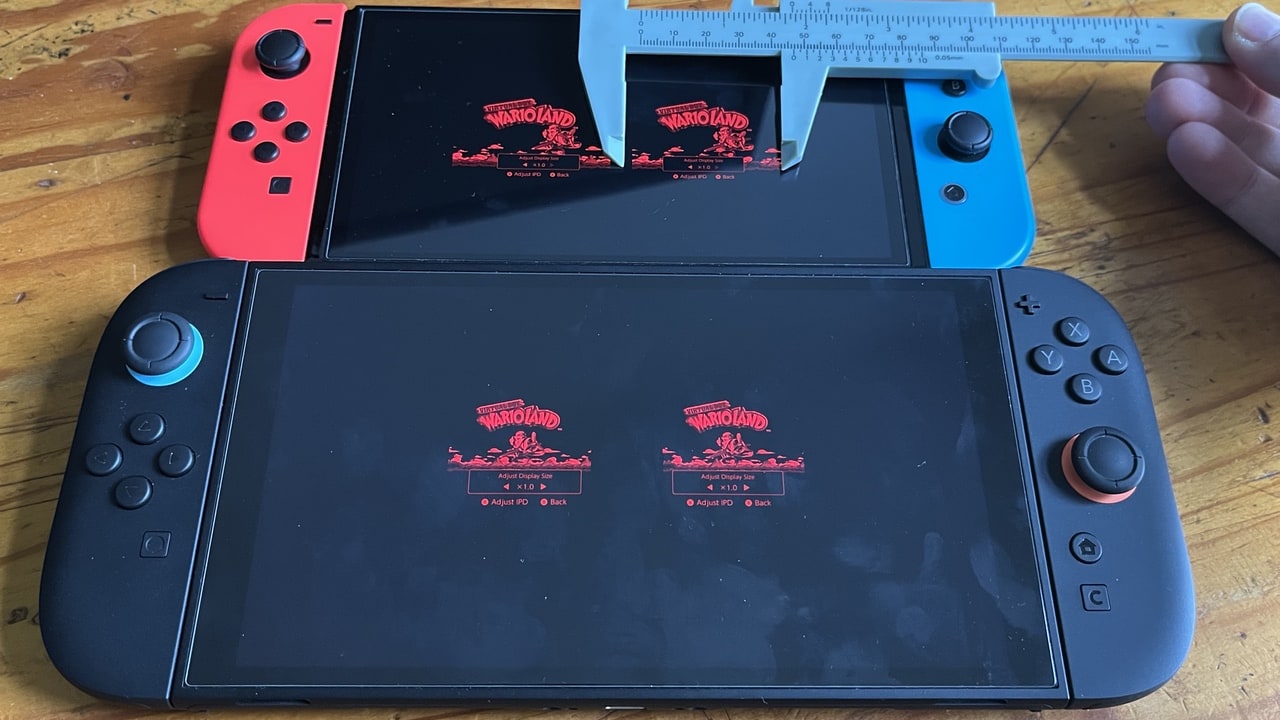
Virtual Boy – App render size comparison Switch 2 and OLED

The Switch OLED renders the Virtual Boy much larger than on Switch 2.

It’s a big difference. The Switch 2 puts Wario Land into a 35mm wide postage stamp per eye, before passing through the lenses, while the Switch comes in at 41.5mm and the Switch OLED at 46.5mm. It’s a huge difference, and it makes the pixel grid much, much more visible. You can adjust the zoom within the emulation, to at least shrink the image size, if not the pixels on the Switch OLED – Switch 2, meanwhile, has a wider zoom range and can go up to 1.3x in size to effectively match the Switch OLED at 45mm. I’ve never used an original Virtual Boy, so cannot say what is most authentic, but I’d personally rather see more of the game view than less.

OLED does have its advantages, though, with the cardboard edition in mind. With an OLED panel, any pixel on the screen that’s not in use is off. It’s pitch black. Meanwhile, the backlights of the Switch 2 and Switch bleed through the black and make it a dark blue, to my eyes. The red lenses cut out all but the red light, helping to even the playing field with the plastic Virtual Boy, but the cardboard one doesn’t have the red filter, which can make the Switch OLED king in this scenario.

Virtual Boy red filter

And so we come to the games. The game selection menu passes through the filter in an ominous red hue, but this is actually a bit of a lie, as it’s rendered in full colour by the console. The games themselves are all-red all of the time, though. Seven games are featured on day one, from 3D Tetris to Golf, Red Alarm, Teleroboxer, and the most noteworthy by far, Virtual Boy Wario Land.

Coming a year after his debut as a protagonist on the Game Boy, Virtual Boy Wario Land pioneered multi-plane platforming, with Wario able to use jump pads to bounce to parts of the world further away from the camera, and really pushed the number of parallax layers featured to give the environments its 3D depth. There’s smaller details too, like blocks having multiple layers to them, even little grassy fronds on the ground having a couple layers, giving added depth here, and the sprite scaling as things move in and out of the screen is really nicely done. Practically the first thing you encounter are spiked balls swinging towards your view, and it shows the smoothness of this.

Virtual Boy Wario Land – Wario jumping between planes in 3D

Teleroboxer does a similarly good job with the boxing robots you fight having lots of layered sprites to create a canny 3D effect, and The Mansion of Innsmouth has the classic first person 3D dungeon crawling aesthetic as you move through corridors, while blasting monsters with an on-screen cursor. But for true 3D, you’ve really got to look to Red Alarm, a Star Fox style rail shooter with the world rendered in red wireframe – with just a single colour, this was probably the best path to take, but does mean you can see enemies through obstacles.

And then there’s 3D Tetris, which takes the notion of the block-dropping puzzle and makes it feel like Star Trek’s 3D chess. The classic tetromino shapes are put to one side, and you’re instead given other blocky assortments, layering them down on multiple flat layers. It can be tricky to make out how things are being placed with the shifting 3D view of the Tetris lasagna you’re making, and it’s odd to have split blocks to drop as well. Thankfully the right of your view has a simple 2D representation of the layers and where each block will land. It’s a bit of a cheat, but makes this more playable.
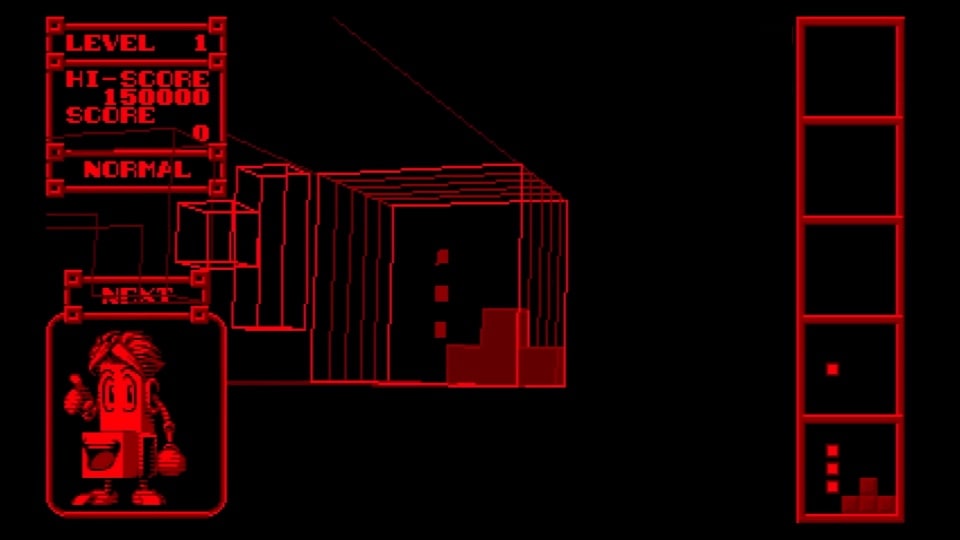
Virtual Boy 3D Tetris

The main problem with the Virtual Boy’s game line up is that it never had the chance to mature. 1995 means that we were still getting experiences and ideas from the SNES or Game Boy, in part thanks to the single colour displays, and it was a time when sports games like Golf and Mario’s Tennis were… well, they were just fairly standard golf and tennis games. Neat to see, but not exactly ground-breaking.

All in all, the Virtual Boy for Nintendo Switch feels authentic (even if closer inspection does make it appear more toylike), and does a solid job of rendering the console’s small selection of games. It is a shame that, when this costs £67, Nintendo didn’t push on to remake the Virtual Boy controller, improve the ergonomics of using the headset, or even build in the ability to charge and play at the same time. That high price means that Virtual Boy will remain a retro curio for Switch owners and gaming history enthusiasts.

  •  

Gear.Club Unlimited 3 Review

The Nintendo Switch was not home to many great racing games, especially ones that didn’t feature karts and moustachioed drivers. So far, that’s continued to play out for the Switch 2, but there are some key signs of change with the arrival of GRID Legends last month. Drafting directly behind it is Gear Club Unlimited 3, an arcade/sim-cade racer that also boasts its own storyline, licensed vehicles and updated visuals, hoping to snatch its own place on the podium. While it puts up a valiant effort, it feels like it’ll remain firmly in the middle of the pack.

As we’re seeing more and more on Switch 2, Gear.Club Unlimited 3 gives you the choice between a 30fps Graphics option and a considerably smoother Performance mode with a 60fps refresh rate. Ideally, racing games need to be 60fps – though 30fps is fine if its stable – and it’s definitely snappier and more responsive. The Graphics option here targets 30fps, but it does not manage it by quite some margin. Stutters and lag happen throughout races in this setting, so much so, that I’d say it’s currently unusable. It doesn’t really seem to make all that much difference to the visuals, either, other than the quality of tyre smoke at the start of races.

In the world of Gear.Club, winning is everything. The story mode sees you joining the organisation as a rookie, before trouncing one of the old pros and stealing his slot on the tour to Japan. Thankfully, everyone is thoroughly amiable, and he comes along as your mentor instead, narrowly avoiding some genuinely interesting conflict and drama. All the story dialogue is told via text boxes and static character art, which serves to emphasise the game’s budget leanings, while the suit and shirt-wearing bigwigs feel completely out of place in a tournament of underground racers. The story is, at best, a fairly forgettable frame to the racing action. At worst, it’s just explaining the next menu you’ve unlocked.

Gear.Club Unlimited 3 Japan

The cars make a better first impression. They are extremely well modelled, shining and glistening in their metallic glory, and striking a tone that will have you feeling pretty positive about Gear.Club Unlimited 3’s chances, though with a roster of 39 cars, it’s relatively slim pickings.

Actually racing them isn’t so positive. Gear.Club Unlimited 3 offers a couple of options to tailor your experience, with different levels of brake assist and anti-skid. Whichever option you go for, the cars are relatively well grounded, and pretty reliable in the way they manoeuvre, if a bit lifeless, though there’s still a nagging sense of worry and uncertainty if you go for Expert settings and turn off anti-skid.

Where it comes unstuck is drifting. At no point does this become natural, easy, or enjoyable, and you’ll find you can launch it around curves like a terrible NASCAR driver without losing too much time. That’s all exacerbated by the lack of analogue triggers. We can lay some of that at Nintendo’s door, but when GRID Legends gives you right analogue stick throttle control, and supports the Gamecube controller’s analogue triggers, there’s little excuse for not having it in place.

It just doesn’t come together very well. Rubber banding in races sees you fly past the entire pack, only to have them inexplicably reappear in your mirrors and pass you at the last moment. There’s a Kudos-like scoring system for keeping it clean, and achieving various other feats of vehicular control, but it feels pretty perfunctory and uninvolved.

Gear.Club Unlimited 3 is at its best when it’s trying to emulate Tokyo Xtreme Racer. Battles and duels that take place on packed Japanese highways are the most fun events here, and nipping your way through traffic is a blast. Well, it’s a blast till you clip somebody and invariably end up facing the wrong way.

Gear.Club Unlimited 3 night race

Upgrading your Club is a pleasant little diversion. You’ve got a massive garage to work with, filling it with technicians as well as designing areas to relax in, and stuffing them full of arcade machines. Upgrading your cars is tied to which workshops you’ve unlocked, and then adding engineers to unlock higher tiers within each one, and that’s interesting enough, giving you a reason to take part in an additional race or two, to fill things out.

The problem is that the engineers and upgrades dry up at points, with little to do but persevere with the ‘story’ mode, and just keep on racing across a map that you can barely tell has changed.

Gear.Club Unlimited 3 is a largely solo experience, with the main story mode taking you from a rookie to the leader of the Gear Club Japan arm of the racing company, while taking in time racing across the roads of France. It’s a shame that progress feels so slow, and the upgrade system so lacklustre, because there are elements of the game that work pretty well.

There is a Free-Roam mode too, which I hoped might suddenly turn Unlimited 3 into an open-world racer. Unfortunately, it just lets you – or you and a friend – drive the tracks without any constraints, or you can do some two-player racing, which is a nice thing to have. Being able to explore the world might have been more impactful if there were more sights to see, beyond the occasional train racing by.

Gear.Club Unlimited 3 garage

On top of everything else, the music is horrendously repetitive. I managed about an hour before I turned it off in the races, and maybe a couple more before wanting to cull it in the menus too. Besides that, the game hard-crashed at points too, dumping you back to the Switch 2’s main menu. It’s just another thing to chip away at Gear.Club Unlimited 3’s potential.

  •  

Warhammer 40,000: Rogue Trader Nintendo Switch 2 Review

The Nintendo Switch 2 version of Rogue Trader is not the best version of the game. We might as well make that the starting point for a review that puts me in a very difficult position. How do you rate a game that’s as good as Rogue Trader, but which runs here, somewhat inexplicably, like a bag of spanners? You could just skip right down to the bottom of the page, but here’s the thing, Rogue Trader on Nintendo Switch 2 defies whatever score I finally settle on, because even when it’s running badly, it’s one of the best tactical RPG experiences you’ll find anywhere.

Load times are not good. That starts with the tone-setting creep of a loading bar that laughably shoots to 41% before taking a loooonnnng rest, searching around for the energy to make it to the end. Any movement from major area to the next brings about another lengthy wait, but the central sections themselves don’t incur any loading at all, so there is that. Travelling in your Voidship across the map also causes various stops and starts as different narrative moments are played out, a fresh load cycle happening every time despite those moments taking place in the same bridge section, and it serves to sap a lot of the game’s momentum.

You’ll be slowed down further when the game autosaves, pausing the action for at least ten seconds while it sorts itself out, and if you run quickly back and forth through a new area, the game will hang as it loads the required assets in. It’s then absolutely fine once it’s finished doing so, so it’s almost worth having a run around for a few moments to settle things down. All of this doesn’t sound very good, and… it’s not, requiring players to have rather more patience than most games should given that we now have SSD speeds for storage on Switch 2.

Warhammer 40,000 Rogue Trader Switch 2 flamer

However, Rogue Trader is the kind of game to attract the patient. This is a role-playing game in the purest sense. From the first moments spent creating your character, where you’re choosing their background and backstory as well as selecting their visual design, you’re then drawn ever deeper into the world of Warhammer 40,000 thanks to some of the best writing and storytelling you’ll find in gaming.

If you’ve been a fan of the Warhammer 40K universe, and perhaps read some of the many novelisations, Rogue Trader feels utterly authentic, perfectly capturing the language, lore and feel of Games Workshop’s sci-fi series. It’s intensely literary, with a great deal of excellent writing, and the size of the text has thankfully been enlarged for the Switch 2 edition, so it’s still enjoyable whether you’re playing in docked or handheld mode. There should definitely be a toggle or a slider for this, mind you, but I can live with it as it is.

That writing is enhanced by the excellent voice acting that’s prevalent across the entirety of the cast. Each character feels unique and fully formed, and as your crew expands, you’ll find yourself coming to know each of them in exceptional detail. It’s at a level that you’ll consistently marvel at, and despite the many performance issues in this version of the game, you can definitely look past them thanks to the quality of the actual game itself.

Warhammer 40,000 Rogue Trader Switch 2 lightning

That will depend on how sensitive you are to frame rate issues, though. While things have improved following the first major patch, Rogue Trader on Switch 2 still chugs along when you’re moving around each area, and it’s incredibly inconsistent. Frankly, it looks and feels pretty horrible, and that’s with an obviously reduced resolution across the board as well, which makes the character models and level design look considerably uglier than you’ll find on other platforms.

You might be disappointed to find that following the most recent patch, they’ve also broken the menus. You can access the main options, but none of the graphical or visual options currently work, which feels as though it’s a deliberate choice while they try to improve things. There were previously two different anti-aliasing options, as well as a film grain toggle, but right now, none of it works. I do expect Owlcat to continue working on this, but in its current form, Rogue Trader on Switch 2 looks and feels more like it’s running on the original Switch.

Warhammer 40,000 Rogue Trader Switch 2 character

The shame of all this is that Switch 2 owners are going to experience the game in a way that they may find utterly off-putting. They will check out from one of the best sci-fi RPGs of recent years, and that is tantamount to being a crime. The storytelling, the character building and the tactical combat are some of the best in the genre, but right now, this version of the game is a mess. It is broadly playable – I’m still persevering as the game has got its hooks back in me – but currently, if you can play Rogue Trader anywhere else, you should.

  •  

Inazuma Eleven: Victory Road Review

Inazuma Eleven: Victory Road is a football game that feels, almost wholeheartedly, like it’s not really about football. This is a sports drama through and through, focusing on the interpersonal relationships, the individual journeys, and the yearning for acceptance that epitomises our teenage years, rather than sporting glory. You play as Destin Bellows, a young man with a heart condition, who appears to hate football and attends South Cirrus Academy, a school where football is banned. None of this really screams the word ‘football’ – or ‘soccer’ if you’re so inclined – and yet, Inazuma Eleven: Victory Road also revels in the joy, the purity, and the companionship that football can bring. This juxtaposition also makes it one of the best sports RPGs you’ll find.

I’m a sucker for sports dramas. Maybe it started with The Mighty Ducks, a movie that took a rag-tag team of unlikely players who went from being woeful nobodies to the best team in the league. With Emilio Estevez! While there’s no Young Guns alumni here, there’s that same sense of camaraderie and overcoming adversity throughout Victory Road, starting from incredibly meagre beginnings, before working your way towards rebuilding the school’s football club and setting forth on a path to sporting greatness. It’s the characters that pull you through this drama though, rather than the extraneous bumps in the road, and you’ll quickly embrace Destin and his myriad teammates wholeheartedly.

Level-5 have made this character focus easy, because you won’t be playing football any time soon, at least not in the central story mode. My save file had clocked up an oddly impressive 4 hours before I played my first 5-a-side game against an ageing group of shopkeepers, and I kind of love the investment that’s been built into Victory Road’s narrative. To a certain extent, you won’t care that there’s no football, and when it does arrive, with its quirky stop-and-start gameplay, special moves and occasionally clunky controls, you’ll want to persevere, learn and get a grasp of it so you can lead the team you’ve built to victory. It’s something that wasn’t ably captured in Victory Road’s early beta testing, and it feels a lot more natural within its proper context.

The original Inazuma games were mostly exclusive to Nintendo’s DS and 3DS, using the stylus to move your players around the pitch, and selecting special moves as you went. It was a system that I loved across multiple games, and I was sad to see it go, but Victory Road’s updated take does a good job of replicating and replacing it, with more action and reaction than you needed before.

It’s best to think of Victory Road’s matches as a series of RPG encounters, strung together in quick succession, rather than a football match. Every time your player meets an opposing player, whether you’re playing offence or defence, it begins an encounter. Depending on the player, you’ll have basic options like passing, shooting, or dashing past, but you may also have special moves available to you, each wilder and more unbelievable than the last. That can mean creating clones of yourself to confuse defenders, or unleashing a shot that’s the result of a thousand kicks, but, with the level of variety on offer, it makes matches continually action-packed and exciting. It’s definitely not regular football, but it’s a hell of a lot of fun.

Destin’s tale is easy-going, and occasionally a little slow, but it’s all so amiable, and the characters are so likeable, that I found I didn’t mind all too much. Destin loves to investigate and collect data, so there’s a fair bit of running back and forth, and that’s interspersed with funny turn-based RPG battles/conversations that use rock-paper-scissors mechanics as you try to argue your way to victory. I preferred the original Japanese voices over the English dub, but only marginally so, and if you prefer to play in your native language, it’s perfectly satisfactory.

While the central story mode strings you along without any matches, there’s a secondary story that gets you into the action much quicker. Chronicle Mode brings a time-travelling tale to the Inazuma timeline, sending you back in time to form the ultimate eleven, in the hope of preventing a world-ending apocalypse. Newcomers might raise an eyebrow at first, but returning fans have been here before. Chronicle Mode manages to perform a whole bunch of functions at once: introducing people to the series’ extensive history, getting into the football sections quicker, and bringing an Ultimate Team-like experience to the game to boot. It’s a winning formula, and one that shows how strong the revised gameplay formula is.

Level-5 have given players an absolute avalanche of places to play in Victory Road. From the two story modes, you can then set forth with your created team into a tournament, in either single player, multiplayer or online modes, or there’s another mode where you can play with full-powered historical teams from each of the previous games. If you need a break from all that, you can even create your own Inazuma Bond Town where you can meet up with friends online, filling them with all sorts of decorations, buildings, people, cats or giant statues of Mark Evans. To be fair, it’s probably the weirdest inclusion here, and yet, it feels thoroughly Inazuma.

All of this is wrapped up in a lovely 3D anime aesthetic that ties really well with the traditional cartoon cutscenes. It often feels like you’re playing an interactive cartoon – a fact heightened by the story modes’ many cutscenes, and chapter-by-chapter framing – with Level-5’s design department clearly working at the height of its powers. It definitely bodes extremely well for this year’s Professor Layton and the New World of Steam.

  •  

Woojer Strap 4 Review – Rumble pack

Gamers are always looking for the next level. A bigger sword, a more powerful gun, magic that turns your foes into globs of pink mush. But what about levelling up your gaming setup? A headset would always be my first call, and then maybe a pro controller or high end mouse, but what then?

Woojer have their own ideas on that, and they’ve been toting their haptic-infused devices for several years. While the Woojer Vest – now on its fourth generation – is the headline grabber, the Woojer Strap is the more accessible option, giving gamers and music lovers an extra layer of immersion by strapping a single device to your body, its haptics shocking, rumbling and thumping in time with the action.

Priced at £124 – with a healthy holiday season discount down to £95 – the Woojer Strap 4 is the latest iteration of the single-unit device. In the box, you’re getting the Woojer Strap 4 central unit, an elasticated strap to wrap around your body, a USB-C to USB-C charging cable, and a double-ended 3.5mm cable to physically connect your audio devices.

As gaming devices go, the Strap 4 is pretty straightforward. The unit itself has some weight to it and feels incredibly robust in your hand, crafted from solid plastic throughout, and available in a series of different colours. To the front, there’s a customisable LED ring with rubberised physical volume and intensity controls within it.

The top edge features the power button and Bluetooth pairing button, while the bottom includes a USB-C charging port and two 3.5mm audio sockets, one for input and the other as a dedicated output. I thought the older model’s copper finish looked great, but the addition of RGB allows the Strap 4 to match your gaming setup, and the extra layer of customisation gives you some individuality too. If you’re not an RGB fan? You can just turn it all off.

You’ll need a mobile device for the Strap 4 setup, and it proves pleasingly simple to connect the device to the Woojer app, where it takes you through pairing to your device, and then the secondary pairing of your headphones to the Strap 4. This all worked first time, which almost never happens, and you then find yourself with the main control page, which gives you an input and output display, as well as power remaining and the current latency setting, which you can alter if you find that the Strap 4’s haptic output doesn’t quite match up with whatever visuals you’re looking at.

Besides that, you can directly control the volume and the intensity, though there’s physical buttons for these as well, and, if needed, you can dive into the haptic sensation mode, which alters the behaviour of the haptics through Broad, Focused and Gaming settings.

The app also gives you decent control over the LED lights. There’s a full spectrum colour wheel to dial in the exact tone you want, adjust the brightness, and choose between a series of different effects to keep things interesting. While you’re playing, it’s not exactly something that adds all that much to the experience, but it’s certainly more futuristic, and if you’re out and about listening to music, you’ll certainly turn a few heads.

The Strap 4 experience is definitely easier to get into than the Woojer Vest. It’s small and portable, doesn’t take up much space, and requires minimal setup. You can just throw it on, and start watching, playing or listening to whatever you want, and I really liked how simple it felt. In turn, it immediately lifts your experience, with the added haptic feedback from your audio immersing you deeper in your content than ever before.

You can wear it in a variety of ways, though Woojer seem to recommend particular setups for particular input types, so for music you’d wear it around your waist, or horizontally while playing VR . Fundamentally, you can go for whatever feels best and most natural to you, and I gravitated most towards wearing it across my body, with the strap over one shoulder and the unit in the centre of my chest. This makes the haptic sensation fire directly into your chest, and explosions and heavy hits thump and rumble straight into you. Just like the rumble motors in a controller, it brings the action to life that bit further, and I find it hard to go back to playing without the extra layer it provides.

I loved using the Strap 4 for regular flat-screen gaming, listening to music and rewatching the most recent Star Trek movies, but VR is where it truly makes a major difference. With your senses cut off from the outside world, the rumble feels more nuanced and powerful, and whether you’re playing Beat Saber and throwing yourself directly into the music, or going for something more action-heavy like the new Deadpool VR, the Strap 4 brings a new level of immersion for a relatively low entry price.

While it can’t compare to the full experience you feel with the Woojer Vest, in terms of value for money, I think the Strap 4 hits the sweet spot between what it brings to your experience and the asking price. If you’ve already got a great headset, a pro controller, and a VR setup, the Strap 4 is practically a no-brainer as the next step in your gaming setup.

The only limitation, and this goes for all Woojer devices, is that this is a physical representation of audio output. That means your experience relies on how the audio is delivered, getting the levels right, and it will change on a game-by-game or song-by-song basis. It means there’s a certain degree of variation and inconsistency that some users might find disappointing, and hopefully Woojer can find a way to tap into the rumble and gamepad haptic signals in future. Once you’ve become accustomed to that abstraction, though, I still don’t think you’ll look back.

  •  

Assassin’s Creed Shadows Nintendo Switch 2 Review

We shouldn’t be surprised to discover that an Assassin’s Creed game is good. Admittedly, Assassin’s Creed Shadows was beset by development problems and missed its release date any number of times, but as a series, Assassin’s Creed has earned its place as one of gaming’s key tentpoles. Shadows was originally released earlier in 2025, and proved to be another excellent action-adventure, its Japanese setting opening up a new set of features for the long-running series. Now, it’s arriving on the Nintendo Switch 2, and we’ve had the opportunity to discover whether Ubisoft have managed to stuff the huge experience onto Nintendo’s latest hybrid console.

There’s no getting away from the fact that you can immediately tell Assassin’s Creed Shadows is running on less powerful hardware, but what has been achieved with this port once again shows the level of polish that Ubisoft are capable of delivering and the adaptability of the Anvil engine. Just as with Star Wars Outlaws, Ubisoft have managed to bring across the core experience across in a deeply playable form by making smart decisions with regard to the visual nips and tucks they’ve had to make.

Clear signs include less-detailed floor textures, simplified water effects, static bodies of water, and mild pop-in, which seemed particularly prevalent in shadows. There’s also the tell-tale sign of anti-aliasing shimmer, and at times there’s a distinct line a few feet away from your character where it almost seems to present as screen tearing. That’s only visible under certain circumstances, though, and only when you’re not in motion.

All that considered, Assassin’s Creed Shadows still looks great on Switch 2. When the sunlight is shimmering through the trees, fronds of grass sway in the breeze, and fallen leaves shuffle underfoot, you can’t help but be impressed by the organic, vibrant world that Ubisoft have created. There’s baked in puddle reflections, which still carry a real sense of quality despite losing the ray tracing of the beefier consoles, while birds and beasts populate every scene, albeit with less definition than elsewhere. It looked incredible elsewhere, and still looks arresting here.

The real key is the frame rate. Assassin’s Creed Shadows aims for 30fps on Switch 2, and that does feel clearly slower and less immediate than its 60fps brethren. Depending on how sensitive you are to such things, that, in itself, might ruin the experience for you. It can dip from there at times too, especially through night scenes with an excess of burning flame effects such as in the opening battle, and even some of the cutscenes struggle to maintain a locked frame rate.

However, it mostly sits at or around 30fps, and in this context, that is a strong start. Given the continual patches we’ve seen for Star Wars Outlaws, you have to assume that Ubisoft will be refining the experience further in the coming weeks, but overall it’s absolutely playable at launch. It feels hugely impressive to have Assassin’s Creed Shadows in the palm of your hand, especially given the size and scope of the game, and I’ve really enjoyed returning to the world, even with the reduced graphical fidelity and lower frame rate. It was a good game originally, and it remains a good game now.

Of course, if you have the option of playing elsewhere, whether on PlayStation 5, Xbox Series X|S or PC, Assassin’s Creed Shadows does look, play and perform better. That said, you can’t carry those out the door, and the core experience remains in place on Switch 2, whether you’re playing docked or handheld.

AC Shadows Docked Switch 2 screenshot AC Shadows Handheld screenshot AC Shadows Docked Switch 2 screenshot AC Shadows Handheld screenshot AC Shadows Docked Switch 2 screenshot AC Shadows Handheld screenshot

If anything, this is a game that works remarkably well in handheld, as you complete the odd mission here or trek across the map there, breaking the game’s huge number of quests and side missions down into something more manageable. Thanks to Ubisoft Connect, you can also carry saves over across platforms, so if you want to double-dip, grabbing the game to continue on the go is well worth considering.

There is one underlying issue here at launch, and that’s crashes. I experienced a series of hard crashes after the first couple of hours with the game, but at intermittent points, so there was no clear trigger for them happening. Restarting my Nintendo Switch 2 seemed to remedy the issue, but I made sure to perform manual saves afterwards, just in case. Here’s hoping that a day-one patch will wipe out the issue, especially as I’ve not been the only player to experience them.

  •  

Octopath Traveler 0 Review

Role-playing video games have been around almost as long as D&D itself, but for every step they take towards modernity, many of the fundamentals remain the same. Octopath Traveler 0 is a game that’s more aware of that than any other AAA release this year. It readily leans on RPG fundamentals like turn-based combat, grinding for experience and epic storytelling, while aping the 16-bit visuals of classics like Chrono Trigger and Final Fantasy VI. It’s also a reworking of the mobile title, Champions of the Continent, but, for all of that, Octopath Traveler 0 looks and feels every inch the modern RPG.

Admittedly, we’ve been here before. The first two Octopath games took eight separate characters, and interlinked their eight narratives to great effect, but it was the HD-2D visuals that instantly won them an avalanche of pixel-art admirers. Octopath 0 immediately pulls the same trick by being undeniably stunning to behold, updating the look of the classics with a shimmering, living filter that brings every scene to life in remarkable fashion. I don’t think I could ever get bored of this art style, and three games in (and with a bunch of other HD-2D games alongside) that looks likely to pan out.

While the visual style remains the same, the overarching structure and narrative framing have changed, this time putting a created character at the centre of everything. Your silent protagonist gets their own name, look, and even a favourite food, but they don’t say much of anything at all, while other characters readily monologue through conversations to their heart’s content. You get used to it, but I did miss the individual characters of the last two games.

That said, the teams at Square Enix and DokiDoki Groove Works have crafted an interesting and companionable bunch of characters to surround yourself with, and there’s a huge number of them, and their backstories, to involve yourself in. Whether touched by tragedy, or seeking knowledge and influence, there’s hundreds of narrative threads to pull on, some of which go nowhere, while others contribute to your own, world-altering quest.

Outside of the thirty recruitable characters, virtually every person you come across can be spoken to, investigated, bartered with, or hired, whether through your persuasive talents or by beating them in combat. It’s an enjoyable, and often productive, diversion, and it makes every town and village feel as though it’s brimming with life and character, even when these backstories are often just a few lines.

The core narrative is split into three strands: Power, Fame and Wealth. At the outset, each of these is headed by a particularly hateful lead antagonist, from the murderous playwright Auguste – who’s definitely stolen the Guardians of the Galaxy’s Collector’s schtick – to the beautiful Herminia whose drug cartel stands to corrupt half the population of the continent. You can tackle these in any order, with the other strands remaining frozen while you work your way through the others.

Your hometown, Wishvale, finds itself decimated at the hands of these evil-doers, setting you and your friends off on a quest to collect the eight divine rings, and you find yourself chasing each of them down, enacting your revenge while also rebuilding your homestead.

Octopath Traveler 0 ship

Town building is a big part of Octopath 0’s gameplay, and it’s well done, even if you might find it a little limited and straightforward. You can build various homesteads, shops and facilities and gain certain boons by inviting people to live there, while the layout and expansion of Wishvale is up to you, albeit within the framework that you’re given to work with.

You’ll find yourself decorating and tinkering for hours, and getting to see your creation in the beautiful game engine is well worth it. There’s a small fly in the ointment for Switch 2 players, who don’t get to use quite as many objects as PS5 or Xbox Series X|S owners (400 compared to 500), but there’s still enough customisation to truly make this place feel like your own.

Octopath Traveler 0 turn-based combat

Octopath Traveler 0 evolves the series’ turn-based combat, though it does feel fundamentally the same as its predecessors. Boosting attacks and breaking enemies is the key to success, wearing down their defences by discovering what weapon types they’re weak to. This time, you can have a massive 8 different characters in your party, with half of those in the back line providing support, while you can also recruit helpers to throw in with you.

It’s a shame that the difficulty level often bounces between ridiculously easy and teeth-gnashingly tough, but it does even out the further you go. If you’re a fan of turn-based combat, Octopath 0’s rendition remains interesting throughout, with the multiple characters bringing some of the mobile-centric chaos and carnage that you’d expect with multiple effects and attacks going on, while failure means you often have to strategise and plan to progress.

Octopath Traveler 0 path action

If you head into the menus, there’s plenty of the traditional levelling and equipping you’d expect to find, and you can unlock skills in the order you want, which is a nice touch, although you have to bear in mind how much SP they cost to cast when you’re starting out. There’s a huge amount of customisation available, with characters able to learn others’ skills, while your central protagonist can also change jobs – choosing from eight, obviously – learning new skills and improving their stats as they do, and letting you experience some of that variation the previous games had with multiple characters.

One of the biggest worries with Octopath Traveler 0 was whether it was going to feel like a mobile port, and thankfully, it doesn’t. From the huge cast of voice actors, through the multiple quests and asides, to the town-building and exceptional production values, Octopath Traveler 0 feels every bit the full console game. It definitely has a different flavour to the previous titles, and I can see some fans struggling with the shift, but in many ways, it feels fresh and unique when placed alongside its predecessors.

  •  

Metroid Prime 4: Beyond Review

After being caught in the middle of yet another Space Pirate scuffle with the Galactic Federation, this time a mishap with a strange artefact sees Samus zapped away to the planet Viewros. There, she’s enlisted by the holographic ghosts of the Lamorn to help preserve and release their dead civilisation’s knowledge into the wider galaxy. To do this, you must reach and retrieve five teleporter keys from five different biomes and regions on this planet.

Stripped of her equipment, as is tradition, Samus is given the beginnings of a brand new set of gear, almost all with a slick new purple hue… because they’re pretty much all psychic. A gemstone is embedded in her helmet, so the scanning visor also allows for a variety of telekinetic manipulations, the beam cannon can now fire guided bolts, and there’s barely visible platforms and grapple points that you need the psychic view and psychic grapple to manipulate. The nomenclature is pretty ham-fisted, but it is an effective blend of the old and the new, successfully adding a new layer on top and around the core gameplay. It can be a little confounding at times, when confronted by a puzzle that leans on a less commonly used mechanic. I often forgot that I could turn a morph ball bomb into a grab-able psychic bomb to trigger raised nodes, for example.

Metroid Pimre 4 psychic beam bolt

You have that same blend of old and new, from a Metroid series perspective, for the controls and combat. The fundamentals are now those of a modern first person shooter, though you still lock on with the left trigger and automatically circle strafe around enemies. This means you can easily keep moving and evading incoming attacks thanks to this, and then move your actual target point on screen using the right stick or with motion controller after touch. Alternatively you can drop in and out of mouse mode when playing with detached Joy-Con 2 on Nintendo Switch 2, getting more of a PC FPS control scheme, which certainly has advantages for quick and precise aiming.

Personally, I kept things very vanilla, playing purely with controller, no motion controls, and then regularly re-aiming with a snap as needed. This generally worked very well for me, though it’s fair to say that it does struggle a bit when trying to target certain enemies in a crowd – some of the combat-heavy sections really throw a lot of enemies at you – and for targeting weak spots during the larger scale boss battles. Those moments aren’t common, and you can overcome them with a little patience, the game generally feeling quite forgiving in these most frantic and frenetic moments.

Metroid Prime 4 robot combat

Through the opening biome of the adventure, the mixture of nature and sandstone-like ruins ably demonstrates the downfall of the Lamorn civilisation and how nature was corrupted around them. From here, things get far more heavy metal, from lighting powered factories to facilities deep in a volcano and beyond – are the Lamorn actually Bond villains?

They’re typical elemental archetypes, but I rather enjoyed how the Lamorn facilities and technology have more than a hint of H.R. Giger, Alien and Prometheus to their look and feel. It’s obviously not wholly original, but this biomechanical style absolutely works for me.

Instead of linking these regions together directly, they’re instead joined up by the barren desert of Sol Valley, a wide open expanse that you need Samus’ new Vi-O-La motorbike to cross in any sensible amount of time. It’s a pretty slick addition and it’s fun to zip up and over the sand dunes, crashing through green crystals and searching for the handful of secrets and points of interest between locations.

You can be attacked during these moments by a few different types of fast-moving enemy, and thankfully things are kept quite light, thanks to a locking homing disc attack… or you can generally just avoid them. The only issue is that there’s not that much to do here. There’s a handful of Breath of the Wild-like puzzle temples to seek out, and green crystals that you need to power up your Power Beam, but it’s largely just connective tissue between the regions.

Metroid Prime 4 Vi-O-La motorbike

And you will be going back and forth plenty. Backtracking and exploring newly accessible parts of the world is a key part of the Metroidvania formula, and in some ways Metroid Prime 4 does this very well, and in others it makes it a bit of a chore. Actually getting back to previous locations isn’t fast travel fast, but thanks to the bike, it’s also not actually all that time consuming. It does still feel like dead time, but the actual time you spend trekking back and forth isn’t too bad when you feel focused on an objective.

The real problem with this, though, is the game simply doesn’t leave you alone to soak in the atmosphere and figure things out for yourself. Early on in the adventure you meet Specialist Miles MacKenzie, who fights alongside you for a brief period, before setting up a camp for himself and any other Federation Troopers that you find along the way, putting together a rag-tag team of survivors. They’re a contrasting group of characters, but MacKenzie stands out for his… quirky dialogue, when compared to the more by-the-book nature and tone of some other troopers (who I inevitably liked more).

Metroid Prime 4 MacKenzie dialogue

I have mixed feelings about this and how it affects the storytelling alongside the stoically silent Samus. The vast majority of the game, is spent on your own with rare interjections over comms when exploring a region, but once you’ve completed an area, beaten a boss, found a new tech part, it feels like MacKenzie helicoptering in like an overbearing parent to make sure you don’t get lost. That’s even more annoying on the handful occasions where he’s actively misleading, “helpfully” suggesting I visit one locale or another only for me to hit a familiar dead end and double back again. If I’d done this on my own? Fine, but for it to be because the game effectively lied to me is annoying. I know this handholding is important for the game’s accessibility, but there really should be an option to turn this off.

For the overarching story, I really liked the drip feed of learning what happened to the Lamorn and how their civilisation died, picking up the journals and logs, and finding their psychic statues. The broad team of Federation Troopers did also grow on me for their key moments and narrative payoffs.

  •  

Marvel Cosmic Invasion Review

Marvel Cosmic Invasion is a nostalgia-soaked love letter to nine-year-old you. A side-scrolling beat ‘em up that looks like it just stepped out of a 90’s arcade, Cosmic Invasion features the character design of Marvel’s comic heyday, pixel-art visuals that ape Capcom’s Super Hero fighting series, and a tag team mechanic that is pure X-Men vs. Street Fighter. In short, with this much 90’s nostalgia powering it, how can Marvel Cosmic Invasion possibly fail?

Marvel big bad Annihilus wants to take over the universe and it’s up to you and three friends – either online or local in very slick drop-in drop-out multiplayer – to stop him. The story is suitably silly and slight. The, thankfully skippable, static cutscenes bracketing each level are completely incomprehensible scrolling beat ‘em up hokum, but the opening animated intro and accompanying theme-song is an unadulterated delight, perfectly capturing the essence of the iconic X-Men cartoon. You’ll be listening to it on repeat on your chosen music streaming platform of choice, let me tell you.

With an impressive character roster of 15 heroes, Cosmic Invasion certainly offers a stacked cast of Marvel do-gooders. There’s the expected A-listers like Spider-Man, Wolverine and Iron Man, but also a few more niche picks, such as Beta-Ray Bill, Cosmic Ghost Rider, and Phyla-Vell. Whilst I would have personally liked developer Tribute Games to delve a little deeper in the weeds of the Marvel character back catalogue – Marvel Rivals did this  with Jeff the Land Shark, turning the diminutive hero into a fan favourite and star of numerous comics in the process – the overall depth and breadth of the line-up really can’t be faulted.

Marvel Cosmic Invasion four player co-op

What can be faulted is the variance in how much fun the characters are to play as. Flying characters suffer the most, the cost of being able to hover around the place a bit is seemingly being lumbered with a vastly reduced move-set. Storm is a total snore-fest, with only a handful of attacks on offer, whilst Silver Surfer, Iron Man, Phoenix and Phyla-Vell struggled to get much play time, simply because they can’t do very much. A couple of basic attacks, a range attack and a special? It’s not much terribly exciting. Plus, the insistence on flying heroes and enemies is unnecessarily fiddly, it’s often difficult to tell where you and your enemy are, resulting in a lot of accidental punching of thin air.

Wolverine and Black Panther are both superb, however, with varied combos and juggles putting their flying counterparts to shame. She Hulk’s range of pro-wrestling themed moves are brilliant fun to unleash, and Venom and Spider-Man deliver all the web-based antics a fan could hope for. The impressive sounding 15 character roster is quickly reduced down to five heroes you’ll actually want to play as, with the rest acting in a support role, leaping into the action with a brief bonus attack at the touch of a button.

Marvel Cosmic Invasion Sentinel battle

If the heroes are well catered for, the villains they’ll be punching are not. Considering the vast universe of characters Tribute Games could call upon to include, they picked some lame ducks here. Most of the time you’ll be beating-up the exact same bug-like minions, only they’ll be painted in slightly different colours from level to level. Sure, there’s a few Sentinels to take on and some symbiotes, but mostly you’ll spend your time battling big mutated bees. Where’s the Kree? The Skrulls? The Chitauri? For a game set in the galaxy-spanning Marvel Cosmic comics, the lack of decent bad guys to duff up feels like the waste of an iconic licence.

Boss fights are also quite boring, even if they do feature a decent range of Marvel villains. No matter if you’re facing Knull, The Phoenix, or MODOK, your enemy will launch the same limited range of attacks and will soon be defeated without much effort. Indeed, for a game aping a 90’s coin-up, Marvel Cosmic Invasion is unexpectedly easy, offering little challenge and only occasionally pushing back against the player. My partner and I only had one or two re-starts and saw off the entire game in a couple of hours. We had little use for the tag-team mechanic either. Sure, you can swap in and out characters to deliver a massive juggling combo – so long as you don’t pick a flyer as a partner – buy why bother when a few punches will kill most opponents?

Marvel Cosmic Invasion Rocket Raccoon and Ghost Rider

Worse, the levels themselves are oddly dull and repetitive. Scrolling beat ‘em ups are hardly known for their variety when it comes to level design, but Streets of Rage 4, Absolum, and Tribute Games own Teenage Mutant Ninja Turtles: Shredder’s Revenge prove it can be done. With no weapon pick-ups, no vehicles to drive or mounts to ride, no new moves to unlock, and the aforementioned limited range of enemies, Marvel Cosmic Invasion, even with its short run time, ultimately becomes a bit of a slog.

Despite all of the over-the-top visuals with nostalgia dripping loveliness then, playing Marvel Cosmic Invasion is just a bit, well, boring.

  •  

Creative Aurvana Ace 3 Wireless Earbuds Review

The name Creative means a great deal in gaming and audio circles. Known as the creator of the Soundblaster range of PC audio cards, their range has expanded to include audio products of all kinds, from the excellent Creative Pebble series of speakers through to gaming headphones with SXFI technology. The Creative Aurvana Ace 3 is the newest edition of their ANC-equipped true wireless earbuds, offering a cost-effective alternative to Apple’s AirPods Pro 3 and the Galaxy Buds Pro 3.

The Aurvana Ace 3 are stem-style true wireless earbuds, available in an eye-catching translucent purple colourway, that’s matched through the charging case and each earbud. There is something quite retro about their look, with a mid-noughties vibe that brings an unexpected wave of nostalgia with it. When it’s paired with the silver band running down each stem, they’re certainly unique-looking, but if you’re hoping for a more understated option, this isn’t it.

They feel light in the hand, which diminishes that premium sensation, but it does mean that you can easily wear them for hours without any fatigue. The earbuds are rated for 7 hours, which is an hour less than the AirPods Pro 3 but an hour more than the AirPods Pro 2, with a total of 26 hours of playback with the charging case, all of which played out pretty effectively in our testing.

The charging case lid hinge is a little flimsy, but the body of the case itself feels solid and is the perfect size for chucking in your pocket. It also includes wireless charging, which is a very welcome inclusion. At half the price of their top-end rivals, it’s a good start for the Aurvana Ace 3.

The audio pairing and setup is a little more convoluted than its core competitors, though, as there’s a suite of features to set up to make the most of the Ace 3. The Creative app handles nearly everything here, but you also need the separate SXFi app, which seems unnecessary.

First, and perhaps most importantly, you use Mimi sound personalisation to create a listening profile. This involves a short hearing test – best done in a quiet space – and the results then tailor the output to your own ears. It’s a stark difference, particularly factoring in my 40+ year old hearing, and the years of damage I’ve done to them by, well, listening to headphones that I’ve turned up too loud.

After that, you can choose your EQ presets to tailor the audio to your personal taste, or delve deeper into a custom EQ setup. Even if you’re not clued up about audio, frequencies and kHz, it’s all easy enough to mess around with in search of the roght sound.

The Aurvana Ace sound very good indeed, even without any tuning. Part of that is the ability to utilise the best audio codecs out there, translating LDAC, AptX Lossless and AptX Adaptive into a seamless listening experience. The Ace 3 are equipped with Snapdragon Sound, so if your Android device meets the right specification, not only will you benefit from the high resolution audio, you’ll experience fewer connection issues, and benefit from exceptionally low latency, making your mobile gaming just that bit more enjoyable.

Putting them to the test with some of my favourite tracks, I was immediately surprised by just how detailed the audio was from the Ace 3. Billy Eilish’s No Time To Die sounded suitably epic, with her vocals sounding so precise that it felt as though she was singing directly to me.

Changing tack, the brutal cacaphony of Pupil Slicer’s Heather was delivered in spades, losing none of its venom on its way into your ears. It’s always incredibly satisfying to hear new elements in songs, and the Ace 3s combined technologies make that a certainty. The dual xMEMS drivers here certainly help with audio separation, and bass response in particular is fantastic, being rounded and full, without becoming overwhelming.

The hybrid ANC proved moderately effective at blocking out background noise, though it is a clear step behind the Airpods Pro 3 and Bose Quietcomfort Ultra, and on a windy walk to work, they struggled against the wind quite a bit. Still, at this price point, it’s effective enough, and with the quality of the audio itself being so high, I don’t think anyone will be too disappointed with their performance.

As with many less expensive earbuds, the touch controls aren’t quite as reliable as their more expensive brethren. The Aurvana Ace 3 does keep things pretty simple, and there’s only one touch point on the main body of each earbud, rather than a panel or squeezable section. That does make changing the volume less efficient, requiring a long press on each earbud to move the volume up and down, and if you’re running that’s a real pain, but it does work, once you’ve adapted to it.

Phone call quality is good, possibly helped by the ability to use Snapdragon Sound via the connection to my Honor Magic V5, and family members confirmed that my voice was clear and easy to hear during calls. It helps to wrap up a compelling package from Creative, and if you’re looking for an excellent-sounding pair of earbuds at a mid-range pricepoint, you’d be hard pressed to find better.

The Aurvana Ace 3 are amongst the easiest earbuds to live with in this price bracket, and though their RRP is £140, you can currently snag them for a slightly bonkers £90 via the Creative website. The Nothing Ear (3) are also worth considering, currently coming in at £139.99, though they have worse battery life than the Ace 3 and are noticeably heavier too.

  •  

SIVGA Robin SV021 Wired Headphones Review

I’ve been fascinated with headphones from an early age. My dad was a broadcast journalist and a real geek, filling our house with space-age tech like reel-to-reel players, condenser microphones, and CB radios. Most important, though, were the headphones. Huge, unwieldy things for my tiny head, they still opened my eyes – and ears – to just how good music could sound, and that fascination has stayed with me ever since.

So my interest was piqued by SIVGA’s latest, the Robin SV021, a closed-back, wired audiophile pair of over-ear headphones, which boast earcups crafted from wood. While they look genuinely beautiful, the sound they produce is even better.

SIVGA Robin SV021 wooden earcups

Each of the Robin SV021’s earcups are handmade from Rosewood. If you want a pair of headphones that’s immediately different from the metal and black plastic-toting ones elsewhere, it’s a great place to start. Imprinted with the SIVGA logo, the external surface is perfectly smooth, and the wood carries a warmth and softness that plastic and metal simply can’t. I did worry about their durability, but after cramming the Robin into my bag on more than one occasion, they remained unblemished.

Elsewhere, the headband is wrapped in leather, with a thin slice of memory foam beneath it, while the frame, extenders and hinges are made from rigid, burnished metal. It’s all finished off by a pair of the plushest, softest ear cushions I’ve come across in a while, and they feel absolutely fantastic, moulding around your ears and providing a decent level of passive noise cancellation as well. The Robin SV021 look and feel utterly premium, and they definitely punch above their £150 price point.

Audio is handled by dual wiring to each earcup, with the two ends of the braided cable leading down to a single gold-plated 3.5mm jack. While the braided section is noise-free, the single cabling to each earcup will produce cable noise if rubbing against clothing, which does make it less appealing for listening while on the go.

SIVGA Robin SV021 cable

That’s not its main draw, though. The Robin SV021 are reassuringly universal, and I’ve spent my time hopping between a MacBook, Nintendo Switch 2 and my PC. It has a relatively low impedance at 32 Ohms, and it performed well with every device I tried, with plenty of volume while retaining an excellent level of detail.

The SIVGA Robin SV021 sound excellent. The 50mm drivers are capable of moving plenty of air around, and there’s a wonderfully wide soundstage here, giving instrumentation and audio some real room to breathe. I’ve been playing a huge amount of Octopath Traveler 0 on its way to review, and the orchestral soundtrack has been delivered exquisitely by the Robin SV021, with that wider soundstage making it feel as though you’re experiencing a live recording.

They’re absolutely perfect for gaming, thanks to their lightweight design and ultra-soft ear cushions. I was able to wear them for hours, and they may well be the most comfortable headphones I’ve reviewed this year.

SIVGA Robin SV021 leather band

Checking in with my music collection, I loved how enveloping Gunship’s Tech Noir sounded, with the throbbing synth tones delivered with an exacting level of detail. The intro’s sci-fi spoken word sits clearly apart from the ominous notes beneath, while the bass response is excellent, with plenty of warmth and clarity. The Robin SV021 are certainly warmer-sounding rather than clinical, and they’re easy to live with across a range of different genres and content types. Crucially, they make you want to listen to music.

At £150, the Robin SV021 are aimed at the mid-range audiophile who’s looking for something a little different. Despite their closed-back design, they boast a wide soundstage, and their well-balanced tuning provides a hugely enjoyable listening experience no matter what you’re using them for.

  •  

Tomb Raider Definitive Edition Nintendo Switch 2 Review

It’s easy to throw around the word ‘classic’ when talking about games, but 2013’s Tomb Raider stakes a solid claim to the label. This is the game that reinvented Lara Croft for a new generation, setting in motion a great trilogy of action games, while also inspiring a new cinematic outing for the British heroine.

Some 12 years later, that original title has finally raided its way onto Nintendo’s consoles for the first time, for both the Switch 2 and the original Switch. Returning to the game in 2025 reveals just what made it so special, though you may want to experience it on the Switch 2, rather than its older sibling.

With the Nintendo Switch and Switch 2 release, Aspyr has ported across the Definitive Edition of the game with all of its original DLC, scrubbing the game up and enhancing it with a few Nintendo-specific bells and whistles. In 2025, it is definitely showing its PS3 and Xbox 360 origins, but that doesn’t diminish its status as one of the best action-adventure games of all time.

To be honest, just the fact that Lara is listening to wired earbuds in the opening cutscene is enough to date Tomb Raider, but her shipwreck and subsequent kidnap have lost none of their initial impact as she’s separated from her friends amidst some truly terrifying iconography.

Tomb Raider Switch 2 cinematic

The Nintendo Switch 2 version of the Definitive Edition is certainly crisp and sleek looking, and while the textures are showing their age, it’s still an eye-catching game, all these years later. It’s also running at a locked 60fps, making it feel as smooth and responsive as you could hope for a 12-year-old game. The original Nintendo Switch version sticks to 30fps and a lower resolution, but it’s otherwise the exact same game, just losing some of that sense of immediacy.

I’d forgotten just how brutal Tomb Raider 2013 was. Lara is impaled within the first five minutes of the game, she spends most of her time screaming, grunting, or dying, while she’s surrounded on all sides by dead bodies, walls covered in bloody smears and flickering candles.

Admittedly, most of the dead bodies here are of Lara’s making, and as a Lara Croft murder-simulator, Tomb Raider Definitive Edition is visceral, painful and without mercy. She is, of course, fending for her own life, and those of her friends, while trying to escape from a cursed island full of cultist soldiers, but at least once or twice you’ll likely wince with the impact of a few of the blows.

Tomb Raider Switch 2 action adventure

So much of what we think of in terms of the modern action-adventure was in place for Lara’s 2013 outing, and while some of the gameplay elements are definitely of their time – hello split-second QTEs with instant death for failure – there are other aspects, like the life-like climbing and clambering, dual-path skill tree, stealth kills and kinetic bow and arrow action, that remain as of-the-moment as anything else released this year.

The Rihanna Pratchett-penned tale also ekes out plenty of drama from the proceedings, and manages to make Lara feel both vulnerable and terrifyingly strong and single-minded. It’s been long enough since my last playthrough that I’d forgotten many of the story beats, and I was easily wrapped back up in the island of Yamatai.

Aspyr have opted to include some features that are exclusive to the Nintendo Switch 2 version of the game, but… well, they’re not especially useful, or impactful. First up are motion controls. ‘Great! That’ll work really well for lining up those head shots or hunting a deer’ I hear you say, but wait! These motion controls are only for spinning around artifacts that you’ve discovered, which isn’t particularly useful.

There’s also mouse controls, which is great when a lot of developers seem to have forgotten that they exist. Unfortunately, they’re so sensitive as to be completely unusable in their current form, which makes you wonder how much testing Aspyr put into them before launching the game. Perhaps the shadow launch was also a surprise to the development team?

Tomb Raider Switch 2 bow combat

Sarcasm aside, both of these things can be easily fixed with a patch or two, which I hope Aspyr will be willing to put the time into, and neither is integral to the experience. With the game sitting pretty in second place on the Switch charts right now, I’d hope it’s worth their while to finish things off.

A big part of that draw will be the budget pricing, with it retailing for a very reasonable £16.39, plus a 10% launch discount to knock it down to £14.75 on both Switch 1 and Switch 2. While the Switch 2-specific features offer literally nothing as it stands, it’s a great game to return to once more, and it still holds up visually, particularly on the smaller screen.

Impressively, Aspyr have even fired up the multiplayer servers, and while many players won’t even remember that Tomb Raider had a multiplayer mode, it’s here in its entirety, letting you sneak around, finishing off other players with abandon. Thanks to the game’s popularity right now, there’s also plenty of players to face off against, so if you fancy a spot of 2013-centric Lara Croft multiplayer, you can.

Tomb Raider Definitive Edition may offer returning fans a nostalgic run through one of Lara Croft’s best adventures, but in 2025 it’s still a remarkably solid experience, especially on the Nintendo Switch 2.

  •  

Gioteck WX5+ Controller Review

If we rated things based solely on looks, the Gioteck WX5+ would immediately score top marks. This wireless controller for Switch, Switch 2 and PC boasts Hall Effect sticks and triggers and a pair of pro back buttons, but it’s the visual design that immediately grabs you. The delightful ‘Crayons’ livery is tied to RGB lighting, making this one of the most visually appealing controllers we’ve seen in a very long time.

At £24.99, Gioteck has also made one of the cheapest wireless controllers out there, especially considering all the features that Gioteck have crammed in. In terms of value, you’re simply not getting Hall Effect, programmable back buttons, RGB, a 3.5mm headphone socket, gyro and vibration anywhere else at this price point.

That budget pricing isn’t even immediately obvious when you pick it up. It is quite light in the hand, but the plastic that’s been used feels solid, and the textured grips help to keep it set in place.

Gioteck WX5+ buttons close up

While the Crayons livery is my personal favourite – who doesn’t want their controller to look like melted cake? – the other options are equally eye-catching, especially the 60s-flavoured Spiral and the multi-coloured mess of Doodle. If you’re a more serious type – or a teenage boy – there’s Dark Camo which is much more understated. There’s probably more chance of losing it, though.

Each of the analogue sticks houses colourful RGB rings as well, but it’s the performance of these Hall Effect sticks that’s most impactful. They’re pleasingly taut, returning to centre with a reassuring certainty, and they feel excellent in use. The Hall Effect tech should also mean that they are exceedingly long-lasting, outperforming standard potentiometer-equipped controllers that are more likely to suffer from stick drift.

Gioteck WX5+ rainbow crayons pattern

The triggers are also Hall Effect, meaning that they’re a touch more accurate, while also benefiting from the frictionless tech. You can also switch them between analogue and digital performance, potentially cutting out a few more milliseconds of reaction time when playing shooters and other competitive titles, even without physical lockouts, which are ultimately the only thing the WX5+ is really missing. If you’re playing on Switch or Switch 2, the whole analogue trigger thing will be lost on you, but in a multi-platform house it’s a nice thing to have.

The only component that I’m not entirely sold on here is the cross-shaped D-pad. It feels too large under your thumb, and the left and right response feels slightly different. It didn’t cause any problems while playing, but there’s something about it that doesn’t feel as well-made as the rest of the WX5+. The other face buttons, and the shoulder buttons too, are reliable and responsive, and it’s just a bit odd that the D-pad feels as different as it does.

Gioteck WX5+ back buttons and configuration

Around the back of the controller, there’s two programmable ‘pro’ buttons. These sit well under your middle fingers when you’re naturally gripping the controller, but with enough resistance to ensure you don’t accidentally activate them when you’re getting increasingly frustrated with purple shells ruining your peerless driving in Mario Kart World.

The Gioteck WX5+ is practically a no-brainer in a household that’s looking for a great-value second controller, and it even makes a compelling cost-effective argument against the official Switch 2 Pro Controller as a daily driver. In the hand, there is an obvious difference in terms of quality, particularly in the plastics used, but when you’re in the midst of the action, the WX5+ is a deeply reliable performer.

  •  

Kirby Air Riders Review

What is Kirby Air Riders? That’s the question I’ve found myself wrestling with throughout my time with it in the past couple of weeks. Is it a kart racer? Well… kind of. Is it a vehicular combat game? Sure, you could say that. Is it a multiplayer platform, designed almost completely to be played with others? Yes. Definitely. Yet there’s still a nagging feeling that Kirby Air Riders is one of those games that exists purely for its own reasons. As the first non-Smash Bros game to be directed by Masahiro Sakurai in over a decade, it carries an odd weight of expectation, only adding to the strange and slightly off-kilter vibes you’ll find when you check in for Kirby Air Riders.

Air Ride is the first pillar of Air Riders. This is racing, by way of Kirby and friends’ idiosyncratic flying, floating and grinding. It’s all largely controlled by the left analogue stick and a single button, with boosting and vacuuming up enemies forming your key abilities. Holding the button down starts a boost, with your racer slowing to a crawl before being unleashed when you release the button. Similarly, holding the button while turning initiates a drift, letting you angle your way around the corner, before launching yourself forward at the perfect moment. There is a sense of familiarity to this, part Mario Kart, part Sonic Racing, and as a basis for the game’s mechanics, it’s a good start.

You can then hoover up enemies and abilities from the track. This is your main offence, and there’s a real sense of fun to be had in sucking something up and spitting it at your nearest rival, letting you whizz past them. You can suck up fire, ice, poison or sleep abilities, as well as a host of others, aiming to use them to maximise your advantage. Aiming can be a little tricky at times, mostly because of the speed you and your target are usually moving at, and there’s not quite the surety you have in Mario Kart about how your attacks are going to pan out.

Kirby Air Riders racing

Still, the racing is fast, fun and frenetic, with a decent balance between the chaos of a kart racer and the fairness that you need to keep returning to it time and time again. It feels very different to its main rivals, and that uniqueness is probably its biggest selling point.

The second main mode is Top Ride. This takes the action and turns it into a top-down isometric experience, reminiscent of old-school racers like Super Offroad or its modern brethren Super Woden GP. This, of course, is all very Kirby though, and the small-scale courses look every bit as lovely as you’d expect with candy-coloured scenery and cute incidentals to careen around.

Kirby Air Riders Top Ride mode

Top Ride is my favourite mode in Kirby Air Riders. It feels incredibly nostalgic, retaining that retro flavour of top-down racers of yesteryear, while boasting dazzling modern visuals. You can choose how many racers take part, though I’d recommend the maximum of eight, which gives you all of the competitive action you could want. Any less than that feels like a sidenote.

Playing in single player presents you with a cavalcade of task and rewards to make your time with Air Riders that bit more individual. There’s a large number of tasks to fulfil on each track – such as landing perfectly three times in one race, or being in the lead for longer than ten seconds – and you’ll unlock decals, machines, and riders as well as a host of other customisation options that let you tailor your vehicles and racer license to your own tastes.

Setting decals and messing with colour schemes and patterns is suitably user-friendly, and I can see people honing in on this mode to come up with some really unique and interesting designs.

Kirby Air Riders City Trial Skyah Map

City Trial is where things come a bit unstuck. Battle modes can be hit and miss in kart racers, and while City Trial presents some interesting ideas, it pumps the chaos up to 11. The camera also can’t quite keep up with the constantly accelerating action, and I found myself repeatedly dazzled by the hyperactive motion, often blinking sensation back into my eyes.

City Trial unleashes you in an arena where you spend your time whizzing around collecting power-ups, while trying not to lose them to your rivals. Once the timer runs out, you’re shown the number and type of power-ups you’ve acquired before then choosing a Stadium finale. You then take part in a minigame that, ideally, plays to your vehicles’ strengths.

Kirby Air Riders Stadium mode

Unfortunately, the balance between collecting power-ups and the Stadium finales feels badly paced. I often enjoyed just tootling around, nabbing power-ups while occasionally hitting other players, but it does feel like it goes on for too long, while some of the Stadium events then take all of 30 seconds to complete. It’s not without its charms – unlocking a bunch of new things each time you play definitely helps with that – and there’s the regular events that draw players toward a certain part of the map, but it’s just a bit too drawn out.

Road Trip pulls all of these things together into a journey mode. Along the way, you’ll take part in races, Stadium challenges, or fight bosses in the arena, with a story mode running through that gives you a glimpse into the lore behind Kirby Air Riders, continuing the perpetually perplexing decision to give Kirby a worryingly deep and dark backstory. The cutscenes look fantastic though, and Road Trip does a good job of feeding you events, unlocking rewards and keeping things moving along at a decent lick. I’d recommend playing on Hard, though; otherwise, it’s a little too friction-free.

Kirby Air Riders Chef

Kirby Air Riders’ presentation is all very Smash Bros. The chunky menus are clear and easy to understand, and the upbeat soundtrack is head-boppingly cheerful, before it all gives way to chaos. However, just like Smash, in the right hands, Kirby Air Riders becomes more tactical, more skill-based, and the more time you spend with it, the more likely you are to be swept up by its unique charms. It doesn’t have the immediacy of Mario Kart, or the growing collection of recognisable characters from Sonic Racing: Crossworlds, but it’s undeniably charming.

  •