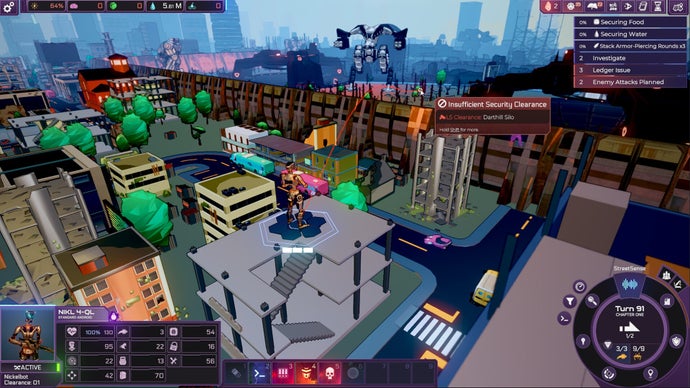
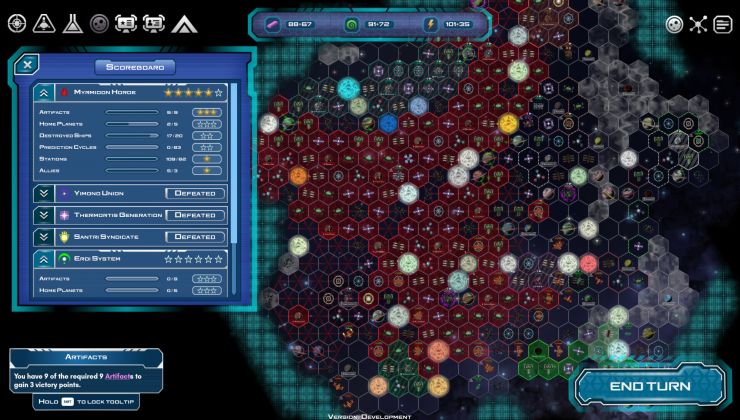
Why is everything rolling sideways on my desk all of a sudden? What’s this mysterious force, dragging my chair towards the wall? Why are all the cars in the vicinity tumbling and rolling in the direction of *checks press release* ...North Carolina, USA? It can only be gravitational disturbance caused by the impending 1.0 release of a massive strategy project. This time it’s Heart of the Machine, a “4X-style”, “dimension-busting” sci-fi game developed by Arcen Games and published by Hooded Horse.
HIGH Spellbinding gameplay loop. Meaningful additions to the base game.
LOW Faulty Bifröst mode. Odd UI choices.
WTF Why does Egil always gotta be such a bro?
Like its forefathers Age of Empires and Starcraft, Northgard stands tall in the annals of RTS history.
For eight years, it has maintained loyalty from an active player base, and the developers at Shiro Games have reciprocated that commitment by providing frequent patches, content-rich DLC and now, their massive (and free!) Definitive Edition update. This update, along with key features of the original game, represent the culmination of years spent refining the formula for RTS game development, making it a crown jewel of the genre.
The new update is no surface-level touch up. It grants access to three new clans (Snake, Horse and Dragon) each possessing unique abilities or exclusive units. The DLC, Cross of Vidar, includes an extra clan (Lion) and an additional campaign for the story mode, new biomes such as Valhalla and a retrospective digital artbook. Returning players will also notice general improvements to performance and graphics as well as some rebalancing and other adjustments.
I first played Northgard a few years ago as I was recovering from an Achilles heel surgery. Having virtually nothing else to do, I spent the better part of a day playing it while there was still a promotion running on Steam, which allowed me to download and play the full game for a limited time.
Its cartoonish visuals recalled early entries in the Warcraft series — by today’s standards, a little crude but bright and charming.
From the opening cutscene on, it was clear that the premise behind it wouldn’t be anything to write home about, but I still love a good Viking revenge story. The player controls Rig, the son of a Viking chief who had been assassinated by a rival chief named Hagen. Rig scours the mysterious continent, Northgard, to bring his father’s killer to justice, only to discover that Hagen was but a pawn in an insidious scheme with the end goal of triggering Ragnarok.
Past the plot and into gameplay, zone-based progression is a key mechanic that requires the player to first scout areas before they can be colonized or exploited. Players can take over occupied zones by deploying their military units, and once they reach a given zone, a 45-second timer will start. If they survive, the zone becomes theirs. It is imperative that the player continues to expand their territory (thereby increasing their resource production) lest they fall victim not only to invasion, but also to low morale, economic collapse, famine or any number of calamities.
Given potential threats, the player must pay close attention as they manage their resources — Happiness, Food, Wood, Kröwns, Stone, Iron and Lore.
Happiness can be generated from Feasts and Breweries, Food is sourced from various animals and crops, Wood is gathered by chopping down trees or destroying buildings, while Kröwns are earned from trading resources or raids and can be spent on upgrades, buildings or units. Stone and Iron are taken from ore in Mines and can be used for both building and unit upgrades, and Lore is uncovered by exploring ruins or studying Lorestones, and can be used to unlock stat boosts and improvements on a skill tree.
Northgard offers a good balance of control and automation. As long as their basic needs are met, Villagers will continue to spawn and automatically get to work, but the player can also make adjustments to how the work is being done most effectively by reassigning workers.
For instance, when there is a Food shortage and no immediate threat, the player can instantly turn idle Warriors into Fishermen simply by selecting each of them and directing them to the Fishing Hut. With such flexibility, it’s hard to imagine revisiting the RTS games of my youth and not being frustrated, having to live with my choices every time I made a new unit.
After finishing the campaign, a number of other features and modes greatly increase replay value.
The single player mode has many customizable conditions that allow the player to ramp up the difficulty, thereby supporting the player as they try to develop their own skills. Multiplayer modes provide variety, including the Bifröst mode (PvE co-op for up to 4 players) as well as a co-op conquest mode and invite-only, public, and ranked multiplayer options in various arrangements.
In general, Northgard’s pace is much slower than its contemporaries, allowing the player to be more deliberate about every choice they make — which, as someone who takes a while to make decisions, I appreciated.
Looking back on my first impressions of the game and comparing them with my experiences playing over the course of the last two months, it seems to me that the Definitive Edition update marks a victory lap for the game. Even after two years away, coming back and playing Northgard still feels as fresh and exciting as the continent was to Rig and his band of Viking settlers when they first embarked on their quest, and it’s all ripe for the taking.
Disclosures: This game was developed and published by Shiro Games. The game is currently available only on PC. It was obtained via publisher and reviewed for PC. Approximately 28 hours were devoted to the campaign mode and approximately 6 hours were spent in multiplayer for a grand total of 34 hours. The main campaign was finished. There are both PvP and PvE modes for online multiplayer.
Parents: This game is rated E10+ by the ESRB with Fantasy Violence, Mild Language, and Use of Alcohol. Also includes Users Interact. This is a strategy game in which players help a clan of Vikings establish a new settlement. From an overhead perspective, players build structures, gather resources, and deploy scouts/warriors to explore and colonize new areas. As players explore the land, they can encounter and battle various creatures (e.g., ice zombies, dragons, giants) and other Viking colonies. Battles are accompanied by weapon clashes, impact sounds, and cries of pain; enemy units are depicted on the ground when defeated. During the course of the game, players can build a brewery; villagers can sometimes be seen drinking from mugs. The word “hellbent” appears in the game.
Colorblind Modes: There are no colorblind modes available.
Deaf & Hard of Hearing Gamers: This game has text-based dialogue with some sound effects (usually laughing or grunting as a way to emphasize certain lines) but no audio cues that impact the gameplay in any significant way, thus making it fully accessible.
Remappable controls: The controls can be remapped.
While the old saying goes 'A game in the basket is worth two in Steam Wishlist', as we teeter into a new year it's good to highlight a couple of the games shuffling our way. Especially when there are quite so many of them that include big stompy mechs. Some of them as big as cities. My engine oil-starved heart beats and thumps in anticipation.
I've tried to keep the list to games confirmed for release next year – tragically cutting The Free Shepherd, which is planned to release in 2027 – but there is one exception.
So let's begin with the outlier that's likely to wander tardily into 2027.
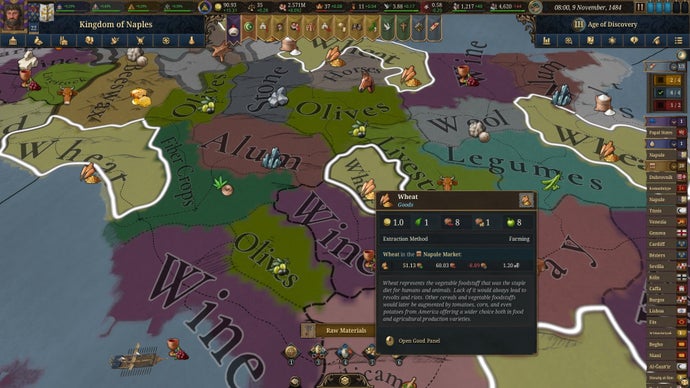
Europa Universalis 5 has its first public patch, which encompasses over 350 fixes. Among the bigger things it smacks with the heal-o-spanner (an actual game development tool, traditionally carved from the base of a Taito arcade machine) is the Steams achievements system, which will no longer shower players in plaudits they haven't earned. On the plus side, you'll now earn achievements even if you activate the "allow ahistorical" game rule.