If you’ve ever wondered whether you can make easy Linden Dollars in Second Life, I decided to test it during a special x2 multiplier Virtual Fishing event at Stress Free.
Here’s how it works.
Each fishing buoy allows 40 casts. After using all 40 casts, I earned 20 Linden Dollars. Not bad for something that’s super simple. Unlike other games in Second Life where your avatar has to run around collecting items, Virtual Fishing is very relaxed. You literally just click the cast button and wait.
That’s one big difference compared to games like Crystal Craze and Mushroom Mania. In those games, your avatar runs around grabbing crystals or mushrooms. It’s more active and a little more intense. Virtual Fishing, on the other hand, is almost passive. You can chat, adjust your outfit, or just chill while you fish.
Speaking of outfits, I tried a different look during the stream. I’m still deciding if I’ll go back to my previous outfit, but that’s part of the fun in Second Life, changing your style anytime you want.
I also talked about how new players can get started. One helpful tip is checking out the Avatar Welcome Package in the Library. It includes a Meshbody Legacy body and a Lelutka head, which is a huge upgrade if you’re just starting out. It’s a great way to improve your avatar without spending a ton of Linden Dollars right away.
Overall, Virtual Fishing is simple, low-effort, and beginner-friendly. It may not make you rich overnight, but during special events like the x2 multiplier, it’s definitely worth checking out.
If you enjoy relaxed ways to earn Linden Dollars, fishing might be your new favorite activity. 🎣💰
James Cameron's big blue aliens are back in theatres in Avatar: Fire and Ash and Ubisoft is piggybacking on the film with some new Avatar content of their own. Not a full new game this time around, but rather a major expansion, Avatar: Frontiers of Pandora - From the Ashes. This DLC offers a new campaign that introduces the violent Mangkwan tribe from Cameron's latest movie, although it isn't entirely standalone, as you still need to own the base Avatar: Frontiers of Pandora game to play it. The expansion arrived shortly after a major Frontiers of Pandora update, which added […]
In early November, CGMagazine had the distinct honour of being among a select group of gaming outlets invited to James Cameron’s production company, Lightstorm Entertainment. There, we were able to get an extended sneak peek of not only the highly-anticipated third cinematic installment in the Avatar franchise, Avatar: Fire and Ash, but also got hands-on with the latest paid DLC expansion for the Avatar videogame, titled Avatar: Frontiers of Pandora – From the Ashes.
The joint use of the word “ash” is no coincidence, as it symbolizes both the introduction of a brand-new antagonist to the Avatar universe, the hostile Mangkwan Na’vi clan (a.k.a. The Ash Clan), and further entwines the narratives of both the cinematic and videogame worlds of Avatar together, as they currently exist within the same timeline and canon.
Unlike the base game and its two story packs, which featured a customizable character simply known as “The Sarentu” that could be male, female or androgynous in both appearance and voice, Avatar: Frontiers of Pandora – From the Ashes focuses on So’lek, a battle-hardened Na’vi warrior and trusted ally of The Sarentu, the latter whose clan has been reborn following the events of the first game.
As one of the hundreds upon hundreds of Na’vi that fought alongside Jake Sully during Avatar’s climactic Battle of the Hallelujah Mountains against the RDA forces, but not before suffering the loss of his entire clan and eventually his first winged Ikran (a.k.a. banshee) companion in battle, So’lek has endured unspeakable pain and loss in the 15 years that have followed, and the return of the “Sky People” (i.e. humanity, the RDA) to Pandora is now forcing him to relive those nightmares.
Despite the above, however, So’lek sees both hope and kindred spirits in the Sarentu, who are valiantly fighting to rebuild their clan from the handful that still survive, as well as a growing number of trustworthy humans who have since joined the resistance and are learning to co-exist peacefully with both the Na’vi and the largely untamed flora and fauna of Pandora.
This is the new family that So’lek has chosen to embrace as his own, so when the sudden and unexpected emergence of the Mangkwan Na’vi and their alliance with the RDA once again threatens his friends, family and all that he holds dear, So’lek does not hesitate to protect them at any cost, using every tool in his arsenal.
Players at the event were given about three hours to play as So’lek through a lengthy pair of From the Ashes missions. I was assigned to a PC demo unit with a PlayStation DualSense controller connected. For me, this was a tiny bit awkward as I generally prefer to use an Xbox Series or Xbox Elite 2 gamepad as my main when playing Avatar.
Fortunately, owning a PS5 as well, it took me very little time to get myself accustomed. As far as I could tell, apart from some minor tweaks, the control scheme for Avatar: Frontiers of Pandora – From the Ashes is almost identical to that of the base game and its story packs, so existing Frontiers of Pandora fans will be able to hit the ground running.
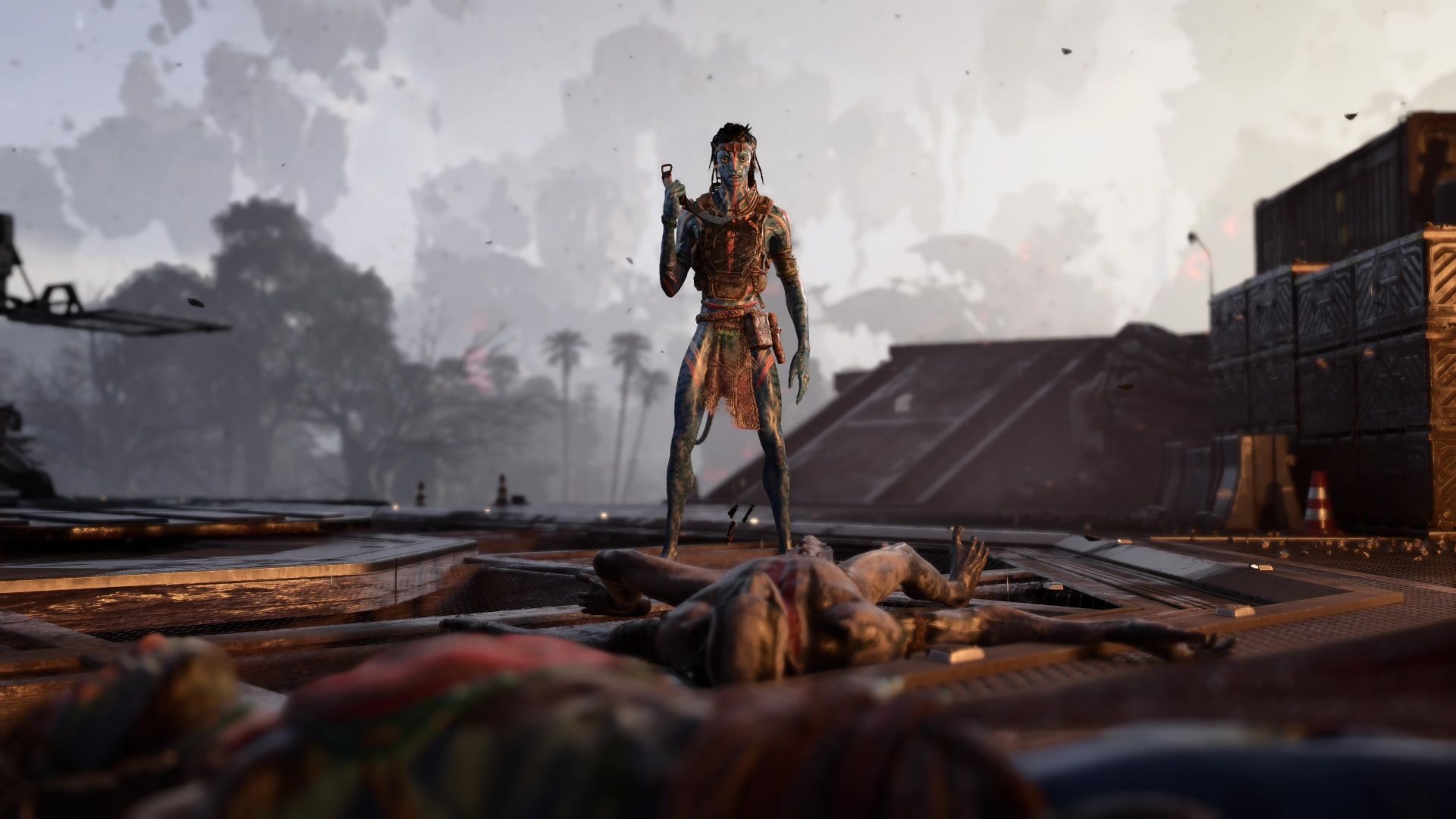
The first mission, entitled “Alone” immediately sets the tone for So’lek’s sombre journey with its stark, greyish colour palette. So’lek arrives at the Arahane Clan’s Hometree (also the Sarentu’s adopted Hometree) to find it has been devastated and overtaken by a united force of RDA and Ash Clan forces. Much of Hometree is still ablaze or covered in ash, and patrolling RDA Amp Suits, equipment, and the like are nightmarishly emblazoned with black and red paint proclaiming their allegiance. Many Sarentu are either fallen or not yet accounted for, but So’lek is desperate to find and save as many survivors as he can, especially his close friends from Frontiers of Pandora.
“Avatar: Frontiers of Pandora – From the Ashes focuses on So’lek, a battle-hardened Na’vi warrior and trusted ally of The Sarentu…”
In comparison to the Sarentu character, So’lek’s many years of combat experience make him a far more powerful threat, even when armed with only his knife, bow, and arrows. Using stealth, he can sneak up upon most RDA Amp Suits (i.e. mechs) for a lethal finisher, but he is also able to take them down frontally with melee attacks as well, without having to stagger them first, unless the cockpit is heavily armoured and requires more damage to be dealt before the weak spot is exposed.
RDA Foot soldiers and Combat EXOs can be swatted away almost as easily as flies when up close, but they can prove to be a whole new challenge for So’lek altogether when backing up AMP suits, mechanized Hellhounds, and flying units like the Samson 16 gunships all at once. As with Frontiers of Pandora and its previous DLCs, players can expect firefights that are gritty and spongy. As nimble So’lek may be, he will regularly take damage, and players will need to keep an eye on their health and restorative items to avoid a quick death and shameful return back to the previous checkpoint.
So’lek’s skill tree progression is symbolized through the collection of dog tags, which are earned as So’lek defeats formidable enemies that stand in his way. These tags unlock XP, which the player can use to upgrade his warrior abilities and skills. Case in point, the gamesave I was given access to had already unlocked the “Take it Slow” ability, which enables Slow Motion automatically whenever So’lek aims while sliding or jumping from high ground, allowing players more time to line up their shot with a bow and arrow or other weapon, not to mention looking very Avatar-badass while doing it.
One of my main critiques of the Avatar: Frontiers of Pandora base game was that it didn’t go quite far enough to capture the feeling of what it might be like to be a 9-foot-tall Na’vi warrior in terms of gameplay or visual scale. It felt more like playing one of the Far Cry games, but on Pandora, which is still quite a trip, but it was missing something.
Strangely, even while reviewing the game, I never thought that the solution to the problem would be to add a third-person mode. Now here we are one year later with an optional, over-the-shoulder mode at the touch of a button, and while it doesn’t solve every issue with the original game, it nevertheless feels that developer Massive Entertainment has finally cracked the code.
The ability to see all of So’lek in third-person and at proper scale within the world around him makes a huge difference not only in how much of a footprint he actually takes up on screen when compared to the humans, RDA vehicles, wildlife and so on, but also how the player interprets the actions So’lek is taking.
Putting it simply, Avatar: Frontiers of Pandora lets players run around as giant blue cat-people, firing off arrows, guns and other weaponry in slow-motion, and now we can finally witness both the Sarentu and So’lek doing all that awesome the cool stuff, instead of only imagining it from behind the camera, giving players a greater sense of agency amidst the action taking place on screen.
(Note: Third Person mode will be part of a free title update for Frontiers of Pandora, coming on December 5th, ahead of From the Ashes’ release on December 19th.)
A new “rage-meter”-style ability called “Warrior Senses” allows So’lek to draw upon built-up adrenaline caused by pain, fear and anger to temporarily gain heightened perception, resilience and strength. Accessed by pressing L3 + R3 when the meter is filled, So’lek’s regular Na’vi Senses go into overdrive, instantly marking every visible enemy on the map in red, exposing weak points and augmenting the damage dealt by So’lek towards them.
With the right weapons and resources, players can exploit these opportunities to inflict major damage against their enemies, or alternatively, they can use the moment to temporarily flee to an area on the map that’s less hairy and give themselves a moment to heal themselves. So’lek can even call in Iley, his new, trusted Ikran, to pick him up during battle so that he can quickly reposition himself elsewhere on the map.
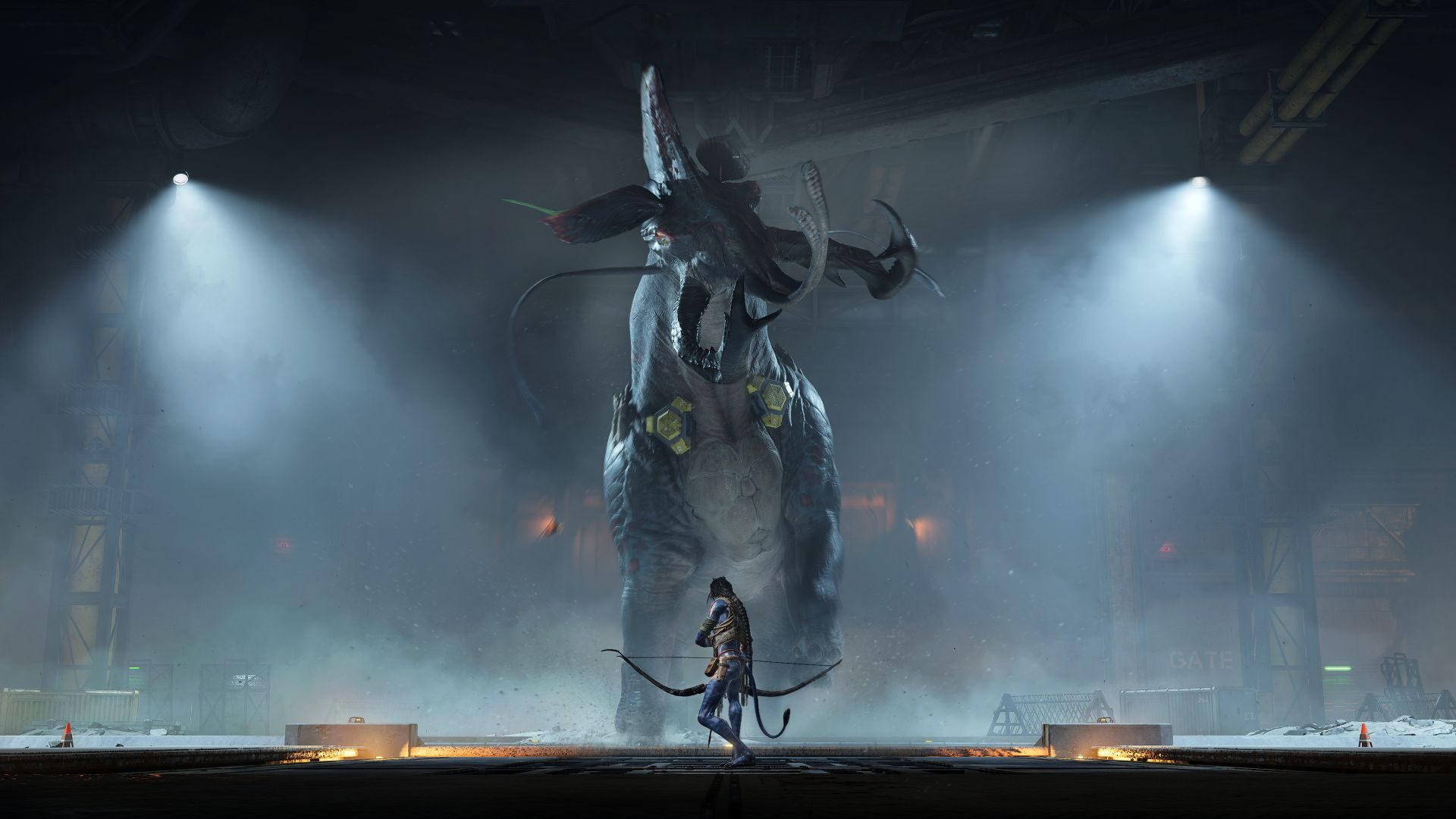
The second mission, titled “The Beast,” sees So’lek at a later point in the game where he is tasked with infiltrating an RDA Laser Ore processing facility, once again in the hope of finding the captured members of his clan. As I soon learned after several attempts, stealth is the way to go here as the RDA forces are far too numerous, but even when avoiding combat as much as possible, finding my way inside the facility proper was no picnic either.
It took me much longer than expected to find the electrical panel I needed to shut down so that I could then open the main access door and slip inside. Even once I was in, I found myself frequently turned around by similar passageways, structures and crawlspaces that I either had difficulty making out, or I could see them but couldn’t figure out a means of getting to them.
Once a Ubisoft rep reminded me that So’lek was capable of performing a “boost jump” and “air boost” abilities that the Sarentu character had in the first game, platforming and exploration became significantly easier, but only when I was certain that I knew where I was going and what I was doing.
This brings me to the only serious concern I have right now with From the Ashes, which was the same concern I had with Frontiers of Pandora: Apart from tracking the scents of animals, humans, or other Na’vi, the pathfinding is rather poor. At present, navigation remains almost identical to that of the first game, with quest waypoint markers, altitudinal information, beacons and/or guidance when using Na’vi senses only showing up and guiding players when they are very close to the objective, even with full Quest Guidance turned on in settings.
This often means that players will need to get within metres of the objective before the game starts providing clear breadcrumbs to follow. The game provides hints in the top left corner of the HUD, but they’re usually vague and are supplied on a drip feed, which I found vexing. I get that Frontiers of Pandora is a game that wants its players to explore its rich worlds, and as Avatar fan I’m all there for it. That said, at times the game’s tendency to make the locations of objectives vague and/or lock them behind too many back-and-forth steps can grind the momentum of some missions to a halt.
Otherwise, I’m quite excited about what I experienced at the Avatar: Frontiers of Pandora – From the Ashes preview event, particularly the narrative threads. At points in the demo had me briefly crossing paths with key villains that no doubt will be battling So’lek later on, including the infamous Ash Clan trio of Wukula, Zari and Rakx, as well as the newly minted human RDA Commander, Tyler Kupowski, who is the protégé and heir apparent of Avatar’s main villain, Colonel Miles Quarritch.
I’m very eager to see what unfolds when So’lek and Kupowski finally meet face to face, and what it will be like to fight as So’lek with my customized Sarentu character as a companion, rather than the other way round. With Avatar: Fire and Ash premiering in theatres on the very same day as From the Ashes, December 19th is going to be a crazy day in the Avatar universe.
Starting out as a freelance videogame writer and narrative designer for various indie game studios, Aoife O’Friel found her way into Ubisoft as a scriptwriter on the procedural quest team for Assassin’s Creed Odyssey in 2018 and never looked back. She soon joined Massive Entertainment (an Ubisoft Studio), where she would spend the next seven years working in her chosen field to bring Avatar: Frontiers of Pandora and its story packs, The Sky Breaker and Secrets of the Spires, to life as narrative lead.
Now, as a Narrative Director, O’Friel is in charge of the story for the latest expansion, Avatar: Frontiers of Pandora – From the Ashes, making her the perfect person to talk to about the game’s new protagonist, So’Lek.
During the preview event early last month at Lightstorm Entertainment HQ in L.A., despite her busy schedule, we briefly managed to sit down with O’Friel to discuss So’lek’s character, his motivations, what obstacles we can expect him to encounter, and who he is ultimately destined to cross paths with.
So Aoife, what can you tell us about So’lek? Obviously, we’ve met him as a recurring character in Avatar: Frontiers of Pandora, but it looks like From the Ashes will be the first time that we are actually able to control So’lek as a playable character, right?
Aoife O’Friel: Absolutely. So you are playing So’Lek in From the Ashes, and as you mentioned, we’ve met him before in Frontiers of Pandora. We understand that he has a lot of tragedy in his past. He’s had this loss of family, loss of Clan, even the loss of his first ikran [a.k.a. banshee, winged mount] in the Battle of the Hallelujah Mountains. And then in the main game, we saw that vengeful drive he had to hunt down the commanders in that battle, and he took their dog tags. And he wore them around his neck.
But now, playing as So’lek, we really get to focus on, you know, what does that vengeance mean for him, and also, what is it doing to him, internally? Like he suffers from a lot of survivor’s guilt and PTSD, and this vengeance, [the] central path he’s on, where does it lead? He’s not going to find peace that way. He’s not going to get his family back. So getting to experience the western frontier through his perspective and [discovering] what he wants and what he’s looking for…It’s different, for sure.
Along those same lines, like, what inspired the decision to turn the focus from The Sarentu to So’lek in Avatar: Frontiers of Pandora – From the Ashes?
Aoife O’Friel: A lot of it was to do with Avatar: Fire and Ash. We had the opportunity to have the Mangkwan, the antagonist clan from the movie, also be the antagonists in From the Ashes. And so we wanted to be able to delve into their backstory and into their motivations. And So’lek ended up being a perfect fit for that, because he has this rich backstory that we haven’t really tapped into.
[In the first Avatar film], we saw, you know, of course, the Battle of the Hallelujah Mountains that I mentioned, and then we see [So’lek’s] journey in the comic book series, but then he has so much in his past that is still unexplored. And we realized, you know, this is an opportunity to have the Ash Clan be part of So’lek’s past too, and [tie] these things together, especially as the Ash Clan are driven by darkness. So’lek, to a different extent, is also driven by darkness. So it [allowed] us to compare and contrast by choosing So’lek to be the protagonist.
Speaking of the new characters, what can you tell us about the new clans in Avatar: Frontiers of Pandora – From the Ashes? That was something that kind of surprised me. I was expecting that there was going to be at least one, as we saw in the trailer, but in fact, there are actually two.
Aoife O’Friel: Yeah, so we have our lovely Wind Traders who come a little earlier [to the Aranahe] than expected… because they have this warning that they have seen a darkness that is coming to the western frontier. And so they are different Wind Traders than [those] in the movie. They are a different clan of the Tlalim, but they are just as exuberant and are kind of a party people. They love to travel and trade and have gossip, and so they’re very fun-loving. And then it’s really interesting to see them be concerned.
They come to the Aranahe Hometree, and they warn the Aranahe and So’Lek that “something’s coming. Our journey here wasn’t easy. These are bad times.” So it was really fun to, like, have this, look at these, these really exuberant party people, and then have that be this nice beginning, I guess, before everything turns dark for the rest of the story, because the Mangkwan show up.
Yeah, building out those personalities with Lightstorm was really fun because we had a lot of questions for them on like, what do the Mangkwan Clan care about? How come they’re so different to other Na’vi, you know, what kind of relationships make sense for them, like Wukula and Zari, the brother and sister? Does it make sense for them to have a rivalry, you know, with Rakx and her ikran, and how hard she drives ikran and that she doesn’t take time to mourn [their deaths]? Does that make sense for how they feel about wildlife? So it was really great to explore this whole new culture and bring it into the game.
Getting back to Sol’ek, he seems even angrier nowadays, despite having suffered the loss of his clan several years ago, right? Obviously, he’s gone on quite some adventures [and] misadventures in the comic book series as well, so there are other factors, but would you be able to elaborate a little more on that?
Aoife O’Friel: Yeah, I agree with you, [if anything] he has gotten angrier, but it’s because of everything that’s happened before, right? He has suffered so much loss before, and he hasn’t fully come to terms with it, and now everything that he’s finally managed to grasp for himself, his new family, it’s all under threat again, and so he’s been here before, right? He’s lost people before, and he is so afraid of losing more people. He’s suffering from that survivor’s guilt we talked about, the PTSD, and he’s just, he can’t go through it again. And so I think that’s really what drives so much of his anger in From the Ashes because he knows what’s at stake.
So as we all know, a new third-person mode will be coming as a free update to Avatar: Frontiers of Pandora on December 5th and will also be a part of the upcoming From the Ashes paid DLC expansion when it launches on December 19th, right alongside the theatrical release of Avatar: Fire and Ash. The base game and its previous story packs, The Sky Breaker and Secrets of the Spires, both supported co-op. Will there be a co-op mode for From the Ashes?
Aoife O’Friel: In From the Ashes, no, there is no co-op, but perhaps you’re thinking of the Sarentu character returning as a companion?
Oh, yes, my mistake, confusing those two things. Actually, regarding the Sarentu, in the previous game, the Sarentu were referred to and addressed as They/Them and had three voice options (male, female and androgynous) portraying them. Will the Sarentu still be voiced by the same actors in their new supporting role?
Aoife O’Friel: Yes. The Sarentu character… some players have spent hundreds of hours with that character, as we’ve talked about, and they built that character to be who they want them to be, choosing voice, choosing appearance, choosing gear, and that’s the character then that you will see, as the Sarentu companion in From the Ashes. It’s the one that you have created yourself.
Avatar: Frontiers of Pandora
That’s great to hear, as I’ve grown quite attached to my Sarentu! Moving on really quickly, is it necessary for players to have played through The Sky Breaker or Secret of the Spires DLC to get the most out of this new expansion?
Aoife O’Friel: I mean, of course I would recommend it (laughs jokingly). But no, you don’t even have to have played the main game. If you want to jump straight into From the Ashes, you absolutely can. We’re going to have a little video at the beginning, like a “Previously on Pandora” type video that will set up the main characters and the main events.
So if you want to jump right into From the Ashes, you absolutely can, and you can understand what’s come before. But yeah, I mean, I think to get the full experience, of course, play [them]! I hope the players will want to. Maybe they start From the Ashes, and they’re like, “Oh, I really want to know more about this person,” and they’ll want to jump into the rest of them.
We’re almost out of time, but how excited are you about this new DLC addition and the fact that it’s being connected to the movies in such a direct way [as opposed to the non-canon Avatar games of the past, like 2009’s Avatar: The Game]?
Aoife O’Friel: It’s true, I mean, we’ve always had the connection. I mean, everything that we do is canon, which is an incredible privilege to be part of this universe and to know that everything that we made is actually contributing to the entire history of the franchise. But, yeah, especially now with From the Ashes being very closely tied to Avatar: Fire and Ash because of the Mongkwan and the RDA alliance and that they want to spread their fire across Pandora, we get more of that tie-in. But yeah, I’m beyond excited. I’m embarrassingly excited. Yeah, I can’t wait for people to experience it and just to see how this universe keeps evolving.
Avatar: Fire and Ash
Final question: What’s it like working with James Cameron? Like having him sign off on all your [work], making it “officially canon?”
Aoife O’Friel: It’s so cool to know that. I mean, I’ve never had the privilege of speaking to him, but it is so cool to know that he, of course, is incredibly invested in this universe. He created this universe, and he has [signed off] on everything that we do, and makes sure that it all fits into the canon, and that it feels cohesive and it feels real. So it’s incredible to know that he likes this, and he’s, you know, giving it the seal of approval. Yeah, it’s really fun.
Aoife, it’s been lovely meeting you. Thank you so much for taking the time to meet with me and allowing me to ask you some questions. I personally look forward to playing Avatar: Frontiers of Pandora – From the Ashes once it’s finally in the public’s hands.
Aoife O’Friel: Nice to meet you, and oh, thank you!
The DLC expansion for Avatar: Frontiers of Pandora – From the Ashes will release on digital storefronts for PC and current-gen consoles (PS5, Xbox Series, PC, Steam, Amazon Luna) on December 19th, 2025.
When I logged into Shroud of the Avatar that evening, I went to my row‑home in
the Harbor Market district of Lightbringer Isle. I know Lightbringer Isle
hosts a monthly fishing contest, a recurring event that draws many players
from across the game world. I live on the isle, and I also run a small vendor
shop there, selling bait, lures, and food.
The rules of the contest are simple: to enter, I need to catch a fish bigger
than the “small tiger shark” that only one other player has shown so far. That
means the bar is set high if I want a shot at winning.
Fishing in Shroud of the Avatar is straightforward. All you need is a fishing
rod, bait, your fishing skill, and a body of water. Any open water deep enough
will do. According to the game’s mechanics update that introduced support for
multiple water types, saltwater fishing is fully supported. (sotawiki.net)
Because the contest at Lightbringer Isle is held in saltwater, I stocked up on
saltwater‑appropriate bait, specifically minnows, which I’ve been using for
all my fishing attempts.
I’ve been spending my evenings fishing in roughly one‑hour sessions. I
livestream my attempts on multiple platforms, though I have zero viewers.
There’s no chat or audience to worry about. It’s just me, my rod, the
saltwater, and the quiet hope that this cast might land something
extraordinary.
Between fishing sessions, I would log out of the game and do something else
before starting another hour of fishing and livestreaming. It helps me stay
refreshed and focused when I return.
There was one session where I logged in to fish, started the livestream, and
got ready for the contest, but the allergy medicine I took earlier hit me
harder than expected. I ended up getting knocked out and fell asleep. I had
the stream running for about two hours without realizing it. When I woke up, I
ended the livestream. Definitely not the most productive fishing session, but
at least I got some rest.
During my other sessions, I’ve cast my line into the saltwater all around
Lightbringer Isle, not just near the docks. The sea is calm, the night quiet,
and I settle into the rhythm. I’ve hauled in a few modest fish, saltwater bass
or mackerel, but nothing that could beat the small tiger shark catch. I’ve
tried using minnows as bait for every attempt, but so far, the results haven’t
been what I was hoping for.
As I continue fishing, I know there are still a couple of days left in the
contest. I haven’t caught any sharks yet, but I’m not giving up.
I’ve been watching the contest unfold, and so far, I know that only one player
has caught a small tiger shark. That means if I want a chance at winning, I
need to catch something bigger.
Then, in one of my later sessions, I cast again. The bait sinks into the
saltwater, the float drifts gently, and the progress bar slowly fills as I
wait. I hold my breath. When it finishes, I begin reeling. The line feels
heavy. The rod bends under the weight. Every inch pulls back.
Though I haven’t pulled in a shark yet, I know there’s still time. The thrill
of the unknown keeps me coming back, casting my line in hopes that the next
bite will be the big one.
For now, I’m just enjoying the process, the calm water, the quiet
anticipation, and the possibility that the next tug on the line could be
something extraordinary. I’m a resident, a vendor, and an angler, and I’m
still chasing that big catch.
Maybe I’ll go again next month. Maybe I’ll reel in something even more
impressive. Or maybe I’ll just enjoy the saltwater, the breeze, and the hope.
For now, my line is out, and I’m waiting. 🎣
When you first slip into the Erika (Kalhene) mesh body in Second Life, you’ll immediately sense it’s not just another avatar shell, it’s a deeply thought-out platform made for real expression. Erika doesn’t just give you a pretty shape. The HUD hands you sculpting power: deformers let you adjust your breasts, waist, legs, and butt in ways that feel organic, giving you full control of your silhouette.
Erika shines in realism thanks to its support for Bakes-on-Mesh (BOM). With BOM, your tattoos, stretch marks, and veins layer naturally on the body without weird distortions. On top of that, the material options (Gloss and Oiled) let you subtly fine-tune how your skin looks, adding depth and personality via the HUD.
One of Erika’s defining features is its inclusive transgender add-on. You don’t need to buy a separate “male body”, Erika’s package already includes animated HD genitals in multiple sizes, with matching tattoo layers that are fully tintable. You control the size right from the HUD. This means you can fully express your gender identity without juggling separate bodies or broken compatibility.
The little touches are meaningful too. You get five nail shapes (plus an option to hide them), 32 polish colors (French, faded, and more), and even long toenails that work across all foot shapes. On the animation side, Erika includes six butt-physics animations plus two breathing animations, which breathe life into your avatar.
Customization doesn’t end there. With the HUD, you can wear add-ons like Bubble Boobs, Squeeze Legs (thin or wide), Petite Waist, and Petits Seins, all without needing separate attachments. There are also 40 wearable deformers for further sculpting, so you can make your body as stylized or realistic as you want.
Erika comes with a surprisingly generous wardrobe box. Inside, you’ll find underwear, dresses, jeans, skirts, shirts, leggings, footwear (sneakers, boots, heels), bikinis, all fitted for the Erika body and compatible with its add-ons.
Under the hood, Erika is smartly optimized. It’s a BOM + Bento body that’s “low lag,” and it also supports a neck-fix via the HUD, ensuring a seamless fit with many popular mesh heads. The current (or recent) version, v4.3, brought improvements like smoother rigging, an upgraded HD bento vagina, and a redesigned HUD interface.
From the community’s perspective, Erika is praised for its versatility, value, and ongoing updates. One user even noted that Erika feels like a serious rival to other high-end bodies, but at a much more accessible cost: “way much cheaper and including so many extras for free.”
In short: If you’re looking for a mesh body in Second Life that’s feature-rich, customizable, inclusive, and reasonably priced, Erika is hard to beat. It’s designed not just to look good, but to give you real creative freedom, especially if gender expression matters to you.
I remember the day like it was yesterday. I sat down in front of my PC, launched VMagicMirror, loaded my favorite avatar, and everything felt so smooth. The app barely made a dent in my system—my CPU hung out around the usual 5‑10 %, my GPU had breathing room, streaming was seamless. I thought: This is it—VTubing is totally doable on my setup.
Fast‑forward a few updates, and I nearly jumped out of my chair when I pulled up Task Manager. To my horror: VMagicMirror was hogging 15‑20% of my CPU just sitting there. The “Power Usage” tag? “Very High.” That “lightweight avatar app” I trusted started feeling more like a furnace waiting to explode.
So what changed?
Honestly, I don’t know all the details (and you probably won’t get them unless you’re digging into dev logs). My guess is, the app likely got “better” in terms of features and tracking — but that means “heavier” on resources. And if your PC is not top of the line, you might feel that hit.
My “reset” plan (and why I chose it)
Since I mainly use VMagicMirror for streaming and vTubing, I don’t care that much about having the absolute newest features if it means my system catches fire. So here’s what I did:
Downgraded to version 2.0.11 — This was the last version I was using before I noticed the big jump in CPU usage. As soon as I rolled back, CPU dropped back down to “normal” levels for me again.
Monitored background load — Made sure OBS, browser tabs, and other apps weren’t fighting for resources at the same time. Freed that up.
Kept an eye on future updates — While I’m comfortable with my setup for now, I’ll keep an eye on the change log to see if a future version addresses the efficiency issues (and when it does, I may upgrade again).
Wrapping up
Here's what I learned: An app you trust and use daily can quietly change its footprint. One day you’re cruising at 5–10% CPU, the next you’re at 20% and wondering what’s happening. It wasn’t catastrophic, but for me it was distracting and it risked messing up my streams.
By going back to version 2.0.11 of VMagicMirror, I regained the lean performance I had before — no fuzzy tracking, no major feature drop for what I need. For now, it works.