Diora might be the most ambitious game I've played on the Playdate. It's all about perspective: You turn the handheld's crank to rotate your viewpoint of the bite-size 3D landscapes, which lets you peek around corners to find solutions to various puzzles. On a device with a 1-bit, black-and-white display, the miniature worlds feel miraculous, like little dioramas you can spin around in your hands. But the most impressive part is the puzzles that will have you twisting your brain as much as the crank.
In Diora you play a "network technician" traveling to various locations across a city, fixing up machinery in the wake of a strange accident. …
I finally acquired an original Lenovo Legion Go and of course I had to put Linux on it and get rid of Windows, so I finally got to see the fuss over Bazzite.
Some roguelikes let you fight with preset weapons, but a small sub-genre lets you invent your own, turning every run into a playground of spells and chaos. Noita is a great example, letting you play with the world’s physics by freely mixing and matching effects. Magicraft does something similar, but with a more traditional roguelike viewpoint, and becomes pure chaos once a run really gets going. Both demand sharp reactions, but Arcane Trigger approaches things a little differently.
Arcane Trigger has you playing as an arcane gunslinger, combining different bullet types and spells to unleash massive chains of firepower against a strange realm encroaching on your own. It begins simply, as most roguelikes do, but escalates very quickly, eventually letting you fire dragon eggs and even meteors. The key difference is that everything here is turn-based.
In fact, all you really need to do is click the fire button. You don’t need to move at all, just pull the trigger. That doesn’t mean there’s no depth, though. The order of your bullets matters, as do your upgrade choices. You’ll be aiming to collect three of a kind to fuse bullets together, lean into specific elemental synergies, or ban certain bullets entirely so you can focus on a single strength. When it comes to combat execution, however, it’s still just one button.
As a result, this is a roguelike where your reactions don’t need to be constantly tested. Instead, you’re free to take your time crafting and refining your attacks. As you progress, you’ll develop a stronger understanding of how different builds work, and you’ll also unlock other gunslingers to experiment with. It’s an incredibly easy game to play, but a difficult one to master, and it’s refreshing to experience a roguelike that embraces a slower pace for once.
Death Howl is ambitious simply for the two genres it tries to fuse. Deckbuilders are almost always roguelikes, and Soulslikes are almost always action-heavy. The idea that you could blend these systems in a way that not only makes sense but actually feels good to play seems almost absurd. Yet Death Howl pulls it off, all while telling a moving, heart-wrenching story about grief.
You play as a mother who has lost her son and refuses to be consumed by the despair threatening to overwhelm her. Instead, she steps into the spirit world to search for him and bring him home. The writing is excellent, and the quieter, emotional moments between the violence are genuinely powerful. It hits especially hard if you’re a parent, but the struggle to push back against grief is something most of us understand in some way.
As for how it plays, you explore the world, interacting with objects to uncover new knowledge and gather items that can be turned into cards. You can refresh the spirit realm by resting at special stones, which restore your health but also revive the spirits, forcing you to push through them again.
Combat is turn-based and unfolds on a grid, with you and your enemies jockeying for position while you manage mana to play moves that attack, defend, or trigger entirely different effects. It’s a delicate balance and one that often feels stacked against you, but that only makes each victory more rewarding.
The challenge in every encounter reinforces the strength of the protagonist and her relentless fight to recover her son. Expect an uphill climb and a world that isn’t afraid to land emotional blows as you push forward.
A year is a long time – we have twelve whole months ahead of us, and most of them will likely be filled with brand-new game releases; some we already know about, while others are still the subject of rampant speculation. Today, we’re taking a look at indie games that are confirmed to be coming out in 2026 – titles that, barring any unexpected delays, we’ll be able to get our hands on and play later this year.
Happy New Year! 2026 has arrived, and the indie game releases are not slowing down. Not one bit. We hope you’ve all had a good rest during the holiday season, because January is already hurling a handful of promising indie titles at us – so strap in and enjoy our list of personal picks from the first week of the month!
Dead Format has the most insanely intriguing premise I’ve seen come out of a horror game in a long while. You take cursed, supernatural VHS tapes, each representing a different genre of film, and dive into them Inception-style to explore their every nook and cranny? And you do this within the framework of a survival horror game?
We continue our exploration of the holiday season – here are all the coolest indie game releases from last week that we believe you might want to check out! Enjoy!
The holiday season is almost here, but that doesn’t mean there’s a shortage of indie games coming out! Far from it, really. So, here’s what December had to offer so far – these are some of the coolest indie titles that came out during the first few days of the month. Enjoy!
Tormented Souls 2 picks up more or less where the original left off, and begins with protagonist Caroline Walker and her freshly-rescued sister Anna riding a train to the town of Villa Hess for some much-needed answers.
Avatar Frontiers of Pandora: From the Ashes by Ubisoft was released on December 19, 2025, just before Christmas. A game that quickly reminded me why I first fell in love with Pandora’s vivid world in 2023. While the original game had its highs and lows, this expansion offers a new story that feels personal, meaningful,…
I’ll be straight up: S.T.A.L.K.E.R. 2: Heart of Chornobyl is one of the craziest game experiences I’ve had in a long time. You stroll into it knowing it’s been hyped forever, thanks to the original game being so good, a sequel to a beloved cult classic, finally arriving after years of delays, cancellations, and an…
Sektori from developer Kimmo Lahtinen is what I’d like to call a work of art. And before I get questioned heavily here for stating such, there’s a lot to unpack here as to why. Honestly, this is one of the best twin-stick shooter games I’ve played in ages! So what exactly is Sektori, and why…
pieceArcades are awesome. I know this, you know this, we all know this. Something about the lights and sounds of the cabinets, the physicality involved with tapping those oh-so-satisfying oversized buttons to play each game, speaks to a primal gaming urge. Unfortunately, arcades have become less and less common over the years, which means the ones that are left tend to be overcrowded, expensive, and sometimes falling apart. In response to this, a booming market has emerged of at-home controllers that emulate the feel of an arcade cabinet, to varying degrees of success. The good people at Junkfood were kind enough to ship me their take on the arcade controller - the Sworl.
The Sworl comes in two variations: The Sworl Basic for $175, and the Sworl Multiconsole for $225. The Basic works with the PC and the Switch, while the Multiconsole works for all modern platforms. The Sworl is entirely customizable, with everything from the button layout and profile to the colors and animations for the LEDs, to the deadzone of the sticks; you can make the Sworl into the controller that best suits your needs. It takes a little bit of setup within your browser to get working, but once that's finished, it's easy to change any settings you want and save them to separate profiles. I highly recommend doing this, as it can save the headache of having to remap every single game you play to your preferred settings. Choice is king with the Sworl, and it allows for an extremely tailored experience if you go looking for it. So that's the basic setup, but what's the product itself like?
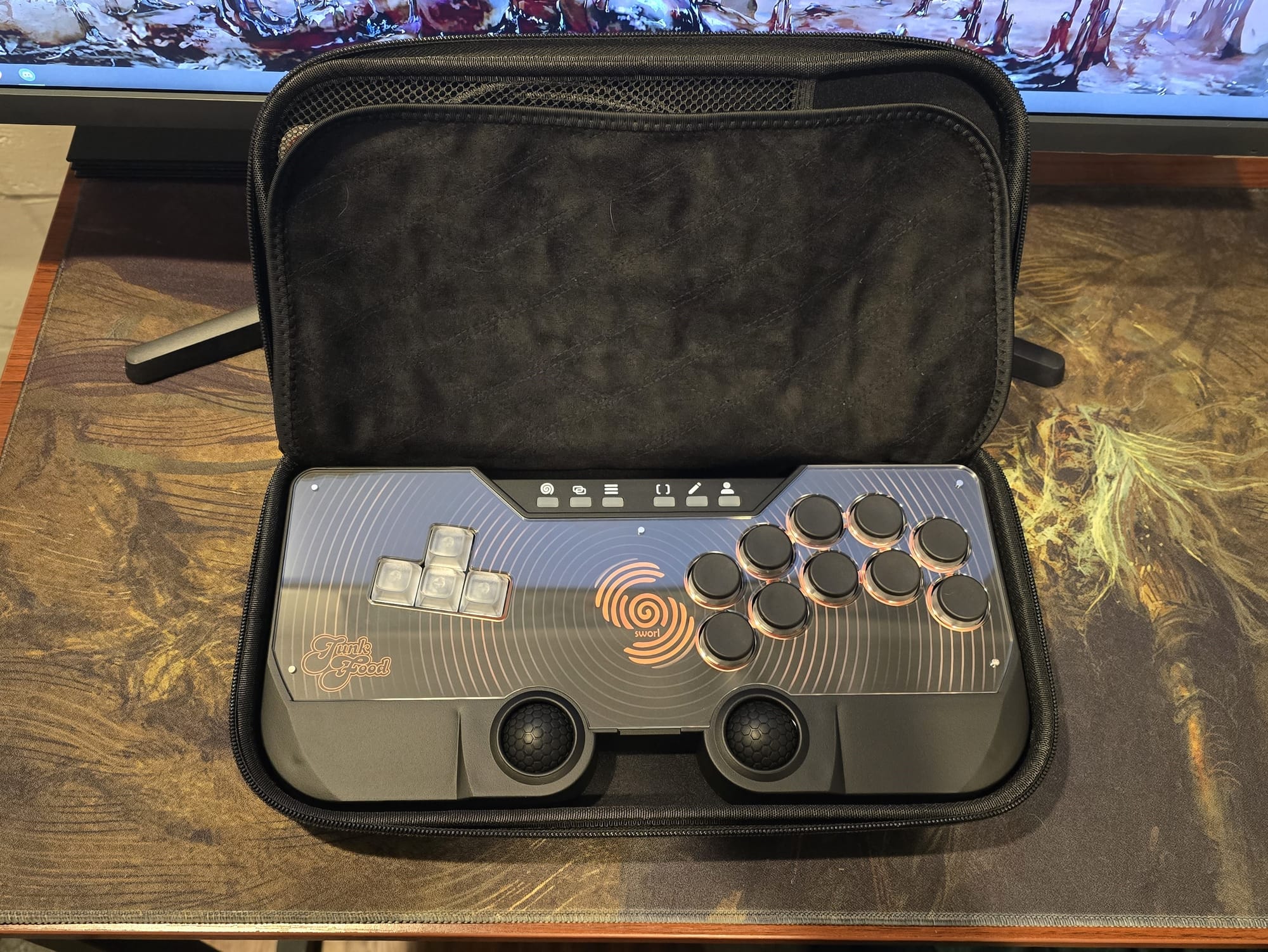
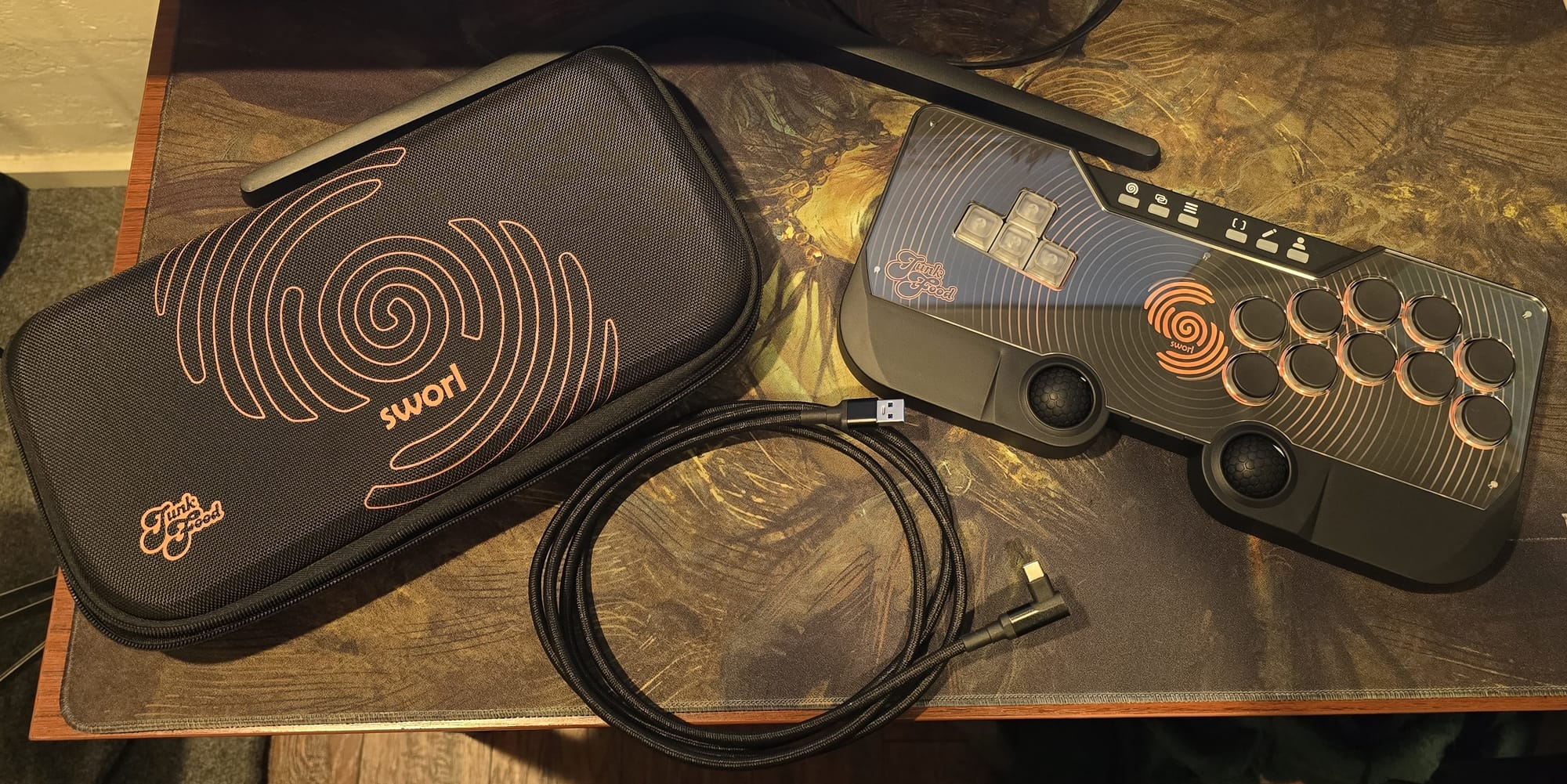
The packaging for the Sworl is immaculate. I'm a sucker for good, clean presentation when it comes to my gaming peripherals, and the Sworl delivers immediately. The box is a sleek and minimalist orange design, emblazoned with the controller's branding. Upon opening it, you are greeted with a high-quality, black, solid-shell nylon carrying case, evoking an immediate sense of quality. The solid shell case zips open to reveal the Sworl itself, along with a sturdy braided C-class connection cable and a QR code that explains everything the Sworl can do.
Source: Author
The Hardware
The actual controller is, in my opinion, peak design for something like this. It's extremely sturdy, with a hard plastic design that feels high-quality without being too heavy or cumbersome. With these more arcade-style controllers, I tend to find myself either wanting more room on the face of the system or less, but the Sworl hits that balance perfectly.
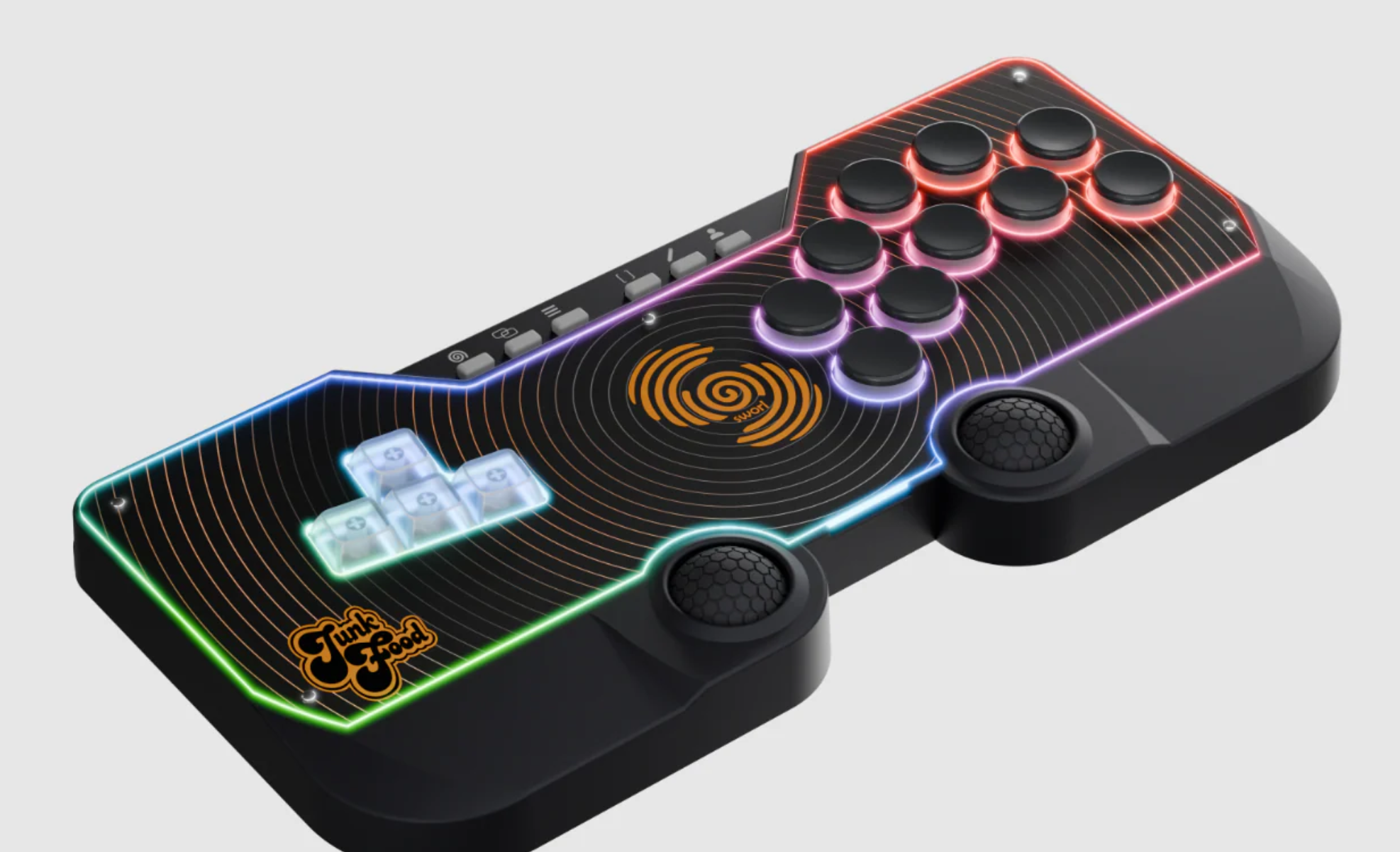
The controller itself comes with four cardinal direction keys, set up in a WASD fashion, along with ten large black buttons, each of which sits on a dazzling rainbow LED. Along the top of the controller is a row of six rubber buttons, each of which is used to help customize the Sworl as well as pause games and navigate menus. What stands out the most to me for the Sworl is the two domes that lie suspiciously close to where your thumbs naturally fall when playing. These domes are actually full-fledged analogue sticks, with a cool hexagon design that allows for better grip.
Those analogue sticks are buttery smooth and just the right size for comfort. Their inclusion addresses a long-held problem with tabletop arcade controllers - the traditional joystick. These peripherals may be seminal in the dark halls of arcades, but when you're relegated to using a large, cumbersome, typically unresponsive ball on the end of a stick for more contemporary titles, the whole thing tends to fall apart. While the unfortunate reality may be that sacrifices are necessary to meet in the middle, the Sworl bridges that gap perfectly with the installation of its analogue sticks. The sticks are easily accessible, with big domed heads, plenty of grip, and an ease of placement that makes it so you never feel like you're reaching or stretching. You can also use their web app to customize dead zones and make the Sworl feel exactly how you would like. They're simply comfortable to use.
Comfort isn't the only thing the Sworl has going for it. Somehow, the people at Junkfood have been able to perfectly translate the satisfying click-clack of a mechanical gaming keyboard to buttons the size of USD 50-cent pieces. Obviously, the controller has to work well to be useful, but it goes a step beyond and becomes downright delightful to use.
Source: Author.
Playing With Sworl
My initial journey with the Sworl was that of Street Fighter 6, Capcom's excellent (and frankly, underrated) latest installment in the iconic Street Fighter franchise. After getting the controller initially set up (which was as easy as changing the keybinding in the settings), I realized that I had picked the perfect game to test drive the Sworl. Street Fighter 6 has a fantastic RPG mode, where you can create your own fighter and take them around the world to train with different Street Fighter characters. A huge portion of this mode is running around an overworld, finding hidden items, and challenging citizens and other contestants to fights. To say the analogue sticks were a blessing in this mode would be an understatement. Running with the keys and using the right analogue stick for camera control was seamless, and I fully believe that without the Sworl, I wouldn't have played the mode half as much as I did. I've played Street Fighter 6 with a controller, and while it's a fantastic fighting game for beginners and veterans alike, playing it with the Sworl brought it to a whole new level.
On Junkfood's website, it shows the Sworl being used to play the massively popular Marvel Rivals,and that got me thinking: what else could the Sworl be used for beyond just fighting games? I decided to test this theory on a few different genres, with varying results. My favorite game to use the Sworl for – and honestly my preferred way of playing this game – is TMNT: Shredder's Revenge. I understand that a side-scrolling beat 'em up is a bit of a cop out, as Shredder's Revenge is essentially an arcade game in itself, but that doesn't detract from the fact that playing it on my PS5 with the Sworl brought new life to a game I've already played to death.
Next up was Batterystaple Games' criminally underrated 30XX, a rogue-like based on the classic Mega Man games. While I found the binding to be a little bit difficult at first, once I got used to the placement I had set up, the Sworl once again brought a unique arcade-like quality and challenge to the already wonderful game. The analogue sticks in particular were extremely useful for the more tricky platforming, and 30XX emphasized the wonderful ergonomics of the Sworl better than any other game I had experienced to that point.
Sworl Multiconsole. Source: Press Kit.Pre
Lastly, I hopped into Left 4 Dead 2, just to see how the Sworl would handle something like a fast-paced first-person shooter. Of the genres I tried out, I would say that this was the most difficult to get used to. Left 4 Dead 2 requires some quick reaction time, and I was really struggling to get my footing while using the Sworl. That being said, it could just be how ingrained that game is in my psyche from playing it for the last 15 years, rather than the Sworl itself. The controller did exactly what I told it to do, and the sticks worked just as well as they would on any standard controller. Despite having difficulties, I still found myself having a lot of fun trying to configure the controller to my specifics and trying out different configurations.
Something else happened with the Sworl that I hadn't previously considered. It hasn't left my desk in the time I've had it, as I would always find myself hopping on, playing a few rounds of Street Fighter after I was done with work in my office. It was always on display, its brilliant LEDs coursing through the buttons at random intervals. As such, everyone I brought into my office has inquired about it. Just by looking as intriguing as it does, the Sworl effortlessly became a conversation piece.
My office doubles as a small recording studio, and without fail, anyone who had come in to help me with setup or play some music pointed at the Sworl and asked what it was. To my surprise, I was watching people who had very little interest in video games in general spend time gleefully button-mashing on Soulcalibur or Street Fighter. It invites the same level of accessibility and curiosity into the home that anyone can get by walking into an arcade. If you're a fan of these types of peripherals and you're looking for a modern version that ticks off all the boxes, I give my full recommendation to the Junkfood Sworl.
When I was a university student 10 years ago (oh dear, I am getting old), I was on the committee of the adventure gaming society. We were a small, but lovable, group of geeks who gathered together every Saturday to play board games and tabletop RPGs of every persuasion. We played a lot of Fantasy Flight’s Game of Thrones board game, which is at its best and bloodiest when you can get a whole table full of players scheming and plotting together. At that time, Game of Thrones was moving towards its sixth season, all the pieces were still in motion, and advancing towards what we were all certain would be one of the greatest climaxes in television history… right?
Then, when 2016 rolled around, a new challenger arose for the crown of the best nerdy show in town: Stranger Things, which launched on Netflix on the 15th July. With its strong emphasis on 1980s nostalgia, Stranger Things revitalised interest in everything from Kate Bush’s Running Up That Hill to “New Coke” (which, despite its name, is more than a decade older than I am).
Welcome to the Hellfire Club. Source: Wizards of the Coast.
Dungeons and Dragons stood at the centre of the spotlight that Stranger Things shone on 80s pop culture. The game is a major plot point in the show, several characters play it, and the antagonists share their names with monsters and mythical figures from the Forgotten Realms.
That major public promotion did wonders for the popularity of my modestly-sized university gaming club. We saw a massive influx of new members, something I want to emphasise is unambiguously good. Gaming is a big tent, and bringing more people with diverse ranges of interests and experiences into that tent serves to make the stories that we can tell together more authentic and more interesting.
Now, as Stranger Things blazes through its final season, Wizards of the Coast has launchedWelcome to the Hellfire Club, a module containing four Dungeons and Dragons adventures, designed to replicate the experience of playing alongside fictional Dungeon Master Eddie Munson from the Netflix show.
RPG Taverns invited me to play the first of these adventures, “The Vanishing Gnome.” Evidently, they still had my contact information after I included them in my piece on TTRPGs and community building.
Naturally, I was more than happy to do some dungeoneering, but there was just one issue…
I’ve never seen an episode of Stranger Things in my life.
"Max, the Daredevil" Magic: the Gathering art. Source: Wizards of the Coast.
Everything that I’ve recounted about the show so far, I know either because I have absorbed it from popular culture or I’ve been able to piece it together after some research.
I’ve played with the Stranger Things-themed Magic: The Gathering cards, and YouTube’s algorithm has popped a handful of Stranger Things shorts in front of me over the years, but when it comes to actual concrete knowledge of the show, I don’t know the Upside Down from Benny’s Burgers.
Nevertheless, I endeavoured to give it a shot anyway. Here’s what I learned.
In Pursuit of Vanishing Gnomes
On a chilly Thursday evening in mid-November, I found myself down in the Hawkins Room of RPG Taverns, which had been decked out with a broad selection of 80s paraphernalia. I had a Stranger Things-themed cocktail in one hand, a collection of colourful dice in the other, and I was ready to search for some missing gnomes.
RPG Taverns, Hawkins Room. Source: Author.
This adventure, and I would assume the other three in this set, was clearly designed to mimic D&D as it was during its early days. While the game uses the 2024 edition of the rules (you won’t be making any fortitude saves here), tonally it harkened back to an earlier era. There wasn’t much of an emphasis on storytelling or deep characterisation; the focus was on the fundamentals of travelling into dungeons, bashing monsters, and grabbing loot.
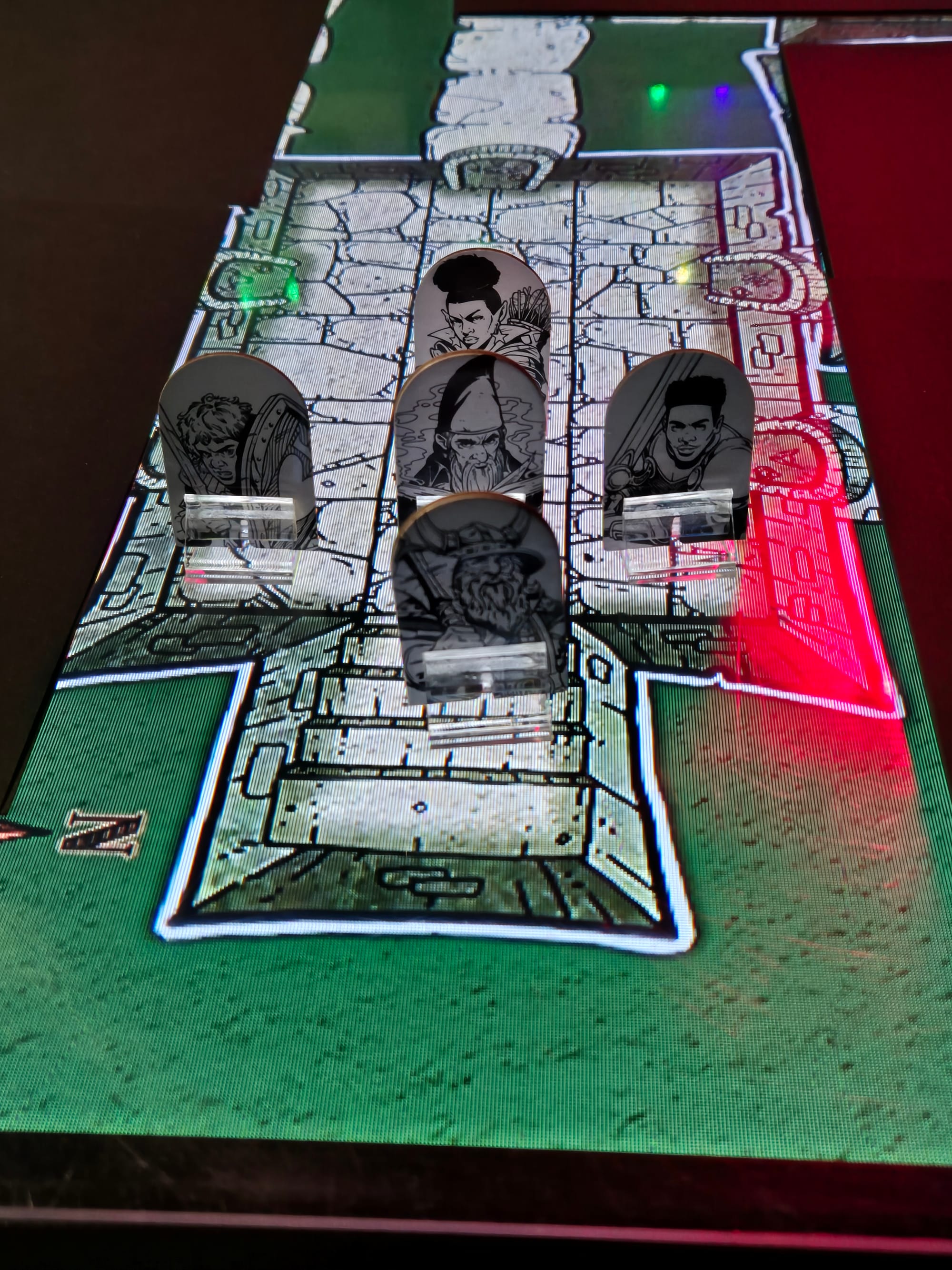
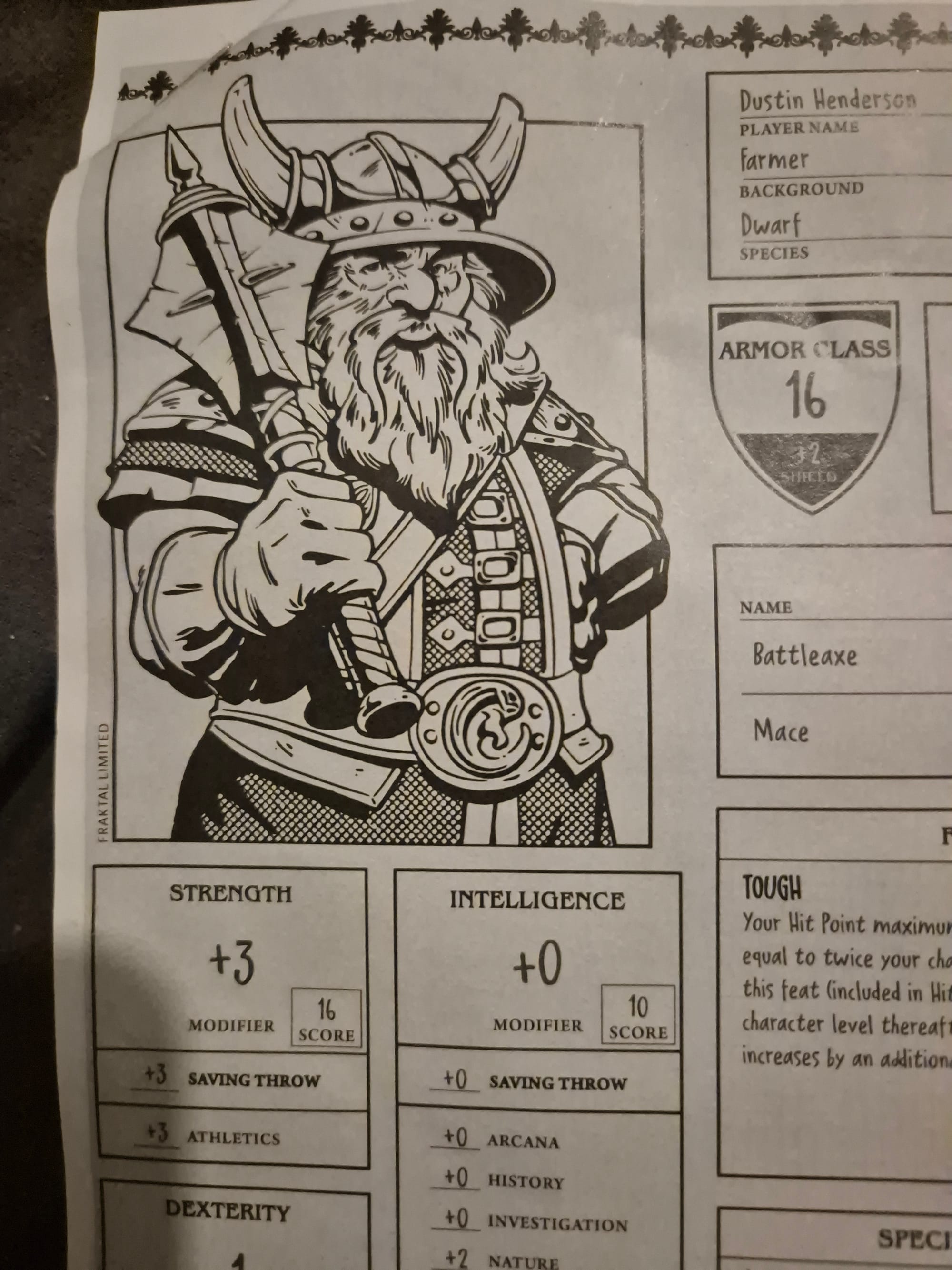
A selection of character sheets was fanned out before my fellow adventurers. I chose to play as Nog, the dwarven cleric. Nog, and all of the other options available, are the characters played by the Stranger Things kids in their own campaign. Having never seen the show, I didn’t have much to inform my characterisation. I knew that I was neutral good, that as a cleric, I would presumably be reasonably pious, and that I had a truly magnificent beard. This lack of knowledge was a blessing in disguise, as it gave me a blank canvas I could fill with my own vision of who Nog was. I had a great deal of fun portraying him as pretentious and smug, but ultimately well-meaning. I clashed frequently with Will the Wise, our party’s Wizard, on the issue of science vs faith, and Tayr the Paladin about which of us was truly the most devout.
Welcome to the Hellfire Club. Source: Wizards of the Coast.
There will undoubtedly be other Nogs out there who are significantly more humble and less argumentative than my portrayal, and there’s a degree of charm to that. While other groups will run characters with the same names and based on the same broad archetypes, my Nog was uniquely my own. He was a bit of a jerk, but he was my jerk.
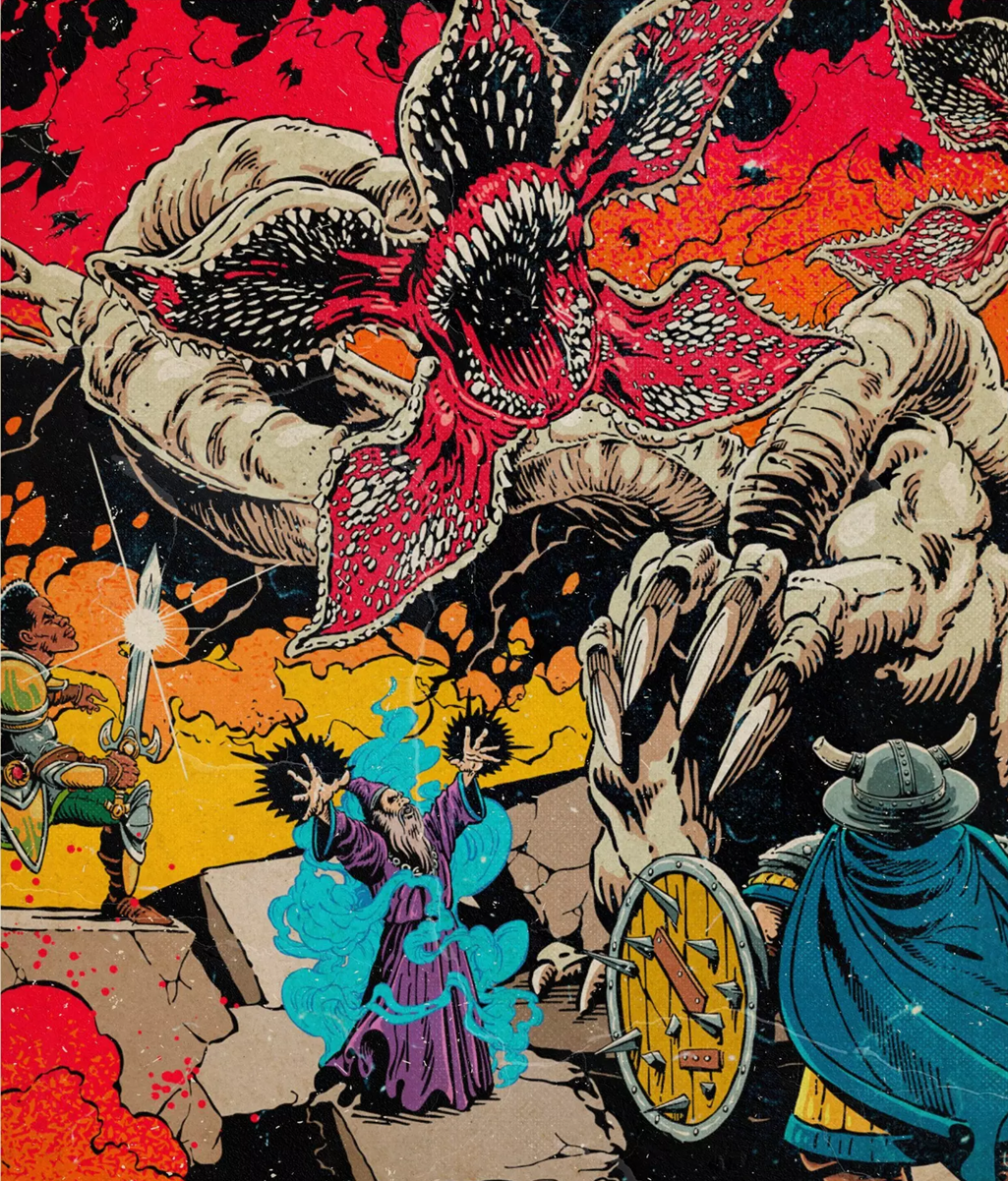
As for the quest itself, the titular vanishing gnome gave us a literal call to adventure, inviting us to seek them out, before living up to their title and disappearing. We were off! We ventured into a nearby dungeon, beat up some spiders, entered what was very strongly implied to be the Upside Down from the show, and fought a Demogorgon (that’s the faceless fiend from Stranger Things, not the Demon Prince from the Abyss who would have completely eviscerated our poor Level One party).
The adventure was an effective tutorial on how to plunge into dungeons, from the pre-generated character sheets to the streamlined story that guided our party immediately towards the action. This box is clearly designed to show new players the ropes, and in that goal, it’s successful. Personally, I prefer roleplaying experiences that are a bit more narrative-heavy; I’m more of a fan of delving into character motivations than into dungeons. That’s just my own perspective, though, and as an introduction to D&D, the Vanishing Gnome makes the game approachable.
Maybe the Real Vanishing Gnomes Were the Friends We Made Along the Way
Welcome to the Hellfire Club. Source: Wizards of the Coast.
So despite my lack of awareness about Stranger Things, I was able to pull off a successful gnome rescue. Were there some winks, nudges, and other scraps of fan service that flew over my head due to my lack of Stranger Things knowledge? Frankly, I have no idea. There weren’t any moments where I felt out of my depth or lost, though, and I glided through the experience comfortably enough.
RPG Taverns is based at 16 Harper Road in Southwark, London, and they will be running the first two adventures from Welcome to the Hellfire Club (The Vanishing Gnome and Scream of the Crop) from December 14th - 23rd, and then again from the 27th - 30th.
Welcome to the Hellfire Club can also be purchased from a variety of online retailers if you’re looking to try it out at home. It’s a good welcoming point to Dungeons and Dragons for fans of Stranger Things, and if you’re not a fan, you’ll probably be able to stumble through as I did.
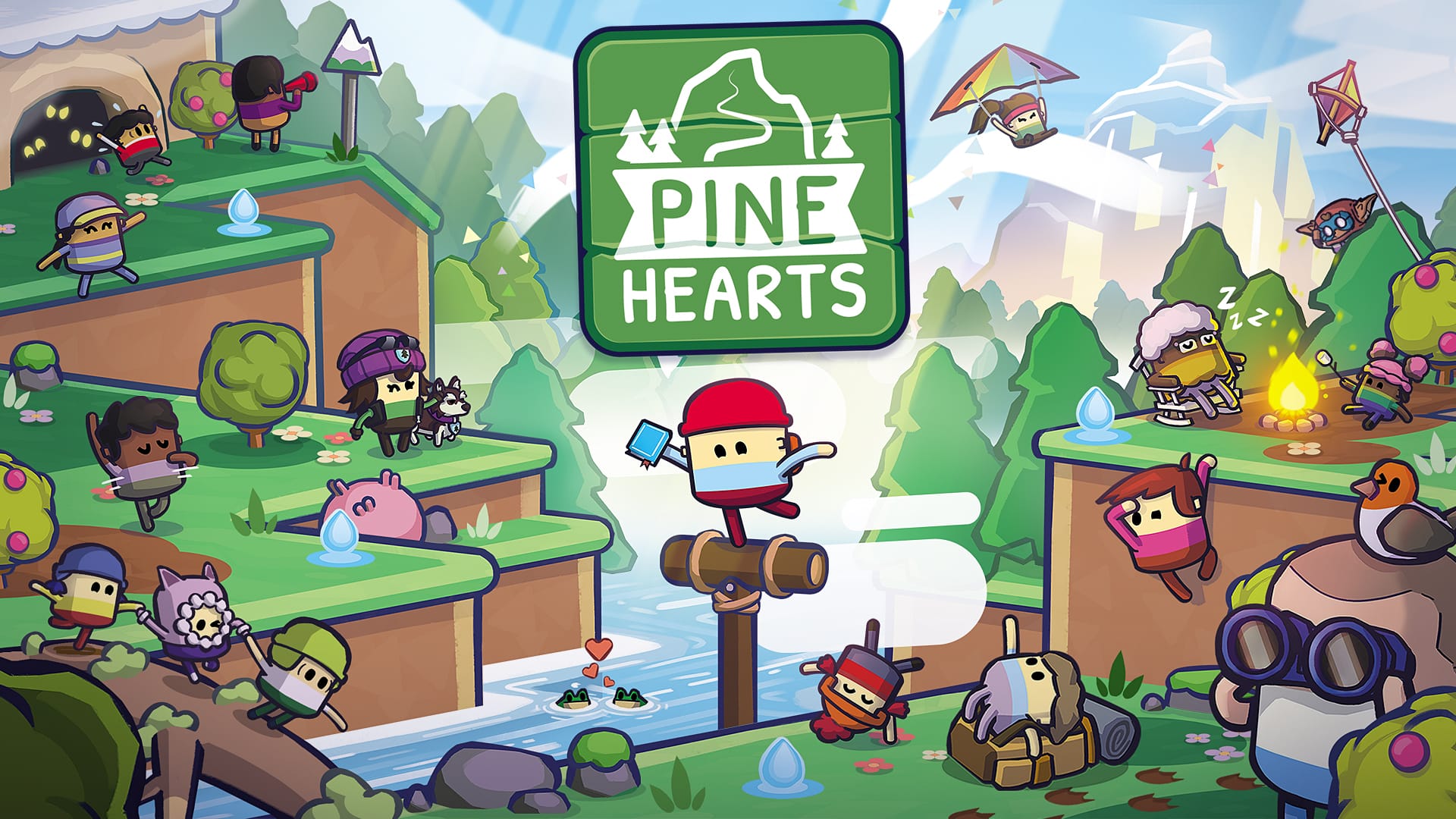
I had the pleasure of interviewing the developer of Pine Hearts two years ago, after playing and thoroughly enjoying the demo. I was excited to play the game, but as it does, life caught up with me, and I ended up delaying my playthrough until just now. I'm definitely sad that I didn't play this sooner! Pine Hearts is an adorable, heartwarming, and sometimes heartbreaking romp through a small English nature reserve full of fun, quirky characters and memories for our darling protagonist.
Grief and Moving Forward
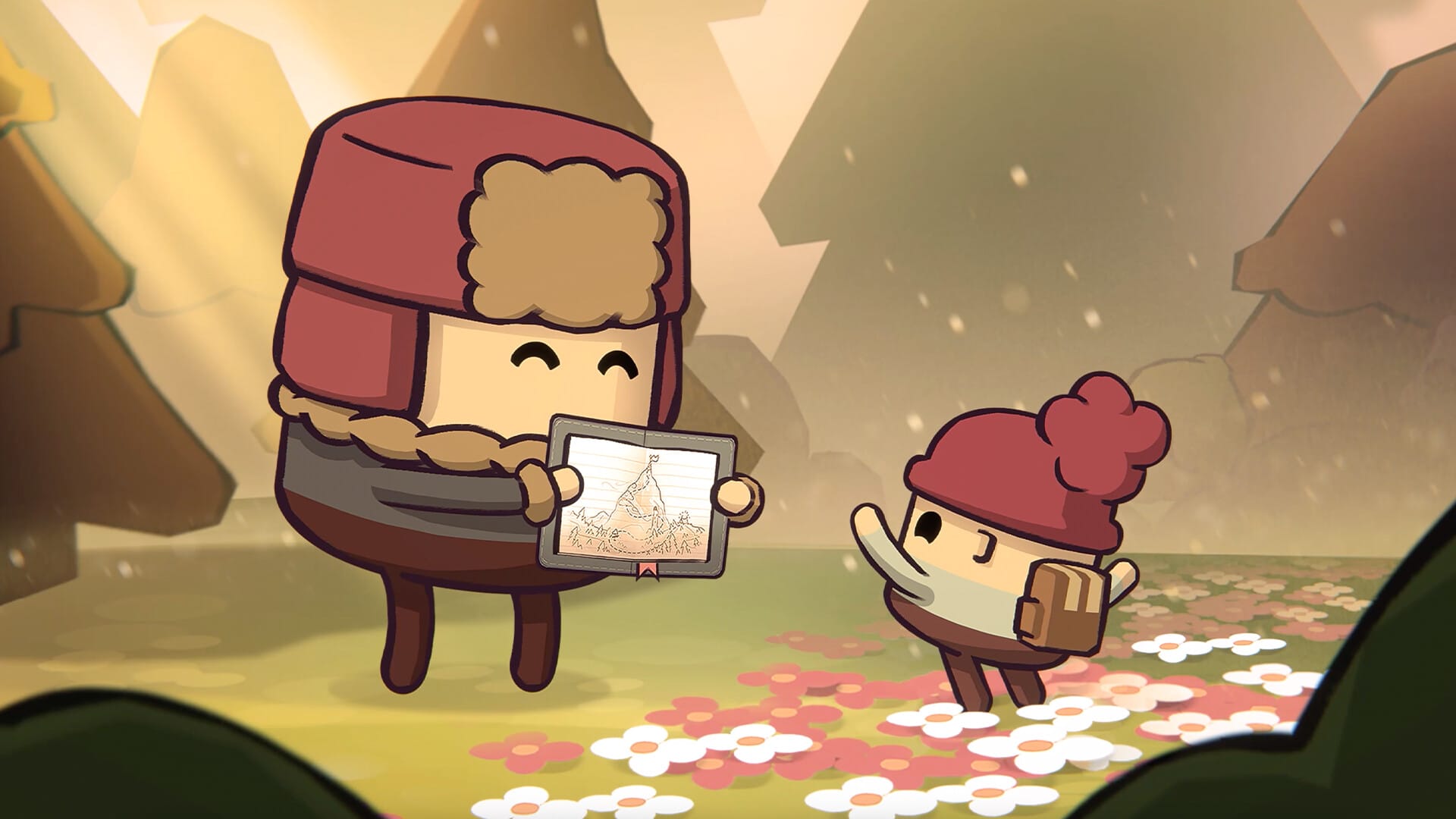
Pine Hearts follows the story of Tyke, who is determined to climb to the summit of the titular nature reserve, following the journal his father left behind cataloging their adventures in Tyke's childhood. Along the way, Tyke helps the various inhabitants of the reserve to resolve their problems, from a missing performing band to puzzles in castle ruins to shady fishermen and more. Tyke assists others while working through his own memories of his father, all in an attempt to overcome the challenge - both physically and emotionally - of conquering the summit of Pine Hearts.
I found this adventure, while brief, to be very satisfying. Tyke never talks, but he certainly feels things deeply. With every memory you uncover in this game, you're presented with a little bit more about his connection to his father, and the sometimes rocky relationship they shared. It's touching to see how young Tyke viewed the world, so full of scary things but easily faced together; at the same time, it's heartbreaking to see how much Tyke lost when he lost his father.
At the same time, Tyke doesn't let this grief overwhelm him. Every action he takes is for the benefit of others, often going well out of his way to do so. Rather than simply taking the most direct route to achieve his goals, he engages with this park that's so sentimental to him, building new memories to supplement and support the old ones, and finding closure in other people's stories. I find this deeply beautiful, and I found myself often tearing up throughout Tyke's journey.
Via Hyper Luminal Games.
Cutesy and Clever Visual Design
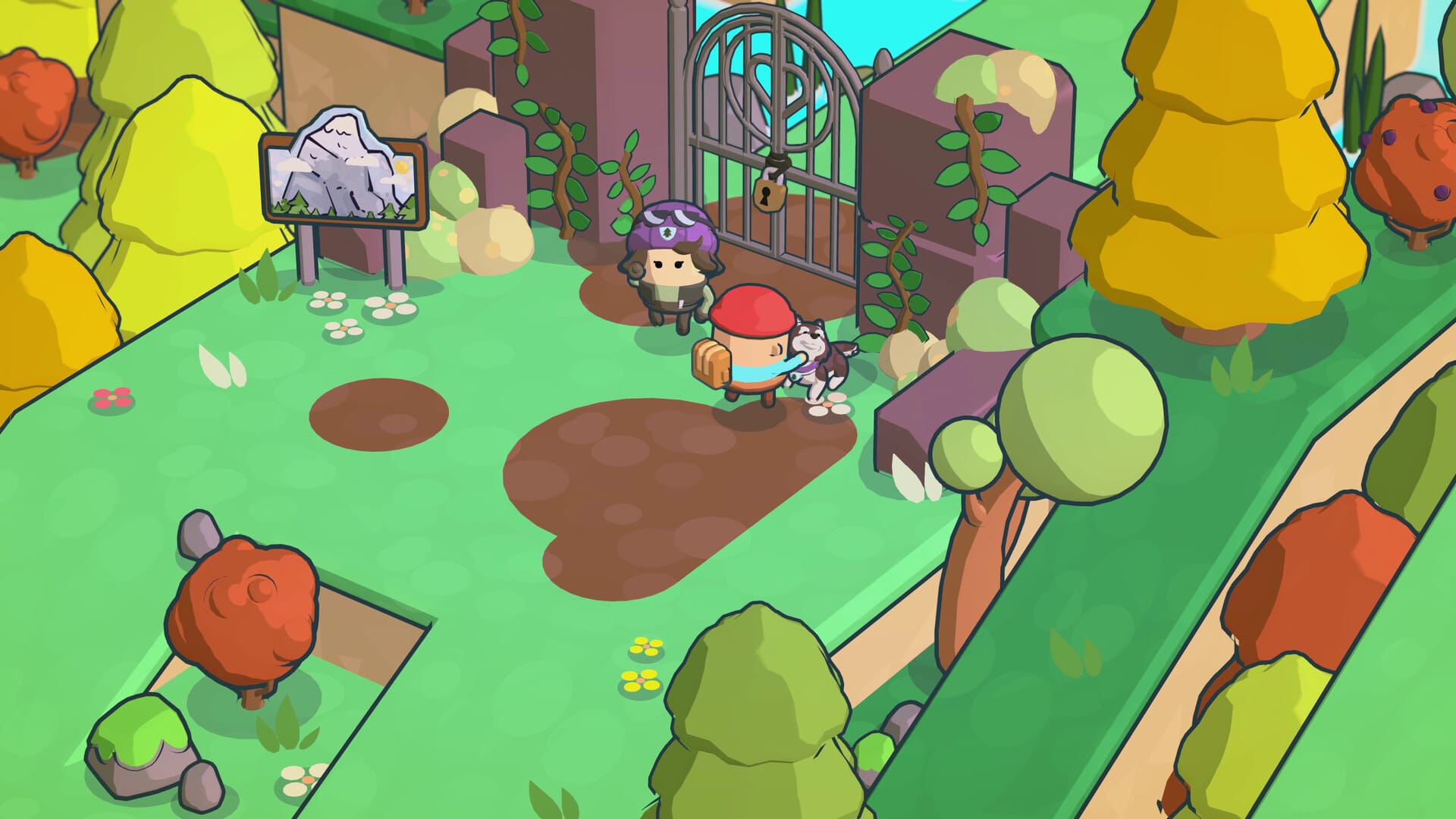
The aesthetics of Pine Hearts are, in a word, charming. The blobby, noodle-limbed character designs feel like they're pulled straight from a children's show, with matching bubbly background elements in bright, saturated colors that make it a delight to behold. I adored each different area of the game, which felt distinct and yet cohesive as a world, and appreciated the attention to detail that came with each space; there are distinct greens in the golf course and lush gardens in the castle! As a bonus, every animal you encounter in the game is precious, and yes, you can pet all the dogs.
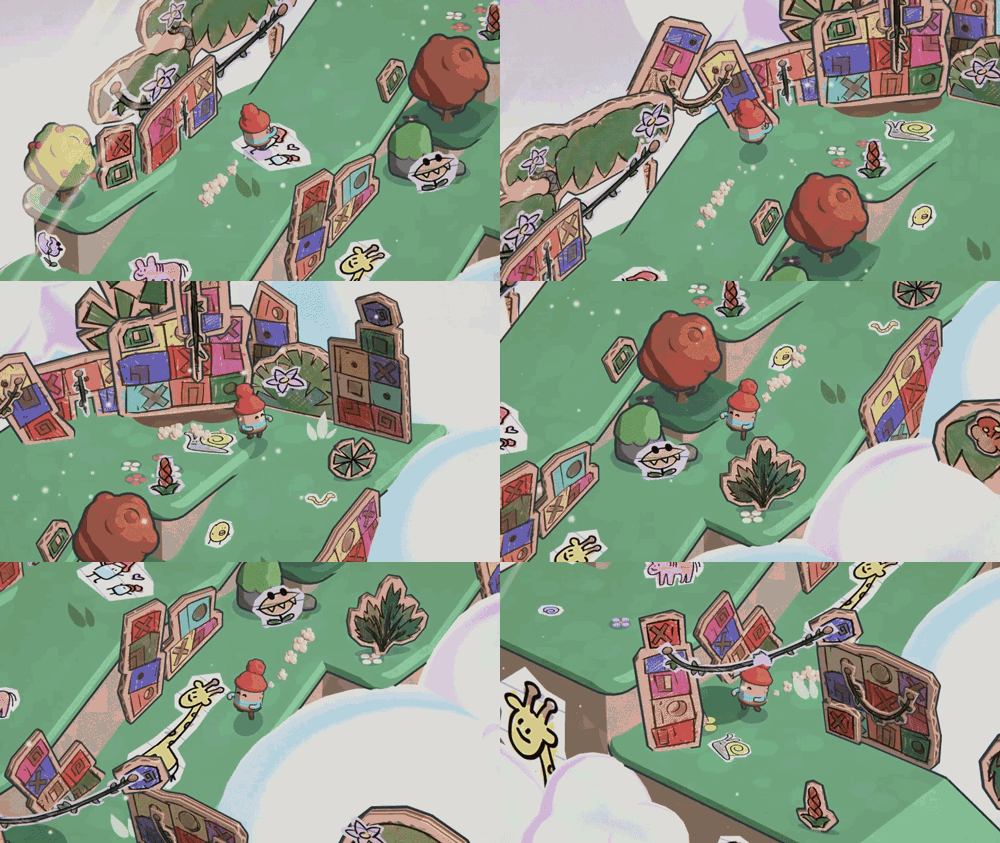
The secondary setting - Tyke's memory world - has a lovely cardboard-cutout design that feels like when kids work together to put on backyard plays for their parents, which I think is entirely appropriate. The softness of the world through Little Tyke's eyes, complemented by dreamy overlays and a smaller field of view, gives a lot of weight to the fact that he hasn't been back to this park since his father's passing; all of his memories of it have been aggrandized by time and distance, leaving us with this rounded view. It's a really clever way to include the inconsistency of memory into this game that uses memory as a main plot.
Via Hyper Luminal Games.
Metered Progress and Memory-Based Movement
The actual gameplay of Pine Hearts is just as solid as the visuals. Though movement through the environment can be challenging at times - the movement controls aren't super precise, and there are brief moments where paths are obscured by the landscape - interacting with it never felt like much of a chore.
Progression through the game relies on Tyke collecting teardrops, either from the environment itself or by completing tasks for the various characters within it. When he hits certain milestones, you unlock memories that reveal a new movement mechanic like chopping through blocking logs, digging to reveal hidden items or collect quest pieces, jumping to clear gaps, and a few others. All of the different areas of the largely open world map are explorable using a combination of these abilities, so you're encouraged to return to previous areas and re-explore as you unearth new mechanics.
I found this to be both an interesting way of exploring and slightly frustrating at times. Progress was occasionally difficult when I didn't have a mechanic I sorely needed and couldn't figure out how to get around it (though there was always a way to progress without the missing mechanic, even if it wasn't obvious at first). Still, there were always more than enough drops available to ensure I unlocked what I needed eventually. In the meantime, I simply explored other areas of the map and came back to puzzles I got stuck on later.
This slow, unlocking progression meant that I was encouraged to interact with everyone and everything, which made for some fun moments I wouldn't have thought about trying otherwise. It was nice to see the interaction prompt pop up in a seemingly random area and watch Tyke do something silly like play hopscotch, roast a marshmallow, or clap at a seal. These little moments always rewarded you with drops, making them both cute and satisfying. It kept me invested and playing for long stretches without getting bored.
Via Hyper Luminal Games.
A Genuine Work of Heart
Pine Hearts was so clearly made with a great deal of heart and care that I can't really find any fault in it. It's a wonderful experience to curl up with, especially if you're someone who's experienced a similar grief or shares a similar level of love and respect for a childhood vacation spot. These memories aren't perfect, and they can be difficult to relive, especially if we've lost the person we made them with, but that doesn't mean we have to give up on them, even when things get hard. Helping Tyke to find closure through kindness to others was rewarding in its own right; I genuinely felt like the world had the potential to be a little nicer after finishing the game.
You can find Pine Hearts on Steam, Nintendo Switch, Google Play, and the Apple Store.
While I was provided with a free press review key for Pine Hearts by the developers, my thoughts and opinions about the game are my own. This is not a paid or sponsored review.
RANDOMAX is a vertical shoot ‘em up developed by ASTRO PORT and published by Sanuk Inc. It’s a brief roguelite where no two playthroughs are the same between the weapons you receive and the bosses you face. This title is easily addictive, though it is on the short side.
Also acting as a visual novel, RANDOMAX does have a storyline, though I didn’t find it important. I enjoyed this game more as an arcade title than anything else due to the high score features, fast-paced gameplay, and quick stages. I got through all stages within twenty minutes (give or take) each time I played.
In the year 2050, the Sepulch Space Archipelago galaxy is attacked by Randomax Pirates. Three women–Cosmi, Urara, and Dariha–hop in their respective ships (along with a shipping company, ARGO EXPRESS) to fight against these marauders. The character you chose to play during that run and the boss have a quick conversation before and after the fight. Everything about the story is the same no matter who you play as. Since the game is so short, I didn’t think the story element was needed. After playing through it once, I skipped all the dialogue boxes during each run. I found the dialogue to be a bit annoying, but it’s a minor complaint.
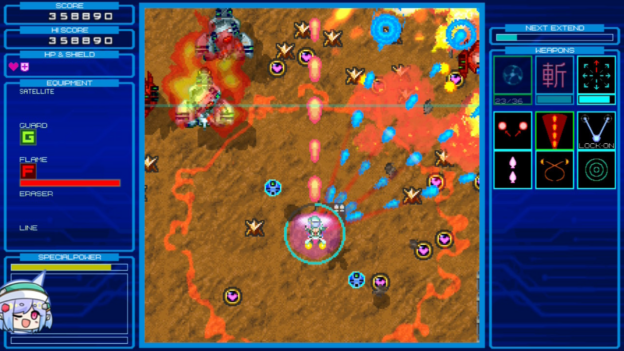
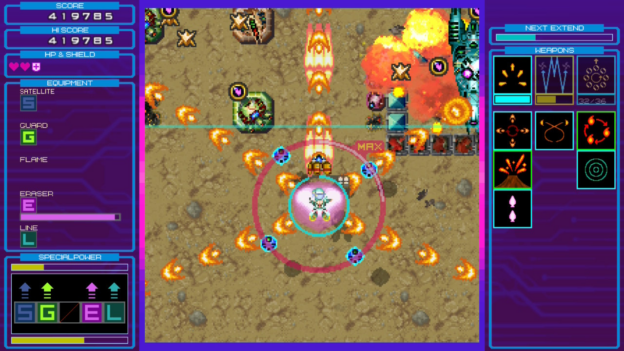
The gameplay is where RANDOMAX truly shines. It’s bullet hell at its finest, with each ship being able to equip up to three types of weapons at once. The controls are easy enough, using the L-stick to move and holding down the X, A, and B buttons to shoot their respective weapon. There are more than seventy types of weapons you can get, ranging from homing missiles, lasers, shuriken, bubbles, and even balloons. Some weapons shoot forward, others in multiple directions, and some will shoot in the opposite direction from which you’re moving. My favorite weapons to get were the heat seeking ones (which were great for boss battles) and full-screen weapons so there was little aiming involved. I could shoot to my heart’s content and focus on collecting the items.
When defeating enemy ships, they’ll drop items that’ll help fill your health meter to give you an extra hit, your ship’s shield (for a free hit), or the extend meter (which will help give you an extra boost). To be honest, the game is so fast-paced—with the screen covered in bullets and explosions—that I didn’t often notice these meters. I shot my weapons, collected the items, and, when something good happened, I praised myself and kept going.
RANDOMAX does have some strategy involved, though. After each enemy wave, you’ll visit the ARGO EXPRESS ship which will give you the option of choosing one, two, or three new weapons at random. You can reject a weapon or assign it to one of your buttons. When assigning a new weapon, it’ll stack on top of the existing weapon in that spot. It won’t replace it, though you’ll need to use up all the bullets of the weapon on top in order to use the next in that slot.
The ship will also sometimes give you the chance to add a ship upgrade, such as a flame wall around your ship, adding extra guards around you to deflect bullets, and more. I found the guard to be the most useful since I often didn’t pay attention to the enemies’ bullets, but the enemies themselves. Or, I had my homing bullets do the work so I could aimlessly fly around the screen.
RANDOMAX has five difficulty settings, too: easy, normal, hard, insane, and ultra. I started the game on normal and promptly got my butt kicked. Once I learned more of how the game worked through the easy setting, I worked my way up each challenge. Despite the enemies’ increase in bullets, I found the game got easier as I worked my way up and improved my strategy, despite the randomness of the weapons.
After completing the easy mode for the first time in twenty minutes, I thought the game was just alright. Then I blinked and realized I had put roughly five to six hours into it. I got through all five difficulty modes with all three characters. With over seventy weapons and forty bosses to find, I didn’t quite complete the game. Otherwise, it’s a matter of beating your own high scores. There’s no online leaderboard, multiplayer, or anything like that.
So, in terms of replayability, you’ll get your money’s worth out of this title. But it is short. I can see myself going back to RANDOMAX here and there to play a quick round or two. It’s certainly a fun time and, even though I wasn’t impressed by it at first, it quickly sucked me in. Despite the story not being needed, and some brief lag when there are tons of explosions on screen, this game is addictive.
Hero Seekers is a JRPG developed by Vanguard and published by KEMCO. This title contains a linear gameplay path, a decent story with interesting character backgrounds, and turn-based strategy combat. It looks great on the outside, but does it really stand out compared to other games in the genre? Well, the answer is yes and no.
I think the strongest part of Hero Seekers is the story. Over time, many Heroes have stepped up to defeat the Demon King. All succeed, but the Demon King gets resurrected each time and erases the previous Heroes from everyone’s memory, trapping said Heroes in a loop of their worst nightmare.
The game begins with a trio of Heroes—Lunette, Ramsar, and Ruwan—defeating the Demon King, only for them to get separated. Lunette awakes in a strange town where humans are being enslaved by demons. Only she remembers her party defeating the enemy, with Ramsar and Ruwan nowhere to be found. Thus, her quest begins to bring back lost history by freeing lost Heroes from their nightmares.
Overall, I found the narrative covered themes of hope, loss, and the importance of history in a unique way that was engaging with its characters. However, the gameplay wasn’t strong enough to help back up the story. There were too many characters with stories that ended up getting thrown away. There are twenty-four Heroes to find and add to your party, but you can only have five party members at a time. Four fight in your party and one is in reserve, earning experience from the party’s battles, but ultimately not contributing and just being there for backup.
I assume the developers created many characters to help with replayability so you can mix and match party members. Once you’ve completed Hero Seekers once, there’s no real need to go back and play it again anytime soon since the story is as straight as an arrow and the combat gets stale after a while.
I also didn’t want to swap out the main characters. Lunette is the playable character, and even though you can switch her out, it felt wrong to. She meets Nyla and Zalesh along the way, and they are also important, and in every conversation and cutscene. It felt weird to swap them out, too, when they’re still being addressed by NPCs. Every other Hero was simply there as an extra. They all had their own backstory, which was great, but once you unlock them, that’s it. They have no dialogue or interaction with anyone else for the rest of the game. I used Lilione as my fourth party member and Maximillion as my fifth on reserve. Other than aiding in battles, there was no reason to have more than the three main party members.
The gameplay of Hero Seekers is rinse and repeat. You go from one town to another, talk to an NPC or two, and they’ll tell you where to go next. So, back to the overworld you go, heading to a dungeon. The dungeons are more or less all the same. There are no puzzles or obstacles in the dungeons. It’s simply a matter of finding where the stairs are to move to the next level. Essentially, each dungeon is a large maze with long corridors, some dead ends with or without chests, and eventually you stumble upon the stairs.
And when I say large, I mean it. Every area in Hero Seekers—the dungeons, the overworld map, the towns—is huge with a lot of empty space. I can’t begin to describe how much space is wasted in every area. The towns in particular are needlessly large with tons of buildings with no doors. The only buildings you can go into are the town’s castle or the shop. There is a town or two where you can go into an NPC’s home, but there’s no reason to. No matter where I was, I basically wandered around until the game stopped me to tell me I was either going in the wrong direction or I triggered a cutscene.
There are no maps in this game, so I couldn’t look at the overworld to get a sense of direction to make it to the next area. Instead, I wandered until something appeared on screen. Or, again, the game stopped me for going too far in the wrong direction.
Overall, the gameplay in between combat was going through the motions for the sake of moving the story along. There are no side quests or mini games, nothing.
The combat in Hero Seekers was fun for a little while. On the overworld and in dungeons, you’ll get into random battles with wild enemies ranging from jellyfish and goblins to dragons and the undead. Every character can use physical attacks with melee weapons or use SP for magic attacks.
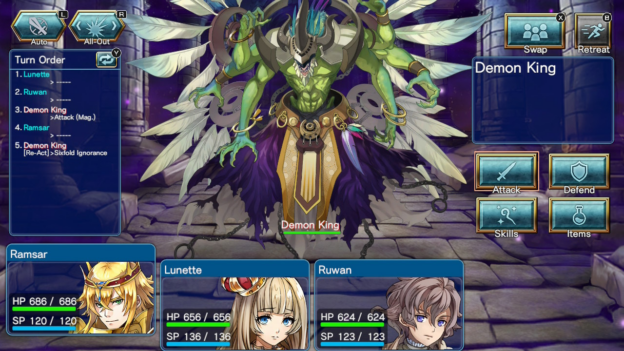
On the left side of the screen, you’ll see the turn order listing your party and the enemies, based on everyone’s speed. I’m not sure if my party was overpowered or not, but in pretty much every battle my whole party was faster and would basically one-shot the enemy team before they could even attack. I did grind a little bit in the beginning to get money so I could buy upgraded weapons and armor, so I’m not sure if I accidentally boosted my team too much. Thus, the battles were monotonous for me.
There is an auto feature for battles, though. If you’re grinding or simply just don’t feel like getting into wild battles when traveling to the next area, you can use the auto feature. The party will either go “all-out” using their strong attacks, or you can set the auto feature to “healing” or “no special” meaning they’ll only use physical attacks.
The boss battles could be tricky. Again, my party was usually faster than the boss so I had a good advantage. Also, there wasn’t much variety in the bosses. Many of them were main enemies from the story, so I battled them a couple of times. Many of the enemies, including some of the bosses, seemed weak to wind attacks. Nyla and Zalesh both have wind magic attacks, so they carried a lot of battles on their shoulders.
So, the story in Hero Seekers was great, but it could have been better if the gameplay supported it and had a little more variety and less of a linear feel to it. Yes, I know RPGs are typically linear, but this game didn’t allow me to do anything unless I was moving forward with the plot and gave me nothing else to explore in the towns or dungeons.
The music, graphics, and backgrounds in this game were amazing, though. The backdrops to the battles were gorgeous, and the music gave me Final Fantasy and Castlevania vibes with enough variation in tunes for the wild battles, boss battles, cutscenes, and general wandering.
Overall, Hero Seekers is a solid JRPG. The story is strong, though the gameplay doesn’t quite match its energy and feels bland after a while. With enough characters to try, replayability is present, but the linear way of playing doesn’t leave much desire for me to start over. I got through the main story within ten to eleven hours, so I did spend a good amount of time with this game. Despite some of its flaws, it is worth checking out if you enjoy RPGs.
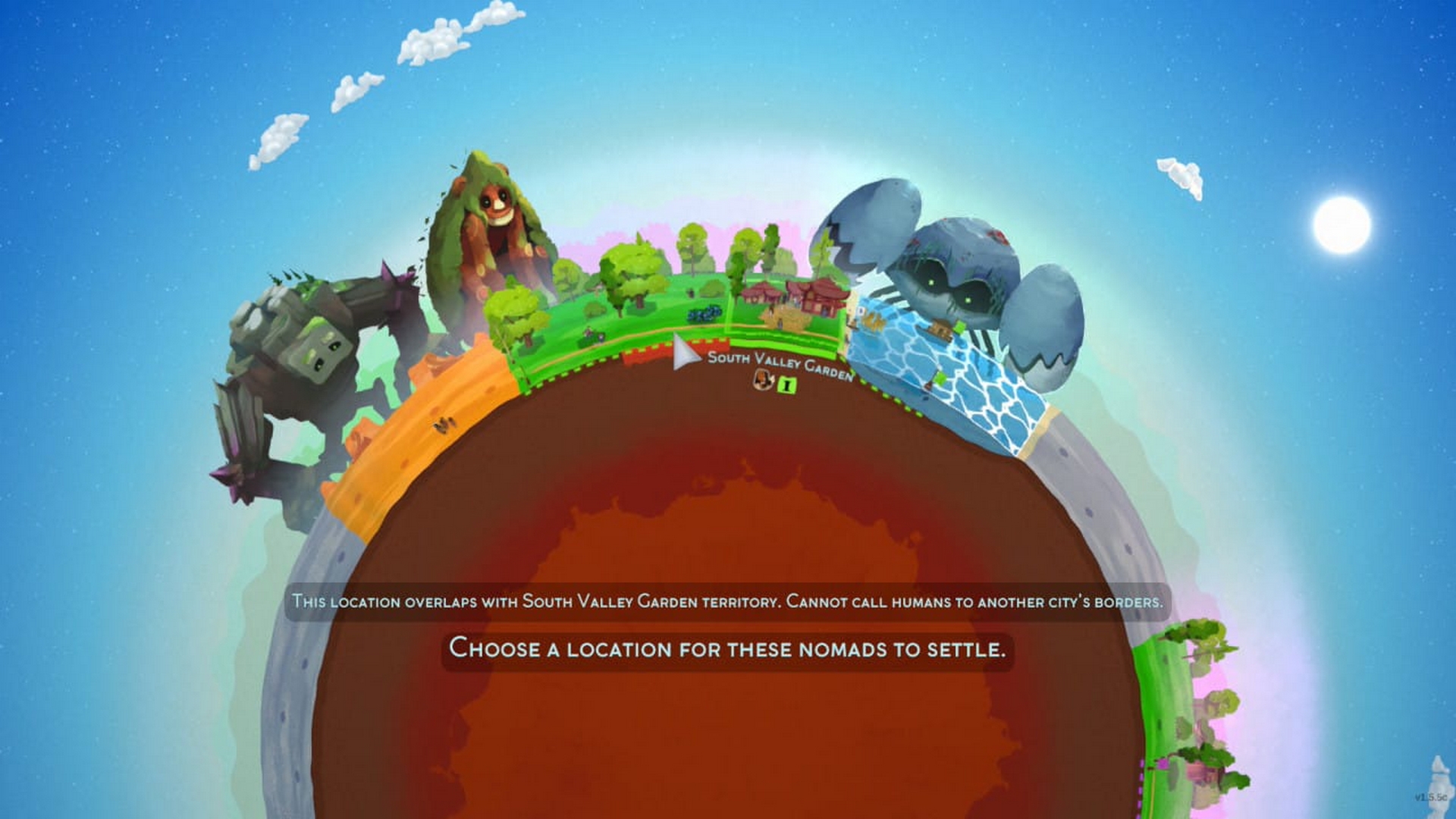
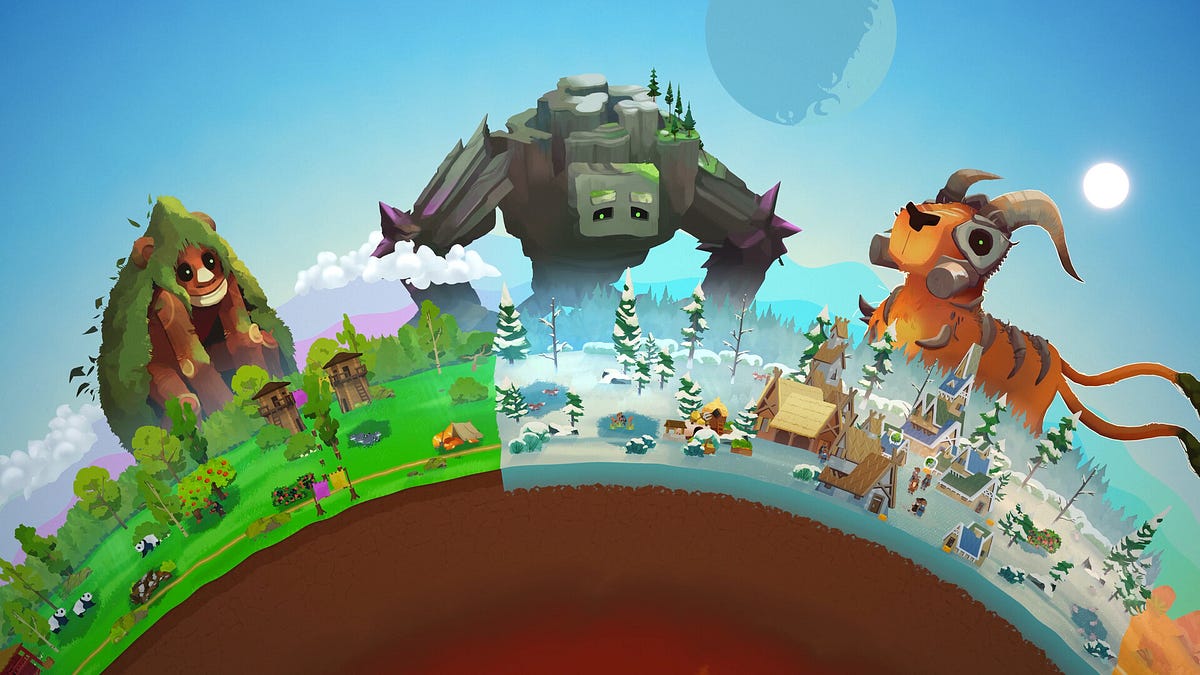
Reus 2 is a god game that’s all about building planets and seeing how civilizations react to the world you create for them. Instead of controlling people directly, you shape the land itself using giant beings, then sit back and watch how things play out. It’s a slower, more thoughtful kind of strategy game.
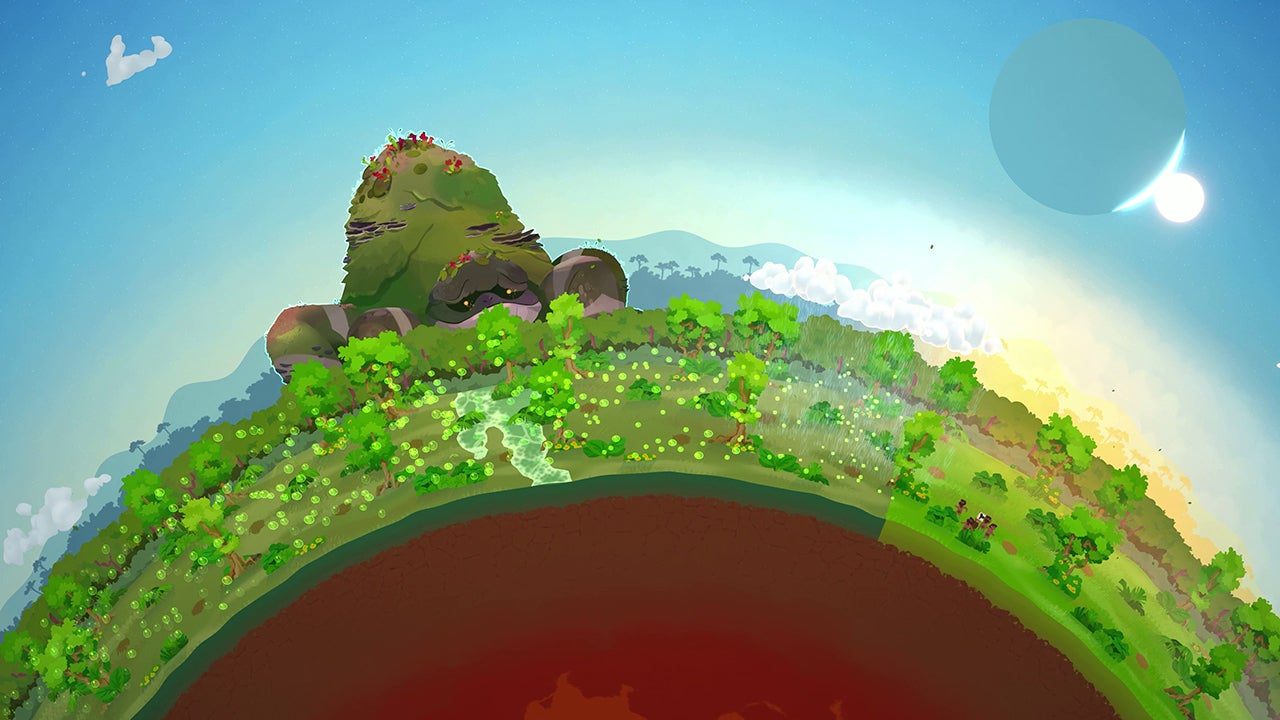
You play as these giant god-like beings that shape the land instead of directly controlling people. You’re placing forests, mountains, oceans, animals, and resources, and then watching little civilizations try to make sense of it all. Sometimes they thrive. Sometimes they don’t. And most of the time when they don’t, it’s because of a choice you made without realizing how much it would affect their little world.
What I like most about Reus 2 is that it doesn’t feel like it’s nagging at you to play it “correctly.” There’s a lot of experimentation, a lot of “oh, that didn’t work at all,” and then going back in with a better plan. It’s not stressful, it’s not fast, and it doesn’t feel like it’s trying to punish you for learning. That makes it really easy to relax with, especially if you’re burned out on games that want you locked in all the time.
That said, this is definitely a thinking game. You’re not smashing buttons or reacting quickly to anything. You’re placing things, watching patterns form, and slowly understanding how all the systems connect. When it clicks, it feels great. When it doesn’t, it can feel a little confusing because the game doesn’t always explain why something went wrong. You kind of have to piece it together on your own. This was a little frustrating at first and I will admit I did have to look up a tutorial. But once you get the hang of things it’s actually kind of fun.
Visually, I really like it. It’s clean, colorful, and easy to read at a glance, which matters when you’re staring at planets for long stretches of time. The music stays in the background and doesn’t get annoying, which I appreciate, because this is the kind of game where loud or dramatic music would completely kill the vibe.
The controls in the Nintendo Switch version are where I have mixed feelings. The game clearly wasn’t built with a controller as the main focus, and you feel that. Menus can be a bit clunky, text can be smaller than it should be, and sometimes doing something simple takes more steps than it needs to. It’s not unplayable by any means, but there were moments where I thought, “This would be way smoother with a mouse.”
I also wouldn’t recommend this to someone who wants action or instant gratification. If you need explosions, combat, or constant feedback, this probably isn’t going to hold your attention. Reus 2 is slow on purpose, and that’s either going to be exactly what you want or something you bounce off of pretty quickly.
For me, though, it worked. I like games that let me think, mess up, and try again without acting like I failed some kind of skill test. Reus 2 feels more like tending to something than beating it, and that’s not something you see a lot of anymore.
It’s not perfect on Switch, and I won’t pretend the controls didn’t annoy me at times. But if you’re into chill strategy games, god/sandbox-style games, or anything where watching systems interact and grow is half the fun, Reus 2 is worth your time. Just go into it knowing it’s more about patience and curiosity than excitement.



 .
.

 A year is a long time – we have twelve whole months ahead of us, and most of them will likely be filled with brand-new game releases; some we already know about, while others are still the subject of rampant speculation. Today, we’re taking a look at indie games that are confirmed to be coming out in 2026 – titles that, barring any unexpected delays, we’ll be able to get our hands on and play later this year.
 Happy New Year! 2026 has arrived, and the indie game releases are not slowing down. Not one bit. We hope you’ve all had a good rest during the holiday season, because January is already hurling a handful of promising indie titles at us – so strap in and enjoy our list of personal picks from the first week of the month!
 Dead Format has the most insanely intriguing premise I’ve seen come out of a horror game in a long while. You take cursed, supernatural VHS tapes, each representing a different genre of film, and dive into them Inception-style to explore their every nook and cranny? And you do this within the framework of a survival horror game?
 We continue our exploration of the holiday season – here are all the coolest indie game releases from last week that we believe you might want to check out! Enjoy!
 The holiday season is almost here, but that doesn’t mean there’s a shortage of indie games coming out! Far from it, really. So, here’s what December had to offer so far – these are some of the coolest indie titles that came out during the first few days of the month. Enjoy!
 Tormented Souls 2 picks up more or less where the original left off, and begins with protagonist Caroline Walker and her freshly-rescued sister Anna riding a train to the town of Villa Hess for some much-needed answers.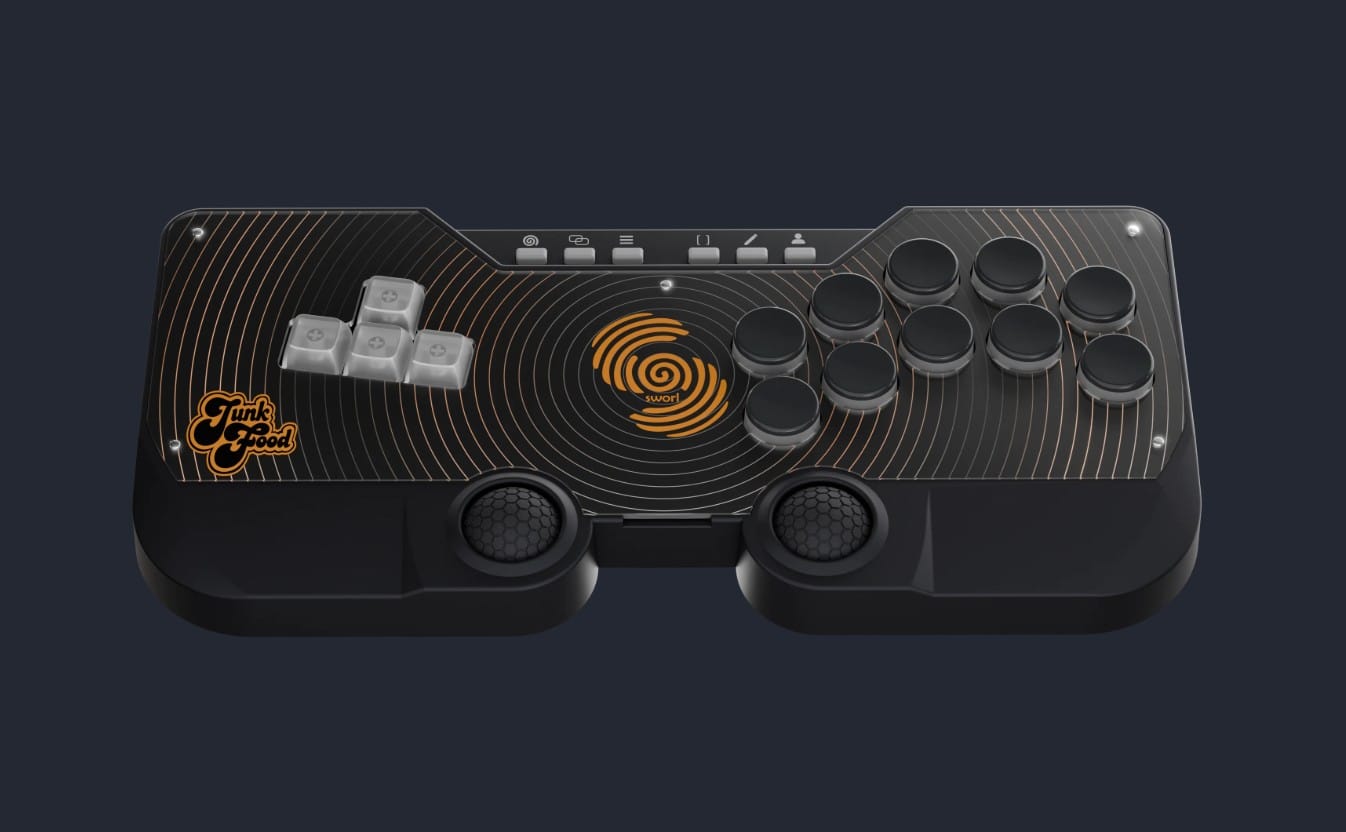







 What I like most about Reus 2 is that it doesn’t feel like it’s nagging at you to play it “correctly.” There’s a lot of experimentation, a lot of “oh, that didn’t work at all,” and then going back in with a better plan. It’s not stressful, it’s not fast, and it doesn’t feel like it’s trying to punish you for learning. That makes it really easy to relax with, especially if you’re burned out on games that want you locked in all the time.
 That said, this is definitely a thinking game. You’re not smashing buttons or reacting quickly to anything. You’re placing things, watching patterns form, and slowly understanding how all the systems connect. When it clicks, it feels great. When it doesn’t, it can feel a little confusing because the game doesn’t always explain why something went wrong. You kind of have to piece it together on your own. This was a little frustrating at first and I will admit I did have to look up a tutorial. But once you get the hang of things it’s actually kind of fun.
 Visually, I really like it. It’s clean, colorful, and easy to read at a glance, which matters when you’re staring at planets for long stretches of time. The music stays in the background and doesn’t get annoying, which I appreciate, because this is the kind of game where loud or dramatic music would completely kill the vibe.
The controls in the Nintendo Switch version are where I have mixed feelings. The game clearly wasn’t built with a controller as the main focus, and you feel that. Menus can be a bit clunky, text can be smaller than it should be, and sometimes doing something simple takes more steps than it needs to. It’s not unplayable by any means, but there were moments where I thought, “This would be way smoother with a mouse.”
Visually, I really like it. It’s clean, colorful, and easy to read at a glance, which matters when you’re staring at planets for long stretches of time. The music stays in the background and doesn’t get annoying, which I appreciate, because this is the kind of game where loud or dramatic music would completely kill the vibe.
The controls in the Nintendo Switch version are where I have mixed feelings. The game clearly wasn’t built with a controller as the main focus, and you feel that. Menus can be a bit clunky, text can be smaller than it should be, and sometimes doing something simple takes more steps than it needs to. It’s not unplayable by any means, but there were moments where I thought, “This would be way smoother with a mouse.”
 I also wouldn’t recommend this to someone who wants action or instant gratification. If you need explosions, combat, or constant feedback, this probably isn’t going to hold your attention. Reus 2 is slow on purpose, and that’s either going to be exactly what you want or something you bounce off of pretty quickly.
For me, though, it worked. I like games that let me think, mess up, and try again without acting like I failed some kind of skill test. Reus 2 feels more like tending to something than beating it, and that’s not something you see a lot of anymore.
I also wouldn’t recommend this to someone who wants action or instant gratification. If you need explosions, combat, or constant feedback, this probably isn’t going to hold your attention. Reus 2 is slow on purpose, and that’s either going to be exactly what you want or something you bounce off of pretty quickly.
For me, though, it worked. I like games that let me think, mess up, and try again without acting like I failed some kind of skill test. Reus 2 feels more like tending to something than beating it, and that’s not something you see a lot of anymore.
 It’s not perfect on Switch, and I won’t pretend the controls didn’t annoy me at times. But if you’re into chill strategy games, god/sandbox-style games, or anything where watching systems interact and grow is half the fun, Reus 2 is worth your time. Just go into it knowing it’s more about patience and curiosity than excitement.