
Zobrazení pro čtení

Air India Flight 171 lost thrust seconds after takeoff, and investigators now point to the cockpit

Investigators examining last year’s Air India Flight 171 crash have concluded that the pilot in command deliberately cut fuel to both engines, as reported by NextShark. The finding marks a significant development in the probe into one of the deadliest aviation disasters in recent memory.

The Boeing 787 Dreamliner lost all thrust seconds after taking off on June 12, 2025, in Ahmedabad. The aircraft crashed into a medical student hostel, killing 241 people on board and 19 on the ground.

Authorities in India, working with technical experts from the United States and the United Kingdom, analyzed cockpit voice and flight data recorders recovered shortly after the crash. The recordings reportedly indicate a manual shutdown of both engines, with no evidence of mechanical failure that would have required such an action.

Investigators focus on manual fuel cutoff in cockpit

The Boeing 787’s twin engines rely on electronically controlled fuel systems that require deliberate manual input to alter fuel flow. Investigators reviewed throttle positions, engine core speeds, and fuel flow data to reconstruct the sequence of events between liftoff and impact.

@DGCAIndia , In Ahmedabad @airindia flight crash,has Black Box investigation revealed the sentence “Now….will start flying”, said by a pilot. And Baramati flight crash incident,the flight was carrying 1 gallon of ATF. Source based info for your confirmation. @PMOIndia @HMOIndia

— Niraj (@NirajGunde) February 20, 2026

The report also references Captain Sumeet Sabharwal, alleging he had been battling depression in the months before the crash, citing unnamed sources close to the inquiry. Separate reporting has also tracked unrelated disputes like a massive TikTok roaming bill that drew attention over consumer contract terms.

Sabharwal’s family has rejected those claims and called for a fresh and impartial investigation into the incident. Pilot associations in India have raised concerns about reports assigning responsibility before the final findings are released, urging authorities to refrain from attributing blame until the Aircraft Accident Investigation Bureau issues its official determination.

The crash has also prompted legal scrutiny, with reports that Air India offered financial settlements to some victims’ families that included provisions potentially limiting further legal action against the airline and the aircraft manufacturer. Other recent coverage has noted Meta $65M political spend in a separate context tied to policy pressure and industry lobbying. Air India has not publicly disclosed the terms of any agreements, and the Aircraft Accident Investigation Bureau has not yet released its final report on the cause of the crash.
  •  

Trump threatened to decertify Canadian planes over Gulfstream dispute, then Canada made a move no one expected

Canada has moved to approve two Gulfstream jet models after President Donald Trump publicly threatened major trade action over what he said were stalled certifications. The latest development was detailed by Bloomberg, which reported that Canada’s aviation regulator issued Type Certificates for the Gulfstream GVII-G500 and GVII-G600 on February 15.

Type Certificates are the formal sign-off that an aircraft meets Canada’s airworthiness standards, clearing the models for operation under Canadian rules. For Gulfstream, a unit of General Dynamics Corp., the approvals represent progress in a dispute that had quickly escalated into a political flashpoint. The move also signals that Transport Canada’s process is continuing even as the issue draws attention from both governments.

Trump had raised the issue in January, accusing Canada of “wrongfully, illegally, and steadfastly” refusing to certify four Gulfstream models: the G500, G600, G700, and G800. He warned that if Canada did not approve all four, he would impose a 50% tariff on Canadian-made aircraft, and he also threatened additional measures tied to the certification fight.

Canada advances approvals amid tariff threats

While the G500 and G600 now have Type Certificates, the remaining two aircraft referenced in Trump’s comments still appear unresolved. Transport Canada’s website continues to list the G700 and G800 as pending, and Canada’s Minister of Transport’s office has said discussions are still underway with the Federal Aviation Administration on those models. The dispute has played out alongside other high-profile legal and policy clashes in the U.S., including the Zuckerberg’s Meta smart glasses trial.

Canada’s aviation regulator issued certificates for some Gulfstream jet models after President Donald Trump complained the country had “refused” to greenlight the aircraft and threatened tariffs and other measures in retaliation https://t.co/01ypdeEGnx

— Bloomberg (@business) February 20, 2026

Trump’s threats extended beyond tariffs. He said he would “de-certify” planes made in Canada until Gulfstream was “fully certified,” language that raised the stakes for Canadian manufacturers with heavy reliance on the U.S. market. The warning specifically included aircraft produced by Bombardier Inc., a Montreal-based company whose business is closely tied to American buyers of private jets. Any disruption to certification status for Canadian-made planes would risk limiting access to the company’s largest market.

Canadian officials responded by emphasizing the independence of the country’s certification system. The day after Trump’s initial post, Canadian Industry Minister Melanie Joly said the certification process for Gulfstream’s jets was “well underway” and stressed that Canada does not politicize aircraft approvals. The response framed the issue as a regulatory matter rather than a concession to political pressure, even as Trump’s comments suggested he viewed certification as leverage in a broader trade fight.

For now, the approvals cover only two of the four Gulfstream models Trump highlighted, leaving the G700 and G800 to be addressed through the ongoing regulator-to-regulator discussions. The episode has also landed amid heightened tensions around Trump-related government actions, including the DOJ Trump banner dispute, but Transport Canada’s current listings indicate the remaining certifications are still in progress.

  •  

He agreed to switch plane seats for a stranger, then instantly realized his mistake

An American Airlines passenger learned the hard way that agreeing to swap seats can sometimes lead to an unpleasant surprise. As Daily Dot highlighted, Jeff Olson said his decision to move seats before takeoff resulted in him sitting next to a fellow traveler whose behavior quickly made the flight uncomfortable.

Olson was flying from Chicago to Los Angeles when another passenger asked to switch seats. He assumed the request was to help a family sit together, a situation many travelers are familiar with. Instead, his new seat placed him next to a woman who treated the cabin as if it were her personal living room.

The situation escalated shortly after takeoff, when Olson realized the seat change had put him inches away from behavior he never expected to deal with mid-flight. He took to the social media platform, Threads, to document what happened during the flight.

Sometimes being polite on a flight backfires

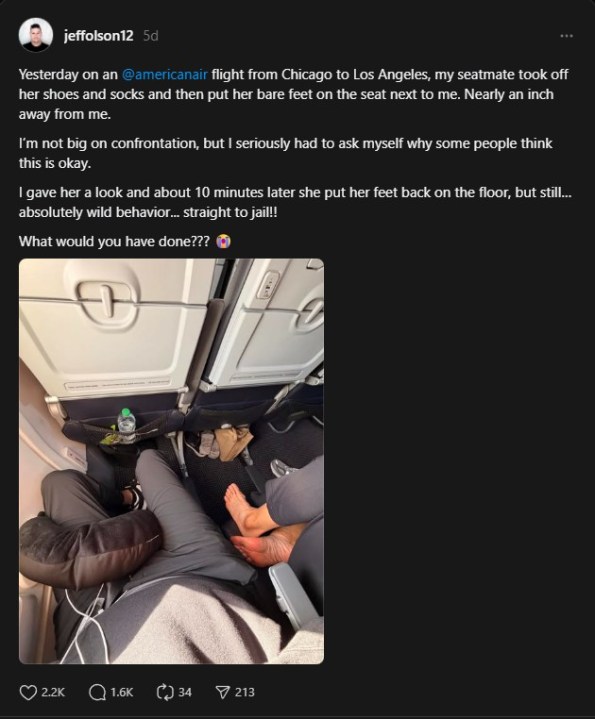
Olson shared a photo showing a pair of bare feet positioned next to his legs after the woman beside him removed her shoes and socks. According to Olson, she propped her feet up on the armrest, placing them nearly an inch away from his thigh.

Olsons-post-about-his-flight-experience
Photo by @jeffolson12 on Threads

The angle of the photo made it appear as though her foot could have been touching him, though Olson later clarified he pulled his leg inward just enough to avoid contact. Even so, the proximity was enough to make the situation uncomfortable.

Olson said he is not confrontational by nature, but the behavior was so off-putting that he gave the woman a look. After about ten minutes, she put her feet back on the floor. While the issue did not last the entire flight, Olson said the experience left a lasting impression.

The post quickly sparked debate online, with many commenters asking what they should have done in his place. Several suggested confronting the woman directly or calling over a flight attendant, echoing reactions seen in other recent airline disputes where passengers felt mistreated despite doing everything right, such as when a $5,000 United ticket still wasn’t enough to guarantee smooth boarding.

Olson later explained why he chose not to escalate the situation. The flight was full, and he still had to sit next to the woman for more than four hours. He said calling a flight attendant would likely have caused an awkward scene or delayed the flight, especially since the issue resolved itself within minutes.

He also responded to users who defended the barefoot passenger, joking that they should go “straight to jail”. Others shared similar experiences in the comments, posting photos of bare feet crossing seat barriers in economy, emergency exit rows, and even first-class cabins. Those stories joined a growing collection of unsettling travel moments, including recent reactions from passengers after something disturbing appeared on an airport baggage carousel.

  •