
Temtem: Swarm Review – The Roguelike That Finally Clicked
There’s something almost poetic about the timing. After roughly a year and a half of Early Access development, Temtem: Swarm has made its way out into a full 1.0 release – and the genre it’s playing in has never been more crowded. Vampire Survivors clones, bullet hell roguelikes, creature-collector mashups – everyone’s throwing their hat in. So the real question isn’t whether Temtem: Swarm exists. It’s whether it deserves your time now that it’s complete.
Short answer? Yes. Longer answer? Keep reading.
What Even Is Temtem: Swarm?
If you missed the Early Access period entirely, here’s the setup. Temtem: Swarm mixes the simple, nail-biting fun of survivor games with Temtem’s strategic battles, letting you cook up all kinds of clever strategies with friends or randoms in a world full of familiar creatures and vibrant vibes. Think Vampire Survivors, but with a creature-collecting skin layered on top – and more co-op-focused than most entries in the genre.

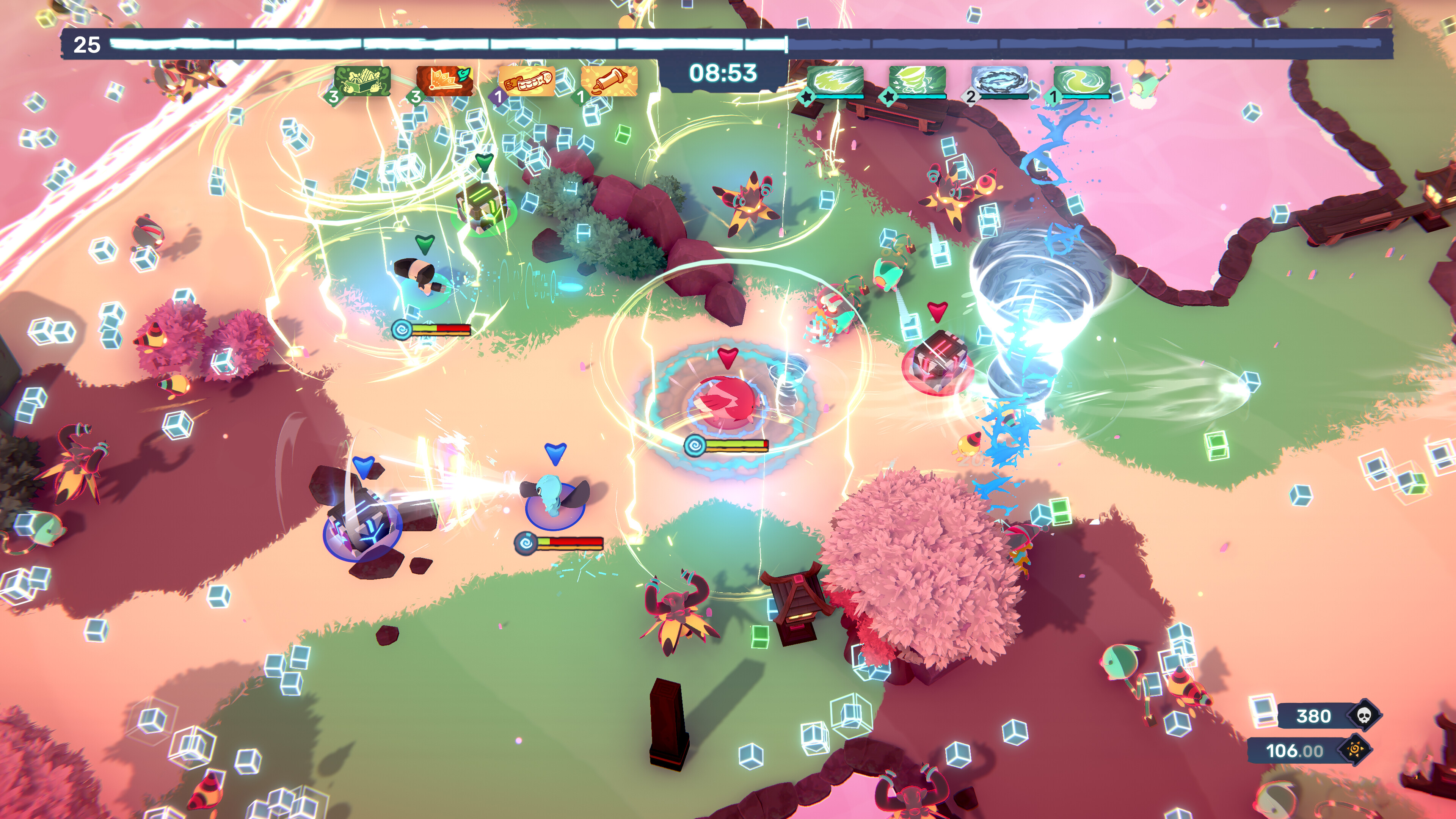
The actual loop is satisfying in that addictive, “just one more run” way. The game’s objective is simple: survive waves of enemy Temtems by defeating them, gathering EXP, upgrading abilities, and evading their relentless advance. Enemy waves start out sparsely, but their numbers and strength increase rapidly with every passing second. Each level-up throws you a trio of new ability choices – some offensive, some utility-based, some that synergize wildly with what you’ve already built.
What separates Swarm from the generic survivor-clone crowd is the mid-run evolution system. Evolving your Temtem mid-run and unlocking new ones through eggs you find on the battlefield are welcome additions to the classic roguelike formula. Additionally, random events keep each run unpredictable, rewarding players willing to take on a bit more risk. It’s a small thing on paper. In practice, watching your little Tem transform and suddenly gain a completely reworked skillset mid-chaos is genuinely thrilling. That moment of evolution feels earned.
New in 1.0: What’s Actually Changed
This is where the review gets meaty – because the 1.0 launch isn’t a quiet graduation. It’s a substantial content drop.
The 1.0 update introduces the Prestige System, a new layer of long-term progression. Upon mastering a Temtem’s skill tree, players can reset it to gain Prestige levels, unlocking powerful passives and the highly coveted, ultra-rare Luma and Umbra color variants. The Prestige loop goes up to level 10 per Temtem, and each step adds real mechanical weight – not just cosmetic flair. Every time you reach Prestige Level 1 with each Temtem, you’re not just powering up one Temtem – you’re elevating your whole roster.
The new additions in 1.0 include:
- Venx – a Neutral Temtem with a unique split-evolution path, offering a choice between the Mental-type Vental or the Melee-type Venmet mid-run
- Chromeon – a Digital Temtem with an adaptive secondary type that changes every time it uses its Ultimate, giving it access to all Techniques in the game
- The Evershifting Tower – a brand-new, procedurally generated arena with 150 different tiles and rotating elemental waves, so no two runs are ever the same
- 29 new Techniques, 4 new Gears, 6 new “Glitches,” and 45 Steam Achievements for completionists
The Evershifting Tower deserves special attention. It strips your roster away – you start from scratch, pick one of a handful of starting Tems, and claw your way upward through procedurally assembled floors. It’s brutal in the best way. For veterans who’d mastered every hand-crafted stage, this is the endgame content they were waiting for.
Venx, meanwhile, is a fascinating design choice. Venx might look like a simple, bandage-wrapped brawler at first glance, but give it a few levels and a little patience, and it quickly turns into one of the most flexible and rewarding Tems in your run. The branching evolution isn’t just narrative flavor – it actively reshapes your run’s identity. Pick Vental and lean into psychological tricks; pick Venmet and just hit things very hard. Both paths feel purposeful.
The Co-op Factor
This is where Temtem: Swarm genuinely distinguishes itself. Cross-platform co-op is now live with full cross-play support between PC and PS5, meaning your squad no longer needs to be on the same platform to pile into a run together. Three players, one screen’s worth of absolute bedlam.
Strategize, share resources (or don’t!), and take down increasingly more powerful bosses. Maximize your attack potential by coordinating gears and skills with precision timing, creating overpowered synergies. The “or don’t!” part is actually key – there’s genuine tension in deciding whether to funnel resources toward the player who’s snowballing, or spread the wealth and keep everyone viable. It sounds minor. After a boss wipe because someone hoarded all the gear upgrades, you’ll have opinions about it.
Ghost Mode – where downed players continue to assist until revived – keeps sessions from becoming a frustrating sit-out experience. It’s a considerate design touch that keeps everyone engaged even when things go sideways.
Where It Still Stumbles
Here’s the honest part. For all its charm, Temtem: Swarm still carries some of the weight of its genre’s ceiling. Early Access reviews noted that the game doesn’t quite reach the originality of Vampire Survivors or the mechanical depth of some of its bullet-heaven peers – and while 1.0 closes that gap considerably, it doesn’t erase it entirely. The hand-crafted stages (outside the Evershifting Tower) can start to feel familiar after enough runs, and the core loop, stripped of novelty, is still a loop. If the genre already exhausts you, Swarm won’t convert you.
The game had apparently sold around 100,000 copies as of 2025, but its concurrent player count had been disconcertingly low. Whether 1.0 changes that trajectory will depend on whether the new content – particularly the Prestige System – provides the long-term hook the game needed.
Replayability and Long-Term Pull
Here’s what actually matters for a game like this: does it have legs? The honest answer is yes – more than before, and by a meaningful margin.
The Prestige System is the real game-changer here. The loop is a 100% guaranteed, RNG-free way to unlock Luma and Umbra variations, plus strong passive buffs in the game. That’s a meaningful distinction. So many roguelikes dangle rare cosmetics behind pure RNG, which turns the endgame into a slot machine. Swarm’s approach ties your cosmetic unlocks to skill progression – put in the work, get the reward. It respects the player’s time without removing the challenge.
The Tempedia – Swarm’s new in-game tracking system – adds a completionist layer for players who want to catalogue every Tem, every technique, every encounter. The prestige system unlocks powerful passives and shiny skins for Tems that have had their skill trees mastered. Combined with the Evershifting Tower’s procedural unpredictability, there’s a genuine endgame here now. Not just “beat the final boss and uninstall” territory.
Verdict: A Swarm Worth Joining
Temtem: Swarm 1.0 is the version of this game that should have been the starting line. After the Early Access adventure, during which community feedback deeply marked development, Crema and GGTech are ready to raise the curtain on what they call the complete version of Temtem: Swarm. That journey shows. This is a game that listened to its players, iterated with purpose, and arrived at 1.0 as something legitimately worth recommending.
Is it the deepest roguelike on the market? No. Does it reinvent bullet heaven? Not exactly. But Temtem: Swarm carves out its own niche with confident design, genuine co-op camaraderie, and a Prestige System that finally gives long-term players something to chase. If you bounced off the Early Access build, this is worth a second look. If you’re new to it entirely – and PS5 owners now have that option at a launch discount – the swarm is waiting.
Grab your squad and Temtem up. You’ll probably stay longer than you planned.