His many personal faults notwithstanding, H.P. Lovecraft’s writings continue to cast a profound shadow over the horror genre. While his own views were reprehensible (even by the standard of his time) the continuing fascination with cosmic horror can be seen across many media. Big Bad Wolf are the latest developers to take influence from this mythos in their upcoming horror adventure game Cthulhu: The Cosmic Abyss, but have moved away from the beaches of Innsmouth and out to sea to take advantage of the thalassophobia (fear of deep water) that underlines much of Lovecraft’s work.
Cthulhu: The Cosmic Abyss begins in 2053 with you playing as Noah, an investigator charged with following the trail of a missing colleague who finds that an occult cosmic threat is spreading across the world. His investigations lead him to a mining facility located deep within the Pacific Ocean wherein he discovers that the missing miners have stumbled upon a passage to R’lyeh. So far, so Lovecraftian, and I was impressed by how well the content I played in the preview build slotted into the wider Mythos whilst also maintaining an identity of its own.
The Cosmic Abyss is played out through a first-person perspective, but this is no action shooter and combat plays no real role in this game. There were no direct engagements with enemies during the section I got to play, though there was still plenty of threat and dread. The full version promises some confrontations with unknown horrors that will require quickness of thought rather than trigger finger to survive. This fits perfectly with cosmic horror as no small part of the terror comes from your insignificance in the face of the unknowable.
With no combat to speak of, the gameplay mechanics instead revolve around investigation and puzzle solving, with a focus on a mind palace method of connecting clues that is reminiscent of Frogwares’ Sherlock Holmes games. In order to interact with the environment you can call on your AI companion, Key, who can scan, assess, and record the information that you acquire. This digital compendium can be called up in order to make connections between clues and objects that you scan, reveal deeper insights and even give you the direct solution to riddles.
The Unreal Engine 5 powered graphics are breathtaking at times, with the scale of the underwater environment being overwhelming. Relatively early on you have to venture outside of the submersed facility to explore a mysterious labyrinth and even though there was no pressure of oxygen limits in place I found the whole section almost unbearably tense. This wasn’t helped by my stubbornness in trying to brute force my way through when a more direct route via further investigations was the more efficient solution.
Major puzzles and obstacles in the world of The Cosmic Abyss will often have more than one solution with the main division between each being the effect they have on your sanity. Leaning into the world of R’lyeh for answers will drive you further into madness whereas presumably more rational and scientific solutions will help keep you sane. This mechanic was hinted at in the preview but I look forward to seeing its full effects in the full game.
As is often the case with early preview builds, there were a few small bugs and glitches, but these were refreshingly infrequent with the game just a couple months from release in April. One that took me a while to work out was that the controls would occasionally revert to AZERTY (to match the Big Bad Wolf’s keyboards as a French studio) so I couldn’t move forward. For a while I thought this was a deliberate effect in keeping with the classic Eternal Darkness’ manipulation of your controls, but checking with the team, it became clear that this was just a bug. Rebranding it as a feature wouldn’t be the worst idea, though!
The world of Cthulhu: The Cosmic Abyss has certainly got its claws into me and I’m eagerly awaiting getting stuck into the full version when it launches in April. What I’ve seen so far promises a twisting and tense narrative that will challenge the grey cells rather than the trigger fingers and, as such, should be a truly cosmic horror experience.
Any conversation about the best indie developers must include Capybara Games. With a catalogue that stems from Might & Magic: Clash of Heroes, through Superbrothers: Sword & Sworcery EP, to Don’t Starve: Shipwrecked, they consistently turn out the kind of games that stay with you long after you’ve finished playing. Battle Vision Network is set to be their latest, continuing in the vein of previous puzzle-infused games like Clash of Heroes, Critter Crunch, and Grindstone, and just like everything that’s gone before, it looks like it’s going to sink its way into your synapses and have you playing out moves while you’re trying to drift off to sleep.
Battle Vision Network is a tactical puzzle Roguelike battler, with teams competing in an intergalactic contest for glory. Dan Vader, Capy’s Creative Director tells us, “A Roguelike run of the game is framed as a season of this sport, and of this spectacle that is the BVN show.” He continues, “At the start of the game there’s only one team available, but as you progress you unlock more teams and more captains, each with their own playstyle and abilities.”
You can see that play out in the gameplay trailer, where a piece of toast shaped like a cowboy faces off against a skeleton in a rainbow cape – that’s Texas Toast vs. Rainbow Sparkle, obviously. It’s not just extremely bright and vibrant, but there’s the same sense of humour and quirky art direction that made Grindstone so memorable.
Dan tells us that Battle Vision Network is a spiritual successor to Might & Magic: Clash of Heroes, and anyone who’s played that classic title will be able to see the same gameplay threads running through BVN, with two teams made up of different units facing off in turn-based combat.
Different units have unique abilities and uses, such as Todd Thumb. This little finger fella can be stacked into a row of three, which sends a large thumb-based attack straight at the opposition. As you progress through a run, you draft more and more units into your team, until you’ve got a full roster, with a host of different abilities that will give you a variety of tactical options to choose from.
As you complete rounds, you’ll earn Bucks, which you can spend on upgrades for your team, or to upgrade specific units. You’ll also gain a Penant Flag through each round, choosing between three enhancements for your team, and leaning into that Roguelike structure and the random factor that can turn a mediocre run into a mammoth success.
Battle Vision Network began life as a mobile-first, PvP, season-based concept, and Capybara were originally working with Netflix to bring it to their mobile game library. However, in 2024, it became clear that Battle Vision Network wasn’t fitting into Netflix’s overarching plan, and Capy were thankfully able to reassess and rework the game, altering how players progress, shifting the focus to a single-player campaign, more like Grindstone and Might & Magic: Clash of Heroes.
Dan honed in on some of the key changes when coming from a mobile title, saying, “OK, we’re going to make a PC widescreen game, and we know that kind of audience soaks up complexity and depth, and experimentation and optimisation, and we can lean into that. And for us, we’re getting older, I have a family, I have a very demanding job, I don’t get to play as many 100-hour RPGs as I used to, so it’s emerged over the years that I really love run-based games, because they’re bite-sized. I can pick them up, I can play a little bit, have a little run, or pause a run, and I don’t feel that I haven’t made a dent in the game. So, we were really enthusiastic to explore our mechanics in that format that we were loving, anyway.”
One of the main differences over Clash of Heroes is that your Captain isn’t just an icon in the corner of the screen, they’re a physical unit with their own abilities, effects and place on the board. They can make the difference between failure and success, but you’ll need to know when and how to utilise them to maximise their impact.
Beyond the gameplay, fans of previous Capybara Games will be delighted to learn that the soundtrack is a collaboration between two of their previous composers: Jim Guthrie, who penned the soundtrack for Superbrothers: Sword & Sworcery EP and Below, and Sam Webster, who wrote the soundtrack for Grindstone. BVN could well be amongst the best-sounding games of 2026, just on that legacy alone.
Battle Vision Network is set to launch initially on PC and the team are targeting being Steam Deck Verified, which seems like the perfect way to experience the puzzling action. As a huge fan of their previous games, BVN has dropped its way straight into my most-wanted list.
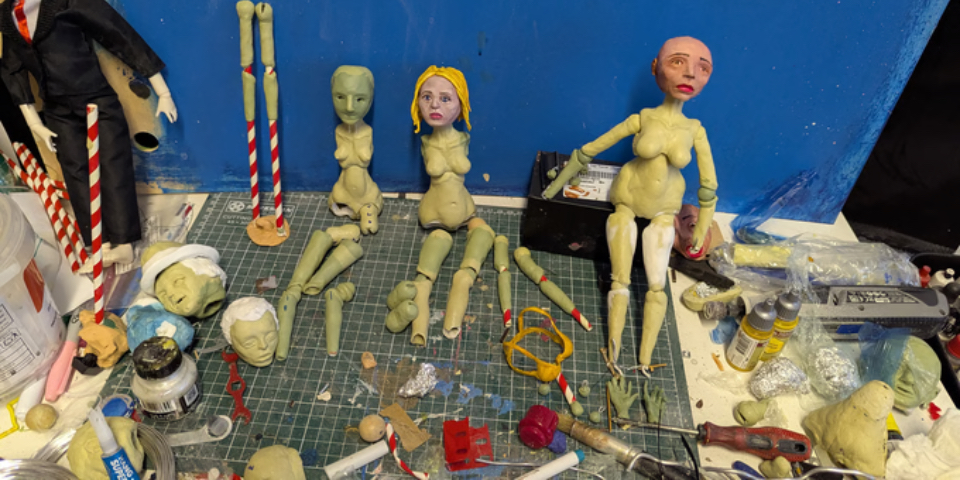
The stop-motion aesthetics of previous games by two-man dev team Talha and Jack have always been uniquely striking, with 2024’s Judero being the title that really gained critics’ and players’ attention. Judero’s take on Scottish folklore combined the handcrafted art of Jack King-Spooner with the coding prowess of Talha Kaya to produce a title that was brimming with humour and style. The duo followed this up with the fun mining game, Mashina, last year, and are now back with a Kickstarter campaign for a surreal and disturbing horror game called Abide. I had the opportunity to sit down and share a virtual coffee and conversation with the pair to find out more.
TSA – Thanks for talking to us. I’m not used to these virtual interviews, but how are you doing?
Talha – Good, good, very excited, very anxious (all of the things) about our new game.
TSA – How is the Kickstarter going so far?
Jack – It’s tracking very closely with the timelimit. Midway point we were midway, and now 64% through we’re 64% funded so it’s going to be tight. It’s different every time; there tends to be a slight flurry towards the end as people who have wishlisted it will get notifications towards the end ‘hey this is finishing’, but it’s not something I want to bank on or anything like that.
TSA – Is the Kickstarter an all or nothing situation for the game?
Jack – It’s all or nothing basically. The other options are work on it part-time and get a zero-hour contract job or try getting a publisher but there’s a whole kind of smorgasbord of things that go along with that and a lot of publishers would just not consider this kind of game at all.
TSA – That’s the problem with being actually original in a way. Also some of the more challenging aspects of the game given the current climate with titles like Horses and Vile: Exhumed
Jack – Yeah, with both of those games it’s kind of baffling that they should be deplatformed from marketplaces.
TSA – What’s your background interest in horror, Jack? I see your dissertation was on extreme horror?
Jack – It was on Kristeva’s idea of the abject and how it ties to visual media and also lots of Lacanian writing about the cinema screen.
[Jack and I went on for quite a while about these psycho-analytical approaches to horror which I’ll spare you here!]
I’ve always had this thing about storytelling and horror and what that says about the present culture and how it can be seen in retrospect. Violence was so in vogue with things like Saw and Hostel. Does this media desensitise you? Are people trying to be desensitised?
TSA – That all tracks with the tangible nature of your art and games. It’s uncanny as it’s very unreal but also uses real handmade materials. With Judero I’m constantly moving between appreciating the beauty of the models and being repulsed by some of the more grotesque aspects.
Your Kickstarter highlights that you’ve consulted with clinical therapists to make sure that the difficult topics you’re including are treated correctly. This speaks to wanting to engage with horror more deeply rather than use it just as an aesthetic.
Jack – I think this is a conversation to be had, an aspect of shock is the unexpected but there’s another type of shock that Abide is about, like the splash of cold water. The horror of the truth which is getting parsed through some of the conversations I’m having with psychologists who have worked with offenders and people who have been in controversial situations. Sometime being honest to these things can amplify the horror.
[Jack and I now went on another long tangent about the history of psychology…]
Lots of horror is just big men with knives are scary – oooh but one of the ways that Abide feels so fresh is that it has a really strong metatext that is coming through as I’m researching it and writing it.
TSA – It’s interesting to hear that you’re digging deeper than the basic jumpscare tropes of so much horror gaming.
Jack – I wouldn’t dismiss the importance of jumpscares though. They are an important tool and can be really interesting in the way they build up with the music and atmosphere etc.
Talha – When it comes to the whole mechanical game design of a horror game there is a lot of stuff that is very animalistic. This whole conversation is making me think that when there is an intellectual base to it than that jumpscare can have more meaning behind it. But when you’re making the game it is just a tool, to keep the player entertained.
TSA –I’m interested in your creative process. Do you make the models etc first or do you have the game outline in mind?
Jack – The game idea comes first and then the artstyle doesn’t necessarily make the game better or worse, it’s just the artstyle. There’s an interpretable element to the art – I mean, with a horror game it’s really fun to make it out of dolls because that’s a trope. Spooky dolls. When you’re making it, everything kind of feeds into itself and becomes part of the creative practice.
Talha – It is trickier to prototype this game because you already need a really well made and decorated house and you need the characters so there is a huge time budget for art and assets.
TSA – This has been a fascinating and wide-ranging conversation. Thank you both for taking the time to talk to me about all of this. Good luck with the Kickstarter and I can’t wait to get hands on with Abide!
The Kickstarter for Abide runs until the 28th February with digital copies of the game being available from the £12 pledge. Speaking to Jack and Talha highlights to me just how crucial these kinds of genuine artistic approaches to gaming and horror are in a world that is becoming increasingly commodified and handed over to Generative AI. I would urge you to check out the Kickstarter and pledge if you are able.
Coming up on a decade since the debut of Transport Fever, Urban Games have figured a few things out about their transport simulation series. Years of post-launch support, added features and working with their community is leading to their most ambitious game yet, when Transport Fever 3 launches this year.
Sticking with their in-house game engine, they’re able to roll a bunch of features and ideals from where Transport Fever 2 has ended up into Transport Fever 3 on day one. That means that this will be a fully synchronous release across PC, PS5 and Xbox Series X|S, when TF2 rolled into the console station a few years after PC, and it also means that cross-platform modding, which was only added to TF2 in 2024, will also be there on day one.
If you’re in it for the economic simulation, then Transport Fever 3 promises even greater depths than before. There’s over a century of transportation history here, starting in 1900 with the city, buildings and cars you see all changing and evolving as you carry on through to 2030. That means there’s over 290 vehicles, ranging from buses and trucks, through ships, planes, trains and even new cargo trams and helicopters. Cargo trams are a particularly interesting one, having been used in Eastern Europe to bring cargo into city centres instead of noisy, smelly trucks – something you’ll need to keep tabs on now, as every citizen in the map is fully simulated with places to work, shop and live, and their happiness will depend on pollution, noise levels and traffic jams.
And you’ll have a fresh appreciation for cargo in this game, as there are now 35 cargo types and it is now no longer handled automatically. If TF2 was all about money, then in TF3 it’s just one of many things to manage.
All of this will add new depths to the transport simulation sandbox, but TF3 will lean further into the tycoon gameplay and story objectives to overcome through a campaign of eight maps. Each one picks a particular period in history and takes inspiration from real events, using these missions as a way to introduce new concepts and keep things varied – there could be competition against an AI, a countdown mission with a timer, and more.
We sampled two of the levels, first heading to Mardi Gras in 1906, but finding that the city has been partially flooded and ruined by a storm. This is purely a narrative conceit here – while this game now has a day/night cycle and weather effects, they are purely cosmetic so as not to add crazy variables to the simulation – but it means that Mayor LaFontaine, the helpful Andrew and Miss Baker are banding together to rescue this year’s festival. LaFontaine wants a new hotel, while Miss Baker pushes him and you to help represent the black community and less wealthy, and Andrew’s just happy to be helpful.
Setting up transport routes, repairing roads and bridges and shuffling the good around that each objective needs gradually gets you used to the user interface, though it’s initially a little unclear how to go about certain tasks. I accidentally clicked through and sold off a couple horse and carts when cancelling an unneeded line, instead of having them sent back to the depot, and when I wanted a ship to go between collecting fish and shrimp, returning to dock between each, it took me a moment to realise I couldn’t drag the stops into a different order and had to set things up a different way.
But with Mardi Gras rescued, I could turn my attention to another festival in need, some sixty years later, with a somewhat legally distinct rendition of Woodstock. Now it’s a local sheriff and an enthusiastic rock organiser who will have to put aside any of the very surface level differences to make this a success, oh and Andrew’s still there to help out, though he’s now a bit of an old-timer.
The objectives have grown in scale by this point, so you need a bunch more wood to construct the stage, and the growing encampment needs plenty of food (and veggie food too, please) which is over on the other end of the map. Do you just get a truck to drive it across, or use the port nearby to ship it to the nearest town for trucks to pick up? It all builds up to a festival that’s as successful as you can make it accommodate people.
I feel that these narrative missions and tycoon gameplay will really help make Transport Fever 3 more accessible. I often find myself at a bit of a loose end when simply presented with a sandbox, so while that absolutely remains, having both a way to ease players into the simulation, and to give objectives in an intelligent way that keeps you more engaged will be great.
You probably know Milestone best for their long lineup of motorcycle racing games, from MotoGP through Ride and on to Motocross, but that’s not where the studio started. No, the studio’s big break came in 1995 with the arcade-style racing game Screamer, which went toe-to-toe with Ridge Racer as a PC alternative. Over a trio of games in the 90s, the series drifted towards more rally racing, before petering out at another studio, but now in 2026? Screamer’s back, and it’s a refreshing new take on the arcade street racer.
The immediate and most obvious shift from the 90s is that the graphics are so very different. Obviously, they are massively higher fidelity, there’s none of the early 3D polygon wibble, and the gameplay is built around more nuanced physics and handling models… but the art direction has shifted towards anime cutscenes, and there’s a drama-filled story to sink into alongside.
Michele Caletti Creative and Development Director discussed the game’s blend of visual styles: “We took inspiration from things like Akira, from Ghost in the Shell, from Bubblegum Crisis, from Cyber City Oedo, from Cowboy Bebop, and many more, but one of the things that we had to take a very strong decision was not to make the game cel shaded.
It would have been the easy choice – It’s an anime, so you make the game cel shaded – but if you do so, you have to oversimplify some details, you cannot go into fine details with cel shading. So the art direction was bold enough to try to blend the anime and the realistic or quite realistic rendition of the world. And then take some other moves like that there’s not onlythe city setting, there are many other settings that try to portray a different but familiar world.”
You know it’s anime sci-fi when you have a dog that can drive a car.
The Tournament is a long-running illegal street racing competition, but this latest edition is for a huge $1 billion prize, drawing in teams from all kinds of backgrounds. For the Banshee PMC, Hiroshi, Roisin and Frederick are looking for revenge on Anaconda Corp and their distinctly fascist-coded leader, Gabriel. The best way to get close is to enter the same tournament, with the possibility that Gabriel’s demise could be made to look like an accident… But it’s also a story that won’t take itself too seriously. I mean, there’s a dog that can drive a car, and whose owner has fitted it with the same universal translator that everyone else uses to communicate using their native tongues – “This is another choice that we made early,” Michele said, “because we wanted to have cultural melting pot of different characters, of different ethnicities and this was important to convey the fact that in this near future the culture is something like what we have today, but even more diverse, even more varied.”
They won’t be the only team that you race as, though, with five teams competing and the story hopping back and forth, putting you in control of various racers, cars and their specific abilities. Even in the opening few story chapters, there’s races where you just need to finish, where you’re driving as a team, where you’re regularly jumping via cutscenes between different cars.
“We wanted to go away from the pure racing focus and jargon and dialogue and always thinking, always about [winning].” Michele explained. “So you see the characters are not even dressed like drivers, because they are something else, then they are drivers. So their goal is to win, yes, but everyone has also another goal. So you will see that during the story, they’re focus shifts towards their inner goal. Then you’ll be playing in the role of all the characters of the game. So everyone has the goal to be first, yes, but from different perspectives.”
What’s particularly striking about the racing is how it reimagines the controls. The right and left trigger make you go and stop, of course, and the left stick is for turning, but drifting is on the right stick, you have a timing minigame for upshifts to give you boost charges, and those feed into a bull-rushing attack to destroy other competitor cars.
It’s quite a lot to get a handle on, and the way you can counter-steer while drifting felt a bit like rubbing my head and patting my tummy at the same time, so it makes sense that the story mode adds these concepts one at a time. When you wrap that around the mix of lavishly produced anime cutscenes and the character portrait dialogue scenes, though, that does lead to a pretty slow feeling rollout over the course of the opening hour or two. I was really waiting for it to give me all of the gadgets and toys to play with.
Michele admitted “The story takes you that slowly, yeah. It takes hours to get to all the mechanics in place, and the point is, you’re never thrown multiple things together to you.”
He continued, “We thought and we discussed a lot about how to lay out the default controls, how to favour the most intricate actions, because you might want to do strange stuff and we want to allow you to do so. I think we’ve reached the balance where it’s not overwhelming. Give yourself some time to get into the mechanics and it’s not about much about the fingers, but the strategy in order to understand and being in control of when to do things, not to overuse the systems.”
The macguffin that makes all of this possible is the ECHO, a device fitted to each and every car like a super sci-fi MGU-K from Formula 1. Fitted by Gage on behalf of the tournament’s enigmatic host Mr. A, it gradually accumulates Sync, both passively over time and when tapping the Active Shift to shift up a gear in time with the rev limiter – don’t worry, it’s still an arcade game and you won’t be asked to downshift at all. This builds up to grant you boost charges, which you can then deploy, and even strengthen by holding and releasing with another mini timing challenge.
As you Boost, this takes that energy and transfers it over to the second meter of the ECHO device, building up Entropy. This gives you charges to use defensively, to create a temporary shield for a few moments, or to unleash as a Strike, boosting forward again and destroying any car that you hit from behind. Save up the Entropy to fill out the meter, and you can enter into Overdrive, putting you in a much longer-lasting Strike boost that can blast multiple rivals into smithereens, and eventually leaves you vulnerable to destruction just from hitting a wall. You can technically outlast the Overdrive, but I would explode my car every time…
That’s where the ECHO’s final trick comes in, as destruction just respawns your car and body, and gets you racing again. There’s no moral quandary over whether or not this new car and person is the same as the one that died – Milestone seem to be leaving that philosophical debate to the Ship of Theseus and the Star Trek teleporter – and instead it’s just a canny way of keeping the action rampaging along.
“We didn’t want to have this pattern of side-striking the cars,” Michele said. “We tried different things like because the hot part is that it’s easy to strike on a straight, it’s harder to strike into a corner, so the more the intricate the trucks, the more it’s complicated to strike. But we experimented with many things like a semi-automatic strike that drives you toward your opponent, but it didn’t work. We tried something like a seeking missile, but it didn’t work. So we ended up with this where you’re still in control, so you if you hit, you feel like you’ve done it. If you miss, you understand what you have done wrong.”
It all blends into a rather unique take on the arcade racer. Combat is direct and to the point, with just the Strike as your only option for attack – no side-swiping and no missiles or energy abilities like in Wipeout or Blur – and there’s a technical depth to master with the drifting and boost timing, not to mention juggling energy.
In one race, I was able to break away in the lead, conserving my boosts in a way that meant I couldn’t be caught, but it felt much more likely to be caught in the middle of the pack and really have to scrap and fight. That ties in very well with the team race mode, with duos or trios battling for victory. This isn’t about the first across the line, and it’s not even just the combined finishing positions that determine the winning team, as every KO also awards points, so that the highest-placed racer might have finished eighth and outscore the winner that didn’t have a single KO to their name.
After adapting to its style of racing, Screamer really started to speak to me. I’m definitely curious to see how the game will blend together its anime narrative and single-player racing scenarios, but that combination of racing and combat? Well, it makes perfect sense for anyone who watched the F1 movie.
The original Outward was well received by players with its offering of an RPG with survival elements, where the world was dangerous and you had to use your wits to survive and make progress. Outward 2 looks to continue on and build on those foundations, making for a more densely packed and more dangerous experience as a result, and still without the compromises of fast travel or quest markers. We sat down with Guillaume Boucher-Vidal, the CEO and creative director of Nine Dots Studio, and producer Natasha Collin to play the alpha build of Outward 2, and find out what is in store for players.
“One of the four pillars of what we wanted to improve in Outward 2 was character creation, increase the the role play opportunities and like being who you wanted. And part of it is that we have three starting areas and they all come with a very different Quest that explains how a regular person ends up living a life of an adventurer.”, said Guillaume as we checked out the creation screen.
Players of Outward will be happy to know there are a lot more options available when designing your character to allow you to make them more personal, from body shape, skin colour, hair colour, styles, and various body markings. Once you have crafted how your character looks you then pick their base skill set and attributes. For those of you who really want a challenge, Deadbeat will provide you with the weakest and most vulnerable character build. While it is Guillaume’s favourite, he steered me away from that, so I settled on a book loving brute instead. Your choices will impact the dialogue options open to you and how some quests may play out, as well as your general survival skills in the world. When it comes to factions, you can only join one out and that is your faction for life. You can also not become an expert in every ability, so the decisions you make on which skills to learn need to be carefully thought through so you focus on a particular playstyle.
For this playthrough of Outward 2, we started in the new location of Haboob, a city which was cut off from the world for centuries surrounded by large flora and a persistent sandstorm. Only those who are exiled seem to leave the walls of the city, and for good reason. There is danger pretty much everywhere outside the walls for anyone unprepared. What you notice about Haboob is its distinct style of interesting architecture pierced with a purple lighting interspersed around, and a perpetual sandstorm above the vast cave system in which the city is located. This is one of three starting areas and depending on your choices you may not see Haboob until much later in the game.
You have your own apartment in Haboob, a market nearby where you can purchase items and weapons, and an opportunity to make a name for yourself, except that all comes crashing down after your first night because of Sebastian. In this story, you wake up to find a guard in your chambers looking for something only for Sebastian to kill him and place the smoking gun in your hands before disappearing. This is where the clock starts ticking as you only have 18 in-game days to track Sebastian down and prove your innocence or lose everything. Each day lasts an hour, so 18 hours seems like plenty of time to save your home, except Outward 2 is not forgiving when it comes to time. If you sleep, which you will need to, you will lose those hours. If you lose a fight and get knocked unconscious, you will lose time and have to deal with whatever situation you have woken up in.
There is no death in Outward 2, unless you play the Hardcore mode, where losing consciousness comes with a 20% chance of your save being permanently deleted. But for a regular playthrough, just because there’s no death doesn’t mean there’s no challenge. Depending on where you fall and your luck you may wake up in a friendly situation or in a dangerous one. In one situation I was found by the Menders, a group of helpers and healers that travel Auriel. They are also one of the factions you can join. They mended me up and even gave me information about Sebastian that I could use.
This was actually the first time Guillaume and Rebecca had seen this scenario play out, which was exciting for them too. I asked about how many different defeat scenarios would be in Outward 2. Guillaume responds, saying, “Hey, it’s a tough question. Like a lot, really? A lot. We need them because we die often and so if you keep seeing the same things it eventually gets frustrating. And we need different defeat scenarios for every dungeon as well. So like, that’s why it’s not a cutscene or something. It’s just a little bit of text.”
Two of the criticisms that were levied at Outward included combat being stiff and the world itself be relatively sparse leading to prolonged sections of nothing happening. Guillaume and the team took those comments to heart, and the world in Outward will be more exciting to explore while retaining a similar size to the original’s map. On map Guillaume says, “The emptiness is one of those four pillars. The first one was character creation. The second one is making a world which is more alive. And so to do that, it has to be a bit more filled. You need to have a bit more random events, to have encounters that are not hostile, to populate visually the world a bit more. It will never be as packed as, say, one of those Ubisoft type worlds where you’ve got, like, every 30 seconds you got something coming at you. We’re not trying to do that. But even as you walk around in the city, I feel like it’s luscious. It has lot of places to visit, and when you’re outside, it is more dense than the first. We’ve got it similar in scope, but because it is more packed, it feels significantly bigger.
“[There are] four regions, four cities, lots of dungeons spread across regions. Normally, we calculated we have a budget of about six to eight dungeons, like major dungeons per area, and then we have many, what we call micro dungeons, so interesting destinations that might not take you an hour to just go through.”
Combat in Outward 2 has been improved with weapons have a wider variety of moves depending on direction inputs, and you can carry different combinations of weapons to inflict damage on enemies. For my playthrough I had a small axe in one hand and an ice pick in another, allowing for quicker attacks. Later, I equipped a trident that allowed slower but more powerful attacks, while also providing ways to evade incoming attacks. Locking on to enemies and moving around them gives a fluid feel to fights, but for some fights you do need to prep.
At one point, we came across a ghost in a cave, which could not be defeated with conventional methods. Guillaume took old clothing, tore it into linen, attached it to a stick, doused it in oil, and set it on fire, as the ghost was susceptible to fire magic. Outward 2 is a game where you have to think logically to come up with solutions or suffer the consequences. I drank straight from a stream which gave my character indigestion, but had I boiled the water, I would have been fine. Magic is another viable combat route in Outward 2 with various spells to equip and learn, but is not something that I saw in the alpha build.
Outward 2 has had its development challenges with Guillaume saying that one of the biggest was switching engines from Unity to Unreal 5 partway through development – a decision made when Unity pitched the idea of the Runtime Fee which would have seen a charge applied to developers for game installs after a certain revenue point. “We were a specialist studio with 10 years of experience in Unity. Starting with Unreal was even worse, having to migrate the work that we had already done. So there is something that is lost in the process because the structure, the architecture of the game has to be thought of in terms of what are the strengths of the engine. So now we are kind of trying to massage it back into a shape that fits these strengths and weaknesses of Unreal Engine.”
Outward 2 is a project that clearly means a lot to Guillaume and the team at Nine Dots Studio, so I asked what kind of legacy do they want Outward 2 to have? Guillaume takes a moment to think before saying, “I want Outward 2 to prove that Outward was not a fluke and I want this game to be a complete expression of architecture. We’re not trying to be more accessible, but we want to attain a level of execution where the people who were not receptive to the first one. Now, we’ll know is it because we didn’t execute it well? Or was it because the vision is not for them?
“For Outward 1 I understand that some people like it was too rough for me – that’s valid. I want Outward 2 to be very tight. It’s the first game in a very long time that we are self-publishing. So it is a game that is about the emancipation of Nine Dots, and taking having more control over how we sell the game, how we communicate with players, how do we collaborate with other developers because we are acting as publishers as well.
“We were very successful with Outward, so we used some of that money to fund another studio called Ever Curious Entertainment and their game called Witherbloom. And we can just keep doing more of that if Outward 2 is successful, even a fraction of the success of Outward. Because we are self-publishing, we would keep so much of that success for ourselves and we would share that success.”
Outward 2 is a game that will appeal to those that want an RPG with survival elements, where no quest log tells you what to do, no markers to pinpoint exactly where you are, and where you deal with cold, heat, hunger, and thirst as well as the dangers around you. It is a tough experience but Outward 2 comes across as a game that will reward those who persevere. If it is successful it could also see more studios benefit as Nine Dots expands into publishing, allowing for a more varied game industry at a time when it is needed.
The name Creative means a great deal in gaming and audio circles. Known as the creator of the Soundblaster range of PC audio cards, their range has expanded to include audio products of all kinds, from the excellent Creative Pebble series of speakers through to gaming headphones with SXFI technology. The Creative Aurvana Ace 3 is the newest edition of their ANC-equipped true wireless earbuds, offering a cost-effective alternative to Apple’s AirPods Pro 3 and the Galaxy Buds Pro 3.
The Aurvana Ace 3 are stem-style true wireless earbuds, available in an eye-catching translucent purple colourway, that’s matched through the charging case and each earbud. There is something quite retro about their look, with a mid-noughties vibe that brings an unexpected wave of nostalgia with it. When it’s paired with the silver band running down each stem, they’re certainly unique-looking, but if you’re hoping for a more understated option, this isn’t it.
They feel light in the hand, which diminishes that premium sensation, but it does mean that you can easily wear them for hours without any fatigue. The earbuds are rated for 7 hours, which is an hour less than the AirPods Pro 3 but an hour more than the AirPods Pro 2, with a total of 26 hours of playback with the charging case, all of which played out pretty effectively in our testing.
The charging case lid hinge is a little flimsy, but the body of the case itself feels solid and is the perfect size for chucking in your pocket. It also includes wireless charging, which is a very welcome inclusion. At half the price of their top-end rivals, it’s a good start for the Aurvana Ace 3.
The audio pairing and setup is a little more convoluted than its core competitors, though, as there’s a suite of features to set up to make the most of the Ace 3. The Creative app handles nearly everything here, but you also need the separate SXFi app, which seems unnecessary.
First, and perhaps most importantly, you use Mimi sound personalisation to create a listening profile. This involves a short hearing test – best done in a quiet space – and the results then tailor the output to your own ears. It’s a stark difference, particularly factoring in my 40+ year old hearing, and the years of damage I’ve done to them by, well, listening to headphones that I’ve turned up too loud.
After that, you can choose your EQ presets to tailor the audio to your personal taste, or delve deeper into a custom EQ setup. Even if you’re not clued up about audio, frequencies and kHz, it’s all easy enough to mess around with in search of the roght sound.
The Aurvana Ace sound very good indeed, even without any tuning. Part of that is the ability to utilise the best audio codecs out there, translating LDAC, AptX Lossless and AptX Adaptive into a seamless listening experience. The Ace 3 are equipped with Snapdragon Sound, so if your Android device meets the right specification, not only will you benefit from the high resolution audio, you’ll experience fewer connection issues, and benefit from exceptionally low latency, making your mobile gaming just that bit more enjoyable.
Putting them to the test with some of my favourite tracks, I was immediately surprised by just how detailed the audio was from the Ace 3. Billy Eilish’s No Time To Die sounded suitably epic, with her vocals sounding so precise that it felt as though she was singing directly to me.
Changing tack, the brutal cacaphony of Pupil Slicer’s Heather was delivered in spades, losing none of its venom on its way into your ears. It’s always incredibly satisfying to hear new elements in songs, and the Ace 3s combined technologies make that a certainty. The dual xMEMS drivers here certainly help with audio separation, and bass response in particular is fantastic, being rounded and full, without becoming overwhelming.
The hybrid ANC proved moderately effective at blocking out background noise, though it is a clear step behind the Airpods Pro 3 and Bose Quietcomfort Ultra, and on a windy walk to work, they struggled against the wind quite a bit. Still, at this price point, it’s effective enough, and with the quality of the audio itself being so high, I don’t think anyone will be too disappointed with their performance.
As with many less expensive earbuds, the touch controls aren’t quite as reliable as their more expensive brethren. The Aurvana Ace 3 does keep things pretty simple, and there’s only one touch point on the main body of each earbud, rather than a panel or squeezable section. That does make changing the volume less efficient, requiring a long press on each earbud to move the volume up and down, and if you’re running that’s a real pain, but it does work, once you’ve adapted to it.
Phone call quality is good, possibly helped by the ability to use Snapdragon Sound via the connection to my Honor Magic V5, and family members confirmed that my voice was clear and easy to hear during calls. It helps to wrap up a compelling package from Creative, and if you’re looking for an excellent-sounding pair of earbuds at a mid-range pricepoint, you’d be hard pressed to find better.
The Aurvana Ace 3 are amongst the easiest earbuds to live with in this price bracket, and though their RRP is £140, you can currently snag them for a slightly bonkers £90 via the Creative website. The Nothing Ear (3) are also worth considering, currently coming in at £139.99, though they have worse battery life than the Ace 3 and are noticeably heavier too.
Konami has released a new Metal Gear Solid Fox Hunt update that includes various tweaks to the publisher’s new multiplayer game while adding a much requested feature.
The most significant change here is how matchmaking works. Previously, players would need to manually select their region which could prolong waiting times depending on your chosen region and the time of day. Now the game will detect if matchmaking is taking too long, widening the search to all regions.
Metal Gear Solid Delta: Snake Eater Fox Hunt patch 1.2.3 is available to download across all platforms and will need to be installed in order to access the game. Here’s a rundown of what changes have been made.
Metal Gear Solid Fox Hunt Update 1.2.3 Patch Notes
Added ability to place enemy detection pings while aiming with a knife or gun.
XP can now be earned in custom matches.
Players will now be matched with others from different regions when matchmaking on their current server takes too long.
Extended the duration of invincibility after respawning.
Fixed an issue where invincibility after respawn was canceled by rolling or using Naked Sense.
Minor bug fixes and adjustments.
Fox Hunt launched on October 30th as part of the Snake Eater remake. In our review we scored the multiplayer mode a strong 8/10, saying:
“Metal Gear Solid Delta: Snake Eater’s Fox Hunt multiplayer mode rounds off one of the best remakes of 2025. It offers a surprisingly robust spin on existing battle royale and extraction shooter concepts, with smaller maps and match times working in its favour, successfully incorporating those stealth and strategy elements fans have come to expect.”
Despite our praise, we also noted the game’s lack of content at launch with two modes and a handful of maps. In some ways, this minimal offering works in Fox Hunt’s favour though the lack of a future roadmap is somewhat concerning. Hopefully we’ll hear more from Konami very soon.
If we rated things based solely on looks, the Gioteck WX5+ would immediately score top marks. This wireless controller for Switch, Switch 2 and PC boasts Hall Effect sticks and triggers and a pair of pro back buttons, but it’s the visual design that immediately grabs you. The delightful ‘Crayons’ livery is tied to RGB lighting, making this one of the most visually appealing controllers we’ve seen in a very long time.
At £24.99, Gioteck has also made one of the cheapest wireless controllers out there, especially considering all the features that Gioteck have crammed in. In terms of value, you’re simply not getting Hall Effect, programmable back buttons, RGB, a 3.5mm headphone socket, gyro and vibration anywhere else at this price point.
That budget pricing isn’t even immediately obvious when you pick it up. It is quite light in the hand, but the plastic that’s been used feels solid, and the textured grips help to keep it set in place.
While the Crayons livery is my personal favourite – who doesn’t want their controller to look like melted cake? – the other options are equally eye-catching, especially the 60s-flavoured Spiral and the multi-coloured mess of Doodle. If you’re a more serious type – or a teenage boy – there’s Dark Camo which is much more understated. There’s probably more chance of losing it, though.
Each of the analogue sticks houses colourful RGB rings as well, but it’s the performance of these Hall Effect sticks that’s most impactful. They’re pleasingly taut, returning to centre with a reassuring certainty, and they feel excellent in use. The Hall Effect tech should also mean that they are exceedingly long-lasting, outperforming standard potentiometer-equipped controllers that are more likely to suffer from stick drift.
The triggers are also Hall Effect, meaning that they’re a touch more accurate, while also benefiting from the frictionless tech. You can also switch them between analogue and digital performance, potentially cutting out a few more milliseconds of reaction time when playing shooters and other competitive titles, even without physical lockouts, which are ultimately the only thing the WX5+ is really missing. If you’re playing on Switch or Switch 2, the whole analogue trigger thing will be lost on you, but in a multi-platform house it’s a nice thing to have.
The only component that I’m not entirely sold on here is the cross-shaped D-pad. It feels too large under your thumb, and the left and right response feels slightly different. It didn’t cause any problems while playing, but there’s something about it that doesn’t feel as well-made as the rest of the WX5+. The other face buttons, and the shoulder buttons too, are reliable and responsive, and it’s just a bit odd that the D-pad feels as different as it does.
Around the back of the controller, there’s two programmable ‘pro’ buttons. These sit well under your middle fingers when you’re naturally gripping the controller, but with enough resistance to ensure you don’t accidentally activate them when you’re getting increasingly frustrated with purple shells ruining your peerless driving in Mario Kart World.
The Gioteck WX5+ is practically a no-brainer in a household that’s looking for a great-value second controller, and it even makes a compelling cost-effective argument against the official Switch 2 Pro Controller as a daily driver. In the hand, there is an obvious difference in terms of quality, particularly in the plastics used, but when you’re in the midst of the action, the WX5+ is a deeply reliable performer.
2K Games and Hangar 13 are rolling out their major “Free Ride” update for Mafia: The Old Country. Available across all platforms, this free addition to the crime sim prequel is chock full of new features, including a new, more open-ended way to experience one of 2025’s most overlooked video games.
The titular “Free Ride” mode, will allow players to immerse themselves in the criminal underworld of Sicily’s Valle Dorata as they complete a series of combat, stealth, and racing challenges away from the linear narrative campaign of Mafia: The Old Country. Completing these challenges will earn you Dinari which can then be used to purchase new outfits, weapons, vehicles, and charms that can be used in both Free Ride and the main campaign.
But that’s not all, other key features from today’s update include:
First-person driving for petrolheads who admire the game’s garage of vintage vehicles and dry-by vistas.
A dedicated photo mode feature for snapping cinematic in-game moments, character portraits, and gorgeous period environments.
Classic difficulty for made men seeking the ultimate challenge.
The all-new Cinema Siciliano mode that transforms Mafia’s visuals into a classic black and white movie, complete with an authentic-sounding audio filter.
Overall, the Free Ride update for Mafia: The Old Country introduces a clever remix of gameplay elements that will certainly help add some longevity to what is the shortest Mafia game in the franchise. And while it doesn’t transform the prequel into a full open-world experience, the new Free Ride game mode will meet some of those Mafia purists half way.
According to Take Two Interactive, Mafia: The Old Country has exceeded the company’s expectations and, despite being snubbed by The Game Awards, it has received a generally positive reception from fans and critics. Hopefully, the game’s success will signal the viability of smaller, lower budget AAA games within the market that don’t all have to chase the same open-world or live service formulas.
Dragon Quest VII Reimagined isn’t just a reimagining of the late PlayStation 1 era JRPG, it’s also a fresh approach to how Square Enix’s back catalogue can be revisited. We’ve had the pixel remasters of early Final Fantasy, we’ve had the HD-2D engine applied liberally to the original Dragon Quest trilogy, and there is, of course, the vast production for the Final Fantasy VII Remake trilogy. Dragon Quest VII, though, has been treated in a new, distinct fashion, and I love how it’s turning out.
Simply put, Dragon Quest VII Reimagined looks like dolls wandering around a diorama. Square Enix created these characters as real-life, physical dolls and then 3D-scanned them into the game to really capture the look, giving them a slightly otherworldly feel, but one that’s uniquely charming. They’re still animated as you’d expect from characters in a video game, as opposed to bobbing around like marionettes in a Thunderbirds episode, and combined with the style of the environments you get to explore, it comes together beautifully to help this remake stand out from the crowd.
My hands-on demo time took me to two early portions of the game, visiting the village of Emberdale just as it’s being shaken to its core by earth tremors. They think they’ve got it all in hand – just go ahead as usual with the Fire Festival to head up Burnmont to tribute to and appease the gods – but one of the village elders thinks otherwise and enlists you to try and help. As everyone troops up to the volcano and chucks flaming headgear down into the pit, you instead skirt past and descend into the magma tunnels to find the truth of the matter.
Just as with the Nintendo 3DS remake of this game, Dragon Quest VII Reimagined does away with the randomised battle encounters and instead has all the enemies appearing in the overworld. It’s a significantly more modern approach that helps to ease some of the pain of running around and exploring the world, and gives you the chance to sneak up or time a Sudden Strike attack while still in the main game world.
This comes in tandem with a bunch of other quality-of-life improvements that are now fairly typical for RPG remakes, but always good to see. There’s a bevy of party automation which can be applied across all the characters or individually, giving them battle tactics to be more aggressive or defensive, to us magical abilities or focus on healing. This is already a massive time saver for basic encounters, but you can also speed up battles, dip in and out if battles are going to plan or not, and it’s just great to be able to cut through to the more meaningful moments.
You’ll still have plenty to do, though, thanks to the expanded Vocation system, allowing all the characters to ‘moonlight’ with a different class, blending their abilities together instead of entirely switching. Periodically in combat, this will also lead to characters getting ‘Worked Up’ and being able to unleash a powerful, vocation-specific attack, buff or ability that you can set up to aid your party composition. These can be really useful when toughing it out in a beastly boss battle.
Jumping ahead in this adventure to the town of Wetlock, and the townsfolk have been captured by a man doing his best Pied Piper impression. Another bad guy to battle, eh? Well, not all is as it seems, and after battling some real hordes of slimes and other monsters – some of which combine themselves in large numbers, call in reinforcements and more – you get the truth of the matter. Wetlock has been flooded, but it wasn’t this old chap; he was actually saving people from the evil merman Gracos.
Once you reach him, Gracos proves to be a stern challenge, and it’s for these moments that you really want to pull back some of the automation and take more manual control to pick the best abilities, choose when to heal or defend, and generally make every moment count. The party has become more varied thanks to the addition of the wolf-raised Ruff and the battle dancing Aishe, and being deeper into the game means that there’s a huge array of abilities and spells to choose from across the board. Finding the most effective abilities, buffing the team and staving off Gracos’ worst is a fun juggling act.
Dragon Quest VII Reimagined is shaping up to be another fantastic remake from Square Enix. It’s a bit bewildering just how many different styles and approaches they’ve taken to revisiting their classics, but this takes a wonderful art direction and combines it with a great set of quality-of-life improvements while tweaking it to address the biggest criticisms. All in all, it should be the best way to revisit this adventure when it arrives next year.
2K Games and Hangar 13 are rolling out their major “Free Ride” update for Mafia: The Old Country. Available across all platforms, this free addition to the crime sim prequel is chock full of new features, including a new, more open-ended way to experience one of 2025’s most overlooked video games.
The titular “Free Ride” mode, will allow players to immerse themselves in the criminal underworld of Sicily’s Valle Dorata as they complete a series of combat, stealth, and racing challenges away from the linear narrative campaign of Mafia: The Old Country. Completing these challenges will earn you Dinari which can then be used to purchase new outfits, weapons, vehicles, and charms that can be used in both Free Ride and the main campaign.
But that’s not all, other key features from today’s update include:
First-person driving for petrolheads who admire the game’s garage of vintage vehicles and dry-by vistas.
A dedicated photo mode feature for snapping cinematic in-game moments, character portraits, and gorgeous period environments.
Classic difficulty for made men seeking the ultimate challenge.
The all-new Cinema Siciliano mode that transforms Mafia’s visuals into a classic black and white movie, complete with an authentic-sounding audio filter.
Overall, the Free Ride update for Mafia: The Old Country introduces a clever remix of gameplay elements that will certainly help add some longevity to what is the shortest Mafia game in the franchise. And while it doesn’t transform the prequel into a full open-world experience, the new Free Ride game mode will meet some of those Mafia purists half way.
According to Take Two Interactive, Mafia: The Old Country has exceeded the company’s expectations and, despite being snubbed by The Game Awards, it has received a generally positive reception from fans and critics. Hopefully, the game’s success will signal the viability of smaller, lower budget AAA games within the market that don’t all have to chase the same open-world or live service formulas.
Steering wheels have to be one of the most inconvenient of gaming peripherals. There’s cables dragging everywhere, clamps for nearby tables or desk that never quite sit right, or the space needed for a full stand or seating rig, if you’re truly going to commit. Equally, there are few add-ons that make games as gratifying to play. Hurtling around a race track while you feather the real-world throttle, using your paddles to gear change, all the while fighting against the bucking realism of force feedback, can make you feel like a virtual Colin McRae or Max Verstappen. If you’re into racing games, they make themselves more or less essential.
Turtle Beach know all this, and with the Racer Wireless Wheel for Xbox, PC and Android, they’ve tried to make a steering wheel that’s easier to live with. It’s one that’s designed to slot into your gaming life – and your living room – with a practised ease, parallel parking its way into your heart. Largely, they’ve achieved that.
The first thing you’ll think when you grab it out of the box, is just how good it feels. This is a premium-feeling wheel, despite coming in at £139.99/$179.99. It is largely made from a combination of matte and gloss black plastic, with some rubberised grip sections on the left and right of the wheel, but it’s solid, clean-feeling plastic, centred by a bright yellow cut-out at the top of the wheel, to provide a modicum of colour and pizazz.
While most wheels immediately have you looking for the nearest desk or table edge, the Racer Wireless Wheel gives you more options, starting with some metallic lap tray inserts. These slide into place at the bottom of the wheel, and you lock them with the same rotating mechanisms on the top of the device that you use for the deck clamps. The underside of the curved metal has rubberised grips, and once you’ve got it set in place on your lap, it mostly stays where you want it to be, thanks in part to the grips and thanks in part to the pleasing amount of weight in the main body.
The weight plays a role in making the Racer Wireless feel like a premium product, but it certainly helps it to behave more like a traditional wheel, even when it’s not attached to anything. Thankfully, you can lock it into place in a table with the simple clamps, and things feel exactly as you’d hope they would with it secured in place.
Serious racers will then ask, where are the pedals? The answer is, there aren’t any, with the Racer Wireless wheel dealing with accelerating and braking by mapping it onto some analogue paddles. You’ll notice that this completely does away with manual gear shifts, but it’s best to remember just who this wheel is aimed at: casual racers who want to feel more connected to their racing games. For that, it does a great job, injecting fun and a dose of realism in equal measure.
The lack of pedals makes the setup that much more streamlined and simple to use as well, and it makes the Racer Wireless a unique option. There’s an accessibility angle here as well, where this control set up makes it more suitable for games with a disability or injury that would make pedals difficult or impossible to use.
Across the face of the wheel, you’ll find all of the central inputs you need, and they feel solid and well-made – particularly the D-pad. I had no problem cruising through menus and making changes to the options in Forza Horizon 5, and other than the occasional moment where you might lose the touch memory of where some of them are, like the dinky shoulder buttons, they do exactly what you need them to do.
There are two customisable function buttons on the left side of the wheel, which can replicate any of the other main inputs, as well as a multifunction button that opens up the Racer Wireless’ other abilities, particularly its audio controls via the 3.5mm socket. You’re getting a full suite of Turtle Beach audio options, including four EQ’s and then various adjustments to mic monitoring and the like, though you’ll need the app to get to all of them.
You can make a bevy of adjustments to the wheel’s performance via the Turtle Beach Control Center 2 app – available for both Xbox and PC – from updating the firmware for both your wheel and the wireless dongle, to digging into the nitty-gritty of the wheel’s setup. I made the change from 360-degree rotation to 180-degree here, and it made a huge difference to my interactions with the wheel, as it felt so much less cumbersome to turn when not attached to a desk.
You can also alter the input levels for both the left and right paddles, and the wheel itself, adjusting deadzones for all three, as well as choosing between standard, precision and fast response times. I found that Fast suited me well enough, and made the Racer Wireless feel massively responsive, if a bit twitchy at times. It’s great to have that level of granularity though, in something that is more or less aimed at the more casual racer.
In keeping with the more casual, no-frills approach, there’s no force feedback or vibration, but you might not miss it once you start hammering around the track. Without those features, the Racer Wireless is capable of up to 30 hours of battery life, and that played out in our testing. In fact, it also holds onto its charge remarkably well too, and after returning from a week’s holiday, it had lost just a couple of percent.
The clear thing that was apparent from my time with the Racer Wireless wheel, was just how much fun I was having. It isn’t a one-to-one recreation of driving – far from it – but it does make racing games like Forza Horizon 5 come alive when you’re comparing it to a controller. It’s straightforward, and nearly as easy to pick up and play with as a regular controller. While I did once lose the 2.4Ghz dongle, there’s a handy slot in the base to keep it in when not in use, and you can always opt to go wired instead.
There was the occasional niggle. The selector switch at the side gives you two Xbox options, one for a wheel, and one for a controller where there’s no steering wheel option, but in F1 2025, it wouldn’t recognise either for driving the car. There is a sturdy list of supported games for both Xbox and PC, but F1 2025 isn’t currently listed, despite the previous two entries being there. Here’s hoping that more games are added in the near future.