Zobrazení pro čtení

Titanium Court Is Just The Right Amount Of So Much

Titanium Court Is Just The Right Amount Of So Much

The other evening, in those weird hours when it’s too early to go to bed but too late to dig into a new task without ruining any chance of going to bed, I was looking for a new game to play. I remembered seeing mention of the demo for Titanium Court, a game that in its Dawnfolk vibes felt like it might be something small and lightweight to poke around in at the end of the day. It was not that. I don’t quite know what it is, but I like it.

Titanium Court appears to be several games in one. There’s a match-3 section, and a battle section, and a whole narrative of a fantasy kingdom in which you wander into a party one night and then discover you are the queen, tasked with fighting enemy forces while you try to get out of there. Here’s a trailer that doesn’t explain anything:

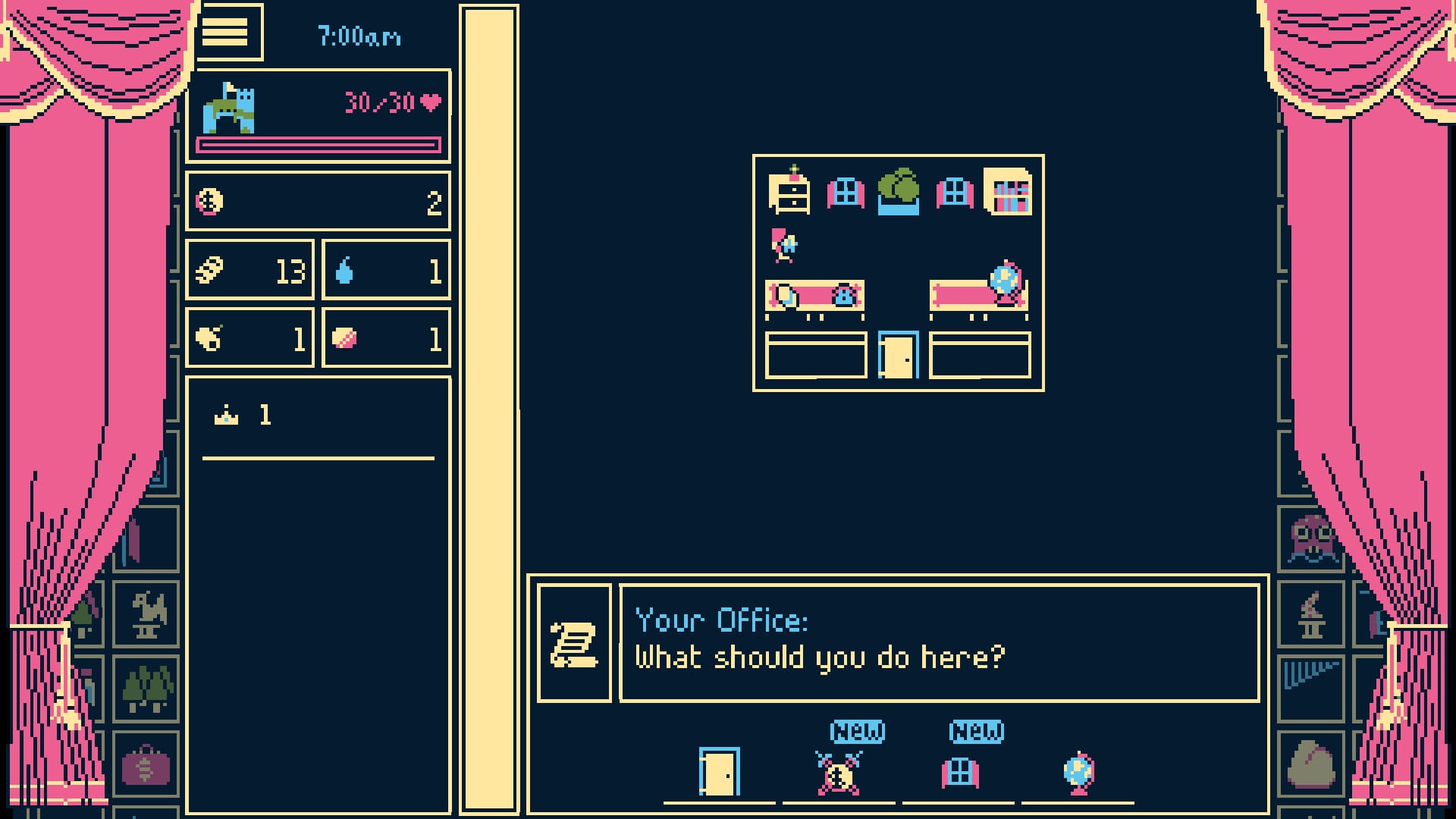
The gameplay part of all this involves fighting enemies in a two-phase battle that takes place on a tiled grid. In the first phase, called High Tide, you match resource tiles into lines of three to remove them from the grid. Matching features like water, hills, and fields gives you resources like food, rocks, and wood. You can also arrange the landscape to better protect the square representing your kingdom from enemy troops, surrounding it with hills or water. Matching multiple groups of three in a row also gives you more turns to play during this phase, making the whole thing a complicated mini-strategy game.

In the second phase, called Low Tide, you spend the resources you’ve gathered to deploy soldiers or farmers. The farmers gather more resources as the battle rages (provided you left some resource tiles on the field for them to harvest), while the soldiers go out to destroy enemy strongholds or fight to keep enemies from reaching your kingdom. You don’t control your troops; you just watch their tiny fights take place interspersed with images of cricket players, cats knocking things off tables, and Jenga towers that represent the tide of battle.
Titanium Court Is Just The Right Amount Of So Much
AP Thomson

Complications get added as the demo goes on. Special buildings can appear on the grid that you can access during Low Tide, but only if you keep them on the grid during High Tide, trying not to match them even when it’s very tempting. These can be hospitals that heal you, or shops where you can buy items; I was especially fond of a mirror I could arrange next to my kingdom to get two-for-one troops. Enemies get more varied, with catapults you can fend off by surrounding your kingdom with hills, or flying enemies who frequently mobbed by kingdom.

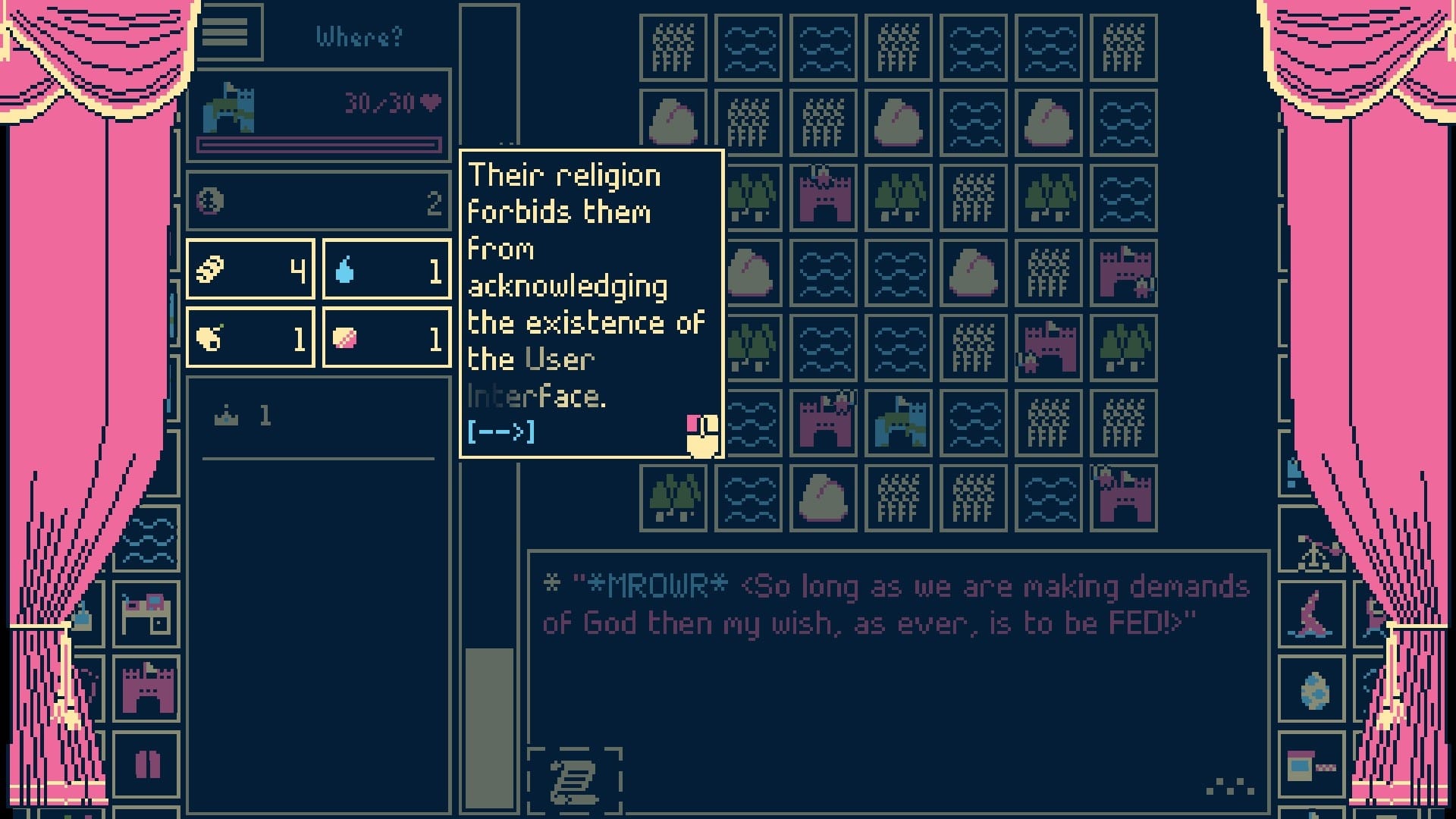
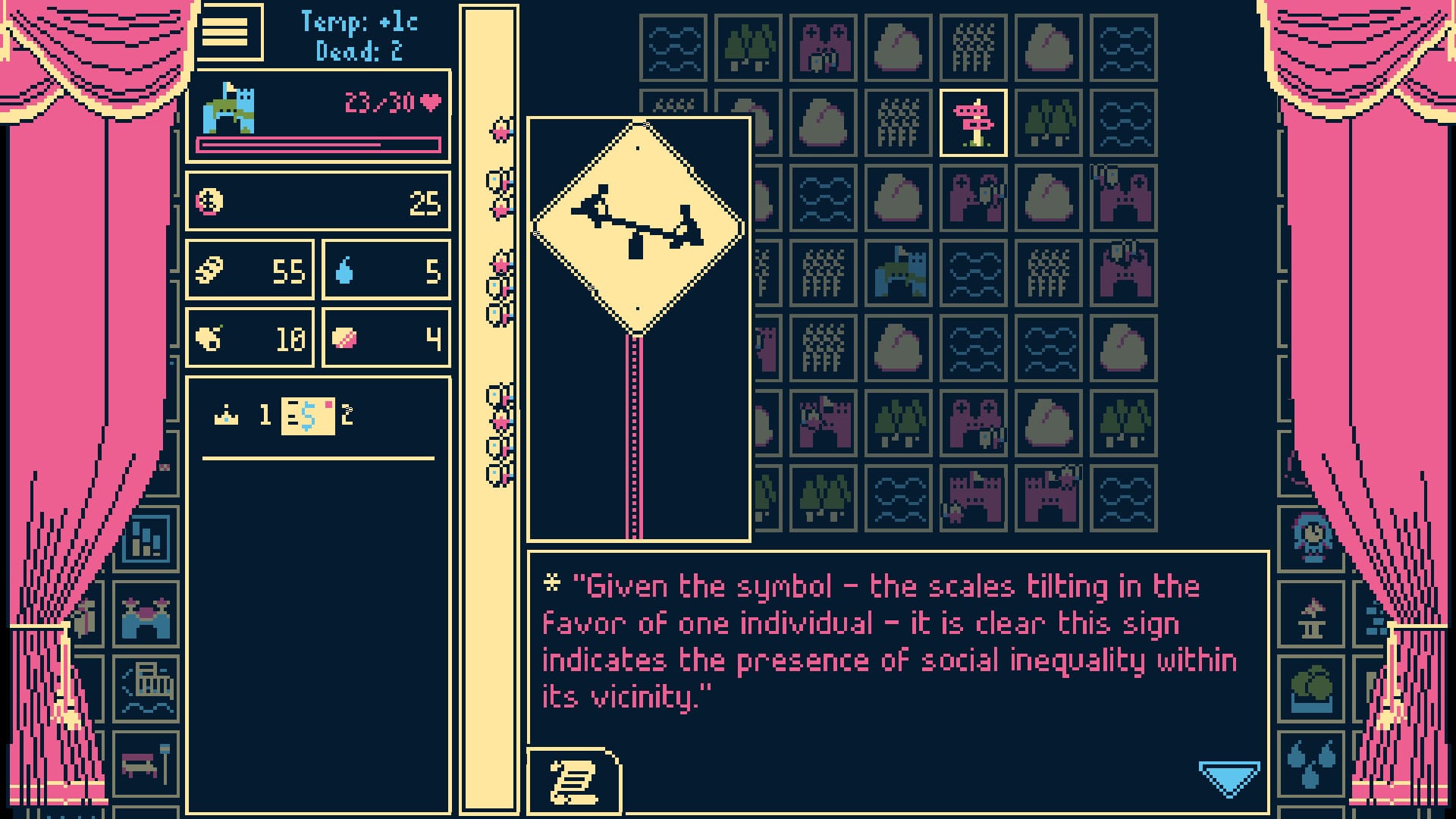
Layered atop all this is moving your kingdom along a roguelike map that even the game admits is confusing as hell, trying to make it to some kind of exit. And surrounding all that is the narrative element, which frequently breaks the fourth wall and is full of surreal jokes, talking cats, and a seeming conflict between the in-game narrative and the demo’s tooltips.
Titanium Court Is Just The Right Amount Of So Much
AP Thomson/Aftermath

It would be easy for all this to become grating, but instead these narrative bits never overstay their welcome, lasting just long enough to be funny without becoming too much. Absurd maximalism is deeply not my thing, but it totally works here; characters in the game seem just as confused as you, and it creates this vibe that you're all in this together, trying to survive and make sense of this very strange world.
Titanium Court Is Just The Right Amount Of So Much
AP Thomson

Titanium Court is weird as hell and completely charming, enjoyable both to play and just to experience, which feels like an impressive balance to pull off. The demo is available now, and the full game is "coming soon" according to Steam, though there's no release date yet.

  •  

What If Red Dead Redemption But It's Just A Bear Driving A Train

What If Red Dead Redemption But It's Just A Bear Driving A Train

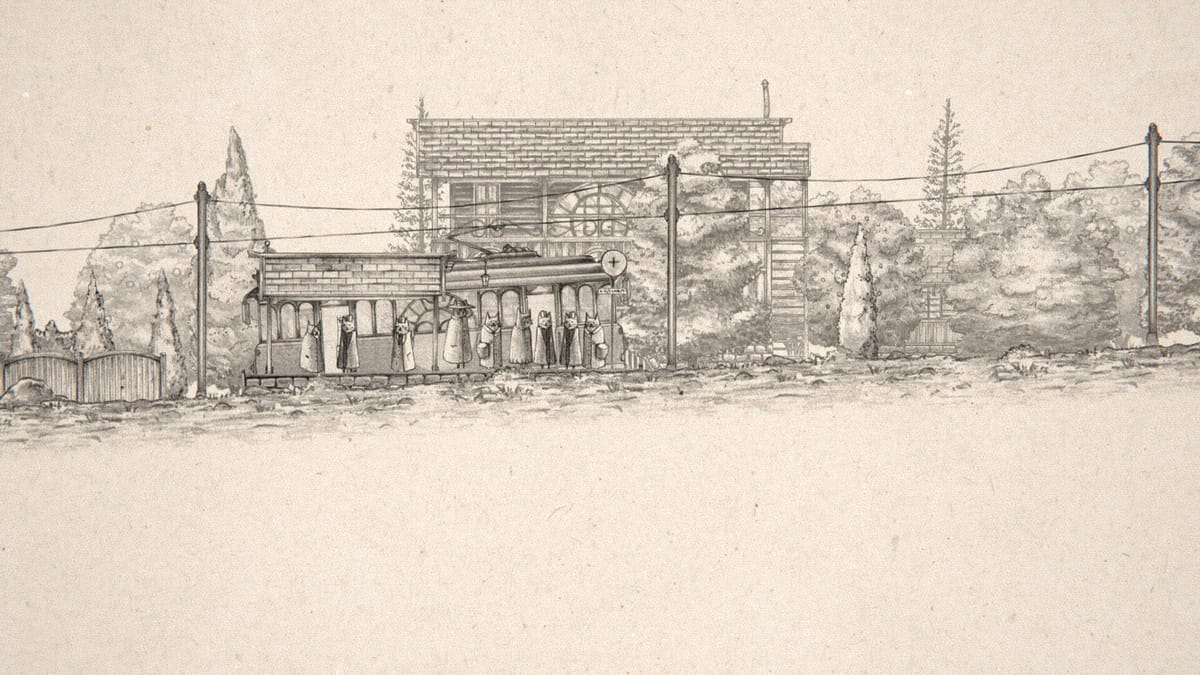
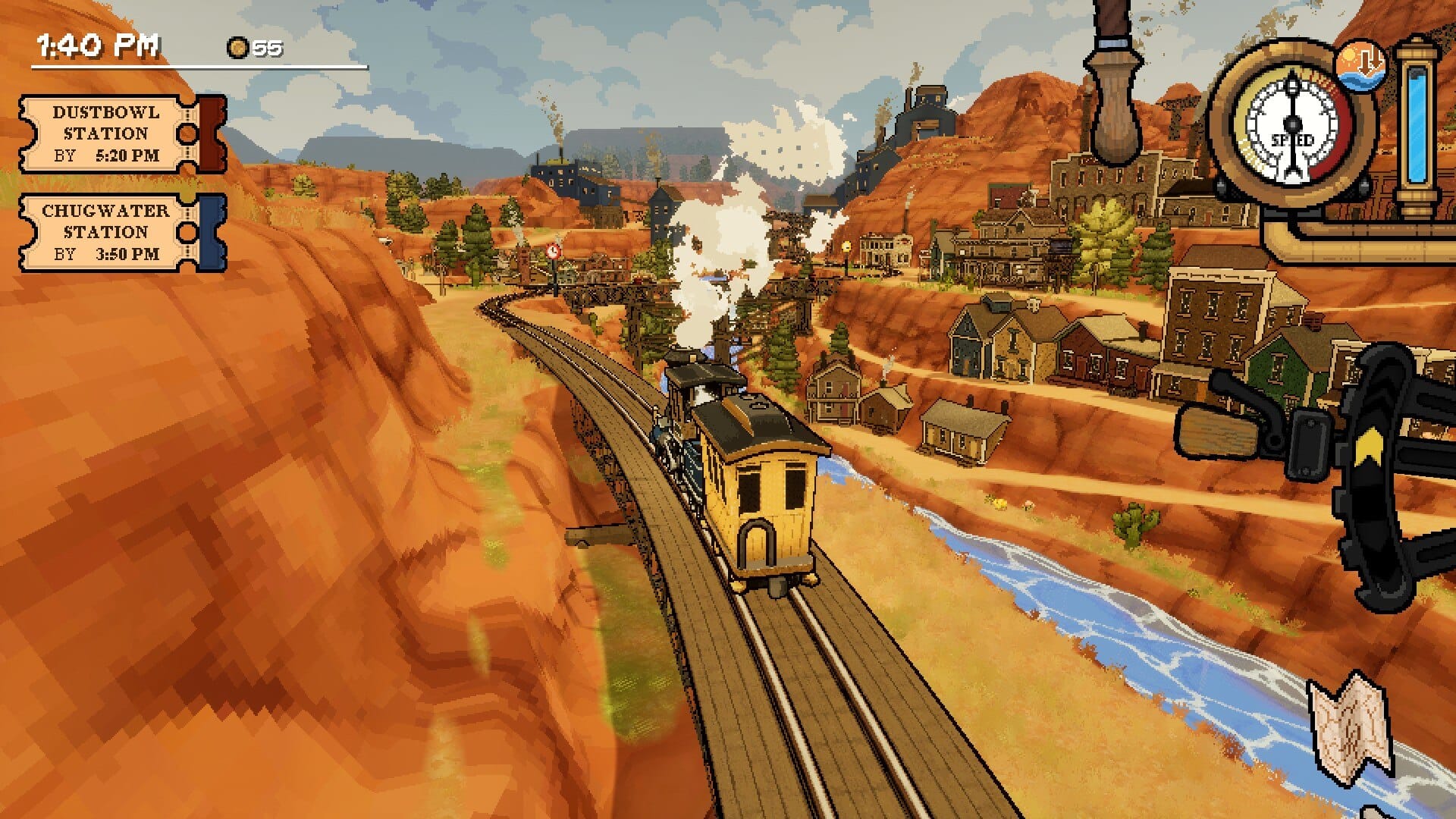
In 2024 I wrote about A Short Trip, a tiny hand-drawn game where a cat drives a train. Well now I’m back with A Bumpy Ride, a Western game where a bear (I think?) drives a train. I’m not sure why we’re seeing a boom in the animal-drives-a-train genre, but I’m into it.

A Bumpy Ride is being developed by Cosmoporium Games; its Steam demo recently got an update that includes a tutorial and unlimited in-game days of play. During those days, you pick up various animal passengers from one station and drive them to another. In addition to wanting to get to their destination on time, the animals like it when you obey train traffic signs, like going slow when a sign says to go slow or sounding your train whistle when a sign says to sound your train whistle.

The tracks you follow are set into a sprawling desert landscape that, even rendered cartoonishly, really evokes a 19th century developing West. Wooden towns appear among the tumbleweeds and cacti, from little outposts of only a few houses to relatively sprawling metropolises set among cliffs or along rivers. Some paths in the demo are blocked off by boulders that the game says requires TNT to clear, and though you can’t do this in the demo I did enjoy rolling into a TNT depot and imagining chugging around with a bunch of dynamite. The weather changes, as does the time of day, with the sky becoming an endless expanse of stars that reminded me of being alone in the wilderness in Red Dead Redemption.

While there isn’t all that much to do in the demo mechanically, what you can do is very satisfying thanks to the game’s chunky interface. You control the train with a lever on the right side of your screen, pulling it to speed up, slow down, stop, and reverse. The whistle is controlled with a pull-down tab at the top of the screen that I spent a lot of time pulling just for fun. Track directions are switched with a pop-up interface that’s equally satisfying, and also often sent me frantically checking my map to make sure I was headed the right way, especially when I was first unveiling which directions are available and wasn’t sure where a set of tracks would take me. You also have to keep your train topped up with water, stopping in just the right spot at towers placed around the map to let water pour into the right car of your train.

What If Red Dead Redemption But It's Just A Bear Driving A Train
I wish I could explore the town (Cosmoporium Games/Aftermath)

Satisfied passengers pay you money, and you can use this to upgrade to a new train, buy more seats for passengers, or install a bar car that makes passengers a bit more cheerful. I definitely did not satisfy all my passengers, especially when I was first learning the map and took them on long, scenic tours into the night instead of getting them to their destinations. But once I knew where I was going, A Bumpy Ride was a simple, lovely experience of chugging along following traffic laws and watching the landscape roll past, listening to the jaunty music and admiring the landscape.

Cosmoporium plans to release the game later this year, and the Steam page promises more areas, train cars, and a level-up system that will include “new upgrades, staff, and skins.”

Short Trip Is A Tiny Game Where A Cat Drives A Train - Aftermath
And also rings the bell
What If Red Dead Redemption But It's Just A Bear Driving A TrainAftermathRiley MacLeod
What If Red Dead Redemption But It's Just A Bear Driving A Train
  •  

Not Even A Video Game Can Convince Me To Read The Directions First

Not Even A Video Game Can Convince Me To Read The Directions First

We had these report cards in elementary school that, in addition to grading us on school subjects, also evaluated how we were doing on general life skills. I did pretty well in classes besides math, but the two skills I repeatedly failed were “penmanship” and “following directions.” I am simply not very good at reading and understanding explanations before I begin a task, and it’s this tendency that’s making the game Uncle Chop’s Rocket Shop a bit of a nightmare for me, but also really fun.

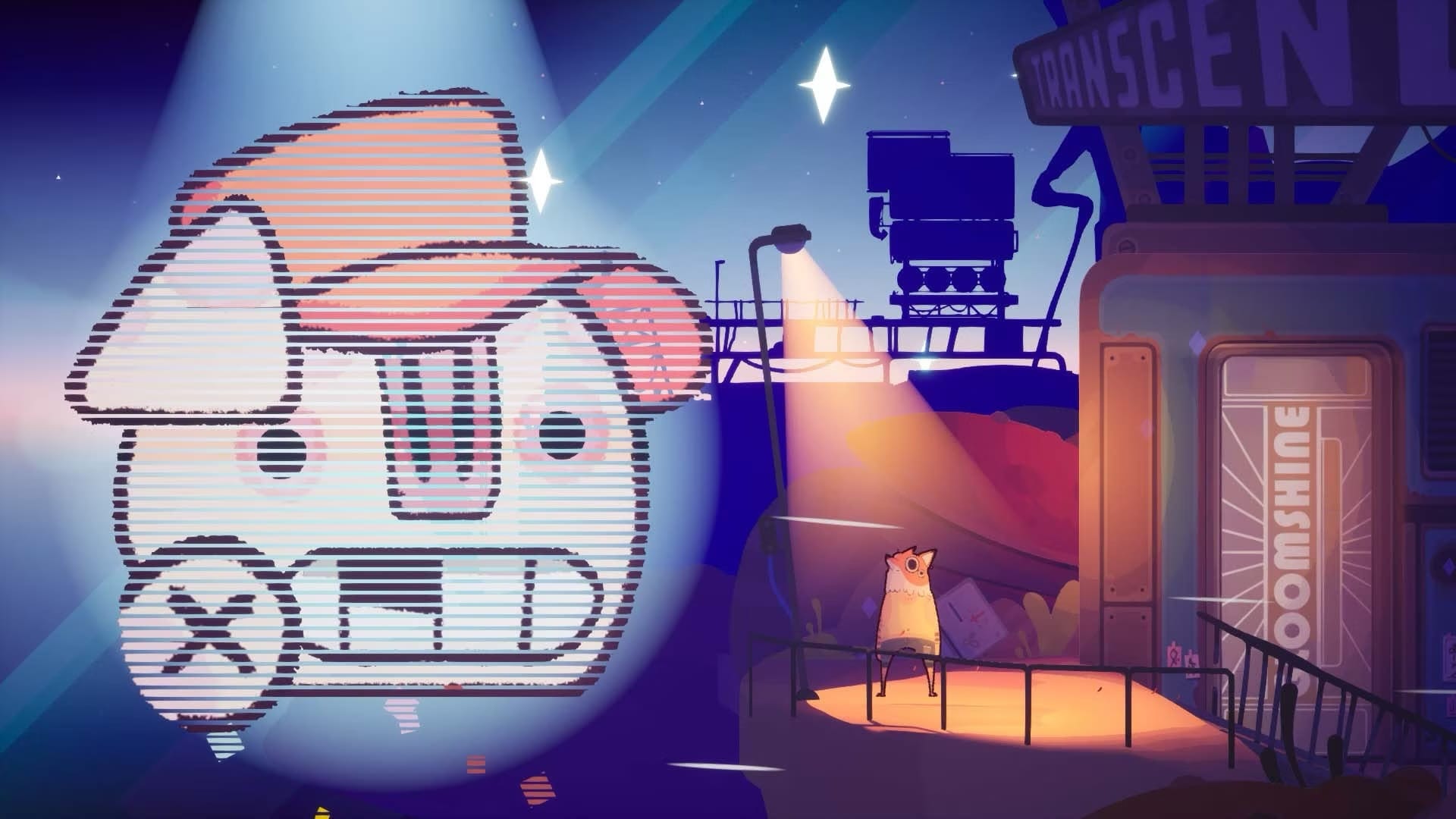
Uncle Chop’s Rocket Shop came out in 2024, and it’s been sitting in my Epic store library for a while before I finally decided to check it out this week. You play as Wilbur, a fox-headed dude who inherits an intergalactic mechanic’s shop and has to fix enough spaceships to make growing rent payments. There’s more plot than this– I’m only a few in-game days in, and I’ve already encountered mystical beings, thieves, meteor showers, and other hints that this isn’t just a job simulator. It’s possible to die, but the game is also a roguelike, with upgrades to your mechanic’s shop persisting between runs. But the bulk of your day is taken up by choosing from a number of repair jobs and getting them done to the customer’s satisfaction.

There are two modes to choose from: one with time pressure, where customers will get angry if you don’t fix their ships fast enough, and one that does away with the clock but makes the repairs harder and more exacting. I hate time pressure in games so opted for this more chill mode. This seems like a good way to learn the game, and especially how to come to grips with its giant, weird manual.

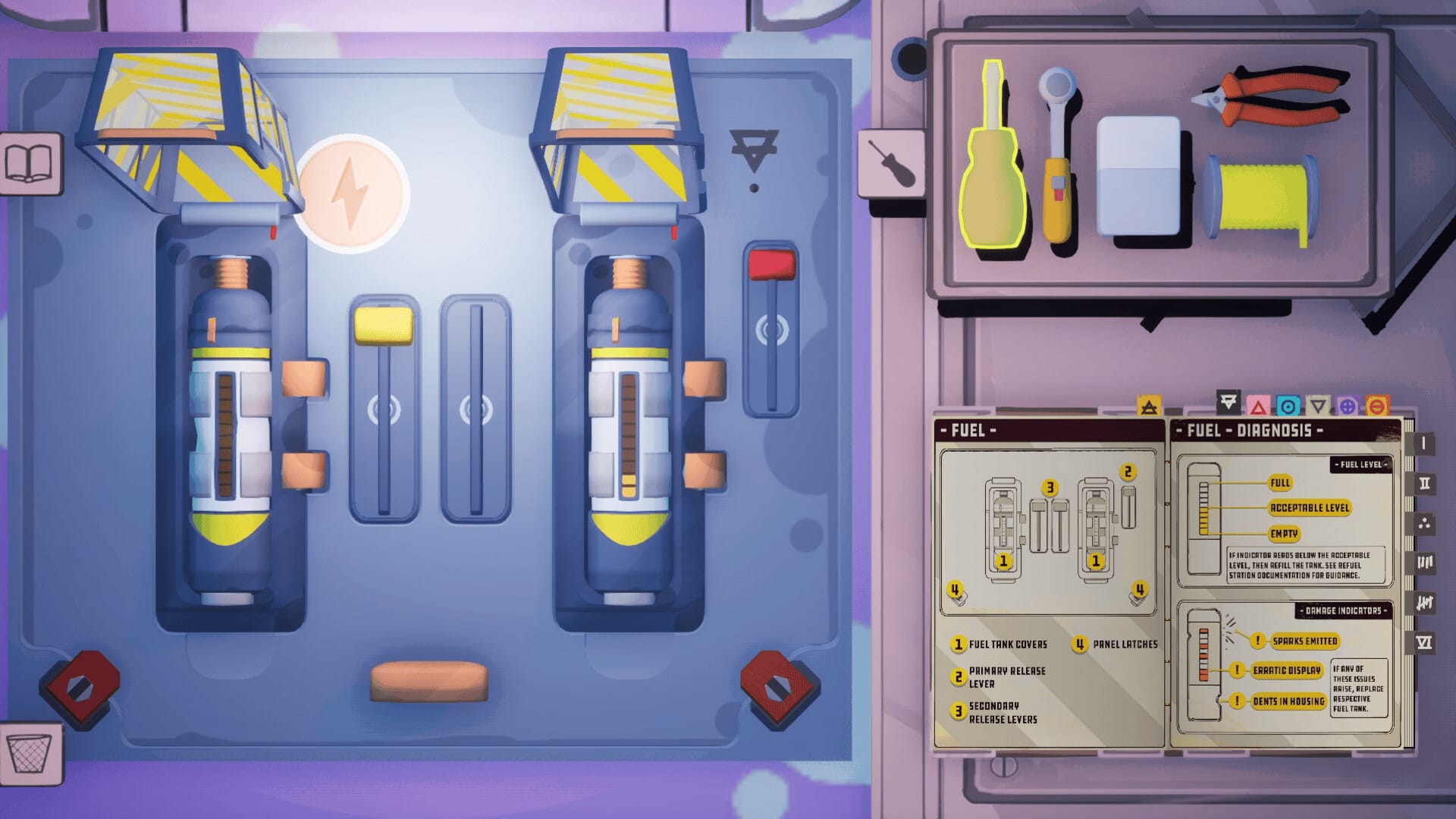
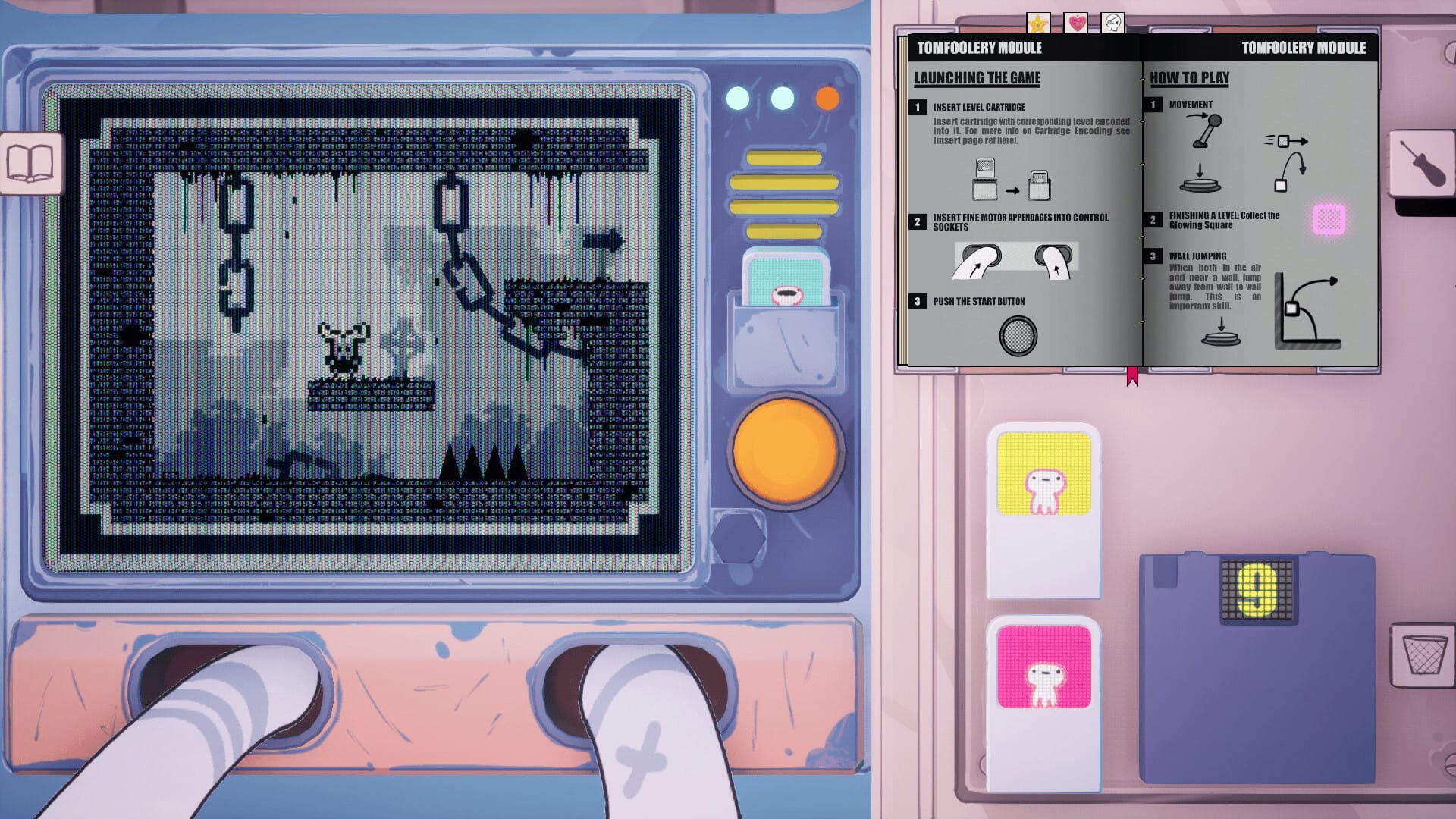
When you go to refill a customer’s fuel pump, for instance, you’ll see a symbol that will tell you which tab in the manual to go to, which you do by physically pulling the book out of your inventory and clicking through its pages. There, you’ll get a variety of images, brisk instructions, and references to other parts of the manual that will help you troubleshoot and solve the problem. My fuel jobs have been pretty basic–remove the fuel cell, refill it at my fuel station without filling it too far and exploding it, putting it back in. Oil is a little more complicated–in addition to the oil levels, there’s the oil quality to consider, as well as a pump, heat gauge, and other gadgets that could be busted. A recent job included both of these tasks and two new complications. There was an alarm that wouldn’t stop timing out and locking me out of the other ship modules, which had to be disarmed with a series of puzzles, and a “tomfoolery” module that required buying a new repair station to fix and then playing a whole other video game to calibrate.

Not Even A Video Game Can Convince Me To Read The Directions First
Beard Envy

The actual fixing is wonderfully tactile, with lots of buttons to press and levers to pull and bolts to unscrew. Just like in real life, you have to make sure you do all these things–I’ve lost money for forgetting to close a panel back up, or gotten stuck because I was flipping switches in the wrong order. The manual tells you all this, but it’s written like a real professional manual that assumes a certain familiarity with the objects at hand. Everything you need to know is in there, but it can be a little baffling to get your head around, especially if you’re not a great visual learner or are me, who cannot help himself from skimming the instructions before diving into a ship’s guts. In the game’s time-pressure mode, I imagine learning a new task for the first time requires an overwhelming amount of speedreading and making good choices, but in my chill mode I have no justification for not taking the time to look everything over first besides being a dumbass. I find it hard to understand the manual without experiencing the thing it’s describing, but going step-by-step often gets me stumped if a problem is deeper in the book. I’ll plunge ahead with unearned confidence, run into problems, give the manual the most cursory glance, dive back in, and get stumped again, in an absurd loop I have no one to blame for but myself.

Not Even A Video Game Can Convince Me To Read The Directions First
Beard Envy

I hate reading directions, but I do like research, so I enjoy looking stuff up in the manual even if I’m not fully digesting it. It’s hard not to get impatient to fiddle with all the strange machines, which give me some great Spaceteam vibes. The computer I’m playing Uncle Chop’s on sits next to an Ikea bookshelf I put together myself also without reading the instructions in full, and which is now listing to one side because I didn’t pay enough attention to the importance of rigorously attaching its shitty plywood back. Looking up from a game that reminds me I apparently haven’t grown at all as a person since third grade to real-world proof of the fact that I haven’t grown at all as a person since third grade is a lot, and the in-game consequences for my bad habit feel like a reminder that there will also be real-world consequences when my bookshelf inevitably collapses. At least in the game I’ll get a chance to start again, unlike my bookshelf, which will destroy everything around it when it forces me to pay for my hubris.

Uncle Chop’s Rocket Shop is available on PC and consoles.

  •  

Morse Makes Learning An Obscure Skill Fun

Morse Makes Learning An Obscure Skill Fun

You don’t need me to tell you that the world is a hellscape lately, but a fun thing about living in it is that it’s full of people with specific interests or niche areas of expertise, and they know all kinds of things you don’t know that you can go learn from them. Recently-released video game Morse is about Morse code, a very niche interest, and is even getting some people into telegraphy, an even more niche interest.

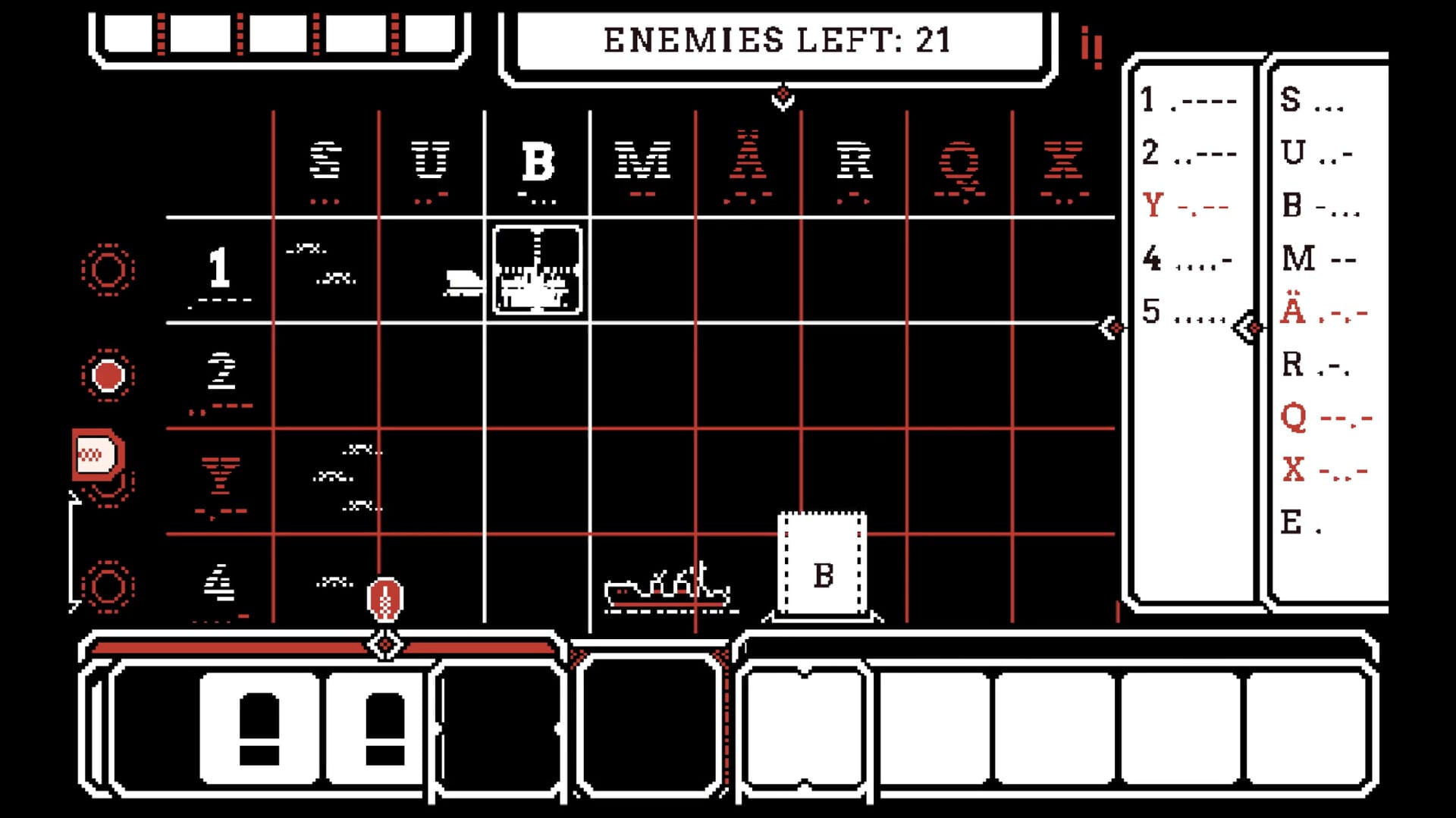
I feel like I’ve been hearing about Morse for years (10 years, apparently!), and it finally released in November. It’s changed quite a bit from the demo I played last year, which featured a narrative; now, you fend off growing waves of enemy ships on a grid you navigate with Morse code.

You tap out letters to move your cursor between grids and squares, all while enemy ships steadily approach from the right side of the screen. You can’t see them at first, so you need to set up mines to reveal them, or fire exploratory rounds to get a sense of what’s happening. As you move through the game, you unlock and upgrade weaponry, but things also get tougher: more ships to beat back, and more rows and columns to frantically dot-and-dash your way around.

I’ve only spent about an hour with the game, but I’ve really enjoyed its very specific mix of stressful and calm. In one way, it’s frantic; there’s way more ground to cover and problems to deal with than I feel like I can, and I’m constantly scanning the field and clicking away with my mouse to dart around. On the other hand, there’s something particularly slow about the whole thing. Tapping too fast will cause you to enter the wrong letter or nonsense instead of letters, so you need to take your time to keep from getting jumbled up. There’s a bit of a delay before you move, and shells take some time to load in. So peppered among a chaotic battle are all these micro-moments of downtime, and the whole game requires a kind of intentionality and level-headedness to succeed at that, when I pull it off, really makes me feel like I’m mastering a skill.

The ideal way to play this game, obviously, would be with an actual telegraph, which has been an option at festivals but less so at home. The Steam forums have a guide on how to get, build, or use one, and players have shown off their own versions online. It’s a game that invites weird controllers and making your own weird controllers. While I am not a controller sicko like Chris Person, I can respect people who are, and the pared-down input required for Morse seems like an approachable way to get into tinkering.

Morse code and its preservation isn’t something I’ve thought a lot about, but there’s a whole world of enthusiasts out there keeping it alive. In an email, developer Alex Johansson said he hopes to use Morse to introduce more people to a hobby with an aging population, which is an issue I have literally never considered before–what happens if there’s no one left alive who knows Morse code? I love how such a simple little game has given me a peek into a whole world I knew nothing about, with its own customs and lingo and values. Instead of doomscrolling the news, you could be learning Morse code! Maybe the world isn’t so bad.

  •  

Dogpile Knows The Best Dog Is A Big Dog

Dogpile Knows The Best Dog Is A Big Dog

I’m in a fight with my landlord over getting a dog, if “fight” means I texted him about it a couple times and he never answered and now I just drive myself nuts wondering if he’s purposefully not answering so that he doesn’t have to say “no” or if he just regular isn’t answering and I should harangue him. I am a person who should have a dog, and in the absence of one, I get my fix wherever I can: friends’ dogs, convincing dogs on the street to notice me and then pretending to be surprised, and video games that have dogs in them, like Dogpile.

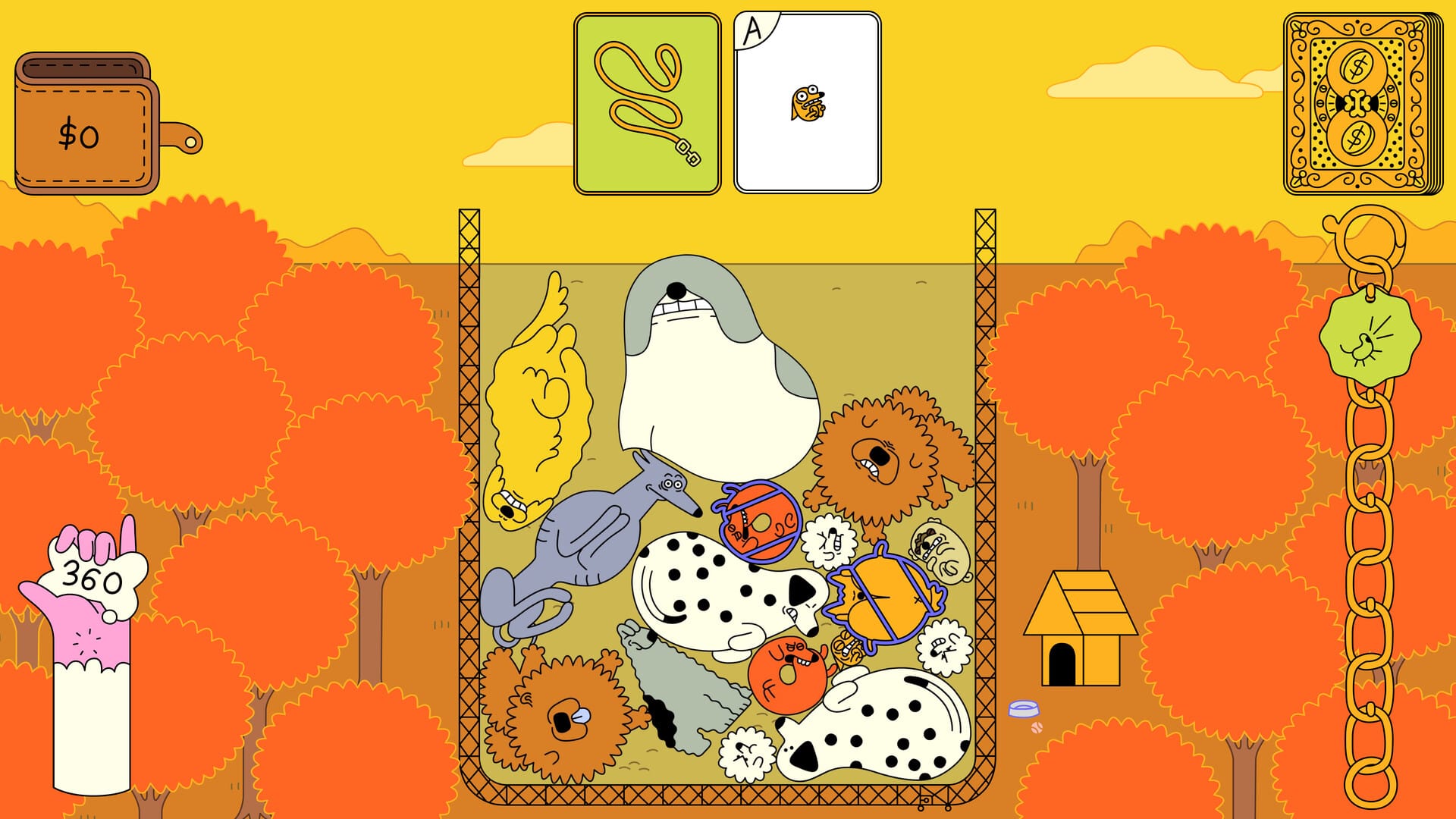
Dogpile is a collaboration between two Australian studios, Studio Folly and Toot Games. You have a deck of dog cards, which you play to drop dogs into a yard. If two dogs of the same type touch, they merge to form a bigger dog. Those bigger dogs merge to form even bigger dogs, and you keep merging dogs until you either win by getting the biggest dog, or your dogs spill out of your yard and you have to start over. There’s also the smaller goal of earning an increasing amount of “bones” in a certain number of hands, with penalties coming into play if you don’t make the requirement.

I appreciate a game that understands that the best dog is a big dog (a problem for my own desire to have a dog, since I have a very small apartment). The game’s dogs are very charming, from tiny angry chihuahuas to greyhounds that look like they’ve been up too late doomscrolling to golden retrievers that just look happy to be included. 

Size isn’t the only quality of a dog you have to pay attention to. Dogs can have traits: friendly dogs will be drawn toward dogs of their type, while timid dogs will move away from other dogs. This can be really useful for space management, helping jostle dogs around to get them to touch. Some dogs can be unusually big or small, and dogs can also get fleas that make their traits not work. My least favorite trait is “crated,” which prevents a dog from merging for several turns. You can change dogs’ traits in an interface stylized like a dog wash, removing bad ones or adding good ones.

In the game’s pet shop, you can buy new dog cards or “tags” that modify your game, such as by making all the dogs super bouncy (I thought this would be great, but it backfired on me). The tags add a metagame over the whole thing that I’m sure will appeal to strategy nerds, but honestly I most like just dropping the dogs into the yard, watching them tumble and then pop into another kind of dog, and seeing all of them pile up in an awkward, jostling crush. 

The whole thing is bright, cute, and chill, and it ate up most of my Friday night as I said things like “get over there, butt dog” and “aah, no more puffballs” at my computer. Dogpile is out now on Steam.

  •  

Too Real, News Tower

Too Real, News Tower

I’ve finally been playing News Tower, a management game where you’re put in charge of every facet of a 1930s newspaper. Like, every facet, from which reporters cover which stories to making sure the bathroom is clean. It’s the kind of video game stuff I tend to love, but all of it taking the form of running a news outlet hits a little too close to home.

One of the last freelance pieces I wrote before starting as managing editor of Kotaku in 2016 was a review of The Westport Independent, an indie newspaper management game that was mostly focused on the editorial end of things. I remember finding both the game and writing the review emotional, making me think about what my editing career had been up to that point and what it would look like in my new role. And while being managing editor involved, well, both managing and editing, there were still big chunks of the business that were firmly other people’s problems.

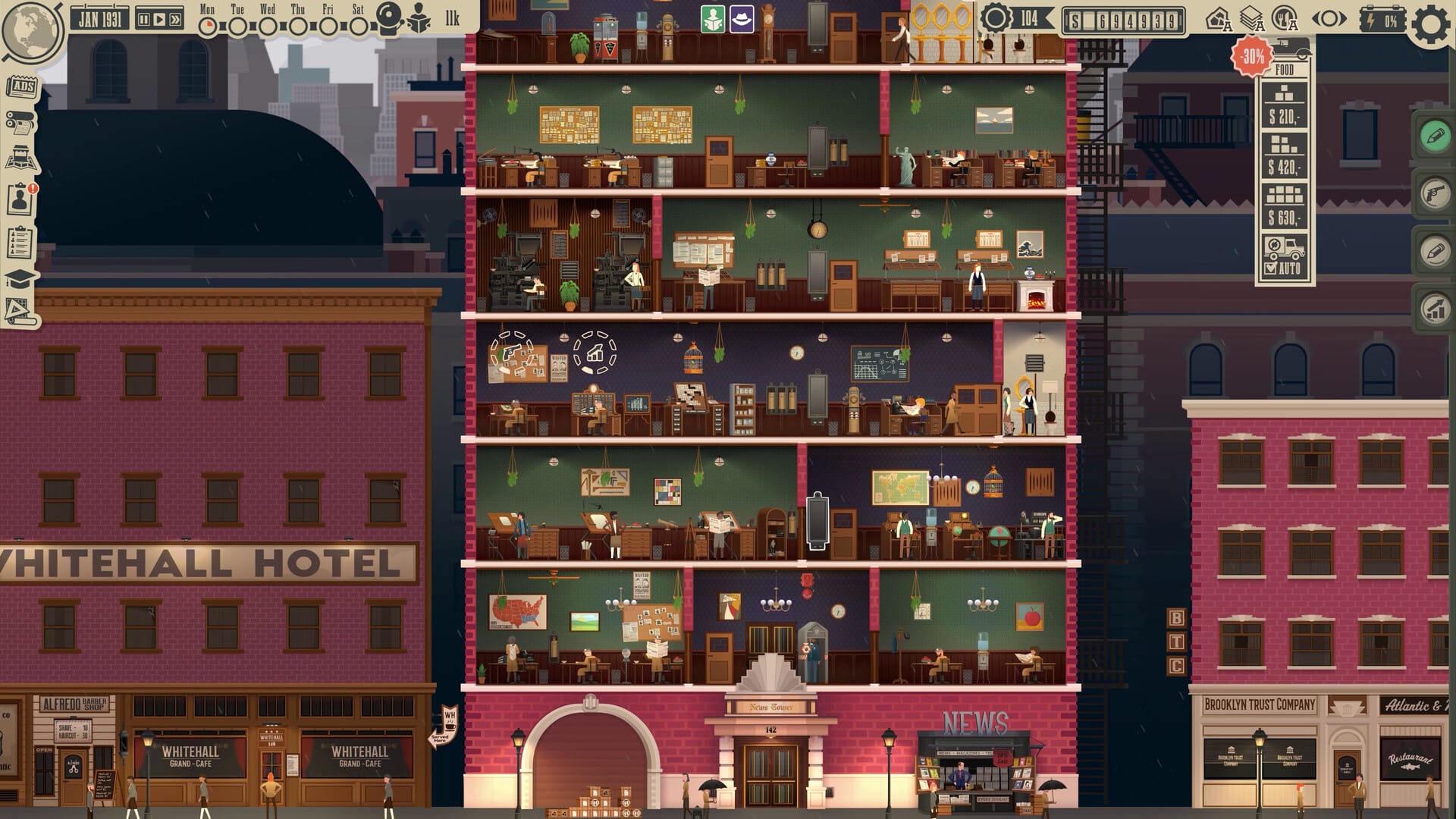
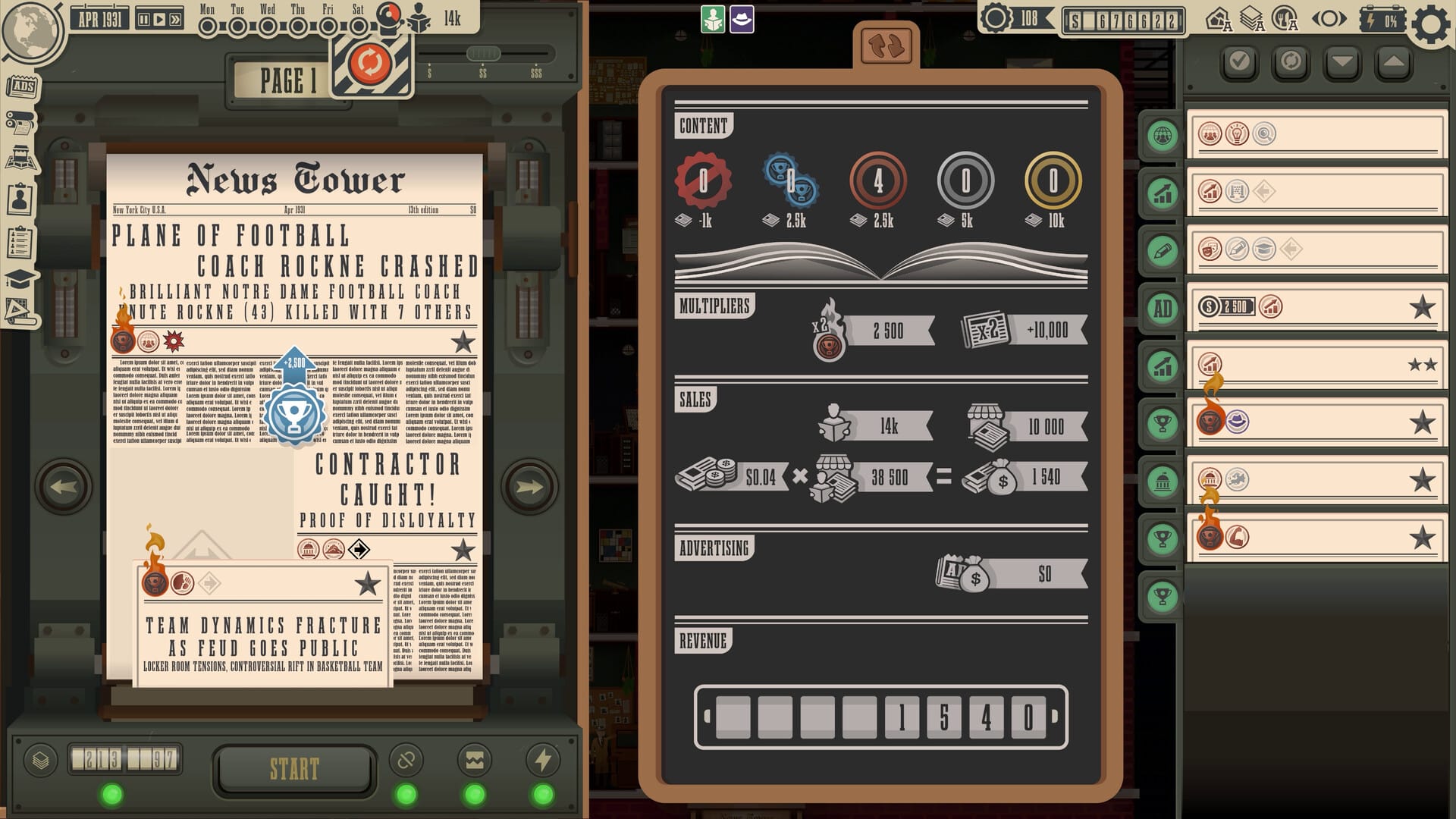
Not so now, and not so in News Tower. In the game, you inherit a struggling paper and, most crucially, the building it’s housed in. The newsgathering is pretty simple: your telegraph operators find news across the city and globe, and then you send a reporter to cover it based on their strength in its subject area, such as sports, crime, politics, or economy. When a reporter is done they hand their story off to be typeset and assembled, and at the end of the week, you arrange your stories onto the pages of a newspaper and print it off to be sold. All of this takes in-game time; you have to juggle how long stories take to report to make sure you have enough to fill your pages, and I’ve spent a lot of the game’s Sunday evenings muttering “come on, come on” as the assembly person’s progress bar slowly filled and the clock ticked down.

But you play as the publisher, not the editor-in-chief. Beyond the work of the paper itself, there are all kinds of other things to oversee. You lay out your newsroom, buying and placing everything from reporters’ desks to lamps to trash cans. The printing press takes up a ton of space, and it’s also hot and noisy, which saw me sequestering it to its own floor and then desperately arranging acoustic panels and tiny fans around it. You need paper, someplace to store the paper, and someone to carry the paper where it needs to go. Your employees get hungry and thirsty, so you need a water cooler and food for them. They need to use the bathroom, so you need air vents to keep the bathroom from stinking and an employee to keep it clean. Things break, so you need a repairperson to fix them. 

Employees will get uncomfortable if their physical needs aren’t met, slowing them down. I’m early in my first run with the game, and my person in charge of stocking supplies is unhappy with everything: it’s too dark at his desk, the printer is too loud and hot when he has to put paper in it, the bathroom is too stinky when he has to go in it. I’ve literally carried out his duties for him, using my mouse to drag boxes of paper from outside the news office up to the shelves as he meandered up and down the stairs, all while bemoaning our lack of paper. 

I’d like to give him another lamp or more fans or some help, but I currently have barely enough money to keep us in business. I’ve refused to take out a loan, even though I’ve been making extra money by doing deals for the mafia instead. I’ve sold off odds and ends to scrape together handfuls of dollars for something I need more urgently, swiping up reporters’ potted plants and clustering their desks around a single light bulb, swearing I’ll fix things later if we can just sell enough papers this week. This money stress has made me unkind to my virtual employees; I swung from making my reporters a lovely little newsroom to snapping “You wouldn’t complain about the lighting if you were out reporting” within a handful of in-game time.  

Too Real, News Tower
Sparrow Night

News Tower is paced such that none of this is too stressful mechanically. Since the reporting largely happens on its own once you set it ticking, you have plenty of time for this day-to-day management, and you can move and re-do your layout easily. The game gives you plenty of clues to what’s wrong, if you have the means to fix it. But emotionally, I’m finding it a lot. It feels like there’s so much to handle, and so much of it relies on money I don’t have, and I still want to make everyone happy and not fire anyone. On top of all that, I still really want to make a good, honest paper that highlights the most important news, even as I promise the mafia I’ll do the opposite. There’s so much to do and so few resources to do all of it perfectly, but I’m still so certain I can, even as this commitment just digs me deeper into an early-game hole.

I’ve never really had the experience of a management game not feeling fun because it’s too similar to my real life. A game like Frostpunk is a harsh setting I’ll never find myself in; Stardew Valley is a lovely escape that sands all the rough edges off actual farming. I usually love little chores in games like this, but all the little chores in News Tower are just pinging all my brain cells attuned to my real life chores. I recently got access to the game’s financial reports, and I’ll be honest I can barely look at them without thinking about my own real-life financial reports and all the responsibilities they entail. 

I’m drawn to the game because it’s about journalism, but maybe I’m not in a place to play a journalism management game right now. This might be praise for News Tower: It definitely feels like running a news outlet, or at least running a news outlet if you’re me, someone with an over-developed sense of responsibility and a self-imposed mandate to do everything perfectly that I should probably work out in therapy instead of in a video game. There’s definitely a lesson in here about priorities and time management that I badly need to learn. At least my real life news outlet is doing a lot better than my virtual one, and at least the only bathroom I have to deal with there is my own. (Which is also currently dirty, oh no.) 

  •  

Somehow, The Musical Ghost Story Home Repair Genre Works

Somehow, The Musical Ghost Story Home Repair Genre Works

The baffling trailer for There Are No Ghosts At The Grand, some kind of supernatural mystery/ home renovation/ musical game, has stuck with me since I saw it back in June. The game has a Steam demo out now, and though it’s just a brief look, I was pleasantly surprised by how well all those disparate genres fit together.  

You play as a man named Chris David, who inherits a hotel called The Grand from his missing father. During the day you renovate the hotel, and at night you investigate a mystery involving monsters, a talking cat, and different characters with connections to different rooms of the hotel. In addition to all that, characters sometimes break into song, with your dialogue choices becoming part of the lyrics. 

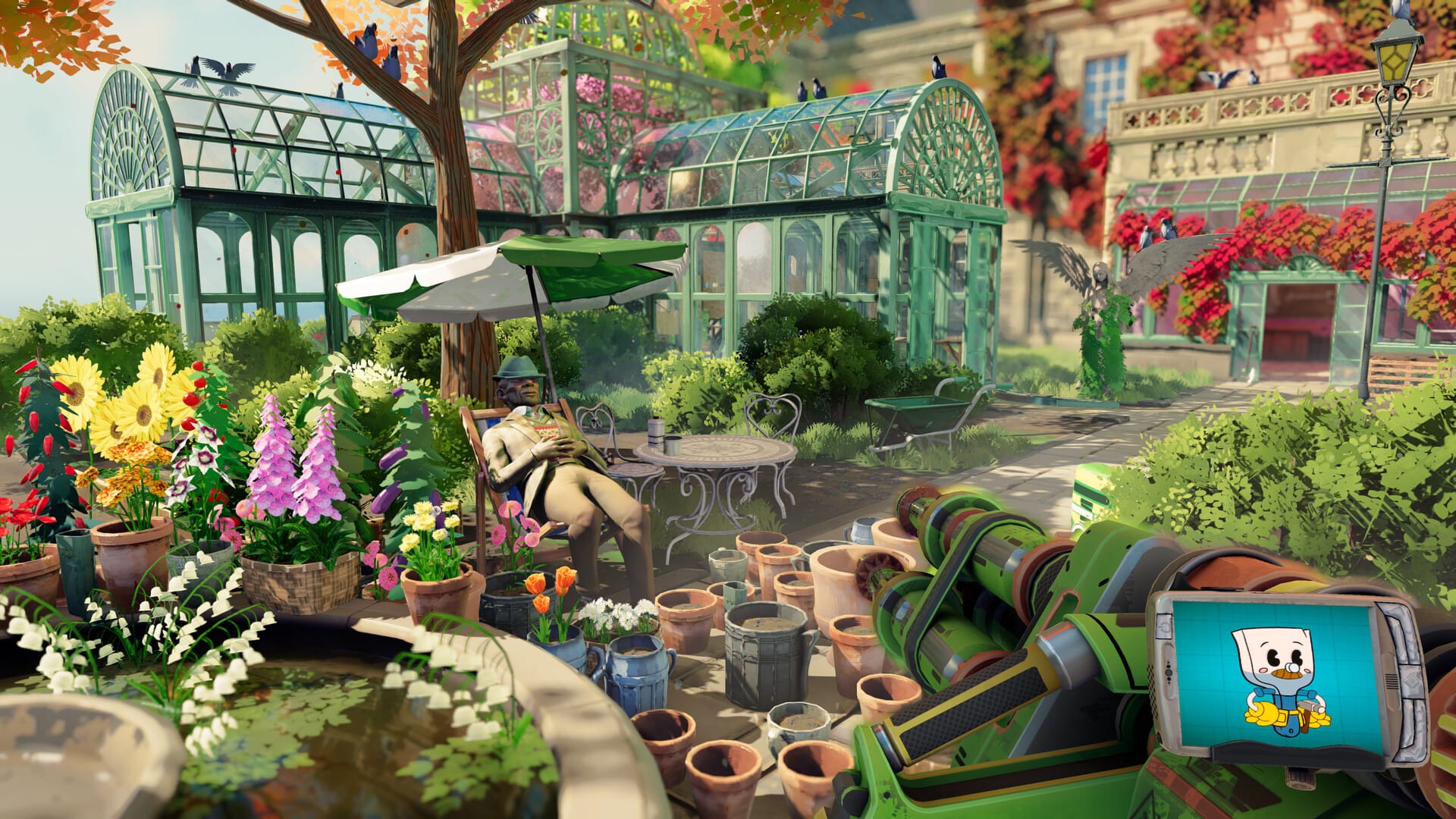
I did not, alas, see the hot priest from the trailer above in the demo, but I did get a sense of how all the game’s different bits play. When the demo opens, you use a gun-like tool to fix up a room of the hotel: vacuuming debris, righting furniture, and blasting off wallpaper and replacing it with paint. The renovation mechanic isn’t super-detailed–you only have to paint a bit of a wall before it gets fully coated, for instance–but it felt nicely forgiving after how much time I’ve spent painstakingly blasting nooks and crannies in Power Wash Simulator 2 lately.

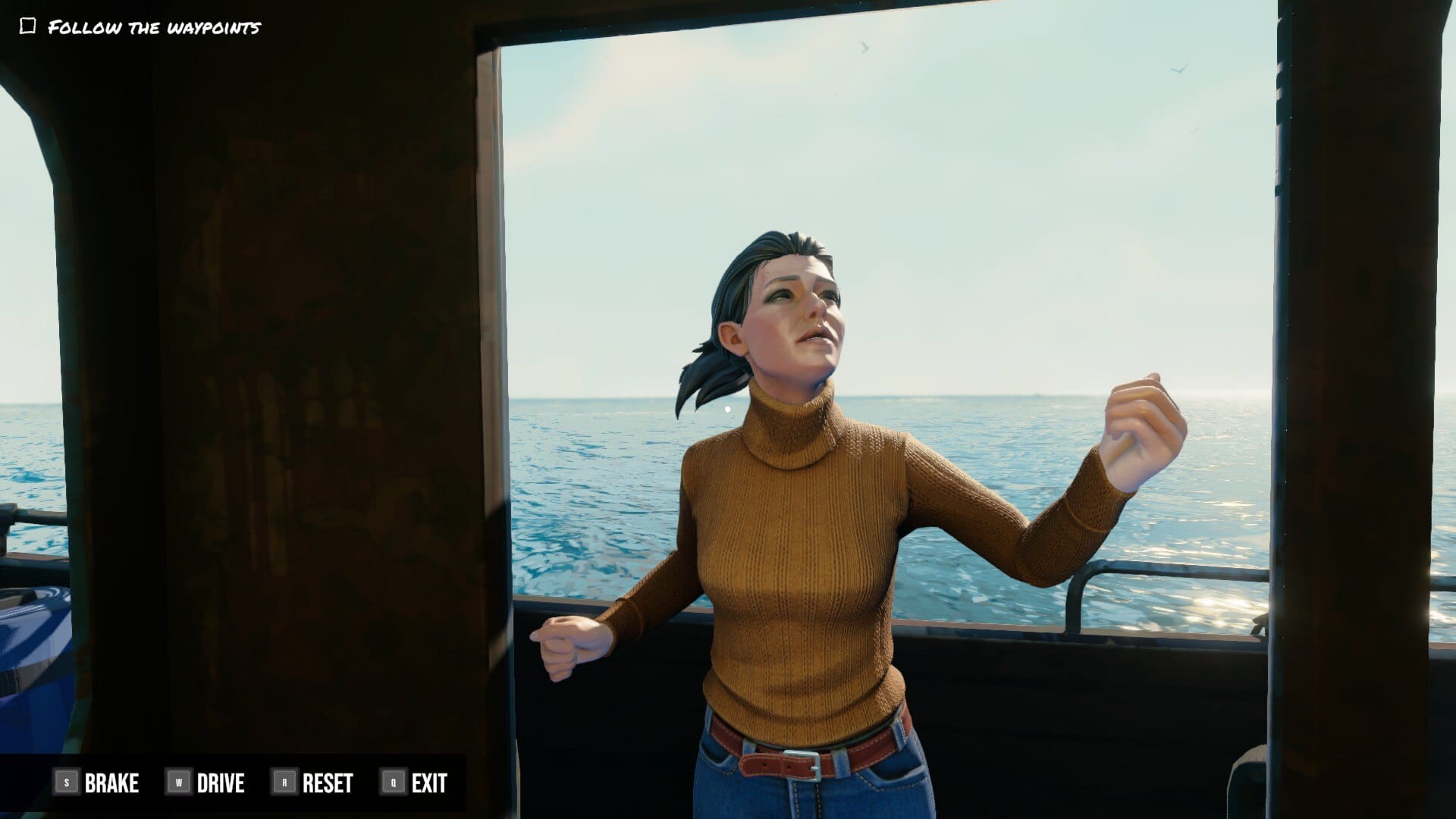
Your renovations get interrupted by a woman named Maddie, who wants your help investigating some black slime that’s washed up on the town’s beach. Here your renovation tool serves a different function, letting you move pieces around to repair a boat. Once we set sail, as I followed waypoints toward an abandoned island, I noticed the soundtrack had gotten unusually loud. When I turned my head, I realized the music was coming from Maddie, who was singing an upbeat pop number about the situation in town.

Somehow, The Musical Ghost Story Home Repair Genre Works
She's just singing! I love it! (Aftermath/ Friday Sundae)

I don’t know if there’s some moment in the full game that explains why characters spontaneously burst into song, but the whole thing was so disarmingly weird that I forgot all about steering the boat while I gaped. Like the trailer song, Maddie’s song was super-catchy; at the end of it, I chose between dialogue options to add a funk-inflected verse sung by Chris that included the lyric “I’m not some venture capitalist.” Creative director Anil Glendinning told Polygon There Are No Ghosts At The Grand becoming a musical was “a little bit unexpected…  as it was just because of the music we were listening to at the time,” which included “[a] lot of music from the British scene around the late ‘80s, early ‘90s.” As a musical theater nerd, the idea that the game is a musical just because sounds great to me, and while what I experienced of it was definitely jarring, I was totally delighted by it.

On the island, the supernatural stuff kicks in, and while I won’t spoil it, it was both an interesting mystery and mechanically appropriate to the idea of home renovation. Your renovation tool has different functions, such as switching the mode on the vacuum to fire stuff back out in order to repair things or place objects. Everything being done through your tool helps the game’s different pieces feel connected and keeps the demo from feeling too busy. The challenges and puzzles I faced on the island were pretty basic, and at times things even felt a little too hand-holdy, but I appreciated the guidance when being dropped in the middle of the game. 

The demo lasts about 40 minutes, and it basically feels like that reveal trailer: an interesting kind of weird, but one that hasn’t come down on the side of good weird or bad weird yet. I wasn’t completely sold on the demo’s humor, which could feel a little try-hard, but the whole thing felt surprisingly cohesive and very charming. I’m psyched that it’s a musical because everything should be musicals, and I’m really curious to see if that part holds up. There Are No Ghosts At The Grand is set to release for PC and Xbox in 2026.

  •  

Finally, A Biking Game That Embraces Vibes

Finally, A Biking Game That Embraces Vibes

As a cyclist, I have a bad habit of ignoring directions and navigating by vibes. I'll look at whatever route Google Maps spits out, agree it seems reasonable, and then completely ignore it in favor of getting somewhere based on a deeply personal sense of how I think roads fit together, using landmarks like "It's the street with the bar where I fought with my ex once" or "I think it's near the place that had good vegan sandwiches 20 years ago." This almost always works eventually, even if it's inefficient. My friends don't get it, but Despelote creator Julián Cordero gets it.

Cordero's Bike Race: New York City was one of four games I saw at Saturday's No Quarter exhibition at the NYU Game Center. No Quarter is an annual showcase of games commissioned by the game design department; the event is always a fun time, and the games are always the good kind of weird. Cordero described Bike Race in a written blurb by saying that, as a daily cyclist, "I tend to be very late to things and I always think I can catchup on time by biking faster. This is a game about that."

Bike Race uses two repurposed Citi Bikes as controllers. (Game Center chair Naomi Clark told me one of the bikes had been found abandoned, and the other had been decommissioned recently.) The bikes are imposed onto a scan of New York City, similar to a late game level in Despelote. Two players have to race to a real location, while the game encourages spectators to use Google Maps and shout out directions to help them get there.

The bikes aren't easy to control; turning is imprecise, and pedaling feels like it's on a kind of delay that made it hard to keep up my momentum. This meant a lot of careening up buildings or flying off the tops of cars, though wrestling with the bike did feel a lot like riding a real Citi Bike. All of this is made more difficult by the scan of the city, which turns a place I've biked for decades into a blobby nightmare of vaguely familiar buildings and streets.

0:00
/0:07

A player playing Bike Race

When I played, I was tasked with getting to the Tenement Museum, a place I have biked by approximately ten million times and even have a friend who worked there. I knew it was downtown somewhere; I had an intense feeling of who I was when I was regularly nearby, and vivid memories of navigating the neighborhood on a bike I had kitted out in distinctive bands of red and black gaffer tape. But trying to turn all that into lefts and rights, especially without street signs, was thrillingly hard. The people watching me eventually surmised our game had started in midtown and we needed to go south, but I quickly ended up too far south, though quite how far wasn't clear until someone recognized a white building and realized we'd somehow gone to City Hall. Trying to get from City Hall to the Tenement Museum– again, a ride I have made countless times--became a stressful, dreamy, impossible journey. I swapped places with games journalist Yussef Cole and quickly Google Mapped the museum. Yussef was able to identify its location of Delancey Street, but we couldn't locate the cross streets in Bike Race's version of NYC; going east, we hit the Williamsburg Bridge without finding it, and as Yussef peddled frantically back toward the west, the other player beat us to it.

In honor of Aftermath's second birthday, we're having a sale! For a limited time, you can get your first month of our Reader tier for just $1!

Subscribe for $1

Some players I spectated had to get to No Quarter, which means Brooklyn must be in the game too. Other games I watched ended up by the Intrepid on the west side and the spot at the bottom tip of Manhattan where you can see both the Brooklyn and Manhattan bridges. But there were lesser, more personal landmarks too: a random bank placed just so on a corner that made me realize we were near my undergrad college, or a storefront that made me yell unhelpfully "we're on that street in Chinatown with all the lamp stores!"

0:00
/0:13

I loved the way Bike Race's rendering of NYC obscures major landmarks and emphasizes a kind of local familiarity, while also making my home turf feel strange and new. It turns the whole city into vibes, and forces players to navigate the way I do: vague memories, hunches, and their own personal compass. I felt vindicated watching people have fun with it, even if it made me understand a bit more why my commitment to vibes drives my friends nuts.

The Definitive Citi Bike Strategy Guide - Aftermath
Would you like to get the most out of NYC’s Citi Bike while paying the least amount of money? Here is an SEO-friendly guide.
Finally, A Biking Game That Embraces VibesAftermathChris Person
Finally, A Biking Game That Embraces Vibes

  •  

Let's See How Being 'AI First' Is Going For Krafton

Let's See How Being 'AI First' Is Going For Krafton

In late October, Krafton–publisher of games like PUBG, inZOI, and the embattled Subnautica 2–announced it would be going “AI first,” an increasingly common buzzword for companies looking to get in on the AI boom before it goes bust. You’ll never believe this, but that move involves people losing their jobs.

Krafton said its pivot to AI would involve a “complete reorganization of the company's operational development system, placing AI at the center of problem solving,” according to a machine translation of its Korean announcement. The move also included a $69.7 million investment in a GPU cluster, and an additional $20.8 million to support employees in “directly utilizing and applying various AI tools to their work.” 

In early November, Krafton instituted a hiring freeze, though this excluded departments working on original IP or AI. Krafton CEO Bae Dong-geu said at the time that “rather than reducing costs through AI First, individual productivity must increase at the company-wide level.” Well yeah, that makes sense; your company invests in the hot new tech that its creators keep promising will revolutionize your work, so of course you need to work harder to help it get there. 

Today, Business Korea (as spotted by Eurogamer) reported that the company has “begun offering resignation support to all employees.” Business Korea writes that the resignations would be voluntary, with severance based on years of employment. 

A Krafton rep told Business Korea:

The core purpose [of the reduction] is to support members in proactively designing their growth direction and embarking on new challenges both inside and outside the company amid the era of AI transformation… [T]he company plans to support members in autonomously deciding whether to continue the direction of change internally or expand externally.

This is some spectacular business bullshit language. Framing those unwilling to turn their current jobs into whatever bastardized version of them would exist at an “AI first” company, or who cannot or will not bow to these increased productivity demands, as “embarking” or “expanding” on new “external” challenges is a great way to put the rug-pulling onus on employees rather than the company. And while I can appreciate buyouts as an alternative to layoffs, this “if you don’t like it, there’s the door” inherently acknowledges that Krafton is making a move it knows will be unpopular with its employees–you know, the people who did the work that gave Krafton “record-high cumulative performance in the third quarter” of this year.

But all of this is simply how AI is manifesting in the real working world, from Duolingo to The Washington Post to YouTube and beyond. If AI doesn’t outright replace your job–or, more accurately, if your boss doesn’t decide to try to replace you with AI whether or not AI can actually do your job–then its inclusion turns your job into something unrecognizable. At which point, maybe seeing yourself out is a better option, though in this current age of tech layoffs probably doesn’t feel nearly as sunny as “embarking on external challenges” makes it sound. 

Meanwhile, we’re all still waiting on that AI-powered utopia Sam Altman and his ilk are promising while their software is convincing people to kill themselves. Everything is going great!   

  •  

Thanks/No Thanks For Telling Me About Buckshot Roulette, Everyone

Thanks/No Thanks For Telling Me About Buckshot Roulette, Everyone

Back when I wrote about CloverPit, a bunch of readers said “Oh, this is just Buckshot Roulette,” a game I hadn’t heard of. Over the weekend, while piling my Steam library with games I was excited to play once I stopped building a new website, I tossed Buckshot Roulette in there. I finally got the chance to play a bit, and yeah, it definitely presses some of those same dark, complicated brain buttons as CloverPit.

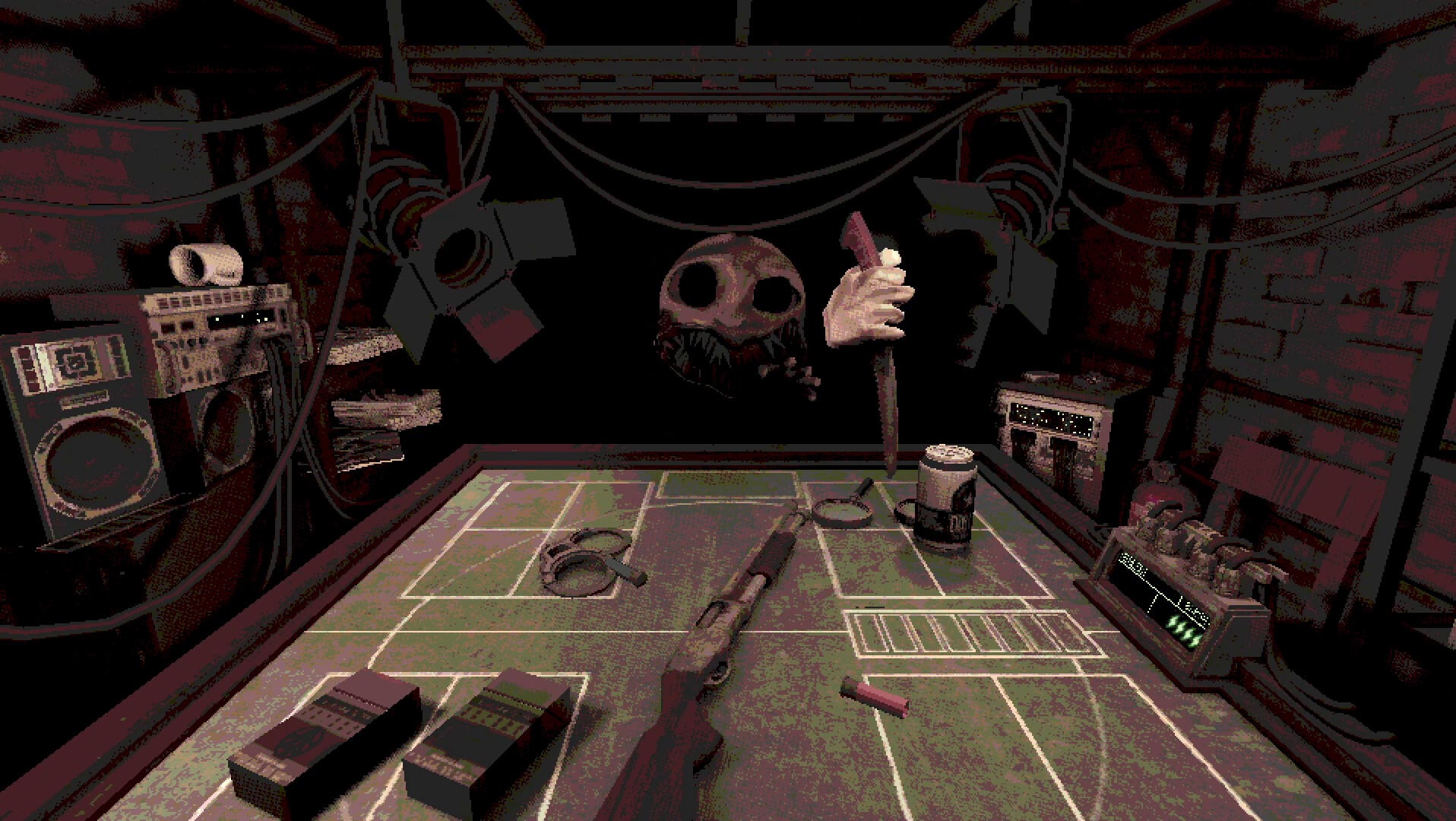
Buckshot Roulette is a 2023 Itch.io game that came to Steam in 2024. In single-player mode, you’re sat across from a dealer in a grimy room. The dealer loads a variety of live or blank shotgun shells into a gun, and you take turns passing it back and forth deciding whether to shoot yourself or your opponent. Shooting yourself with a blank gives you another turn; shooting the other person (or shooting yourself) takes a point off health. The game progresses over rounds, with your health refilling in the first two before the third goes into “sudden death;” if you die here, you lose and start over.

You get items before some rounds, which can help you craft whatever passes for a strategy in this game. The magnifying glass will tell you whether a live or blank is in the chamber, the handcuffs force your opponent to skip a turn, and the knife increases the gun’s damage. Your opponent, of course, also gets items, and in my single-player games I’ve found there to be a wonderful sense of dread as I watch the dealer busy themselves with theirs, knowing something bad is about to happen to me but being unable to stop it.

Beating single-player for the first time unlocks an endless mode, and there’s also a multiplayer mode that I haven’t been able to check out yet but have enjoyed watching YouTube videos of. Playing the game with friends seems like a fun/terrible social experience, where playing solo has, like CloverPit, exposed all the grossest wiring of my brain when it comes to the appeal of gambling and chance. 

Both games lay bare the fantasy of making your own luck and precisely where strategy lies when it comes to gambling. They both have strategy; I’d posit Buckshot Roulette’s is a bit easier to employ than CloverPit, given your more limited options and the math that undergirds it. But at the end of the day, you’re still at the mercy of chance in both games–and in both games, I am absolutely certain that I can be totally in control, that I’m on a streak or that the odds hate me, that everything is laden with meaning and portents and that way more is going on than just me sitting alone in whatever dismal virtual room clicking buttons. 

Both games’ aesthetics seem to want to highlight how gross this all is, with their jagged art styles and abrasive music. But at the same time, they fully indulge in the thing they’re criticizing. Playing them both, I ask myself if I’m really playing them ironically or from a distance, if I’m engaging in some kind of intellectual exercise or just mashing the same buttons that led to loot box regulation or dunks on sports betting. And given that neither game is actually gambling, does that make it better–can you have the pleasure without the pain?--or does that make it worse–with none of the consequences of real gambling to stop me, am I just training neural pathways that could lead me down those roads? 

Neither CloverPit or Buckshot Roulette necessarily want to answer those questions, putting themselves out there for you to wrestle with. They’re interesting experiments, finding me at a time where other developers are playing with similar ideas of how we engage with randomness and what it does to our heads. They’re also both really fun, even if what that fun is unsettles me if I look at it too closely. I'm impressed that such a little game has so much going on, that it lets me bring so much of myself to it. Thanks for the moral crisis, readers.   

  •  

The Seance Of Blake Manor Is My Blue Prince

The Seance Of Blake Manor Is My Blue Prince

Everybody loved Blue Prince, and at this point it feels like everybody has finished (or, “finished”) Blue Prince, but I’m still here thinking “boy, I really should get back to Blue Prince” while knowing there’s a good chance I won’t. As much as I liked what I played, it just didn’t get its hooks in my brain the way it did with others, and it’s the kind of game that needs passion to see it through. But I have finally found my sicko mode, “can’t stop thinking about it and need to talk to everyone about it” puzzle game: The Seance of Blake Manor.

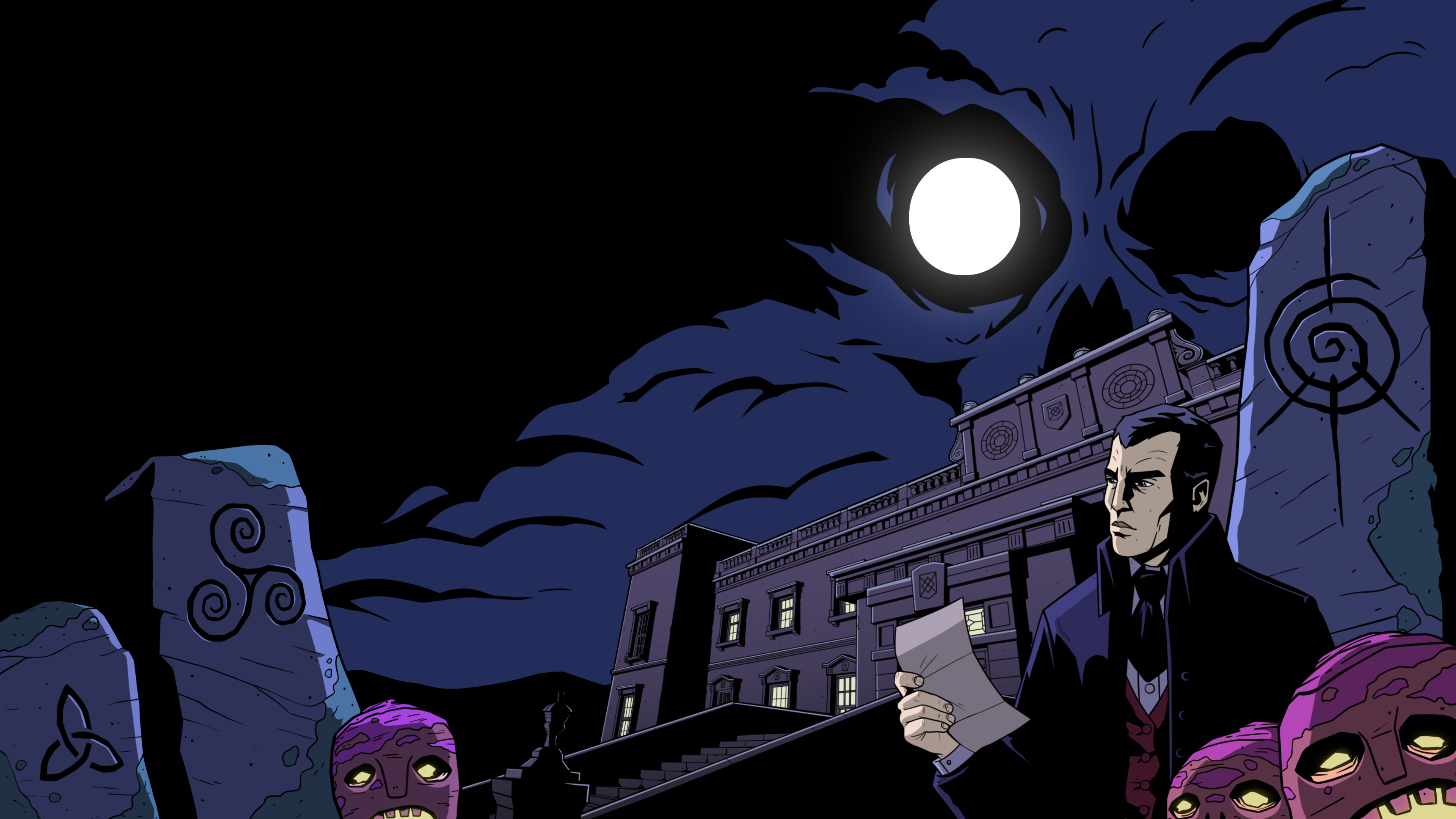
The Seance of Blake Manor casts you as Declan Ward, a detective in 1890s Ireland who’s been called to a mysterious manor hotel to investigate the disappearance of a woman named Evelyn Deane. A diverse crew of guests has gathered at the manor to attend a seance, and it quickly becomes clear that they all have their reasons to wish Deane harm. You have the weekend to figure out what happened to Deane and who’s responsible before the seance occurs on Sunday night.

The time limit can feel pressuring, but time only passes when you undertake certain clearly-marked actions, such as examining objects, questioning guests, and attending events like meals and lectures. An important first step in solving the mystery is filling your timetable with the weekend’s activities and guests’ schedules, so you’ll know who will or won’t be where every hour. The latter is particularly helpful; one fruitful avenue of investigation is to break into everyone’s rooms and go through their stuff, and you definitely don’t want to get caught. Ask me how I know.

The Seance Of Blake Manor Is My Blue Prince
Analyzing a character tells you more about them and gives you topics to discuss (Spooky Door)

Every guest and staff of the hotel has a backstory, motive, and relationships with other characters. And they’re not just cursory stuff for atmosphere; I almost immediately forgot about the game’s central mystery as I dug into secret love affairs, thwarted career ambitions, cryptic plots, mystical societies, class and race tensions, failed romances, and people struggling to square their faiths with a changing Ireland and with the popularity of Spiritualism, a 19th and early 20th century movement to communicate with the dead that threatened much of society’s status quo. (Spiritualism is one of my top niche interests, and I’m also currently learning the Irish language; the fact that there’s a game about both is very exciting for me specifically.) To add to the plot stuff, the game is also full of things to learn about the history of the manor, Chrisitian gnosticism, and Irish folklore, politics, and history–a lot of this information is kept in the manor’s library, where you can research plot-essential stuff, but also browse the shelves for more detail on a topic. I’ve spent way more time doing this than I have actually trying to figure out what happened to Deane; I’m currently just before Saturday dinner and feel like I have no hope of solving her mystery and preventing whatever horrors it’s hinted will happen at Sunday night’s seance. With over 20 characters to learn about and whose problems to solve, I’m constantly panicking about the time limit, though players who’ve beaten the game tell me not to worry and that they ended things with time to spare.

The Seance Of Blake Manor Is My Blue Prince
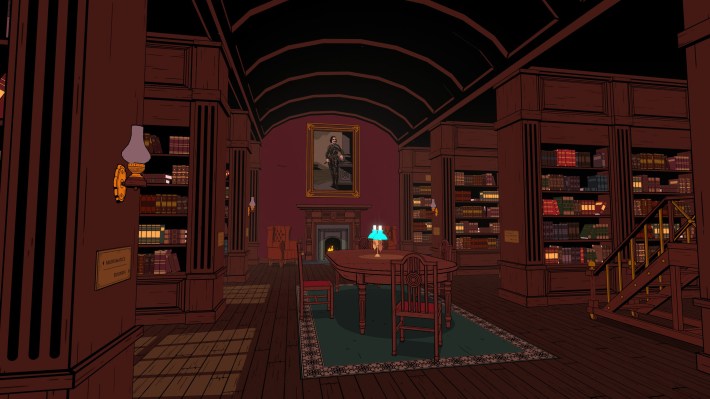
The library (Spooky Door)

The game has a robust set of menus to help you keep track of all this and figure out what to do next. When you talk to characters, available topics are represented by icons to choose from, and while characters will only talk about certain topics so you don’t fritter away your time too badly, not all of them are essential for your investigations. Discovering more about the topics that are important places those topics on a mind map/ conspiracy board that shows how they’re connected and paints an overall picture of a character and their story. (I’d show you images, but they would be full of spoilers; you can see a glimpse of this in the trailer above.) When you’ve connected enough bits of information, you’re given a Mad Libs-style screen in which to create a hypothesis by filling in words from your conspiracy board, and then you can confront that particular character about it. I found these Mad Libs a little fiddly on occasion to express my hypothesis exactly how the game wanted me to, but it’s a fun mechanic with a lot of guardrails to make sure you know what’s going on. So far, some of my confrontations have wrapped up a character’s story, while others have introduced actions I need to take to fully resolve things, which means more investigating.

The game menus do their best to keep everything organized for you and to nudge you about where to go next, but I haven’t always found it to be quite enough, so I also keep a notebook beside me while I play. Occasionally I’ve been frustrated when I feel like I know enough to confront a character but haven’t discovered all the things to let the game know I know them, but those instances have been pretty rare. My main problem is that everything is so interesting that I’m constantly getting off track, suddenly remembering that time is ticking down and I’m no closer to putting my top priorities to bed.

The Seance Of Blake Manor Is My Blue Prince
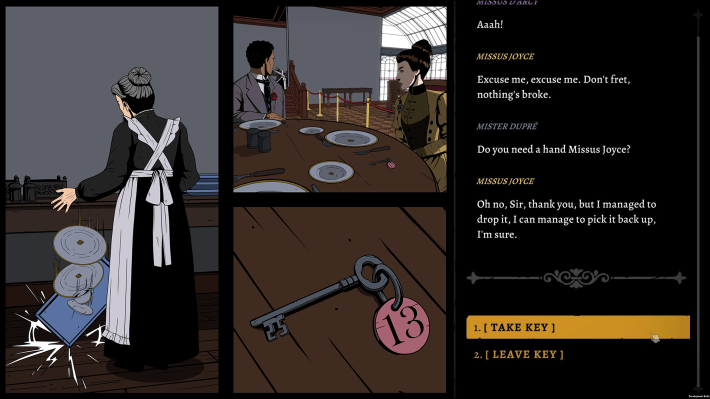
Story cutscenes are told through dialogue and static images (Spooky Door)

For me, The Seance of Blake Manor echoes Blue Prince’s interlocking mysteries and sense of place without having to contend with its life-eating RNG and open-endedness (I’ve also seen some players compare the two game’s art styles.). There’s some Lorelei and the Laser Eyes vibes too (a game I actually did finish!), and I’ve wrestled with wanting to start again to introduce the game to the friend I played Lorelei with, and not wanting anything to come between me and seeing its end. But at the same time, I’m tempted to start again just so there’ll be more game to play, even though I have a full in-game day and evening left; like a good book, I both want to know what happens in the end and to never be done with it.

It sucks to be writing about Blake Manor on a Monday morning because now I want to be playing it but a whole work day stands in the way. There is just so much in this game, all of it given so much detail and attention that I’m thoroughly lost in it, while still providing enough guidance to keep me from getting totally washed away. It’s captured the obsession and passion of all those puzzle games I couldn’t get into this year, while still being a constrained experience I can actually tackle, with that time limit bringing a tension that feels essential to the game’s story and atmosphere. There’s a free demo on Steam if you want to get a feel for it first; you should do this not just because the game is good, but because then I’ll have more people playing alongside me to talk about it with.

  •  

Have You Heard The Good News About Tasks

Have You Heard The Good News About Tasks

I often wonder (as a joke, but also not) if it’s too late for me to run away and join the Shakers, a centuries-old religious sect that believes in the value of hard work. I feel like I’d fit right in given my love of a good task: something I can set my head and hands to and get done through perseverance, something that might not be the most interesting or the most attention-getting part of a project, but is helpful and necessary.

I’ve had jobs like this, most notably when I was a dishwasher and prep cook at a feminist vegetarian restaurant, where the owners used to joke they could get me to do anything by prefacing it with “hey, do you want to be useful?..” I felt this way when I lived on a docked boat, where the fire had to be started and the water jugs had to be filled every day. And it’s a feeling that’s my favorite part of Power Wash Simulator 2, a game that, to me, is all about the joy of tasks.

Sure, there’s some whole meta-game of upgrading your tools and buying new furniture for your office, but honestly I barely look at those options when I play. The meat of the game is being faced with some filthy structure and having to clean it; you could play with friends or max out your equipment to get this done faster, but there’s no avoiding the part where you just have to walk around aiming your nozzle at things until those things go from dirty to clean.

A lot of players love Power Wash Simulator for its chill, soothing vibes, an escape from the real world and even from the pressures of the real things in your real life that probably need cleaning. The game’s big draw for me is that, however I play it, as long as I keep spraying I’ll eventually “beat” the level and make progress; the key to success in the game is to just keep cleaning until there’s nothing left to clean. Power Wash Simulator reminds me that there are things in this world I can actually do, and I don’t even have to be particularly good at them; I just have to start doing them and then not stop doing them before they’re done.

This is a quintessential joy of the task, and it hits the same brain buttons that get hit in my real life when I have something to do that might not be that sexy or fun, but needs to be accomplished. I might never have the opportunity to power wash an amusement park ride or even a deck, but there are plenty of things around me that just need doing, and here I am as a person who can do them. At the end of the day, just like admiring my cleaned Power Wash Simulator structures, I can reflect on my completed tasks and take pride in knowing I’ve contributed my own small part to the foundation of necessary efforts that undergirds the world.

My evangelization for the joy of tasks comes with a few caveats: I know not everyone is hard-wired for that kind of thing, and that my approach of “do things until I’ve done them” doesn’t work for everyone. And I’ll warn you that if your brain does play nicely with tasks, it is very easy to end up doing all the tasks, and nothing ruins a good task like tipping over the thin line of “enough tasks” to “too many tasks.” I will also warn you that, at least if you’re me, there’s a slippery slope from enjoying tasks to getting into endurance hobbies like distance running and bikepacking, which are basically at their core also tasks: You can carry your body from point A to wherever point B is by simply repeating the task of moving your legs enough times. (Distance running is at least a cool task in that sometimes people cheer for you while you’re doing it, which is not the sort of thing that happens when you are, say, taking out your apartment’s compost bin or paying your company’s bills.)

While I could resent that my love of tasks often gets me labelled “uptight” or “overly responsible” while Power Wash Simulator gets positive player reviews and critical acclaim, I will instead appreciate that there’s a video game that loves a good task as much as I do. If a game can counter the negative PR that has for eons dogged the task and introduce more people to the joy of getting things done, I’m all for it.

  •  

To Boldly Go: An Exclusive & Unleashed Deep Dive Q&A with the Star Trek Online Team

To get a better understanding of what it takes to warp a new season to players, we had the pleasure of sitting down with two of the creative minds behind Star Trek Online and Unleashed.

The post To Boldly Go: An Exclusive & Unleashed Deep Dive Q&A with the Star Trek Online Team appeared first on TheXboxHub.

  •  

Loot boxes are still rife in kids’ mobile games, despite ban on ‘gambling-like’ features

klyaksun / Getty Images

In September 2024, Australia introduced a new classification approach for games with gambling-like content.

Under this scheme, videogames containing in-game purchases linked to chance-based features such as “loot boxes” or “gacha” must have a minimum classification of M (not recommended for children under 15 years of age). Additionally, videogames which contain simulated gambling, such as social casino games, must be classified R18+ (legally restricted to adults aged 18 or older).

These new laws aimed to address the impacts of gambling-like content in games on children, given growing evidence such content in games may cause financial harm and is potentially linked to problem gambling.

However, our new research shows that a year later, there remains widespread non-compliance with the new laws in games on the Apple App Store and the Google Play Store. Parents have to navigate a confusing landscape to determine what games are appropriate for their kids to play.

Regulating loot boxes and gambling-like features in games

The dominant business model of the games most popular with children, such as Roblox and Fortnite, is “free-to-play”. These games cost little or nothing to play up-front, but most of the game’s revenue comes from in-game microtransactions.

The new classification approach primarily targets loot boxes. These are features in games which fall under a broader umbrella of “random reward mechanics”. These features usually require an in-game purchase, after which players are given a reward of random value and rarity.

Random reward features are increasingly being considered gambling, with particular concern around their impacts on children and young people leading to future gambling behaviours.

Other countries including Belgium, Spain, and just this week, Brazil, have attempted to ban loot boxes for young people, with varied success.

Australia’s existing classification laws govern what type of media content is appropriate for different age groups. In 2024, these laws changed to include “in-game purchases linked to elements of chance” which can be purchased using real currency, or any virtual equivalent which can be purchased using real currency.

The changes were not retroactive, and would only apply to any game which was released, or updated to include or alter loot box features from September 2024 onwards.

Under these laws, the maximum penalty for mislabelling a game is around A$6,000. But in the context of how much money these games make, this figure is a drop in the ocean. Many of the top-grossing games earn millions in revenue, creating little incentive for publishers to ensure compliance.

Non-compliance with loot box classifications

In our research, which is yet to be peer-reviewed, we looked at the 100 top-grossing mobile games across both the Apple App Store and Google Play Store. We wanted to determine whether they had loot boxes or simulated gambling features, and if so, whether their advertised age rating was compliant with Australia’s new classification laws.

We found 20% of these games on the Apple App Store, and 48% on the Google Play Store, were non-compliant, displaying age ratings lower than required despite having loot boxes or similar features and being updated after September 22 2024.

This remains the case one year after the new classification rules were introduced.

Misleading multiple age ratings

While assessing these games for compliance with the new classification approach, we found another problem with age ratings listed on the Apple App and Google Play stores: they frequently display multiple conflicting age ratings, making it challenging to understand a game’s actual age rating.

So, we examined the top 25 grossing mobile games on these stores (31 games total) to understand the breadth of this problem. We looked at each game’s age rating listed on the Apple App Store and Google Play Store, and any ages mentioned in each game’s description, privacy policy, and terms and conditions documents.

We found 30 of the 31 games displayed multiple conflicting age ratings. Only one game, Lightning Link Casino Pokies, a simulated gambling game, showed one rating (R18+).

Alarmingly, 18 (58%) of these games displayed four different age ratings simultaneously. For example, Gardenscapes was rated G on the Google Play Store, 4+ on the Apple App Store, 16+ in its privacy policy, and 16+ with parental permission in the terms and conditions.

Earlier this month, Apple streamlined age rating displays on the App Store. However, these ratings still don’t align with Australia’s classification rules, and the change has not fixed the underlying problem – a lack of consistency and enforcement for game classification across different platforms.

What are parents supposed to do?

Mobile platforms distribute games at an international scale, and in massive numbers. Their effective regulation is vital for protecting consumers – especially children.

The current regulations are ineffective at enforcing compliance with correct and clear age ratings in the top-grossing games on mobile app stores. These laws exist to guide parents and children’s decision-making regarding content which is or isn’t appropriate.

However, in a landscape where age ratings are confusing and don’t reflect classification laws, how can parents trust this information and effectively navigate decisions around which games their children should or should not play?

We recommend stronger penalties for misclassification which are scaled to company revenue, enforcement action against misleading and deceptive age ratings, a single consistent age rating for a game across app stores and policies, and clearer guidance and support for parents.

The Conversation

Taylor Hardwick is employed under funding by the Australian Research Council (FF220100076; DE240101275). She is a board member of both Freeplay, a Melbourne-based independent games festival, and the Digital Games Research Association of Australia (DiGRAA).

Ben Egliston is a recipient of funding from the Australian Research Council (DE240101275, DP250100343). He has previously received funding from Meta and TikTok.

Leon Xiao is supported by a Presidential Assistant Professors Scheme Start-Up Research Grant (9382009) awarded by the City University of Hong Kong (香港城市大學) (March 2025). His full conflict of interest statement can be found here: https://www.leonxiao.com/about/conflict-of-interest

Professor Marcus Carter is a recipient of an Australian Research Council Fellowship (FT220100076) on 'The Monetisation of Children in the Digital Games Industry' and has previously received funding from Meta, TikTok and Snapchat; has consulted for Telstra; and has been engaged as an expert witness on behalf of Epic Games, Inc. He is a previous board member and former president, of the Digital Games Research Association of Australia. He also receives funding from an Australian Research Council Discovery Project (DP250100343).

Tianyi Zhangshao does not work for, consult, own shares in or receive funding from any company or organisation that would benefit from this article, and has disclosed no relevant affiliations beyond their academic appointment.

  •  

The Seance Of Blake Manor Is My Blue Prince

Everybody loved Blue Prince, and at this point it feels like everybody has finished (or, “finished”) Blue Prince, but I’m still here thinking “boy, I really should get back to Blue Prince” while knowing there’s a good chance I won’t. As much as I liked what I played, it just didn’t get its hooks in my brain the way it did with others, and it’s the kind of game that needs passion to see it through. But I have finally found my sicko mode, “can’t stop thinking about it and need to talk to everyone about it” puzzle game: The Seance of Blake Manor.

The Seance of Blake Manor casts you as Declan Ward, a detective in 1890s Ireland who’s been called to a mysterious manor hotel to investigate the disappearance of a woman named Evelyn Deane. A diverse crew of guests has gathered at the manor to attend a seance, and it quickly becomes clear that they all have their reasons to wish Deane harm. You have the weekend to figure out what happened to Deane and who’s responsible before the seance occurs on Sunday night.  

https://www.youtube.com/watch?v=QF8sknUZUW4

The post The Seance Of Blake Manor Is My Blue Prince appeared first on Aftermath.

  •  

Roblox Shinobi Life 2 All Codes (November 2020)

Looking for all the new Update codes for Roblox Shinobi Life 2 that gives free spins once you redeem the YouTube code from our list.

In this post, we will be covering how you can redeem the codes in Shinobi Life 2 and a list of all the OP codes that are working to get free spins.

List of all Roblox Shinobi Life 2 Codes

Redeem all these codes as soon as possible before they get expired. We will keep this list up-to-date, you can come back and see if there is a new code added to Shinobi Life 2.

Shinobi Life 2 Codes (Working)

Here is a list of all the codes that are currently working in SL2:

  • Ch4seDaDr3am!: Redeem this NEW code for free 30 spins
  • K33pTry1ng!: Redeem this code for free 15 spins
  • B3L3veEt!: Redeem this code for free 15 spins
  • PtS3!: Redeem this code to Stat Reset

If any of the code seems to not work, try pasting the code and hit enter multiple times!

This is a security measure added by the developers of the game to prevent exploits.

Read this guide on farming Spins in Shinobi life 2

How to redeem Shinobi Life 2 Codes?

If you want to redeem the codes in Roblox Shinobi Life 2, follow these easy steps:

  1. Join a Shinobi Life 2 Server
  2. Once you are in the game, go to the edit character customization area
  3. Now look for the [YOUTUBE CODE] area is on the top right corner
  4. Copy one of the code from our list and paste it

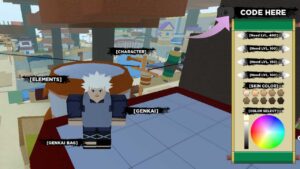
Once you enter the code it will give you the reward, here is a picture how it would look like if you still cant find where to redeem the codes:

Shinobi Life 2 Codes

Other Roblox Game Codes:

The post Roblox Shinobi Life 2 All Codes (November 2020) appeared first on Quretic.

  •  

Roblox Pet Heroes – All Pets with Stats List (2022)

In this tier list, we are having a look at all the pets including the stats in Roblox Pet Heroes that you can obtain by hatching or could obtain by trading.

Pet Heroes – Pets List

All the stats of the pets are non shiny that are Level 1.

The stats of every single pet from the list will include their damage, health and ability.

You can also check out all these codes for Pet Heroes to get free Gems

Isle of Beginnings Pets

Here is a list of all Pets from Isle of Beginnings that comes from starter egg and from the start of the game:

Neon Rider (Starter Egg)

  • Damage: 38
  • Health: 520
  • Ability: Speed Demon

Ancient Druid (Starter Egg)

  • Damage: 38
  • Health: 520
  • Ability: Druid’s Call

Ram

  • Damage: 42
  • Health: 240
  • Ability: Charge

Boar

  • Damage: 25
  • Health: 170
  • Ability: Frenzy

Bear

  • Damage: 13
  • Health: 160
  • Ability: Scratch

Wolf

  • Damage: 18
  • Health: 110
  • Ability: Howl

Bunny

  • Damage: 10
  • Health: 75
  • Ability: Hide from Enemy

Cat

  • Damage: 14
  • Health: 50
  • Ability: Scratch

Dog

  • Damage: 7
  • Health: 100
  • Ability: Bite

Parrot (Starter Egg)

  • Damage: 32
  • Health: 180
  • Ability: Mimic

Flying Islands Pets

Here is a list of all Pets from Islands Egg:

Dragon (Islands Egg)

  • Damage: 60
  • Health: 260
  • Ability: Flamethrower

Pegasus (Islands Egg)

  • Damage: 33
  • Health: 270
  • Ability: Tornado

Frog

  • Damage: 25
  • Health: 220
  • Ability: Poison Touch

Snail

  • Damage: 9
  • Health: 240
  • Ability: Shield

Wasp

  • Damage: 25
  • Health: 90
  • Ability: Poison Shot

Cow

  • Damage: 11
  • Health: 90
  • Ability: Charge

Pig

  • Damage: 8
  • Health: 110
  • Ability: Feed

Chicken

  • Damage: 14
  • Health: 70
  • Ability: Escape

Sky Buffalo (Islands Egg)

  • Damage: 24
  • Health: 240
  • Ability: Tornado

Ocean Ruins Pets

Here is a list of all Pets from Ocean Ruins:

World Turtle

  • Damage: 24
  • Health: 600
  • Ability: World Shell

Anglerfish

  • Damage: 39
  • Health: 210
  • Ability: Glow

Narwhal

  • Damage: 20
  • Health: 250
  • Ability: Clarity

Seahorse

  • Damage: 18
  • Health: 100
  • Ability: Escape

Jellyfish

  • Damage: 12
  • Health: 150
  • Ability: Poison Touch

Squid

  • Damage: 10
  • Health: 90
  • Ability: Bite

Crab

  • Damage: 8
  • Health: 120
  • Ability: Snip

Shark

  • Damage: 13
  • Health: 70
  • Ability: Bite

Sky Buffalo

  • Damage: 24
  • Health: 240
  • Ability: Tornado

Volcano Mines Pets

Here is a list of all Pets from Volcano Mines:

Cerberus

  • Damage: 44
  • Health: 360
  • Ability: Soul Drain

Devil’s Goat

  • Damage: 39
  • Health: 210
  • Ability: Sacrifice

Fire Raven

  • Damage: 27
  • Health: 220
  • Ability: Self Destruct

Cave Spider

  • Damage: 16
  • Health: 120
  • Ability: Poison Shot

Crystal Rhino

  • Damage: 12
  • Health: 160
  • Ability: Crystal Spikes

Scorpion

  • Damage: 15
  • Health: 60
  • Ability: Snip

Lava Bull

  • Damage: 5
  • Health: 120
  • Ability: Charge

Bat

  • Damage: 11
  • Health: 90
  • Ability: Feed

Golden Egg Pets

Here is a list of all Pets coming from Golden Egg


Fossil

  • Damage: 25
  • Health: 150
  • Ability: Nibble

Unicorn

  • Damage: 35
  • Health: 200
  • Ability: Magic

Griffin

  • Damage: 50
  • Health: 350
  • Ability: War Banner

Warbler

  • Damage: 70
  • Health: 450
  • Ability: Morrighan’s Call

Special Pets

Here is a list of all Special Pets

Penguin

  • Damage: 12
  • Health: 85
  • Ability: Iceberg

Polaris Star

  • Damage: 0
  • Health: 200
  • Ability: N/A

Nyan Cat

  • Damage: 65
  • Health: 400
  • Ability: Nyan Stars

Bongo Cat

  • Damage: 35
  • Health: 600
  • Ability: Bongo Bongo

Here is the source where we found out about the pets, have a look to find out more in-depth about the pet abilities.

The post Roblox Pet Heroes – All Pets with Stats List (2022) appeared first on Quretic.

  •