Zobrazení pro čtení

Reality Isn't So Kind: How Final Fantasy VIII's Child Soldiers Defy Destiny
Reality Isn't So Kind: How Final Fantasy VIII's Child Soldiers Defy Destiny

The day is long. Beginning with an early morning training session that ends in blood and scars, followed by a teacher-led field test against the Guardian Force Ifrit, Squall finds himself on unfamiliar shores, the intrepid pre-graduate SeeD mercenary tasked with securing a portion of the Galbadian-occupied city of Dollet.

Pridefully, Seifer Almasy pushes Zell and Squall onward, where they meet the new transfer, Selphie, at the top of a ridge. Tired, battered, and sidling war crimes mid-seige, they follow Seifer to an abandoned radio tower, where the abandonment of their post has them play unwitting heroes before a withdrawal order.

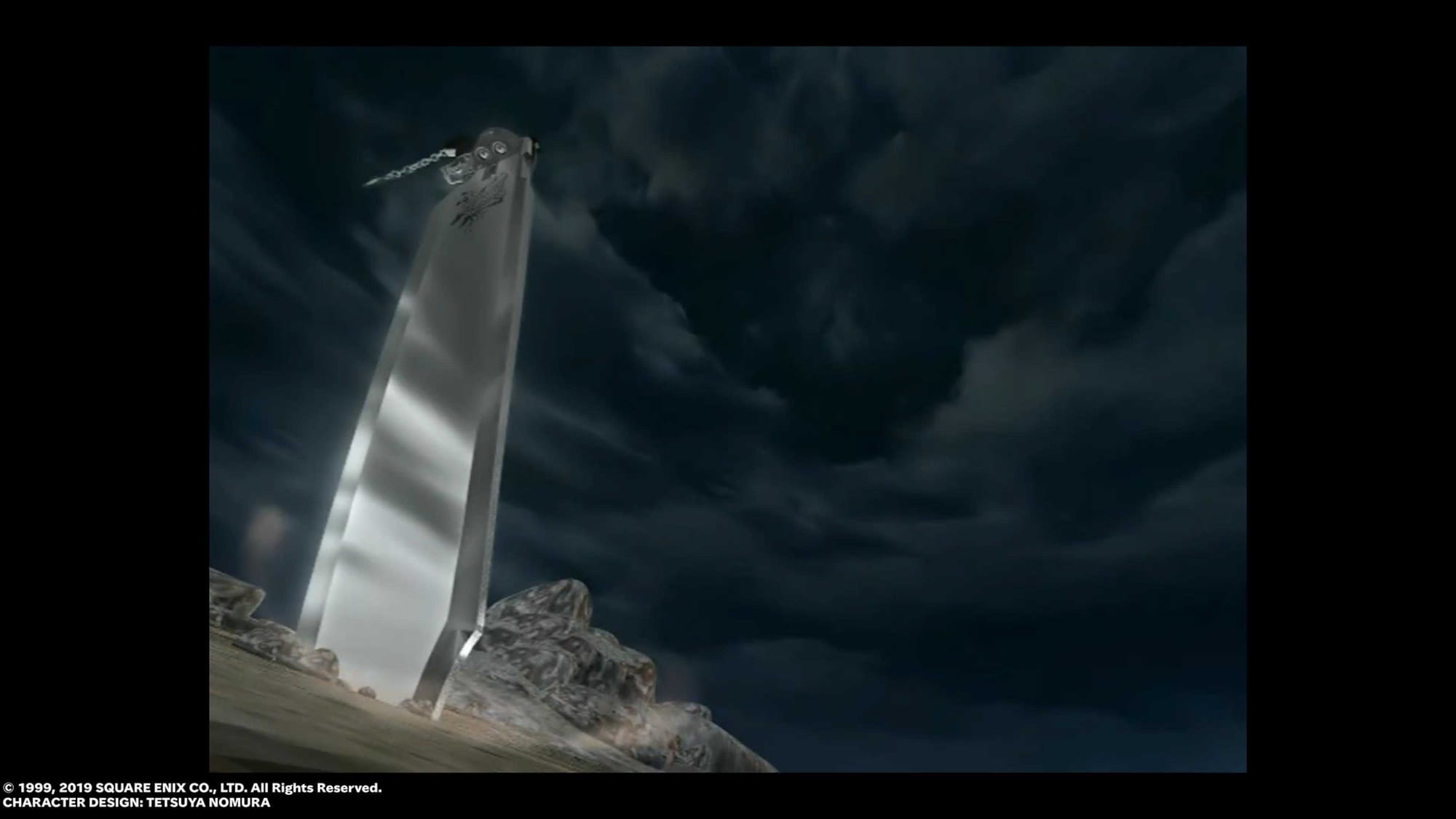
Briefly, Seifer asks Squall about his personal dream.

"The way I look at it," says Seifer. "As long as you make it out of battle alive, you're one step closer to fulfilling your dream."
Reality Isn't So Kind: How Final Fantasy VIII's Child Soldiers Defy Destiny
Screenshot: Author.

It's a romantic one, Seifer says, though players familiar with Final Fantasy VIII know the outcome of his misguided aspirations. Inspired by action films and the abandonment of boyhood, Squall's rival dedicates his solipsistic dream to manipulating another. And Seifer's dream is this: to be a sorceress' knight, to follow in the footsteps of a childhood motivation, to play the hero. Seifer may come across as a bully, but he's very critical of the world as presented. Despite being part of the student-retained "Disciplinary Committee," Seifer's laid-back attitude underpins a character that doesn't respect the status quo.

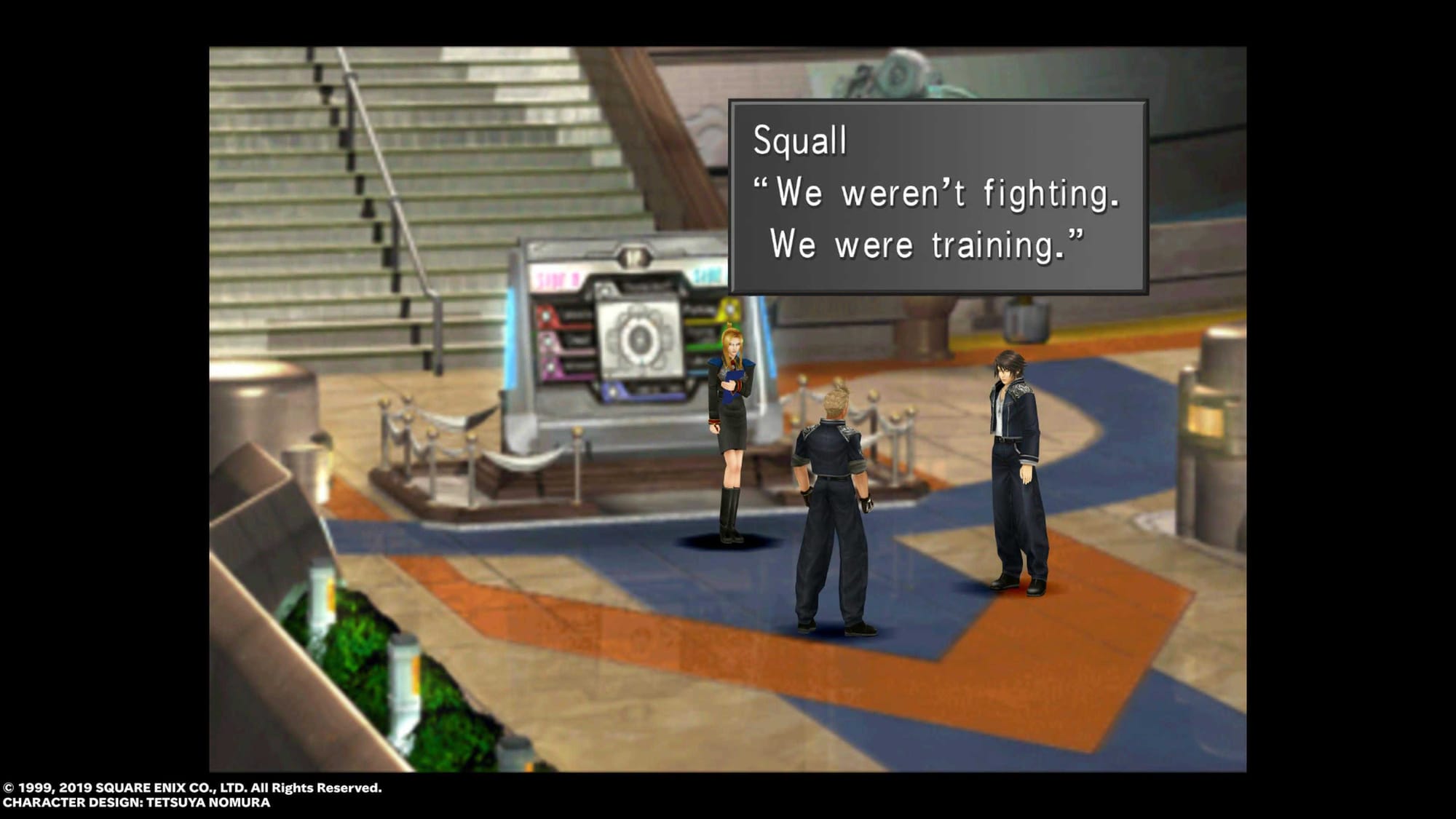
Later in the game, after Squall and company have been abducted and imprisoned by the Galbadian military, Squall faces torture at the hands of an opportunistic guard. The torturer demands to know the true goal of SeeD—something that Seifer, a failed student who didn't graduate, supposes is a secret universal truth of those who complete their exams.

While Squall's sophistry (and frequent apathy) are defensive, this dismissive joke ties into the game's underlying themes, driving the anti-violence philosophy espoused when the party reaches Fisherman's Horizon, and deeper still, the thematic identity of adept child soldiers in a world of ineffectual adults.

"...Flower." Squall can barely lift his head from the pain of torture. "The true goal of SeeD is to spread seeds all over the world, to fill the world with flowers."

No, the goal of SeeD isn't anything ecological. Seifer and Squall both experienced caged, manipulated dreams. The only environments affected by these young soldiers become battlefields.
Reality Isn't So Kind: How Final Fantasy VIII's Child Soldiers Defy Destiny
Screenshot: Author.

Soft Imperialism

Squall is faced with the sins and circumstances of his actions more than once in the course of Final Fantasy VIII's story. At Fisherman's Horizon, a sealevel utopia governed by a socialist mayor and populated by peace-loving engineers, Squall confronts the reality of his actions as a student of warfare. The apathy that guards him from responsibility is stripped away as he is forced to face the fact that war and peace are not a simple binary.

SeeD mercenary interference, even when left to small squads of two or three, can be enough to upset governments, political agendas, and entire communities. Paid warfare shapes the world, allowing both activists and opportunists to recreate the setting, law, and standard.

Squall tells Mayor Dobe at Fisherman's Horizon:

"It's hard for me to explain. I wish everything could be settled without resorting to violence...and there would be no need for battles. Like you've been preaching, it would be wonderful if things could be settled by discussion. The only problem with that is that it takes too much time. Especially if the others are not willing to listen. So I believe that fighting is inevitable at times. [...] I think the world needs both people like you and people like us."

The Timber region's early-game exploitation by SeeD is framed as salvation. Rinoa, revealed to be an excitable activist and the rebellious daughter of a Galbadian general, begs Balamb's headmaster to grant her Squall, Zell, and Selphie. These newly graduated cadets do not have the life experience or the political acumen to comprehend the gravity of their duties. The 18-year-long Timber rebellion has been fronted by underground resistance groups who, in the wake of the second Sorceress War, fight for independence from Galbadia.

While Timber rots beneath fascist rule and faces continual hardships due to the clashes between resistance groups and the military, its retrograde standards assign it as an independent nation. Galbadia's firmer "peacekeeping" force shuts down railroads and prevents mainstream outside news from reaching local citizens.

Rinoa's misguided activism and Team Squall's violent interference feel like justice and salvation. Inevitably, their actionable plan leads to a disruption in the city; the party attempts to assassinate a high-profile Galbadian leader, only for Squall to clash again with Seifer. Their naive tactics result in further retribution for Timber; instead of sticking with the citizenry, Rinoa and the others abandon the region as the war escalates and their mission changes.

Timber, while temporarily "saved," must contend with the Galbadian army alone. As resistance groups continue to fight for independence, the ever-changing direction of SeeD manipulates the political atmosphere—a wedge between countries and regions imbalanced by warfare. Initially, they are presented as guns-for-hire who have the power to enact regime changes or defend war-torn regions, and Squall is a representative of the sort of apathy the apolitical Gardens espouse.

SeeD are not heroes; they are the willing but naive weapons of a private military.
Reality Isn't So Kind: How Final Fantasy VIII's Child Soldiers Defy Destiny
Screenshot: Author.

What is SeeD?

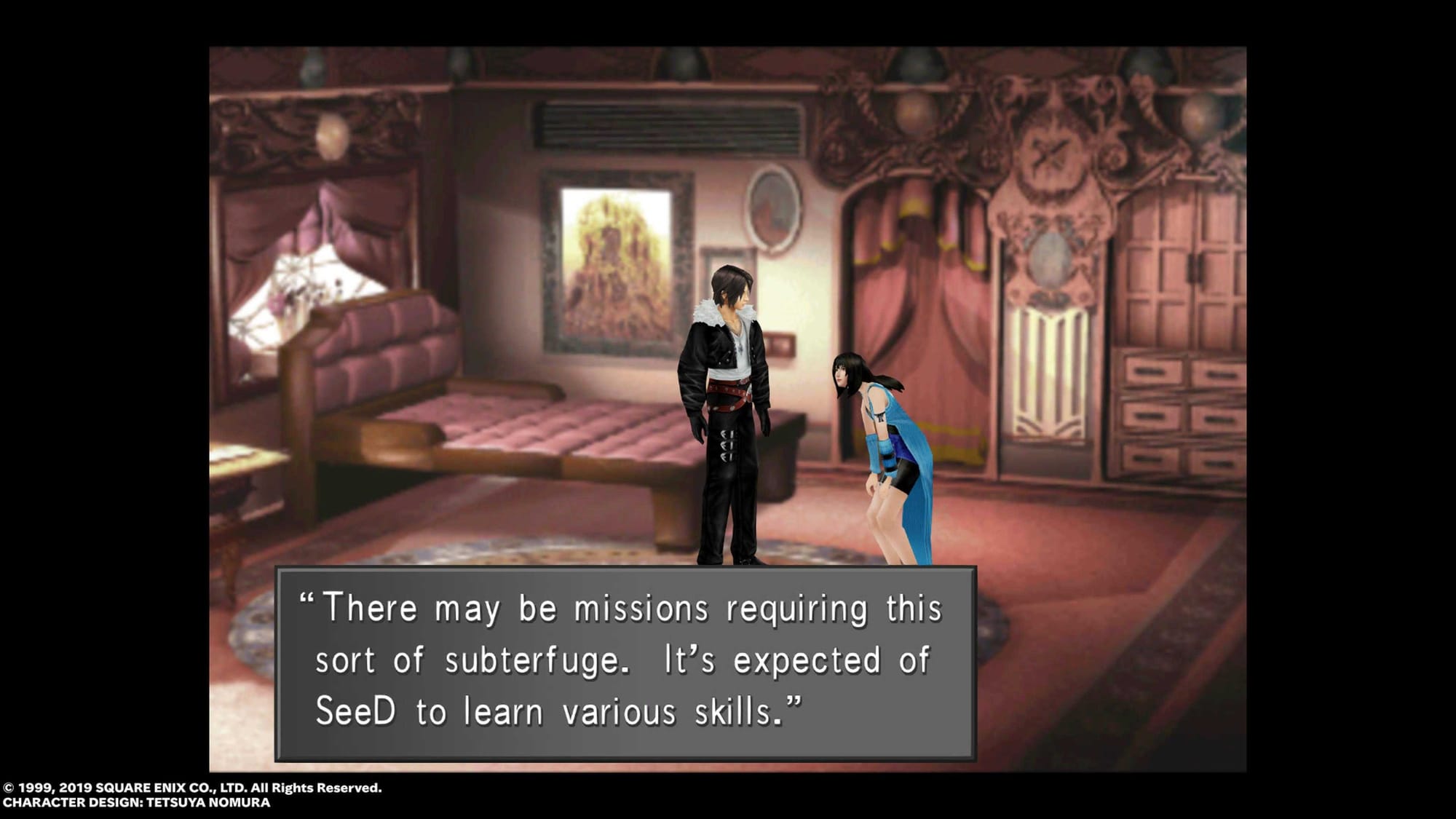
A corps brigade of military students, a mercenary force, a private army—SeeD is made up of young operatives who graduate from Garden, an international military academy that deploys their undergrads, students-in-training, and graduates on paramilitary missions that range from battle support to undercover operations. SeeD members provide support, protect civilians, slay monsters, and can also be utilized for surgical missions.

Balamb Garden is the centralized base that trains SeeD cadets, but sends its members to other Gardens, including Galbadia and Trabia. SeeDs are set apart from other world militaries because their operatives can utilize para-magic (a synthetic recreation of Sorceress magics) and brutally powerful but heavily controversial Guardian Forces.

SeeD forces are primarily made up of children. Many undergraduates are homeless orphans displaced by previous wars. In that fact, the SeeD organization does not have to worry about refilling its ranks—the continued military actions and violent regional shakeups all but ensure more children will be absorbed into the SeeD program.

While the true purpose of SeeD is more mythological than its leaders initially admit, it is fronted by the Headmaster's desire to have a military corps that can do some good in the world. His flat naivety is repeated post-graduation, where he tells the cadets he wants SeeD candidates to "think and act for themselves." A cold, disconnected, haughty sentiment to place at the feet of human weapons.

Uncivil Unrest

Child soldiers are not a fantasy fiction. While they may be used as plot devices in games such as Final Fantasy VIII and Metal Gear Solid, this is a real-world problem that grew exponentially between 2005 and 2022. Dangerous military organizations rely on child soldiers because they are easily captured and coerced. Children are conscripted as anything, from fighters to scouts to messengers to guards.

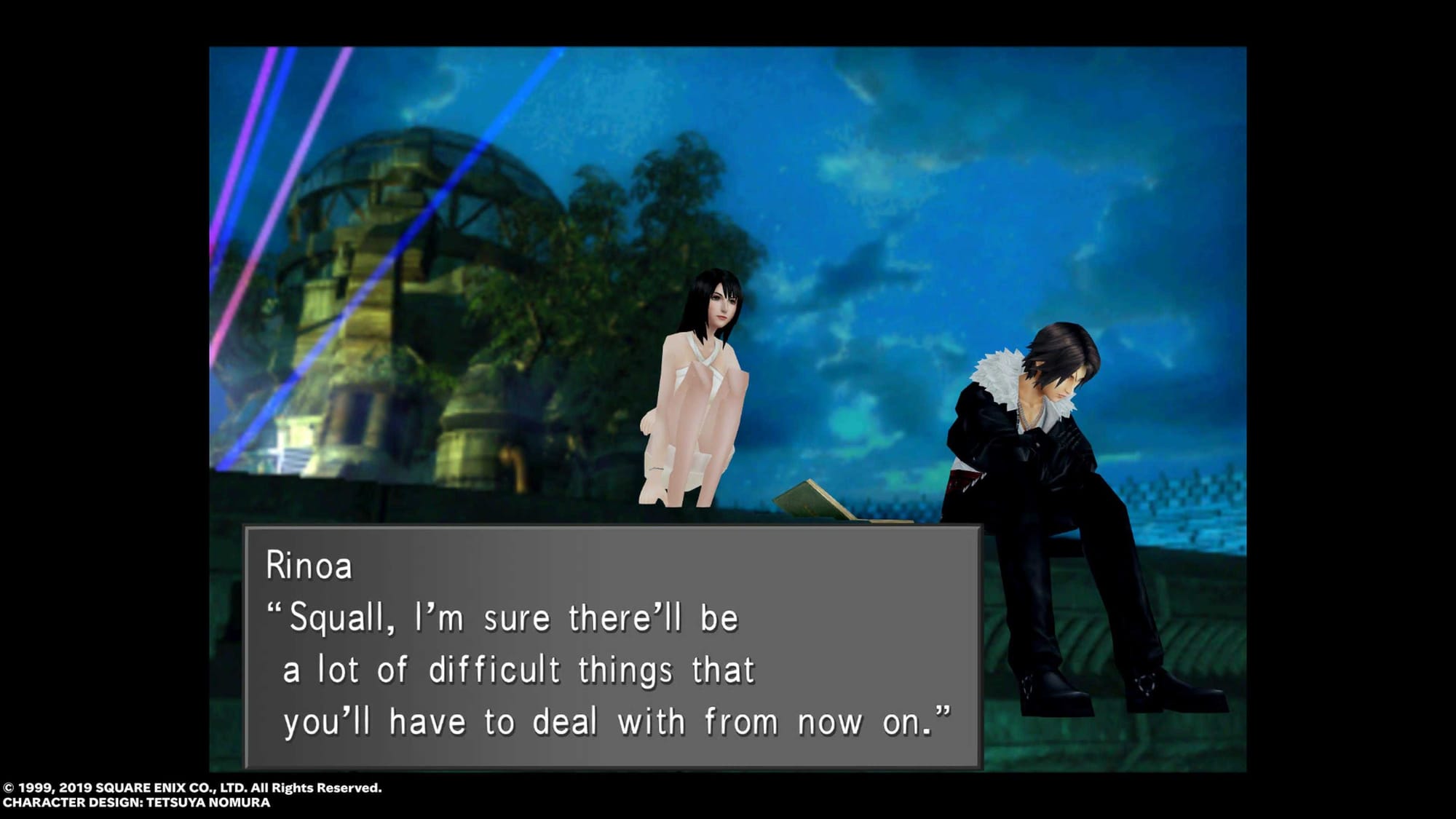
The density of Final Fantasy VIII's plot casts a shadow on the dispensability of Garden and its child soldiers. It is not by accident that SeeD members must be between the ages of 15 and 19, or that the organization prefers the malleable minds and bodies of children. The anti-humanitarian actions of Garden are the ultimate example of "the ends justify the means." Headmaster Cid and his cronies place unbelievable pressure on cadets like Squall, whose young lives are so entangled by the pursuits of Garden that they cannot envision themselves in a place without it.
Reality Isn't So Kind: How Final Fantasy VIII's Child Soldiers Defy Destiny
Screenshot: Author.

To this end, there is no happy ending in Final Fantasy VIII. Garden is not dissolved, and its place in the world is actually reinforced by Squall's incidental run-in with Matron at the end of the game, where he seals his destiny by creating a causal loop.

War never changes, because SeeD doesn't know anything else.

World at War

If you bear the misfortune of being in your 30s (or older), you have no doubt borne witness to the war crimes of the United States military during the 20th and 21st centuries.

The invasion of Iraq happened in 2003, when I was just fifteen years old. America is an oil-dependent country, poor in its own resources, historically ignoring the needs of its citizens as it pours taxation into military might. America, as an empire, rules and defends through fear, invading other countries to create regime changes or dismantling other governments entirely by replacing figureheads with American-approved political powers. We are reactive, violent, and cruel.

In Metal Gear Solid V, the Militaires Sans Frontières is headed by Big Boss in the 1970s. This "Army Without Borders" is a private military that provides its resources to all clients, and its self-appointed "soldiers without borders" program does not make judgments based on nation, creed, or ideology. Noble, certainly, but militaries for hire commonly care about resources above all else, and the actions of Big Boss and Master Miller show this. Big Boss's ideology initially prevents him from becoming a warmonger. Still, the nomadic, Cold War-era MSF carries out operations that destabilize entire regions, recruiting and kidnapping soldiers from all over the world to join their operation. Like SeeD, they stabilize their recruits with propaganda, creating a mighty force that owes singular allegiance to a mythology.

While the tyrannical military actions of Galbadia in Final Fantasy VIII cannot be defended, Garden's less-than-scrupulous tactics allow an apolitical third party to create and recreate the world at will. The rise of Galbadian and Estharian powers in Final Fantasy VIII is the direct result of the fallout of the Sorceress War two decades prior, just as SeeD is a reaction to the potentiality of another powerful sorceress like Adel.

Players are shown early on that SeeD can be used for good, such as thwarting Galbadian forces in the Dollet region or aiding Rinoa and the Timber resistance in defending their city. However, the will of the Garden is, ultimately, up to its Headmaster and investors, and the so-called "good" they generate is backed by bureaucracy and gil.

Love Blooms on the Battlefield

It is the nature of SeeD to die in someone else's war. The love story between Rinoa and Squall is underlined by the fact that Rinoa has the luxury of choosing her battles and battlefields; Squall, in contrast, is a creature of Garden.

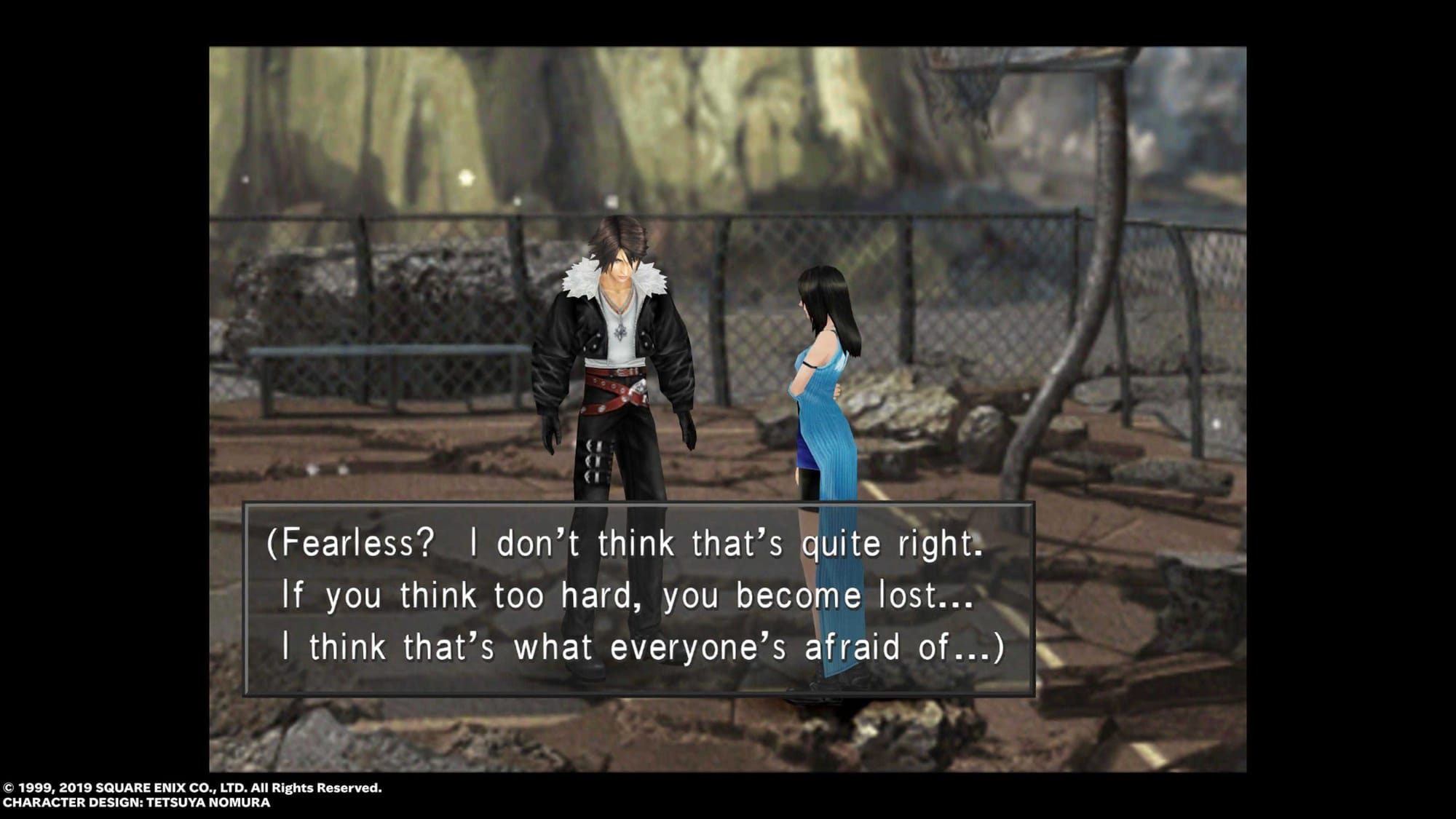
The characters themselves exhibit various pathologies and traumas that emerge during the course of the combat. Squall's cold disposition and disconnectedness are a shielding apathy. "As long as you don't get your hopes up, you can take anything...You feel less pain." Selphie's dogged, dark humor strips down the reality of their cause, from absurdity to direct violence. Irvine, his traumas most notable to the story itself, fails as a sharpshooter, choking at the exact moment he is to assassinate the Sorceress in Galbadia. Zell says, "You tell us to go, we go. Even if it is a losing battle," resigning the cocky humor of his character to the reality of being a SeeD.
Reality Isn't So Kind: How Final Fantasy VIII's Child Soldiers Defy Destiny
Screenshot: Author.

During wartime, the more conscientious among us ask ourselves how we can go on enjoying our daily lives in the face of such despair. Like Balamb and Galbadia, America is often at war with itself: we watch via social media as masked cowards use lethal force on everyday citizens, and entire cities are caught up in the wake of violent chaos, pushed onward by a military engine that neither makes sense nor has the favor of the people.

Rinoa does her best to undo Squall's emotional armor, occasionally needling him in an effort to remind him that he's an actual person, and not just a mercenary of Garden.

"Gosh, you're such a pessimist. There are no guarantees in the future. That's why TODAY, the time we have now, is important. Squall, we wanna help you, as much as we can, for as long as we can. We all love you. There, I said it. Please don't freak out. We just wanna live, y'know, live through this time with you, together."

Right and Wrong

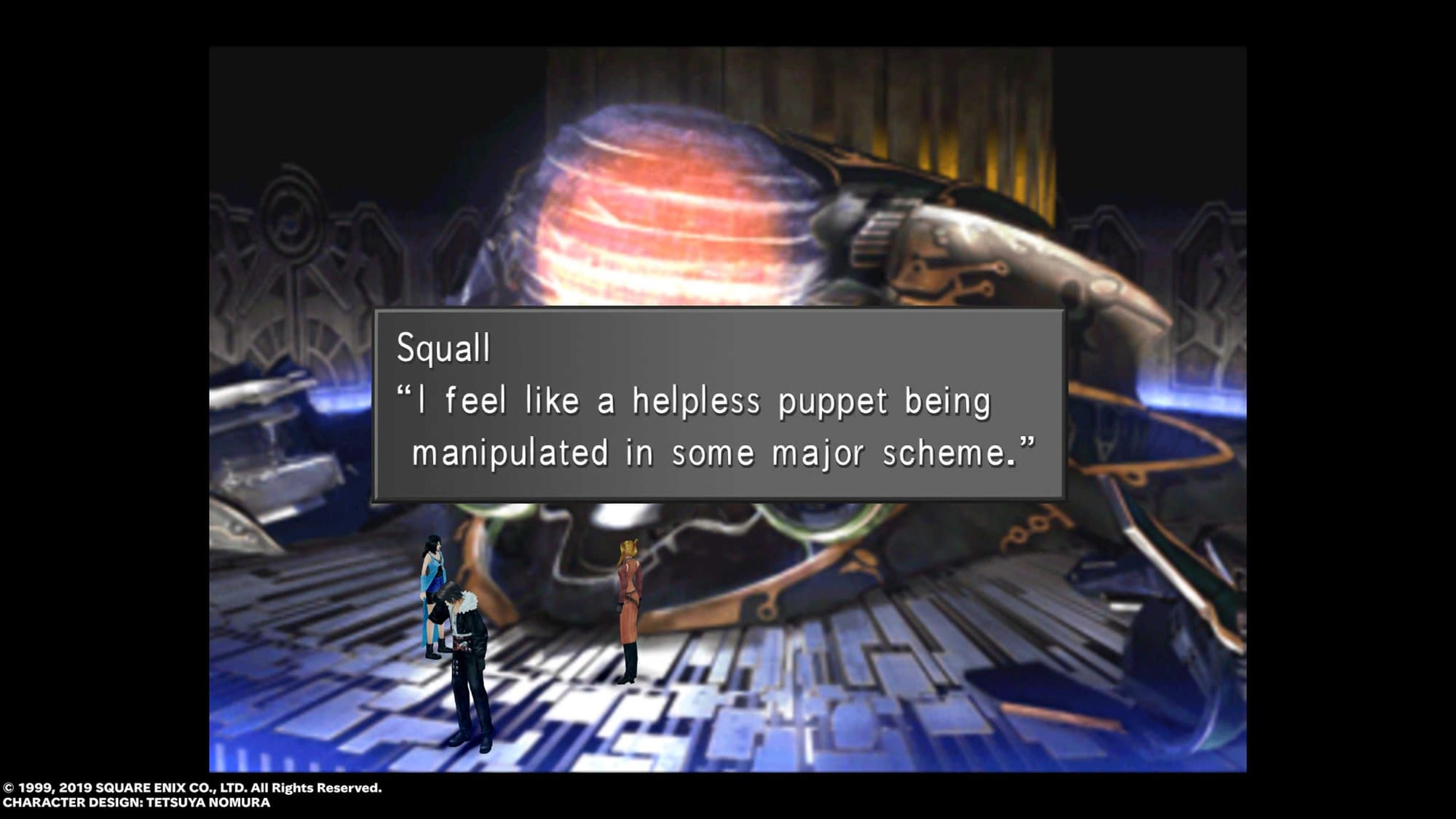
Every action has an equal and opposite reaction. During their mission in Timber, Zell lets his anger get the best of him, reacting strongly to Seifer's rogue actions. Hearing this, President Deling threatens to use the entire military force of Galbadia to crush Garden. As retribution for the attempted assassination of the Galbadian Sorceress, missiles are sent to Trabia Garden, and the player is only allowed to see the aftermath. SeeD soldiers become unwitting heroes as war escalates and the Sorceress takes control of the Galbadian military. Children are placed on the frontlines.

"What's the point of talking about it now!? You don't know what's going on, either! This is crazy. I don't know what's goin' on anymore. I feel like a helpless puppet being manipulated in some major scheme."

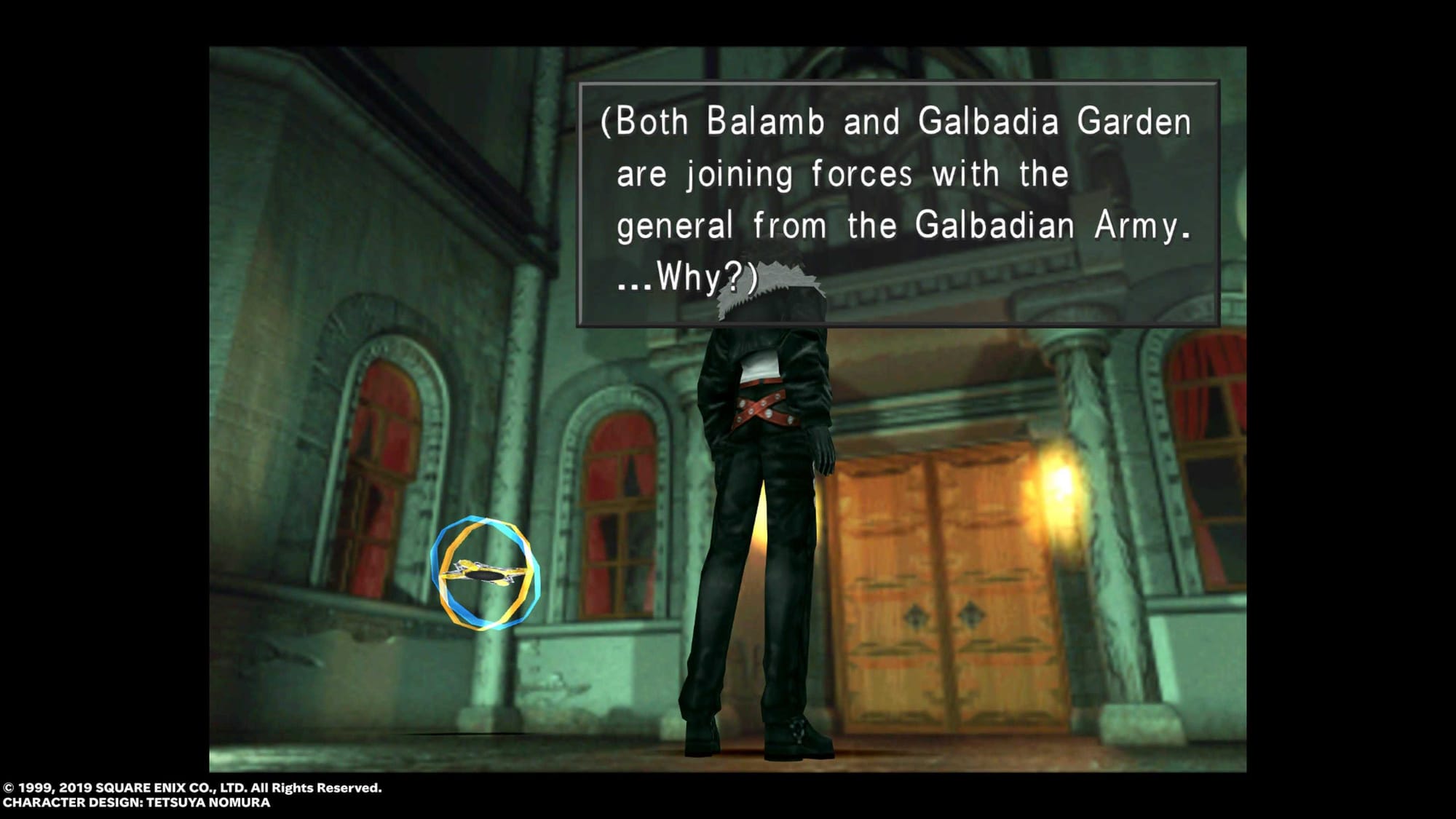
Later, when Squall must face the truth of Garden's dark investments, he realizes that the true goal of SeeD is not so simple as he was led to believe. His childhood naivete is stripped away as he is forced to confront the darker truths of being a child soldier. Directionless, Squall doubts those around him, including the Headmaster of Balamb Garden.
Reality Isn't So Kind: How Final Fantasy VIII's Child Soldiers Defy Destiny
Screenshot: Author.
"SeeD will defeat the sorceress. The Garden will train SeeD members. The many missions around the world are only training for the final battle against the sorceress. But now that the sorceress has become a major threat, our true mission has begun."

Headmaster Cid admits that all of SeeD's training, including their real-world tactical missions that have resulted in student and civilian death, has all been for a singular purpose. Garden may not be a sovereign nation, but it operates as one. As with America's invasion of Iraq or Venezuela for oil, warfare is rarely ever about the pursuit of freedom or emancipating a beleaguered citizenry from a dictator. It's an opportunity disguised as a revolution.

"Right and wrong are not what separate us and our enemies. It's different standpoints, our perspectives that separate us. Both sides blame one another. There's no good or bad side. Just two sides holding different views."

Squall is forced to reckon with the human cost of warfare. SeeD missions are not just extensions of Garden's power; they have real human costs.

Liberi Fatali

"We're not kids anymore... We're strong enough to take care of ourselves. Make our own decisions...We're confronting a big one right now. Do we fight Matron or not...? I say we fight...Shoot for a common goal...Hey, at least it'll keep us together a little longer."

Irvine reminds Squall that it doesn't matter what's come before; it's the actions of today that make a difference. Ultimately, it is camaraderie that forces Squall to change. As a group, they no longer owe allegiance to Garden. Squall admits that he wishes they didn't have to fight, that maybe a path of peace could be possible if they had the time and resources to explore it. When he becomes Commander, he realizes he can no longer weigh the cost of individual lives; Squall is responsible for every single person who fights on behalf of Garden.
Reality Isn't So Kind: How Final Fantasy VIII's Child Soldiers Defy Destiny
Screenshot: Author.

Too often, children must carry the sins of authority, stripped of any choice by the adults and figureheads in their lives. Even into adulthood, there are moments when our lives feel choiceless, when we are forced between despicable action and frustrating inaction. Irvine reminds the party that it was never their choice to join Junction Guardian Forces, it was never their choice to fight, it was never their choice to be part of someone else's army.

Irvine resigns himself to his past.

"You've all heard this before. How life has infinite possibilities. I don't believe that one bit. There weren't many paths for me to choose. Sometimes, there would only be one. From the limited possibilities I faced, the choices I made have brought me this far. That's why I value the path I chose...I want to hold true to the path that HAD to be taken."

As children whose lives have been ripped apart by war, Squall and the others continue on the only path they've ever known. These children of fate have been born into a world that only wishes to use them. Irredeemably, "fate" and "destiny" are utilized against them, limiting possibility and potential. But Squall makes an effort to face this destiny head-on, to cut away the worn paths laid out for him.

Quotes from Final Fantasy VIII were pulled from the game script.

  •  

Classic 'Bubble Bobble' gets a rather nice C64 remaster by Dave's Retro Forge [BIG 1.1 UPDATE]

If you were a huge fan of Taito's Bubble Bobble in the Arcades or at home, then you'll be pleased to know that as of right now, you can download Dave Retro Forge's graphically superior version of 'Bubble Bobble Remastered' for the Commodore 64. A new version which is getting great viewer feedback such as "The C64 version is the one I played the most, and this looks fantastic" and "Wow, great job!

  •  

King's Quest V - A great adventure game by Sierra gets an Amiga OCS remaster

Many years ago in the early 90's there was a classic Adventure game by Sierra called King's Quest V, which featured the first King's Quest instalment to replace the typing user interface with a point-and-click user interface. It was in my opinion one of the best games in the series, which even today sits proudly on my shelf amongst other greats by Sierra. Well if you too remember this game will

  •  

A new Dead Rising is reportedly on the way, and one that might come with a familiar face

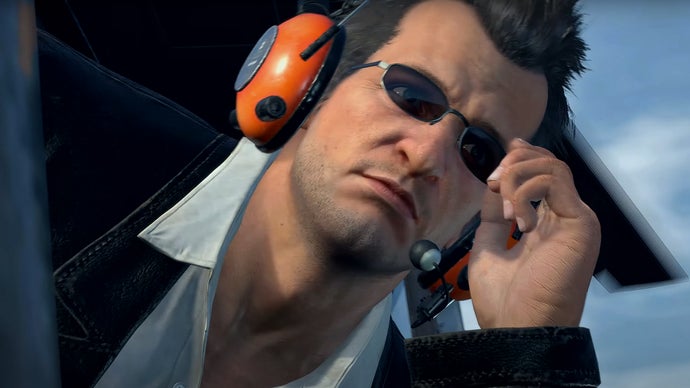
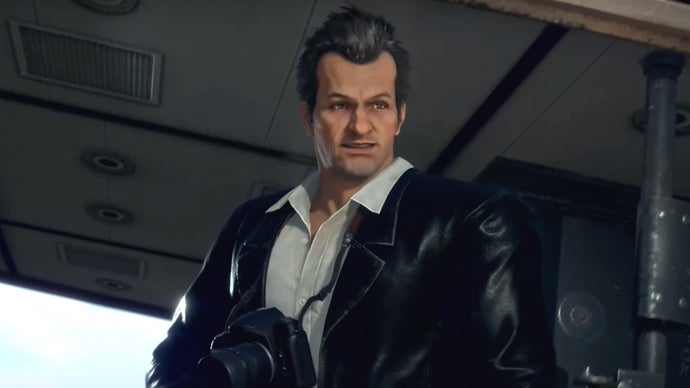
All that trouble going on with Monster Hunter Wilds aside, for a good long while now Capcom has been doing quite well for itself. Multiple quite well liked Resident Evil games, fresh new bits like Kunitsu-Gami: Path of the Goddess and the upcoming Pragmata, and even a few remasters, namely for the Ace Attorney games (throw a dog a bone and give us a new one of those, though Capcom), but also for series like Dead Rising that also haven't had a new entry in a while. Well, for now at least, as a new report suggests a new Dead Rising might be in our future.

Read more

  •  

Nightdive Explains How Outlaws Set the Standard for Western Games

Nightdive Explains How Outlaws Set the Standard for Western Games

  • Morgan Shaver, Communications Manager at Nightdive Studios
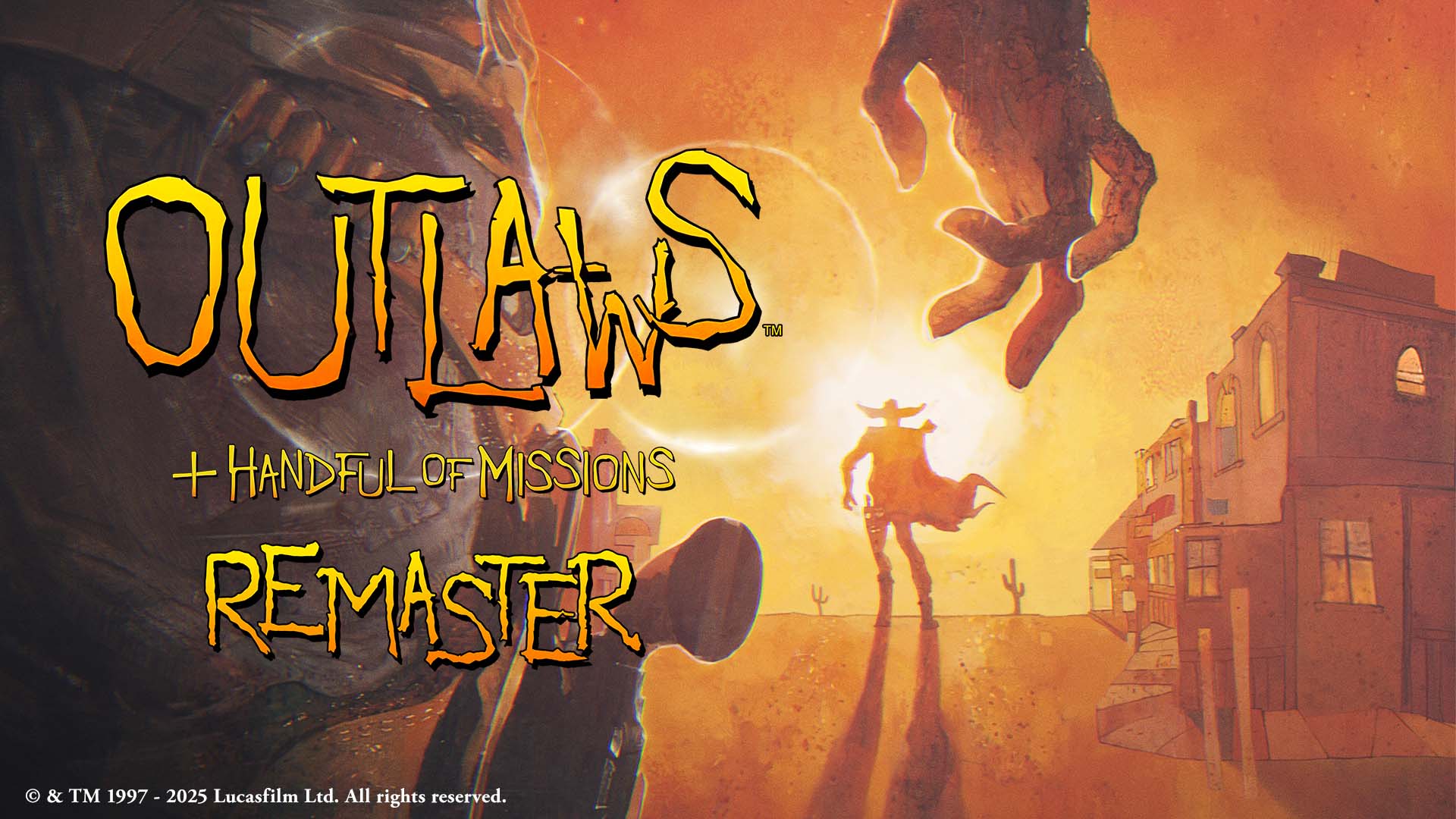
Outlaws Remaster

In the ’90s, over a decade before the release of epic Western adventures like Red Dead Redemption, LucasArts introduced the world to Outlaws. Originally released in 1997, Outlaws was a truly groundbreaking entry in what was widely considered a niche genre at the time.

It was also LucasArts’ first venture into the creation of an original first-person shooter.

From Star Wars to Outlaws

To help set it apart from previous Star Wars-related releases, LucasArts modified the Jedi game engine they’d previously utilized for Star Wars: Dark Forces and enhanced the INSANE animation engine to better optimize it for Outlaws’ cutscenes.

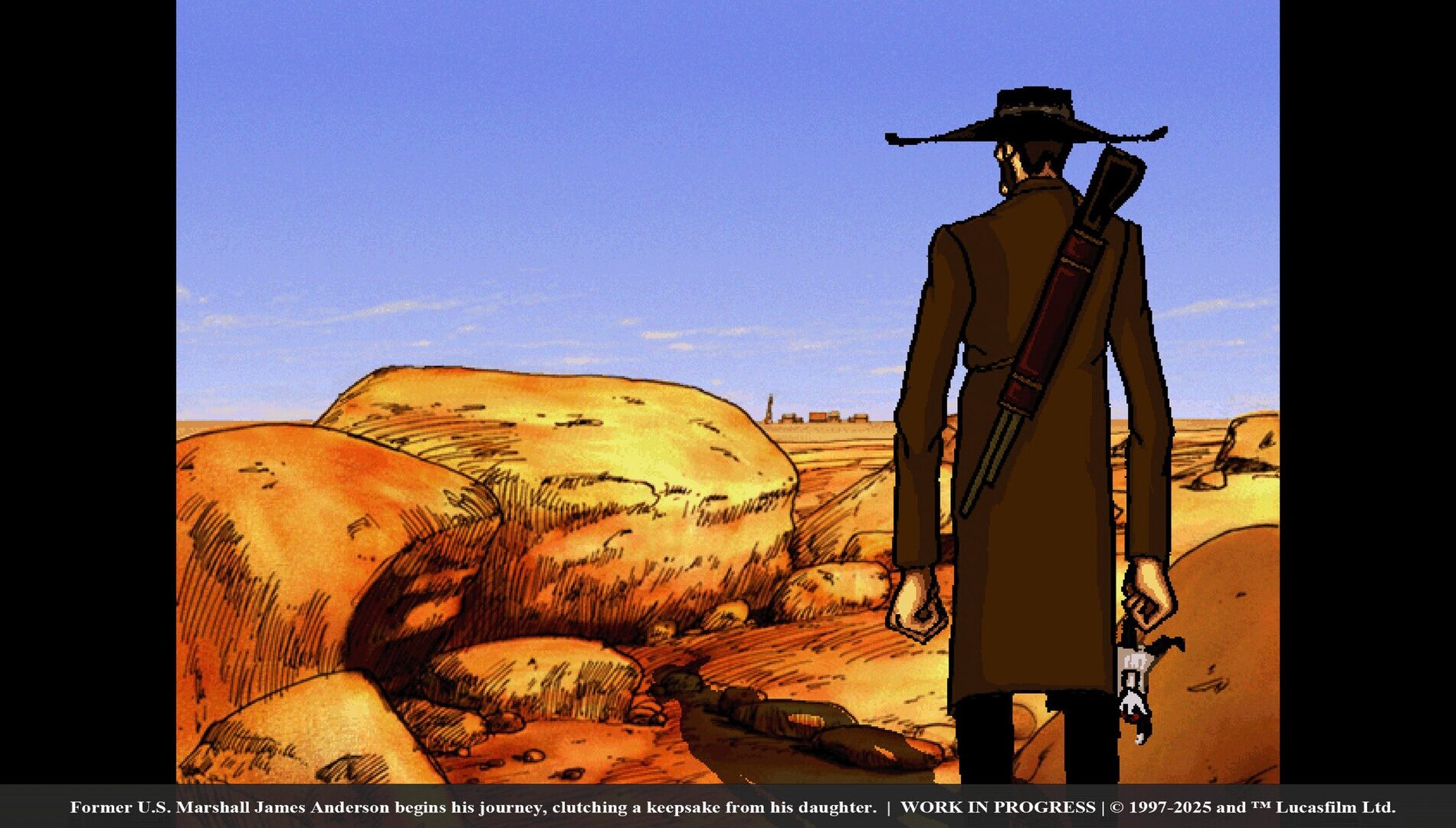
LucasArts also created a compelling Western-style plot and cast of characters for the game, including protagonist James Anderson, a retired U.S. Marshal who sets off on a quest for vengeance after his wife is murdered and his daughter kidnapped by outlaws.

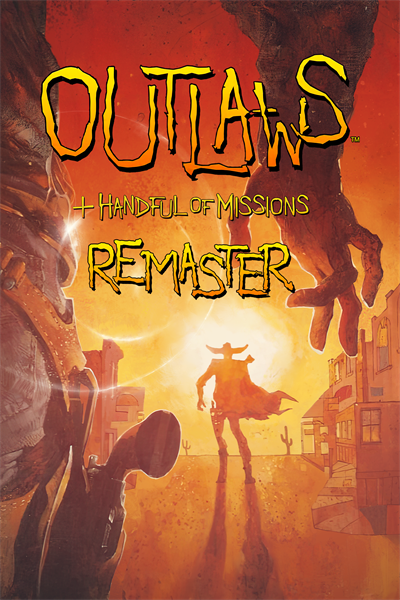
Outlaws + Handful of Missions Remaster

Drawing inspiration from Sergio Leone’s spaghetti Westerns, the outlaws who murder Anderson’s wife aren’t rogue agents wreaking havoc at random. Instead, they’re employed by a corrupt railroad baron, Bob Graham, who seeks to intimidate Anderson into selling his farm so he can build his railroad through it.

Departing from the colder sci-fi settings of titles like Star Wars: Dark Forces, even the grimmest moments in Outlaws are bathed in warmth thanks to its colorful, hand-painted backgrounds and fully animated, voice-acted cutscenes.

A great example of this can be found right at the beginning of the game, with cutscenes showing the happy home life Anderson will soon be robbed of, along with his wife and daughter.

Beyond its visuals and story, a key way in which Outlaws proved itself noteworthy was with its soundtrack.

Outlaws Remaster

LucasArts understood music to be an essential part of the Western genre, with Outlaws becoming the first FPS of its kind to feature a fully orchestrated score created by legendary composer Clint Bajakian.

Working with the Original Team

In Nightdive’s recently released Outlaws + Handful of Missions: Remaster, you’ll be able to revisit the game’s iconic soundtrack in its Vault. In addition to behind-the-scenes documents and concept art, the Vault features commentary from Clint Bajakian for each of the score’s 15 tracks.

“The style was to be an original homage to the great spaghetti Western soundtracks of the late Ennio Morricone,” Bajakian explains in his exclusive Vault commentary. “Most all of the score is live recording, making possible the achievement of something real, something truly spaghetti.”

Not only will fans be able to enjoy Clint Bajakian’s insight into the creation of the game’s soundtrack, but Nightdive also conducted a special Deep Dive podcast interview for Outlaws with original level designer Kevin Schmitt.

“I textured most of the levels in Outlaws — you know, the texture artist created it and I put it on the walls,” Schmitt recounts in his Deep Dive interview. “I placed the props, I placed the enemies, I did the scripting, I placed the audio. We wrote a lot of the dialogue; we did everything back then.”

Outlaws Remaster

As nice as it is to have these as bonus items with Outlaws + Handful of Missions: Remaster, for Nightdive including members of a game’s original development team wherever possible is considered a key part of the remaster process.

“Involving members of the original development team is important because it’s vital for authenticity, accuracy, and respect for the artists and developers who brought their vision to life,” Kick explains. “Their insight into mechanics, limitations they faced, and design helps our team keep the remasters we develop faithful to the original, not just in look, but in spirit as well.”

Modernizing a Timeless Classic

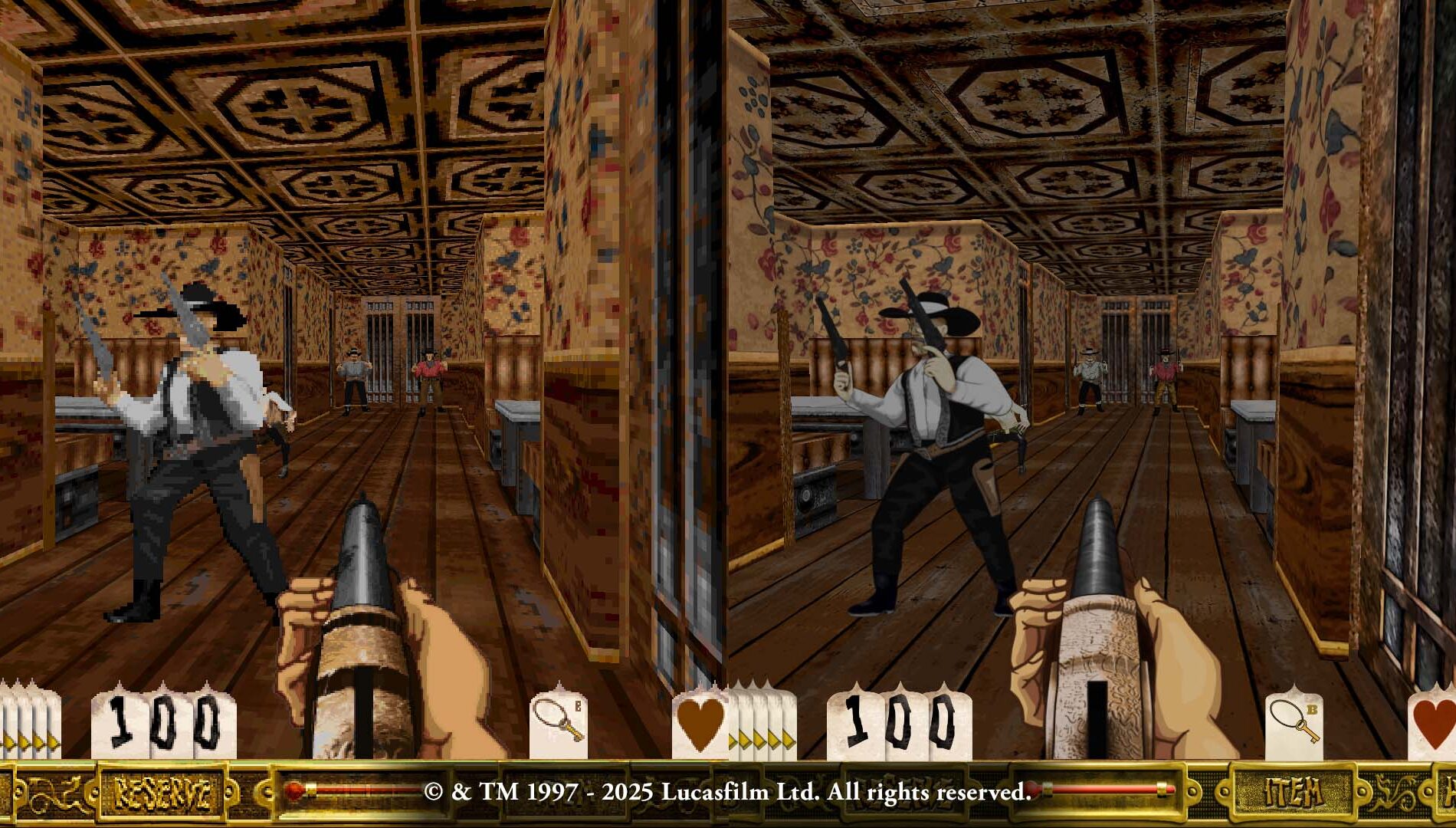
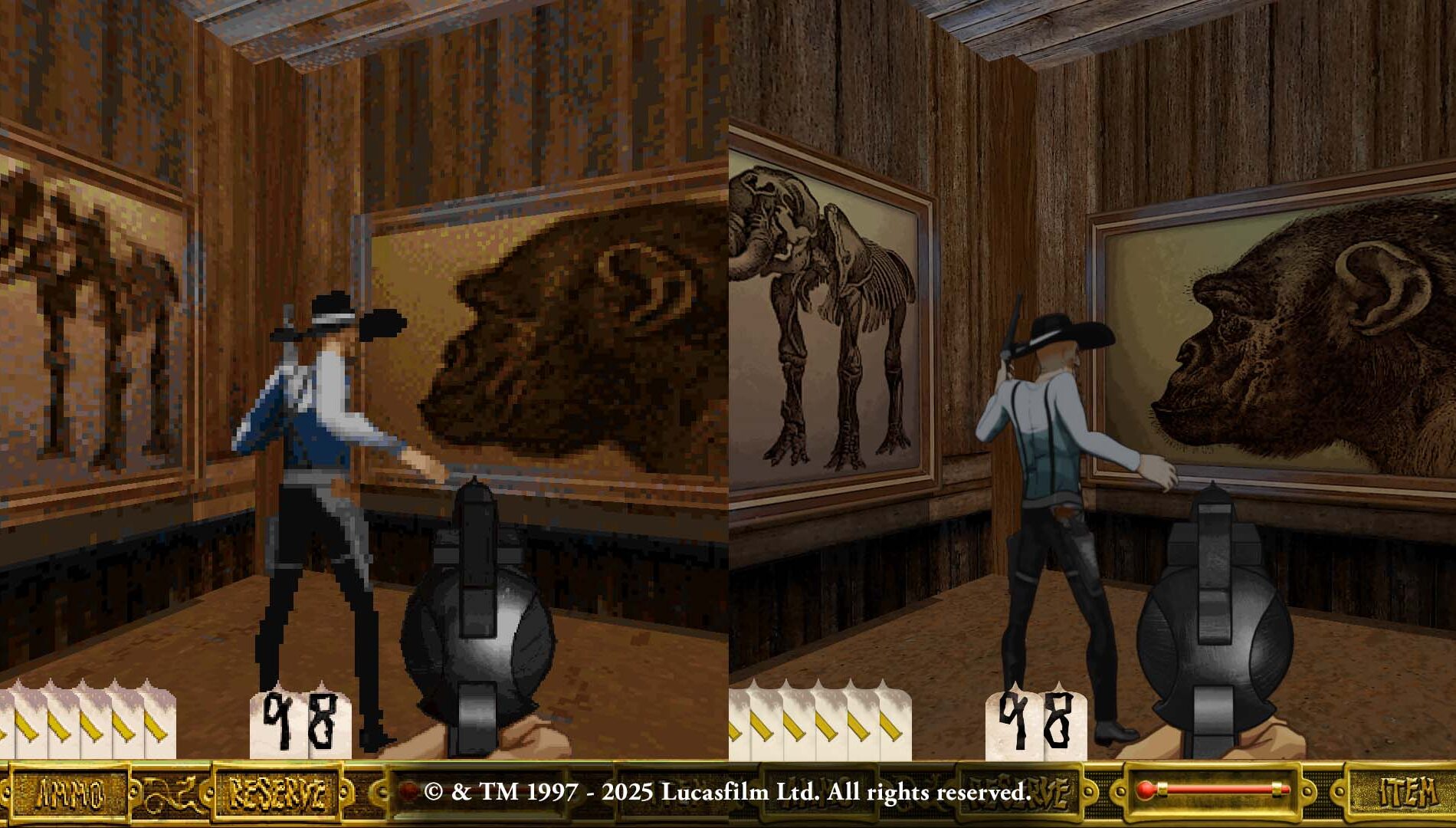
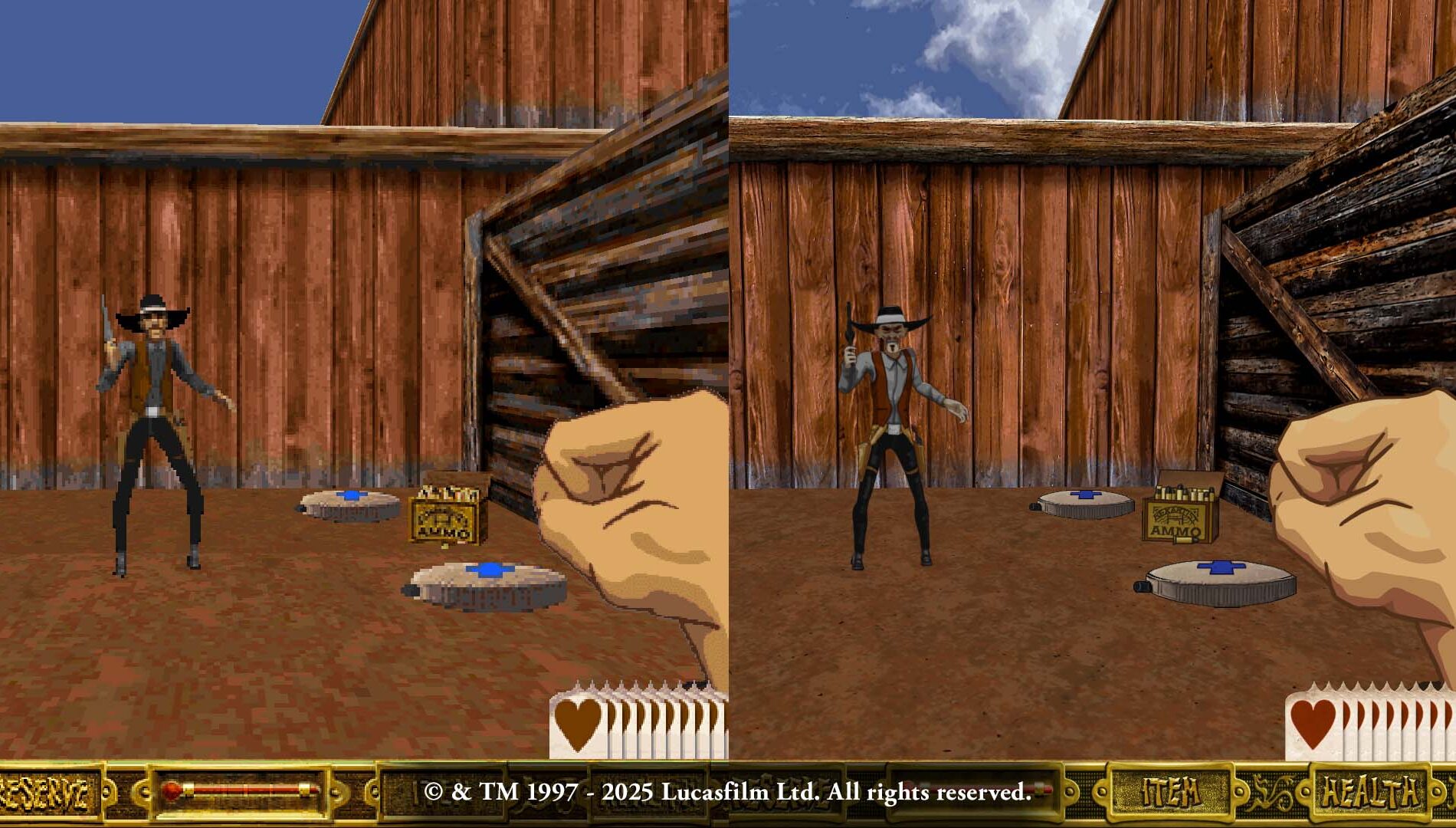
For Nightdive, maintaining the authenticity of a game’s original experience is one of the studio’s primary goals. The team wants the game to play the way you remember it, with options included in Outlaws + Handful of Missions: Remaster that emphasize this, including the ability to toggle between the game’s original and remastered graphics.

While originally a PC release, Outlaws + Handful of Missions: Remaster will be available on consoles for the first time ever, including Xbox One and Series X|S. On consoles, Outlaws will offer improved gamepad support, including a weapon selection wheel, aim assist, and rumble.

No matter how or where you choose to play it, nearly three decades after its original release, Outlaws continues to remain a defining entry in the Western genre — one that’s well worth revisiting or checking out for the very first time.

When asked why Outlaws continues to resonate with gamers to this day, Kick explains:

“Where most FPS games of its era were about shock and spectacle, Outlaws told a simple, emotional story underscored by a music composition that treated the material with genuine gravity. There simply weren’t many Western-themed games during this time.”

Outlaws Remaster

If you’re wondering whether physical editions of Outlaws + Handful of Missions: Remaster will be available for purchase in the future, the answer is almost certainly yes.

“Fans are always asking about a physical edition,” Kuperman notes. “We think that physical editions are important to game preservation.  We know that our fans always appreciate that option, so we hope to release physical editions of the game, including the game cart, for our fans to enjoy in the future.”

If you want to saddle up and play the game right here and now, Outlaws + Handful of Missions: Remaster is available digitally on Xbox Series X|S and Xbox One!

Outlaws + Handful of Missions: Remaster

Lucasfilm, Disney, Atari, Nightdive Studios

21
$29.99
From the team that brought you STAR WARS™: Dark Forces Remaster comes the return of the 1997 western FPS classic, Outlaws! Saddle up and ride back into the Wild West with the gunslinging ex-Marshal, James Anderson, and face off against the good, the bad, and the even worse this side of the Mississippi as you work to uncover a twisted plot of greed and corruption. With your trusty six-shooting .45 Revolver, Scoped .44 Rifle, 10-Gauge Shotgun, and good ol' Sawed-Off 12-Gauge Shotgun, you'll be packin' plenty of firepower to take out all manner of outlaw varmints. Outlaws + Handful of Missions features high-resolution, uncompressed cutscenes and updated visuals for weapons, characters, and enemies, all fully recreated from archived art and stylized to match the original look with full color palettes. Outlaws + Handful of Missions also offers Cross-Play Multiplayer with game modes including Deathmatch, Team Play, Capture the Flag, and Kill The Fool With The Chicken! It's Payback Time.

The post Nightdive Explains How Outlaws Set the Standard for Western Games appeared first on Xbox Wire.

  •  

Rediscover Legends Reborn with the Masterful Remasters Bundle

A new era of classics has arrived. The Masterful Remasters Bundle brings together some of the most iconic games ever made – rebuilt, enhanced, and reimagined for a new generation. Whether you’re revisiting old favourites or discovering these worlds for the first time, this collection is designed to honour the past while shining with modern polish.

Even better, every purchase supports Direct Relief, helping provide medical aid, emergency support, and vital resources to communities in crisis around the world. Legendary adventures meet life-changing impact – this is a bundle with true purpose.

Choose Your Tier. Reclaim the Classics

Each tier of the Masterful Remasters Bundle expands your library with beloved titles rebuilt for modern play, offering a journey through some of gaming’s most influential worlds.

Afterlife Tier

A perfect entry point — two unforgettable cult classics brought back to life.

  • Shadow Man Remastered: Return to the dark, atmospheric journey through Liveside and Deadside in this enhanced version of the 1999 action-horror classic. With updated graphics and restored cut content, the nightmare has never looked better.
  • Stubbs the Zombie in Rebel Without a Pulse: Chew brains in style as you terrorise a retro-futuristic city in this quirky, beloved reverse-horror comedy—now polished up for modern systems.

Reaver Tier

Everything from the Afterlife Tier, plus three massive remastered journeys.

  • Rise of the Triad: Ludicrous Edition: Experience over-the-top ’90s FPS action—exploding monks, ludicrous gibs, and all—in this definitive edition packed with upgrades and restored content.
  • Tomb Raider I–III Remastered: Step into Lara Croft’s earliest adventures like never before, rebuilt with modern lighting, improved textures, and enhanced controls while preserving the soul of the originals.
  • Legacy of Kain™ Soul Reaver 1&2 Remastered: Explore Nosgoth once more in two of the most iconic narrative-driven action-adventures ever made—now remastered for the modern age. Raziel’s journey through fate and betrayal has never looked so good.

Raider Tier

The ultimate collection – includes everything from previous tiers plus two additional iconic remasters.

  • Tomb Raider IV–VI Remastered: Complete Lara’s golden-era saga with enhanced versions of The Last Revelation, Chronicles, and The Angel of Darkness. A must-have for any Tomb Raider fan.
  • Turok 3: Shadow of Oblivion Remastered: Return to the Turok universe with updated visuals, modern performance improvements, and restored features. A brutal, atmospheric finale rebuilt for today.

Play Legends. Support Lives.

Every purchase of the Masterful Remasters Bundle helps support Direct Relief, one of the world’s leading humanitarian organisations focused on improving the health and lives of people affected by emergencies and poverty. Your contribution helps deliver medical supplies, emergency aid, and ongoing support to communities facing crisis—ensuring your nostalgic adventures make a meaningful difference in the real world.

A Limited-Time Chance to Relive Greatness

All keys are delivered instantly, so you can dive straight into the action, exploration, and nostalgia. But like all legends, this bundle won’t be here forever. Once it’s gone, so is your opportunity to secure this definitive remastered collection for a charitable cause.

Rediscover the classics that defined generations.
Experience them in their best form yet.
And help Direct Relief provide life-saving support worldwide.

The post Rediscover Legends Reborn with the Masterful Remasters Bundle appeared first on Green Man Gaming Blog.

  •  

20 Best PS4 Games of All Time [2025 Edition]

With more than 117 million units sold, it’s clear that Sony’s PS4 was a very successful console. It has naturally amassed a vast wealth of both first-party and third-party releases, and this list runs down 20 of the best games it has to offer in no particular order.

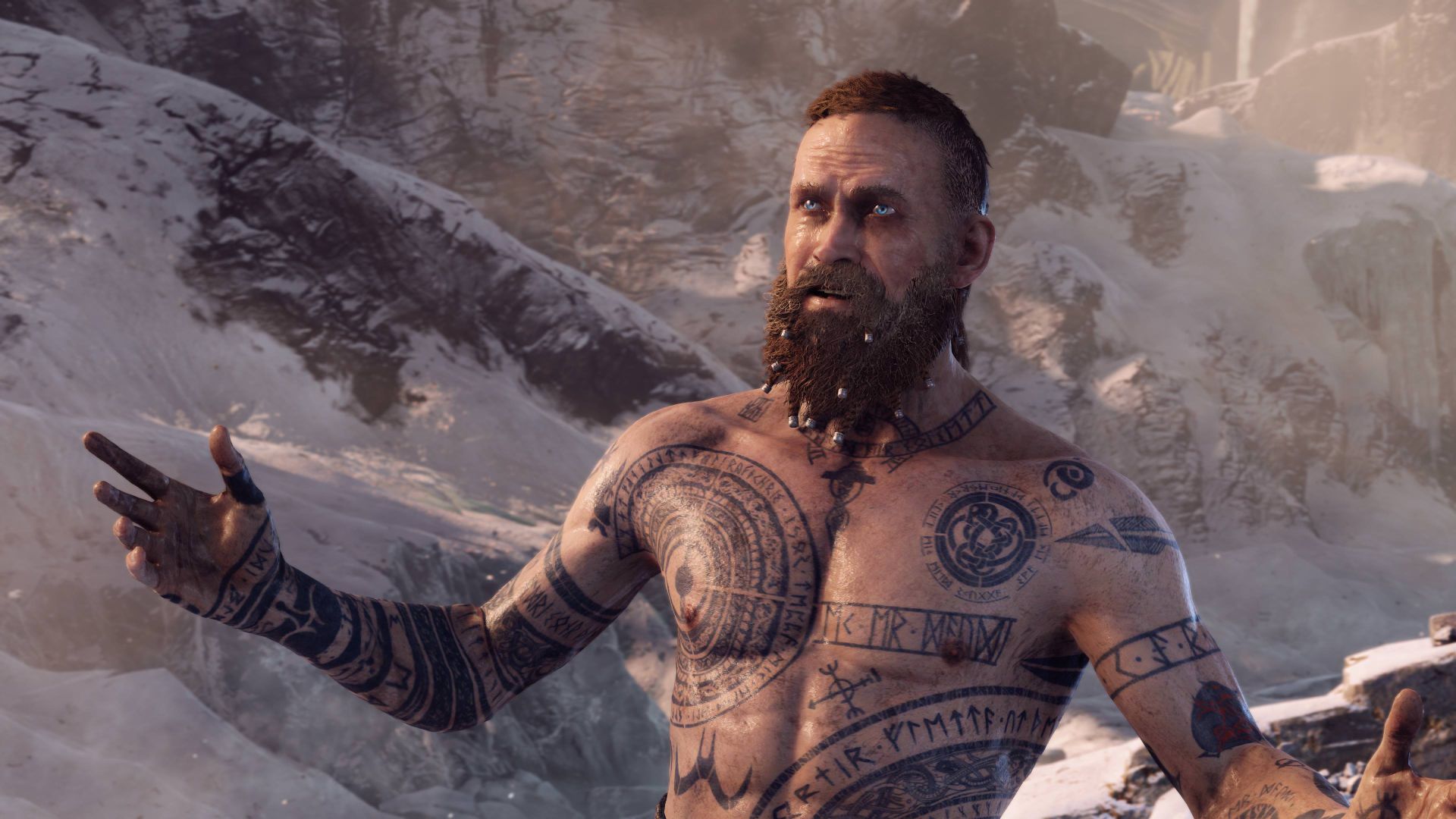
God of War 

There aren’t many games that are able to deliver a stunning experience in such a smooth manner as Sony Santa Monica was able to do with the 2018 reboot. This story sets the protagonist in a new setting; new boss fights and outstanding level design. It’s both fresh and recognizable at the same time, and the new combat and the camera on offer also embodies the spirit of modern third person game while making it more intentional. The 2018 reboot is definitely one of the best games on the PS4, and is a great starting point for newcomers.

  •  

The Interplanetary FINAL FANTASY IV

The Interplanetary FINAL FANTASY IV

The implementation of so much innovation rarely goes as well as it does in Final Fantasy IV. In every area, Cecil’s fantastical road trip to the moon innovates and improves on the mechanics and writing that Final Fantasy III set out to do. For the first time, we see Final Fantasy begin its inexorable crawl towards action gameplay by implementing the ATB (Active Time Battle) system. The extra storage afforded by the Super Famicom allowed for a story and characters deeper than we had previously seen in the series. All of this culminated in the incredible adventure that finally redeemed the Dark Knight and sent Final Fantasy into space.

The Interplanetary FINAL FANTASY IV
Major spoilers ahead for Final Fantasy IV.

An Epic Tale

Final Fantasy IV’s story is in stark contrast to the tale of the four nameless Warriors of Light seen in the previous game, even though a surprising number of elements have remained the same. We start our story as Dark Knight Cecil, who is in service to the King of Baron and tasked with bringing the mad King all of the world's crystals of light. The crystals are currently owned by each region's ruling group, and Cecil comes to realize that his task would involve robbing these mostly defenseless people. This task leads him out of Baron and through a cave to the small town of Mist.

I want to highlight our main party quickly, as I think that they are the strongest part of this game. They help tie the narrative together and give me a better reason to care about the fate of this world.

Cecil is our main character; overcoming his manipulation at the hands of the Baron and becoming the warrior of light is his heroic trait throughout the story. Seeing his unwavering dedication to his mission, while watching Kain continue to serve Golbez, makes him an outstanding main character that is easy to grow attached to.

The Interplanetary FINAL FANTASY IV
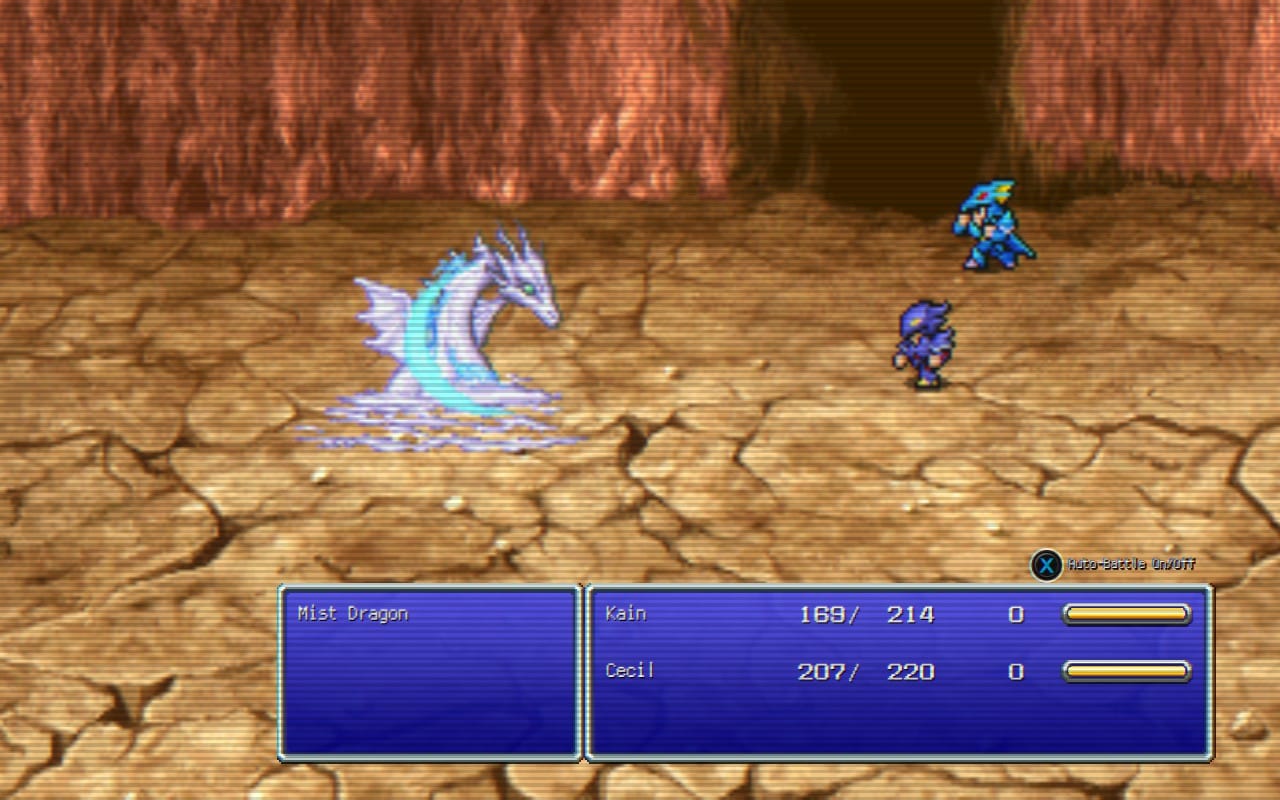
Ah the Mist Dragon of Mist Cave on my way to Mist Village. Source: Author.

Kain is the foil to Cecil; his betrayals lead us to believe that the manipulation Golbez achieved while Kain was in the Dragoons and Cecil commanded the Red Wings was so absolute that Kain would give up his best friends for the mad sorcerer. Out of all of the comings and goings, I really only appreciated how they handled Kain's. Also, jumping is the best move in Final Fantasy, and I know it’s not actually stronger than other moves, but the big number makes me feel really good.

Rosa is Cecil's main love interest, characterized by her loyalty to Cecil, never straying far from his side. She also never gives up on Kain, making the friendship between the three of them shine amongst all of the other characters.
Rydia is the girl that Cecil finds after destroying all of Mist. I kind of wish that there were more of a father-daughter relationship between her and Cecil; however, I also really like that she gets to find her spiritual plane and have the independence to learn her craft on her own.

Battling With Time

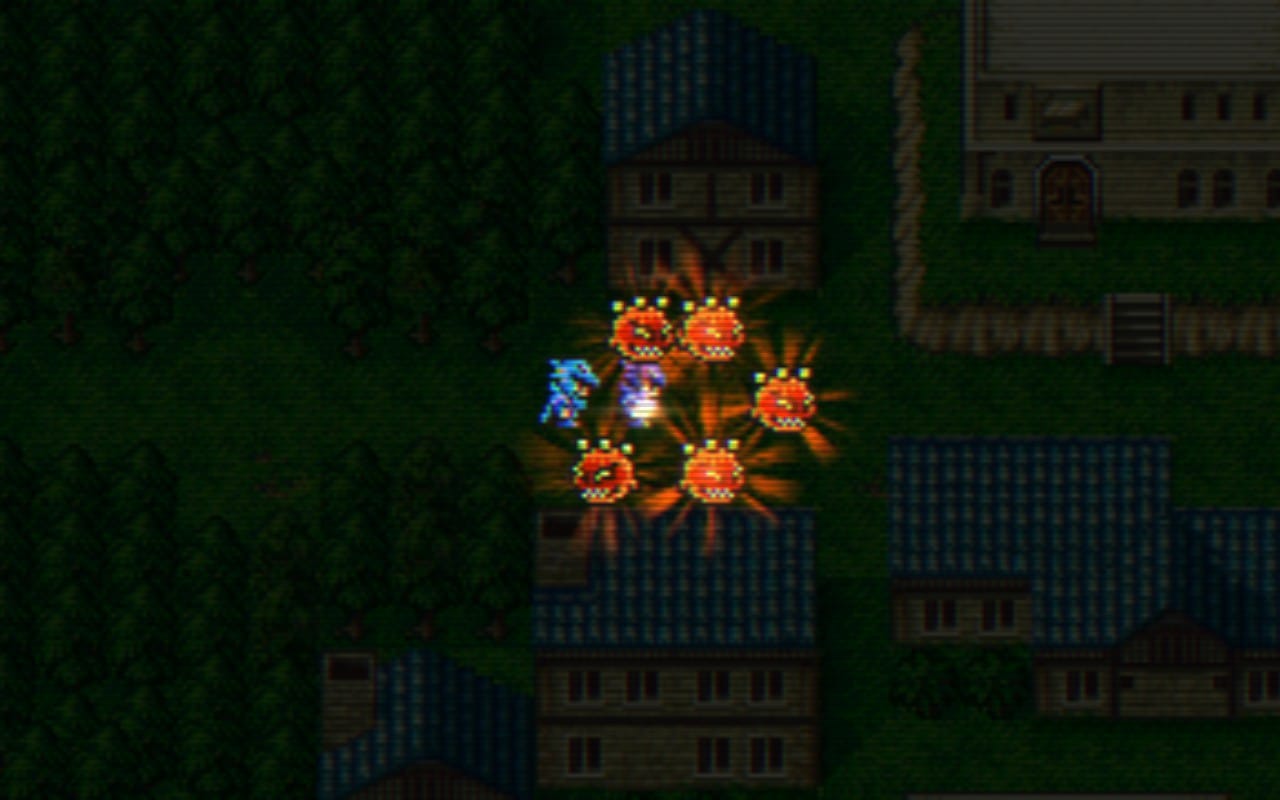
Coming in pretty hot off Final Fantasy III, the ATB bar caused me immediate distress. Even though I knew that wait mode was enabled, I still felt the pressure of that little bar pleading with me to navigate the actions menu as fast as possible. This isn’t so bad after a few battles when you have only Kain and Cecil to worry about, but seeing a wizard's whole spell book caused me to concede to the clock as I would decide which spell to use.

The Interplanetary FINAL FANTASY IV
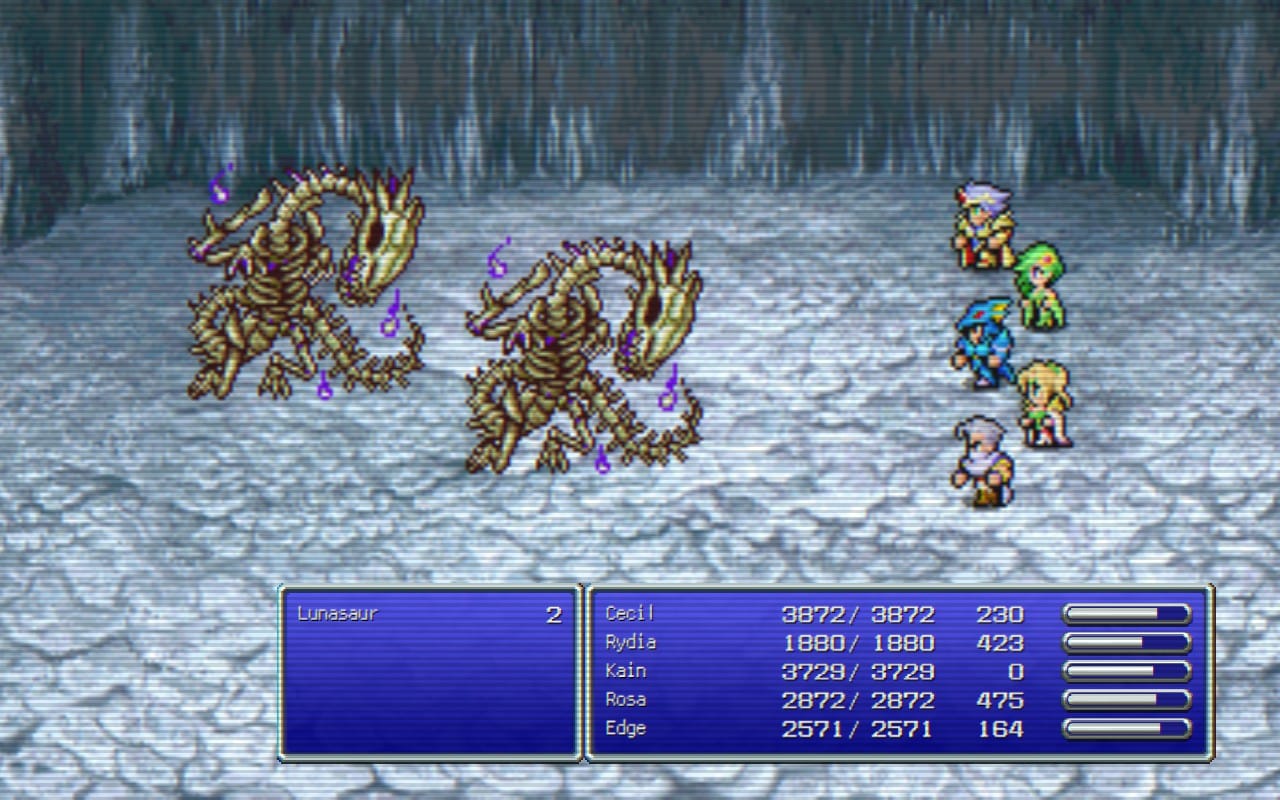
Bone Dragon. Source: Author.

After beating the game, I admit that I really enjoyed the ATB system. It’s no Chrono Trigger, but unfair comparisons aside, it helps make battle much more engaging. I hadn’t realized, but from the NES trilogy, I had developed a habit of taking a drink or throwing a few chips in my mouth as soon as a battle started. That is NOT something that you can do in this game. Well, you can with the wait mode; it’s hard to explain, but that little meter demands your attention even if it does wait for you. After 20 hours, I still could never convince myself that the enemies would actually wait in wait mode.

Another growing pain that I faced was just having to pay attention to both the menu bar and the action happening above. Very often, an enemy would attack at the exact moment that one of your character's ATB meters filled. My attention was drawn to the menu, causing me to miss the damage number shown after the enemy took a swing at a party member. There were so many times that I would choose to heal a party member only to find that a different party member had just lost half their life, chunked away by an enemy attack. Mastering the ability to watch these numbers is really thrilling. I used to play healer in Final Fantasy XIV for exactly the same rush of managing multiple health bars and timing them with your own cooldowns.

I think many of the damage dealers also function in such interesting ways. Queuing up damage feels so good as you are inputting new moves while watching Kain come down from a Jump that you sent him on a few seconds before, then all the action stops as Rydia calls in an epic Summon. Removing the turn-based action and allowing the characters' actions to be just slightly delayed brings us a bit closer to actually seeing a live battle happening in the main window.


Cecil finds out too late that the price of his loyalty to the King was to genocide the summoners living in the town of Mist. He then learns that the King was only a puppet to a dark sorcerer named Golbez, who wants the crystals so he can activate the Tower of Babel and reach the Moon.

The Interplanetary FINAL FANTASY IV
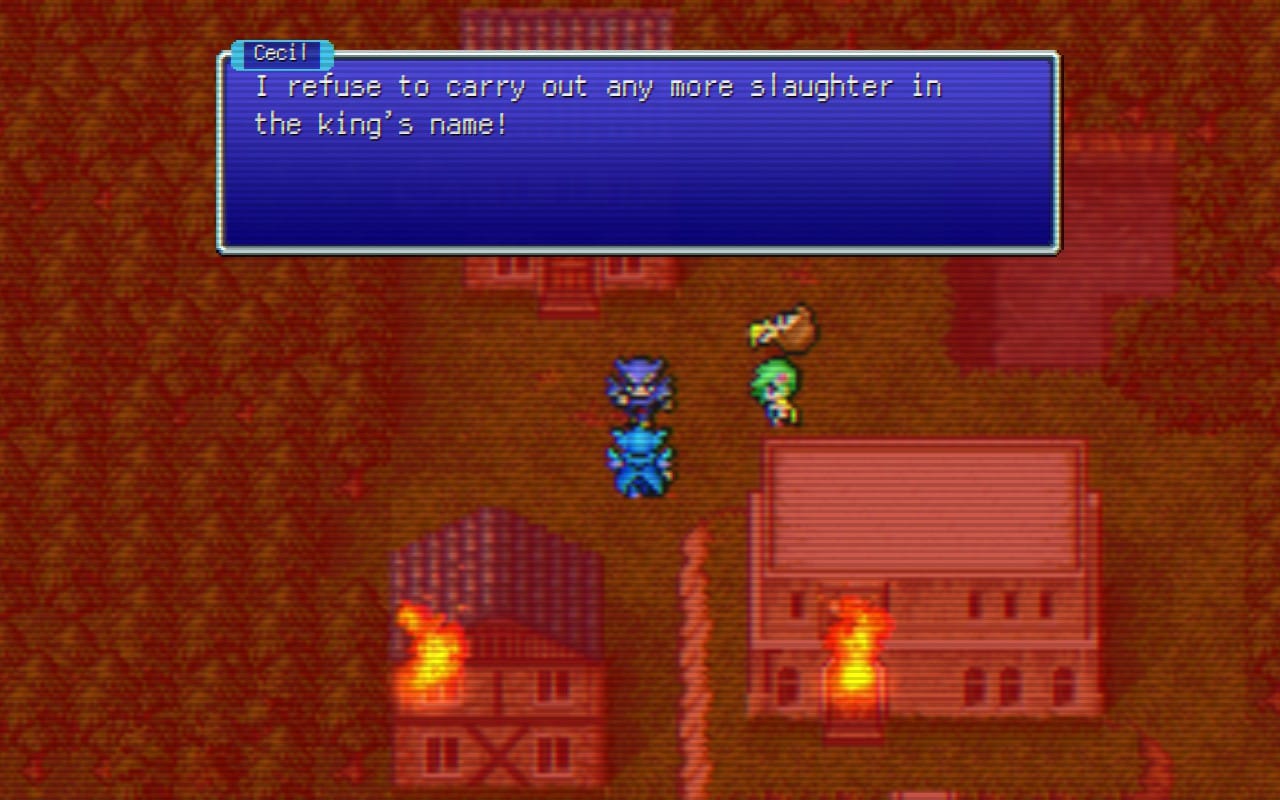
I QUIT! Source: Author.

My only complaint with the story is that the pacing is absolutely atrocious. Every single dungeon in the first half of the game will swap party members and tell all of their stories in fairly compact chunks that I wish were expanded throughout the journey. Many of the characters are actually put on bed rest after the overworld section, as they don’t have any story left to explore. The side quest format of Final Fantasy III is used to tell these characters' tales when they easily could have been woven into the main plot and explored over many hours instead of only one or two.

I thought that I really disliked the ATB system in the first hours of Final Fantasy IV because of the overload of looking through the enormous spell libraries of Tellah, Palom, Porom, and Rosa. After finishing the game, I know now that my problem was not with the ATB system, but the storytelling method in which characters are so frequently added and removed from your party. Perhaps fans of this game think that this type of gameplay variety enhances the experience. I found that it caused combat encounters to feel slightly rushed, as you fumble through spell selections to cast something from a list that you only received about 30 minutes prior, which won't be used again after that specific cave.

Notably, this section contains Cecil’s redemption, in which his class is changed from Dark Knight to Paladin. Veterans of the series up to this point will be familiar with the Dark Knight twist, which most Final Fantasy games rely on; the classic Star Wars reveal, where the dark knight is revealed to be truly good at their core. The Paladin transformation, however, is wholly unique to Final Fantasy, and for the first time, we see a true departure from the “Dark Knight is Darth Vader” plots that we’ve seen before. Well, at least for now, that is; more on that when we discuss the ending.

The Interplanetary FINAL FANTASY IV
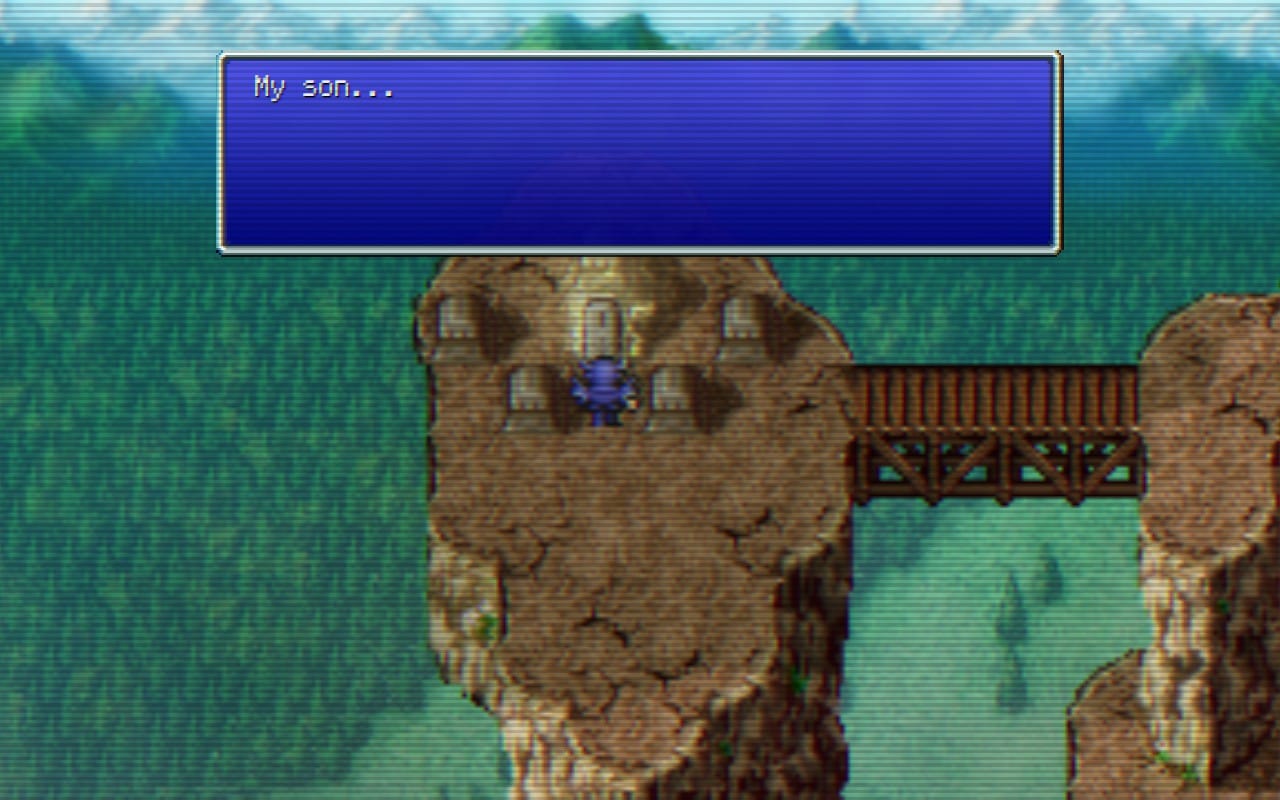
The child of light. Source: Author.

It is soon revealed that Rosa has been captured by Golbez, who demands the final crystal as the price for setting her free. Cecil hands it over without any other plan, and the group makes their escape from what was definitely a trap to kill all of them. Their destination is quickly revealed: Apparently, there is a whole other land that lies beneath Earth's surface, and they must go there to stop Golbez from taking the four crystals of darkness.

This underworld segment puts the gang on a bit of a losing streak. They are, time and time again, unable to stop Golbez from taking all of the crystals. I had really started to feel bad for the party, and even worse, almost all of their friends had to sacrifice themselves to effect the narrowest of escapes. Towards the end of this act, Kain even comments on how insane it is that people keep giving their lives without thinking about another way first. In the wake of losing Yang, Cid, and Tellah, it’s becoming too much.

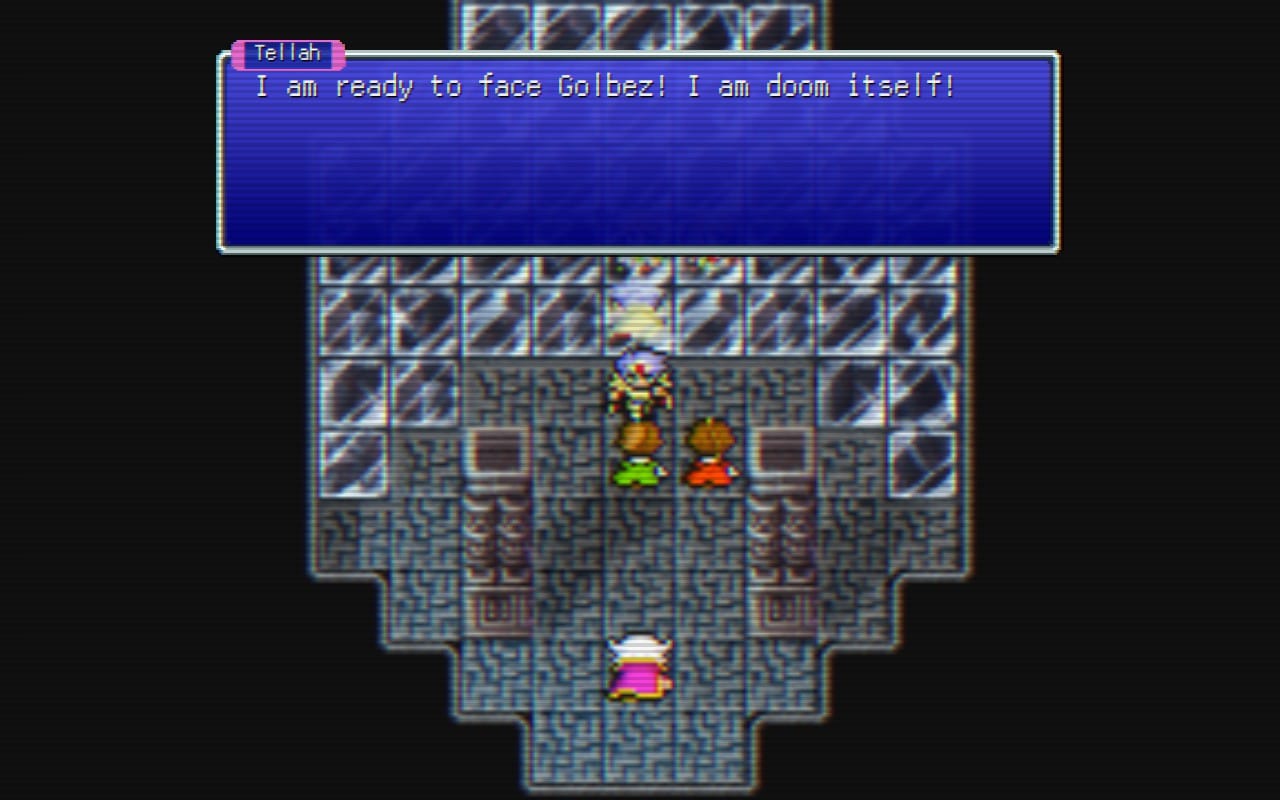
So let’s talk about Tellah. He is, without a doubt, my favorite character, with only Kain as a close second. Tellah’s daughter Ana runs away with Prince Edward early on in the game and is consequently blown to smithereens by the Red Wings during a bombing raid. Tellah then tracks down Edward and beats him black and blue while calling him a “spoony bard” until they are forced apart. He then swears to learn the most powerful spell in Final Fantasy and kill Golbez all by himself.

There is a section where he learns Meteor and yells, “I am doom itself!” and runs out of the room to go find Golbez. The man was crazy. He gets his encounter with Golbez, but it doesn’t go well, as ultimate magic in the Final Fantasy universe drains your life force if you aren’t strong enough to use it. He fails to kill his mark and loses his life in the process.

The Interplanetary FINAL FANTASY IV
Oh Tellah, you legend. Source: Author.

Throughout Final Fantasy IV, you have to fight the four elemental lords much like you do in Final Fantasy I. These fights are largely unremarkable except for Rubicante. In the underworld, you team up with a young Ninja named Edge, whose parents have been turned into monstrosities by Doctor Lugae. They are being held by Rubicante in the Tower of Babel. In a heartbreaking scene, you watch Edge's parents kill themselves to prevent harming their son, then you must face Rubicante.

This is an extremely difficult boss fight and becomes one of the biggest failings of this early implementation of the ATB system. Without telegraphed moves like you would see in a game like the beloved Chrono Trigger (which came along 4 years later), timing these hits the way that the game wants you to is hit or miss (literally). Many online guides recommend that in most of these fights that ask you to learn timings, you are advised to just smack with Cecil and ignore the mechanic almost entirely. This is easier than timing casts of Blizzaga, but Rubicante is still no pushover, and if you can’t survive his larger attacks, you won’t be able to pass him.

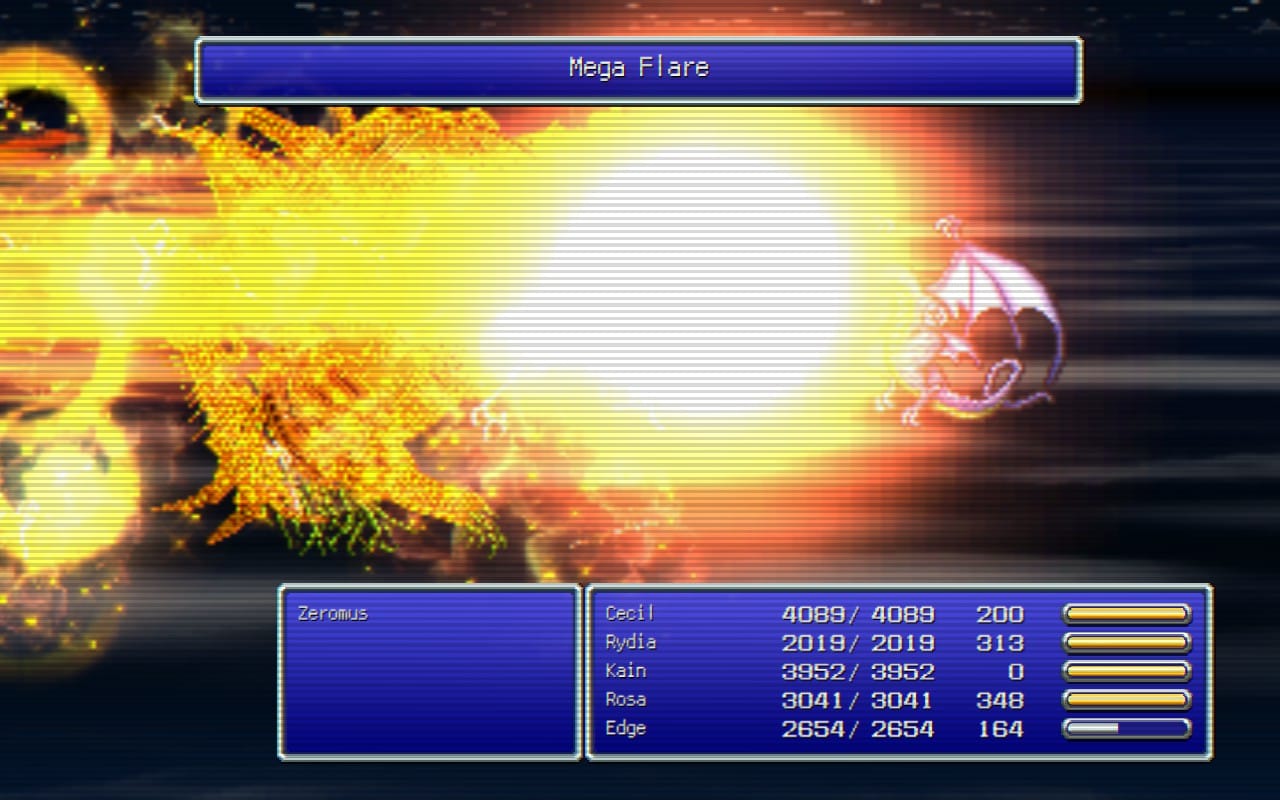
Golbez finally arrives on the moon with all of the crystals. We still don’t know what he wants there, but we know that we have to stop him. In the same town that you rob at the beginning of the game, the village elder raises an excellent airship (spaceship?), the Lunar Whale, from the ocean to send you and your party to the moon. At this point in the game, you are free to do a few side adventures that involve getting all of the summon spells for Rydia and smacking Yang on his bald monk nogin with a frying pan. I really enjoyed the Land of Summons quest line, and its rewards make it a great detour. Bahamut's Mega Flare is the coolest magic spell in the game, and it never gets old.

On the moon, you learn that Cecil is actually the descendant of a race of Lunarian people and that Golbez is his brother (see, I told you we’d still get our Darth Vader story). Golbez was being used as a puppet by Zemus, which makes Kain a puppet’s puppet, which is hilarious but also shows the reach of Zemus’s manipulation. Golbez uses the crystals to summon the Giant of Babel from the black pit to destroy the entire world. One giant kaiju robot fight involving dwarven tanks and mage airships later, and we are in the final dungeon, on our way to the core of the moon to stop Zemus for good.

The Interplanetary FINAL FANTASY IV
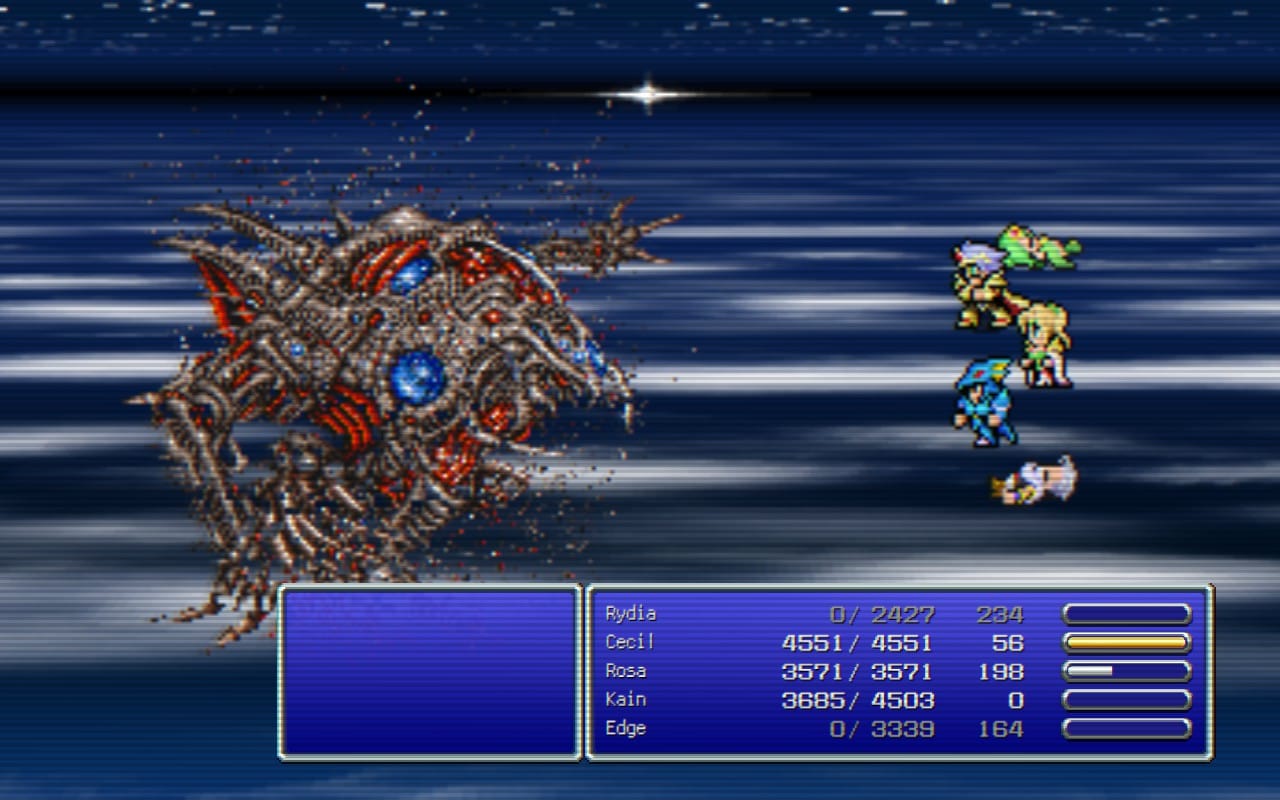
Zeromus, Master Manipulator. Source: Author.

As always, the final dungeon in a Final Fantasy game is the most intense and the most fun. You command the main party that you’ve been honing for the past 5 hours, and your skill in ordering them should shine through brilliantly across all of the challenges on the moon. Sadly, though, the final segment highlights all of the issues that I had with the early hours of the game. Swapping party members over and over doesn’t let you feel the progression of your party, and to see all five main protagonists operating at full strength right at the end emboldens that fact.
Cecil watches as FuSoYa and Golbez fight with Zemus. Killing him sheds his physical body to reveal something else. With the prayers of your friends aiding you, you dispel the illusion and reveal Zeromus (the spirit and hate of Zeromus made incarnate).

This fight was tough, but I’m four Final Fantasy games in, so I know the drill.
There was no way that I could survive the final boss's party nukes, so I ground out ten more levels on the moon. Thank god for the Pixel Remaster; I just cranked experience gain up to 4X and fought 8 Behemoths and 6 Dragons, and I was ready.

With proper management of my health and good Dragoon-jump timing, Zeromus goes down without a sweat, and the world is saved. Typically, I would have given this a few more tries before grinding out levels to see if I could beat it with some skill and a big spoonful of luck, but they had placed a five-minute unskippable cutscene right before the fight, so my tolerance was a little lowered. All in all, I enjoyed this fight just as much as Chaos from the first game, though out of the four games so far, Chaos is still the most fun to actually fight.


I love the cyclical nature of Final Fantasy. For me, there doesn’t have to be any additional reason why evil exists. Good and evil are forces of nature, two sides of the same coin. Zeromus reminds us of that as he is defeated, and our heroes despair. “How can we truly win?” they ask, a little dejected.


Cecil is the warrior of light and the embodiment of good, the force of nature sent to balance all things. And when the light grows too strong, the warriors of darkness will be sent to balance things just as Cecil has. Every Final Fantasy to this point follows this ideology: for every dark god possessing a power-hungry man, there is a warrior of light sent to stop him.

The Interplanetary FINAL FANTASY IV
That's my bestie Bahamut. Source: Author.

Final Fantasy IV treads very neatly in the lines of tradition while striking out and blazing a new action-combat trail that will eventually lead to Final Fantasies more resembling Devil May Cry than its Dragon Quest roots. Despite lulls in the story's pacing, I relished every bit of character development and each fast-paced battle. This is widely recommended as an excellent starting point for the series, and I wholeheartedly agree. Final Fantasy IV feels like the start of something big, and if I were playing this as a kid in 1991, I would be on the edge of my seat waiting for whatever Hironobu Sakaguchi would make next.

  •  
  •  

Sacred 2 Remaster: Behind the Scenes of A Legendary RPG

Sacred 2 Remaster: Behind the Scenes of A Legendary RPG

Summary

  • Sacred 2 Remaster is coming to Xbox Series X|S on November 11, 2025.
  • Set in the sprawling fantasy world of Ancaria, Sacred 2 offered a unique RPG adventure full of unique characters and stories.
  • Find out how the remaster aims to honor the original game’s legacy while building a modern experience for new and returning players.

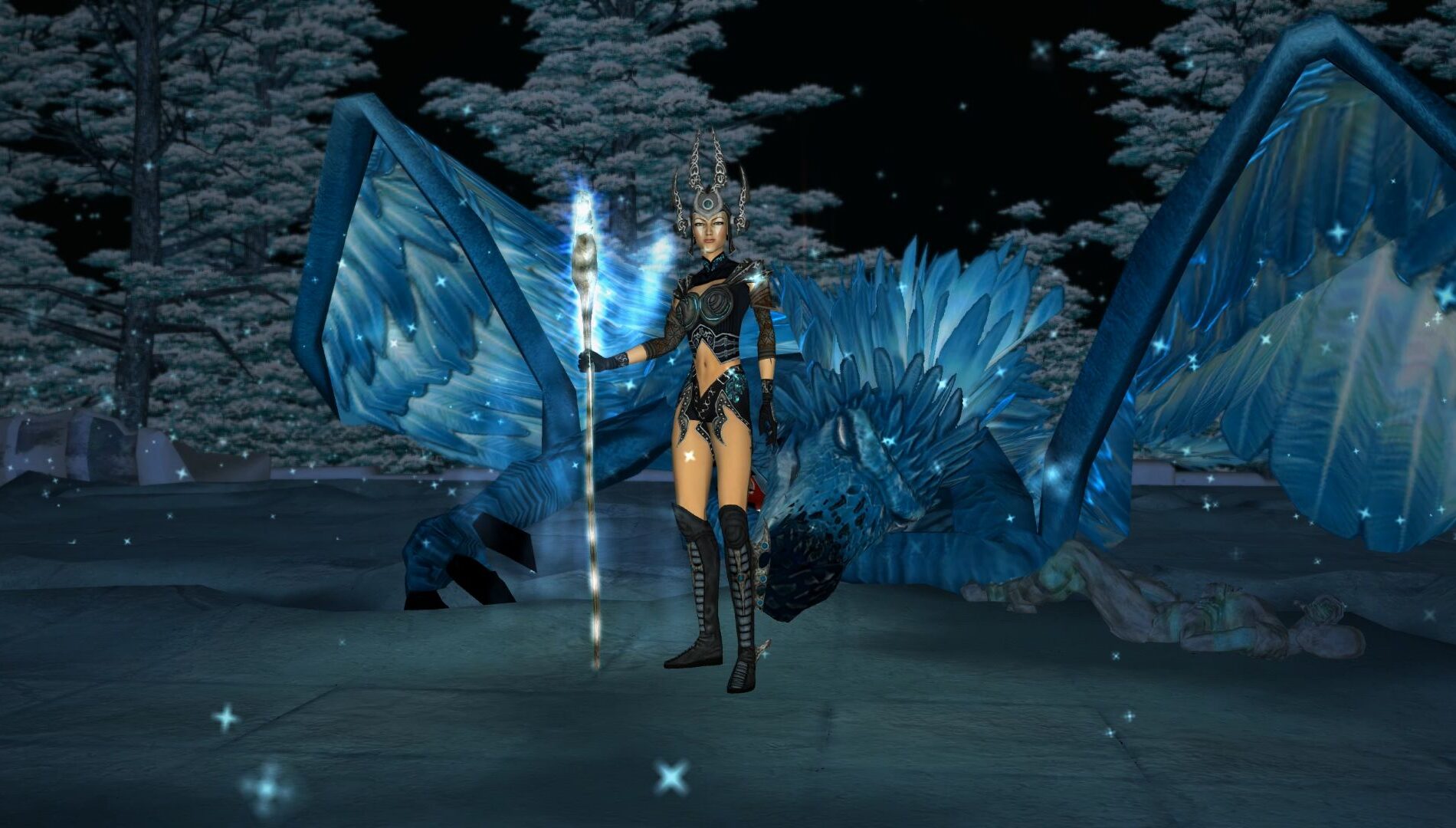
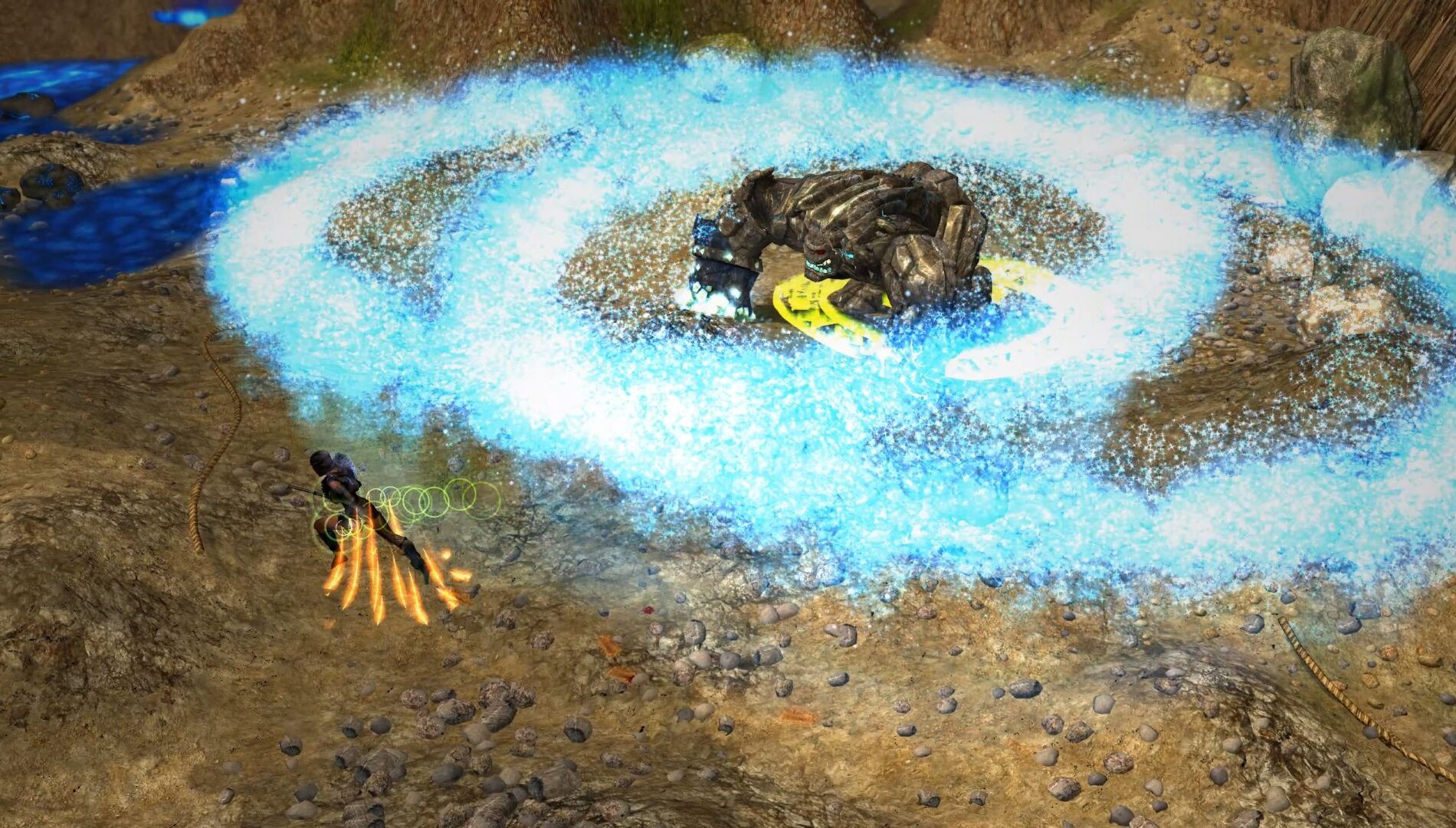
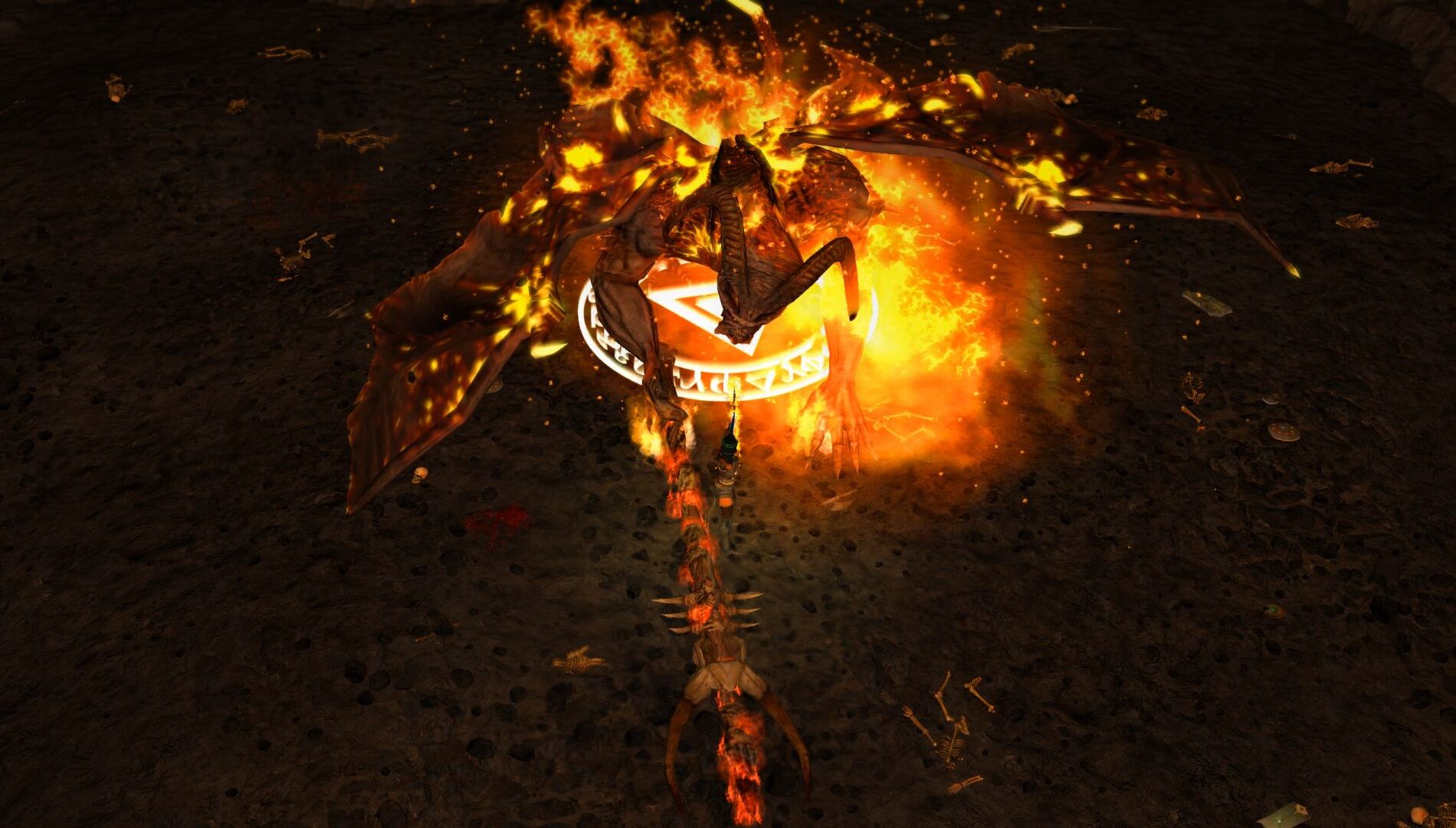
Sacred 2 is an action RPG that first made its debut in the early 2000s, quickly earning a loyal following for its ambitious world and distinct personality. It offered a massive, seamless map filled with sprawling towns, dense forests, scorching deserts, and perilous dungeons—all ripe for exploration. Its roster of diverse characters came with rich backstories and unique combat styles that set it apart from other RPGs of its time.

But what truly made Sacred special was its tone. It wasn’t afraid to be funny, mixing dark fantasy with tongue-in-cheek humor and quirky charm. Players could customize their combat arts to match their playstyle, and the innovative Light and Shadow campaigns let you experience the story from two opposing sides, depending on your character’s alignment. Sacred 2 was rough around the edges, but fans embraced its imperfections—and over time, it became a beloved cult classic.

All of this is why today’s news feels especially meaningful: Sacred 2, the iconic RPG, is now available on Xbox Series X|S for the very first time. This marks a major milestone—not just for the franchise, but for the millions of fans who’ve called Ancaria home for over two decades.

At its core, Sacred 2 is more than a game—it’s a piece of modern art. Video games are one of the most powerful storytelling mediums of our time, and this remaster is our tribute to that legacy. It’s a love letter to the fans, a celebration of 20 years of adventure, and a promise that the world of Ancaria will continue to evolve.

Bringing Sacred 2 to life on today’s platforms has been a technical challenge, but one the team has embraced wholeheartedly. Our team rebuilt the game engine from the ground up to ensure a smooth, immersive experience across all devices. Xbox players will enjoy the same rich gameplay as PC players previously experienced.

This remaster isn’t just a visual upgrade. It’s a celebration of everything that made the original Sacred unforgettable: the humor, the chaos, and of course, the Blind Guardians. We’ve preserved the soul of the game while enhancing it for a new generation of players While we couldn’t include everything from the community patches over the years, we did our best to include material that added to the player experience where possible.

We placed a lot of importance and effort on making the experience smooth for Xbox players- regardless of if players enjoyed the game 20 years ago or are brand new to the franchise. Our graphics have stayed true to the original to preserve the original look and feel of the game. We’re excited to welcome the community back to Ancaria, and we’re committed to supporting the title post launch. Our future updates will be influenced by community support and feedback, and we’re looking forward to the future of Sacred.

Sacred 2 Remaster launches today, and is available on Xbox Series X|S.

Sacred 2 Remaster

THQ Nordic GmbH

33
$29.99
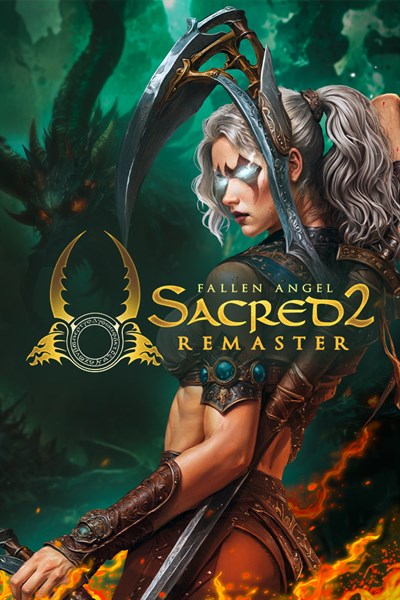
Ancaria stands on the brink. T-Energy, the mysterious power source that once brought prosperity, now fuels corruption, conflict, and chaos. In the midst of war and betrayal, six heroes rise — each with their own fate, abilities, and path through a living, breathing open world. In this remaster of the beloved action RPG Sacred 2: Fallen Angel, players return to a massive fantasy realm filled with hundreds of quests, dangerous dungeons, and unique combat arts to master. Battle monstrous creatures, uncover ancient secrets, and shape your character through loot, leveling, and deep customization. With refined combat mechanics, a modern UI, full controller support, and all expansions included, the remaster brings new life to a fan-favorite — whether you’re revisiting Ancaria or setting foot in it for the first time. Forge your legend. The fate of Ancaria awaits.

The post Sacred 2 Remaster: Behind the Scenes of A Legendary RPG appeared first on Xbox Wire.

  •