Normální zobrazení

Received before yesterday

The Prisoning: Fletcher’s Quest Review

20. Únor 2026 v 10:00

You can tell that a medium has reached some form of maturity once things start getting meta and titles appear that draw attention to the process of being constructed and the dilemmas that are faced by their creators. Countless great modern novels and films that are as lauded as Citizen Kane are clear examples of this and, whilst not in the same league as these, The Prisoning: Fletcher’s Quest is of a similar vein. You play as a burned out developer who undergoes hypnotism in a therapy session only to find himself trapped inside his own creation, a search adventure game with procedurally generated layouts.

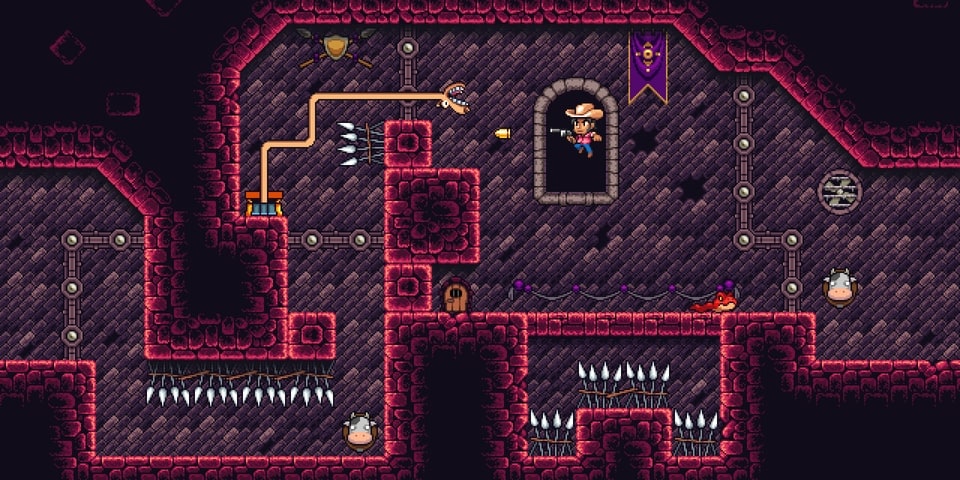
The pixel-art aesthetic in Fletcher’s Quest is really nicely done and the various areas of the game look distinct whilst enemies and characters are well designed. Bosses are particularly memorable and everything benefits from a bright and colourful approach. Music is solid enough with a few standout tracks, again often in boss fights.

The game’s narrative is clearly nonsense and is all presented in a suitably tongue-in-cheek fashion. This is perhaps most obviously seen by the fact that the early rooms of the game have to be traversed not just devoid of weapons or skills but also of clothing. The pixel graphics mean that you are saved the detail of such nudity, whether you’d like it or not, but characters do comment on it. Your first mission, therefore, is to find clothes and a means of defending yourself.

The Prisoning exploration

While billed as a Metroidvania (I prefer ‘search adventure’ myself) the game actually reminded me more of classic home computer titles such as Jet Set Willy and Manic Miner. The flip-screen traversal and assortment of ludicrous enemy types brought me right back to my earliest days of gaming in the mid to late-1980s, but without the extreme frustration that accompanied those often nigh-on-impossible games. The main difference, however, is actually an unintended consequence of the choice to use procedural generation – rooms and areas are relatively forgettable, lacking the intricate design that the genre really requires to succeed.

The generated layout is completely functional with areas blocked until you beat bosses and unlock new skills, but many rooms feel interchangeable and the extreme frequency of save and travel points mean that backtracking is rarely required. Indeed, on the default difficulty it was generally quicker to collect items and then die to return to the last save point. As collection progress is maintained, the game seems to actively encourage you to avoid playing it. If I’m being generous this might be a deliberate move in keeping with the meta view of the genre, but I think it’s just another result of the use of procedural generation.

In terms of skills, you play through the whole game with just a pistol, and one that initially is a real pea-shooter. You can fire one bullet at a time and if you miss then you have to wait until the bullet disappears from view before you can fire another. This adds a level of strategy and reward for accuracy that does help to keep things interesting. As you defeat each boss you’ll be granted an additional bullet (a fact that I forgot, which made the second main boss unnecessarily difficult) as well as a traversal skill like double-jump and butt bounce.

The Prisoning side-scrolling shoot 'em up section

As well as standard single screen platforming challenges, The Prisoning occasionally breaks things up with horizontal shooter sections and the final boss is an auto-runner minigame that treads a fine line between challenging and downright annoying. That said, given my first playthrough was under three hours, the variety is restricted by the short length of the game. This, again, helps to make the game feel like a lost retro title.

The four boss fights are the most memorable part of the game, not coincidentally because they are clearly the most hand-crafted moments. You’ll find yourself up against a giant robot, a skateboarding shark and more, with all offering distinct challenges and necessitating different approaches. The one that stood out for me was the shark, both because of the uniqueness of the antagonist, but also the slippery slope of forced humour it introduced.

The Prisoning shark boss battle

The whole game has a lot of lol random’ humour that is very hit or miss. The nudity is the most obvious example but the shark boss features a lot of dialogue about how badly it is designed and frustratingly difficult it is. This kind of meta-joke is so often undermined by the content being as annoying as the joke pokes fun at. Admittedly this boss was rendered more challenging by my forgetfulness, but the battle goes on for a long time with you only having two hits before death.

MMO Week in Review: Intrepid is the new 38 Studios

23. Únor 2026 v 02:00
MOP’s Justin has joked, darkly, that the Ashes of Creation fiasco is shaping up to be the next-gen 38 Studios, and I am sad to admit he is probably right – it’s another failed MMORPG that we’ll be stuck talking about for the next 10 years thanks to lawsuits and countersuits that most definitely will […]

Mortal Online 2 plans its next test server for plate armor and VoIP changes

20. Únor 2026 v 00:00
Mercenary Plate is just too darn good in Mortal Online 2. That isn’t intentional, but it is how things have shaken out, hence why the next patch that’s going into public testing on February 25th will involve stat normalization for plate armor. No one wants to pick armor that’s just not going to be good in […]

Review: Revolgear Zero (Nintendo Switch)

22. Únor 2026 v 17:25

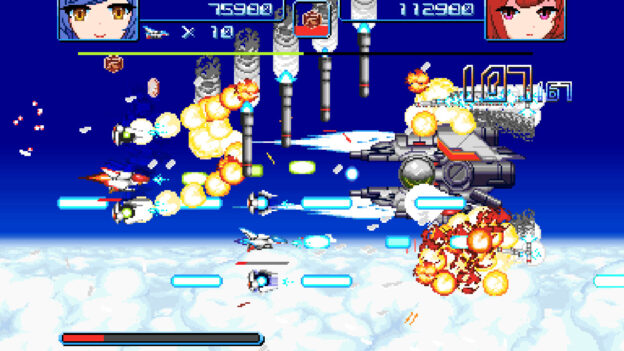
If you’re looking for speedy shmup action, Revolgear Zero has you covered. It offers a solid variety of enemies and weapons in which to take them down effectively. Co-op play makes the game even more fun, but glitches prevent me from giving as broad a recommendation as I first thought.

What little story there is doesn’t really get a proper mention until the closing credits (evidently, there are six endings). All you have until then is the cryptic “Grant a new legend to the cosmic warriors who survived the fiercest  battles.” But when I was asking myself what was happening, I also had to remind myself that this genre doesn’t need a coherent tale attached to it.

Revolgear Zero has four levels of difficulty, covering a wide range of gamers. Whether you’re looking to ease your way in or you want threats to the extreme, the game has you covered. As somebody who was reaching for his glasses and pausing to crack his knuckles, after a few minutes of play, guess which difficulty I started with?

Difficulty assistance comes in the form of co-op. I appreciate this, as a surprising number of shmup games overlook co-op for unknown reasons. But beyond an aid to the challenge, it’s just so much more fun flying, shooting, and strategizing with a buddy. So much that I’d add or subtract half a point to my final score depending on whether you’re going solo or with a friend.

I touched on enemy variety briefly in my introduction. You’ll see mechanical ones (large and small), organic threats, and even the stages themselves, soon proving a potential danger. Some scroll both vertically and horizontally, with portions of the background damaging you with a touch. At certain points, you will be less focused on shooting than on finding a safe spot to camp out and wait for your opening.

As far as the weapons, I won’t waste time trying to describe each in my limited word count. Firstly, because many are variants that most shmup fans are already familiar with. Secondly, because half the fun is experimenting with different combinations and loadouts. It’s one of the game’s strengths, figuring out your own favorite combos, which likely will differ if you’re playing alone or with a friend. They also change depending on the stage, whether you’re in more open areas or tight spaces. Earning weapon upgrades (collect every coin you can) and being able to flip between them on the fly can be the difference between victory and a game over.

Visually, Revolgear Zero starts a tad bland in the sky, but gets much better the further you advance. It introduces a much greater variety of colors, different effects, parallax, and more. It’s not a cutting-edge look by any means, but it is a pleasing one. The music rocks, complementing the graphics to deliver an aesthetically pleasing audio/visual package. There’s no slowdown either, even when the screen is filled with bullets and coins.

Unfortunately, there are game-crashing bugs. More than once, the game shut down after finishing a stage. Once, I was prompted to share the info with Nintendo. The second one was the generic “There was a problem, and the software needed to close.” Revolgear Zero is still a good release, but my recommendation comes with caveats. It’s not a must-own.

Revolgear Zero goes beyond the token shoot’ em up in many ways. Its weapon system has depth, and what it lacks in length, it makes up for in replayability. It’s a fun game to play solo, and even more fun in co-op. I’ll keep an eye on Bikkuri Software and hope their next Nintendo release will have its glitches ironed out.

The post Review: Revolgear Zero (Nintendo Switch) appeared first on Pure Nintendo.

Review: Broken Sword – Shadow of the Templars: Reforged (Nintendo Switch)

19. Únor 2026 v 12:01

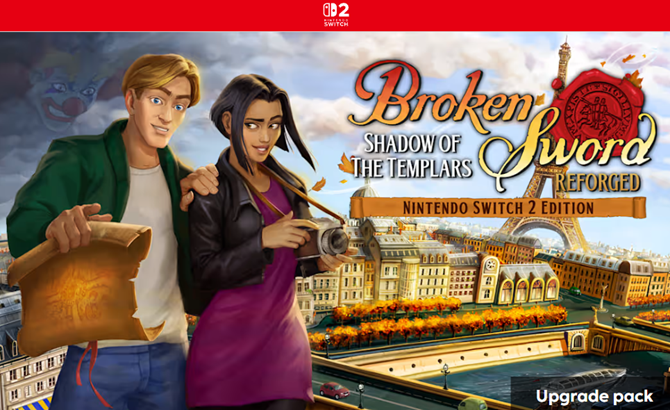
Late ’90s Paris—an auspicious time and starting point for my all-time favorite globetrotting graphic adventure: Broken Sword. This Reforged version is “substantially enhanced,” with improvements varying in quality, especially for purists like myself. But with options to play the original (and, in my eyes, virtually flawless) game, it makes any of my gripes inconsequential. Reforged offers the best of both worlds.

I readily disclaim my nostalgia for this game, having first played it in my late teens on the Sony PlayStation. Despite some long load times, that 1998 port introduced me (and other console gamers) to what would become a long-running series. Nintendo players may know the game from even later ports on the GBA (see my retro review in PNM Issue #32) or the Director’s Cut versions on DS and Wii. The latter were popular with those unfamiliar with the original game and just getting into the genre. That’s much less so with existing fans (for reasons too numerous to discuss here), but Revolution Software has acknowledged this, excising those weaker updates to focus on the superlative original.

Broken Sword is a story-driven game with an explosive start, literally. There is a bomb blast at a sidewalk cafe, and American tourist George Stobbart gets caught in it. His early motivations may seem limited (not unheard of for this genre). Is it a sense of justice stemming from his law studies and/or survivor’s guilt? More likely, he’s just an inquisitive man on vacation looking for adventure without an itinerary or restrictions on his time and expenses. Being able to partner with a pretty photojournalist certainly helps, too.

Nicole Collard is your non-playable support—a shutterbug George admires and builds chemistry with as the adventure progresses. While she may seem passive (especially compared to George, who is actively traveling historical and cultural crossroads), she has some fun surprises up her sleeve that I won’t dare spoil for first-time players. The relationship between her and George builds organically.

Their initial search to learn more about the deceased cafe victim and his killer (disguised as a clown) soon leads to a mystery whose origins lie in the Middle Ages, the scope and threat of which are hard to imagine. The Knights Templar make for a popular topic in books, movies, and more now (and rightly so), but decades ago, not as much. Broken Sword was a pioneer that encouraged many gamers to learn more about history.

Truly tying all these threads together is the plethora of side characters (and George’s interactions with them). There is no such thing as a lesser NPC in Broken Sword, as even those of limited importance still leave a positive impression. Even seemingly mundane exchanges lead to entertaining, often funny, and memorable results. It’s one of the reasons the Director’s Cut faded after its honeymoon period, as gamers let the devs know these nonessential interactions were, in fact, essential insofar as their contribution to the game’s charm and challenge. Are you showing the greasy tissue you found in the sewer to every character you meet? If not, you’re missing out.

The character vocals impressed the heck out of me in my younger years. Now I better recognize some voice actors in dual roles and their stereotypical accents. Nonetheless, I’m still impressed. Highlights include Rolph Saxon as George and most of the Irish dialects. Modulation stands out, and with subtitles on, you won’t miss a beat. Of course, the vocals are only part of the audio package. The late Australian composer Barrington Pheloung’s orchestral score lives on, chiming in at leading points during the cinematic adventure, making it even more music for your ears. My lone musical issue (though small enough to have no impact on my score) is that the fiddle player in the Irish pub seems slightly off, with overly loud music and choppy transitions between tunes. Some of this may simply stem from growing up with the PlayStation version, where the character got removed (he gives no dialogue). You can do a quick settings adjustment, though, and perhaps a patch will polish this or grant the option to remove it entirely.

But beyond the audio, it’s the game’s visual presentation likely to attract the attention of most players (as well as the most in this review). The original Don Buth Studios art has been redrawn in high definition, and you can flip between both styles instantly with the tap of a button. The joy I get from combing through each screen and studying every change, no matter how small, might be hard for many to understand, but it’s real all the same. Reforged is at its best when staying faithful to the timeless beauty of the original, making subtle enhancements feel natural. A few of the earliest examples are the animated intro, which has never looked better. Now, some cars travel along the city streets, which feels right. Another is the cafe where the explosion took place. While always appearing blown up, it now has even more damage at the site where the bomb sat. Again, it feels right. One more is the character of Flap, described by George as a “gorilla” gangster. He’s gained a few inches to better match his brawny description.

Reforged is less successful when it deviates more than is needed from the original. For example, while I appreciate the autumn foliage lining the block of Nico’s apartment, other color choices in the redrawn scenes feel more like “Paris in the Spring.” The lighting can also be too much or too little—the Hotel Ubu chandelier in one instance and the sewers in another. In the effort to create realism, some details and grittiness that shone through in the original get lost. The redrawn Crune Museum (a singular instance, thankfully) barely resembles the original, especially during the daytime scenes. Warm colors and textures are replaced by something best described as if Sam’s Club built a museum in their Tire & Battery Center; it’s an odd choice. 

Thankfully, these gripes are ultimately nullified with the inclusion of the original presentation accessible on the fly (something the Director’s Cut predecessor lacked on Nintendo hardware). Of course, less experienced Broken Sword players, like my wife, might prefer the new version, and I understand that. Heck, I often prefer the new version myself. But don’t hesitate to compare and tinker with settings, especially if playing in handheld mode, where the original shines brightest.

The puzzles reflect the time of the original release. In 1996, the percentage of the global population having cell phones and Internet access was small enough to be counted on one hand. Calling from public telephones and getting info from print is George’s way. You’ll manage a good-sized inventory and talk to everyone you meet about everything you can think of. Those coming from the Director’s Cut version may find it jarring to have more options to work with, but the extra challenge also brings extra charm. However, I’d think long and hard about picking the “Story” experience over “Classic,” at least at the start. Broken Sword – Shadow of the Templars: Reforged having the option is great, but will you soon regret the hints and hotspots? 

You can die attempting to solve certain puzzles, but autosaves (and manual ones) lessen having to replay too much. Thankfully, the cursor works very well, even at the default setting, which is paramount for some puzzles that require quick timing or can lead to death. You can also play in handheld mode with a capacitive stylus. Impatient gamers may welcome the option for speedier movement. That said, except for the previously mentioned puzzles built around quickness, Broken Sword isn’t a fast-paced game and is best enjoyed at a pace to savor everything it offers. Oh, and did I mention among point-and-click games, Broken Sword has a puzzle that is the GOAT?

Broken Sword – Shadow of the Templars: Reforged respects the fans who helped make it a commercial success. But it also invites new players to discover the game (and, by extension, the franchise) that, for many, has become the genre leader. Don’t be turned off by the awful menu icon, the spoiler screenshot in the listing, or any other marketing blunders. The game itself is outstanding.

It’s the compelling interplay of thrilling story, memorable characters, enjoyable puzzles, and stunning presentation that ensures Broken Sword – Shadow of the Templars: Reforged will become a top choice for a new generation of players. Let’s hope the sequel (and the rest of the series) finds a home on Nintendo hardware. It’s 2024, and my game of the year is a graphic adventure first released in 1996. Go figure.

Switch 2 version notes:

Peruse the eShop, and you’ll also see Broken Sword – Shadow of the Templars: Reforged – Nintendo Switch 2 Edition. The full game is $29.99, which remains a fair deal. But, if you already own the original, the DLC is just $4.99 ($2.99 on sale). Hard to complain about that.

But what are you actually getting if you go the Switch 2 route? Well, you’re getting an already great-looking game, now 4K docked or 1080p in handheld mode. These are pretty sweet upgrades, and I was able to pick out some new details that I overlooked last time.

The other new addition is mouse controls. Given that’s how Broken Sword was first conceived, these are natural. Comfortable and working as expected, their integration serves as an example for other Switch 2 games.

The post Review: Broken Sword – Shadow of the Templars: Reforged (Nintendo Switch) appeared first on Pure Nintendo.

Roguematch: The Extraplanar Invasion Review

23. Únor 2026 v 10:15

Roguematch: The Extraplanar Invasion made for an odd relationship. I loved it and hated it in roughly equal measure.

The post Roguematch: The Extraplanar Invasion Review appeared first on TheXboxHub.

Disciples: Domination Review

23. Únor 2026 v 09:21

Disciples: Domination is an enjoyable sequel that builds on the original in certain ways, but remains a very similar experience to what came before, complete with the same drawbacks.

The post Disciples: Domination Review appeared first on TheXboxHub.

Fruitbus Review

23. Únor 2026 v 09:09

It doesn’t demand anything of you. Its customers will happily wait weeks, if not months for you; they don’t mind. You can do whatever you want. And that’s Fruitbus’ secret sauce. A warm community spirit without expectations.

The post Fruitbus Review appeared first on TheXboxHub.

REANIMAL Review

22. Únor 2026 v 21:27

REANIMAL is a big step up from the Little Nightmares games in terms of story and world-building. This feels more mature, more epic, and, at times, much more terrifying.

The post REANIMAL Review appeared first on TheXboxHub.

Spellcaster Chronicles Preview– A Bold but Divisive MOBA Shift

21. Únor 2026 v 13:22

Quantic Dream is entering the MOBA space was never going to be neutral. This is a studio historically known for authored consequences and controlled narrative arcs, now producing a 3v3 arena title in Spellcaster Chronicles coming to early access on Steam February 24th 2026. The premise is mechanically coherent, if philosophically unusual: reduce hero complexity, lower…

The post Spellcaster Chronicles Preview– A Bold but Divisive MOBA Shift appeared first on Invision Game Community.

Into the Mire: Jurassic World Evolution 3 Wetlands DLC Review

21. Únor 2026 v 13:14

I know I’m a bit late to the party, but I was lucky enough to get hold of a copy of the new Jurassic World Evolution 3 Wetlands DLC pack for Jurassic World Evolution 3. The Jurassic World Evolution series has always been at its best when it leans into ecological complexity rather than pure…

The post Into the Mire: Jurassic World Evolution 3 Wetlands DLC Review appeared first on Invision Game Community.

❌