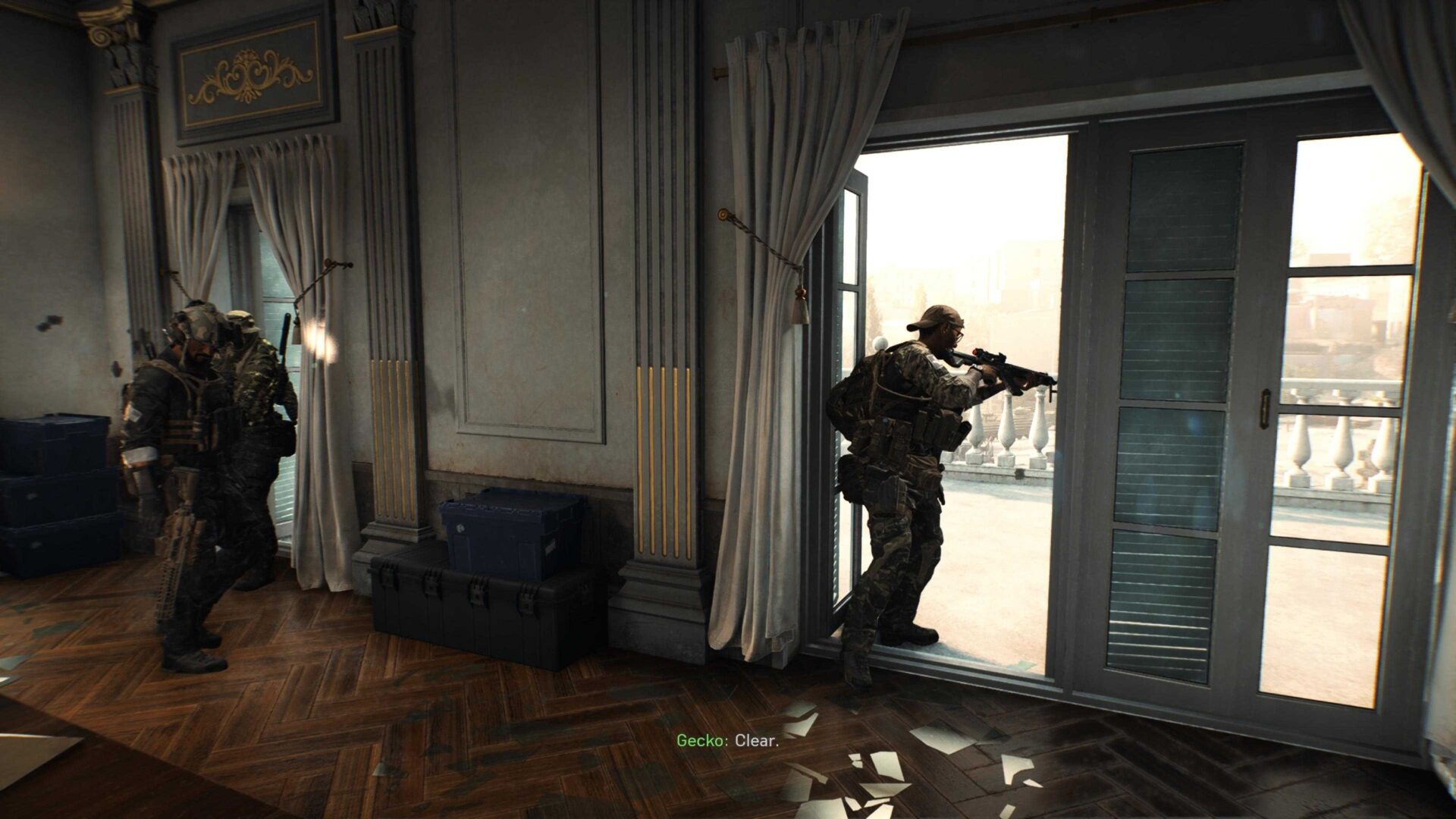
Kinetic Games has been hard at work bringing Phasm0phobia up to the high standard of quality they want the game to have. Now they’ve taken another big step by updating the first map they created for the game.
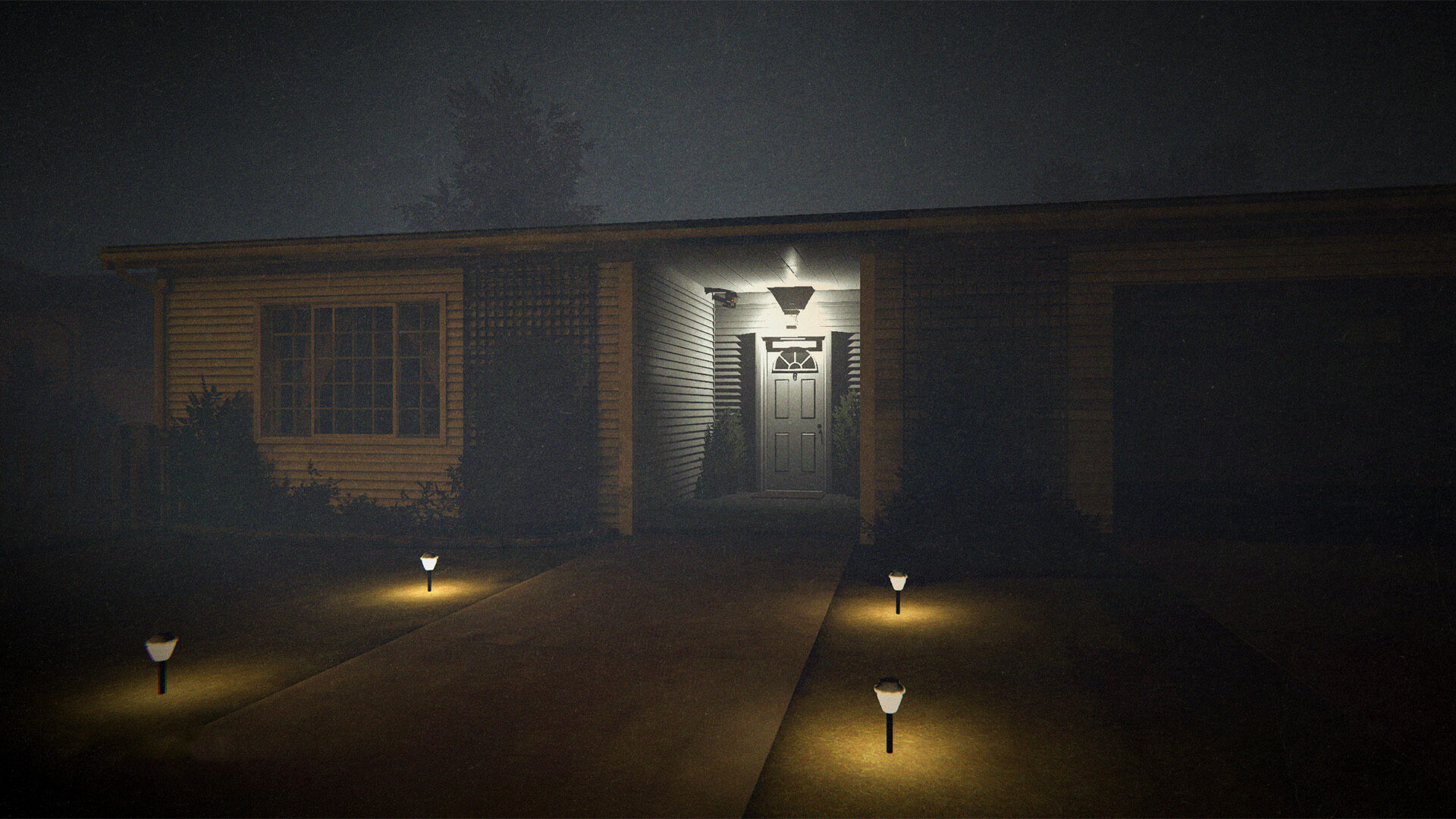
Announced today, fan favourite 6 Tanglewood Drive will receive a massive overhaul in the same vein as the Grafton and Bleasdale farmhouses. The updated map will be available on March 3rd, 2026 and is meant to increase the quality, interactivity, and replayability of the well-loved location. The updated Tanglewood will feature brand-new ghost interactions within the map and a new surprise in the basement.
Kinetic Games will keep this structure and much of the original feel when refreshing the design. “The last thing we want to do is remove the magic that players already experience in the game. We understand that Tanglewood is a fan favourite and it’s many of ours too,” said Art Director at Kinetic Games Corey Dixon.”
He continued, “The aim of the Tanglewood rework is to raise the map to the same level as the newer locations, and make Phasmophobia the game we’ve always wanted it to be. We’re so lucky to have such a dedicated fanbase, and we’re always conscious of how it could affect our veteran ghost hunters.”
Considered by many to be a beginner’s map—in fact, the original tutorial for the game was set in this house—Tanglewood is a smaller location, consisting of a single-floor house with two bedrooms, a hobby room, two toilets, a garage, a basement, and a living room, kitchen, and dining room. Following the Phasmophobia 2026 Roadmap, the next map planned for a revamp will be 13 Willow Street—another beloved location by fans.
The 6 Tanglewood Drive map rework is a free update that will be available for Phasmophobia on all platforms. Phasmophobia is available in Early Access on PC via Steam, PS5, PS VR2, and Xbox Series X|S, and coming soon to the Nintendo Switch 2.
At CES 2026, ASUS made a unique announcement: it was teaming up with Kojima Productions for a special version of its ROG Flow Z13, the ROG Flow Z13-KJP. This new version of the ROG Flow Z13 would keep all the features people loved about the original convertible tablet and give it a very special facelift inspired by Kojima and Death Stranding.
It was an announcement I did not expect when I walked into the ASUS tech showcase a few weeks before CES 2026, but I was interested. I have now spent a few weeks with the ROG Flow Z13-KJP, and while it does not offer any new hardware features compared to the standard Flow Z13, the Kojima touch makes it an excellent option if you have been sitting on the fence about jumping on this unique portable computer.
Unboxing the ROG Flow Z13-KJP is an experience in itself. This is one of the coolest tech unboxings I have done in a long time. Seeing the ROG Flow Z13-KJP quickly while at the preview did not do the hardware justice; there is a lot at work here that makes this device truly special. First, the skinning of this device is elaborate. ASUS has gone all out to give the Flow Z13 the Kojima treatment, with every aspect of the laptop, from the keyboard, look of the back of the device, and even down to the startup animation, having gotten some attention.
If you ever wanted to feel like you were using a device pulled from the world of Death Stranding, this would be that device. The subtle details and even the keyboard’s shape feel intentional, working together to make a device that feels incredibly unique. Given how many people love Hideo Kojima’s work, I have no doubt this device will sell out pretty quickly once it launches. And, given that the Flow Z13 was an impressive portable computer when it launched, this facelift only adds to that appeal.
But I do have to reiterate, while this is a major change in the design of the device, the ROG Flow Z13-KJP is below the surface, the same computer as the 2025 ROG Flow Z13. The ROG Flow Z13-KJP features the AMD Ryzen AI Max+ 395 processor at its core, a chip that integrates 16 Zen 5 CPU cores with Radeon 8060S graphics. This Strix Halo design utilizes a unified memory architecture, allowing the system to allocate up to 64GB of LPDDR5X RAM as video memory. This setup removes the need for a discrete graphics card inside the chassis while still delivering performance capable of handling modern games and local AI workloads.
We talk about it in our review of the original ROG Flow Z13, but this little computer is incredibly powerful, and despite its size can do things many bigger laptops simply can’t the ridiculous amount of memory at its disposal (128GB LPDDR5X 8000) means it can take on AAA gaming, be a power house when it comes to video editing and 3D modeling, and it is even more than capable of taking on AI work, if you ever wanted to run an LLM locally.
It is crazy to think this is all packed into a relatively portable device, but ASUS somehow made it all fit. And with this version of the Flow Z13, it all fits and looks like it is pulled right from a science fiction universe at the same time.
“While the internal hardware remains unchanged, ASUS has included several exclusive touches for the ROG Flow Z13-KJP.”
On the display side, the ROG Flow Z13-KJP features a 13.4-inch ROG Nebula Display that balances portability with high-end specs. The panel features a 2.5K resolution (2560 x 1600) in a 16:10 aspect ratio, offering extra vertical space for productivity. It supports a fast 180Hz refresh rate and covers 100 per cent of the DCI-P3 colour gamut, ensuring smooth motion and accurate hues for content creators. With 500 nits of brightness and Dolby Vision support, the touchscreen remains visible and vibrant even in brighter environments.
I have seen the ROG Flow Z13 in person and spent some time using it. However, having it in the office and testing it more thoroughly gave me a clearer understanding of how it performs, whether watching media or playing games on this tablet PC. It delivers deep blacks and vibrant colours, making everything I tested look sharp, even at lower brightness levels. While the Kojima Productions edition does not introduce any exclusive display technology, ASUS set a high standard with the original model, and it continues to impress here.
I was also struck by how many ports ASUS has incorporated into the device. Despite its compact tablet form factor, the ROG Flow Z13-KJP offers an impressive selection of connectivity options for peripherals and external displays. It includes two USB4 Type-C ports with support for power delivery and DisplayPort, as well as a dedicated USB 3.2 Gen 2 Type-A port for legacy accessories. An HDMI 2.1 port allows for direct connection to a television, and a UHS-II microSD card reader provides expandable storage. The system is powered by a 70-watt-hour battery and cooled by a vapour chamber designed to keep its high-performance components running efficiently within the slim chassis.
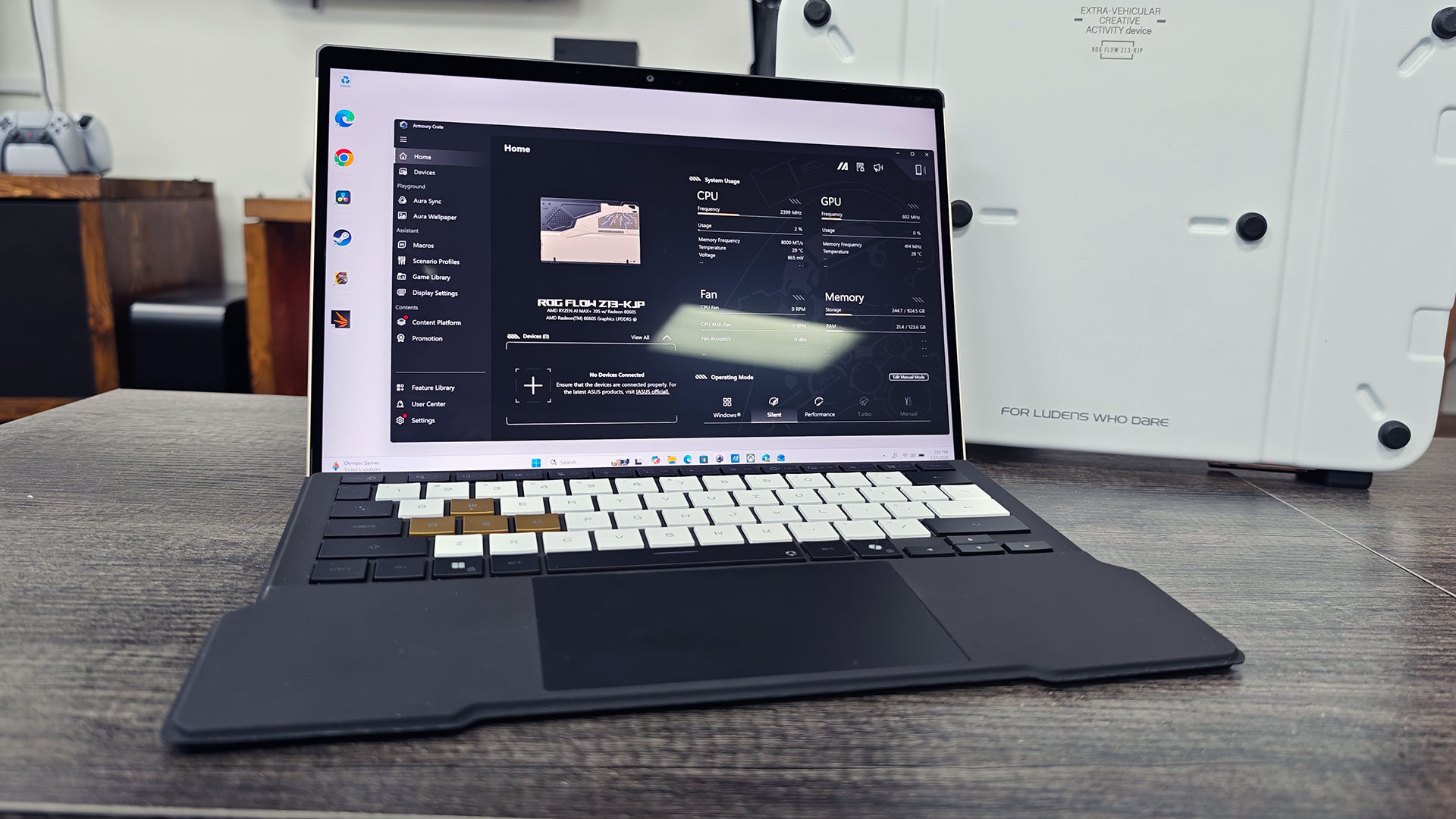
While the internal hardware remains unchanged, ASUS has included several exclusive touches for the ROG Flow Z13-KJP. The device features a custom startup animation showcasing Ludens when powered on. Unlike the standard ROG Flow Z13, this edition also includes a themed version of Armoury Crate designed specifically for the Kojima Productions collaboration, complete with a distinctive visual style.
The package also includes a custom briefcase designed to carry and protect the ROG Flow Z13-KJP. Is it more practical than a traditional laptop sleeve? Not particularly. It is bulkier and less convenient, but undeniably stylish. The design feels inspired by Death Stranding and is sturdily constructed, even if many owners may ultimately display it rather than use it daily. It is fully functional, though for everyday commuting or travel, placing the device in a standard messenger bag may prove more convenient than carrying the dedicated case.
Despite its bulk, the ROG Flow Z13-KJP feels distinct and genuinely special. It is a powerful PC that can handle a wide range of demanding tasks, from gaming and content creation to AI workloads. Like the standard ROG Flow Z13, it retains its tablet-first form factor, meaning it does not offer the traditional keyboard experience found on most laptops.
Given the performance hardware inside, battery life does not match that of more efficiency-focused laptops released in 2026, particularly those built around Intel’s Panther Lake platform. Even so, the device remains undeniably compelling and may prove especially appealing to fans of Hideo Kojima and Kojima Productions.
At a starting price of $2,799.99 USD, this is not one that will come cheap, but it compares pretty closely to the standard ROG Flow Z13, so if you are a Kojima fan and were on the fence about jumping onto that laptop, this could be your time. Also, ASUS is releasing a selection of accessories that complete the experience, with a mouse and headset releasing with a unique Kojima Productions-inspired aesthetic to complete your overall computing experience. It may not be for everyone, but for “For Ludens Who Dare”, this could be a fun addition to your mobile gaming experience.
Night Street Games announced today that its latest game, Last Flag, will officially release on April 14.
Last Flag is described as an “over-the-top” 5v5 capture-the-flag shooter, originally conceived by Night Street Games founders Dan Reynolds and Mac Reynolds. The duo felt that other titles in the capture-the-flag genre failed to recapture the experience they had as kids, where hiding and finding the flag was the most exciting part of the game.
Players in Last Flag compete for fame and fortune in a 1970s-style game show setting. Matches are designed to last around 20 minutes, creating an experience the developers did not want to feel “too sweaty.”
“Working on Last Flag has been a dream for all of us at the studio. It is not often you get to build a game exactly how you want,” said Mac Reynolds, CEO and co-founder of Night Street Games. “Our PC launch is a huge milestone, but we are just getting started. New maps, new contestants and some unexpected twists are coming later this year. We cannot wait to share it all.”
If this sounds appealing, you will be glad to know Night Street Games is running an open demo from now until March 2. Participants can earn exclusive cosmetic rewards, such as the Lunar Gold-themed skin set, which will carry over to the full game when it launches in April.
As previously mentioned, Night Street Games was founded by two brothers. What makes that particularly interesting is that Mac Reynolds manages the band Imagine Dragons, while Dan Reynolds serves as its lead singer. The pair say they launched Night Street Games in an effort to create multiplayer experiences built with heart.
For now, Last Flag will be available only on PC via Steam or the Epic Games Store. However, the developers have confirmed console versions are in development and expected to launch later this year. Be sure to check out Last Flag when it releases on April 14.
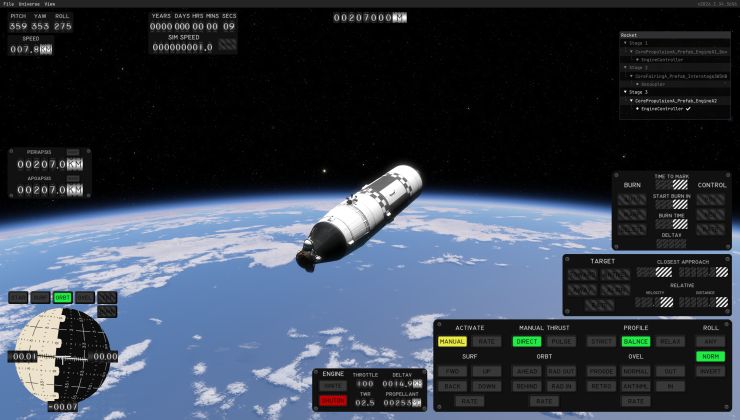
Kitten Space Agency is a promising upcoming space simulation game that's pretty much a spiritual successor to Kerbal Space Program and now for Linux too.
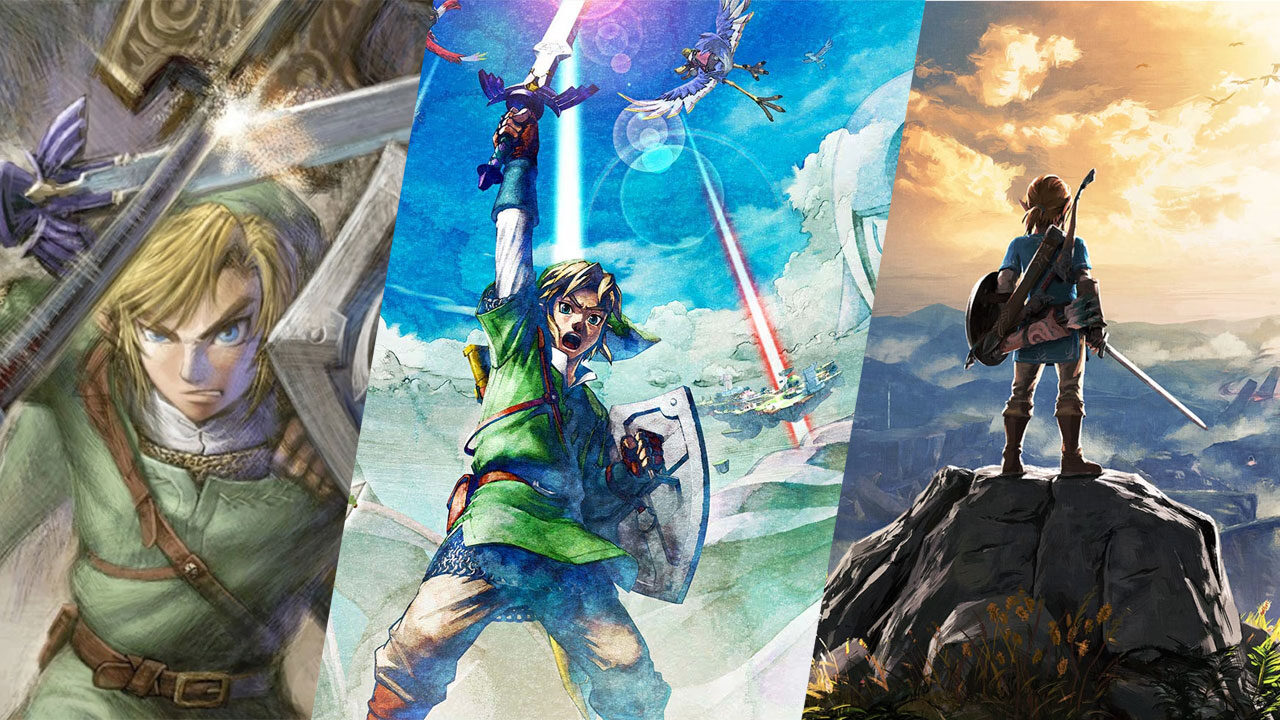
On December 4th, 2025, CGM’s Dayna Eileen messaged me, completely unprompted: “You should rank the Zelda games.” Being on the cusp of The Legend of Zelda’s 40th anniversary, it seemed like a worthy challenge. A challenge that would require wisdom, power and of course, courage to complete.
I’ve loved The Legend of Zelda series since I first played Link’s Awakening DX back in 1998, and I’ve definitely developed some strong opinions about it as I’ve gotten older. So now, as we celebrate The Legend of Zelda’s 40th anniversary, here is my humble opinion on how the series stacks from worst to best.
Much like with my Comprehensive Ranking of the Metroid Series, the focus of this list will be primarily on the “mainline” Zelda games; however, I would be remiss not to mention the many spin-offs that also exist within the series. As such, they will also be listed from worst to best in the honourable mentions section.
17. The Legend of Zelda: Skyward Sword
In all my years, I wouldn’t have thought it was possible to genuinely hate a Zelda game, but I HATE The Legend of Zelda: Skyward Sword. A gimmicky tech demo that was released on the Nintendo Wii, five yearsinto its lifespan. Almost everything about this test of patience feels like the antithesis of what The Legend of Zelda should be. Terrible combat that prioritizes motion controls over fluid swordplay? Check. Small areas separated by an empty and pointless Sky World? Check. A companion who handholds you through the entire adventure? Big ol’ check on that.
It took years of established lore and flushed it down the toilet for a pointless retcon, so Din, Faeror and Nayru were replaced by a single goddess Hylia—making the Triforce kind of perfunctory. It failed to include the series’ main antagonist, so Ganon: King of the Moblins was reduced to The Demise—a nebulous concept about hate and anger or some lazy badguy writing. It’s a game so lazy it makes you fight the same terrible boss three times because it couldn’t come up with better Spore creatures for you to fight.
That isn’t to say it’s all bad. I loved the painted art style, and the game’s score is one of the best in the series. But for what it was, when it came out, it failed as both a video game and it failed even harder as a The Legend of Zelda game.
16. The Legend of Zelda: Phantom Hourglass
Phew, now that I got that out of my system, let’s move on to less offensively lower entries on this list. The Legend of Zelda: Phantom Hourglass is a pretty serviceable game, however there’s no denying its status as an actual tech demo for the recently released Nintendo DS, with the two releasing only three years from each other. It’s not really a bad game, but so much of its design feels in service of showing off what the system was capable of.
It’s a lot of using the touchscreen for movement, which was a particular bugbear for many people. Puzzle solving was certainly interesting, but it’s usually just a lot of drawing lines between obvious points. And as a kind of direct sequel to Wind Waker, it didn’t feel particularly unique. However, that puzzle where you needed to close the DS was GENIUS, and the game had one of the most fun multiplayer modes of any DS game at the time.
15. The Legend of Zelda: Tears of the Kingdom
This one’s going to seem like absolute blasphemy. I always tell people, The Legend of Zelda: Tears of the Kingdom, feels to me like the fully realized version of Breath of the Wild, but I would sooner go back to Breath of the Wild than play Tears of the Kingdom. In a lot of ways, it’s a really good game. Its story is more expansive, its world is a lot bigger, and its mechanics feel far more fleshed out. But it’s a really good game, only if you never played the game that came before it.
When I wrote my list of things I wanted to see in The Legend of Zelda: Tears of the Kingdom, I was genuinely hopeful Nintendo might have listened to criticisms about the Switch’s flagship title. Instead, we got a lot of half measures. Swords still shatter like glass, but now you can glue sticks together, so it’s kind of fixed. Was constantly switching armour annoying? Good news, we’ve doubled the amount of armour sets you can find. Didn’t like constantly pausing the game to scroll through menus? Well, now we’ve made the menu one long linear list, on top of needing to pause to scroll through menus!
The overarching story is a bit better, but the most important bits—Zelda’s experience in the past—need to be found on the map, and important plot points can therefore be experienced out of order, which made sense in Breath of the Wild cause Link was recovering lost memories…oh, never mind. The weirdest thing to me is that it positions itself as a sequel but almost NEVER references the past game’s events. Which is why I say, there’s a lot to like about Tears of the Kingdom, but it’s only really worth playing if you haven’t played the game that came before it.
14. The Legend of Zelda
This is going to sound very similar to where I put the original Metroid games on my previous list. The Legend of Zelda was, without a doubt, a groundbreaking video game. It pushed the limits of what the NES was capable of and showed gamers that video games could be more than simple distractions—they could be entire ADVENTURES.
However, I think it’s fair to say, The Legend of Zelda hasn’t really stood the test of time. It’s certainly fared better than other games of the era, but it’s a bit clunky, needlessly difficult and almost completely unplayable without a guide—the first example of the “Nintendo Power Game.” While it deserves no shortage of praise for its size and scope—and being one of the first cartridge games to offer a save feature—it definitely hasn’t gotten better with age.
13. Zelda II: The Adventure of Link
Similar to its immediate predecessor, Zelda II: The Adventure of Link also hasn’t particularly stood the test of time. It shares an equally unnecessary difficulty and borderline unplayability without a guide. While it’s not a particularly bad game, there are a lot of barriers to entry that made it somewhat unenjoyable both then and now. It’s a bit of a weird one because there’s actually a lot I like about Zelda II: The Adventure of Link.
It’s shift to a 2D platformer for enemy encounters, or dungeons and caves, gave it a unique style, and its focus on combat created an interesting system that I’m surprised no other entry in the series has explored. Similar to something like Castlevania II: Simon’s Quest, it built a world that felt genuinely big within the confines of the most common 8-bit design philosophies. It’s a game I would love to see remade, ala. Metroid: Samus Returns—with modern gaming sensibilities and Link’s moveset from Super Smash Bros.
12. The Legend of Zelda: Echoes of Wisdom
This is going to be the most difficult part of the list because the games are objectively good, but didn’t really leave a lasting impression on me—let’s call it the “mediocre middle.” The Legend of Zelda: Echoes of Wisdom deserves a certain degree of props for being the first “official” game in the series that featured the titular princess in the leading role. Also, it’s inventive gameplay that borrows the sense of freedom its Switch predecessors pioneered, while tailoring it to a more “traditional” top-down Zelda experience, was genuinely unique.
However, by that same token, The Legend of Zelda: Echoes of Wisdom doesn’t really have a lot of memorable moments. Dungeons are a welcome return, but since they need to be cleared with beds and boxes, they lack the visual and thematic distinction that made previous Zelda dungeons so memorable. Also, Nintendo’s obsession with linear menus and objects that function identically meant half the game is spent sliding through inventory lists to find the thing you need. In the end, it’s not that bad, but it’s not really a Zelda worth returning to.
11. The Legend of Zelda: Twilight Princess
Now, before you get your torches and pitchforks for this one, just hear me out. I honestly DO like The Legend of Zelda: Twilight Princess. For a launch title on the Wii—or Gamecube life-support, depending on how you look at it—it was a genuinely monumental game. It gave us Midna, who is definitely the best support character ever in a Zelda game, Zant, who was one of the best villains in a Zelda game, and its size and scope were pretty impressive for the time. And that Ganon fight? *Chef’s Kiss*
However, I also think it comes out REALLY strong in the first half and then loses a lot of steam in the back nine. While I like its aesthetic, it also feels a little dark for dark’s sake—an obvious correction from the criticism The Legend of Zelda: The Wind Waker received. It’s got some pretty forgettable dungeons, two genuinely useless items, and a combat system that was a bit of a step back from its predecessor (why unlock the moves Wind Waker just GAVE you?)
10. The Legend of Zelda: Ocarina of Time
Okay, feel free to pick up those torches and pitchforks now. I’ve said it before, and I’ll say it again: The Legend of Zelda: Ocarina of Time was genuinely revolutionary for its time. For the first Zelda of the 3D era, it was pretty incredible what it was able to achieve in terms of worldbuilding, story-telling and overall design. It has some of the most memorable moments in any Zelda, some of the best dungeons and boss monsters and all but cemented the idea of the “Zelda formula.”
But on multiple repeat playthroughs, The Legend of Zelda: Ocarina of Time just doesn’t really do it for me. Story-wise, it follows a little too closely to The Legend of Zelda: A Link to the Past, to feel original or even as a supposed prequel. Its combat is a monotonous game of wait-and-attack. Puzzles usually involve looking around the room for an object and then hitting said object, and it’s all just…kinda boring.
Like I said, it’s rightfully deserving of its praise, but I can’t help but feel like it’s a little overrated.
9. The Legend of Zelda: Link’s Awakening
You may have thought The Legend of Zelda: Link’s Awakening would’ve appeared higher on this list, and honestly…so would I. Link’s Awakening has a real special place in my heart as the first one in the series I ever played to completion, so cracking the top 10 ain’t too bad. The Legend of Zelda: Link’s Awakening is a pretty amazing game when you think about it. Originally conceived as a Game Boy port of A Link To The Past, the project grew into a full-fledged game.
It’s one of those miraculous Game Boy games that really showcase how capable the system was when people knew how to develop for it. Its world felt as big as its SNES inspiration, its dungeons were inspired, and both visually and audibly, it really stood out. Its story was unique and mysterious, constantly hinting at what was really going on, but never saying it outright. If not for Pokémon Silver/Gold, it may just be the crown jewel of the Game Boy.
And if you want to experience it, the Nintendo Switch “remake” is a pretty faithful 1:1 recreation of the original, with improved graphics.
8. The Legend of Zelda: A Link Between Worlds
I wrestled with whether The Legend of Zelda: A Link Between Worlds should go in the proper list, or in the Honourable Mentions, because in some ways, it is kind of a remake of The Legend of Zelda: A Link to the Past. But the more I thought about it, the more I realized it deserved a spot on the list because of just how much it sets itself apart from its counterpart.
While it does end up being somewhat of a reboot-sequel, it both adds and changes so much about its predecessor that it really stands alone as its own thing. The way it plays with perspective by having Link paste himself onto walls and move in two-dimensional space in a 3D top-down game was unbelievably inventive, allowing for a whole new way to explore dungeons and the overworld.
The way it had players rent items from a shop, allowing for a sense of freedom in how they approached dungeons without subtracting from the overall narrative, was such a stroke of genius that it was probably too good for a second game. It felt so new, while using SFX and subtle nods to pay tribute to its SNES predecessor, and it’s one of the few 3DS games that actually used the 3D to genuinely impressive effect.
7. The Legend of Zelda: Spirit Tracks
I will die on the hill that The Legend of Zelda: Spirit Tracks is woefully underrated. Unlike its direct predecessor, it actually feels like a fully realized Zelda game on the Nintendo DS and less like a tech demo. All the good ideas The Legend of Zelda: Phantom Hourglass had are refined and expanded. It feels a bit better to control; its items are a bit more unique to the game, and the world feels bigger and more interesting.
Not only that, it was the first game to really involve Princess Zelda in a much more active role, setting her as Link’s companion character throughout his entire adventure. Getting to use her within the Spirit Tower, as she possessed Phantom Armor was a really thoughtful and interesting inclusion and set up for a lot of interesting puzzles. Plus, it gave her fun little personality quirks, like a fear of mice that rendered her immobile.
Also, you get a little train, and you can make it go Choo Choo. WHAT MORE DO YOU WANT!?
6. The Legend of Zelda: The Minish Cap
It’s hard to describe how incredible The Legend of Zelda: The Minish Cap was if you weren’t there for it. As the official Zelda game on the Game Boy Advance, following the re-release of The Legend of Zelda: A Link to the Past, it felt every bit as big and inventive as its predecessor—and in a lot of ways, even more.
Developed by Capcom in what was meant to finish off the “Triforce Trilogy,” The Minish Cap made everything bigger by, ironically, making everything smaller. Because of the magic of the Picori—who, at the time, were hinted at being the creators of the Master Sword—Link could shrink down to the size of a bug—turning blades of grass into massive trees, and puddles into vast lakes.
It allowed the game to be incredibly creative with its dungeon and area design, playing with perspective and offering really memorable dungeons and boss monsters. Plus, it took full advantage of the GBA’s power, creating a bright and colourful world with a stellar soundtrack and excellent use of audio clips from The Legend of Zelda: The Wind Waker.
5. The Legend of Zelda: Breath of the Wild
I’ve spoken at some length about how much The Legend of Zelda: Breath of the Wild resonated with me when it first came out. The circumstances of my life at the time, coupled with the sheer size of the Nintendo Switch’s launch, had the game connect with me in a way few others had. And upon repeat playthroughs, I’ve only been shocked by how new the game always feels. Stepping out onto that plateau always inspires a sense of adventure in me, no matter how many times I see it.
And while it’s certainly not a perfect game, it’s incredible how much the game wants to feel like a big, bold adventure. In a lot of ways, The Legend of Zelda: Breath of the Wild feels like a spiritual reboot of the NES The Legend of Zelda. It’s a game that makes my top five Zeldas simply for how new, fresh and big the whole thing felt and still does to this day.
4. The Legend of Zelda: Oracle of Ages/Seasons
If The Legend of Zelda: Link’s Awakening was a showcase of what the Game Boy was capable of, then The Legend of Zelda: Oracle of Ages/Seasons is a showcase of what the Game Boy SHOULD NOT have been capable of. Two games, larger in scale than their predecessor and made even larger by the unique world-shifting mechanics each one possessed.
Witnessing these two games when they were released in 2001 was like experiencing a miracle in real-time. It gave players incredibly fun items, animal sidekicks, unbelievable dungeons and two really great antagonists. It’s no wonder Nintendo didn’t let any other developers make Zelda games because Capcom set the bar so high with these ones, even the Big N wouldn’t be able to follow them up properly.
3. The Legend of Zelda: A Link to the Past
Of course, we couldn’t approach the top three without mentioning the one game that really showed what The Legend of Zelda could be as a game. The Legend of Zelda: A Link to the Past was like a complete reinvention of the NES classic—feeling similar, but new in all the right ways. It had a bigger story, a bigger world, bigger dungeons, bigger monsters…it was just a bigger adventure!
Similar to Super Metroid, it utilized the power of the Super Nintendo to give players a suite of quality-of-life improvements that actually made the game playable without the need for Nintendo Power magazine. Its sprite-work and soundtrack remain iconic to this day, and it’s the only game in the series to feature a pink-haired Link, which is pretty neat.
2. The Legend of Zelda: The Wind Waker
It’s hard to know how to describe The Legend of Zelda: The Wind Wakerwithout getting completely overwhelmed by all the ways it absolutely OWNS. The debut Zelda on the Nintendo GameCube took full advantage of the system, creating an experience that was big, bold and completely unforgettable. It’s got a sweet, Miyazaki-esque story about a boy (not chosen by fate) who sets out to rescue his sister, and chooses to become a hero. It’s got an art style that’s bright, colourful, interesting, and intentionally designed to stand the test of time.
It’s got a world that, despite being 90% ocean, has something to discover around every corner. Literally every square of the map grid has an island on it, on top of all the surprise secrets you can find on the ocean if you sail long enough. It’s got some of the most memorable dungeons in both theme and design, and its combat system is the best Zelda has ever had—using the foundation designed for Ocarina of Time and enhancing it with contextual prompts to utilize special attacks.
It’s amazing to consider that when it was released, The Legend of Zelda: The Wind Waker was LAMBASTED by “fans” for being too cartoony and babyish, all because Nintendo put out a tech video of Link fighting Ganon that looked gritty and badass. But history has since come around on The Wind Waker, and it remains the second-best Zelda ever released.
1. The Legend of Zelda: Majora’s Mask
The Legend of Zelda: Majora’s Mask is, without a doubt, the best Zelda, PERIOD. It took the foundation that its predecessor laid and used it to make a game that was bolder, more daring and far more engaging. It’s honestly hard to believe it was released less than two years after The Legend of Zelda: Ocarina of Time, for how much of an improvement it is over that game.
Its world may be smaller than its predecessor in a pure pixel-ratio sense, but it feels so much bigger and lived-in, thanks to much more dynamic areas and three-dimensional characters and stories that bring it to life. Its combat is far more engaging, made even better by the fact that there are four distinct ways to approach it. Centring so much around the Masks meant items found in dungeons could be used more directly to explore the world, and they felt less like keys required to complete half a dungeon.
Its story is dark and deeply resonant, not simply handed to the player, but slowly discovered as they explore the land of Termania, talk to its inhabitants and complete the myriad sidequests the game has to offer—Kafei’s Quest alone could be the plot of an ENTIRE video game. And allowing players to play as a Deku, Goron and Zora allowed them to experience the full breadth of the Zelda world, which is almost a game crime that no other entry has ever brought it back.
I’ll always find it interesting that the two best Zelda games were the ones people genuinely hated when they first released. I guess it’s true what they say, “true genius is never recognized in its time.”
Honourable Mentions
The Legend of Zelda: Tri Force Heroes – The 3DS Zelda spin-off that suffered a similar fate to Metroid Prime: Federation Force, the second attempt at a co-operative Zelda game tied around the idea of outfits bestowing abilities to the user was pretty inspired. And unlike the predecessor that inspired it, thanks to the internet, jumping into a game with others would have been incredibly convenient if there was ever a player base for it.
The Legend of Zelda: Four Swords Adventures – A pretty unique idea for a multiplayer The Legend of Zelda, held back by the necessity for every player to have a Game Boy Advance and Gamecube Connecter. The way it combined classic top-down Zelda with co-operative, level-based design was pretty inspired, and if you could get a group together, it really worked.
Hyrule Warriors/Age of Calamity/Imprisoning War – Combinging a Musou game with The Legend of Zelda was nothing short of a stroke of genius, an while all three Hyrule Warriors games have been pretty solid, for my money the first entry will always be the one worth talking about—boasting the biggest and best roster, a plethora of features and it wasn’t required for crucial plot details to two other games.
Ubisoft has gone through many rough patches in recent years, but the CEO of Ubisoft, Yves Guillemot, is enacting a plan to save the company.
Recent months have not been exactly good for Ubisoft as they have gone through many layoffs and studio closures due to the less-than-great sales of its recent games. In an interview with Variety, Guillemot spoke about how these lay-offs and closures are all part of a plan to reignite the spark that Ubisoft once had.
The current idea is to reformat its studios into “Creative Houses.” Essentially, every house will have full responsibility over its assigned brands’ development, plus its profit and loss. They will design new IPs and operate like their own dedicated business with transparent accountability geared toward performance and actual autonomous creativity.
The latest addition to the creative house project is Vantage Studios, which seems to be in charge of making new games under the Far Cry, Rainbow Six Siege, and Assassin’s Creed IPs. “We have a solid pipeline underway across Vantage Studios. Under the Assassin’s Creed brand, several titles are in development, spanning both single-player and multiplayer experiences, with the ambition to further grow a community that exceeded 30 million players last year,” said Guillemot. He also claimed that they have two ongoing Far Cry projects underway and are putting more resources into Rainbow Six Siege events.
Before all of this restructuring happened, the company cancelled six games from its selection of recognized games, especially the highly anticipated Prince of Persia: The Sands of Time Remake. This doesn’t bode very well for the company, even though Guillemot says, “While such decisions are never easy, they allow us to concentrate our talent on the highest-potential projects and ensure that every release meets the quality our players expect.” Despite three of the cancelled games being entirely new IPs, it can only be speculated on what Ubisoft’s current projects are.
Speaking of current projects, one of the only games in development that didn’t get cancelled was the Splinter CellRemake. This is still a shock because, according to MobileSyrup, Ubisoft just recently laid off 40 employees working on the remake since 2021 from the Toronto office. Even now, Ubisoft says that the game is not cancelled, but judging by recent trends, it could just be a matter of time. Especially so since 1,200 Ubisoft employees went on strike a couple of weeks ago because of the same cost-cutting measures.
Only time will tell if or when Ubisoft will come out of this restructure still kicking or not. In the meantime, we just have to hope that new Watch Dogs and Assassin’s Creed games will come out soon.
The Entertainment Software Association of Canada (ESAC) has officially released its listings for the top-selling games in Canada in 2025.
The full list of 20 games included in the rankings is surprisingly diverse, with many genres included. In fact, four of the top six best sellers are made—at least in part—right here in Canada. Even though other games like the legendary Grand Theft Auto V and the recently released Borderlands 4made it onto the list, Canada still holds the top two ranking spots. So let’s get into some Canadian highlights listed in the rankings.
Sitting at number one in the whole country is Battlefield 6, which some people probably did not know was made partly in Canada. Partly meaning that Battlefield 6 was a four studio conjunction of production with Motive Studio out of Montreal, tagging into the design team to work on story elements, along with development in general. Along with Motive, there was also DICE out of Stockholm, Criterion Games located in Guildford, UK, and Ripple Effect Studio from Los Angeles. All of these Studios worked together to develop the newest game in the franchise’s long history under the “Battlefield Studios” banner.
Moving one rank down to number two is NHL 26, which was developed exclusively by EA Vancouver. EA Vancouver is also responsible for numerous other hit games included under the EA Sports branding. FIFA, NBA Live, NCAA March Madness, and the exquisite SSX were all made by EA Vancouver, and they even helped Konami develop ports of the original Castlevania for the Commodore 64 and MS-DOS operating systems.
Without further ado, here is the full list of every top-selling game in Canada for 2025 according to ESAC.
Donkey Kong Bananza, Nintendo
Grand Theft Auto V, Take 2 Interactive
Red Dead Redemption II, Take 2 Interactive
Civilization VII, Take 2 Interactive
Elden Ring: Nightreign, Bandai Namco
Forza Horizon 5, Microsoft
Pokémon Legends: Z-A, Nintendo
Call of Duty: Black Ops 6, Microsoft (Canadian)
Minecraft, Multiple Manufacturers
Split Fiction, Electronic Arts
Kingdom Come: Deliverance II, Plaion
Ghost of Yotei, Sony
The Elder Scrolls IV: Oblivion: Remastered, Microsoft
John Carpenter’s Toxic Commando is a 4-player co-op FPS where you obliterate hordes of terrifying monsters to save the world.
In John Carpenter’s Toxic Commando you’ll gather your squad and send the Sludge God and its undead horde back to hell. Jump in with fellow commandos online for pure co-op chaos – revive teammates, share ammo, cover backs, and laugh through the madness. When infected … Read More
Denshattack! is a fast-paced and wonderfully silly game where you flip, trick, and grind your gravity-defying train through a colorful Japanese dystopia.
In Denshattack!, hop aboard your custom train and embark on a hectic quest to defeat the sinister Miraidō corporation alongside a vibrant pack of outcasts. Ollie, kickflip, and grind through Japan’s biggest cities, meadows, volcanoes, and oceans. Rack up points chasing high … Read More
INFERIUS is a first-person roguelike deckbuilder blending Dante’s Inferno with Lovecraftian horror across the nine levels of hell.
In INFERIUS, use Major Arcana Tarot Cards to strategize against horrors lurking in darkness. Build the perfect deck, challenge rulers embodying sins of their dominions – Limbo, Lust, Gluttony, Greed, Anger, Heresy, Violence, Fraud, and Treachery – die often, and repeat.
Pre-strategize and enhance cards before … Read More
Meat Grinder is an open-world simulation-adventure where you run a hot dog shop and discover how far you’ll go to keep it running.
In Meat Grinder, you’ve opened your own hot dog shop in the foggy streets of Grimshore. Prepare, cook, and serve sausages to customers during the day. But when stock runs low, you’ll resort to unusual methods at night to replenish your … Read More
Cannon Keep is a tower defense game where you build your city block by block, finding optimal layouts to defend against relentless enemy onslaughts.
In Cannon Keep, you’ll place, pack, and merge buildings onto the grid to grow your economy and defense simultaneously. Expand your city’s borders above and below ground to increase damage output and resources gained. Explore underground to gather materials and … Read More
Burden Street Station is a surreal narrative adventure where you shapeshift during conversations to uncover how God went missing.
In Burden Street Station, life’s moments are extracted from mortals and transformed into sentient books for consumption by higher beings. A lowly librarian and a book without a moment of its own are coerced into solving the mystery of a missing God.
Galactic Vault is a fast-paced FPS roguelite where you build weapons to their full potential while infiltrating high-security vaults.
In Galactic Vault, big corporations hoard all technology in a dystopian future. As a former VOLT operative, your mission is infiltrating and plundering tech vaults to recover cutting-edge equipment. Start with low-tech weapons and unlock advanced options with hard-earned currency for stronger starts.
Clockwork Ambrosia is a steampunk fusion of metroidvania and weapon-building 2D shooter where you combat deadly robots and monsters.
In Clockwork Ambrosia, pull on the boots of airship pilot Iris, stranded after a near-miss crash on a mysterious island. The populace has disappeared, seemingly replaced by malevolent robots and cyborgs. Piece together unique weapons with game-changing modifications and synergies – screen-filling shot splitters, devastating … Read More
CAPTURED 2 is an anomaly hunting horror game where you’re trapped in an ever-changing apartment, capturing anomalies on camera while surviving deadly entities.
In CAPTURED 2, you play as Emily, a teenage girl who goes missing during unexplained disappearances and finds herself trapped in an endless hallway within her own apartment, slowly losing her memory. Strange anomalies appear throughout procedurally generated loops, and capturing … Read More
Glintseeker Island is a singleplayer mining exploration adventure where you descend into mysterious caves filled with treasures and ancient threats.
In Glintseeker Island, you’ll explore caves searching for artifacts and loot to bring safely back to the surface. Sell excavated treasures to the local merchant or upgrade hammers with gemstones at the blacksmith. Be strategic when mining – use hammers carefully to unearth treasures … Read More
The Loopler is an idle-like roguelite simulation where you watch a car drive in loops while numbers climb and dopamine flows.
In The Loopler, you’ll pick upgrades, discover synergies, and put together builds designed to maximize your runs toward infinity. Place gates on the track to enable even more synergies and enhance the craziness that unfolds. Each consecutive round increases the goal, challenging you … Read More