CAPTURED 2 is an anomaly hunting horror game where you’re trapped in an ever-changing apartment, capturing anomalies on camera while surviving deadly entities.
In CAPTURED 2, you play as Emily, a teenage girl who goes missing during unexplained disappearances and finds herself trapped in an endless hallway within her own apartment, slowly losing her memory. Strange anomalies appear throughout procedurally generated loops, and capturing … Read More
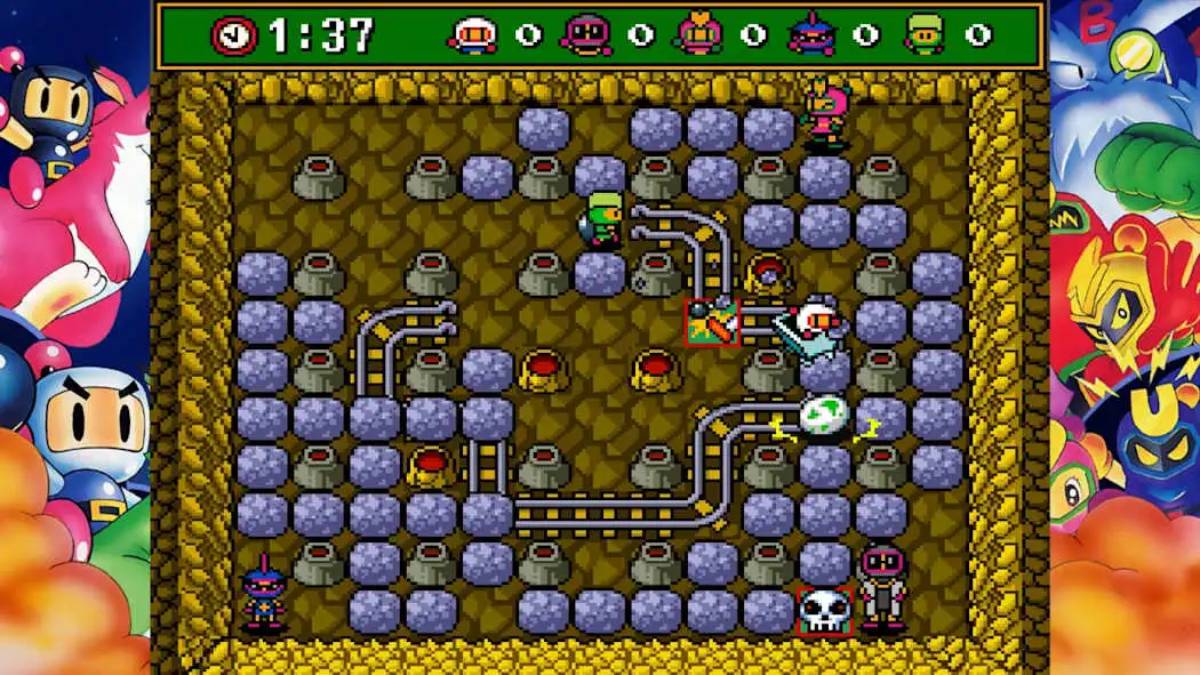
Recent shadowdrop release Super Bomberman Collection brings back some classic Bomberman games, some for the first time outside Japan, and we’re happy to see it! But if we’ve learned anything from modern retro compilations, the quality is extremely dependent on execution. So how does this one do?
The package contains the five Super Bomberman games, all originally released on the Super NES and Super Famicom, as well as two bonus Famicom games. The later Super titles didn’t originally release outside Japan and have received localizations here, which is a nice touch! Frankly, though, these are fairly language-agnostic games and you probably would have been fine.
Putting these five games together in one collection might feel a bit redundant! And it is, to a degree. The advantage is in two ways. The first? Historical value. The game makes it easy to look at what power-ups are added in each one, and preserving all five is good regardless. The second is that you can choose your favorite variant. Each of these changes does color the experience, and through either taste or nostalgia, you’ll likely have a favorite.
Image via Konami
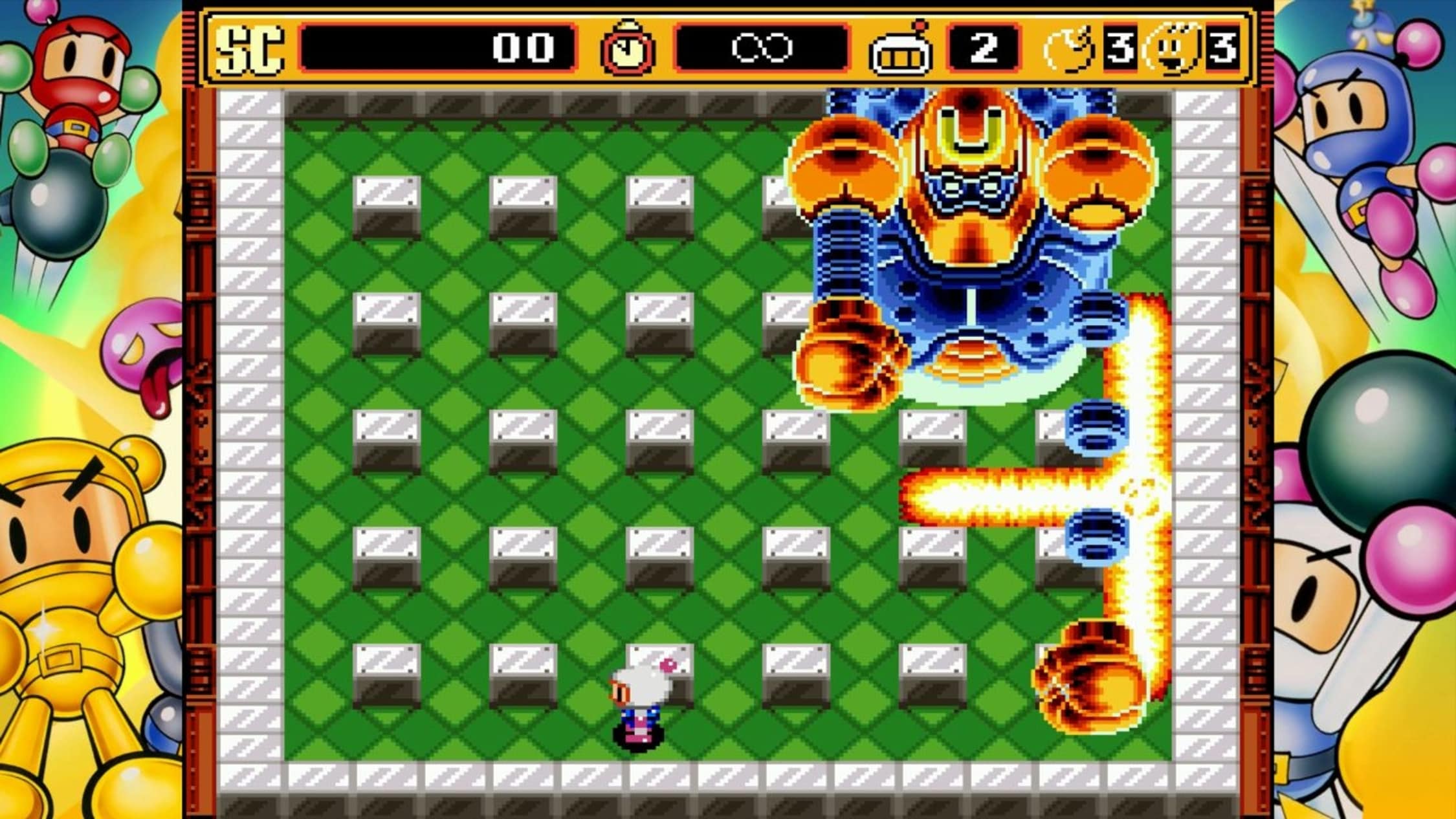
If you’re having trouble deciding, though? We’d recommend going straight to 5. It has almost all the things from the other games, and there are options to configure it however! And as such a late Super Famicom game that other staff at Hudson were probably already working on Mario Party during development, it really takes advantage of the hardware. If it drops the ball on anything? Maybe it’s aesthetics. It’s trying really hard to do a robot/sentai thing in a way that a lot of the selectable characters feel same-y.
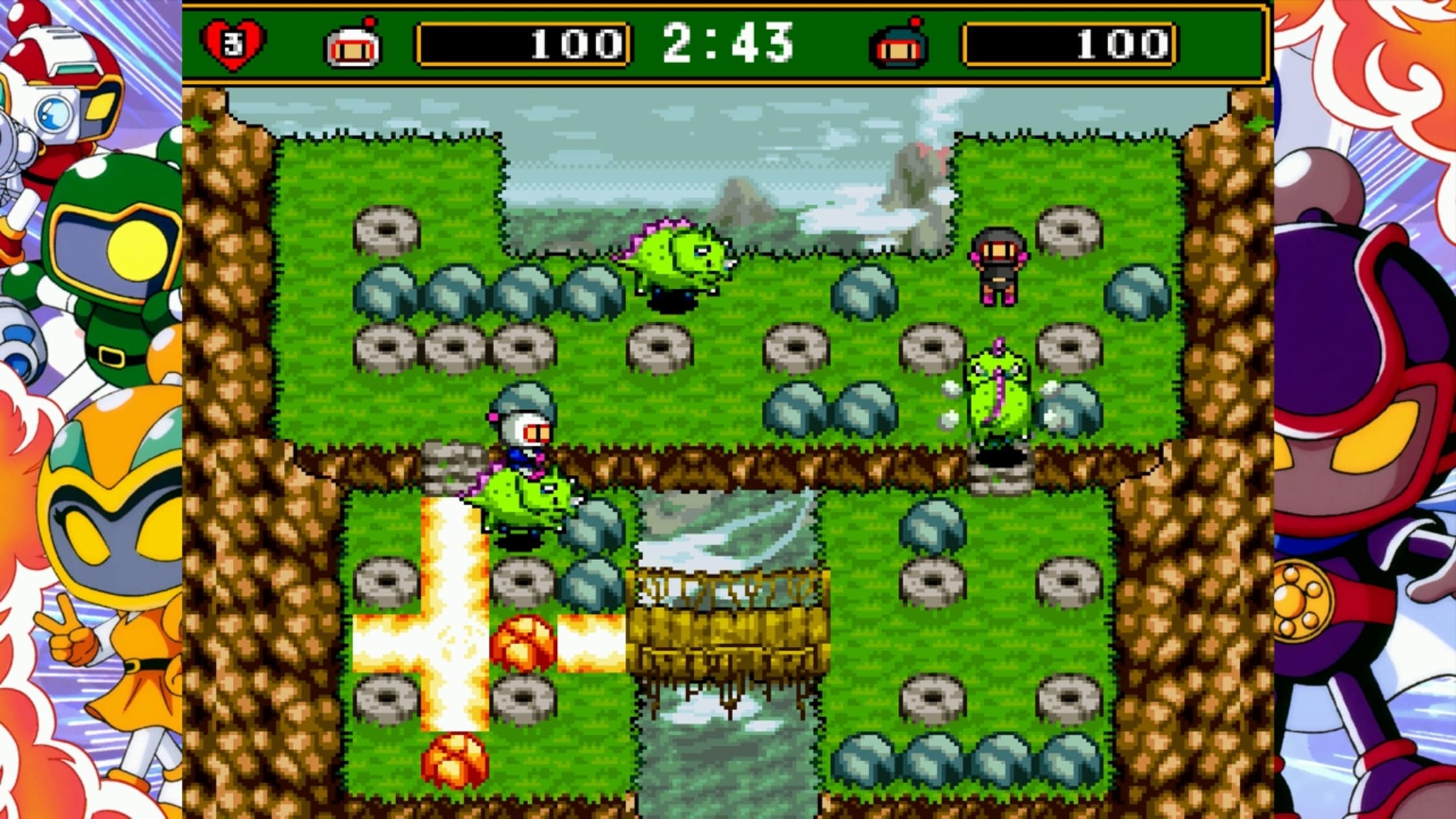
It’s also true that each of these games has a solo campaign. The franchise’s bread and butter is its competitive play, but there’s a dedicated group of people who really embrace the single-player arcade levels. And these are good ones! We’ve spent a while playing, and we are undeniably bad at them but there’s a puzzly element to taking on risky opponents in an optimal order.
When it comes to gallery modes in retro compilations, our usual stance is that it’s a great effort of preservation! But we don’t spend a lot of time with that stuff. Super Bomberman Collection’s “unbox” mode feels a lot more robust, though. With the detail and ability to virtually open the box and pull out the manual, it captures a bit more of the nostalgia of the originals.
Image via Konami
While it doesn’t have built-in functionality for this sort of thing, Super Bomberman Collection takes advantage of system-level multiplayer features like Switch 2’s GameShare and Steam’s Remote Play Together. How well does it work? Better than you’d think! We spent our time testing it out on Switch 2, and didn’t experience any of the frequent connection issues we usually get. What’s more, it’s the sort of game that can weather some minor hiccups if you get them, and it also doesn’t look too bad in the windowed GameShare screen.
Super Bomberman Collection, developed by Red Art Games and published by Konami, is out now on Switch 2, Switch, PS5, Xbox Series and Steam. Physical editions of the game will launch on August 25, 2026.
Ubisoft are laying off around 40 people at Ubisoft Toronto, the studio behind the forthcoming remake of the original Splinter Cell. That’s approximately eight percent of the studio headcount. It’s all in the service of Ubisoft’s drive to cut costs after restructuring their operations around a big dollop of Tencent funding, which has elsewhere seen Ubisoft propose to lay off up to 200 people in Paris, and chop fixed costs by €200 million over the next two years.
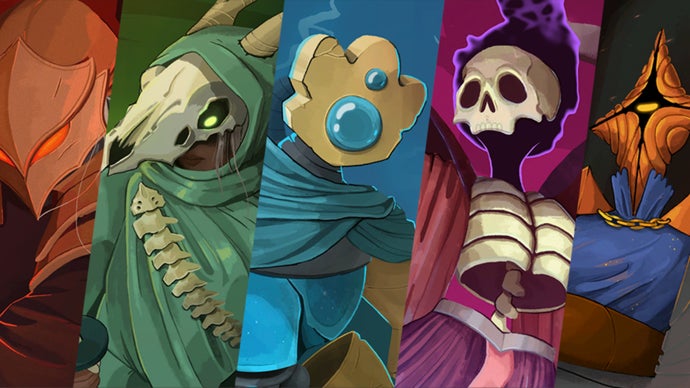
You don't have to wait too much longer to murder the steeple for a second time, with Slay The Spire 2's early access release now set in stone. Following the delay which pushed it back to this previously secret Thursday, it'll arrive on March 5th, 2026.
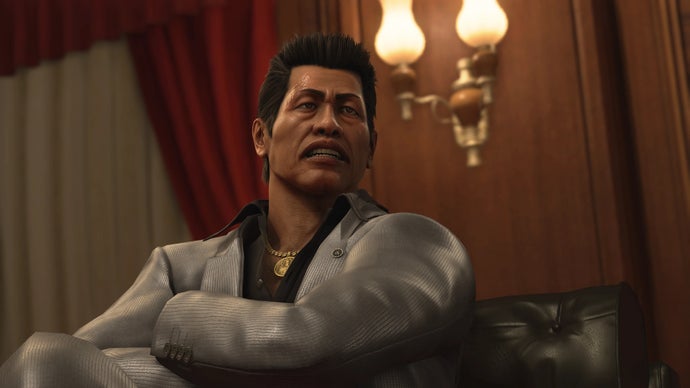
There's now a mod for Yakuza Kiwami 3 & Dark Ties which swaps out the likeness of actor Teruyuki Kagawa. Kagawa's casting in the remake, which saw him lend both his voice and likeness to secondary villain Goh Hamazaki, caused fan backlash due to a 2022 report from Shukan Shincho detailing sexual assault allegations against the actor.
Kagawa apologised at the time, but didn't specify what he was apologising for or confirm the events reported in the article. Kiwami 3 & Dark Ties director Ryosuke Horii recently said Kagawa's casting was the result of developers RGG Studio having "tried to think of someone who makes you go, 'This guy's a creep'".
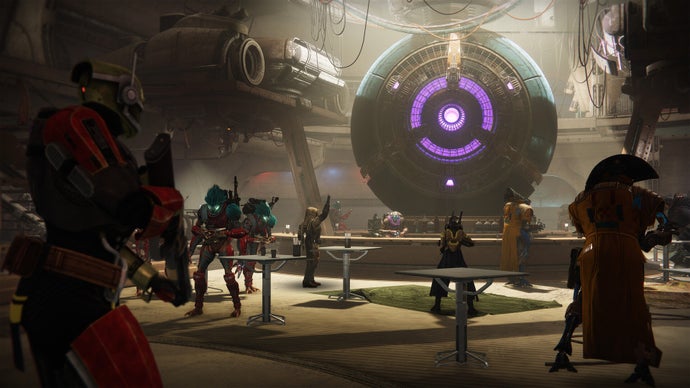
The next big update to Destiny 2, Shadow and Order, has been delayed as it undergoes a substantial round of tweakage and expansion. Such a substantial round of tweakage and expansion, in fact, that it'll no longer be called Shadow and Order when it returns.
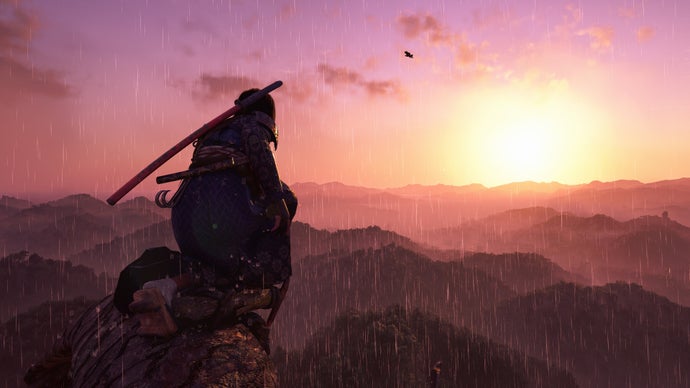
Video game updates are an incredibly funny thing, mostly because I come from a time where they weren't a thing at all, apart from the odd second printing that patched some things here and there. Which is why my humerus has been particularly tickled by the news that a new Assassin's Creed Shadows has arrived today that, amongst a couple of other things, add in the ability to simply let you jump.
“Get me somebody who’s played The Chinese Room's Vampire: The Masquerade – Bloodlines 2 STAT,” I yelled, barging through the double doors of our seedy news saloon. “I need 300 or more tasty words on these leaked videos of the older, unreleased Hardsuit Labs version.” A grim silence fell across the chamber. Mark furtively donned a pod-racing helmet. James hid himself behind his latest tower of graphics cards, with an apologetic murmur that while he had played a few hours of Bloodlines 2, he was very busy right now building towers of graphics cards.
“If you want something done, do it yourself, STAT,” I bellowed, swivelling on my heel while looking up the origins of the term “stat” on my phone. It turns out it’s something medical doctors say to convey urgency, and comes from the Latin “statim”, meaning “immediately”. “What a perfect way to introduce this video showing a hospital level from the aforesaid leaked Hardsuit Labs version of Bloodlines 2,” I roared to myself. “Why, I’ve accidentally written 177 words of the news post already.”
Lego Batman: Legacy of the Dark Knight has become the latest game to have its initially listed recommended RAM requirement yanked down by a substantial amount, following in the footsteps of fellow 2026 release 007: First Light.
This is probably a sentence that could be said literally any day of the week, but a new cosy farming sim is on the block, this time taking the form of Starsand Island. The flavour on this occasion is of the anime variety, with some slightly goofier farming mechanics (i.e. turning your watermelon patch into one singular, 10 foot tall watermelon), some very Pokemon Legends: Arceus looking combat, and some appropriately cute animals to hang out with. And there's skateboarding! But never do launches go all that smoothly, as developer Seed Sparkle Lab have had to do a dash of damage control regarding some concerns over the game.
WARNING: Major story spoliers for Yakuza Kiwami 3 & Dark Ties, as well as the original Yakuza 3, lie ahead.
It’s natural to spend a lot of time thinking about what games could have been, had different decisions been made. Whether the change is preferable to the reality often doesn’t come into it, the fantasy of another possible world is the draw.
Despite that, few studios choose to make major shifts - at least as far as the main stories of those games go - when they remake their previous games. This won't necessarily be a philosophical decision: the remaster or remake has to sell. Games which get revisited are ones players deeply love, and the suits will inevitably see tweaks to their fundamentals as an unnecessary risk. Old Oblivion is loved, so Bethesda adopted a rubber glove approach to the Oblivion remaster. They limited changes to modernising visuals and snipping away some annoying features. It's akin to polishing up a holy relic, rather than replacing the gemstones or changing the engravings.
It's another day, another Subnautica 2 dev vlog, this time one with a big focus on multiplayer. This ability to play with, heaven forbid, other people is one that developer Unknown Worlds very much understands is not for everyone, given the first game's big focus on isolation and ruffing it yourself. So, this vlog is all about explaining why you don't need to worry if you like to go solo. And also to show off a dive elevator.
Having suddenly appeared on the Nintendo eShop, Pokémon Fire Red and Leaf Green are coming to the Nintendo Switch and Switch 2 next week on 27th February – that’s Pokémon Day, which will have a traditional stream with new announcements, for which this was no doubt meant to be a surprise.
The games are priced pretty highly, set at £16.99 / $19.99, but also have the quirk of having distinct versions released for every language that they were shipped in.
The reason for this, per the eShop store page, is that “Because this version replicates the way the game was originally released, each language version is separate and there are no in-game options to change the language.” That’s an unnecessary complication for modern gamers, and honestly doesn’t make too much sense, but it hopefully won’t catch too many people out.
These Game Boy Advance remakes of the original game are rare enough to be prized possessions amongst game collectors, if you can find an original cartridge – it will be a great way to mark the Pokémon franchise’s 30th anniversary, that’s for sure.
The remakes updated the originals with the graphics of the GBA era – also making it so that Green was the pairing to Red, instead of Blue as it had been for the original western release – and added the Sevii Islands to visit, while bringing some other improvements like a contextual tutorial, save game recaps, and ties to the other Game Boy Advance and GameCube Pokémon games. Fire Red and Leaf Green also came with a special wireless adapter for local link play, and since wireless is now built into everything you own, this will also be supported on Switch.
Most importantly for the here and now, these games will have support for Pokémon Home added to them, so Pokémon caught in this game can be brought through to the newer titles.
With no build up or fanfare, Nintendo and Monolith Soft have just released Xenoblade Chronicles X: Definitive Edition – Nintendo Switch 2 Edition…. edition, a paid upgrade to the game that brings technical improvements for the new generation hardware. Check out the trailer:
The Switch 2 Edition upgrade is a fairly straightforward technical boost, now with a 60fps target through the game and 4K docked and 1080p handheld resolutions. We don’t know if Monolith has leant upon upscaling techniques or variable resolutions to get there, but this should make for a sharper looking, more responsive game in general.
Xenoblade Chronicles X: Definitive Edition – Nintendo Switch 2 Edition can be bought all together on the Nintendo eShop or with a $5 / £4.19 upgrade for existing owners of the Switch release. A physical release will be available from April 16th.
One of the last Wii U cult classics to be ported to the Nintendo Switch, Xenoblade Chronicles X arrived in March of last year. With it still fresh in Monolith’s memory, it’s understandable why they would return to this first, but fans of the series will understandably be pining for a similar Switch 2 Edition treatment to be given to Xenoblade Chronicles 2, 3 and the Definitive Edition of the Wii original. Xenoblade Chronicles 2 would probably receive the greatest benefits, as Monolith’s first effort with the Switch did have its struggles.
In our review of the Switch 1 release, Dom said, “With a smattering of improvements as it jumps to Nintendo Switch, Xenoblade Chronicles X: Definitive Edition offers up an epic sci-fi tale set in one of the very best open worlds.”
Bungie have announced that their next large update to Destiny 2, titled Shadow and Order, has been delayed.
“Our next Major Update, Destiny 2: Shadow and Order, is undergoing large revisions and will be delayed. This update is being changed and expanded to include sizable quality-of-life updates and as a result, will also be renamed. This update will now launch on June 9, 2026.
We will provide exact details closer to release covering previously announced Weapon Tier Upgrading, but also additions like expanding Tiered Gear to all Raid and Dungeon activities, Pantheon 2.0, Tier 5 stats for Exotic Armors, and more. Through June, we will continue to have routine bug fixes and stability improvements, continued portal modifiers, Guardian Games (March), and the return of a more frequent Iron Banner cadence
In terms of communications, we will be focusing on providing you with updates about our live game content, community activations, and general upkeep through the TWID and our Destiny social channels. Thank you for your continued patience and support. We will have more information on our next major update and future plans for Destiny 2 closer to launch.
See You Starside.”
The Shadow and Order update had been due to arrive just after the Marathon Server Slam and just before Marathon itself launched, so it seemed inevitable that it would be moved to allow Bungie some space for that.
Bungie have not released a roadmap for future updates but if Shadow and Order – or whatever it gets called – is delayed by three months then there is a very good chance that the next expansion, Shattered Cycle, will also get pushed back.
Bungie are clearly prioritising Marathon, and they really have to as they need another big hit. Destiny 2 is a shadow(keep) of its former self, and delaying big updates for months on end is not going to incentivise the players left.
Coming up on a decade since the debut of Transport Fever, Urban Games have figured a few things out about their transport simulation series. Years of post-launch support, added features and working with their community is leading to their most ambitious game yet, when Transport Fever 3 launches this year.
Sticking with their in-house game engine, they’re able to roll a bunch of features and ideals from where Transport Fever 2 has ended up into Transport Fever 3 on day one. That means that this will be a fully synchronous release across PC, PS5 and Xbox Series X|S, when TF2 rolled into the console station a few years after PC, and it also means that cross-platform modding, which was only added to TF2 in 2024, will also be there on day one.
If you’re in it for the economic simulation, then Transport Fever 3 promises even greater depths than before. There’s over a century of transportation history here, starting in 1900 with the city, buildings and cars you see all changing and evolving as you carry on through to 2030. That means there’s over 290 vehicles, ranging from buses and trucks, through ships, planes, trains and even new cargo trams and helicopters. Cargo trams are a particularly interesting one, having been used in Eastern Europe to bring cargo into city centres instead of noisy, smelly trucks – something you’ll need to keep tabs on now, as every citizen in the map is fully simulated with places to work, shop and live, and their happiness will depend on pollution, noise levels and traffic jams.
And you’ll have a fresh appreciation for cargo in this game, as there are now 35 cargo types and it is now no longer handled automatically. If TF2 was all about money, then in TF3 it’s just one of many things to manage.
All of this will add new depths to the transport simulation sandbox, but TF3 will lean further into the tycoon gameplay and story objectives to overcome through a campaign of eight maps. Each one picks a particular period in history and takes inspiration from real events, using these missions as a way to introduce new concepts and keep things varied – there could be competition against an AI, a countdown mission with a timer, and more.
We sampled two of the levels, first heading to Mardi Gras in 1906, but finding that the city has been partially flooded and ruined by a storm. This is purely a narrative conceit here – while this game now has a day/night cycle and weather effects, they are purely cosmetic so as not to add crazy variables to the simulation – but it means that Mayor LaFontaine, the helpful Andrew and Miss Baker are banding together to rescue this year’s festival. LaFontaine wants a new hotel, while Miss Baker pushes him and you to help represent the black community and less wealthy, and Andrew’s just happy to be helpful.
Setting up transport routes, repairing roads and bridges and shuffling the good around that each objective needs gradually gets you used to the user interface, though it’s initially a little unclear how to go about certain tasks. I accidentally clicked through and sold off a couple horse and carts when cancelling an unneeded line, instead of having them sent back to the depot, and when I wanted a ship to go between collecting fish and shrimp, returning to dock between each, it took me a moment to realise I couldn’t drag the stops into a different order and had to set things up a different way.
But with Mardi Gras rescued, I could turn my attention to another festival in need, some sixty years later, with a somewhat legally distinct rendition of Woodstock. Now it’s a local sheriff and an enthusiastic rock organiser who will have to put aside any of the very surface level differences to make this a success, oh and Andrew’s still there to help out, though he’s now a bit of an old-timer.
The objectives have grown in scale by this point, so you need a bunch more wood to construct the stage, and the growing encampment needs plenty of food (and veggie food too, please) which is over on the other end of the map. Do you just get a truck to drive it across, or use the port nearby to ship it to the nearest town for trucks to pick up? It all builds up to a festival that’s as successful as you can make it accommodate people.
I feel that these narrative missions and tycoon gameplay will really help make Transport Fever 3 more accessible. I often find myself at a bit of a loose end when simply presented with a sandbox, so while that absolutely remains, having both a way to ease players into the simulation, and to give objectives in an intelligent way that keeps you more engaged will be great.
Bethesda has released update 1.2 for Skyrim on Nintendo Switch 2, fully addressing the woeful performance that blighted the game’s latest port. It follows on from an update shortly after its December release that quickly removed the frame rate cap to improve latency, but now tackles this with a full 60fps performance mode, fixes to visual glitches, and more.
The game performance is the most significant improvement, a new toggle under the Display settings letting you prioritise visuals or performance. This tweaks visual settings and resolution targets in order to deliver 60fps, which from anecdotal online accounts seems to be pretty solid. Additionally, the 30fps visuals have been locked back to this frame rate and the graphics tweaked to give steadier performance.
It’s a huge shame that the game couldn’t have had this degree of performance and refinement at its original release, as it led to a lot of bad reviews – we ended up having to give it a 5/10 because of the issues. However, it does give a glimmer of optimism for the Fallout 4 port to Switch 2 which is set to drop next week.
The Skyrim Switch 2 Update 1.2 patch notes are as follows
Features:
Added a 60 Hz mode under Display settings that allows players to toggle between “Prioritize Visuals” or “Prioritize Performance”.
In addition, frame rate has been locked at 30 Hz in “Prioritize Visuals” mode for smoother gameplay.
Crashes and Performance Fixes:
Fixed a crash that occurred when reading “The Crimson Dirks Vol. 4” book for the “Tilted Scales” quest in German.
Fixed an audio-related crash.
Fixed a crash, infinite load, and game freeze that sometimes occurred when rapidly selecting “Load” multiple times in the pause menu.
Fixed a crash that occurred when the “Transmute Ore” spell was repeatedly cast outside of the Haltered Stream Camp.
Improved FPS performance drops that occurred in the following locations:
during the Hide and Seek quest in Kynesgrove
during combat at Secunda’s Kiss
when discovering the “Drelas’ Cottage” location
when engaged in combat with a giant at the Talking Stone Camp.
Visuals Issues Fixes:
Viewing water planes from a distance or within menus caused them to shift up and down.
Distant aspen trees appeared with a blue tint.
Transitioning out of caves caused an outline of the entrance to linger during the fade-to-back loading screen.
User Interface Fixes:
Switching between mouse and controller mode while in dialogue or the Help menu, caused different options to be highlighted.
Switching between mouse and controller mode while in help menus or user hints, did not dynamically update callout prompts.
The “Ready/Sheathe” option was missing from the Joy-Con 2 Mouse Controls menu.
The “Delete” prompt remained grayed-out within the Load menu when swapping between mouse and controller mode.
Deleting a save in the Save/Load menus reset the highlighted selection to the top of the menu list.
While in mouse mode, the cursor remained stuck within a smaller section of the screen when changing between docked/undocked modes or interfacing with GameChat.
Controls Fixes:
The “Eagle Eye” Archery perk remained active after switching between mouse and controller mode.
Holding down the Right Joystick while reassigning a button caused that button to disappear from the Controls list.
The Joy-Con 2 controllers provided haptic feedback while in mouse mode.
Buttons became unresponsive when controls were remapped while moving the Joy-Con 2 controllers in mouse mode.
Rotating the map in mouse mode was slower and less smooth than in controller mode.
Audio Issue Fix:
Scrolling SFX continued to play while holding up or down on the Left Joystick or buttons at the top or bottom of the Save/Load menus.
Localization Fixes:
“Amiibo” appeared as plural in Spanish.
Miscellaneous:
Added new translations for the features listed above and UI updates.
There’s a lot of people wishing that the mid-2020s were more like the mid-1990s, but I don’t expect many were doing so for a chance to experience the Virtual Boy’s brief heyday. Yet here we are, with Nintendo releasing both a plastic recreation and a jazzed up cardboard edition of the Virtual Boy to go alongside the console’s addition to Nintendo Switch Online + Expansion Pack. It’s playable with Switch, Switch OLED and Switch 2, so we’ve done just that.
The plastic shell of the Virtual Boy has been recreated in a charmingly accurate fashion from a distance, but you see plenty of fakery when you pay closer attention. All of the physical controls, sockets and sliders of the original Virtual Boy – the IPD slider, the volume wheel, controller port and all the rest – are now just surface details, and like a treasure chest that reveals itself to be a Mimic in a D&D campaign, the red shell at the top of the body now opens up to reveal a cavernous maw, eager to consume your console.
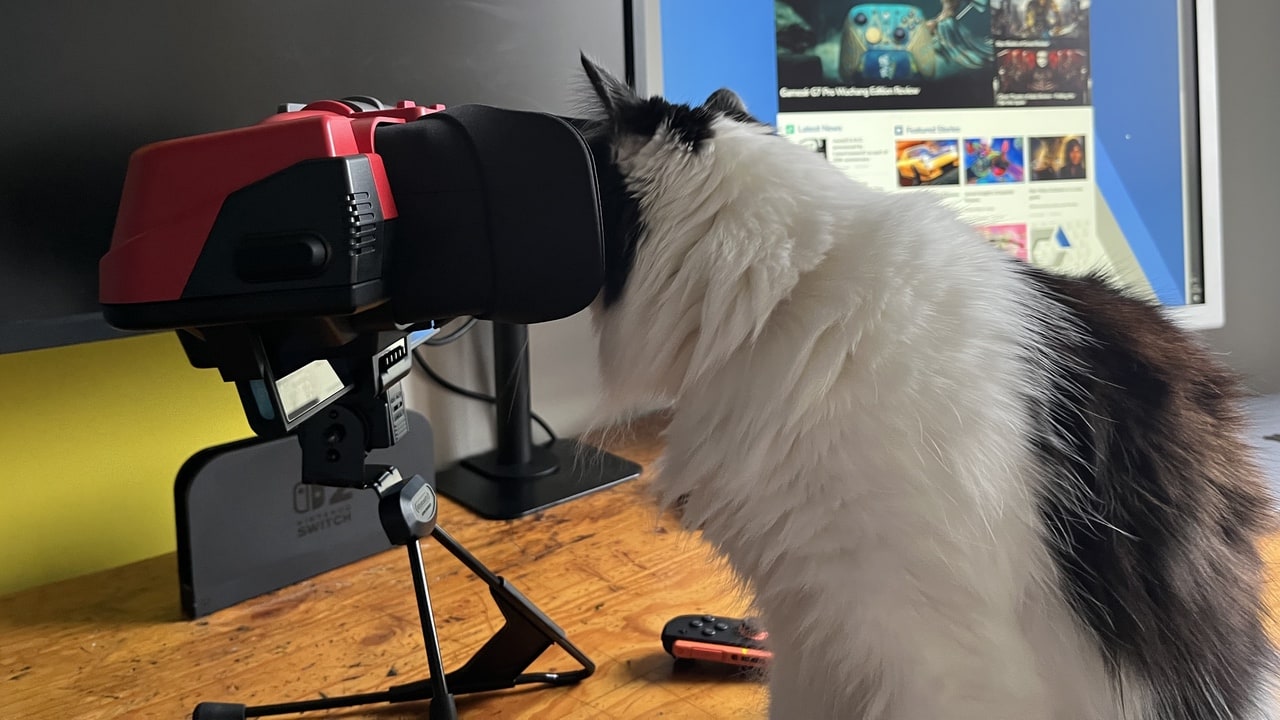
Far more accurate are the backward tilted legs, sturdily holding the headset in place, and stubbornly allowing just a single adjustment. There’s no up or down here, just a tilt back and forward, and it means that you have to really lean in to get your Virtual Boy on. If potential eye strain weren’t enough reason for Nintendo to suggest regular breaks, then bad posture and possible back pain were another. While remaining authentic to the original is admirable in some ways, it means this remains an annoyance for anyone that isn’t my cat. I found that the box the Virtual Boy came in brought the headset up to a sensible viewing height for me.
The Virtual Boy is for ages 7+, but my cat is 3, so it was not turned on at this time.
Another slight disappointing element is the inelegance of Nintendo’s solution to the difference in shape and size of the Switch and Switch 2. Another detail on the underside of the Virtual Boy is that the protuberance that the stand grabs onto is also a basket to catch and support the console, the inside having a funnel and hinged flap to ensure it’s in roughly the right place, with a little bit of wiggle room. The basket is screwed onto the body of the Virtual Boy, and it’s sized for the Switch 2 by default, with a separate plate for the original Switch and Switch OLED included in the box.
I’d argue that’s overkill, and a needless faff for Switch 1 owners, when really a plastic insert would have done the trick. Heck, in a pinch when wanting to swap back and forth and compare screens, I just shoved my little finger in to give a modicum of support, and a plastic wedge could have made this more easily universal, in my opinion.
The Virtual Boy Switch 1 support is a bit of a basket case.
Another problem with the baskets? There’s no space for a USB-C charging cable or any kind of power pass through. Switch 2 could, I suppose, play with the top lid cocked open for the top charging port, letting outside light leak in more easily. In general, now you’re playing with (battery) power.
What really matters is what’s happening inside the headset, and you’ll have to peer into this mysterious box to see it. Back in 1995, Nintendo had to pull some remarkable mirror-waggling tricks to get the single-colour LED strips to trick your eyes into seeing images, but in 2026, it’s the standard VR headset method of viewing a screen through distorting lenses. In both case, however, you look through a thick red filter, cutting out all of the other colours that the screen can display.
So, between Switch, Switch OLED and Switch 2, which console gives the best Virtual Boy experience? With this plastic Virtual Boy? I’d have to say the Switch 2. The simple fact is that it’s a higher resolution screen, allowing it to display the 384×224 of a Virtual Boy screen in a smaller space, so you can take in the full image more easily as it appears further away. Each console displays at 1:1 by default, and I feel that with the Switch and Switch OLED in particular, this makes it too large within the headset so that I’m occasionally moving my viewing angle to see if I’m missing something in the corners – and when this is a 3D effect, messing around like this and shifting focus can give you a real headache.
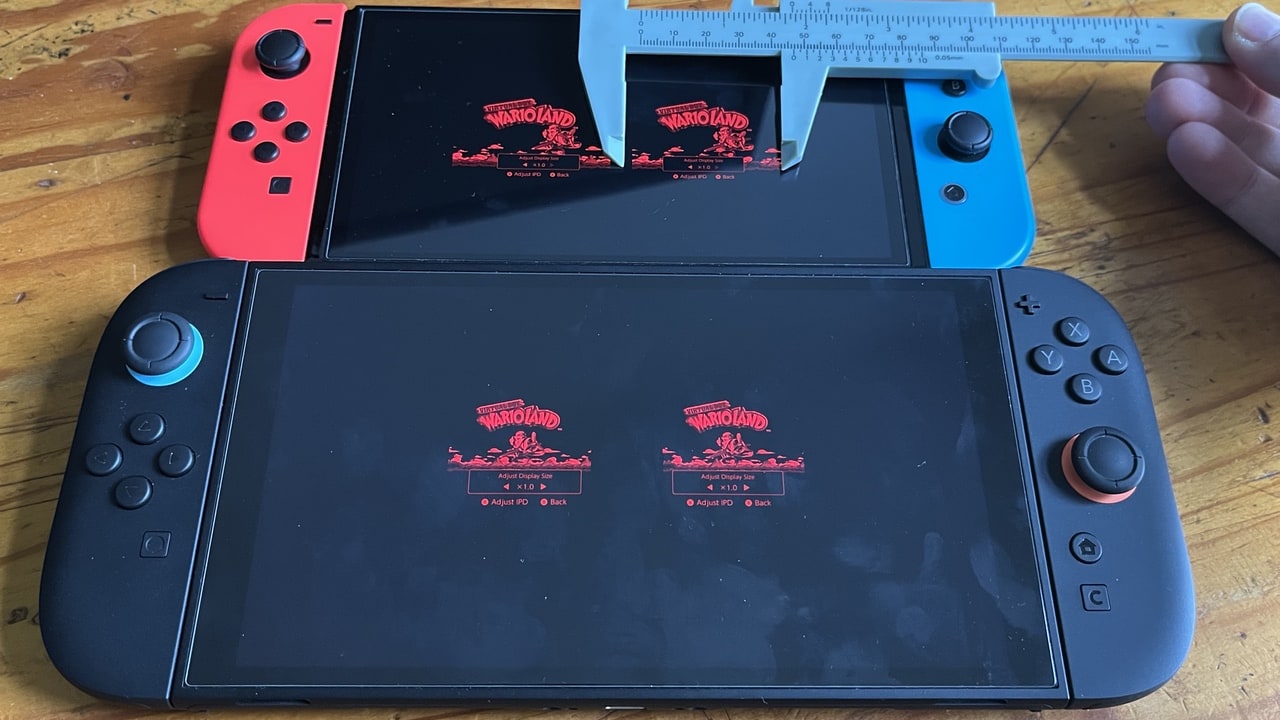
The Switch OLED renders the Virtual Boy much larger than on Switch 2.
It’s a big difference. The Switch 2 puts Wario Land into a 35mm wide postage stamp per eye, before passing through the lenses, while the Switch comes in at 41.5mm and the Switch OLED at 46.5mm. It’s a huge difference, and it makes the pixel grid much, much more visible. You can adjust the zoom within the emulation, to at least shrink the image size, if not the pixels on the Switch OLED – Switch 2, meanwhile, has a wider zoom range and can go up to 1.3x in size to effectively match the Switch OLED at 45mm. I’ve never used an original Virtual Boy, so cannot say what is most authentic, but I’d personally rather see more of the game view than less.
OLED does have its advantages, though, with the cardboard edition in mind. With an OLED panel, any pixel on the screen that’s not in use is off. It’s pitch black. Meanwhile, the backlights of the Switch 2 and Switch bleed through the black and make it a dark blue, to my eyes. The red lenses cut out all but the red light, helping to even the playing field with the plastic Virtual Boy, but the cardboard one doesn’t have the red filter, which can make the Switch OLED king in this scenario.
And so we come to the games. The game selection menu passes through the filter in an ominous red hue, but this is actually a bit of a lie, as it’s rendered in full colour by the console. The games themselves are all-red all of the time, though. Seven games are featured on day one, from 3D Tetris to Golf, Red Alarm, Teleroboxer, and the most noteworthy by far, Virtual Boy Wario Land.
Coming a year after his debut as a protagonist on the Game Boy, Virtual Boy Wario Land pioneered multi-plane platforming, with Wario able to use jump pads to bounce to parts of the world further away from the camera, and really pushed the number of parallax layers featured to give the environments its 3D depth. There’s smaller details too, like blocks having multiple layers to them, even little grassy fronds on the ground having a couple layers, giving added depth here, and the sprite scaling as things move in and out of the screen is really nicely done. Practically the first thing you encounter are spiked balls swinging towards your view, and it shows the smoothness of this.
Teleroboxer does a similarly good job with the boxing robots you fight having lots of layered sprites to create a canny 3D effect, and The Mansion of Innsmouth has the classic first person 3D dungeon crawling aesthetic as you move through corridors, while blasting monsters with an on-screen cursor. But for true 3D, you’ve really got to look to Red Alarm, a Star Fox style rail shooter with the world rendered in red wireframe – with just a single colour, this was probably the best path to take, but does mean you can see enemies through obstacles.
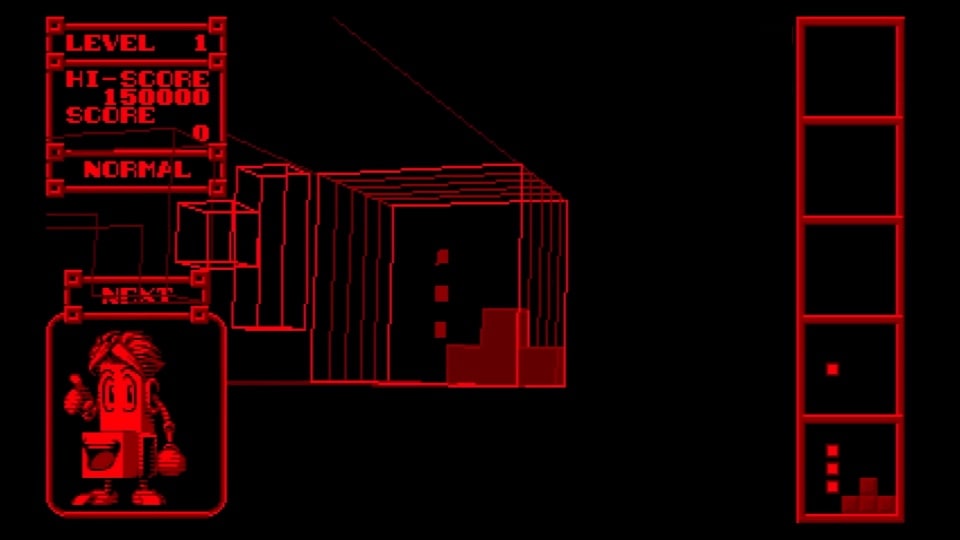
And then there’s 3D Tetris, which takes the notion of the block-dropping puzzle and makes it feel like Star Trek’s 3D chess. The classic tetromino shapes are put to one side, and you’re instead given other blocky assortments, layering them down on multiple flat layers. It can be tricky to make out how things are being placed with the shifting 3D view of the Tetris lasagna you’re making, and it’s odd to have split blocks to drop as well. Thankfully the right of your view has a simple 2D representation of the layers and where each block will land. It’s a bit of a cheat, but makes this more playable.
The main problem with the Virtual Boy’s game line up is that it never had the chance to mature. 1995 means that we were still getting experiences and ideas from the SNES or Game Boy, in part thanks to the single colour displays, and it was a time when sports games like Golf and Mario’s Tennis were… well, they were just fairly standard golf and tennis games. Neat to see, but not exactly ground-breaking.
All in all, the Virtual Boy for Nintendo Switch feels authentic (even if closer inspection does make it appear more toylike), and does a solid job of rendering the console’s small selection of games. It is a shame that, when this costs £67, Nintendo didn’t push on to remake the Virtual Boy controller, improve the ergonomics of using the headset, or even build in the ability to charge and play at the same time. That high price means that Virtual Boy will remain a retro curio for Switch owners and gaming history enthusiasts.
You would think that adding an all-new class to an old game like Diablo II: Resurrected would be a happy event, but then you also likely have never experienced ARPG players in public forums and subreddits, who primarily appear to be the angriest of human calculators. That appears to be the case among players of the game, […]
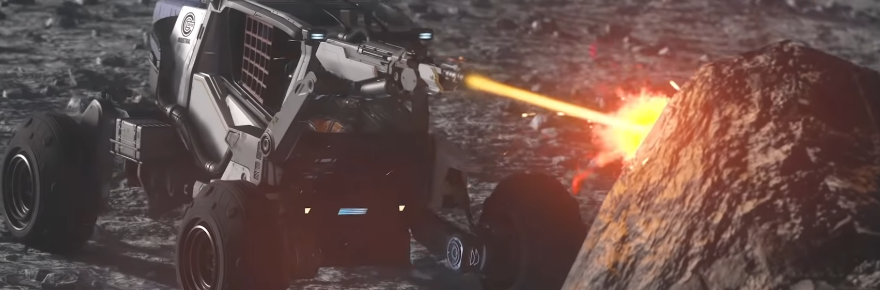
It takes all kinds for internet spaceship sandboxes like Star Citizen to hum, and one of those kinds is the industrialist player: the rock cruncher, the space trucker, the material and manufacturing magnate. If you’ve felt as if this aspect of the game is lacking, then maybe some planned updates from CIG will ease your […]