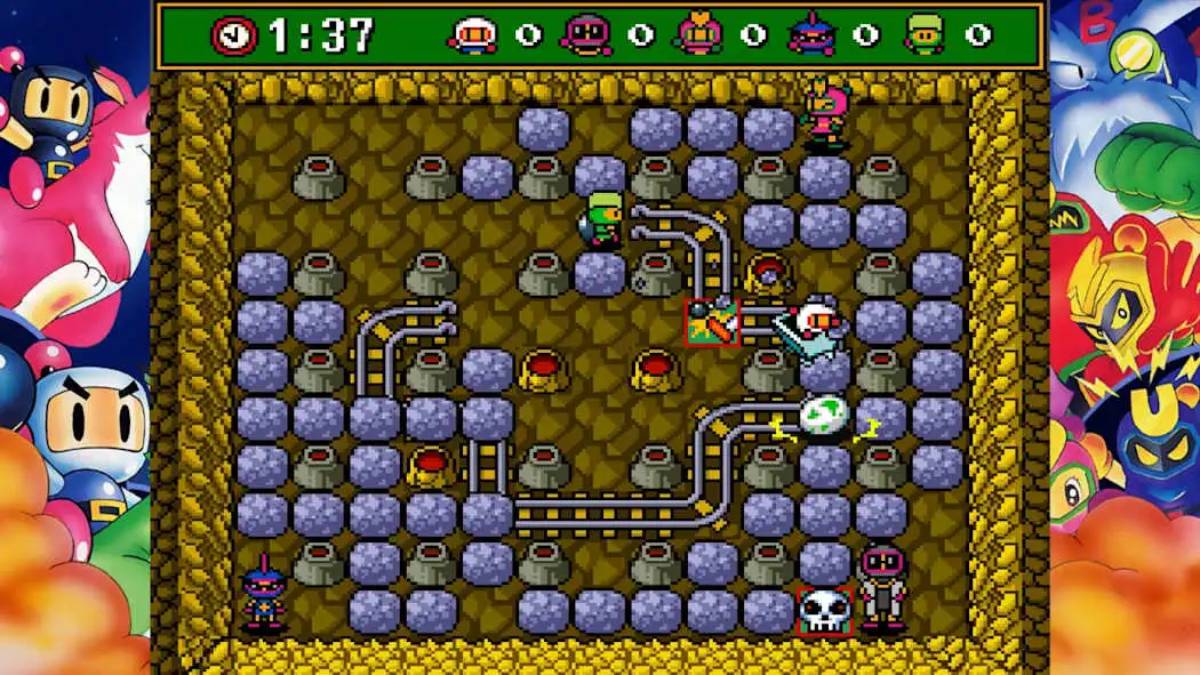
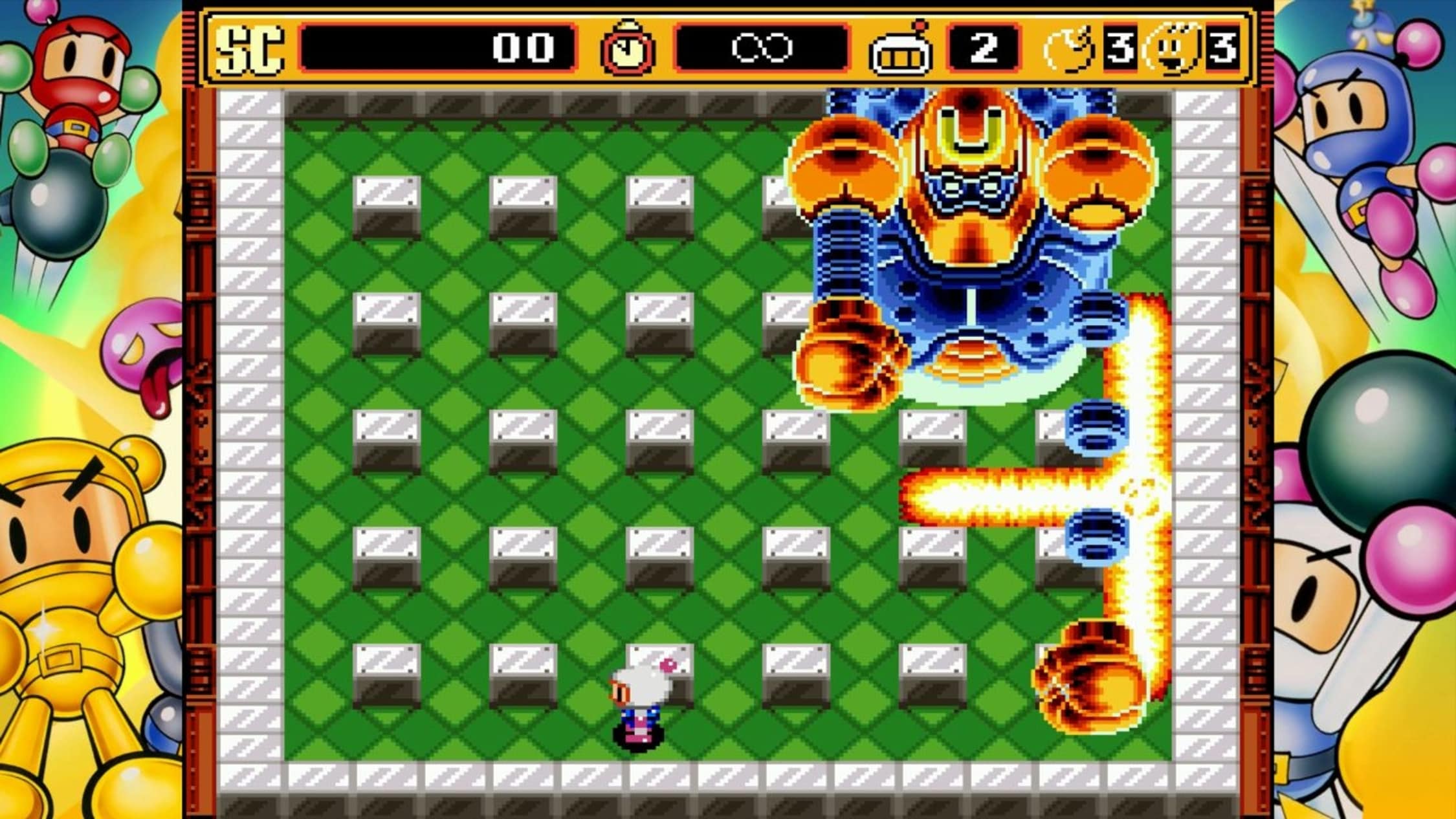
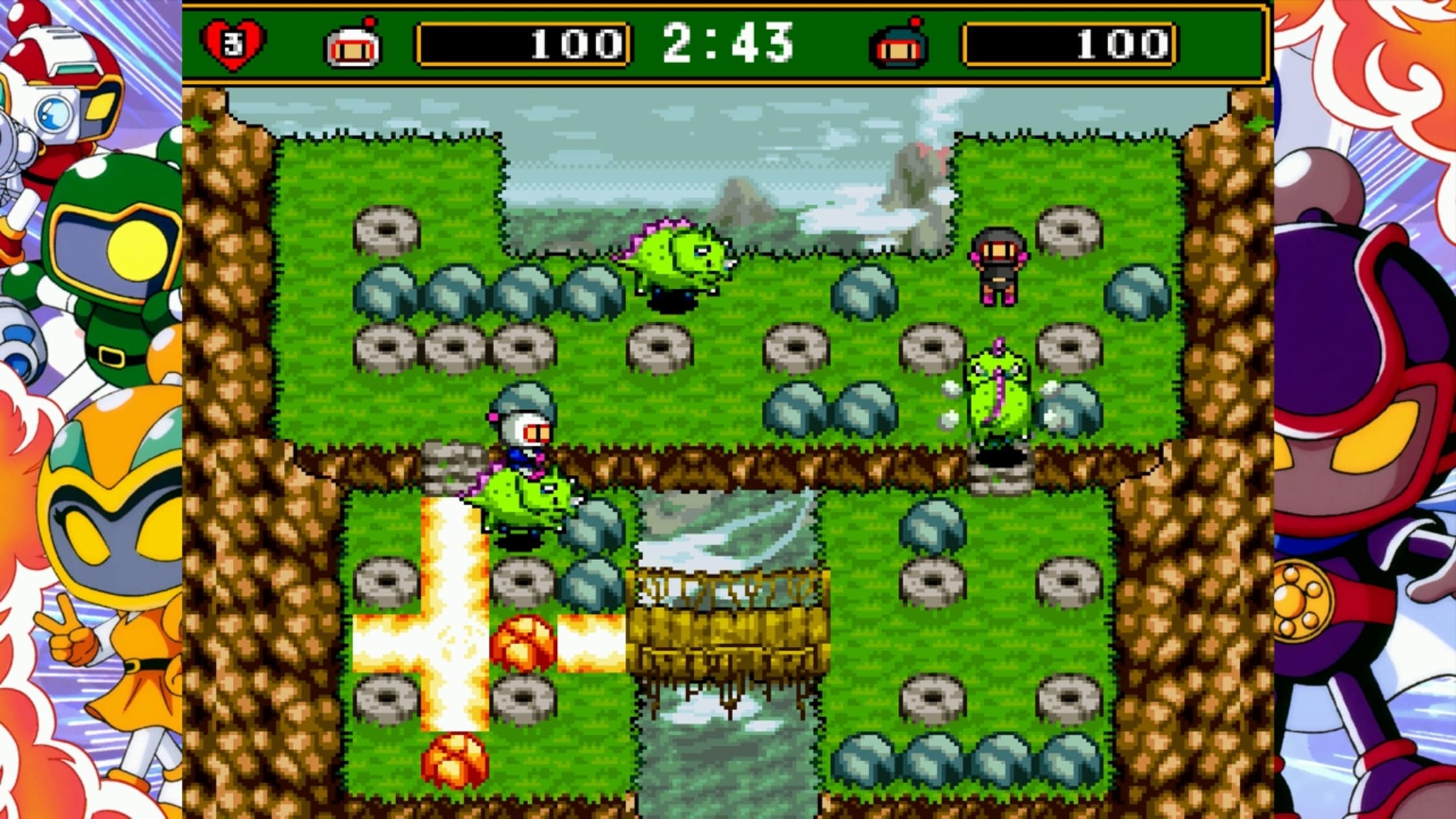
Recent shadowdrop release Super Bomberman Collection brings back some classic Bomberman games, some for the first time outside Japan, and we’re happy to see it! But if we’ve learned anything from modern retro compilations, the quality is extremely dependent on execution. So how does this one do?
The package contains the five Super Bomberman games, all originally released on the Super NES and Super Famicom, as well as two bonus Famicom games. The later Super titles didn’t originally release outside Japan and have received localizations here, which is a nice touch! Frankly, though, these are fairly language-agnostic games and you probably would have been fine.
Putting these five games together in one collection might feel a bit redundant! And it is, to a degree. The advantage is in two ways. The first? Historical value. The game makes it easy to look at what power-ups are added in each one, and preserving all five is good regardless. The second is that you can choose your favorite variant. Each of these changes does color the experience, and through either taste or nostalgia, you’ll likely have a favorite.
Image via Konami
If you’re having trouble deciding, though? We’d recommend going straight to 5. It has almost all the things from the other games, and there are options to configure it however! And as such a late Super Famicom game that other staff at Hudson were probably already working on Mario Party during development, it really takes advantage of the hardware. If it drops the ball on anything? Maybe it’s aesthetics. It’s trying really hard to do a robot/sentai thing in a way that a lot of the selectable characters feel same-y.
It’s also true that each of these games has a solo campaign. The franchise’s bread and butter is its competitive play, but there’s a dedicated group of people who really embrace the single-player arcade levels. And these are good ones! We’ve spent a while playing, and we are undeniably bad at them but there’s a puzzly element to taking on risky opponents in an optimal order.
When it comes to gallery modes in retro compilations, our usual stance is that it’s a great effort of preservation! But we don’t spend a lot of time with that stuff. Super Bomberman Collection’s “unbox” mode feels a lot more robust, though. With the detail and ability to virtually open the box and pull out the manual, it captures a bit more of the nostalgia of the originals.
Image via Konami
While it doesn’t have built-in functionality for this sort of thing, Super Bomberman Collection takes advantage of system-level multiplayer features like Switch 2’s GameShare and Steam’s Remote Play Together. How well does it work? Better than you’d think! We spent our time testing it out on Switch 2, and didn’t experience any of the frequent connection issues we usually get. What’s more, it’s the sort of game that can weather some minor hiccups if you get them, and it also doesn’t look too bad in the windowed GameShare screen.
Super Bomberman Collection, developed by Red Art Games and published by Konami, is out now on Switch 2, Switch, PS5, Xbox Series and Steam. Physical editions of the game will launch on August 25, 2026.
Though it may seem like we just had a big life sim release in Heartopia, 2026 actually has more than one highly-anticipated release in that particular subgenre of cozy game. The next big one on the horizon is Starsand Island, the life and farming sim from Seed Sparkle Lab.
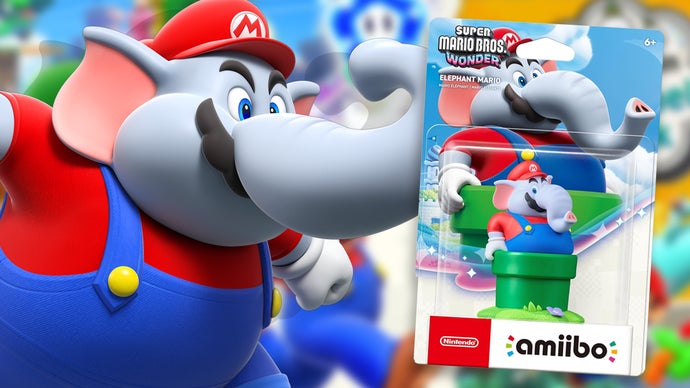
Super Mario Bros. Wonder getting the Switch 2 Edition + expansion treatment in March feels like Nintendo making the correct call, and I couldn't think of a better game to be getting that bit more attention on the new system.
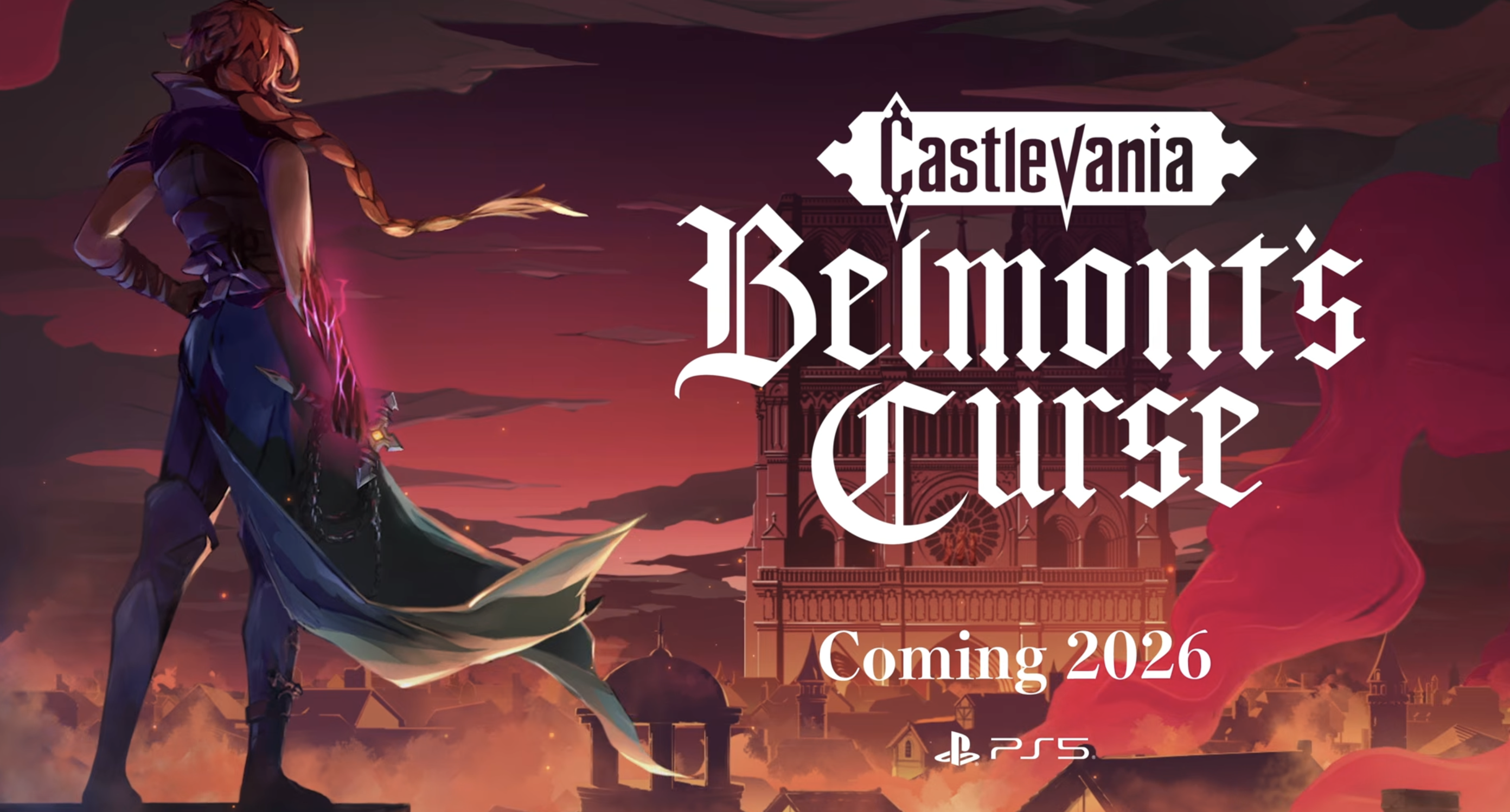
Konami announced the return of Castlevania with Belmont's Curse, a new game developed by Evil Empire and Motion Twin, set for 2026 release. More Castlevania-related products are anticipated.
Sony's State of Play featured the announcement of Rayman 30th Anniversary Edition, releasing on February 13. It includes five versions of the game, a prototype, new soundtrack, and an interactive documentary.
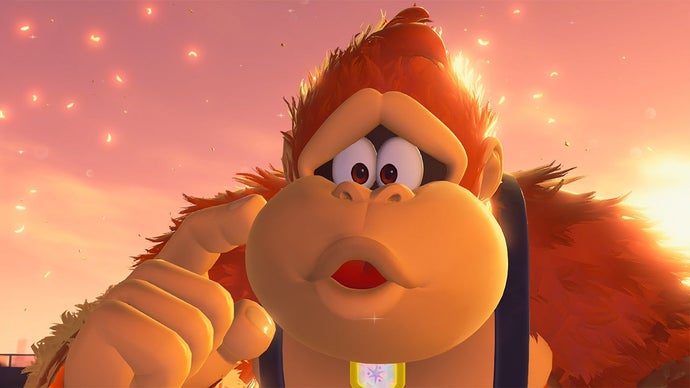
Donkey Kong Bananza is down to $62.99 at Amazon right now, $7 off its original list price, and a 10% saving for those counting. That’s a pretty rare discount for a Nintendo game not that long after release, 6 months at most by my estimates.
If you got your hands on a shiny new Nintendo Switch 2 last year, first of all, congrats, it's a wonderful console, and a whole lot of fun. Second, it is probably, unfortunately, already yelling at you about storage. The console ships with 256GB of onboard space, which sounds generous until you download a couple of chunky first-party games, dabble in a few third-party ports, and suddenly find yourself doing mental gymnastics over which titles you can afford to delete.
This isn’t a Game of the Year list. It’s a look back at the games that lingered in my brain long after I stopped playing them — whether they were brilliant, deeply flawed, or simply hit me at the wrong (or very right) moment in 2025.
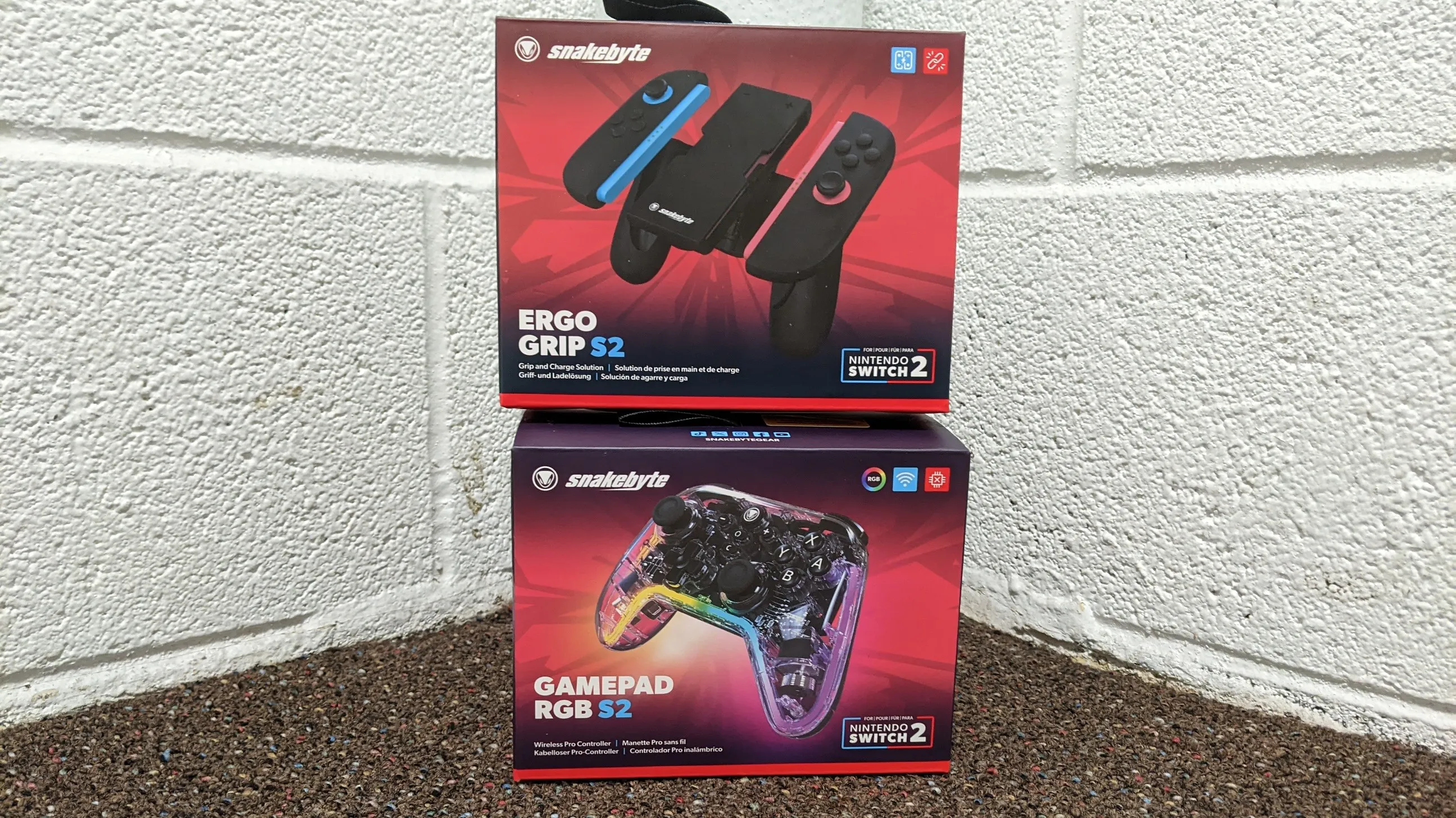
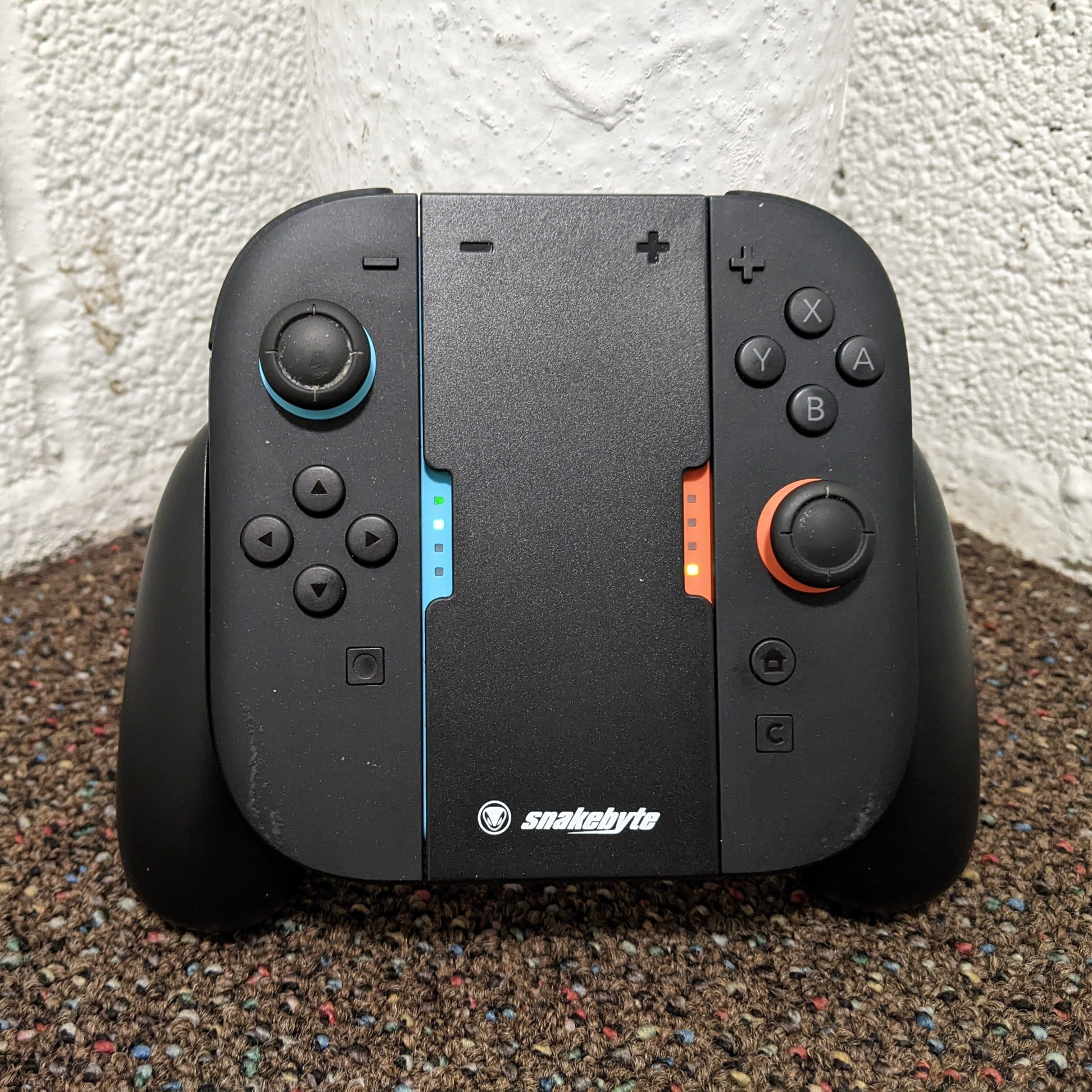
Back when the Switch 2 came out, I looked at some Snakebyte accessories that appeared at launch. They were fine. You know, standard bags and extra charging options. They weren’t exciting or colorful, but they were practical items for a system at an affordable price. Now that we’re a bit more into the thick of things, I’ve been using the Snakebyte Switch 2 Ergo Grip S2 for the Joy-Con 2 controllers and Gamepad Pro S2 controller and they’re a bit more exciting. Especially since I hit a point at which there are more multiplayer options or situations when I will play for hours at a time.
Both of these items are docked Switch 2 sorts of controller options. So if you’re playing in handheld mode primarily, these probably aren’t for you. That’s totally fine! I could see the Ergo Grip S2 maybe being helpful if you switch to tabletop mode for a while and want to use the Joy-Con 2 controllers like that instead of separated whiel playing the Switch 2.
Photos by Siliconera
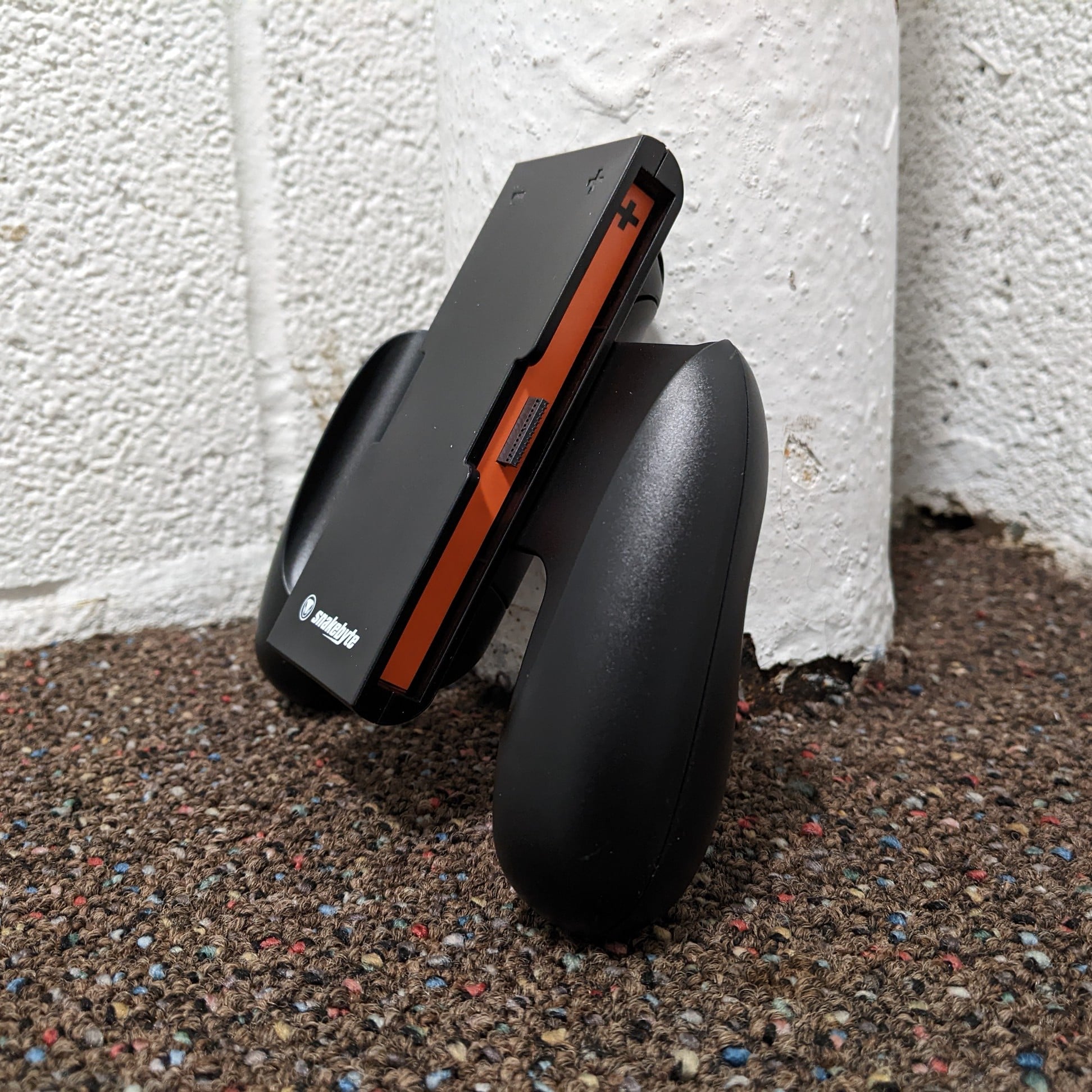
Speaking of which, the Ergo Grip S2 is the Snakebyte Switch 2 accessory I played with the most, since I always have my Joy-Con 2 controllers on-hand. But that’s primarily because of its usefulness for certain situations. It’s handy for if you’re going to play away from home and perhaps are taking the dock or plan to go with tabletop mode. It relies on the same sort of magnet system as the console to quickly pop them onto the grip. It has an over six foot long cable for charging purposes, in case you want to play while it is connected to a dock or charging cable. There are also gaps so you can see battery life indicator lights while using the grip, so you can tell if charging is needed. It’s comfortable and I sort of feel like a budget version of the $40 official Nintendo option, considering Snakebyte is selling it for $20.
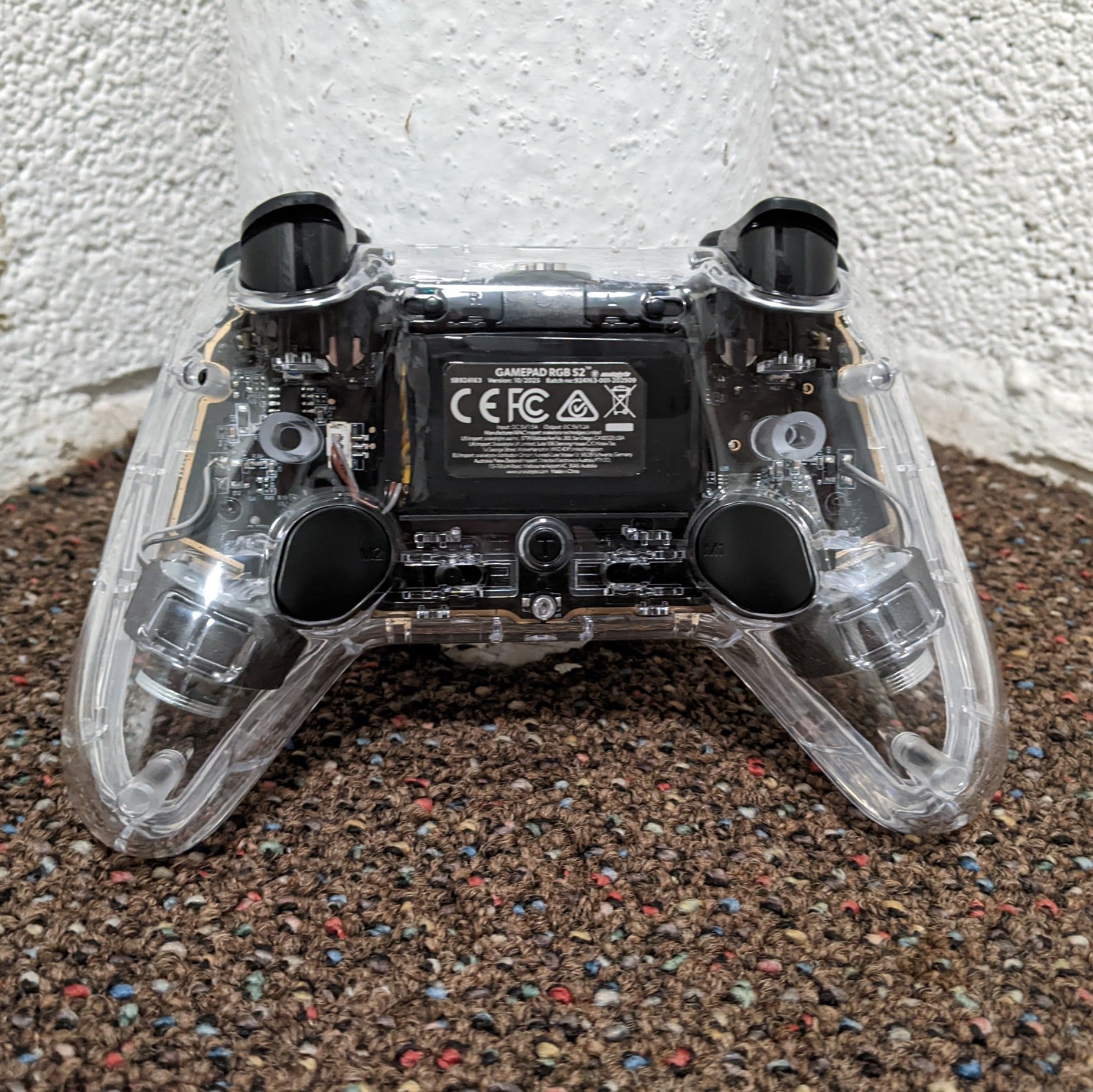
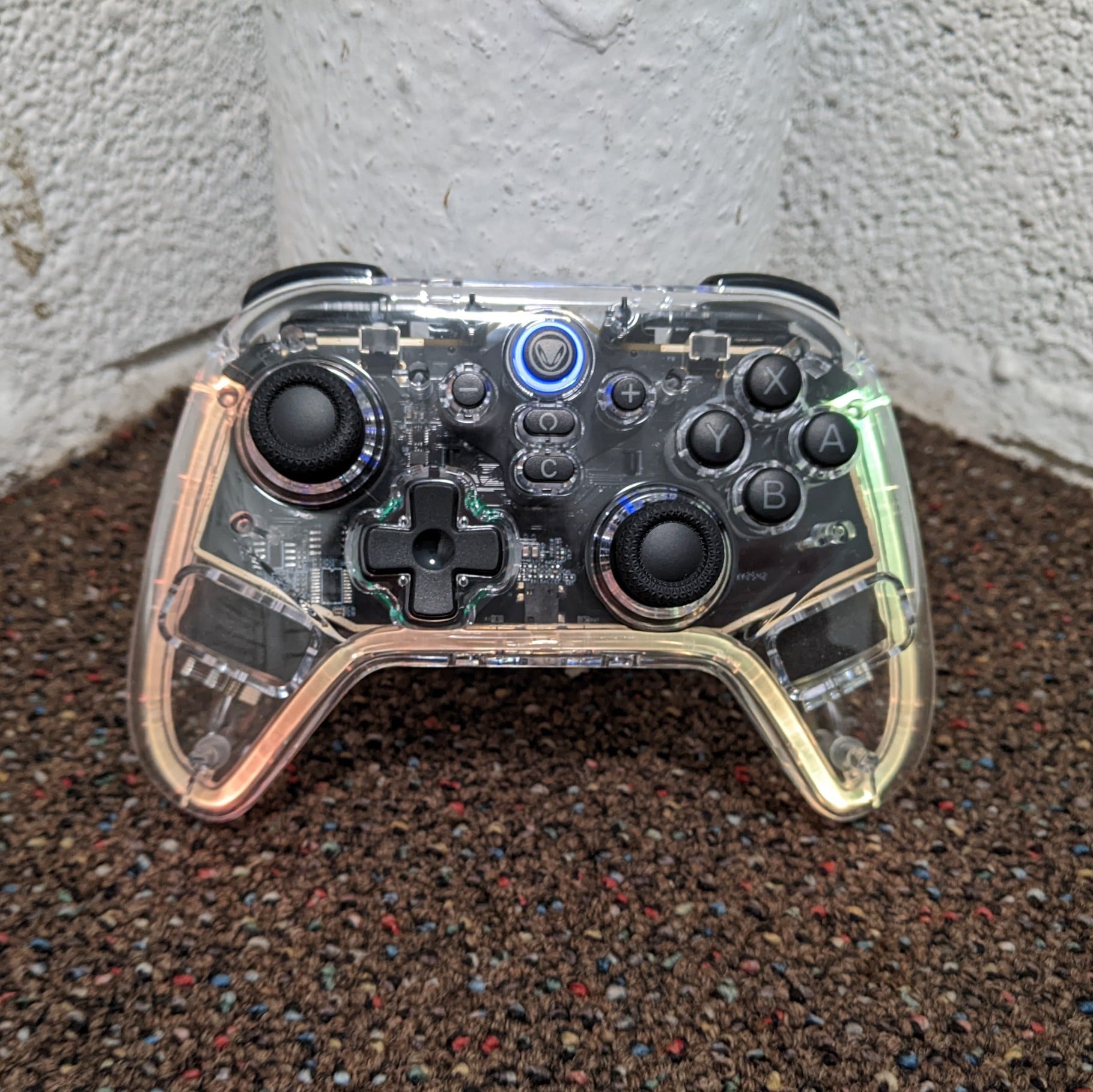
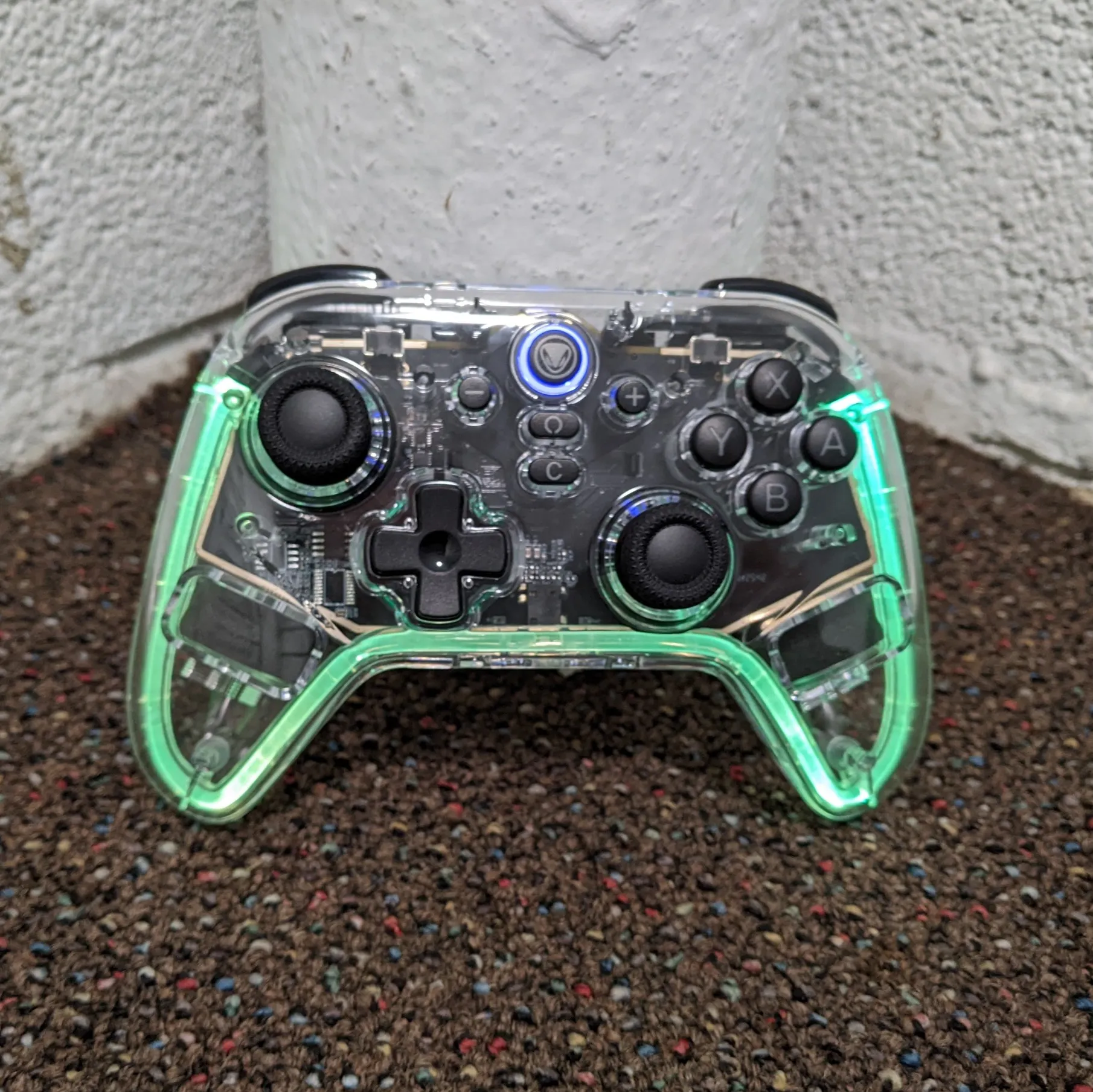
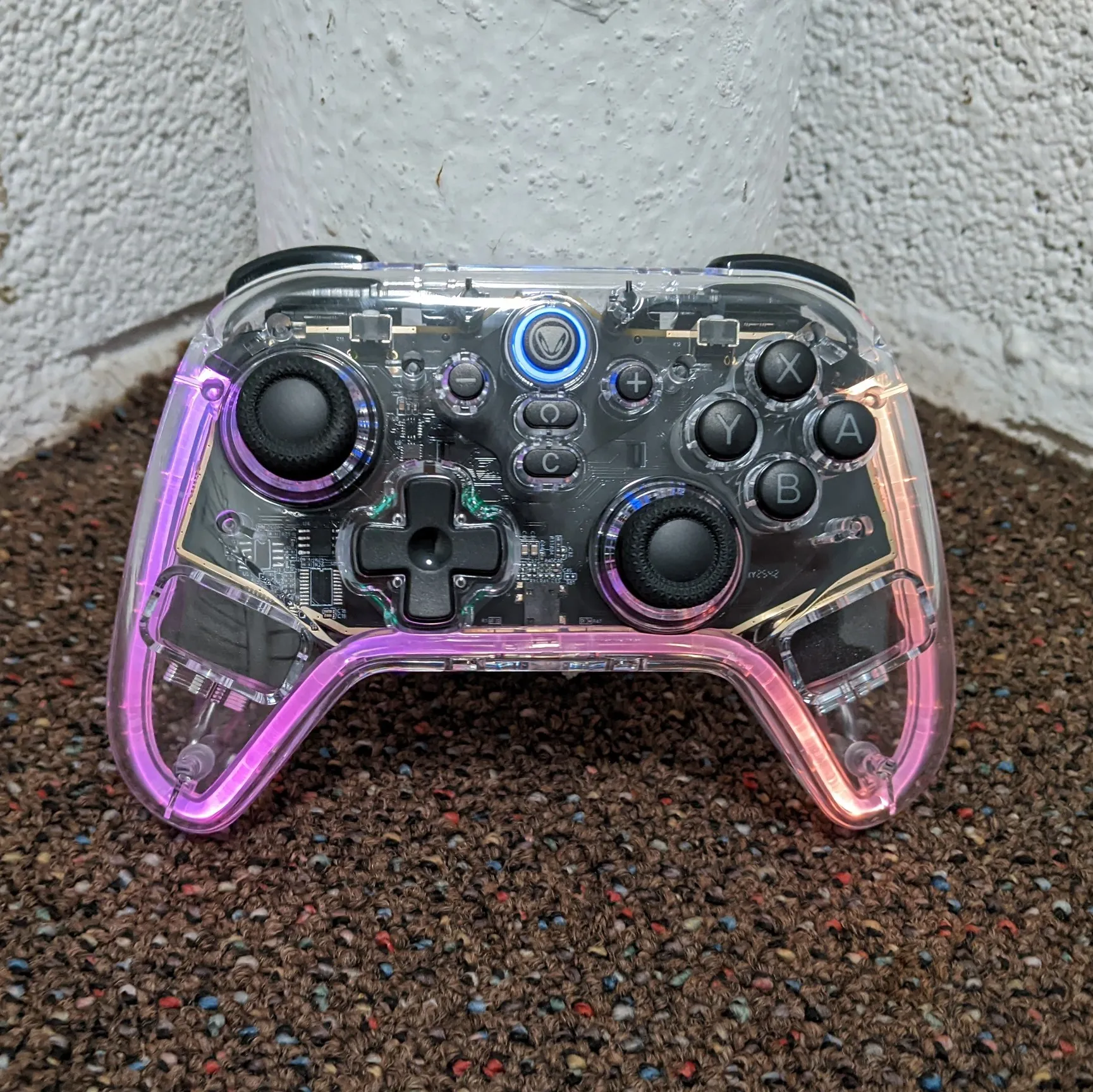
Like that being Snakebyte’s budget option approach to one Nintendo Switch 2 peripheral, I kind of feel like the Gamepad Pro RGB S2 is a budget alternative in some ways for the official Pro Controller. That’s $89.99 after all, and this is $50. It isn’t an exact double, of course. There’s no HD Rumble 2 as an example, and it requires a Bluetooth dongle. It does feature two additional programmable back buttons, and there are locks on M1 and M2 to keep them from being triggered accidentally. Similar locks are present on the triggers. The RGB lighting is there, for those who like that type of thing. But I think the most valuable parts are the Hall Effect sensors on the joysticks and the fact it has its own firmware. Considering we saw third-party docks stop working on the Switch 2 after a firmware update, it’s reassuring.
Photos by Siliconera
Basically, both the Snakebyte Ergo Grip S2 and Gamepad Pro RGB S2 are something of economy options for folks who might not want to pay for the official Nintendo Joy-Con 2 grip or Pro Controller. They might not have all the same features, especially in the case of the controller. But what is here is stable and strong, especially when they’re at least $20 cheaper.
The Snakebyte Ergo Grip S2 and Gamepad Pro RGB S2 are available now.
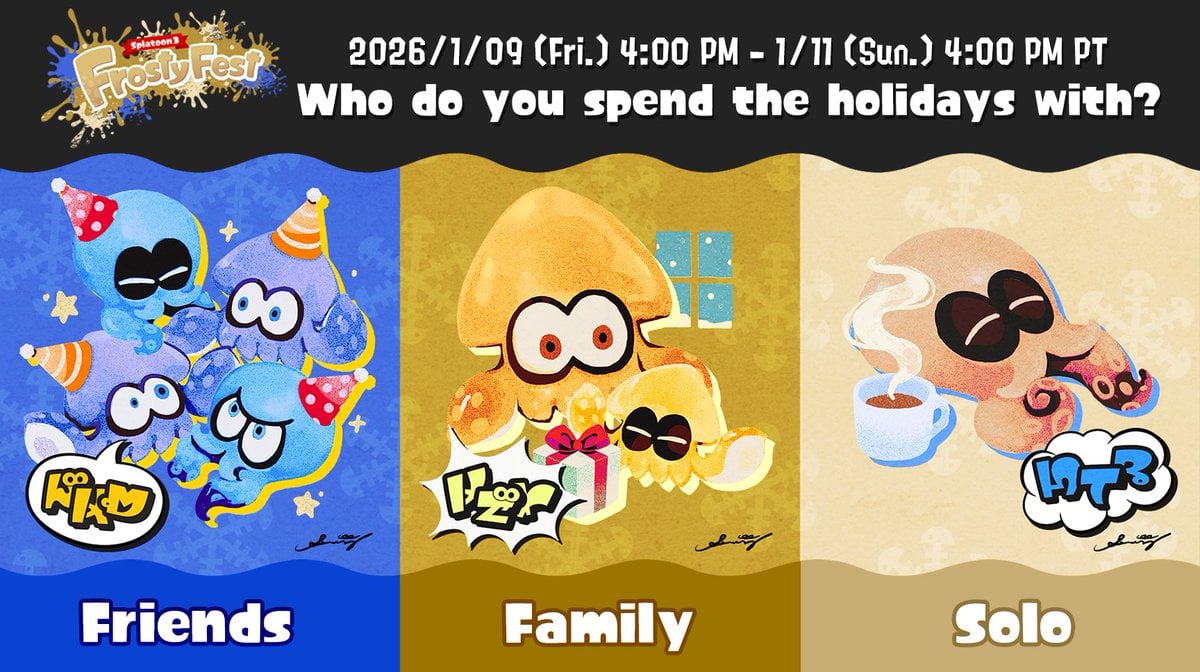
While major Splatoon 3 updates are done, Splatfest events are still happening, and the recurring Frosty Fest one begins at 4pm PT/7pm ET on January 9, 2026. It will end on January 11, 2026. This marks the third Frosty Fest since the game’s debut in September 2022.
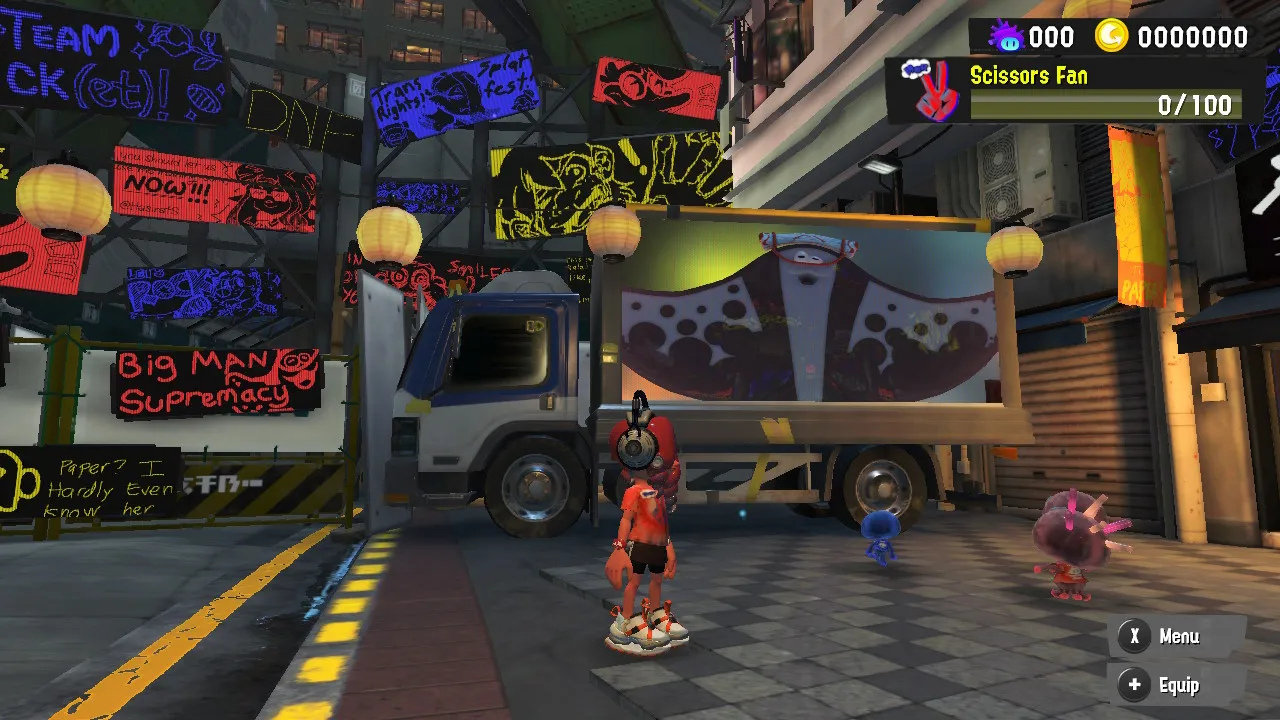
While Splatoon 3 launched in 2022, the Frosty Fest Splatfest events didn’t start in game until the one that took place in January 2024. Each one features winter themes in Inkopolis and Splatsville, special decorations, holiday mysic, and different outfits for Shiver, Frye, Big Man, Callie, and Marie. The theme for the first one was “who do you spend the holidays with,” and the options were Friends (Shiver), Family (Frye), and Solo (Big man), with Team Solo winning. The 2025 event asked “what would make you happiest,” with the teams being Money (Shiver), Experiences (Frye), and Presents (Big Man). Team Presents won that year.
The 2026 Frosty Fest is basically a rerun. The theme is “Who do you spend the holidays with” again. The teams are the same too. So you can choose Team Friends (Shiver), Team Family (Frye), and Team Solo (Big Man).
Here's the official image for it:
Splatoon 3 is available for the Switch, with a Switch 2 update available, and the Frosty Fest Splatfest runs January 9-11, 2026. The next game in the series will be the Splatoon Raiders spin-off with the members of Deep Cut Shiver, Frye, and Big Man.
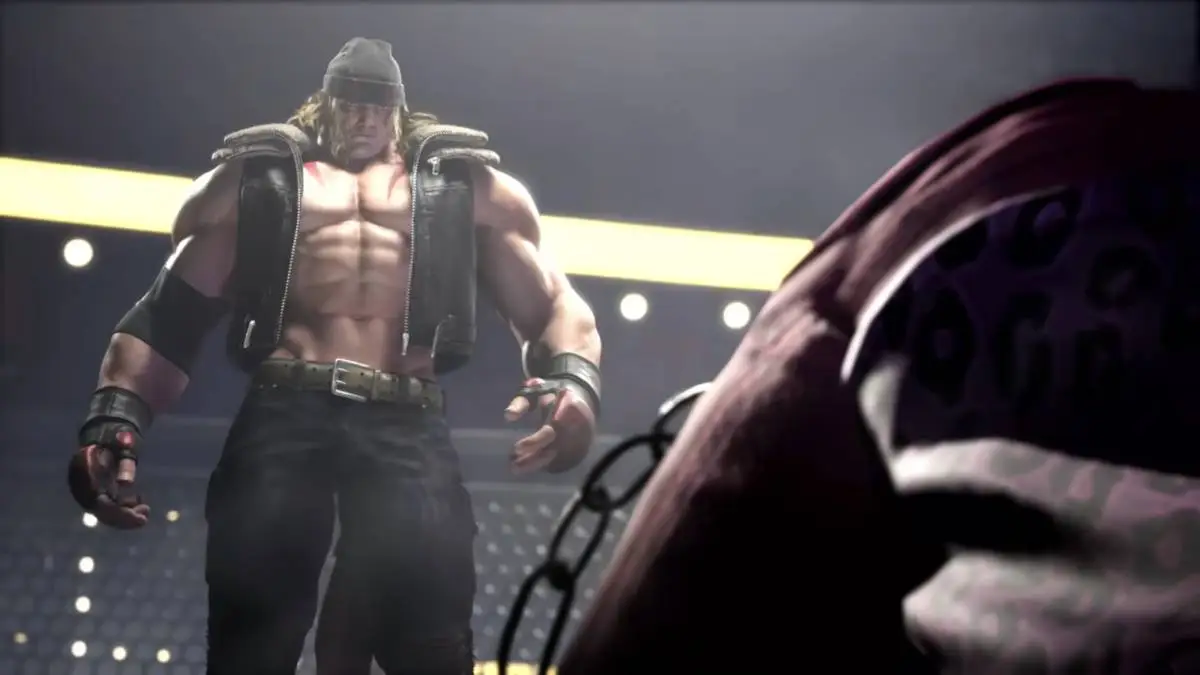
We’re in the midst of the Street Fighter 6 Year 3 Character Pass DLC rollout, with Alex returning to the roster as the next add-on, and now we got a better look at him. Ahead of his “early Spring 2026” debut, Capcom shared a minute-and-a-half long trailer for him. This one is more about setting up his personality and showing his character design in the fighting game than highlighting gameplay, but it helps establish what to expect.
Like Luke, Alex is a character who was set up in sort of a “protagonist” role when he appeared in the Street Fighter series. He showed up in February 1997 in Street Fighter III. He’s known as a wrestler from America, and we see him in the midst of a match where he’s acting as the heel.
Here’s the full video:
https://www.youtube.com/watch?v=uaGvmRTUUvU
Alex is the third of four Year 3 Character Pass add-ons for Street Fighter 6, with the fourth piece being Ingrid in “late Spring 2026.” This season pass focused on bringing older characters back into the fold. He follows Sagat, who started this latest run back in August 2025, and C. Viper in October 2025.
Street Fighter 6 is available for the Switch 2, PS4, PS5, Xbox Series X, and PC, and Alex will appear as DLC in early Spring 2026.
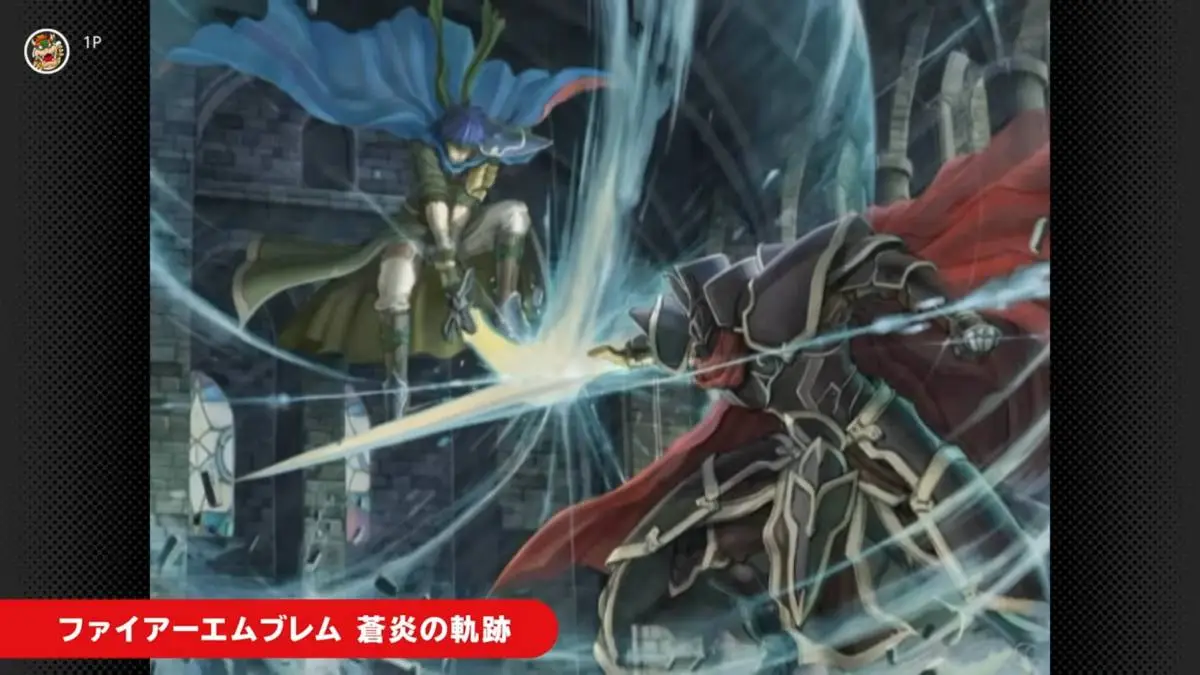
Nintendo added Fire Emblem: Path of Radiance to the Nintendo Switch Online Expansion Pack GameCube app library for Switch 2 owners, and its soundtrack is now on the Nintendo Music app included with that higher tier of the subscription service. This is the first of the two Tellius games, as the second continued the story on the Wii in Fire Emblem: Radiant Dawn.
Fire Emblem: Path of Radiance is the sole GameCube entry in the series. It follows Ike and Soren of the Greil Mercenaries as the two work within Crimea, but King Ashnard of Daein invading the country, leaving its Princess Elincia as a fugitive attempting to get to Gallia. Upon the mercenary company encountering her, they get pulled into and lead the charge to unite people against Ashnard’s forces and restore peace. It’s notable for being the first game in the series with Laguz characters. Two versions are in the NSO app, with the US one altering some classes and having different difficulty.
Here’s the Japanese trailer showing what you can expect from Fire Emblem: Path of Radiance when playing it on a Switch 2.
https://www.youtube.com/watch?v=ygx6y2FzNgk
With the original Fire Emblem: Path of Radiance and Radiant Dawn appeared, it would be possible to bring your GameCube save file over to the Wii. This would allow things like stats and relationships to transfer over.
Fire Emblem: Path of Radiance is on the GameCube and is now available on the Switch 2 for Nintendo Switch Online Expansion Pack subscribers. Other additions to that library included Chibi Robo.
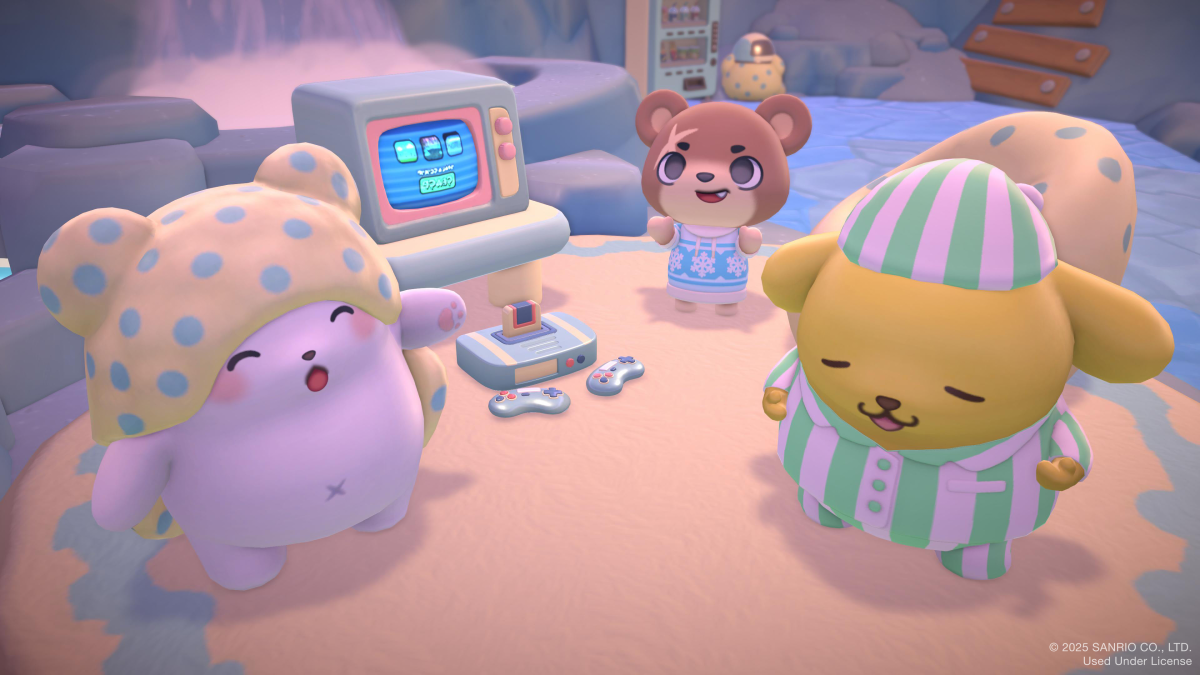
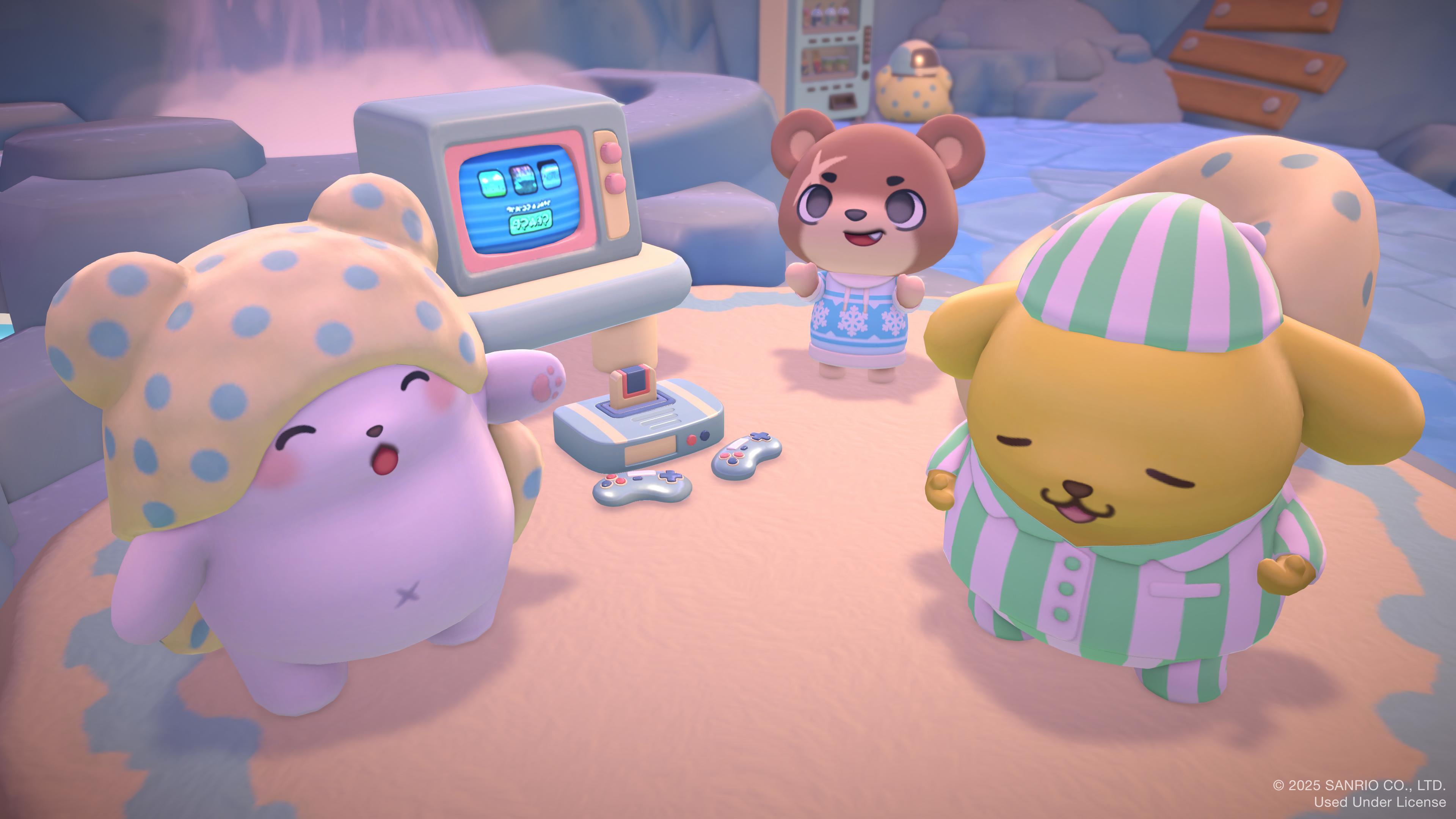
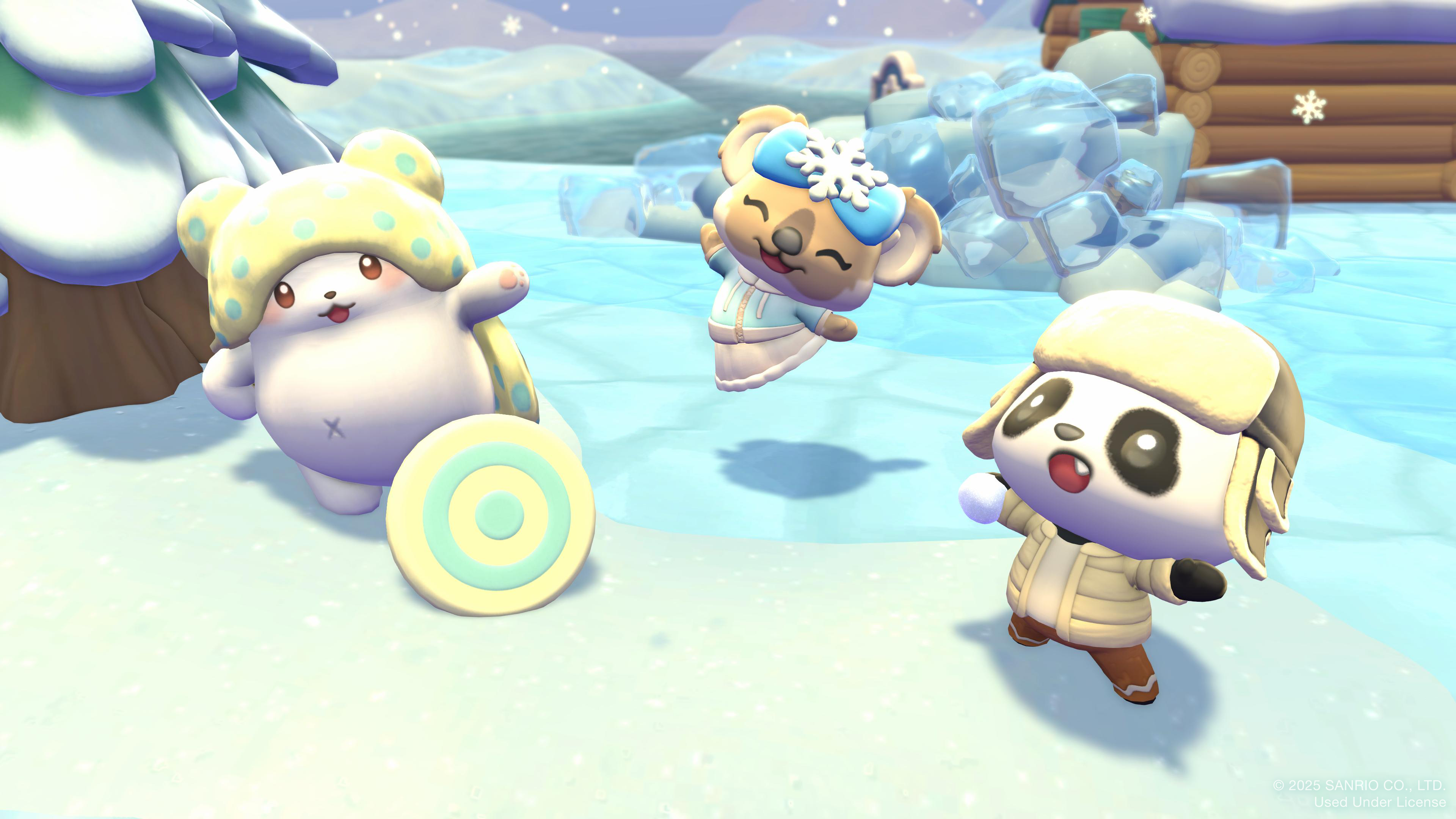
Sanrio and Sunblink confirmed the next mascot who will join Hello Kitty Island Adventure as a permanent character, and it is Moppu from Marumofubiyori. He is in the mobile version of the game on Apple Arcade via update 2.12. He will show up in the console and PC version too, though there’s no release window for him yet there. However, all platforms will feature the Frosty Fashion Frenzy login event between January 15-26, 2026.
Moppu follows Cogimyun, who showed up in the Wheatflower Wonderland paid expansion, and he’s a new free friend. You will need to have unlocked the Icy Peak area and completed certain story missions as a result to reach him. There seem to be new cabins in the area, and visiting him at his home will let you play a brick-breaking arcade minigame called Ice Breaker. There’s a new cooking station for making snacks. We’ll also be able to change our avatar appearance to look like bears. More furniture sets will appear in the patch, with those being called the Gamer Set and Moppu Cozy Set.
Here’s the full Hello Kitty Island Adventuretrailer showing what Moppu looks like in his Icy Peak home and the other new additions there, though it doesn’t confirm appearances of the other Marumofubiyori characters Gyoniku or Kanikama yet.
https://www.youtube.com/watch?v=bVhjGqaDqmY
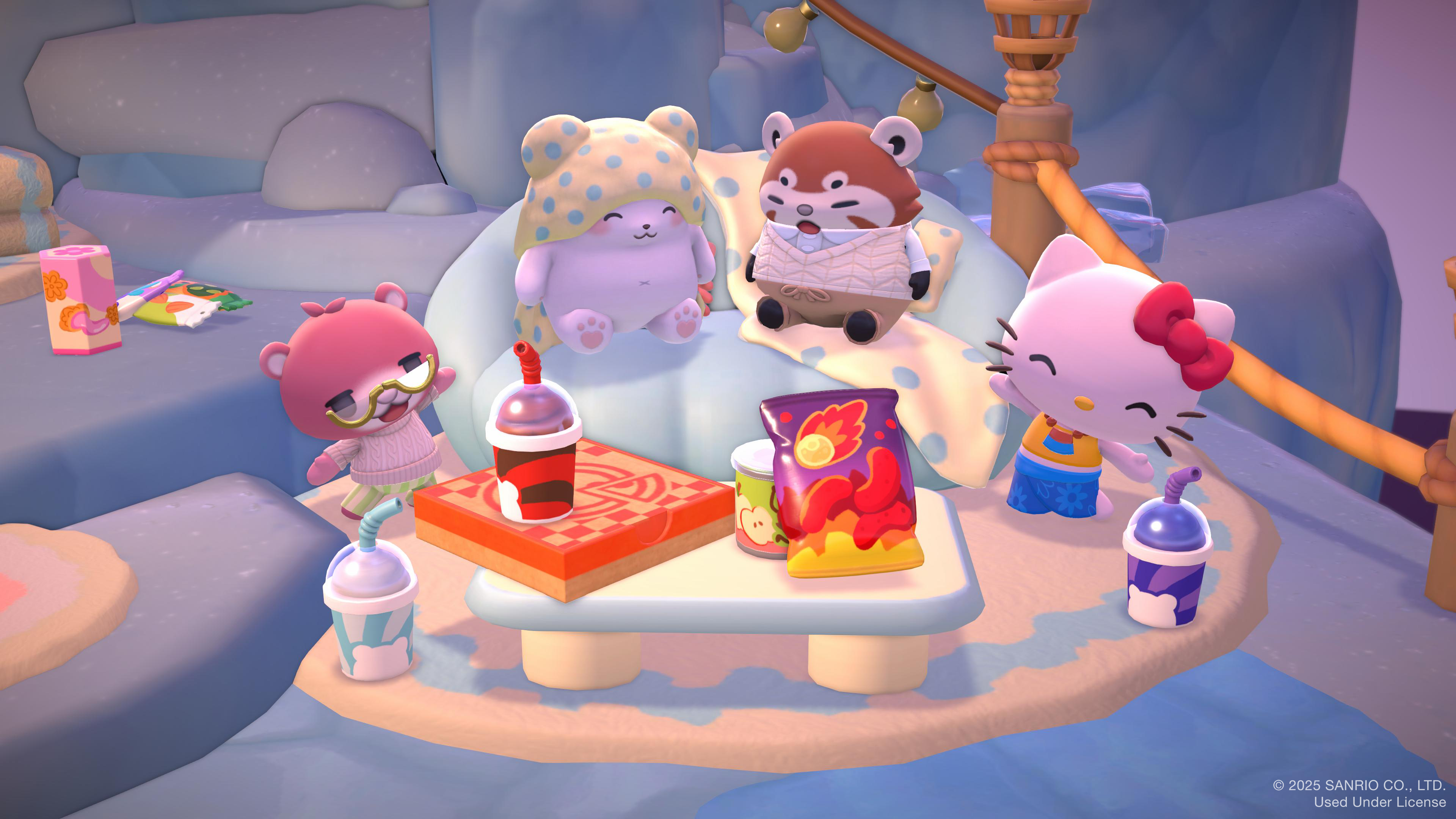
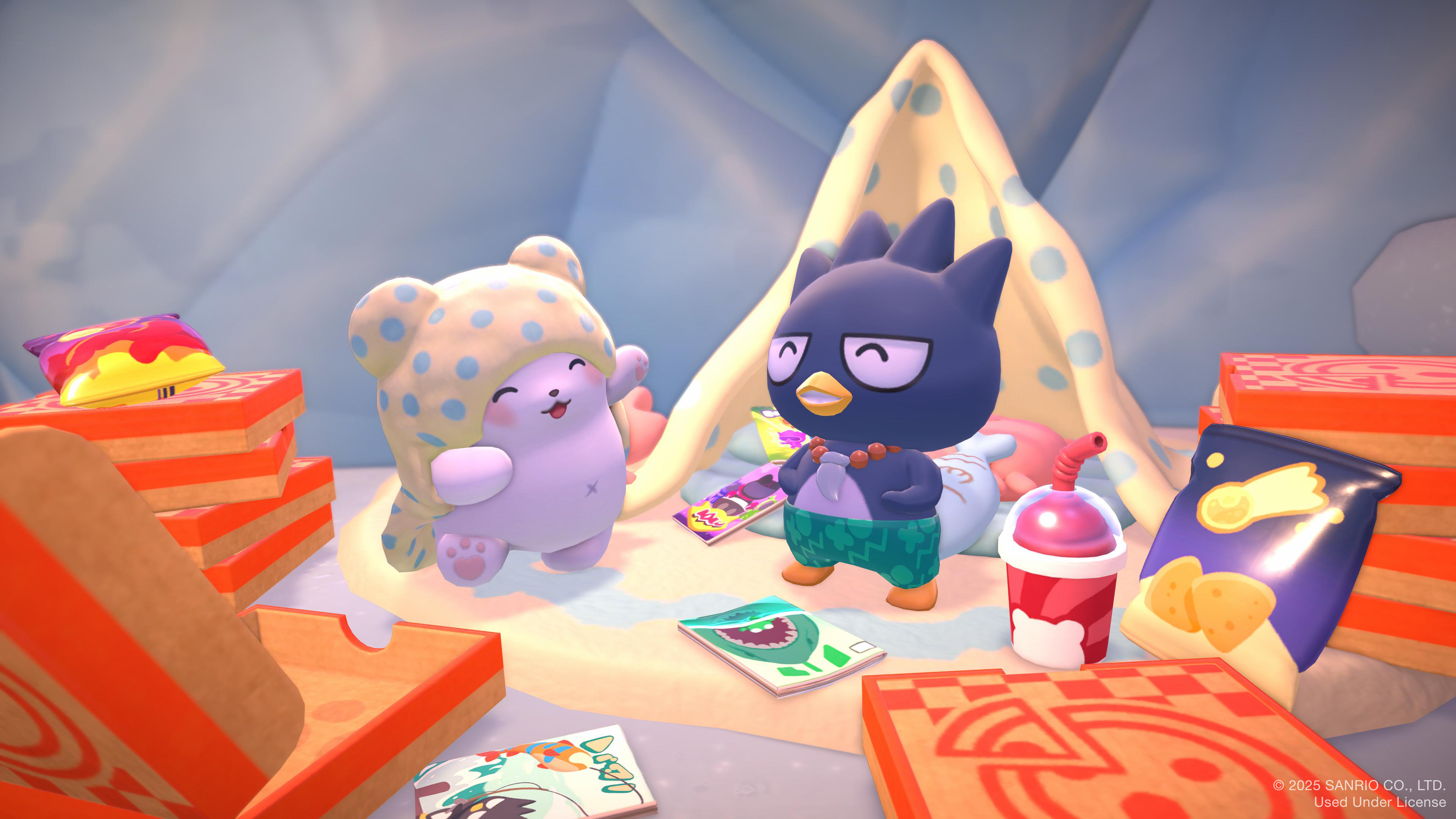
There are also some initial screenshots showing him off.
Images via Sanrio and Sunblink
As for Frosty Fashion Frenzy, this will be the third year the event will run in Hello Kitty Island Adventure. Each time, winter-themed clothing is doled out for free. These are Daily Rewards, so all you need to do is log in to get the extra items.
Hello Kitty Island Adventure is available for the Switch, Switch 2, PS5, PC, and Apple iOS devices via Apple Arcade, and the Marumofubiyori update with Moppu is live on mobile now and coming to other platforms.
A highlight of the Octopath Traveler games is getting really close to characters as we watch their individuals stories play out and we get to build each person we’ve come to care about with jobs we feel suit them best. While Octopath Traveler 0 feels satisfying to play and includes some gameplay elements that can be captivating, it’s unfortunately weakest in both of those areas. While Producer Hirohito Suzuki said in an official Square Enix interview that a self-insertion situation with a “central protagonist” was to “allow you to immerse yourself completely in the story,” in my experience I felt this entry had the exact opposite effect.
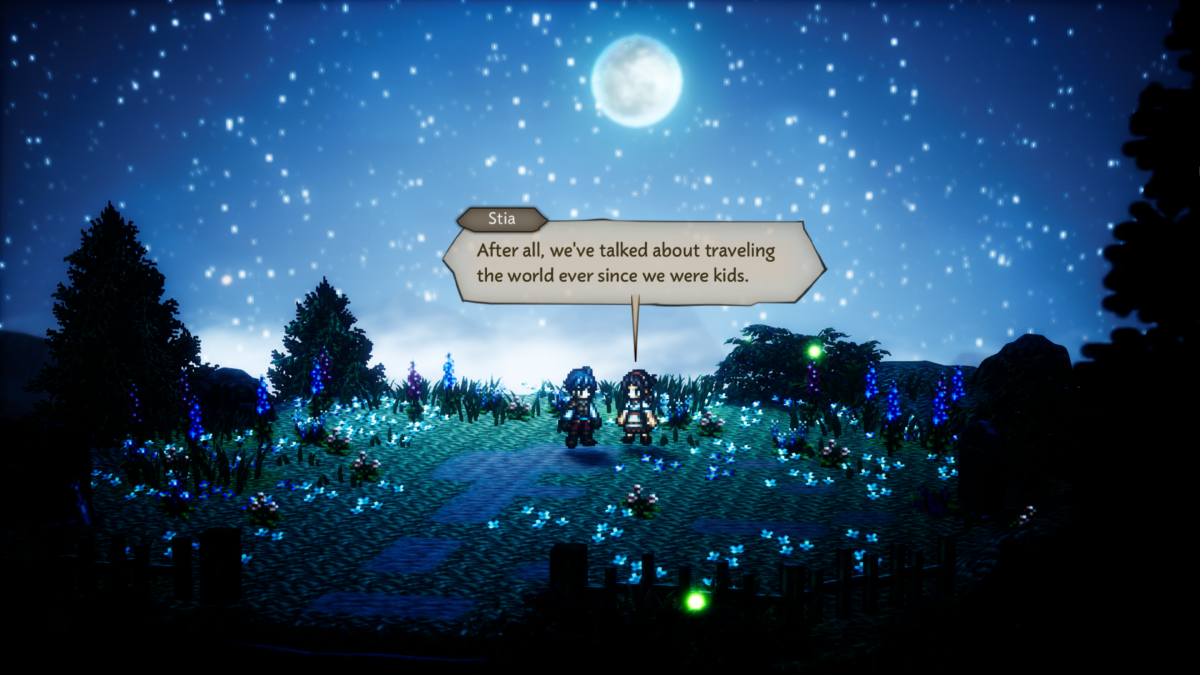
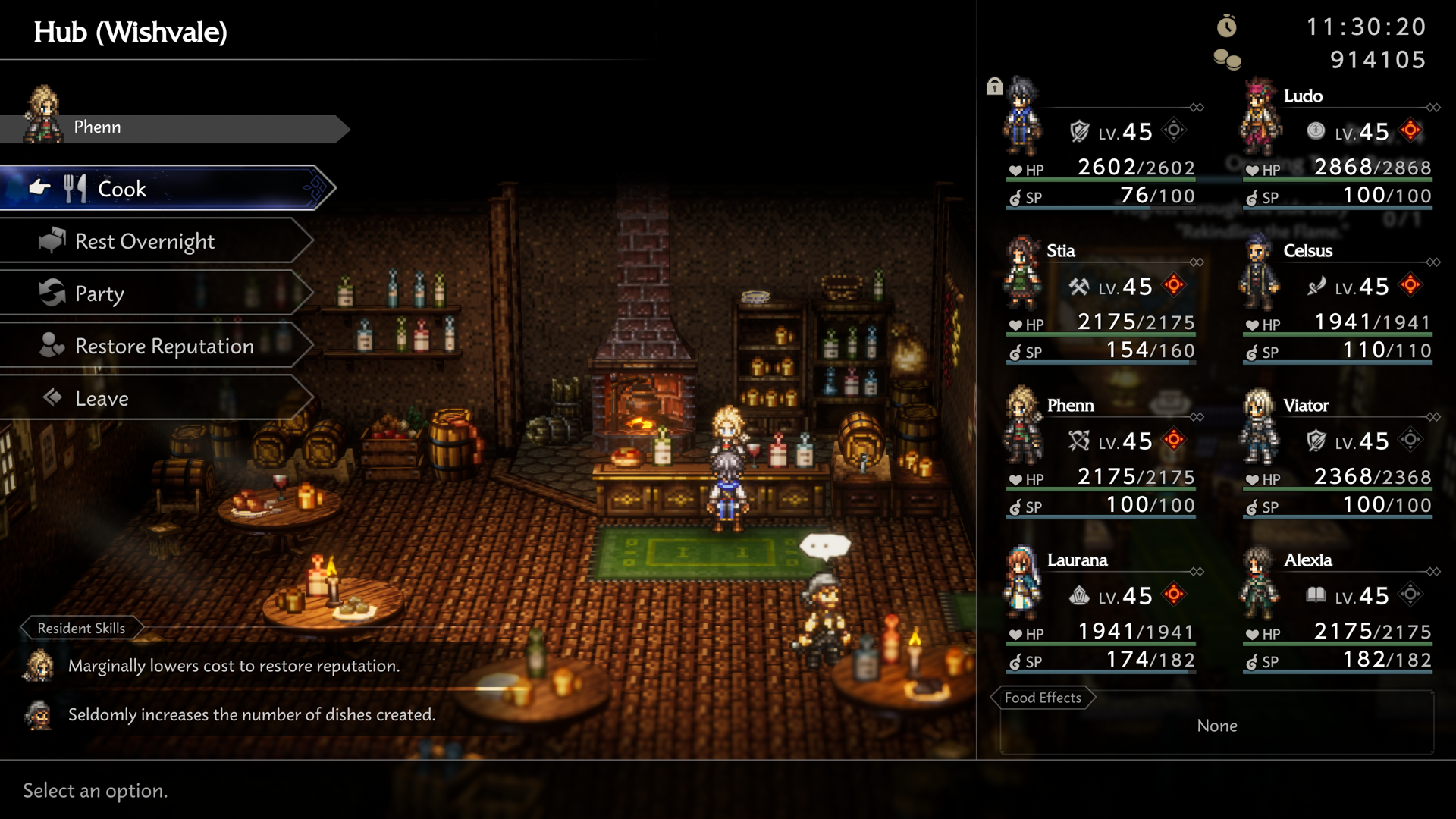
Octopath Traveler 0 begins with our avatar growing up in the town of Wishvale. Their father was head of the Watch and we were following in his footsteps, just as childhood friend Stia trained to be a carpenter like her father. However, on the day of the yearly Enkindling festival, the Master of Power Tytos, Master of Wealth Herminia, and Master of Fame Auguste all came together to raze the town in search of a legendary ring. Determined, our character decides to bring all three down in the name of justice and rebuild the village. This amounts to basically four initial campaign quests, with more opening up as those are cleared. Given this is an adaptation of Octopath Traveler: Champions of the Continent, the narrative in Octopath Traveler 0 ends up feeling very familiar if you're coming from the mobile game.
https://www.youtube.com/watch?v=-xSyjJSAkWw
Multiple storylines in Octopath Traveler games are typical, and 0 even tones things down a bit by reducing the initial scope. Instead of offering one campaign right away for eight protagonists, we get four we can swap between. (Though the Wishvale one is designed to be played between the other quests, unfortunately.) The thing is that most of the time I felt like I was more of a silent observer of the main companion for each storyline, instead of the main character, even though there is a "chosen one" element at play for our avatar. The rebuilding Wishvale storyline? The lead felt like Stia and, to a lesser degree, Phenn. The Herminia and storyline? Bargello is the driving force. The one with Auguste as an antagonist? It felt like Schwartz’s story. Tytos’ tale? Velnorte. It felt constant. While I could define my identity in the initial character creator and a questline might ask if I wanted to join or follow someone on a quest I’d obviously agree to further, I often felt more like an onlooker than the star and as if those choices carried no weight. Even in Party Chats, aside from making a selection that could mean siding with one ally or the other, I felt like it was more about seeing my companions talk amongst themselves. Side quests? It's about the NPCs. Part of this is due to our character being a silent protagonist and everyone else so talkative. Some people might enjoy this approach, but I suspect those who are big fans of the first two games might feel the same way I do about the design decision.
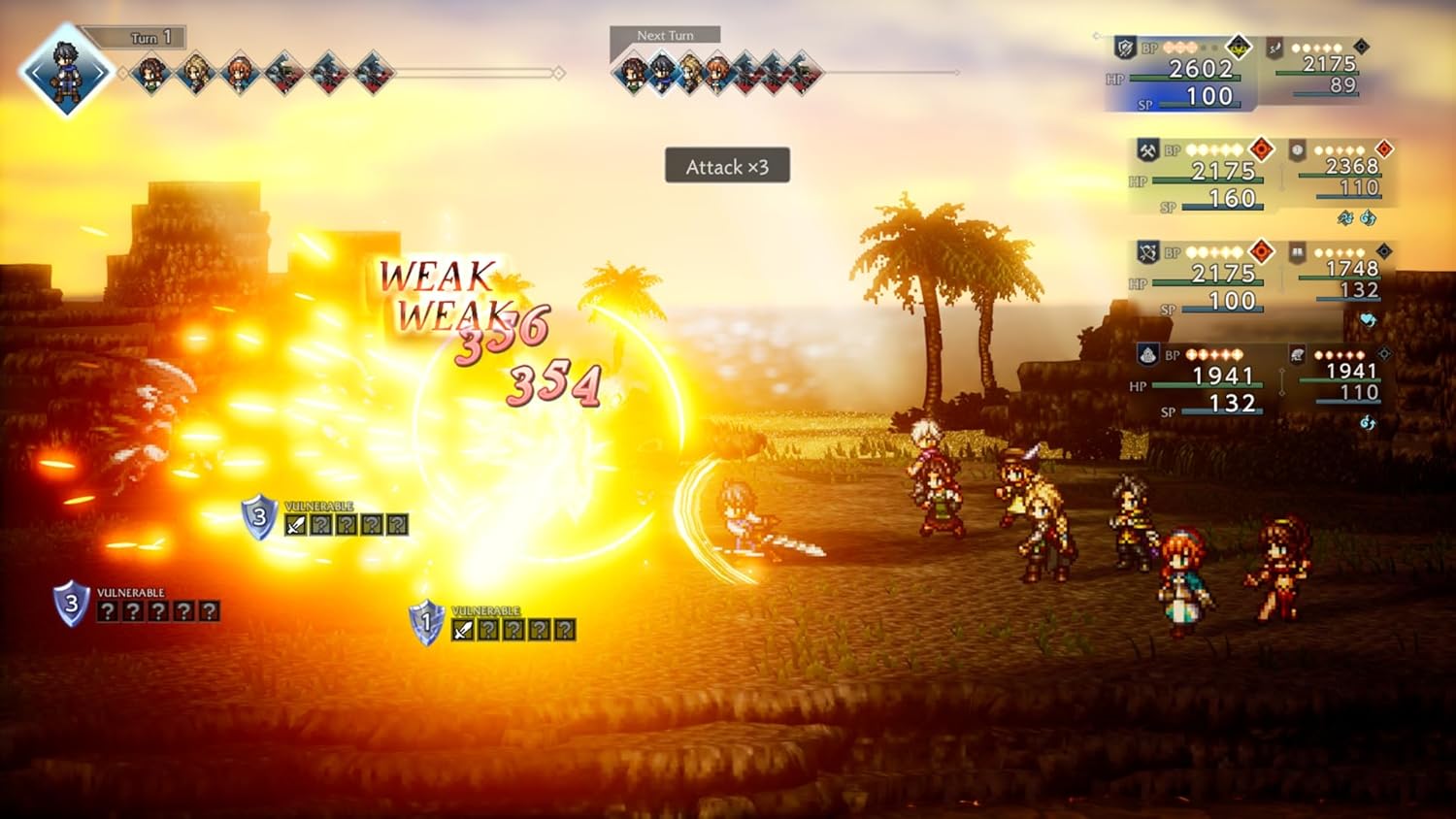
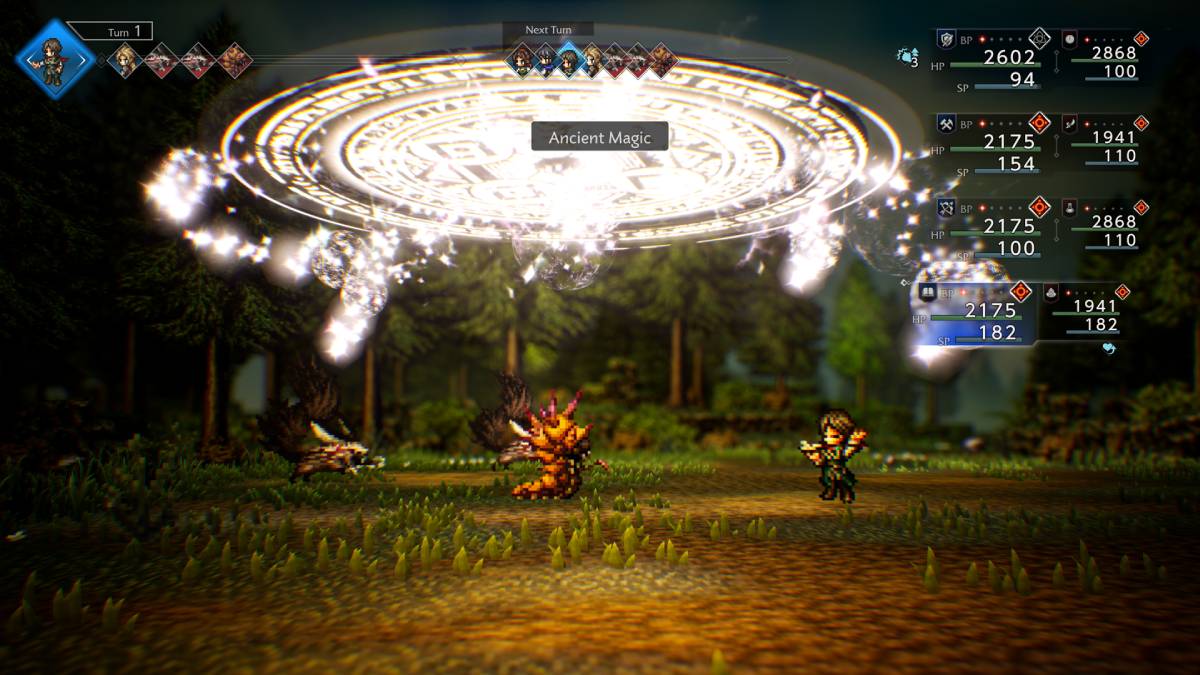
Again, since Octopath Traveler 0 is building off of Octopath Traveler: Champions of the Continent, it can often feel more like it than the other games in the series. Battles still rely upon striking with weapons or elements opponents are weak against to “break” their shield. Completely bringing that number to zero leaves them unable to act and reduces their defenses. Like the mobile game, there are eight characters in battle at once, with four in the front row and four behind them in back. The four in front are active and can attack or use skills. The ones in back are in reserve and heal each round. You can swap between them on the front character’s turn, taking advantage of someone who has different movesets or stored up enough actions to hit up to four times or use a stronger strike. It’s a strong system and quite effective given the reliance on targeting weaknesses, since you can always pull in someone else who could have the right weapons or elemental magic. I adored the combat system, as always, and would love to see an Octopath Traveler 3 use it.
Images via Square Enix
However, as a result of having the 30 possible party members, we lose a hallmark of character builds from the first two Octopath Traveler games. The only person we truly get to customize is our avatar. They can swap jobs, but everyone else is set in their ways. It isn’t like other titles where we pick a job and secondary job. Instead, there are set skills from jobs learned with JP. If you go to the Training Ground in Wishvale, find certain treasure chests, or fight certain folks, you get Action Skills and can equip a set number to each person. Honestly? I’d take the secondary job system over this one any day, but I get the feeling Square Enix and DokiDoki Groove Works were trying to push a diversified party with perhaps one character from each class around instead. As is, it felt like I had less control and less reason to really play around with developing allies, which was one of the things I loved most about the previous two console games.
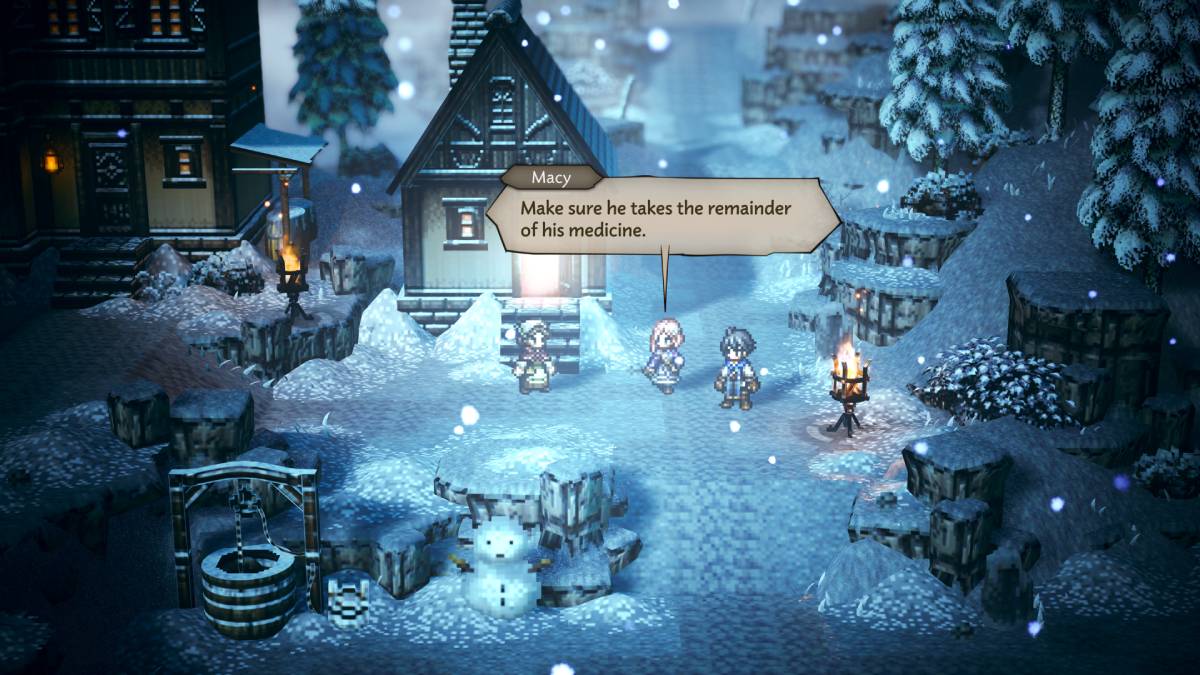
Likewise, I feel I preferred the more limited scope of characters from the previous mainline Octopath Traveler games, as 0 offers so many that it can prove difficult to really connect with them. Their introductory recruitment quests are quite brief! Even the Party Chats didn’t seem to help me really care about them in the way I did people from the first and second games. Even after spending hours with the game, ones I didn’t get to know as a result of campaign quests sometimes just felt like “the person I bring in when I need a mage” or “I actually learned Macy’s name because she’s the only healer I recruited after playing about 15 hours.”
Images via Square Enix
Especially since we aren’t relying on extra allies for Path Actions. Our avatar basically can do it all, and all Path Action options are available immediately. Our success with them varies upon fame, power, wealth, and our overall level, from what I can see. It is handy to be able to do it all at once! Convenient too, since nothing is walled off from us early on due to only wandering around with Stia initially. I do think Octopath Traveler 2 handled it best, with its combination of daytime and nighttime Path Actions, and would hope another game in the series would return to that design choice.
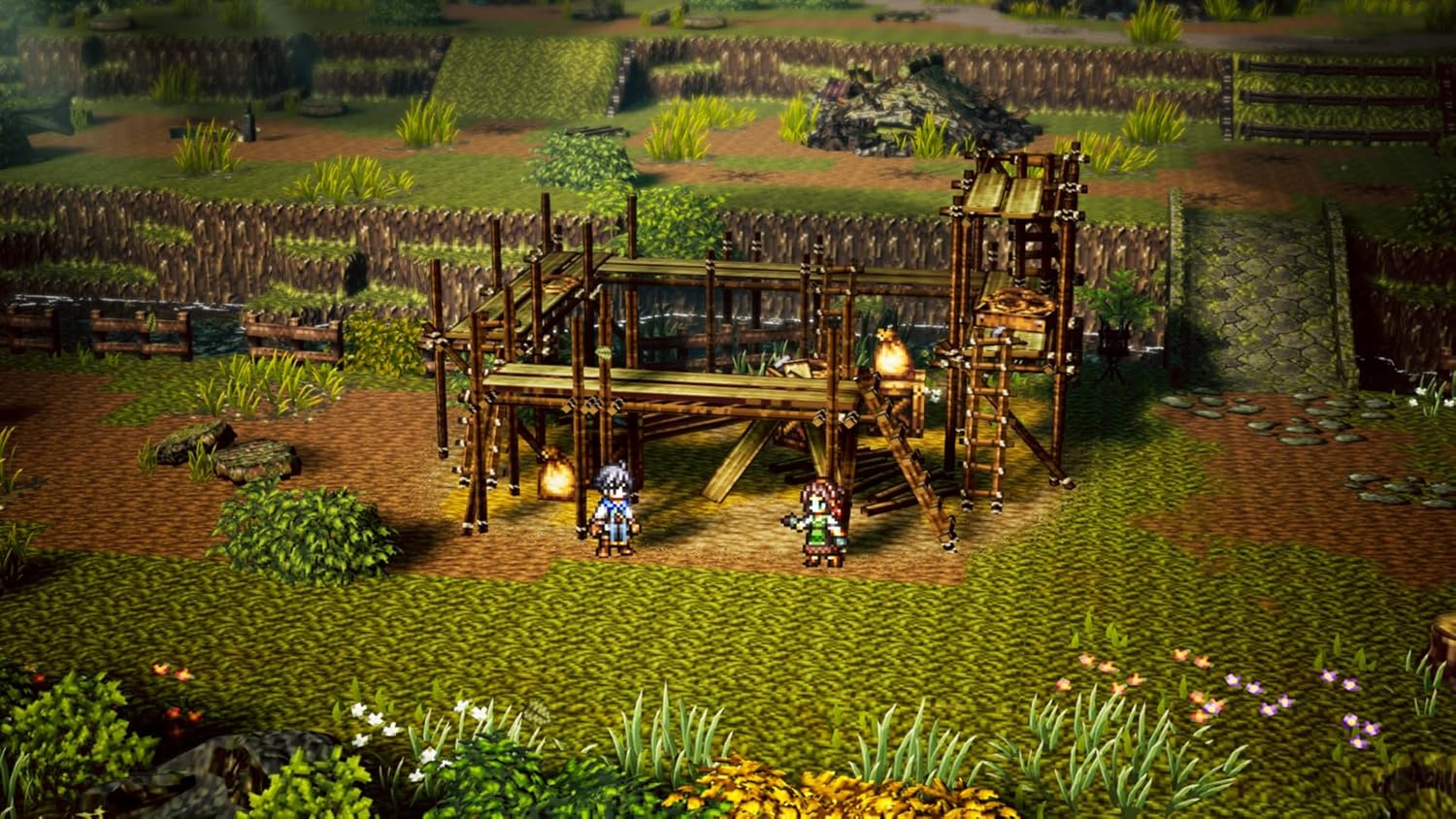
The thing I loved most about Octopath Traveler 0 is the town restoration and Wishvale reconstruction storyline accompanying it. While that does still feel more like Stia and Phenn’s story, I did feel more involved and connected to it than the other parts of the narrative. A downside is, it isn’t like the other campaigns we unlock. We can’t just focus on that storyline. The nature of some of its quests mean we’re forced to go away and go through other missions to make “time pass” and get to it. While it get it and do appreciate that it makes it feel like progress is gradually being made on this big and monumental project while we get revenge, I also wanted to spend all of my time rebuilding, reorganizing, collecting possible villagers, and making that place my own. However, I do wish that some of the NPCs who moved to our town had more of an identity or at least an actual name.
Images via Square Enix
While Octopath Traveler 0 scratches the JRPG itch in some satisfying ways, I found it often never feels as captivating as the first two games. Our protagonist doesn’t feel as connected to events as the companions for the campaign quests, even with what happened to Wishvale. The heroes from Octopath Traveler 1 and 2 get stronger stories. I miss being able to play around with character builds like I did in past games too. The town building element is fantastic, constant access to all Path Actions is handy, and the eight-character party in battles allows for some fun strategic options. But I do hope the next entry in the series is more like Octopath Traveler 1 and 2 than 0.
Octopath Traveler 0 will come to the Switch, Switch 2, PS4, PS5, Xbox Series X, and PC on December 4, 2025.
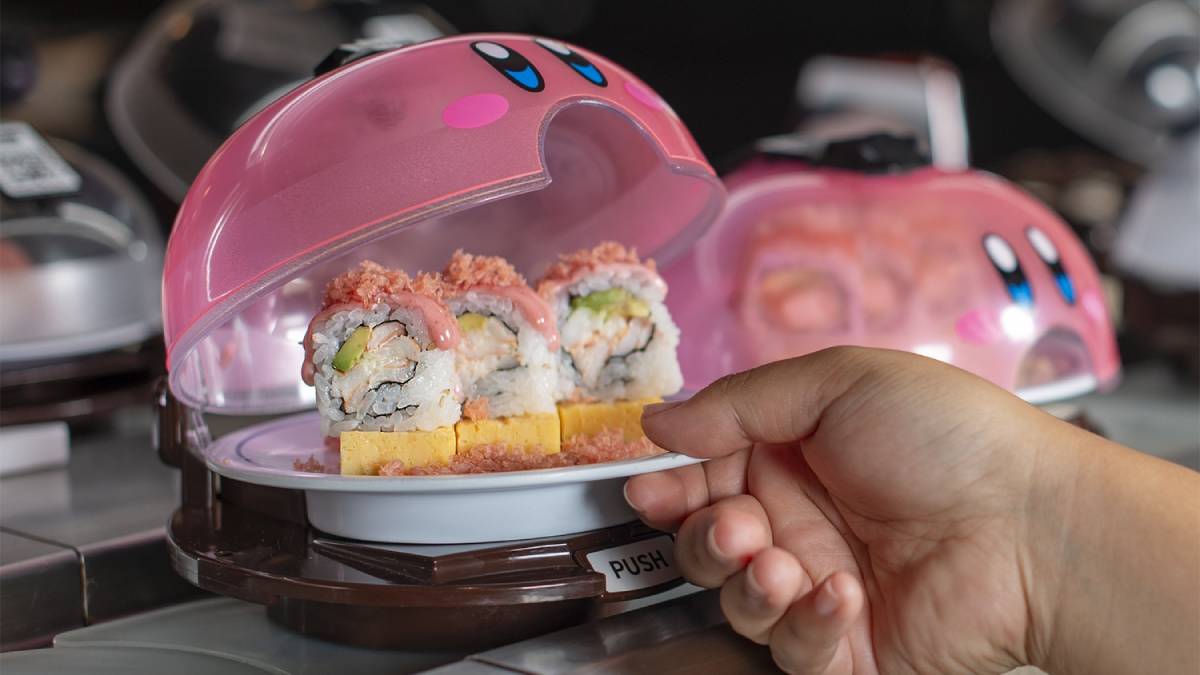
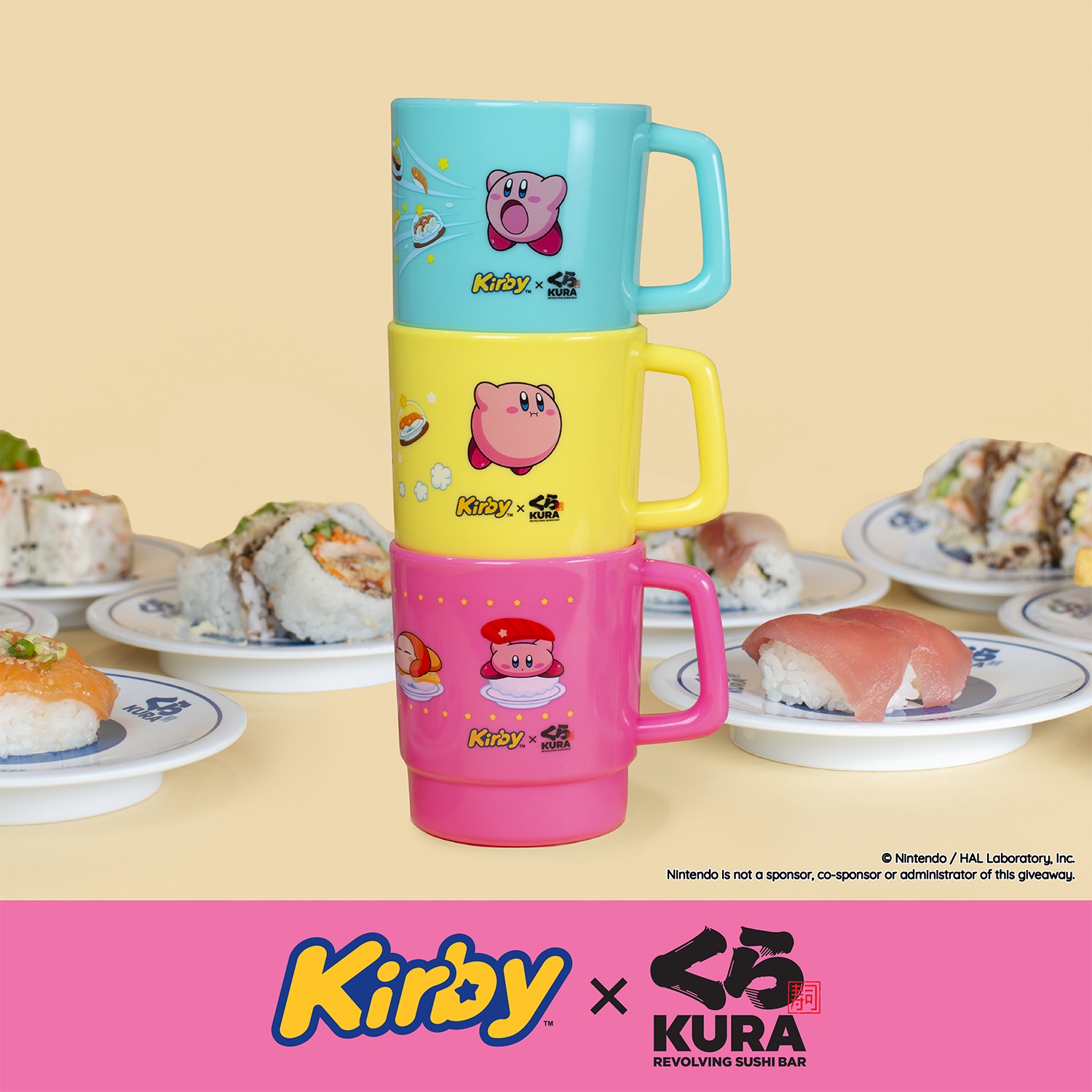
Two Nintendo properties are at two different restaurants in the US right now. If someone heads to Kung Fu Tea, they can get drinks and a straw cap based on Pokemon: Legends Z-Athrough January 31, 2026, while supplies last. Should people head to a Kura Sushi location until January 31, 2026, again while supplies last, they could get Kirby and Waddle Dee-themed sushi and merchandise.
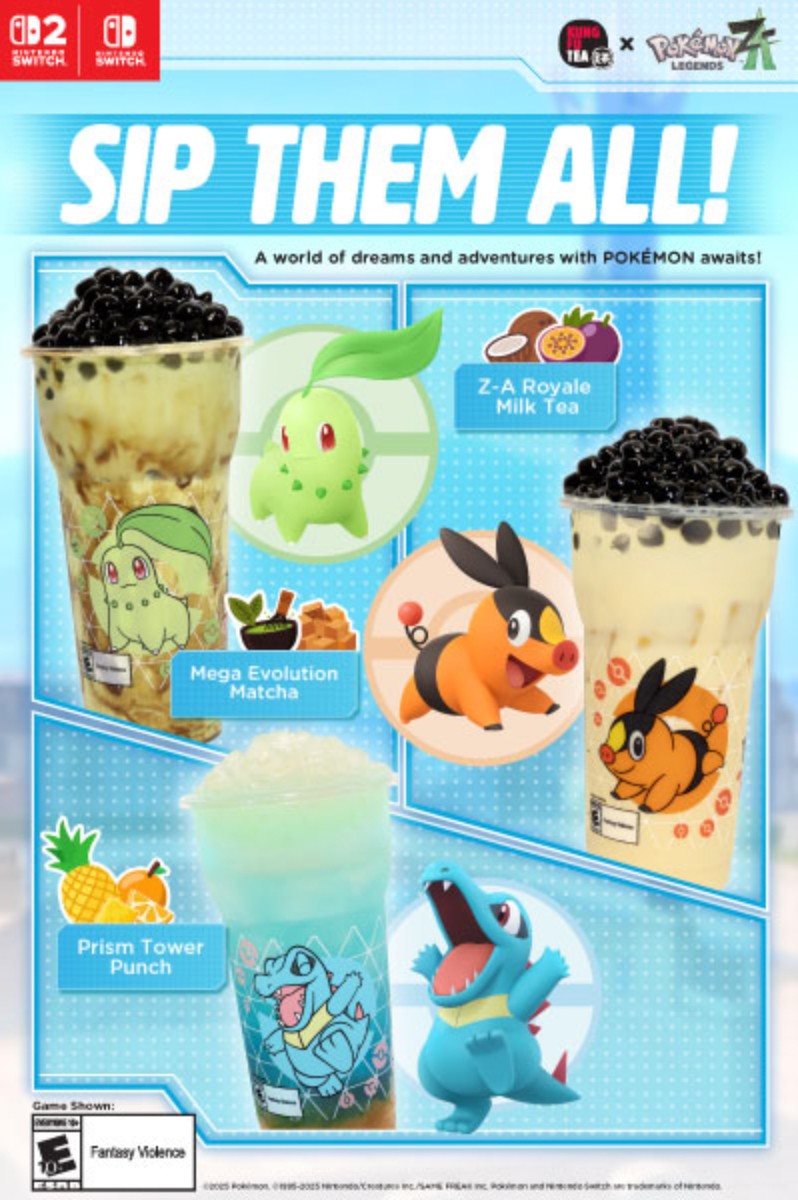
In the case of Kung Fu Tea, there are three kinds of drinks, cups based on Chikorita, Tepig, and Totodile. It is also possible to get a straw cap that looks like Pikachu with your purchase. Each drink is inspired by locations and elements of the game, as well as characters So the Mega Evolution Matcha with brown sugar boba comes in a Chikorita cup, the Prism Tower Punch with aloe jelly, curacao, and lemonade is tied to Totodile, and the Z-A Royale Milk Tea features coconut, passionfruit, green tea, and honey boba. It is possible to order all of them from locations via the website.
Here’s the official art for that promotion:
Image via Nintendo and Kung Fu Tea
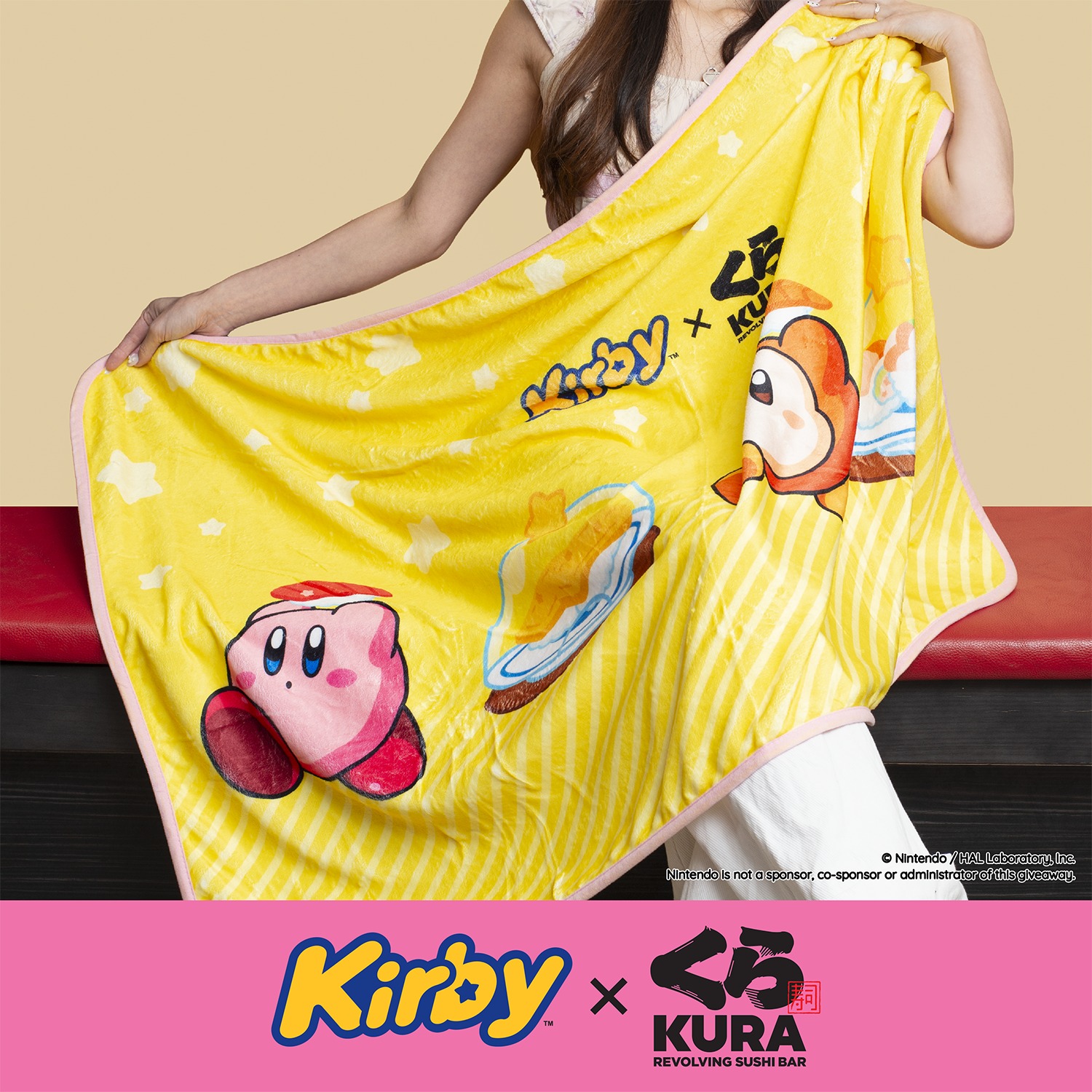
With Kura Sushi, there are both Kirby and Waddle Dee types of sushi, giveaways for a cup set and blanket, and Bikkura Pon Prizes given away randomly for every 15 plates of sushi. Both the Kirby and Waddle Dee options have tamagoyaki (egg) as their base and seem to feature avocado, with one being the Kirby Dreamy Crunchy Roll and the other the Waddle Dee Feisty Feast Roll. You get the cups if you have the Kura Sushi Rewards app, a QR code, and a receipt showing you spent $85 to get the cups now. The blanket is the $85 reward available after January 14, 2026.
Pokemon is at Kung Fu Tea and Kirby is at Kura Sushi in the US until January 31, 2026, though some items may only be available while supplies last. Kirby Air Riders is on the Switch 2, and Pokemon Legends: Z-A is on the Switch and Switch 2.
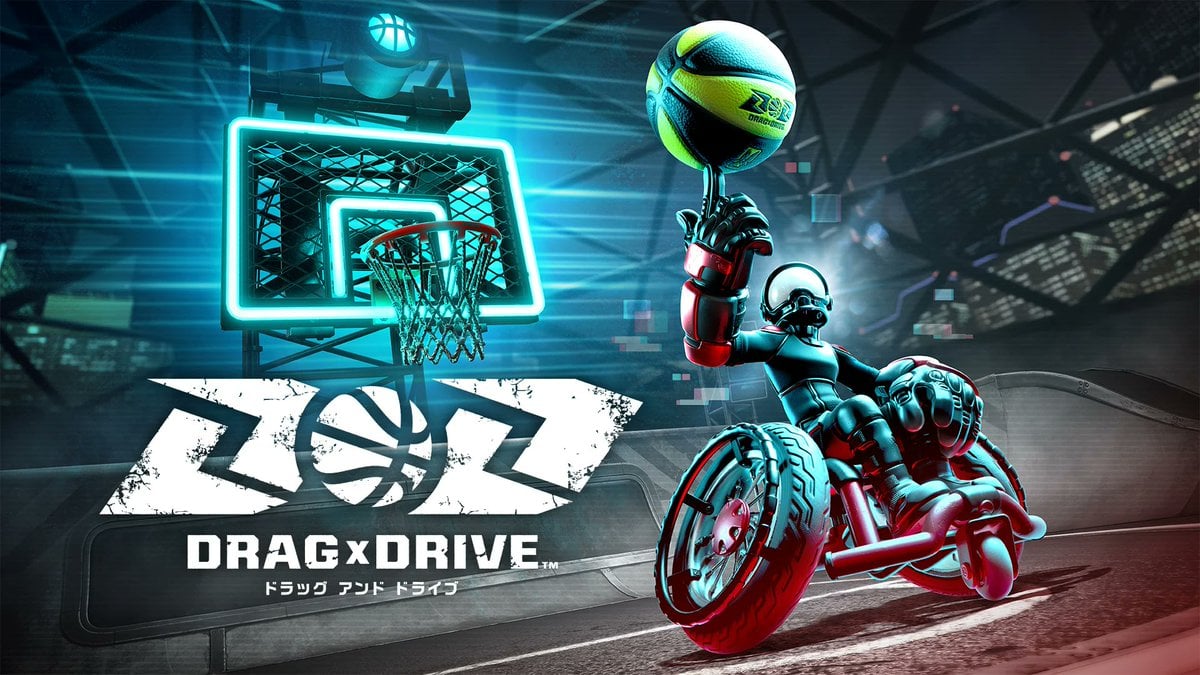
Nintendo updated Drag x Drive, its wheelchair basketball game for the Switch 2, adding a Survival Tag mode for existing players and a demo for those who haven’t picked it up yet. The company also shared an Ask the Developer interview series about it, with Director Yoshinori Konishi and Programmer Hiroki Hamaue mentioning the idea stemmed from experimentations with Switch 2 mouse control possibilities.
With the update, there are a few details about how Survival Tag works in the Drag x Drive patch notes. After updating to 1.2.0, it will be available as an option in LAN, local wireless, and Friend Parks. It’s essentially a game of tag. The announcement confirmed the nature of it means “a tag is considered successful if there was contact from either perspective.” The person who is it chases others around, and tagged people are eliminated.
In the case of how Drag x Drive started with mouse control scheme experimentation and turned into a wheelchair basketball game, Hiroki Hamaue talked about how the “wheel” rolling element started. He noted, “To explore the possibilities of mouse controls, we played prototypes of various games that used, for example, one mouse in each hand, or combined mouse actions with control stick movements and button presses… We discovered that by adding a rattling vibration in sync with mouse movements, it felt like you were actually turning a wheel. We tried pairing this with sliding the mice back and forth with both hands, just to see what would happen. That's when we realised, ‘Hey, this feels a bit like manoeuvring a wheelchair.’”
Yoshinori Konishi then said that was what led to the actual game being developed. He noted, “This caught the attention of the producers, and I was asked to turn it into a sports game… If we went with basketball, all you'd have to do is move under the basket and flick the Joy-Con 2 controller forward to shoot.”
Drag x Drive is available for the Switch 2 worldwide, and there is a free demo.
Eidos Montreal was developing a "soft reboot" of the Legacy of Kain series when Embracer's acquisition led to its cancellation. The studio faces challenges but continues working on a costly internal project.
A consortium of three companies, led by Saudi Arabia's Public Investment Fund, is acquiring EA for $36.4 billion, which could result in significant debt and concerns over Saudi influence on EA's operations.
Hitman: World of Assassination has sold over 25 million copies, confirming its success. IO Interactive is developing 007 First Light and Project Fantasy, with future Hitman news expected in 2028.