There’s a lot of people wishing that the mid-2020s were more like the mid-1990s, but I don’t expect many were doing so for a chance to experience the Virtual Boy’s brief heyday. Yet here we are, with Nintendo releasing both a plastic recreation and a jazzed up cardboard edition of the Virtual Boy to go alongside the console’s addition to Nintendo Switch Online + Expansion Pack. It’s playable with Switch, Switch OLED and Switch 2, so we’ve done just that.
The plastic shell of the Virtual Boy has been recreated in a charmingly accurate fashion from a distance, but you see plenty of fakery when you pay closer attention. All of the physical controls, sockets and sliders of the original Virtual Boy – the IPD slider, the volume wheel, controller port and all the rest – are now just surface details, and like a treasure chest that reveals itself to be a Mimic in a D&D campaign, the red shell at the top of the body now opens up to reveal a cavernous maw, eager to consume your console.
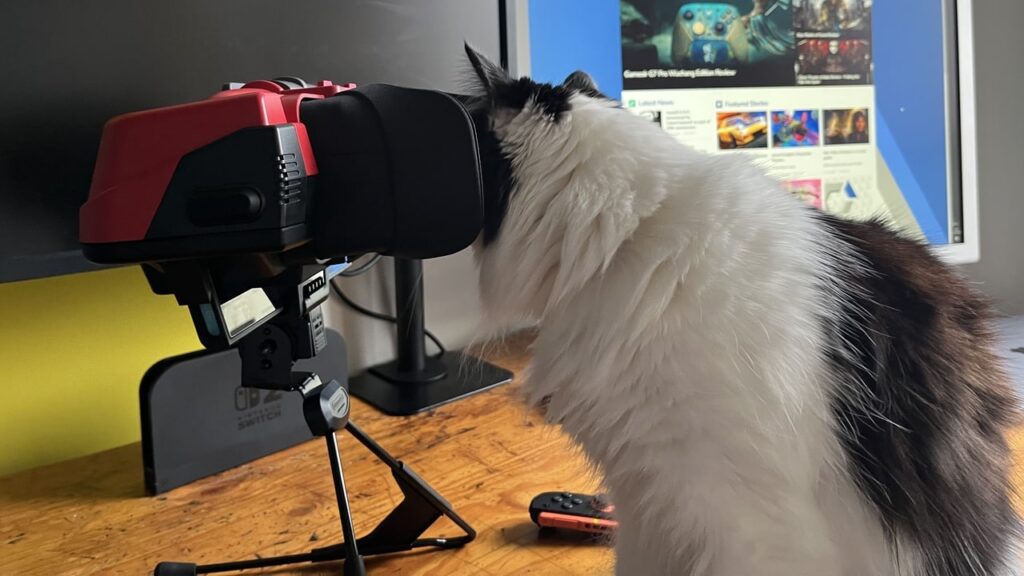
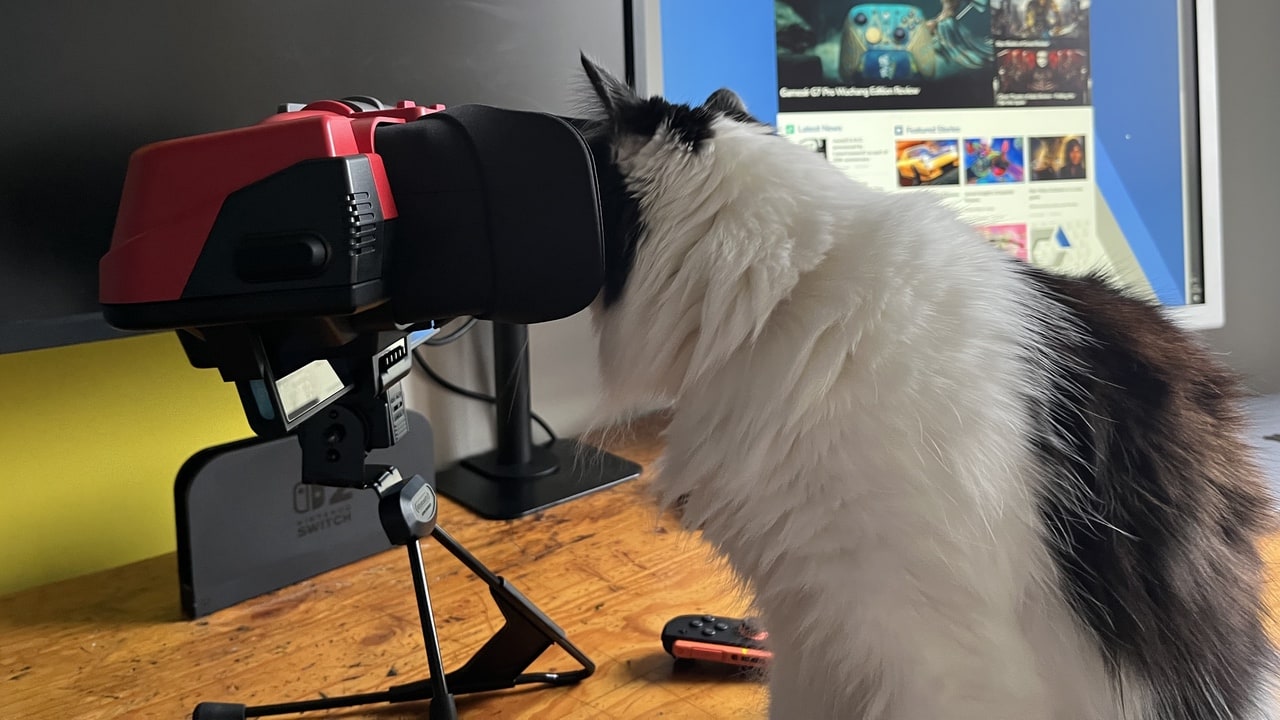
Far more accurate are the backward tilted legs, sturdily holding the headset in place, and stubbornly allowing just a single adjustment. There’s no up or down here, just a tilt back and forward, and it means that you have to really lean in to get your Virtual Boy on. If potential eye strain weren’t enough reason for Nintendo to suggest regular breaks, then bad posture and possible back pain were another. While remaining authentic to the original is admirable in some ways, it means this remains an annoyance for anyone that isn’t my cat. I found that the box the Virtual Boy came in brought the headset up to a sensible viewing height for me.

The Virtual Boy is for ages 7+, but my cat is 3, so it was not turned on at this time.
Another slight disappointing element is the inelegance of Nintendo’s solution to the difference in shape and size of the Switch and Switch 2. Another detail on the underside of the Virtual Boy is that the protuberance that the stand grabs onto is also a basket to catch and support the console, the inside having a funnel and hinged flap to ensure it’s in roughly the right place, with a little bit of wiggle room. The basket is screwed onto the body of the Virtual Boy, and it’s sized for the Switch 2 by default, with a separate plate for the original Switch and Switch OLED included in the box.
I’d argue that’s overkill, and a needless faff for Switch 1 owners, when really a plastic insert would have done the trick. Heck, in a pinch when wanting to swap back and forth and compare screens, I just shoved my little finger in to give a modicum of support, and a plastic wedge could have made this more easily universal, in my opinion.
The Virtual Boy Switch 1 support is a bit of a basket case.
Another problem with the baskets? There’s no space for a USB-C charging cable or any kind of power pass through. Switch 2 could, I suppose, play with the top lid cocked open for the top charging port, letting outside light leak in more easily. In general, now you’re playing with (battery) power.
What really matters is what’s happening inside the headset, and you’ll have to peer into this mysterious box to see it. Back in 1995, Nintendo had to pull some remarkable mirror-waggling tricks to get the single-colour LED strips to trick your eyes into seeing images, but in 2026, it’s the standard VR headset method of viewing a screen through distorting lenses. In both case, however, you look through a thick red filter, cutting out all of the other colours that the screen can display.
So, between Switch, Switch OLED and Switch 2, which console gives the best Virtual Boy experience? With this plastic Virtual Boy? I’d have to say the Switch 2. The simple fact is that it’s a higher resolution screen, allowing it to display the 384×224 of a Virtual Boy screen in a smaller space, so you can take in the full image more easily as it appears further away. Each console displays at 1:1 by default, and I feel that with the Switch and Switch OLED in particular, this makes it too large within the headset so that I’m occasionally moving my viewing angle to see if I’m missing something in the corners – and when this is a 3D effect, messing around like this and shifting focus can give you a real headache.
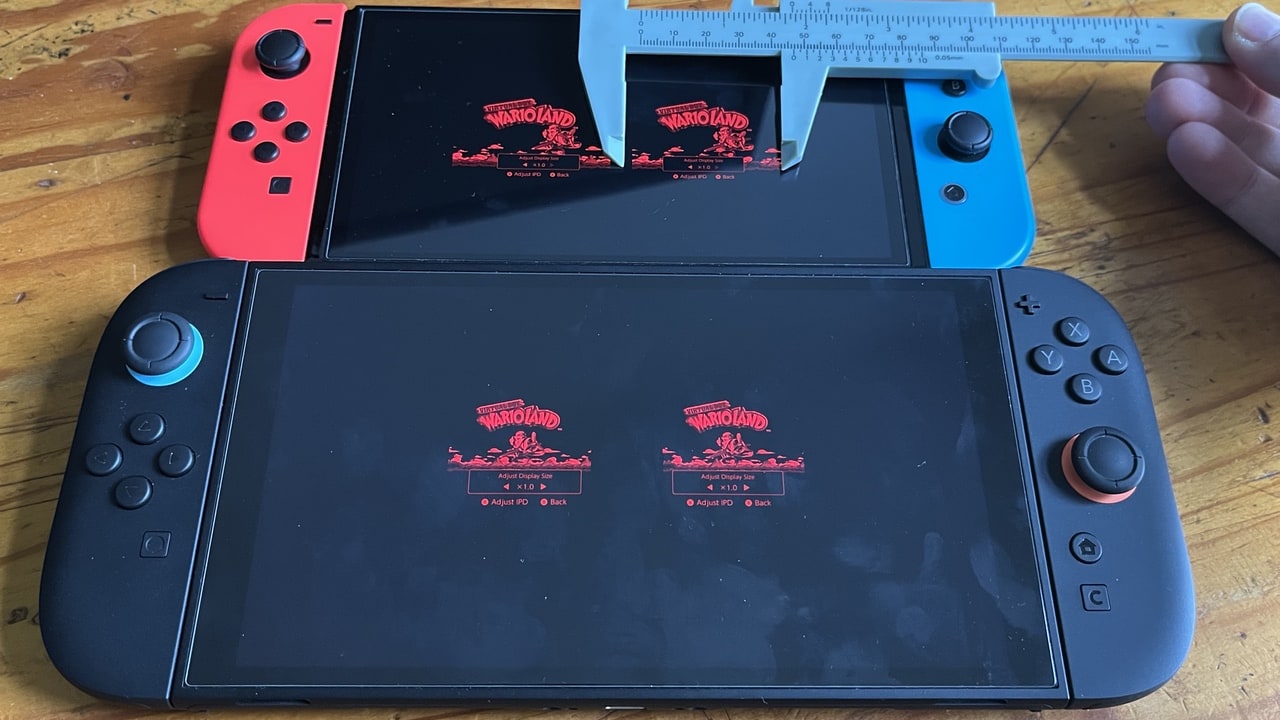
The Switch OLED renders the Virtual Boy much larger than on Switch 2.
It’s a big difference. The Switch 2 puts Wario Land into a 35mm wide postage stamp per eye, before passing through the lenses, while the Switch comes in at 41.5mm and the Switch OLED at 46.5mm. It’s a huge difference, and it makes the pixel grid much, much more visible. You can adjust the zoom within the emulation, to at least shrink the image size, if not the pixels on the Switch OLED – Switch 2, meanwhile, has a wider zoom range and can go up to 1.3x in size to effectively match the Switch OLED at 45mm. I’ve never used an original Virtual Boy, so cannot say what is most authentic, but I’d personally rather see more of the game view than less.
OLED does have its advantages, though, with the cardboard edition in mind. With an OLED panel, any pixel on the screen that’s not in use is off. It’s pitch black. Meanwhile, the backlights of the Switch 2 and Switch bleed through the black and make it a dark blue, to my eyes. The red lenses cut out all but the red light, helping to even the playing field with the plastic Virtual Boy, but the cardboard one doesn’t have the red filter, which can make the Switch OLED king in this scenario.
And so we come to the games. The game selection menu passes through the filter in an ominous red hue, but this is actually a bit of a lie, as it’s rendered in full colour by the console. The games themselves are all-red all of the time, though. Seven games are featured on day one, from 3D Tetris to Golf, Red Alarm, Teleroboxer, and the most noteworthy by far, Virtual Boy Wario Land.
Coming a year after his debut as a protagonist on the Game Boy, Virtual Boy Wario Land pioneered multi-plane platforming, with Wario able to use jump pads to bounce to parts of the world further away from the camera, and really pushed the number of parallax layers featured to give the environments its 3D depth. There’s smaller details too, like blocks having multiple layers to them, even little grassy fronds on the ground having a couple layers, giving added depth here, and the sprite scaling as things move in and out of the screen is really nicely done. Practically the first thing you encounter are spiked balls swinging towards your view, and it shows the smoothness of this.
Teleroboxer does a similarly good job with the boxing robots you fight having lots of layered sprites to create a canny 3D effect, and The Mansion of Innsmouth has the classic first person 3D dungeon crawling aesthetic as you move through corridors, while blasting monsters with an on-screen cursor. But for true 3D, you’ve really got to look to Red Alarm, a Star Fox style rail shooter with the world rendered in red wireframe – with just a single colour, this was probably the best path to take, but does mean you can see enemies through obstacles.
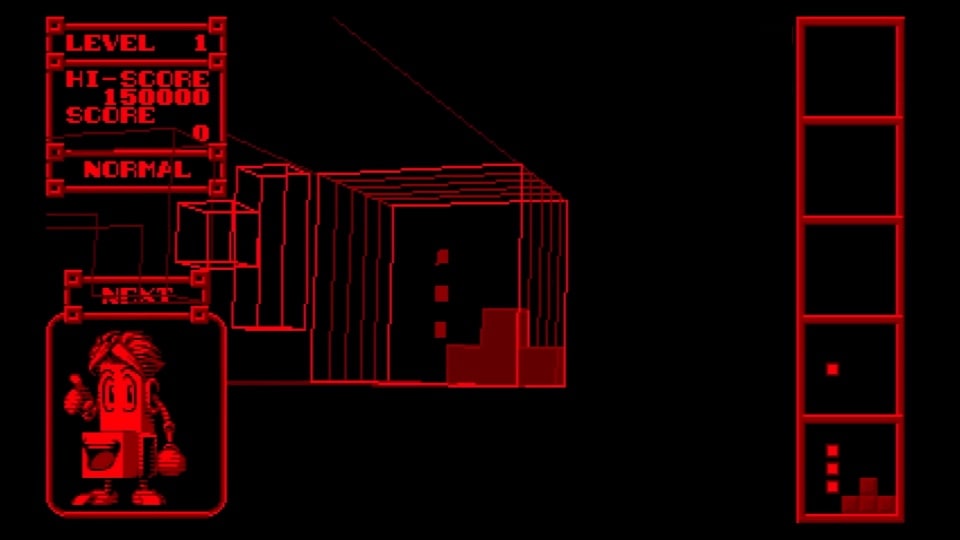
And then there’s 3D Tetris, which takes the notion of the block-dropping puzzle and makes it feel like Star Trek’s 3D chess. The classic tetromino shapes are put to one side, and you’re instead given other blocky assortments, layering them down on multiple flat layers. It can be tricky to make out how things are being placed with the shifting 3D view of the Tetris lasagna you’re making, and it’s odd to have split blocks to drop as well. Thankfully the right of your view has a simple 2D representation of the layers and where each block will land. It’s a bit of a cheat, but makes this more playable.
The main problem with the Virtual Boy’s game line up is that it never had the chance to mature. 1995 means that we were still getting experiences and ideas from the SNES or Game Boy, in part thanks to the single colour displays, and it was a time when sports games like Golf and Mario’s Tennis were… well, they were just fairly standard golf and tennis games. Neat to see, but not exactly ground-breaking.
All in all, the Virtual Boy for Nintendo Switch feels authentic (even if closer inspection does make it appear more toylike), and does a solid job of rendering the console’s small selection of games. It is a shame that, when this costs £67, Nintendo didn’t push on to remake the Virtual Boy controller, improve the ergonomics of using the headset, or even build in the ability to charge and play at the same time. That high price means that Virtual Boy will remain a retro curio for Switch owners and gaming history enthusiasts.