As Mozilla promised they would, Firefox version 148.0 has been released and with it you now get to control what generative AI features are enabled or disabled.
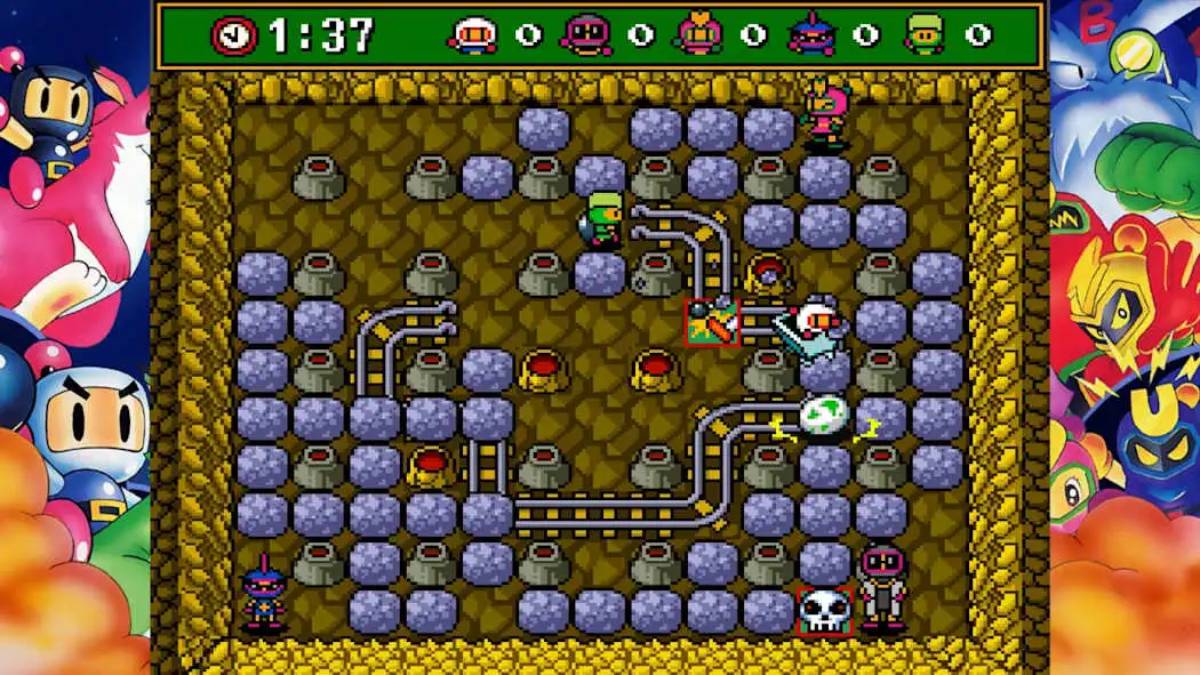
Recent shadowdrop release Super Bomberman Collection brings back some classic Bomberman games, some for the first time outside Japan, and we’re happy to see it! But if we’ve learned anything from modern retro compilations, the quality is extremely dependent on execution. So how does this one do?
The package contains the five Super Bomberman games, all originally released on the Super NES and Super Famicom, as well as two bonus Famicom games. The later Super titles didn’t originally release outside Japan and have received localizations here, which is a nice touch! Frankly, though, these are fairly language-agnostic games and you probably would have been fine.
Putting these five games together in one collection might feel a bit redundant! And it is, to a degree. The advantage is in two ways. The first? Historical value. The game makes it easy to look at what power-ups are added in each one, and preserving all five is good regardless. The second is that you can choose your favorite variant. Each of these changes does color the experience, and through either taste or nostalgia, you’ll likely have a favorite.
Image via Konami
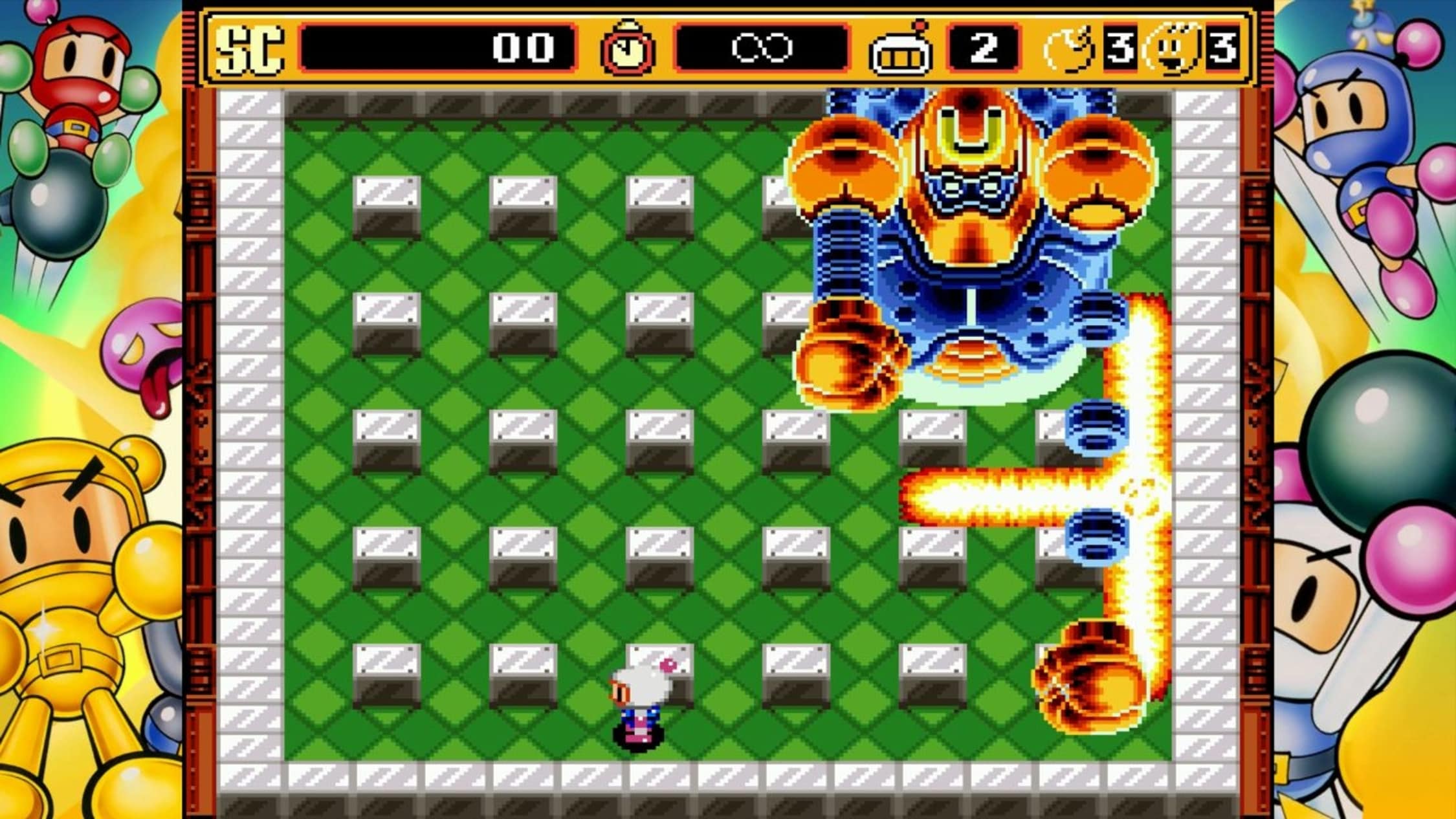
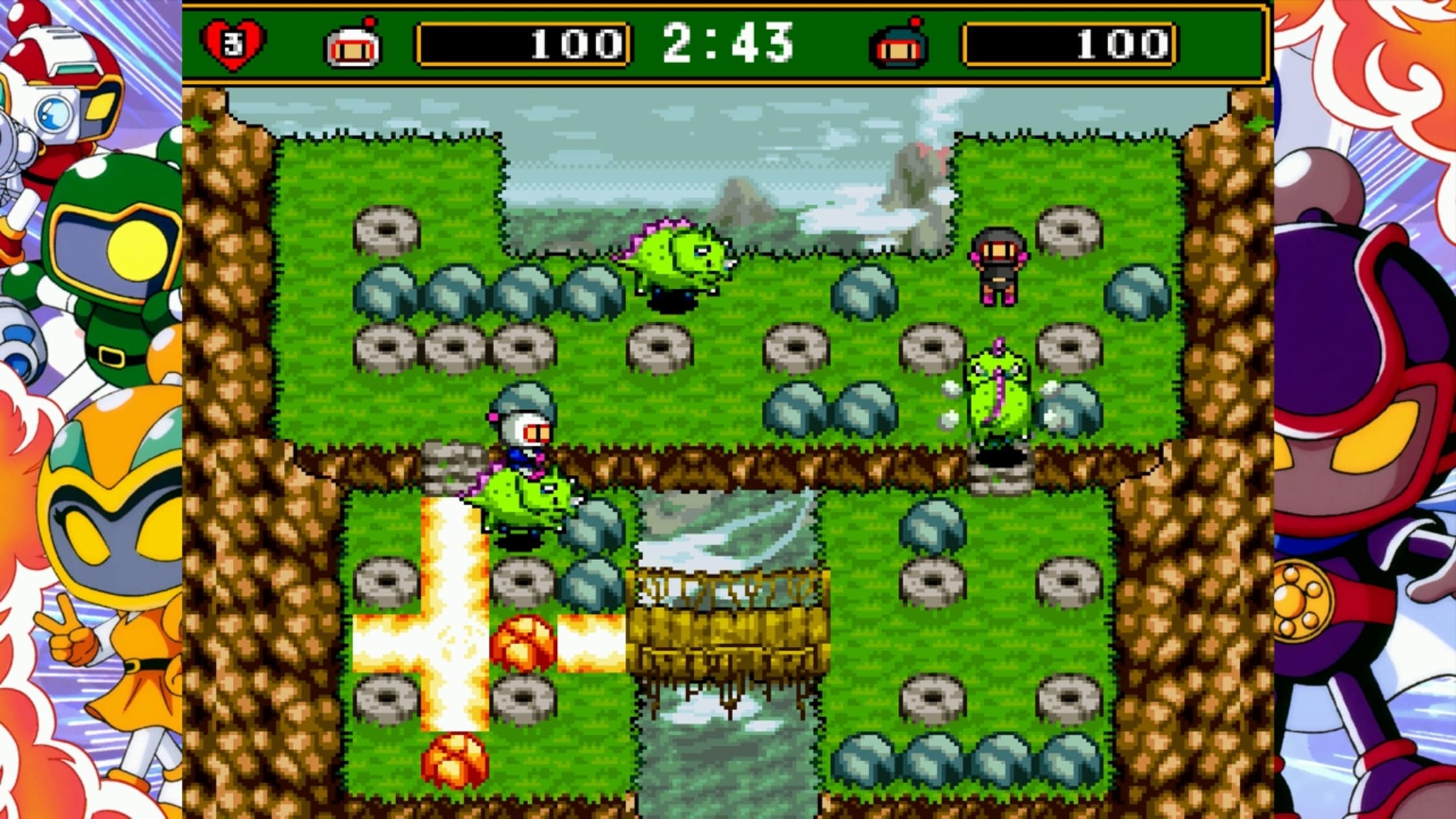
If you’re having trouble deciding, though? We’d recommend going straight to 5. It has almost all the things from the other games, and there are options to configure it however! And as such a late Super Famicom game that other staff at Hudson were probably already working on Mario Party during development, it really takes advantage of the hardware. If it drops the ball on anything? Maybe it’s aesthetics. It’s trying really hard to do a robot/sentai thing in a way that a lot of the selectable characters feel same-y.
It’s also true that each of these games has a solo campaign. The franchise’s bread and butter is its competitive play, but there’s a dedicated group of people who really embrace the single-player arcade levels. And these are good ones! We’ve spent a while playing, and we are undeniably bad at them but there’s a puzzly element to taking on risky opponents in an optimal order.
When it comes to gallery modes in retro compilations, our usual stance is that it’s a great effort of preservation! But we don’t spend a lot of time with that stuff. Super Bomberman Collection’s “unbox” mode feels a lot more robust, though. With the detail and ability to virtually open the box and pull out the manual, it captures a bit more of the nostalgia of the originals.
Image via Konami
While it doesn’t have built-in functionality for this sort of thing, Super Bomberman Collection takes advantage of system-level multiplayer features like Switch 2’s GameShare and Steam’s Remote Play Together. How well does it work? Better than you’d think! We spent our time testing it out on Switch 2, and didn’t experience any of the frequent connection issues we usually get. What’s more, it’s the sort of game that can weather some minor hiccups if you get them, and it also doesn’t look too bad in the windowed GameShare screen.
Super Bomberman Collection, developed by Red Art Games and published by Konami, is out now on Switch 2, Switch, PS5, Xbox Series and Steam. Physical editions of the game will launch on August 25, 2026.
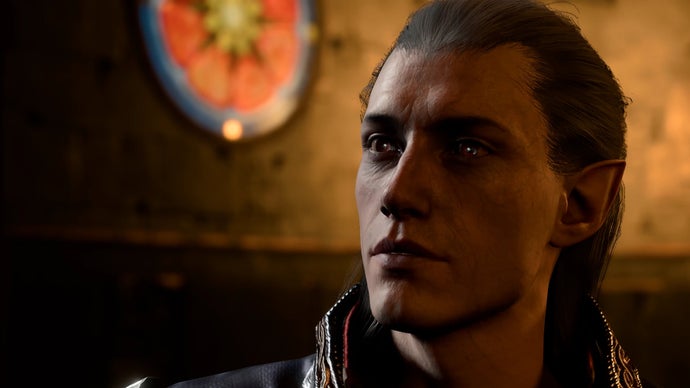
Another intriguing Baldur's Gate 3 custom campaign mod has emerged to confront your party of quirky RPG adventurers. This one's a short story which lets you take a break from BG3's main story to attend a dinner party at the house of a not-at-all creepy rich bloke, who happens to be very good at jamming out on the organ via illusions.
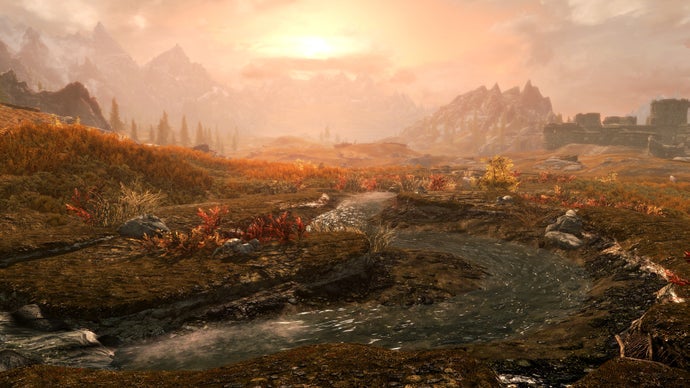
"I mean, look, I think everybody knows why we announced it that way then." Stay calm, I've got to get my dinner first. "We know some things we're doing." Please stop trying to jump on the bench. "It's going to be a while yet." Some of these are things I often have to say to my cat when the clock ticks to within an hour of feeding time. Some of them are things Todd Howard has said about The Elder Scrolls 6 in his latest bout of interview chatter about the RPG. He's confirmed it's running on a new version of the Creation Engine, but will also be a return to Bethesda's "classic style".
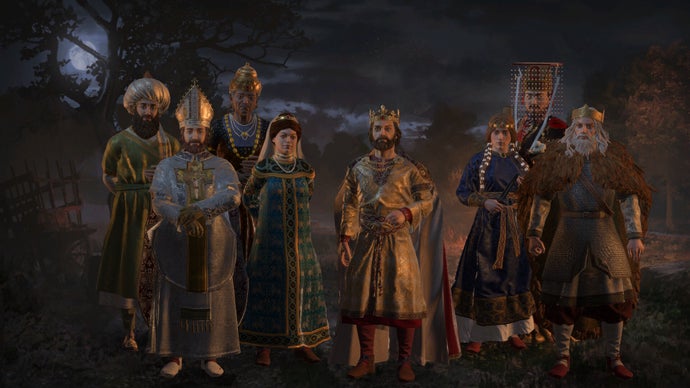
I wake up at 3AM. Do 50 pull-ups on a halberd wedged in the door frame. Do 50 push-ups on the cold stone floor. A servant hands me my protein mead and a wine frappamachiato. I violently double fist the two beverages. I don't eat breakfast, because food that isn't flavourless cup gruel is the enemy of productivity. Then, I'm dressed in my robes for the commute to the throne room. The magic starts. It's 5AM in Crusader Kings 3 and I'm on my medieval monarch grindset.
I pull out Paradox's latest dev diary. Oh, look at that, they're working with a mystery modder on bringing exactly the sort of big number tables to the strategy game that I need to tell at a glance whether I'm out-grinding my inbred wealth-creating cousins who rule other nations across the world.
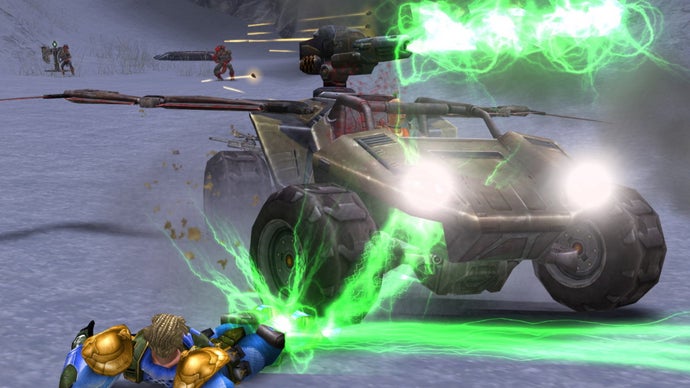
Well, this is cool. You can now download Unreal Tournament 2004 for free and with a patch that ensures it'll run smoothly on modern hardware. This is all thanks to a fan community called OldUnreal, who've made it their mission to keep Epic's classic shooters alive, even going as far as getting the Fortnite publishers' permission to do so.
While a lot of the Witchery chatter so far this year has been about an extra Witcher 3 DLC rumoured to be in the works, one of the projects we know for sure CD Projekt have on the go is a remake of the first Witcher game. Ahead of the remake's arrival, a key dev on the 2007 RPG has just finished a developer commentary run through it, which makes for a great way to pass some time between Witchery things.
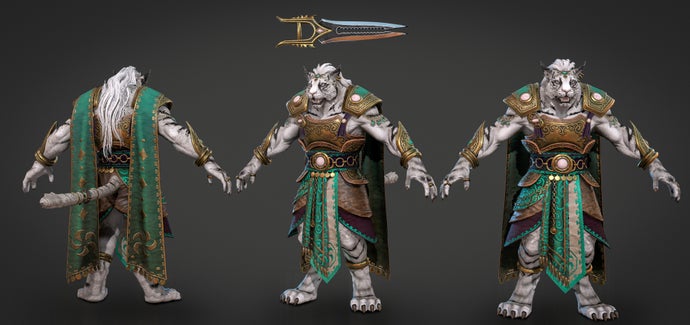
Creative Assembly have just detailed Total War: Warhammer 3’s first character pack, these being “smaller, focused content drops built around a single character with their own unique feature, supported by a handful of exciting new units”, priced (in this case) at £3.99, $4.99 or €4.99 apiece.
It's 1996. The weather's crap. You're wandering the streets of a Scottish village that looks deserted aside from some lumbering horrors who seem intent on sticking weird needles into you. No, this isn't the blurb of iconic film Trainspotting, it's the setup for Silent Hill: Townfall.
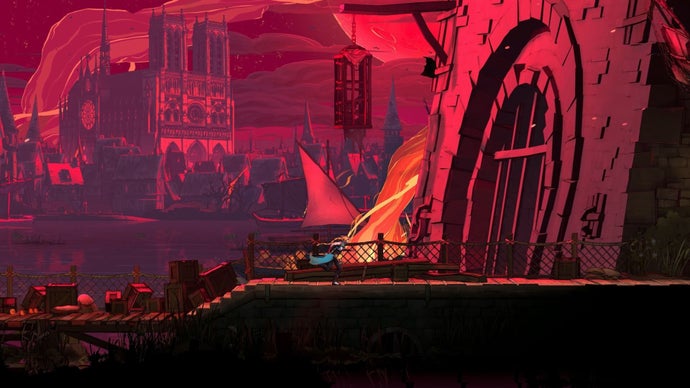
Sharpen your fangs and chuck out all of the garlic bread in your house, Castlevania's back with a new game co-developed by the folks who made roguelike-Metroidvania Dead Cells. Castlevania: Belmont's Curse is the name of this fresh bout of vampire whippage set in medieval Paris, which publishers Konami have teased is just the first of many Castlevania things they have coming as the series turns 40.
I hope you like warlocks. Well, if you're someone who regularly delves into Diablo, I hope you at the very least don't detest warlocks with all of your hellish heart. Because yesterday evening's Diablo 30th anniversary shindig was rather heavy on warlocks, with the class coming to not just Diablo 4's next expansion, but also Diablo 2 and Diablo Immortal. Meanwhile, Diablo 2: Resurrected has moseyed on over to Steam.
New York City Mayor Zohran Mamdani is facing criticism after it was revealed that the application to become an “emergency snow shoveler” for the city requires five forms of identification, far more than what is needed to vote. This has sparked a strong reaction, especially from conservatives, who see it as a contradiction given Mamdani’s ties to the Democratic Socialists of America (DSA), a group that strongly opposes voter ID laws.
According to Mediaite, the application on the NYC government website asks for two small photos, two “original forms of ID, plus copies,” and a Social Security card, adding up to five items. Those who are hired for the job can earn up to $28.71 per hour.
The DSA’s website states that their candidates “stand firm against racist voter ID laws and secret poll taxes like the ‘SAVE America Act,'” and that they educate “working-class voters about the needless complications in our electoral system.” This stance directly clashes with the extensive ID requirements for the snow shoveling job.
The backlash reflects a deeper and ongoing debate over voter ID laws in America
Conservative commentator Stephen L. Miller was among the first to point out the application’s demands on X, calling it “Incredible.” Many other users quickly joined in, mocking Mamdani for what they saw as hypocrisy.
Comic and host Jimmy Failla quipped, “This is Jim SNOW 2.0.” One user wrote, “No joke. To register to shovel snow in Mamdani’s NYC….for the impending snowstorm, you need two types of identification. Can’t make this up.” Others directly contrasted the shoveling ID rules with the lack of voter ID requirements in New York City.
The criticism came after Mamdani urged New Yorkers to show up at local sanitation garages to help ahead of an impending blizzard hitting the East Coast. He reportedly told people they just needed to bring the required paperwork to “get started right away.” While Mamdani received some praise for his storm response efforts during the blizzard, the ID requirement controversy quickly dominated the conversation.
The voter ID debate has gained wider attention recently, as President Trump and other Republicans have pushed for the SAVE Act, which would require proof of American citizenship to vote. Sen. Chuck Schumer criticized the act, saying it would “impose Jim Crow type laws.”
However, recent data suggests that most Americans, including a significant portion of Democrats, support voter ID requirements. This has made Mamdani’s snow shoveler ID policy an even bigger talking point, especially as the mayor continues to face scrutiny over the fiscal challenges he inherited in office.
Meta is making its biggest play yet in the political arena, launching what’s set to be its largest push to back political candidates in the company’s history. This significant move comes at a time when the social media giant is dealing with a lot of negative attention and some of its toughest legal challenges ever.
The company is kicking off a massive $65 million effort ahead of this year’s midterm elections, as reported by MS Now. The goal is to boost state politicians who are friendly to the artificial intelligence industry, with initial efforts focusing on Texas and Illinois. This is a record-breaking sum for Meta’s election investments.
Company representatives have indicated that this huge investment is fueled by worries over potential regulatory threats to the artificial intelligence industry. Meta is looking to fight back against legislation in various states that it fears could slow down or hinder AI development. It’s a pretty clear signal that they want to shape the future of AI without too much government interference.
What’s really interesting is that Meta isn’t picking sides; they’re backing both Democrats and Republicans
They’re using two different super PACs to do this. One group, called Forge the Future Project, is throwing its weight behind Republican candidates. The other, Making Our Tomorrow, is supporting Democrats. These new PACs are joining two others Meta already had, one of which focuses specifically on California, while the other is a broader organization that funds the company’s spending in other states.
For years, Meta and its CEO, Mark Zuckerberg, have shown support for President Donald Trump, who, in turn, has pushed to stop states from regulating companies that invest in artificial intelligence tools. So, in a way, what Meta is doing now with this spending spree feels a lot like the bold, almost oligarchic behavior we’ve seen from other tech leaders who use their financial power to influence midterm elections and the political system more generally.
NEWS:
Meta is about to start a $65 million midterms push — its biggest political effort in its 20 years in business.
Meta is standing up two super PACs that this week will drop money in races in Texas and Illinois to push A.I.
However, I think there’s a unique level of public frustration directed at Meta and its platforms right now. You can see it in the numerous lawsuits they’re facing and the public condemnations from former employees. In recent years, the company has had to navigate various scandals where its algorithm-based platforms have been accused of being used to undermine democracy, facilitate child predation, and even incite violence, including in the lead-up to January 6, 2021.
Meta is currently fighting multiple lawsuits, some of which could be landmark cases. These lawsuits accuse its executives of knowingly creating products with addictive qualities that have been particularly harmful to children. The company, for its part, has denied these claims. Beyond the legal battles, Meta is also looking to expand its number of data centers, those massive, resource-intensive facilities that have drawn significant criticism from communities across the nation.
With all of this in mind, Meta’s decision to back candidates this election cycle presents a pretty big question for voters. It makes you wonder whether, and to what extent, people will support a candidate who is financially backed by a company that operates some of the world’s most widely criticized platforms.
February is a time for lovers, a time for cuddling, and of course a time for Mabinogi players to take stock of their wings and whether or not they are enchanted optimally. That last one might not feel like it is quite traditional, but the quality-of-life patch that the game has just dropped adds a number of […]
Star Trek Online’s Chimerans prove to be more adaptive foes after this past week’s patch: “You will now see them gaining resistance to all damage types, once per damage type they receive.” Yeah, good luck with that you non-adapting space captains! And this is just the beginning of the rest of the news! Read on for a […]
Pantheon: Rise of the Fallen has been using several weeks to post blogs, lore, and design previews of its update due in February, but none of them provided a release date beyond… well, February. As of the MMORPG’s most recent post, we now have a release window of sometime next week as it goes through internal testing, […]
For many years now, we (or one of our writers, if we’re being honest) have noted that Final Fantasy XI has been mostly treating its annual holidays by turning on familiar events and letting players enjoy them. This is true, as the game is mature and has plenty of events as it is. But the Doll […]
Thinking about No Man’s Sky beings images of flight, space, and starships. So when Massively OP’s MJ learned that the new expedition was based on the ground — and only the ground — she was intrigued. It turns out that for this one, the task is to clean up a planet. Now that’s something MJ […]
Yes, we’ve got news from a Star Wars Galaxies emulator that isn’t SWGL for you all today. This time we’re highlighting Star Wars Galaxies Restoration III, the mashup CU/NGE variant that had a 1.0 release in 2022, which is preparing to launch its new Shatterpoint major content update for the classsic sandbox. “Shatterpoint introduces unique content and mechanics, turning […]
You would think that adding an all-new class to an old game like Diablo II: Resurrected would be a happy event, but then you also likely have never experienced ARPG players in public forums and subreddits, who primarily appear to be the angriest of human calculators. That appears to be the case among players of the game, […]