The Daily Grind: Have you ever played a 2-D MMO?
21. Únor 2026 v 14:00


Welcome to SUPERJUMP's annual Games of the Year celebration.As always, I like to introduce these awards by expressing gratitude for the year gone by.
Thank you game developers.
You are creating marvels of art and science - important cultural artifacts - under increasingly difficult circumstances. Whether you work for a large studio or you're a solo developer: thank you. We continue to live in an increasingly turbulent and intolerant world; your creative talents not only give many of us a brief escape from this reality, but importantly, you remind us of the importance of human creativity and connection.
Thank you SUPERJUMP team.
It is truly the honour of my life to work with so many extremely talented people who, aside from being brilliant creative minds, are also truly outstanding human beings. Our organisation is fuelled by talent, passion, and love: love for video games, love for the people who make them, and love for each other as friends and colleagues.
Thank you special guests.
We are joined every year by special guests from across the games industry - whether game development/publishing or media - who give up their time to craft GOTY reflections to share with our audience.
Thank you to our Backers.
Our ability to create that authors' coop environment is heavily influenced by our incredible Backers. Thanks to you, we are able to pay authors every single month. And thanks to you, we have avoided any need to gate our work behind pesky paywalls. On behalf of the entire team, I want to thank you for believing in us and supporting our hard work.
Thank you to our Editors.
Without our brilliant Editors, I couldn't keep this publication humming so smoothly. They also contribute an enormous amount of their time to edit this unbelievably large Games of the Year feature every single year. Thank you to Bryan, Rachel, Briana, and Cat. You are true superstars!
Finally, I'd like to make one final point, just in case there is any doubt: at SUPERJUMP, we believe video games are for everyone. Everyone. Everybody deserves dignity, respect, and - above all - safety. No exceptions. Nobody left behind.
And now, on with the show. Please enjoy this extraordinary and comprehensive celebration of 2025's best video games. And if you like what we're doing, how about buying us a coffee?
James Burns
Founder and Editor in Chief
We have very deliberately titled this feature 2025 Games of the Year. The plural matters. As per our tradition, SUPERJUMP does not award an overall “Game of the Year” trophy to any single game.
Rather, each contributor can select up to three of their favourite games released in 2025 to discuss. Naturally, some games have more contributions than others (so, if you like, you could deduce a “winner” on that basis).
In order for a game to be considered for this piece, it must have been released in 2025. This is a slightly rubbery criterion that also includes:
This is our fifth Games of the Year feature, and as has become tradition, we've invited several special guests to join us. As always, our guests are people we love and admire from around the games industry. We're honoured that they took the time to join us in celebrating the best games of 2025.
Daryl Baxter is a writer, author, and podcaster. He is the author of three books (The Making of Tomb Raider, 50 Years of Boss Fights, and The Making of Tomb Raider: 1997 - 2000), and is a prolific tech and gaming journalist.
Naomi Jackson is a video editor and online presenter/community builder. In addition to editing national and international stories for the ABC Australia network desk, Naomi is a producer/podcast host at SIFTER and a video editor here at SUPERJUMP.
James O'Connor is a multi-award-winning author and narrative designer. His contributions to video game journalism are extensive (including a wide range of print publications from Edge and Hyper to IGN, GameSpot, and Game Informer among many others). James has also contributed to multiple video games as script editor, narrative lead, and narrative designer (including Power Rangers Mighty Force, Ava's Manor, and Kulebra and the Souls of Limbo). James' latest book project is about the making of Untitled Goose Game (check it out here).
Amy Potter-Jarman is the Director of Marketing at Synty Studios. She is the creative force behind Frosty Games Fest (a digital showcase of games made in Australia and Aotearoa, NZ), buzzbang.co (a boutique marketing service supporting ANZ indie game makers), and Pixel Explorers Club (a digital community for curious, short indie game lovers).
Nate Shearer is a video game journalist. He is a regular contributor to Qualbert (specialising in a wide range of game reviews) and NextPlay (crafting diverse stories from news and interviews to reviews and special features).
Jörg Tittel is a director, writer, producer, and publisher working across video games and film. He is the Founder and Creative Director of RapidEyeMovers, the studio behind the Golden Joystick-nominated C-Smash VRS. He is also the creative mind behind The Last Worker, and Skew.
Presented in alphabetical order (this is not a ranking).
"9 Kings isn’t merely a good example of a burgeoning sub-genre —it’s something much closer to Slay the Spire, pushing out into brand new territory."
By Sad Socket
On a personal level, I’ll say this about 9 Kings: This is the first time I've followed a game throughout its Early Access period, putting each individual update through its paces. It was worth the effort.
9 Kings is a simple concept at heart, but one that provides a diverse wealth of content. With its hour-long, city builder meets turn-based tactics mechanics, it’s a game riding the quick strategy trend. However, while most of those games are rigidly recreating 4X gameplay in a smaller package, 9 Kings offers a gameplay loop designed from the ground up with the busy strategy fan in mind. As such, it outmaneuvers its competition and stands out by a clear mile.
9 Kings isn’t merely a good example of a burgeoning sub-genre —it’s something much closer to Slay the Spire, pushing out into brand new territory. It’s an ever-evolving game full of little surprises and details, and a must-have for anyone with an interest in strategy.
"The game's sense of grief feels very real, and its cartoony rendering of Jakarta is lovely."
By Pikselnesia
I've decided to use my submissions in this list to point towards some games that have, in my mind, been underrepresented on end-of-year round-up lists, and Afterlove EP is a game that I have a deep fondness for. It follows a young man, Rama, who lost his girlfriend Cinta a year ago.
As the game opens, he starts to figure out how to pick up the pieces of his life and carry on. He needs to reunite with his band, attend therapy sessions, and decide whether or not he's ready to date again. How the game ends will depend on your actions and choices. It's a lovely and heartfelt experience that was created in the wake of the team's own loss: creative director Mohammad Fahmi died in the middle of development.
The game's sense of grief feels very real, and its cartoony rendering of Jakarta is lovely. It's not a perfectly tight experience, but in some ways that makes it more endearing.
"But for what it's worth, I feel like I'm part of an active, living community, something I haven't felt since Elden Ring."
I know my populist choice for 2025 GOTY might send me straight into SUPERJUMP's purgatory (where game writers like myself are strapped in for the video game equivalent of Clockwork Orange's chair sequence, with footage of Indie Game: The Movie beamed right into our retinas), but I have to go for Arc Raiders, AI-related discourse be damned.
This is an extraction shooter that has my favorite bits of Hunt: Showdown, including sound design, that crunchy gun feeling, and an infinite pool of adrenaline. It shares the post-apocalyptic horror/tension of The Last of Us (played out in real-time, no script!), with enough No Country for Old Men bullets-whizzing-past-your-head moments (while being chased for dear life) to sustain Coen-heads like myself through this cold winter.
However, no matter how good the mechanics and those ray-traced sunsets in Buried City are, the real star of Arc Raiders is the proximity chat. You can talk your way out of being turned into Swiss cheese or thank a random stranger for deciding to revive you after shooting you from a mile away (and turning you into their pet monkey). You can trash-talk a team of three when being cornered while knowing the chances of survival are Prosciutto-slice slim.
Listen, I played a lot of great games in 2025 – Silksong, Total Chaos, Clair Obscur, Baby Steps – but none of them felt as refreshing as this cyberpunk-dystopian extraction shooter where people either team up against deadly robots or shoot each other Wild West style for a lemon or two and a dog leash. Sure, Arc Raiders doesn't exactly shovel a great deal of matter into the tube marked "Evidence for Video Games’ Potential as capital-A art." But for what it's worth, I feel like I'm part of an active, living community, something I haven't felt since Elden Ring. And for that alone, this game gets my GOTY lemon.
"And Roger is an unmissable example of the power of video games."
One thing about me is I love a one-sitting game experience. This is a game I strongly believe is best played with as little prior knowledge as possible, so I will keep this brief. If you’re interested in an emotionally resonant game, with a beautiful two-tone, hand-drawn aesthetic, that packs an enormous narrative punch into its short 1 hour runtime, And Roger is an unmissable example of the power of video games.
"The dialogue and sound are hilarious - it’s all so wonderfully cruel and strangely affecting - there’s simply no other game like it..."
by Bennett Foddy, Gabe Cuzzillo, and Maxi Boch
Developed by indie greats Bennett Foddy (QWOP, Getting Over It) Gabe Cuzzillo (Ape Out) and friends, I like to describe Baby Steps as Daft Stranding.
In this game, all you have to do is control a hapless loser’s legs and feet and make it up a sprawling mountain full of increasingly insane challenges.
The dialogue and sound are hilarious - it’s all so wonderfully cruel and strangely affecting - there’s simply no other game like it and the less I spoil here, the better.
Just keep on your pajamas and clamber.
"I became absolutely addicted..."
By LocalThunk
Though the game came out in 2024, the community has absolutely exploded in 2025, unveiling collaborations with other popular titles like Don't Starve, Among Us, Stardew Valley, and even The Witcher 3! I became absolutely addicted; I now have the game on three different platforms, and I wouldn't have it any other way.
"BallisticNG feels like both a love letter and a fully realised game in its own right."
By Neognosis
In 2025, BallisticNG finally hit “feature complete” with its last major update, version 1.4. The update delivered a rebuilt physics mode, new ships and tracks, refreshed menus and UI, plus a stack of quality-of-life improvements including stronger modding tools and plenty of under-the-hood polish. More importantly, it marked the game’s final form and cemented it as one of 2025’s standout indies.
Boiled down, BallisticNG is the closest thing we have to a modern re-imagining of the classic PS1-era Wipeout series. It’s an anti-gravity racer that understands what made those original games so special: bold iconography, angular ship design, ridiculous speed, intense combat, razor-thin racing lines, and super satisfying airbrakes that let you carve through twisting hairpins and chicanes.
I still love Wipeout 3: Special Edition on the PS1, and I’ll drop back in anytime I need that hit of nostalgia and adrenaline. BallisticNG is the modern, fan-made follow-up to those late-90s classics that defined the genre. It nails the floaty rhythm that feels like surfing on magnets, where every mistake gets punished and you’ll lap a track so many times your left thumb starts to hurt.
First released in 2018 and refined over the past seven years, there’s a huge amount of accumulated content on offer too. Most ridiculous is the sheer number of tracks, with the quality matching the quantity. They’re gorgeous and varied, packed with smart lines, cheeky shortcuts and weapon placement that keeps every lap feeling fresh.
And when the speed classes get truly unhinged, the game stays smooth and responsive, letting you lock into the music and hit that tunnel-vision flow state. With the 2025 update putting the final polish on the whole package, BallisticNG feels like both a love letter and a fully realised game in its own right. It is easily one of this year’s best racers.
"The game is a nesting doll of mysteries. You think you figure things out, at first, and then something surprises you on the next run."
By Dogubomb
The subtle double meaning behind the name of this game captures its charm perfectly. In 2025 this game had me intrigued, entranced and utterly, hopelessly absorbed.
The simple controls, muted colours and faint, elegant music rightfully allow Blue Prince's spectacular story to take precedence as the mystery of Mt Holly and its previous inhabitants worms its way into my brain where it re-emerges long after I step away, beckoning me back to explore its halls once more.
After raving about this incredible puzzle game I was reviewing early last year, I somehow managed to convince my partner to play it. After sitting down next to her and talking her through the basics of the game, I went completely hands off, not wanting to spoil the experience. It was magical to see the things that sparked so much joy in me a month prior were also beginning to electrify her mind in the same exact way.
The game is so subtly moreish and well designed that I don’t share a love of video games with Chloe, so to see her get home from work each day and practically jump right back into my world was so important to me. For weeks on end, I got to share the thing I love most in the world with the person I love most in the world. Blue Prince was my GOTY for 2025 not only because of what the game was, but what it gave me.
I used to love puzzle game growing up. Nancy Drew was my go-to, and recently I've taken a keener interest in low-key games that I can play in a few sessions or generally just pick up and put down.
Blue Prince is not that game. I found myself up far too late or playing for far too many hours trying to unlock all of the mysteries of the darned maze-like manor house.
Blue Prince does not, typically, test my patience, as some puzzle games might (and certainly have). It is curious enough in its slipping of secrets to you that I felt like a cat pawing at a new toy. All I wanted to do was figure it out. I've taken a great deal longer to do that than expected, because my tendency to rush the game meant I didn't linger in its many rooms or search for any deeper clues; but as I played, I realized I had to play more thoughtfully.
The game is a nesting doll of mysteries. You think you figure things out, at first, and then something surprises you on the next run. It is a rogue-like, a genre I've only really experienced through Hades, but it is delightfully different in how "just one more" feels too much like I'm in a gambling house.
The number of times I'd say that to myself – "just one more day" – and I'd inevitably wind up playing through 4 more. Each new potential door feels like it might be the one you need, and I don't know how it manages it, but Blue Prince's randomization mechanics and execution of item dispersal and acquisition (being that they reset everyday) makes it more compelling to play.
"Clair Obscur is, to put it simply, a very important game."
Enough will be said about this game this year by many people, but it really is that fantastic. I'm usually story-aspected when it comes to games, but Clair Obscur's gameplay was one of the reasons I kept coming back. The entire system of timing parries, dodges, and jumps combined elements of action and turn-based gameplay that I, personally, hadn't seen before. I'm often lazy when it comes to games that require "grinding", something I tend to more so associate with turn-based RPGs, but Clair's combat cycle and enemy variation make its battles addictively repayable.
Clair Obscur excels, likewise, in its art direction; its expansive world and general commitment to its core aesthetics create a beautiful, cohesive visual narrative that really is unlike anything out today. Maybe Bioshock? It fills rich, florid environments with sketchpad creations against a haunting backdrop of pseudo-Victorian/Regency iconography. It is breathlessly artful throughout the entire run. There are some levels, such as the musical desert of Sirene, that are so achingly lovely I spent the entire time immersed in the music and the setting to the point of not wanting to progress past it. Sirene, siren: it certainly became its name.
The story, usually my make-or-break when it comes to enjoyment of a game, is lovingly melancholic. The color scheme betrays its mood – dark black, bright gold, deep red – and we are left to start the game on an opening scene that treats tragedy as a surety, nonetheless worth celebration. We play in the beginning as a character – however briefly, just a walk down a crowded, flower-strewn street – who is dead by the end of its opening scene. Clair Obscur is, to put it simply, a very important game.
"Since finishing it, I’ve found myself enjoying this hobby of gaming again."
by Jenny Jiao Hsia, AP Thomson, Jie En Lee, Violet W-P, Ken "coda" Snyder
Finishing Consume Me has been one of the most important gaming experiences I’ve had in a long time. Outside of the game’s clever, gamified design of everyday tasks and quirky art, I fell in love with the message of Consume Me. As someone that constantly puts too much on their plate, the game’s depictions of anxiety, societal pressures, and growing into oneself resonated with me on such a deep level.
Consume Me made me introspect more than I had done with any other piece of media last year, smacking me in the face with an ending that had me pondering the futility of stretching myself thin to the point of collapse. Since finishing it, I’ve found myself enjoying this hobby of gaming again. When I find myself beginning to slip, I know I can always revisit that tear-welling ending and reground myself.
"I adore the gorgeous 2D animation."
By Team Ficus
It was a delight to play Contract Rush DX this year. You get the joy of a shooting game with a fun story and boss battles that keep you on your toes. Or on the ledge, depending on which contract you have decided to complete. I do wonder how we can be discreet when at least one target has a huge ceremony to attend on television. But discreet we have to be, or our characters don't get paid.
Contract Rush's premise is simple. Times are hard; how do you pay bills when the coffee shop has so few customers? Simple: you assassinate! Use coffee and other cafe items to keep you energized. And you'll need the firepower – portals to hell open up at the wrong time, or you might fail to get the right power-up just when the boss has appeared. Time to load up, hope for the best, and try again if needed. Just watch out for monsters and unwanted witnesses.
Contract Rush DX makes sure to balance a high difficulty level with plenty of alternative strategies and ample ways to practice in the tutorial. It helps that you get multiple lives and checkpoints, so you don't have to go all the way back to the beginning each time a bad fall ends in spikes. Not being penalized makes a huge difference in the fun factor of the play experience.
I adore the gorgeous 2D animation. The game is hand-drawn, and the developers show a unique style that lends well to the gameplay. I fell in love with this world - even through the tutorial level - which decides to get demonic while showing us the ropes.
"Death Stranding 2 asserts its divisive and impressive storytelling regiment, reminding us that creativity is still possible in gaming's most expensive spaces."
There was a particular moment in Death Stranding 2, as I directed Sam Porter Bridges up a slope in Mexico. The overlarge moon was hanging like a luminescent disc over my destination, my sight artistically directed toward an unfamiliar bunker perched at the top of the ridge. The star-speckled sky oppressed the mountain ridge while Dancing Ghosts by Hania Rani played, and I thought, 'I'm home again.'
Death Stranding 2 accomplished what often seems artistically and mechanically impossible: Death Stranding is an incomparable experience, and somehow the sequel feels both immediately familiar and foreign, a tribute to both technical and creative expertise. Between the forest fires and the monorails and the endless trek through Australia, Death Stranding 2 asserts its divisive and impressive storytelling regiment, reminding us that creativity is still possible in gaming's most expensive spaces. Death Stranding, as a series, continues to not only be an outlet for Kojima's self-indulgence, but irrefutable proof that creative design and cohesive team-oriented development create spectacular experiences that cannot be replicated in any other form of media. Keep on keepin' on.
I never understood the first Death Stranding, despite it being a perfect fit during COVID, due to its delivery system and isolation. But with On the Beach, Kojima sprinkled some action into the mix, complete with a bunch of MGS references, especially at the end. Having become a dad in 2023, several moments hit me hard, which made me understand Sam Porter Bridges' motivations far more than the previous game. It's also a great showcase of the PS5's power, with fantastic landscapes and moments.
Why aren't more big budget games set in Australia? Sure, Death Stranding 2 isn't exactly an accurate depiction of my home country (although to be fair, it's set in a post-apocalyptic future, so it's not attempting any contemporary accuracy), but nevertheless, I think it does capture something about what makes this continent so magical and unique. From the vivid red soil of the outback to the strange liminality of massive pieces of infrastructure ferrying industrial cargo through empty deserts; there's something truly awe-inspiring about Death Stranding 2's depiction of Australia.
But even more importantly - and as Brandon said above - Death Stranding 2 really accomplishes something I didn't think possible: it brings back so many loveable elements from the first game while still ambitiously crafting its own identity that is truly compelling on its own terms. Yes, the emphasis has shifted: Death Stranding 2 assumes you've played the first game, resulting in a gameplay baseline that provides a platform for further expansion. This means there's less emphasis on finding your footing from moment to moment. Now you're delving into far more complex logistics management with much larger payloads and a significantly greater inclusion of combat (which feels so engaging and rewarding in and of itself).
In a world so focused on nostalgia, sequels, and risk aversion, Death Stranding 2 feels like something that really shouldn't exist in the current era (a big budget experience that is unapologetically weird on almost every level and doesn't rely on frequent callbacks from decades ago). But I'm so very glad it does exist. The art form of video games is all the better thanks to this series.
"I finished the game and immediately wanted to dive in again and see how my choices might play out differently for every character, which really made Dispatch a standout of the year for me."
By AdHoc Studio
This game reminded me how much I love the interactive narrative genre, as a worthy spiritual successor to the Telltale Games.
Half the game is dialogue-led story, and half is management style gameplay where you’re assigning a team of superhero misfits to a variety of jobs across an LA-like city. I found myself equally invested in the narrative cut scenes as I was in the management gameplay. I can’t believe how invested I was in playing what was ultimately call center work, but I really had a blast clocking gleefully in for each episode and learning the quirks of each character. And what a cast of ethically questionable super hero characters they are, thanks to the brilliant writing and incredible voice acting!
I’ve been burned by “choices matter” games in the past where decisions that should have been impactful were made to feel inconsequential, and vice versa. But in Dispatch I truly felt like I was building my own version of the protagonist. My choices were clearly played out in crucial narrative arcs, but also in minor interactions. I finished the game and immediately wanted to dive in again and see how my choices might play out differently for every character, which really made Dispatch a standout of the year for me.
As someone who loves games with branching stories that provide choices which can affect your relationships with other characters, I was cautiously optimistic about Dispatch. While I was confident in AdHoc Studio based on their seasoned pedigree, where many of the developers used to work at Telltale, I didn’t know what to expect from the story and gameplay. The idea of a superhero workplace comedy was intriguing to me, even though I wasn’t sure how I felt about the management-sim mechanics, where you choose which hero can compete a given task, like saving people's life's from a natural disaster or stopping a villain.
I was genuinely surprised by how much I enjoyed playing through Dispatch. It even ran well on my Steam Deck with no issues. This game had some of the funniest dialogue that I have heard in a video game, which made me burst out laughing multiple times. The voice cast was outstanding, with each performer given the chance to shine through compelling delivery. Playing as Robert, a disgraced superhero who had to manage a team of former supervillains, was interesting to see. Many of the choices I made felt like I was bonding with my team, as they became friends in my eyes, while I tried to steer them toward heroism and having fun with them as well.
While I have yet to replay Dispatch, I can’t wait to start a new playthrough and see what new decisions I make that could get me to a new ending.
"If you haven't played Donkey Kong Bananza and you have even a passing interest in 3D platformers, you are absolutely missing out. It's a must-play experience."
By Nintendo
As much as I love me some nostalgia, I'm a firm believer that we're currently living through Nintendo's most bold and creative era. The Switch/Switch 2 period has been remarkable in terms of Nintendo's willingness to innovate and push its core franchises much further than ever before.
Donkey Kong Bananza is the latest - and perhaps the best - example of Nintendo's unflinching boldness at the moment. Although nowhere near as commercially successful as Mario in the modern era, Donkey Kong remains Nintendo's original breakout mascot. And with Donkey Kong Bananza, Nintendo didn't just give him a shiny 2020s facelift; they cast aside much of his gameplay history in order to unleash entirely new possibilities. The result is an experience that doesn't feel like an iteration on past Donkey Kong games. It is, rather, a surprising and clever new 3D platformer that dramatically reinterprets the entire genre. Its simple core premise (the ability to almost completely destroy entire levels with DK's fists) is the anchor for an array of cohesive and lovingly-crafted systems that intuitively stack on top of each other in ways that will keep a smile permanently plastered on your face.
If you haven't played Donkey Kong Bananza and you have even a passing interest in 3D platformers, you are absolutely missing out. It's a must-play experience. Donkey Kong - and Pauline in her vibrant and loveable new form - is far from a call to nostalgia here. These characters are now, again, ambassadors of the truly cutting edge as befits their legendary status.
"Flaws aside, Doom: The Dark Ages’ combat experiment largely succeeds, with the defensive shield confidently rewriting the rules of engagement in a 30-year-old franchise."
By id Software
This year’s Doom keeps its kills bloody and its firearms ultra-violent. While rapid movement has been a pillar of its predecessors, there’s a different rhythm at play in Doom: The Dark Ages.
One key addition shifts its pacing: the Shield Saw. While Doom: Eternal had you evade enemy projectiles, you now block and parry them. The shield isn’t just a defensive tool; you can throw it to pin large enemies or tear through small ones.
A shield slam lets aggressive players zip toward enemies at incredible speeds. At this distance, crunchy melee weapons tempt you to go Whac-A-Mole on some poor demons. The slower combat loop works remarkably well in The Dark Ages’ larger battlegrounds, which are packed with environmental puzzles and high-density hordes.
Having a shield means you’re pelted with even more bullets, but with a well-timed parry, green projectiles are returned to their senders. Parrying in quick succession felt like boxing bouts more than cross-dimensional demon hunting.
Stepping out of combat is when The Dark Ages’ power fantasy cracks. Tame fistfights with a 30-foot-tall mech and hovering on a dragon to dodge fire from stationary turrets made for dull digressions. Flaws aside, Doom: The Dark Ages’ combat experiment largely succeeds, with the defensive shield confidently rewriting the rules of engagement in a 30-year-old franchise.
"Gaming studios should be reminded that interesting multiplayer experiences can continue to happen, should companies be brave enough to create something new."
Multiplayer gaming experiences feel fewer and farther between these days for gamers who are not interested in firing a motley of guns or building temporary structures. While FromSoftware has proven itself again and again, there was momentary doubt that the Elden Ring format could be so easily transferred over to a multiplayer, rogue-lite experience.
Endless hiccups and continual updates have marginally improved an experience that, while flawed, has become more than a bonding ritual for my siblings and I throughout 2025. Frustrating, difficult, and sometimes confusing, Nightreign might be a strange pick for Game of the Year, but after spending 200 hours in the game and playing it nearly every evening for months, the ritual has grown into something precious, the sort of experience that we have been woefully unable to find for nearly a decade. Gaming studios should be reminded that interesting multiplayer experiences can continue to happen, should companies be brave enough to create something new.
What do we think? Just one more run?
"There are a lot of games built on good and evil, but not many on naughtiness in the way Expelled! is. It's a real delight."
There is perhaps no cooler narrative game studio than Inkle – in terms of both the games they make and the tools they've made available so that other people can also create narrative games. Expelled! is both a continuation and expansion of their previous "Overboard" concept, a reverse who-dunnit where each play session is focused on shifting blame and hiding your actions. It has a series of wicked, extremely fun twists hidden within, and the clockwork nature of the world they've built is truly a joy to poke at. There are a lot of games built on good and evil, but not many on naughtiness in the way Expelled! is. It's a real delight.
"The performances delivered within are continuously impressive, and made me feel like I was experiencing this well-trodden road for the first time again."
By Square Enix
Does a thirty-year-old game deserve a spot on anyone's Game of the Year list? After seeing Final Fantasy Tactics make NPR's list of best games in 2025, it cemented for me what FFT has been for decades: the defining game of its genre.
It would be somewhat strange in any other genre for one game to completely dominate and dictate the good and bad for three decades, but Final Fantasy Tactics has continued to do just that, and with the many impeccable quality of life updates brought upon by the Ivalice Chronicles, it will be the defining version of the game from here on out. Not only is FFT: TIC responsible for bringing new players to this immaculate role-playing game, but it has again reminded gamers young and old that the life of a game is not beholden to launch cycles and updates and popularity contests. Final Fantasy Tactics has something to say, and as Yasumi Matsuno reminded us: "The will to resist is in our hands."
I imagine there existed a rather large club of Final Fantasy fans who trudged through less-than-ideal ways to play Final Fantasy Tactics over the years simply because we love that game. Playing it on an original PlayStation is great, but its aged complexion becomes noticeable, as we’ve grown accustomed to certain quality-of-life standards over time. The mobile version is fine. It works, it’s portable, but my hands and eyes would ache. It works well on a PlayStation 1 emulator, allowing for save states and the ability to fast-forward, but still, a void lingered.
Enter Final Fantasy Tactics: The Ivalice Chronicles, its final Pokemon-esque evolution. The wait was worth it. This game, existing somewhere between a remaster and remake, is just SO damn good. Within its hearty stew of improvements, one ingredient rises to the top: the addition of voice acting. This new creative avenue adds incredible depth to every character, and thus enhances the game's overall storytelling. All the voice actors absolutely crushed their performances. I’ve played FFT a dozen or more times over the years, but only now do I find myself reevaluating characters, including ones I previously wrote off as one-dimensional assholes. I can even empathize with their positions, and more deeply care about characters that I felt were ancillary to the story.
I could sing the praises of the many other improvements all day. It all blends together to create an experience that feels and plays great. Yet I cannot say enough about the voice acting. So many elements contribute towards a game’s narrative design, and the original Final Fantasy Tactics already did a wonderful job with what it had. The performances delivered within are continuously impressive, and made me feel like I was experiencing this well-trodden road for the first time again.
"I love everything I’ve played from Supergiant Games. You can feel their dedication, passion, and joy for the craft come through in their games."
Back in the original Hades days, I thoroughly devoured every bit of content the game had to offer. Months later I started anew and did it all over again. I wanted more Hades, even though it already provided a veritable smorgasbord of content and replayability. Thankfully, Supergiant felt the same!
There was zero doubt in my mind that Hades 2 would be an incredible game. Supergiant Games knows what they’re doing, and simply does not miss. As I expected, Hades 2 consumed a majority of my gaming hours from the moment of release to the moment I rolled credits.
Hades 2 gives you more, the flavor never fading over the many accrued hours and runs. Instead, it changes and develops as you continue to enjoy it. It makes me think of the everlasting gobstopper from Willy Wonka and the Chocolate Factory; You can likely enjoy this game for just as long! Each run feels unique thanks to the mindbogglingly intricate web of reactive dialogue, and the creative weapons, aspects, and customizations you can give Melinoe. One run can make you laugh, while another may stoke grim determination. One can frustrate you, while another results in you finishing triumphant and glowing with satisfaction.
The writing is phenomenal (of course), and so is the soundtrack (of course). I can give the same exact praise to every single aspect of this game, each with their own “(of course)”. I love everything I’ve played from Supergiant Games. You can feel their dedication, passion, and joy for the craft come through in their games. Some arcane spellwork of ethereal osmosis transmits that love and passion for their games into us, the players.
"...I feel it to be worthy of a mention here due to how uniquely special it set out to be."
By Rogue Factor
There were a few games that had the unfortunate fate of releasing within the same window as Hollow Knight: Silksong. Hell Is Us was one of them, though as a AA game, it fared better than others. Nonetheless, while I believe there were better games in 2025, I feel it to be worthy of a mention here due to how uniquely special it set out to be.
Hell Is Us does not live in one genre alone. At heart, it is an immersive sim. There's no hand-holding in its semi-open world. You are thrown into the fictional nation of Hadea, a war-torn country based on Balkan culture. The atmosphere is bleak, the soundtrack liminal, the energy brooding like a constantly brewing storm on a hot summer day. It is held up by combat that is Souls-ish in style, though it refrains from falling into too many of the Souls genre's pitfalls. There are no RPG systems, really; it uses combat as a means to an end, keeping the game rather well-paced.
At times, it is also a puzzle game. Never a truly difficult one, mind you, but with puzzles along the lines of "comfortable" if nothing else. This works into my biggest lasting memory of Hell Is Us – the tone. The game is gritty and does not avoid the horrors of war when you're exploring. Some towns you'll visit are still burning, while another is still occupied, its civilians hauntingly gone as if vanished into thin air. Creative Director Jonathan Jacques-Belletête was a former Art Director on the Deus Ex series and that influence shines across the board here in what is one of the biggest hidden gems of 2025.
"Silksong is my top game of 2025."
By Team Cherry
A fantastically challenging, frame-perfect test of technique, this Aussie-made sequel to the popular Hollow Knight has the polish you would expect from a game seven years in the making.
The springy, fast-paced yet methodical nature of the combat will delight and entice you to give it 'just one more try'. This game weaves a web in more ways than one — the intelligent way areas of the deceptive map are hidden adds to the fun of untangling this game's story as if it were a really tight silk knot, while tools and map resources can only be purchased with hard-to-come-by currency that is easy to lose, cleverly forcing hoarders like me to accept and surrender.
My love/hate relationship with this haunted kingdom that's a dream to unlock, but a nightmare as I try to unlock it, grows more and more affectionate every day I dare to play it.
Silksong is my top game of 2025. There’s little I can write that I haven’t already written about its game design. Instead, I offer my experience within the realm of Pharloom, and what it made me feel.
Hope: For breaking free of imprisonment to discover a new world. For seeing a respected game studio deliver on an ancient promise, and having fun doing it.
Sorrow and anger: For the countless lives churned through in service to a flailing would-be god. For those downtrodden and brainwashed masses serving in pursuit of an artificial enlightenment that demands complete servitude. And seeing the real world reflected therein.
Wonder and an adventurous spirit: For the map that continued to grow in size and magic beyond all expectations. It turns out that repeatedly finding whole new biomes through hidden walls is one of my love languages.
Grief: For relationships, both budding and blossomed, that were suddenly demolished by brutal turns in a story, and for knowing that loss intimately.
Admiration and empathy: For the rebellion of community amidst despair, and persisting in a world rife with danger, religious manipulation, and disguised cruelty. And for those with a unique song in their hearts, shared only when a welcoming tune is played.
Silksong’s story is divided into acts, but the story I experienced felt like movements in a symphony. Slow and somber beats mingle with playful, curious notes peeking throughout the measures. Rapid blasts of danger and excitement. A steady, building rhythm leading to an emotional crescendo. Pace and feeling tied together, pulling the listener into adventure, summoned from string and wind. I can tell you what beats happened in each act, but those alone are hollow when compared against what they came together to create.
"It makes me appreciate the art that can only be told through a medium such as video games."
by amptomp
Stumbling upon this right before the end of last year was a gift. How To Walk Out The Door delivers a succinct and poignant narrative in a game that lasts less than half a minute; one of love lost and how those bonds break easier every time we try and walk away.
It’s a testament to the beauty of the creative mind and what it can achieve despite the limitations that can be placed on it. It makes me appreciate the art that can only be told through a medium such as video games.
"Overall, Hyrule Warriors: Age of Imprisonment is my game of the year because it surprised me as a musou game, having an endearing story with peaceful undertones, charming characters, and satisfying combat."
By Koei Tecmo
I often identify with the character designs, personalities, stories, and powers of supporting characters in media. This even includes designated damsels of distress like Zelda and their ironically elusive magical powers. Hyrule Warriors: Age of Imprisonment shines a light on the supporting characters within the Zelda: Breath of the Wild world. Kicking ass with a Korok, Zora Warriors, Zelda, and more, never felt so refreshing.
Zelda is woken up in a field by Rauru and Sonia, the king and queen of Hyrule. The group is then attacked, and Zelda holds her own using her explosive light magic. That alone got an astounding "YES, THIS IS WHAT I WANT" from me. The kingdom takes her in and teaches her how to hone her powers to help find her way back home.
Hyrule is later attacked by Ganon, creating a war throughout the continent. Zelda and company make allies from multiple tribes who have lost important people in their lives during battle. Rauru's approach to fighting for peace is to be cordial with other factions, even if there was recent tension. I found this premise to be quite inspirational, considering real-world current events.
Age of Imprisonment includes a cast of diverse and stylish characters. Raphica is a Rico who attacks with airborne spinning kicks and volleys of arrows, and his pompadour is amazing! Lago is a Zora warrior whose swift sword slashes kind of reminded me of fencing, and he mixes in whirlpools with his combos. Characters can even perform flashy team-up attacks to inflict more damage.
Overall, Hyrule Warriors: Age of Imprisonment is my game of the year because it surprised me as a musou game, having an endearing story with peaceful undertones, charming characters, and satisfying combat.
"Into the Emberlands becomes empowering when dealing with a darkness that you can face and survive while helping those who have been lost for so long."
By Tiny Roar
Into the Emberlands asks an allegorical question and makes it literal: how do we guide those who are lost out of the darkness? The answer: With a lot of patience, memory, and careful resource management.
When Miasma invaded the Emberlands, they deprived the Lightbringers of their magic and villages of their residents. Those lost in the Miasma fell to the darkness, unable to return home or travel to find others. When you enter a village in need of renovations, you are the first Lightbringer who hasn't gotten lost in ages. That means you can find everyone who wandered past the boundary and slowly rebuild people's homes and businesses. The trick is to know when your lantern will go out, or you will become lost as well. You also have an incomplete map (so, no pressure) as the Miasma lurks around you. With the right navigation, you can find tools to extend your lantern's light and carve paths back to the village.
A game about finding those struck by disaster and getting them to safety sure feels familiar. No one could predict the Miasma in Emberlands or the sheer cruelty in ours. It hits close to home to those suffering from similar nonsense, where you can't blame the evil on a purple fog. And yet, in here, you don't have to let it overwhelm you.
Into the Emberlands becomes empowering when dealing with a darkness that you can face and survive while helping those who have been lost for so long. The way back feels warm and comforting, while the way forward is mysterious and foreboding. Still, you have to go forward, or you will be mired in safety without knowing who else needs you.
"I love the cute little-shape characters and the simple yet challenging organization, as well as the convenience of being able to play it on my Switch 2 wherever I go."
This cute and quirky puzzle game is exactly the kind of relaxing, thoughtful, but not overthinking experience that people look for when the world is too stressful, and we need to feel in control of something. I love the cute little-shape characters and the simple yet challenging organization, as well as the convenience of being able to play it on my Switch 2 wherever I go.
"...the point here is that there's a certain beauty to what Keeper provides, and how it speaks to why gaming as a medium is so meaningful."
By Double Fine
When it comes to artistic vision in gaming, one of the games that I felt was most representative of that in 2025 was Keeper, a little game from the studio Double Fine. It was released in an awkward spot, between major releases from other members of the Big Three – Sony's Ghost of Yōtei and Pokémon Legends Z-A. Unfortunately, this caused Keeper to get brushed under the rug to a certain extent, and I was shocked to find it wasn't even nominated for Best Art Direction at The Game Awards. Though, the point here is that there's a certain beauty to what Keeper provides, and how it speaks to why gaming as a medium is so meaningful. Keeper is so blatantly different than those aforementioned games, yet they all coexist within the same medium.
Keeper is essentially a walking sim mixed with a puzzler. Though there are some light platforming segments, a majority of the gameplay involves the player in control of a living lighthouse, with a bird companion sitting atop it. There is no dialogue whatsoever, and any semblance of story must be assumed or taken from the player's own perspective. Lee Petty is the Creative Director, and he was an Art Director for games such as Broken Age. They use a Tim Burton-like art style here that strums the line of Grimbright and Noblebright in tone. At times it is dark and melancholic, while at others it is bright and hopeful. I'd love to delve into it further, but out of respect for Lee Petty's artistic vision, I would rather you experience Keeper for yourself. Petty himself even said as much, intending for players to preserve "some of the mystery for others wherever possible." May you always experience art on your own volition and terms.
"Star-Crossed World contains a multitude of beautiful additions to the already lovely levels contained in this forgotten land."
by Nintendo
A stunning, sparkling wonderland awaits in this 2025 DLC. Star-Crossed World contains a multitude of beautiful additions to the already lovely levels contained in this forgotten land.
I inhaled the new small details and lore clues as if I were the pink blob himself and thoroughly enjoyed his new forms and the mechanics that came with them.
The game that saw my son and I through the pandemic was Berlin based Megagon Industries’ Lonely Mountains: Downhill.
Published by Thunderful, the hyper stylised mountain biker was hard as nails but the instant resets, beautiful visuals and sound - and the almost endless shortcuts and hidden corners made it a game we kept coming back to - and still do to this day.
For Snow Riders, Megagon have gone without a publisher but that hasn’t made them any less ambitious. This one’s about skiing and while it dons an equally great single player mode, Snow Riders shines in (crossplatform) multiplayer.
Now my daughter’s into the game, too, and we’ve all been competing against each other - crossplatform multiplayer with a super simple code system enabling play between PS5, a Steam Deck etc...
A recent update also added a chase camera (as opposed to the largely isometric semi-fixed cameras of Downhill) which has become my new default.
"The unmistakable sights and sounds of coastal Australia fill this cozy, beautiful world which invites you to explore and become part of the community."
I’m being very self indulgent with my list of titles submitted for this, so there was no way I couldn’t include the cutest, coziest, juiciest ANZ-made game of 2025 (in my humble opinion).
On the surface, sure, this is a game about delivering mail in a new-to-you city, but on a deeper level this is a game about the impact one person can have if they are just the right amount of nosy… I mean curious. As you deliver (and open) the mail and meet the vegetable townsfolk, you learn what makes Arralla special, and you become a force for connection.
The unmistakable sights and sounds of coastal Australia fill this cozy, beautiful world which invites you to explore and become part of the community. ‘Letters to Arralla’ is a snack-size, wholesome experience which delivers many moments of humour, whimsy, and calm. Plus, you can take photos, which is what really matters to me in a game, let's be honest!
"My daughter and I love a good Vs Grand Prix, and it's safe to say I don't go easy on her, but I can see she enjoys the challenge. Either way, my daughter is obsessed with the game, and she especially loves playing with me and the time we spend together."
By Nintendo
2025 was not the best year of gaming for me. I spent most of my time playing catch-up with my already large backlog, but there is one shining light for me from this past year.
Christmas of 2024 saw my daughter get her very own Switch Lite, and since then, she's been hooked. Her playing time was mostly dominated by Pokémon. A few months later, Nintendo unveiled the Switch 2, and the very thing that caught her eye was Mario Kart World. Instantly, she told me she wanted to play Mario Kart. She was already hooked on Mario Kart 8, but she would not stop begging. After every advert she'd see for it, there'd be a "Dad, can we get Mario Kart World?!"
Safe to say that June 5th was quite the wait. Eventually, the Switch 2 and the game launched, and for the first time, I had to share my new console with someone else.
Now I'm not saying Mario Kart World is a perfect game; in fact, it's far from it. It's made some serious changes over the insanely popular Mario Kart 8, and sadly, most changes have brought their detractors; I still haven’t gotten used to the wall jumps yet. But they tried something new, something different, and that’s sometimes all you can ask for.
My daughter and I love a good Vs Grand Prix, and it's safe to say I don't go easy on her, but I can see she enjoys the challenge. Either way, my daughter is obsessed with the game, and she especially loves playing with me and the time we spend together.
Gaming was always my thing, now it’s ours.
"A true classic."
By Virtuous
MGS returns, but as a way of reintroducing itself in 2025. Instead of reinventing the wheel, it was remaking it, with incredible graphics and a UI that helped cut down on that rare monotony of changing stolen gear and weapons. The crucial scenes still hit as they did when MGS3 came out in 2004, complete with the original voices. A true classic.
"Combat is fluid and punchy, and the open world is gorgeous to explore."
By Capcom
Looking through my Backloggd, it's easy to see that while I did a fair amount of gaming throughout the year, I didn't play very much that actually released this year. Observing everything new that I played, very few of those games compelled me to sink my teeth into them until the very end. One of those games was Monster Hunter Wilds.
I was bitten by the Monster Hunter bug ages ago, starting with Monster Hunter 3 Ultimate on the Wii U, then diving deep into 4 Ultimate on my Nintendo 3DS. Since then, I've enjoyed a little bit of everything the series has had to offer, and Wilds sits as a near-favorite entry in the series, right behind Rise. While design decisions have pushed Monster Hunter to become more about getting to hunt large monsters as opposed to the slower emphasis on Man vs Nature those earlier entries highlight, I can't help but sing its praises when talking about Wilds. The character customization Capcom continues to offer ever since Street Fighter VI is robust, amplified only further by the riddance of gender-locked cosmetics. Combat is fluid and punchy, and the open world is gorgeous to explore. I often find myself thinking about the developer showcases where one of the developers was fishing and birding instead of joining in on the hunt.
It's been a while since I booted up the game, admittedly. Once I rolled credits, I explored some of the Artian weapons and postgame hunts, but never took the time to explore all the subsequent updates. With the announcement that the final update to the base game will arrive in February, I'm stoked to go back and revisit the game to see all the content that's been piling up.
"The dungeon-crawling, shopkeeping-sim mashup formula is back, but the pixel-art graphics have been replaced with a gorgeous 3D glow-up, and the experience is so much better for it."
Seven years on from the original, getting Moonlighter 2 in Early Access was a wonderful treat as 2025 came to a close. The dungeon-crawling, shopkeeping-sim mashup formula is back, but the pixel-art graphics have been replaced with a gorgeous 3D glow-up, and the experience is so much better for it.
The switch to 3D allows for the existence of stages with multiple levels, and the sheer amount of stuff going on immediately elevates it above the flat design of the original’s dungeons. The second biome, known as The Gallery, features a background of moving cubes filled with artifacts, some of them living creatures. And the third biome, a Grecian-inspired level of floating islands, sees you zip-lining up and across the area to reach the next piece of land, where you’ll battle your foes.
The graphical glow-up extends to the characters and enemies themselves. You can see Will’s backpack bounce along as he swings his sword, watch the expressions on the faces of your enemies as they attack and perish, and see the grass waving lazily in the breeze as sparks and explosions cascade across the screen. It’s a level of detail simply not possible with sprites, and it gives the sequel a level of personality that was sorely missing from the original.
More interesting levels and enemies help make the combat more interesting, too, and the devs have done a great job of taking advantage of the extra dimension this time around. Rolling away from one attack to immediately execute a lunging attack on a ground enemy, then firing off your pistol to take out an airborne enemy, all while avoiding fireballs and lobbed grenades, makes for a smooth and exhilarating gameplay loop. I’m extremely excited to get my hands on the rest of the game once Moonlighter 2 leaves Early Access.
"Everything has changed since the first build of OFF hit the web, but the tale of the Batter is as impactful as it ever was — maybe even more so."
By Mortis Ghost
The debt of gratitude that both indie developers and indie fans owe to people like Mortis Ghost is hard to wrap your head around.
OFF is, at its core, a very simple game, yet without simple games like this one, we wouldn’t have the landscape of games currently available. So yes, nearly every indie RPG is in the lineage of OFF, but with its formal release onto Steam, we can see that it’s also a brilliant little game. Where most RPG Maker titles of this era have aged in the worst of ways, OFF is every bit as elemental and engaging as it ever was.
Many developers have tried to imitate this cryptic, intentionally opaque style and fallen short, but the strange mystery at the heart of OFF is truly evergreen. Everything has changed since the first build of OFF hit the web, but the tale of the Batter is as impactful as it ever was — maybe even more so.
"I have a simple rule: if Wadjet Eye Games makes a new game, I play it."
I have a simple rule: if Wadjet Eye Games makes a new game, I play it. Old Skies is the latest title from director Dave Gilbert, and follows time-travelling agent Fia Quinn as she escorts wealthy clients to different eras as an agent of the ChronoZen agency. All the while, unbeknownst to most of the population, the present radically shifts based on their actions. Wadjet Eye Games has always celebrated and streamlined the classic point-and-click experience, and Old Skies is perhaps their most celebratory take on the medium yet. It's not just a lovely story in and of itself, but an ode to the kind of lovely stories you can tell within this genre space.
"Pac-Man on Atari 2600 is still a fascinating artefact and surprisingly still fun and playable, while the newly commissioned Atari 7800 port is a fine piece of retro engineering that captures the magic of Pac-Mania."
The Atari x Namco collaboration in 2025 has just been a real dream-come-true for retro gamers. It gave fans more than just cool merchandise; it created an excellent Namco DLC pack for Atari 50, Pac-Man-themed Atari consoles, and an exclusive new Pac-Man release for Atari + platforms.
Pac-Man: Double Feature feels like an ultimate collector's edition for any retro and Pac-Man enthusiast. It brings together the highly controversial Atari 2600 port of Pac-Man with an all-new Atari 7800 port, all in one tasty cartridge featuring throwback 80s artwork. Pac-Man on Atari 2600 is still a fascinating artefact and surprisingly still fun and playable, while the newly commissioned Atari 7800 port is a fine piece of retro engineering that captures the magic of Pac-Mania.
"It has that same goofy yet uplifting vibe that the most recent Like A Dragon games have, and that's the kind of wholesome-ish gaming I can get behind."
It’s a great credit to Promise Mascot Agency developer Kaizen Game Works that not only have they managed to create one of the year’s most memorable characters, but that character is a mascot shaped like a dismembered pinky finger. Pinky is the fiercely loyal and fiercely funny sidekick to Michi, a disgraced Yakuza member sent away to a dying town, tasked with resurrecting a failing mascot agency. As you can see, this game is quite a big mishmash of things. It’s part management game, part open-world game, part vehicle-based platformer, with a story that’s full of humour and heart and political commentary.
It all comes together as a cohesive whole, with a compelling gameplay loop of upgrades to your agency or your trusty, beat-up truck, which allows you to uncover a new story beat, meet a new mascot, or get more jobs from a local business. Then there are the constant problems arising during jobs that are a constant source of gags – your perpetually crying tofu black is stuck in a door, your goth jelly baby is getting attacked by teenagers, Pinky is running for Mayor and keeps threatening violence.
It has that same goofy yet uplifting vibe that the most recent Like A Dragon games have, and that's the kind of wholesome-ish gaming I can get behind.
"Ratatan isn’t the game I spent the most time with in 2025, but it’s the one I’ll remember in years and maybe decades to come."
By Ratata Arts
Before Ratatan was announced, I really thought that the world had forgotten the rhythm/strategy hybrid game Patapon — an absolute shame, as it’s one of the most charming video games ever made. I wouldn’t have even dreamed that such a strange, wild, beautiful, innovative title would come back.
Yet here we are, looking at the independent successor that Patapon always deserved. I’ve shown you a lot of music-focused games, but with Ratatan, we have a game where the mechanics and the sound can’t be separated. What you hear, what you see, what you do — it’s all one free-flowing current that doesn’t resemble anything on the market, including its predecessor.
Ratatan isn’t the game I spent the most time with in 2025, but it’s the one I’ll remember in years and maybe decades to come. Like Patapon before it, it’s about the art and emotion of the package, and nothing else felt the same way.
"Rogue Craft DX is a deceptively simple yet addictive roguelike RPG, using an isometric viewpoint to make its chess-like exploration engaging right from the get-go."
In 2025, Evercade went from compiling lost IPs to scoring major exclusives, and Rogue Craft DX was an enhanced edition of a homebrew Amiga game. The Amiga, as a vintage PC platform, continues to be a fascination for the British gaming scene. There's still a dedicated print magazine for it, while the Evercade platform itself captures the very vibe of retro gaming in the UK.
Rogue Craft DX is a deceptively simple yet addictive roguelike RPG, using an isometric viewpoint to make its chess-like exploration engaging right from the get-go. Plus, it has the meanest chickens ever seen in a video game since The Legend of Zelda: Link's Awakening.
"I have died a gazillion times in this game - the most I’ve failed in a game since Celeste perhaps - and like in Maddy Thorson’s classic, I can’t stop coming back for more."
by Kimmo Lathtinen and Tommi Lahtinen
Released in mid November, Sektori may have come in under most people recap radars, but it quickly garnered a dedicated fan base and much deserved rave reviews.
Developed solo over five years by former Housemarque veteran Kimmo Lahtinen, the twin stick shooter is the work of a master at the top of his game. I lied, Kimmo did not compose the banging electronic soundtrack - the tunes are by his brother, Tommy Baynen, and it matches the game in intensity and ingenuity.
At first glance, Sektori most closely resembles Bizarre Creation’s Geometry Wars, but very quickly you realise that it’s much much more than that. The game moves - and makes you move - in the most kinetic ways and it’s been ages since a game has put me into a trance state, where your survival instincts fade into your subconscious and you just…flow.
A Gradius-style upgrade system coupled with rogue-like perks adds an infinite amount of possibilities - sure, luck is involved, but ultimately when you fail it’s only down to you. And fail you shall. I have died a gazillion times in this game - the most I’ve failed in a game since Celeste perhaps - and like in Maddy Thorson’s classic, I can’t stop coming back for more.
"They had an artistic vision when creating Silent Hill f, and it deserves to be experienced firsthand."
The return of the Silent Hill series arrived in the form of Silent Hill f, a brand-new mainline entry. It was one of the most unexpected surprises of the year in terms of storytelling. There are not enough games that dare to be different, to be so potently resonant with their themes that they have a lasting impact months later upon their player. Silent Hill f strives to bring the identity of the series back to something very imbued with Japanese culture, shunning the more Americanized approach. It does not pull its punches, and it shows that the concept of "Silent Hill" is much more than a town alone – it is a phenomenon, an occurrence that can happen anywhere.
While that is a great implication on its own, it is the psychological aspect of Silent Hill f that cuts so deeply. This is a game that is unafraid to tackle the themes the industry seems so afraid to handle in its storytelling. Going against the grain to this extent is very valuable to women, who the themes of this game represent in their entirety.
Spelling out what these themes are would be an absolute disservice to the creators of this game. They had an artistic vision when creating Silent Hill f, and it deserves to be experienced firsthand. In terms of 2025 releases, I believe Silent Hill f is the most important of them all, for how bold it intends to be, and for how willing it is to make its players uncomfortable.
"It has this great lo-fi, psychedelic aesthetic that still manages to be very readable, and a soundtrack to match."
By Sam Eng
I’m glad SUPERJUMP’s GOTY piece is published in January, because there is no fallow period for good games these days. December releases probably get the short shrift among the end-of-year lists and awards, so in a year where a bunch of great indie titles were competing for my top three, I’ve decided to give some props for the best game released this December.
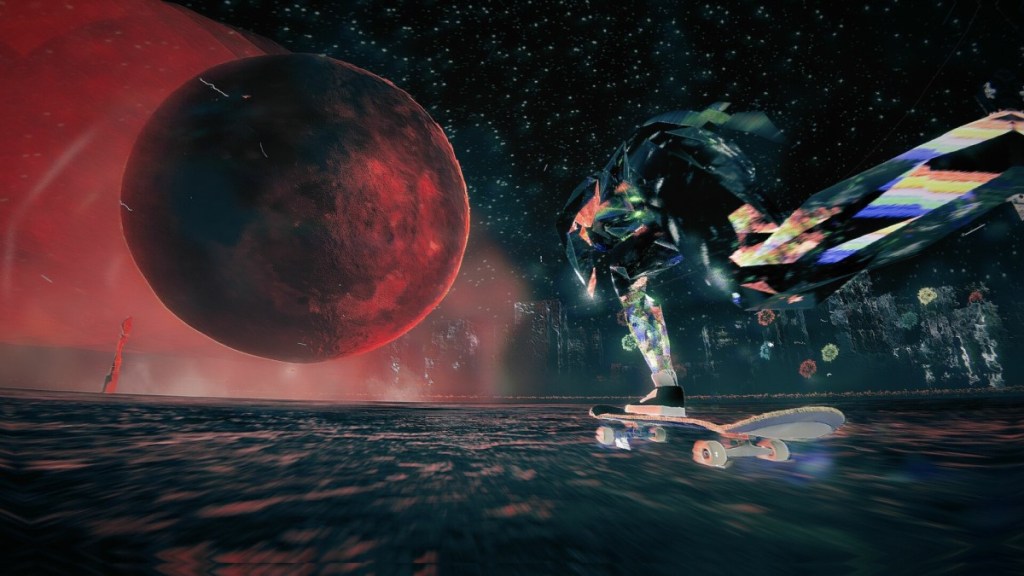
Skate Story has a hell of an elevator pitch, figuratively and otherwise. You play as a demon who has one goal: they want to eat the Moon. The Devil gives you a skateboard to help you reach the Moon, but in exchange, turns you into a glass. You are going to skate through the underworld, and you are going to eat the Moon. If I was giving out specific awards, I would give this the Absolute Coolest Shit In A Game award. It has this great lo-fi, psychedelic aesthetic that still manages to be very readable, and a soundtrack to match. And there’s a streak of dry, absurdist humour throughout the game.
This is not to mention the skating itself, which is rock-solid. Well, not really, because your character shatters in a million pieces when you wipe out – but even that lends itself to the overwhelming style of Skate Story.
"I love how the music flows throughout the game, crescendoing into vocal songs that explain the various bosses’ backstories, one of the many things that makes the game so engaging to play."
I feel like South of Midnight is a game that’s going to be overlooked by many people. I always enjoy a good story-driven adventure game with smooth platforming sections and a compelling narrative, but I didn’t think I was going to embrace the Southern Gothic aesthetic that this game gives out in spades. I love the handcrafted nature that the developers at Compulsion Games created, which makes South of Midnight one of the most visually appealing games of 2025. While I would have wanted an expansive combat system with multiple branching trees to spend my skill points on, I’m glad that the gameplay didn’t become overly complex, as I wanted to find collectibles that could improve the abilities that were present to me.
I love how the music flows throughout the game, crescendoing into vocal songs that explain the various bosses’ backstories, one of the many things that makes the game so engaging to play. I found it fascinating that you use your weaver powers to unravel enemies to heal the world instead of killing them outright. I’m glad I got to play it via Xbox Game Pass, as I would easily recommend it to someone who wants to play something that isn’t a traditional single-player adventure game.
"The entire game is a testament to that wonder of creation – kernels of greatness nestled in half-finished ideas, some stories that might benefit from a rewrite, or old lullabies we sort of just sing to ourselves."
My fiancé and I eagerly played Split Fiction together, pretty quickly after release. We'd blown through It Takes Two, and Split Fiction was more of the same couch co-op we'd loved.
It also starred two authors, and as an aspiring one – and one existing in the world of AI – the game's themes of corporate and computational thievery rang unfortunately close to home. But beyond that tagline – the idea that our core memories manifest and help us build the stories we tell – Split Fiction's true shining achievement is in the tremendous variety of its level design. It has fantastic gameplay, requiring you to flip-flop through two very different genre trappings: science fiction and fantasy. Both are speculative arts, but drawing from often different foundational tones.
Our two protagonists have their own inner battles that unfold through the narrative, and they're well-done stories that take time to tell themselves. One story, or "chapter", might tackle identity, another loss. There are even side stories that you encounter throughout the game, which boil down to racing, platforming, or snowboarding mini-games, and they are all executed (and mapped on the controllers) wonderfully. None of these swaps of gameplay styles feels jarring. There was one particular level involving magic and general witchery, where you could transform yourself into yarn and fly on broomsticks. It was as joyful as opening a toy box. The entire game is a testament to that wonder of creation – kernels of greatness nestled in half-finished ideas, some stories that might benefit from a rewrite, or old lullabies we sort of just sing to ourselves. Split Fiction is a paean to creatives, and it's a damn fun time.
This game easily provided me with one of the most enjoyable co-op experiences that I've had in a long time. Each new level was creative and exciting to play through, where I never knew what would happen next. While I would have preferred to play with another player by my side in person, I enjoyed my time with my fellow SUPERJUMP editor, Bryan Finck, who was along for the ride as we constantly commented on what we saw on our screens, making jokes and helping each other out along the way. One moment, I was riding a futuristic bike in a cyberpunk city, and the next, I was playing as a yeti in a fantasy world.
It constantly switched between the fantasy and science fiction genres to mix up the gameplay, which I greatly appreciated. Even some of the side missions that I found gave me some laugh-out-loud moments that I still think about to this day. I became attached to the stories of Mio and Zoe as aspiring writers who needed to process their issues by helping each other as the narrative progressed. Split Fiction is easily one of the most beautiful games that I played this year, running on Unreal Engine 5, where I didn’t notice any slowdown or glitches whatsoever. I knew that Hazelight was going to put out another excellent game after It Takes Two, but I never expected to have such a fantastic time with Split Fiction.
Split Fiction can be described in many ways – bold, endlessly creative, bursting with brilliant set pieces; a best-in-class co-operative experience. What the game, and its developer Hazelight Studios, can’t be called is subtle. The studio is led by Josef Fares, perhaps best known for shouting ‘fuck the Oscars’ at The Game Awards, among other outlandish quotes (my favourite is telling a journalist they can break his legs if they don’t like A Way Out), but he can keep saying goofy stuff if he and Hazelight can keep walking the walk so emphatically.
Split Fiction is a game that you have to play with another person, about a tech magnate trying to suck up all the story ideas from authors' minds, under the guise of testing out supposedly revolutionary new technology. The villain of the piece may as well be called Sham Shaltman from ShenAI. Not subtle, but maybe this is not the time for subtlety.
The hook of the game, in which the imagined worlds of a fantasy and a sci-fi author intertwine, allows for a constant stream of new ideas. Every level provides something new and impressive, whether it be a fresh twist on the central puzzle-platforming, a fun, breezy side-level, or an impressive boss fight (or all of the above). And it all feels so carefully crafted, by people who have, you know, spent years honing their skills by working on this particular kind of game. Skills and experience you cannot generate out of thin air, or rather, ones you cannot generate from litres of water evaporated into thin air to cool a room full of pointless computers.
Split Fiction was a truly sublime experience and is easily my favorite of 2025. Hazelight Studios was already well-known for its co-op formula, following the excellent It Takes Two, but their latest title quickly became their most acclaimed and best-selling release.
Every level brings a new delight from a gameplay standpoint, with different perspectives, mechanics, mini-games, and hidden side-stories around every corner. With the game itself so good, the story didn't need to be the star of the show, but I found it to be my favorite part of the experience. Protagonists Mio and Zoe grow together as they work to escape their predicament, from a pair of feuding individuals into a true team that supports each other. Some truly excellent moments bring emotional weight to the story, elevating the entire game.
By the time you've worked your way through each incredible level, especially the final act where things get turned up to 11, you feel like you've been part of a true AAA title. Hazelight may not be the biggest studio, but they continue to punch well above their weight and have legions of fans, myself included, waiting impatiently for their next amazing adventure.
"With its broader console release this year, it’s easy to recommend to basically anyone who likes action roguelites, shmups, or anything that rewards clean movement and smart builds, and it’s absolutely worth a nod on any end-of-year tier list."
By Team D-13
In 2025, Star of Providence (originally called Monolith) finally broke out of its PC cult-classic bubble with a proper console release, including on Switch, and this gem absolutely deserves a place in the spotlight. The premise is simple: you’re a tiny ship climbing a mysterious tower, floor by floor, trying to reach the top. It’s twin-stick shooting meets bullet hell in a roguelite package, so you’re constantly moving, dodging, and threading the needle through dense patterns of enemy fire.
The movement feels great, and it’s backed up by a surprisingly deep loot and build system. Your starter weapon is fine, but you’ll quickly start finding guns with different firing styles, bullet sizes, ammo limits, and other quirks. On top of that, weapons can roll random modifiers that change their behaviour even more, so two runs with the same gun can feel completely different. Because secondary weapons have limited ammo and break when they’re empty, you’re constantly making decisions about what to carry and when to use it. Between floors, you’ll grab passive upgrades, stumble onto random modifiers, and choose buffs that slowly turn your tiny ship into something ridiculous. Then you hit the boss at the end of the floor, and that’s where this bullet hell really shows its teeth.
Since landing in 2017, Star of Providence has steadily grown into a much bigger beast, adding new enemies, room layouts, weapons, meaner endgame content, and an ascension-style difficulty ladder for anyone who wants the challenge to keep escalating. With its broader console release this year, it’s easy to recommend to basically anyone who likes action roguelites, shmups, or anything that rewards clean movement and smart builds, and it’s absolutely worth a nod on any end-of-year tier list.
"It’s super fun and impressively polished for an indie release, both in how it plays and how it looks."
Some games you buy after rewatching the trailer, reading a couple of reviews, and letting them sit on your wishlist for a while. Star Racer wasn’t one of those. I saw a few seconds of it pop up on YouTube, loved the retro sci-fi vibe and pixelated look, and thought, “Yep, this’ll be mine.” Five minutes later, it was downloading on Steam.
Even better, the game lived up to those first impressions. It’s super fun and impressively polished for an indie release, both in how it plays and how it looks. During races, you’ve got a mix of SNES-style 16-bit sprites, with environments leaning into a chunkier 3D look that feels very much like Star Fox 64. On top of that, the comic-book art style really brings the characters and cut scenes to life.
The gameplay itself is really fun too. Air brakes on the shoulder buttons let you strafe through corners, and the whole combat-racing loop is built on continual trade-offs. You can burn shield energy to boost and hold the lead, or play it safe and risk getting nailed by the pack. Every lap is high stakes, with even the best races coming unstuck at the final bend.
It’s not just pure racing either. You’ve got weapons, including the ability to bash rivals into walls, and even fire lasers during flying sections. There are airborne segments that crank up the Star Fox vibe even more, and they’re not just for show either. Flying drains your shields, so if you run dry mid-air, that’s it. Race over. You’re constantly balancing speed, aggression, and survival.
Plus, there are unlockable vehicles, a track editor for tinkerers, and four-player local split-screen, which is always a win. I still reckon it would be perfect on Switch, but even on Steam, it's firmly earned its place on my Top-Of-2025 list.
"In what may be the most ambitious visual novel of all time, Kodaka and his co-authors have created a game with 100 different endings."
By TooKyo games
The Hundred Line comes straight from the twisted imagination of Kazutaka Kodaka, the writer of the despair-inducing Danganronpa franchise. In what may be the most ambitious visual novel of all time, Kodaka and his co-authors have created a game with 100 different endings. Some of these endings are comedic, some are tragic, and some are downright disturbing. It just wouldn’t be a Kodaka game if it didn’t make you feel deeply uncomfortable by some of its twists.
Whatever else this sprawling hydra of a story might be, it’s upheld by its lovably flawed cast and its ability to masterfully flip between the grim and the absurd.
"Tiger-Heli is a tough shooter with thrilling progression and great use of contrasting colours."
By TATSUJIN Co.
A brand new exclusive port for the Atari 7800 by a Japanese developer? Crazier things have happened in gaming, but for Toaplan to commission a new port for its seminal Tiger-Heli shoot 'em up in 2025 to commemorate its 40-year anniversary, it doesn't get crazier than this.
It's a marvelous release too; the arcade shooting classic translates perfectly to the Atari 7800's hardware specifications, and the experience is completely different from the NES port from way back. Tiger-Heli is a tough shooter with thrilling progression and great use of contrasting colours. The World War II energy here is like Capcom's 1942 turned up to 11.
"But of course, the standout here is Angel of Darkness..."
By Aspyr
It's no secret that Tomb Raider IV-V were made under pressure, and by a (mostly) new team. But of course, the standout here is Angel of Darkness, a game that floundered at its foundations, due to huge bugs, a strange RPG system that's now a meme, and mostly away from Tombs.
It's my GOTY because the collection is an example of how a series strays away from what made it so good in the first place, despite good intentions from the team.
"The mechanics were simple to follow, and the map was fun to explore; though there were a few moments of confusion, I never felt frustrated enough to put the game down."
This game blew me away with how adorably deep and thoroughly cozy it was! It was a relatively short experience, but I never felt rushed; beautiful scenery, sweet characters, and charming music made me comfortable vibing for long play sessions.
The mechanics were simple to follow, and the map was fun to explore; though there were a few moments of confusion, I never felt frustrated enough to put the game down. I was thrilled to be able to play shortly after launch, and even moreso for the chance to chat with the devs directly!
In January 1968, British science fiction writer Arthur C. Clarke wrote to Science magazine to articulate what would become the third and final principle of his now famous “three laws”, a set of observations about technology, discovery, and humanity’s relationship to them. In this, the most famous of the three adages, Clarke stated: “Any sufficiently advanced technology is indistinguishable from magic."
Fast forward thirty-two years, I’m six years old, and I’ve invited myself round to a friend’s house under the pretence of a sleepover.
In reality, I was there because I knew he owned a PlayStation.
Up to that point, I’d only ever had a passing relationship with videogames. A friend’s birthday party here, playing pinball on the family PC there; but outside of that, my chances to play had been slim to none.
After some debate, we settled on the latest addition to his collection: a game called Action Man: Destruction X. We slid the disc into the tray, the CRT flickered to life, and then, the sonic boom etched into the skulls of millennials the world over.
After negotiating a menu screen and the opening cutscene, the television gave way to the game itself. There was my childhood hero rendered in glorious, pixelated form - equipped with only a boomerang - facing off against a Tyrannosaurus Rex in what felt like a chasmic arena. Now, I don’t wish to be hyperbolic, but at that admittedly early point in my life, this was easily one of the coolest things I’d ever seen. To me, it was indistinguishable from magic.
It didn’t matter that the game was clunky, borderline incoherent and, on reflection, somewhat shit. What mattered was the feeling: the sense of discovery, imagination, and possibility that videogames offered in a way nothing else quite did. That moment set the tone for a lifelong relationship with games, a medium in which I could explore entire worlds built with care, craft, and creativity.
But somewhere along the way, something curdled.
If I really interrogate why I still play videogames, I’d say that they’re a way for me to reconnect with that younger version of myself, a window I can slip through to retrieve some of the wonder that came so freely in childhood, but which adulthood takes too readily. Games still do that for me, but increasingly, the culture which surrounds them seems determined to crush it.
It’s not hard to see why. Today, social platforms shape much of the conversation we have about games, and those sites - Twitter, Reddit, YouTube - are designed first and foremost to reward engagement, not understanding. Invariably, then, nuance doesn’t travel; anger does, and in gaming spaces, that anger metastasises quickly.
The depressing part is that the warning signs have been there for over a decade. Flashpoint moments like Gamergate didn’t mark the advent of toxicity in games; they marked its industrialisation, with harassment campaigns masquerading as “consumer advocacy,” sustained abuse directed at developers and critics, and a lasting lesson learned by bad actors in the community - outrage is profitable. Later crossroads, like the backlash to The Last of Us Part II, followed the same template: review bombing, death threats, and petitions demanding creative works be rewritten to better align with audience entitlement. These moments matter, but not because they’re shocking. They matter because they’re no longer exceptions.
This pernicious behaviour is a dime a dozen today. A studio’s creative decisions are pre-emptively litigated on social media before a game even releases - for example, Bungie’s Marathon hasn’t even been released yet, and it’s already being dissected and denounced online. Developers don’t have to worry about abuse; they expect it. Marginalised players quietly disengage, not because they don’t love games, but because the surrounding culture keeps reminding them they’re not welcome. The question, then, is simple: is this the culture we want to exist within, at a time when games are pushing the medium further than ever?
Videogames today are more ambitious, more expressive, and more artistically confident than they’ve ever been. Yet the way we talk about them, publicly, performatively, online, has grown smaller, meaner, and more caustic. Games are treated less like shared experiences and more like battlegrounds where identity, politics, and personal grievance collide.
I’d like to apologise in advance for this next example. Earlier this week, my Twitter algorithm served up this little gem for my viewing displeasure. Go watch it, I’ll wait…
Now, to me, Asmongold is amongst the worst offenders in turning our modern gaming culture into such a poisonous place. In this clip, he neatly illustrates why. Here is a prominent streamer, with a sizeable audience, openly expressing a willingness to make the lives of strangers more difficult on a whim, and framing it as entertainment. There is no insight here, no critique, no value, just spite, amplified by a platform that rewards it.
Asmongold is not a thought leader, a cultural authority, or a policymaker. He is a Twitch streamer whose influence far outweighs the responsibility he shows in wielding it. And every time his behaviour is normalised, rewarded, or defended, the culture around games becomes a little more hostile, more fractured, and less worth participating in.
If you’ll allow me to zoom out further for a moment, this behaviour isn’t confined to games; it reflects a broader pattern playing out across society in general. Just this past weekend, Bad Bunny performed at the Super Bowl LX halftime show, and I’ve watched as some of the world’s pre-eminent grifters and walking, talking human mudslides have used this not as an opportunity to widen their world, but instead to foment hatred along national and ethnic lines.
It’s tempting to dismiss this as a “bad fans” problem. It isn’t. It’s a systemic one.
Platform incentives reward outrage. Algorithms flatten complexity. Identity becomes tribal. Disagreement turns instantly into moral failure. In that environment, games stop being art to engage with and become symbols to defend or destroy. The loudest voices dominate, not because they’re representative, but because they’re profitable.
This all has consequences; not abstract ones, but real, human costs. Developers burn out or leave the industry entirely. Players self-censor or withdraw. The medium’s public reputation is shaped not by its best work, but by its ugliest behaviour. It only makes it easier for traditional media to dismiss videogames as immature or unserious, and why shouldn’t they when the culture surrounding them seems so allergic to reflection?
This is the part where I’m supposed to present a solution. I don’t have one. Not a clean one, anyway. But I do know what I want.
I want a gaming culture that remembers games are made by people, that creative risk isn’t betrayal, that discomfort isn’t failure, that art doesn’t owe us validation, only honesty. I want conversations that prioritise curiosity over condemnation, and criticism that engages with craft rather than identity.
Most of all, I want us to reclaim the magic that drew so many of us here in the first place. With that in mind, I’ve compiled a list to help move the needle back to a more acceptable, more human place, a ruleset that I like to call…
When all is said and done, I’d like to leave you with this.
In Blood, Sweat, and Pixels, Jason Schreier recounts a conversation he was having with a developer, after hearing about a gruelling production cycle, “Sounds like a miracle that this game was even made.”
“Oh, Jason,” the developer replied. “It’s a miracle that any game is made.”
I wish the people who claim to love games remembered that.
One of the most important parts of history is the rise and fall of the various dynasties littered across cultures. As empires come and go, the families atop these governments become staples, immortalized in culture through the arts, coming in the form of sculptures, books, and of course, video games.
Old World, the 2022 grand strategy game from developer Mohawk Games, features interesting innovations on the nation-building game formula. Rather than offering a selection of global nations, it focuses its sights on the diverse cultures that made up the Ancient Mediterranean. From here, each of these civilizations has multiple leaders to choose from, influential in the culture's development, and with a family to follow them throughout history. Each of these leaders is different, offering players a variety within each different nation to begin their dynasty. While each culture has its own hallmark research topics and structures, the starting characters and decisions that follow propel the events of this narrative-driven strategy game.
In my playthrough, I began my journey as “Pericles the Founder," a versatile statesman and founder of Greece, married to Queen Consort Aspasia, who, for some reason, was already upset with me. I focused on trapping as my initial research to take advantage of the resources around Athenai, the capital of what would be Greece, and set off into this new world. It only took a year for me to realize why Aspasia was disgruntled with me – pregnancy will make anyone irritable. In an effort to please my unhappy wife, I chose to name our newborn daughter after her, born in the second year of our nation's founding.
Old World has some familiar trappings of the strategy simulation genre. I can eventually become governor of my capital or offer the role up to somebody else in my court, the former bolstering my city's development. As I take the job with honor, it's only two years later that I become “Pericles the Settler,” with the foundation of Trapezus, the second settlement under my control. It's also worth noting that the years of Old World are depicted as "Year One" and so on, rather than having an assigned year or date.
The key actors of this game always seem to bring something with them, turning the pages of your nation's history with their own stories. Leonidas enters Greece with his knowledge of civil government to help propel us forward to a modern civilization. Sappho is exiled after a political scandal, allowed to roam freely in other lands, and eventually joins a rival family. Cultists are found living in ruins on a hill near a mountain range, and I allow them to continue their worship and even put up a shrine in what is now my land.
The daughter who soured my wife's mood towards me in the early years has finally turned 10, meaning it's time I formally teach her about the world. It's here that I must confess that my knowledge of world history is limited – it's been quite some time since I've been graded on my ability to remember dates and why they matter, and I was only ever so good at that anyway. I took the time outside the game to glance at who Pericles was when he was alive, and thus decided to teach Aspasia about commerce so she could go down a similar path as an Orator.
My time as a Grecian statesman comprised my first playthrough, and while I've managed a handful of other nations since then, I found that this first endeavor into Old World was more narratively fruitful. My first mistake would ring out through the rest of my playthrough – not knowing how to manage my money. Where Greece had been making some small profits for Years 1-12, it hadn't been enough to hire a philosopher to the court that my wife wished for. Her opinion of me soured more, yet I would not give up any of our resources. In a sort of irony, my daughter would ask me about a situation with money. Since Pericles isn't wise enough to tell her that money isn't everything, I tell her that she can spend money with her friends however she pleases, and this decision would set her on a path from which I could not save her.
Old World is made of ebbs and flows, bouncing gameplay developments with characters and stories that will throw a wrench into things. By Year 24, King Pericles the Pioneer turns ill. Rather than ride out my golden years sick and on the throne, I abdicate the throne to my daughter. Remember how earlier I told her she could spend her money with her friends as she pleases? That lesson alone formed her into a lackadaisical sort of person, and as an adult, she's become an alcoholic. The first thing she does is remove the cult of Aphrodite, those who have been dwelling in the mountains since before our arrival; their religion is gaining too much influence over the city. To make matters worse, we've been at war with foreign invaders for a few years now. I, as Pericles, lived a taxing life, and I can't help but feel guilty for my ignorance. Maybe my wife was right about that philosopher after all.
By the 33rd year, Aspasia had brought many positive developments to the throne. The neighboring Danes offered their leader, Rorik, to be her husband in an effort to unify the countries, and he sits on the throne as King Consort. Through this, it's discovered that the people of Carthage have been spying on Aspasia, and their agent is dispatched expeditiously. Where Pericles' time was focused on building a nation, Aspasia's era is to make the people of Greece happy and safe as we advance towards the future. Only a year later, Rorik and Aspasia give birth to Arisonoe, and in a similar fashion, the throne still can't afford to hire a philosopher to the court.
Some of the narrative events of Old World can feel more random than others, harder to pinpoint their causes. From a narrative standpoint, combining self-prescribed ideas with flavorful text that drives the concepts home, Pericles' sickness comes and goes while his daughter is on the throne. He's healthy again the year she takes over and only gets sick again towards the end of his lifespan while he's back in the political seat as governor of Athenai.
In the early 40s, things continue to take a turn for the worse. War erupts across the country from both the people of Carthage and Persia. Our lack of military might holds us back as we scrounge up soldiers, but governors in the cities fall ill and perish as well or simply make poor decisions. In Year 44, only a year after the passing of Pericles, Aspasia is doomed, sick, and close to death, and Arisnoe is only 10 years old.
In Year 45, disaster falls. Both the King and Queen die from their illnesses as war ensues on Greece's borders. Arisnoe is still just a child, so a court member arrives to take the throne until she turns 18. By year 52, Arisnoe has been raised as an orphan during nearly a decade-long war with Carthage. Rather than pursuing commerce like her mother, she learns military training, the last chance to stop the nation from collapsing. As she turns 18, Polyxena, the regent queen dies of a sudden illness, making way for Arisnoe. As the 50s arrive, city after city falls to barbarians from the south and Carthaginian soldiers from the north. First, Trapezus. Then Thebes. Then Argos. At 25-years-old, Arisnoe takes to the battlefield in Corinth, and in an insane twist of fate, she's spared from death after being rescued by one of her soldiers and returns to the capital. It doesn't take long before Athenai falls to constant attacks.
In my story, Greece is a nation that couldn't make it to a century, with three rulers to take the throne, each bearing the sins of the last. An unwise settler, a listless queen, a daughter forged in war. When I play strategy games like this, or games in the Civilization series, I tend to go with the flow, making decisions on the fly and doing whatever feels natural. While this isn't optimal, Old World rewarded that behavior with a developing story.
I've started new playthroughs in Old World a handful of times since this initial story, and each of them has been different. No two rulers have been the same, nor have their developing moments and national impacts. Each war has demanded something different, each bloodline resonates with different ideals, and each story branch has led to something new.
For a long time now, I’ve thought about ways to transcribe my playthroughs in nation-building games, opting to recount the events as if they were going into a history textbook. The issue I’ve found with this, after multiple attempts, is that the focal point of a nation isn’t gripping when a face isn’t attached to it. Where other games draw on distinct historical figures that work as gameplay mechanics rather than characters, Old World bridges the gap through story developments that act as motivators for gameplay. I applaud Old World for its ability to weave story and gameplay in a way that the historical strategy genre has very much inspired its players, and very clearly benefits from.


The wind howled across the ruined streets of Boston. Radiation still seeped from the fissures of the old world, and yet life clung stubbornly to the cracked asphalt. You, the Sole Survivor, stood atop the Institute’s tower, looking down at a city that had long forgotten hope.
For decades, the Institute had been humanity’s shadow: kidnappings, secret replacements, and cold experiments hidden beneath layers of technology. But now, as its new Director, you could change everything.
“No more hiding. No more taking. No more fear,” you muttered, feeling the weight of centuries of potential resting on your shoulders.
Synths approached, curious, wary — the first of their kind granted true autonomy. And in the deepest labs, scientists turned to you, some doubtful, others hesitant. The path ahead would be long, and dangerous.
At first, progress was fragile. The Railroad watched suspiciously. The Brotherhood patrolled overhead, their iron fists poised for judgment. Settlers whispered fears in the streets.
But small victories grew. Synth-human unions produced the first hybrids — children with minds sharper than humans, bodies resilient to radiation, and the faint glow of promise in their eyes. Ghouls stabilized under Institute care, finding purpose rather than persecution. Even super mutants learned to temper their aggression with guidance.
The Commonwealth began to hum with life again, as old wounds slowly stitched themselves together. It was a fragile hope, but hope nonetheless.
Decades passed. The Commonwealth transformed. Cities rose from the ashes. Hybrids became a cultural force, their existence bridging humanity and technology. Settlers learned to trust synths, and mutants and ghouls found their place in society.
The Institute shared its knowledge openly: medical breakthroughs, radiation-safe crops, and clean water systems. Ethical science became the foundation of governance.
Then, the eyes of humanity turned skyward. Star charts, cryogenic experiments, and spaceship prototypes filled the labs. The once-feared Institute was now the architect of humanity’s survival — not just in the wasteland, but in the stars themselves.
Earth was healing, but slowly. Climate instability, lingering radiation, and centuries of neglect left large swaths of the planet uninhabitable. The ethical choice became unavoidable: leave or perish.
Debates raged across the Commonwealth. Extremists argued that humanity’s soul was tied to Earth. The hybrids, synths, and ethical humans argued for survival among the stars. Your reforms now reached beyond the surface — they became a blueprint for civilization itself.
Starships were built. Terraforming research commenced. Humanity would not repeat the mistakes of the past.
The first generation of ships lifted from the Commonwealth, carrying humans, hybrids, synths, ghouls, and stabilized mutants. Families waved from settlement walls as the last engines roared skyward.
The Sole Survivor’s vision had endured: a society built on ethics, cooperation, and foresight. Earth remained as a caretaker planet for a few, but the stars awaited humanity’s next chapter.
Centuries later, Earth was barren — a silent testament to the choices of the past. Cities lay in ruins, oceans reclaimed their course, and radiation painted the scars of old wars across continents.
Above, humanity thrived. Hybrids led colonies on distant planets, their intelligence and resilience shaping new societies. Synths administered vast networks of interstellar infrastructure. Ghouls and mutants found niches where their strength and adaptability were assets, not liabilities.
In the quiet of orbit, one could still imagine the Commonwealth — its rebuilt settlements, its gardens of radiation-resistant crops, its streets where synths and humans once walked side by side. The choices of one survivor had echoed across centuries, turning a shattered Earth into the cradle of a multi-species civilization.
And somewhere among the stars, the legacy of the Sole Survivor lived on, a whisper across light-years:
“Even from the ashes, we rise. Even from a broken world, we reach the stars.”
Welcome to Next Week on Xbox! In this weekly feature we cover all the games coming soon to Xbox Series X|S, Xbox One, Xbox on PC, and Game Pass! Get more details on these upcoming games below and click their profiles for further info (release dates subject to change). Let’s jump in!
Resident Evil Requiem – February 26
Optimized for Xbox Series X|S
A new era of survival horror arrives with Resident Evil Requiem, the latest and most immersive entry yet in the iconic Resident Evil series. Experience terrifying survival horror with FBI analyst Grace Ashcroft, and dive into pulse-pounding action with legendary agent Leon S. Kennedy. Both of their journeys and unique gameplay styles intertwine into a heart-stopping, emotional experience that will chill you to your core.
Towerborne – February 26
Game Pass / Optimized for Xbox Series X|S / Xbox Play Anywhere
Towerborne is an exciting side-scrolling action RPG brawler. Rise again as an Ace, an immortal warrior reborn to defend the Belfry against the darkness beyond its walls. Journey across a crumbling world, uncover the mystery of the fallen City of Numbers, and push back the corruption threatening humanity’s survival.
Tales of Berseria Remastered – February 26
Optimized for Xbox Series X|S
Engage in the ultimate quest for self-discovery, remastered for the first time. The sacred kingdom awaits the arrival of its savior, and a lone woman named Velvet is marked by traumatic deceit. Join Velvet on her journey for vengeance, along with her cast of eccentric companions, as they sail through the archipelago which comprises the kingdom of Midgand.
Bread & Fred – February 24
Optimized for Xbox Series X|S / Smart Delivery
Bread & Fred is a challenging co-op platformer where two players must cooperate to jump and climb to the top of a snowy mountain. Play as both Bread and Fred in their exasperating and sometimes maddening climb that requires precision with every jump. Each time you land you’ll be closer to the peak and one step closer to mastering the platforming, but your fall down the mountain will be even farther.
Capy Spa – February 24
Optimized for Xbox Series X|S
Grab your towels because the chillest capybara in gaming is ready for a soak! In Capy Spa, you help Pipa, a relaxation-loving capybara, push herb buckets into hot springs to prepare the perfect bath. With 30 carefully crafted levels, two charming biomes (Savanna River and Forest Onsen), and a soothing soundtrack that blends with the rising steam, every stage invites calm and thoughtful moves.
Dark Farts: Parody Smell Edition – February 25
Optimized for Xbox Series X|S / Smart Delivery / Xbox Play Anywhere
Emotional Damage Incoming! The most ridiculously epic Souls-like parody ever created meets outrageous humor in this absolutely insane action-RPG! You’re no chosen one – just a blacksmith with questionable bean-eating habits who accidentally gained ancient dragon powers. Now, you’re humanity’s last hope, and it’s time to show these evil corporations what REAL power smells like!
Deep Space Shooter – February 25
Optimized for Xbox Series X|S
Again you are alone against the hordes of hostile spacecrafts where you can only rely on yourself. It is the victory or the death! An automatic station deep in space has sent an alarm signal and then the connection is disrupted. Your spaceship set off there to carry out reconnaissance. But all of the sudden you encounter huge forces of an unknown enemy. Now there’s no way back – you either defeat them or die. This game is a vertical scroll-shooter with numerous enemies and a gradually increasing level of complexity.
Ghetto Zombies: Graffiti Squad – February 25
Optimized for Xbox Series X|S / Smart Delivery / Xbox Play Anywhere
A squad of mutant kids from the hood is humanity’s last hope in this colorful, humor-packed zombie apocalypse. Blast freaky zombies with ridiculous guns, spray wild graffiti across the city, and face a monstrous Zombie Boss at the end of every mission. Each hero in the squad offers a unique playstyle: choose yours, dig the weirdest guns out of dumpsters, and enjoy the insane headshot animations.
Journey of Johann: Castle Crusade – February 25
Optimized for Xbox Series X|S
Journey of Johann is an action-adventure platformer with puzzle elements. Make your way through levels and a boss with different challenges and obstacles. Collect goblets and secrets and beat time trials. Use your weapons as tools such as climbing, blocking hits, and defeating enemies. The game was designed with speedrunning in mind.
One-Button Games 5-in-1 Vol. 4 – February 25
Optimized for Xbox Series X|S
Challenge yourself with these 5 fast-paced one-button games: Ball Bombs, Baroll, Bamboo, Two Faced, and Light Dark.
Pogui – February 25
Optimized for Xbox Series X|S / Smart Delivery / Xbox Play Anywhere
Safely guide a lovable pup through crazy platforming stages so he can get back to his naptime! Pogui is just a little dog who wants to take a nap, but crazy stuff keeps happening around him! Guide the lovable pug through dreamlike worlds and help him get to bed. Pogui is a side-scrolling precision platformer presented in retro pixel art style. Run, jump and dash your way through colorful but hazardous levels!
UFOphilia – February 25
Optimized for Xbox Series X|S / Xbox Play Anywhere
UFOphilia is a first-person psychological horror game where you explore areas marked by alien phenomena. Use specialized equipment to detect, identify, and photograph aliens, but do so at your own risk… They are watching you too. Equipped with advanced tools, your mission is to detect, identify, and photograph extraterrestrials, each encounter involving unique behaviors and unpredictable dangers.
ChildStory – February 26
Optimized for Xbox Series X|S / Smart Delivery / Xbox Play Anywhere
A small town in the far north goes about its life: preparing for the Festival of the New Star, decorating streets, celebrating. The festival is inseparable from a cycle that repeats month after month. And Sonya stands at its center. She’s part of a story she’s still trying to understand. A kind girl with a sharp mind and countless questions, she searches for answers among snow and lights. Sonya helps friends, makes new ones, explores hidden corners, fights spirits, and solves puzzles. She acts, hoping her actions will lead to understanding.
Corner Kitchen Fast Food Simulator – February 26
Optimized for Xbox Series X|S
Buy cooking equipment, prepare delicious meals, and serve hungry customers. Upgrade your setup, read customer reviews, and expand your business to become the top fast-food joint in the city.
Golfing Over It with Alva Majo – February 26
Optimized for Xbox Series X|S / Smart Delivery
Golfing Over It with Alva Majo is a discouraging game about climbing a surreal mountain with a golf ball, a different take on 2017’s hit Getting Over It with Bennett Foddy. Experience the challenge of climbing an unyielding mountain without infuriating controls being part of that challenge. Bennett Foddy has played this game and granted it his blessing.
Hunt the Night is a retro-style action-RPG that blends fast, skillful combat with dark fantasy lore. Play as Vesper, a member of the Stalkers, and traverse the ruined world of Medhram on a mission to save humanity from a deadly cycle of annihilation. Endure nightmarish overworlds, slash through horrific dungeons, face brutal bosses, and wield an arsenal of powers in a relentless struggle against the Night itself.
Manairons – February 26
Optimized for Xbox Series X|S / Smart Delivery / Xbox Play Anywhere
Unleash chaos, control magic, and save the village… with a flute. Manairons is a 3D action platformer game inspired by the legends of little creatures living in the Pyrenees. Help Nai face off against the landowner who has taken control of a charming village using the power of the “canut,” with magic, flute, and plenty of chaos.
Mole Cart Mining – February 26
Optimized for Xbox Series X|S
Get ready for an underground adventure full of charm and strategy! In Mole Cart Mining, you guide a determined little mole riding a mine cart while rotating tracks on a hexagonal grid to create the perfect route. The goal is simple and satisfying: collect every mineral and reach the exit in style.
No Sleep for Kaname Date – From AI: The Somnium Files – February 26
Optimized for Xbox Series X|S
Iris has been abducted by aliens?! Finding herself on board a mysterious UFO and tasked with completing a bizarre escape game, Iris knows there’s one person who she can always count on for help: Kaname Date, Psyncer! As Date, conduct investigations, solve escape game puzzles, and Psync into the dreams of potential suspects to help Iris escape and unravel the mystery behind The Third Eye Game!
Sands of Aura – February 26
Optimized for Xbox Series X|S
Sands of Aura is an open-world action adventure with a fantasy setting of a realm in its twilight–a world buried beneath a sea of sand. Sail across the sandseas to return life to a dying world in an unforgettable experience that is equal parts engaging story and unrelenting, souls-like combat.
A total of 300 questions with easy, normal, and hard difficulties have been included. Complete problems to unlock background effects and BGM tracks. There are 3 background effects and 3 BGM tracks. Sudoku allows you to use your brain while also being soothed by the effects and BGM.
Trials of Olympus – February 26
Optimized for Xbox Series X|S
The gods of Olympus seek a mortal champion to fight against a rising darkness. Only those who endure their trials may be chosen. In Trials of Olympus, you journey through the realms of Ares, Artemis, Hades, Poseidon, and Zeus. Each god’s domain holds three great trials — vast platforming levels filled with traps, enemies, and divine essences to recover. You cannot fight, for no weapon is yet yours. Instead, rely on agility and wit.
WorldNeverland – Elnea Kingdom – February 26
Optimized for Xbox Series X|S / Smart Delivery / Xbox Play Anywhere
What if you could freely choose another life? WorldNeverland – Elnea Kingdom is a sandbox life simulation game where you can move to a fictional kingdom you’ve always dreamed of and enjoy a carefree life. Why not weave a grand story spanning generations with your own hands?
Aquamarine: Explorer’s Edition – February 27
Optimized for Xbox Series X|S / Xbox Play Anywhere
Aquamarine is a turn-based playable comic book about surviving in an alien ocean. Inspired by the psychedelic sci-fi of the ’70s & ’80s, Aquamarine combines the mystery of old-school adventure games and challenging roguelikes with elements of survival, exploration, and puzzle solving. Journey across a water world reclaimed by nature. Overcome survival and navigational challenges as you discover the planet’s lost history. Master your pod’s controls, study the ocean wildlife, and solve environmental puzzles to help you find your way home.
“Buy the Game, I Have a Gun” -Sheesh-Man – February 27
Optimized for Xbox Series X|S / Smart Delivery / Xbox Play Anywhere
This game is worth every penny, and you should buy it right now, why? Firstly because the whole story was written during a livestream, which makes the story totally nonsensical! If this doesn’t convince you remember that not only do I have a gun, I also know all your secrets. This is of course a joke, I do not know your secrets, yet.
Emoji Battlefield – Island Warfare – February 27
Optimized for Xbox Series X|S
You’ve washed ashore on a mysterious island where ancient emojis have awakened — and they’re not happy to see you. This rogue-like first-person shooter throws you into wild, fast-paced combat against tiki emojis wearing carved masks and wielding primal powers. Before each run, customize your experience with crazy modifiers: make enemies bounce, wear funny hats, or unleash volcanic chaos for maximum challenge. Choose your arena — from overgrown jungles and hidden beach ruins to ancient temples filled with deadly traps — each location has its own hazards, secrets, and surprises.
Mini Racer Car Shop Simulator – February 27
Optimized for Xbox Series X|S
Manage your mini racer car shop, sell mini cars and spare parts, and unleash your creativity with custom builds. Test drive your creations on the racetrack before putting them up for sale. Transform your shop into a haven for mini car enthusiasts and build a thriving business in the process!
Shopping Mall Girl – February 27
Xbox Play Anywhere
Showcase your style and become a supermodel in one of the best shopping games! No matter what your fashion style may be, this shopping mall has exactly what you’re looking for! Get a fabulous new hairstyle at your favorite hair salon Chic Cuts, and dress up in the latest hot trends from our stylish shops! It’s Black Friday! The excitement is real as you race to grab the clothes you need before they vanish from the shelves! Dress up in shirts, skirts, shoes, and accessories, or get expert advice from your personal shopper!
Solar Machina – February 27
Optimized for Xbox Series X|S
Solar Machina is a vibrant 2D pixel art platformer where you control a robot on a colorful journey through tropical landscapes filled with traps and enemies. As you progress, your robotic suit evolves, granting new movement abilities that transform how you play. With smooth controls, distinct biomes, and a nostalgic chiptune soundtrack, Solar Machina offers a satisfying blend of challenge, rhythm, and exploration that keeps engagement from start to finish.
Soulshard – February 27
Optimized for Xbox Series X|S / Smart Delivery
In a realm between life and death, a confused soul seeks redemption and freedom from a past life filled with misguided choices. Playing alone or together via co-op multiplayer, command a soul in search of the exit from this dark and desolate realm. Use the environment to your advantage and avoid treacherous traps to clear 30 challenging levels of hauntingly morose pixel art.
Wild West Tycoon – February 27
Optimized for Xbox Series X|S / Smart Delivery / Xbox Play Anywhere
Welcome to the untamed frontier! In Wild West Tycoon you are tasked with transforming the rugged Wild West into a thriving economic powerhouse. This low-poly style simulation game invites you to master the art of frontier entrepreneurship where every decision counts and every enterprise takes you one step closer to building a legendary empire.
The post Next Week on Xbox: New Games for February 23 to 27 appeared first on Xbox Wire.
It's been another strange, difficult, and yet somehow also brilliant year for video games in 2025. Triple-A releases have been sparse again, compared to the boom times of old, with a great big GTA 6-shaped hole left in the final few months of the year. And yet once again, every gap left by the established order has been filled twice over with something brilliantly new.

Hey everyone!
I wanted to jot down an idea I’ve been working on, it’s a story concept about a basketball player who isn’t a superhero, but has an uncanny ability that makes him feel almost superhuman… for one quarter at a time. I’m writing this as a reference for myself, so I can come back to it later.
The ability was discovered during a scary incident with his younger sister. She ran into the street and almost got hit by a car. In that instant, his senses flared, time seemed to slow and he could see everyone’s movements clearly. He saved her instinctively.
One day, he was playing streetball. He didn’t dribble much (to save energy) but managed to steal balls and make perfect catch-and-shoot threes.
The story focuses on a single official game:
Final Thoughts:
I love the idea of a character who is almost superhuman, but still very much human. His ability is impressive, but the rules, one quarter, once a day, human limitations, keep the story grounded. Even though he can make a huge impact, he doesn’t always guarantee victory, and that’s what makes him relatable and compelling.
Great news, MV readers! To celebrate production beginning on our next issue, we’ve marked down Mega Visions Issue #01 to only $4.99! That’s half the price of our standard print issues!!!
Each issue of Mega Visions Magazine contains 64 pages of gorgeous SEGA and neo-retro coverage, with original art and design.
Here’s what to expect in Mega Visions Issue 01: Cover/Neo Retro: Final Fantasy VII x Final Fantasy VII Remake Modern Reviews: Streets of Rage 4, Doom Eternal, Alex Kidd in Miracle World DX Retro Reviews: Golden Axe: Beast Rider, Punisher (Arcade) Preview: Phantasy Star Online 2: New Genesis Interview: Corey Marshall, Shenmue’s Ryo Hazuki voice actor Features: Making Mutant League, Top 10 video game reboots, Remembering Streets of Rage Remake, The ’90s Consoles That Time Forgot, Column: What Did I…
To learn more about production on Mega Visions Issue #04, be sure to listen to The Mega Visions Show #115.
If you want to subscribe to Mega Visions and receive a discount on each issue, be sure to check out our Patreon page here!
The post MV Issue #01 on sale for only $4.99! appeared first on Mega Visions.
Welcome to the Mega Visions Show #116! This week, I’m happy to be joined by my guest co-host, my brother Adam, who joins the show for the very first time.
In this week’s show, we discuss:
If you enjoyed Mega Visions and want to subscribe to the podcast, you can do so here:
In addition to that, don’t forget to join our Patreon at www.patreon.com/megavisions!
The post AI in My Shenmue | Mega Visions Show #116 appeared first on Mega Visions.

Being a collector can mean many things. Most associate physical media collecting with geeks surrounded by bookshelves of video games that will never get played. Others will hold five PlayStation games in their hands and feel just as much pride in their collection, however small it may be. We hold on to our discs and cartridges even today, as they hold the memories of our experiences. In some cases, an actual memory card holds the record of an actual beautiful memory associated with the game. Whether it's the game that had a best friend coming to your house every day over a blistering summer or the game that finally got your parent to enjoy your favorite hobby with you, only a physical copy will hold those memories.
Displayed below are artifacts held dear by our SUPERJUMP writers, and the memories they contain.
I present my copy of the Wii version of The Legend of Zelda: Twilight Princess. I remember my first experience with this game. I was at the house of one of my mom's friends as a kid, and I didn’t have too many people to hang out with at the time. I was just eating some party snacks or something, and upon entering the living room, they had a copy of Twilight Princess just sitting on their Wii. Immediately, I was sold by the foil art cover. Being a PlayStation kid, I had no idea what The Legend of Zelda even was at the time, but I had only ever seen two other boxes that looked nearly as good as this one: Kingdom Hearts and Kingdom Hearts 2, my favorite games ever at the time.
My family had a Wii that they had bought, hoping that it would get the kids up and moving (still a highlight of that console and something that the Switch has mostly left behind). I went to my dad and practically begged him for a copy of Twilight Princess, which he insisted that I would have to pay for myself. I used a collection of roughly 1,200 US nickels that a grandparent had given me at the time. I felt bad about this trade for a number of years. But as I grew older, I never gained an appreciation for coin collecting, so the only regret I still have over this is paying back my dad in a rather annoying currency.
I was so excited to actually have the game in my hands as I eagerly popped it into my Wii. I played through the opening village and admittedly ran into a problem. Like many others at the time, I was too confused by the opening village area to actually trigger the events to go on the rest of the adventure. In my defense, you have to get a cat to follow you by fishing and then get it to chase you around; It was cryptic for a child. I put it down for a while, but eventually my dad came to me and mentioned how we went through such a hassle trading nickels for a game that I didn’t even play. This got me to actually sit down and play through the rest of the game, and I’m glad I did. The Legend of Zelda: Twilight Princess is the greatest Nintendo action RPG I’ve ever played, and I doubt that I’ll ever trade it away.
It can be incredibly challenging to name your favorite game when someone asks you to do so. In theory, this is something that could always be changing. If you’re a massive fan of the Zelda franchise, you know there will always be the next one coming, and it has a chance of supplanting your past favourite. But when someone asks about your most important game ever, well, that’s something else. We’re talking not just preferences, but something more meaningful and tangible, something that is part of your gaming history.
Historically, I’m a Nintendo nerd. Raised on Hylian princesses, Italian plumbers, and Kongs called Donkey, I had an incredible upbringing in the gaming world.
So it’s a huge surprise, even to me, that perhaps my most important game is, in fact, Virtua Tennis on the Dreamcast.
I was Nintendo through and through. I always got to play on my friend’s Mega Drive, but at no point did I ever consider it superior to my SNES. Then SEGA threw a curveball and released the futuristic (for its time) Dreamcast. Incredible 3D graphics, amazing CD-quality sound, access to the internet, and still my favourite little thing, the VMU.
Being the underfunded young man I was when I bought the Dreamcast, I wasn’t able to pick up many games. I obviously had to buy the Blue Blur in his first mainline 3D outing in Sonic Adventure, but outside of that, I didn’t have anything else.
Thankfully, there was the Official Dreamcast Magazine (ODM) here in the UK, and for the first time as a gamer, I was able to play demo discs. As an owner of the N64, I was always jealous of other console users with their demo discs from magazines, and now here I was, doing it myself; incredibly exciting times for this Nintendo fanboy.
ODM issue 17 gave us Dream On Volume 18, consisting of two videos of upcoming games and four demos for me to enjoy: Sega Extreme Sports, Dave Mirra Freestyle BMX, Ducati World, and, most bizarrely, my most important game, a demo of Virtua Tennis.
As with a lot of SEGA games at the time, it was a port of their arcade version from 1999, but it now allowed multiplayer madness in the home. I didn’t have a clue about this or the arcade version at the time, and I didn’t care; I was just excited to play something new that wasn’t Sonic.
And play I did; I enjoyed choosing one of the then-famous players and seeing who I felt was more accommodating to my play style. I enjoyed playing a best-of-three sets with the computer, and I absolutely loved playing with and dominating my friends.
Just to prove how incredible the VMU was, as you played the game, there would be a little matchstick equivalent of the game happening on the screen of the VMU. Who needed a massive TV with incredible graphics when you have a tiny pocket-sized one that does the same damned thing?
This demo of Virtua Tennis was exciting, fluid, and just simply fun. It wasn't overly complicated and was so easy to just jump right into, even if you were a novice. This game kept me engaged with the Dreamcast; it kept the system alive while I saved up for an actual new game or waited for something for my birthday.
It seems bizarre that this bite-sized demo, of all things, I consider to be my most important game, but I see it as something that truly opened up my gaming mind to things outside of just Nintendo. It taught me that even the simplest of things can be engaging and provide hours of smile-producing fun.
To this day, I always make sure to get the latest system from each company so that I can play all games from across all the systems. Although Nintendo had my heart from the early days, SEGA stole it from them right at the end.
Eventually, I was able to get Shenmue, and my word, did this really make the Dreamcast my most beloved console of all time. But whereas Shenmue made me fall in love with the Dreamcast, it was this small demo of Virtua Tennis that made me fall in love with gaming beyond Nintendo.
I was declared a traitor by my brother and cousins when I bought myself a PlayStation back in the early 2000s. We were a Nintendo family; how dare I turncoat for a competing console?!
It wasn’t a desire to forsake Nintendo that drove me towards buying a PS1, for I would always love them. It was a desire to have something of my own. The Super Nintendo and N64 belonged to my older brother, and he would regularly exercise his dictatorship over their use. Being seven years younger, I could do little to stop him.
I eventually saved up enough money from my paper route and made the leap. I bought a PS1, Crash Bandicoot, and Final Fantasy 7. I had never experienced a game like FF7 before, so ripe with deep narrative and heavy themes, somewhat beyond what my eleven-year-old brain could fully comprehend.
There was a story here far beyond saving the princess/realm/universe, complete with characters whom I bonded with over dozens of hours. It felt like I had discovered a vital element that I was missing before. I needed more!
I immediately became hooked on RPGs, especially Final Fantasy. I devoured FF8, then FF9. When I saw Final Fantasy Tactics in the store one day, I bought it without a second thought.
And once again, a veil was lifted from my adolescent brain, revealing to me an incredibly detailed medieval fantasy world of political intrigue, class warfare, treachery, and sacrifice. Characters had their naivety laid bare, their values challenged and demonstrated through combat. Systems of government and economics were exposed and torn apart through sharp rhetoric. Again, I could not grasp the full depth of its arguments, but it felt profound even then, as if the lessons buried within were relevant to life and I could hopefully decode them someday.
All of this was built upon the most foreign game design I had ever encountered. Every game I had picked up until then felt intuitive, even if I blasted through tutorials. With youthful hubris, I reckoned myself smart enough to figure this game out quickly.
Boy, was I WRONG.
Why were my attacks missing so often?!! Why couldn’t I move my character as far on this grid as the enemy could? Did that guy just destroy my armor? What the heck!!! I gave the protagonist the same birthday as me, but why in the world did that matter?
I shelved FFT for a few months, frustrated after being confronted with my own naivety and defeated so soundly in Dorter Trade City time after time.
But it had a hold on me, pulling at me to give it another shot. So I resolved to take the time to learn. Thus, a lifelong love of this game was born, and I learned a lesson about my own capacity. I hadn’t realized that a game could teach me more about myself.
I got my best friend to try it out, and he enjoyed it just the same. In future sleepovers, I would bring my PS1 over and we would play FFT literally all night, trading the controller in 3-hour shifts. The person not playing would either catch up on sleep or help the other as a consulting tactician.
I would go back to play FFT every few years and found that each time the story and its themes hit me in a new way. Even today, as I’m playing through the recently released Final Fantasy Tactics: The Ivalice Chronicles, I’m taking screenshots of lines of dialogue that feel FAR too relevant to today’s political atmosphere and class inequality.
When I think back, attempting to pinpoint what games were pivotal in stoking my love of storytelling and desire to write, FFT is chief among them. FF7 may have opened my eyes, but FFT opened my mind and continues to do so today.
Young PJ would be happy to know that I finally understand everything that this wonderful game offers and all that it has given me.
More than any of the latest, increasingly expensive gaming tech, Atari has been responsible for rekindling my love for video games and their rich history. The launch of the + Platform really opened the door for both lapsed gamers and newcomers to connect with Atari's history. Both the 2600+ and the 7800+ consoles are designed to play nearly all cartridges right out of the box. Not only the old cartridges that are out in the wild, but even modern homebrew releases from publishers like Atari Age. Atari themselves have even been commissioning and publishing new releases, not just reprinting their legacy software but even brand new ports, such as the recent 7800 port of Tiger-Heli.
For me, the + Platform really opened up a whole new world of gaming and game collecting, and being able to play these ancient cartridges on hardware that connects with ease is just one of the coolest gaming alternatives. One of my favourite things to do is to go out and hunt for Atari cartridges, and I've done this every chance I can get when exploring Melbourne or visiting any city in Australia. I'm often amazed to find some really good hauls in the most unlikely spots, and more often than not, I can get them at a pretty good price. If you're going to a retro game shop, chances are that the business owner will know what the games are worth, and so you want to head into pawn shops and thrift stores that are not gaming-specialised, where you are likely to find a random haul of old games that they'd rather get rid of quickly. Oh, and you can always count on your local Rotary Club op shop to give you the best possible deal on games!
In my many hunting adventures, I've stumbled upon some really rare Atari games, especially when it comes to the North American releases that were released much later in the lifecycle of the original 2600 VCS console. One of my favourites is this copy of HERO, an adventure platformer that was truly ahead of its time. It was like Metroid before Metroid was even a thing. I was on a trip to Sydney and about to board the train to the airport to catch my return flight, when I suddenly had this weird hunch to check out a random pawn shop in Chinatown.
I'm glad I listened to my sixth sense because the secondhand jewelry shop had a random assortment of cartridges tucked away in a corner. I think the owner was surprised that I was interested in buying these, and so I paid nearly nothing for them. My haul from there included the aforementioned HERO and lesser-known 2600 ports of Rampage and Double Dragon. HERO in particular is quite expensive and hard to find in Australia, and so it's the thrill of discovering these hidden gems in the wild (at a great price!) that makes Atari game hunting one of my favourite travel pastimes.
One of the things I love about Blades in the Dark is that it has a mechanism for creating background events for your campaign. During Downtime (though I do this after a session), you roll to see how various factions make progress (or not) on their goals. Mechanically, this is a series of Fortune rolls that advance various project clocks for each faction. The result of this is that while the characters are off doing their own things, the factions in the city also progress with their agendas and goals. Mechanisms like this give a campaign a life of its own. So let’s talk about it.
Let’s start with a definition: a background event is a narrative element that occurs without the direct intervention of the PCs. It can take many forms, such as actions of individual NPCs, groups, or even natural events. Background events can take place in one-shots and campaigns, and they can take place during stories or between stories.
Background Events have a few effects in the game:
Several games have this built into their mechanics. Dungeon World uses Signs & Portents, and the Forged in the Dark games have the Faction Downtime actions. Even if a game does not have specific mechanics for it, they can be done narratively in any game, by just making up some news and events and conveying them to the players.
Here is a model for a mechanized version of background events, if your game does not have a mechanism for this. This draws heavily upon both Dungeon World and Forged in the Dark:
First, come up with some groups or individuals that are up to something.
Second, for each group or individual, give them a goal and some arbitrary steps they would take to accomplish that goal. Here we are building a clock.
Third, decide what interval you want to update these clocks. A good starting interval is between stories.
Fourth, at the specified interval, decide if the clock advances and how much. You can just decide this for yourself, or you can assign some dice to determine this effect. Perhaps roll a d6 and advance the clock that many ticks.
Fifth, convey the outcomes of some or all of the clocks to the characters during the session.
Regardless of whether you arbitrarily create background events or use a mechanism for creating them, the most important part is that you convey their progress to the characters. Like character backgrounds that are written down and not discussed at the table, creating background events and keeping them to yourself does nothing to enhance your game. The events you create have to reach the characters to create the effects above.
For your game, you need to think of how news and information are conveyed. If you are playing a modern supers game, information and news are nearly instantaneous. It will be livestreamed or posted to social media before traditional news can report it. If you are playing a SciFi game where news has to travel great distances but is limited to the speed of light, then perhaps couriers jump from system to system in their FTL ships with news. News is dependent on the arrival of couriers. This will change how the news reaches the players; there could be delays or bundles of news.
Give thought to how news travels in your setting and what constraints or features will be created in your game. The most important consideration is timing. If you want the characters to potentially act on some background events, then the information needs to arrive at them with time to react; otherwise, they will receive the news of the event and write it off because it will take too long to intervene.
Once you work out how the information of the background events reaches the characters, take a moment and think of how narratively you can present the information. The least interesting way to do this is a GM to player data dump, where the GM just tells the players several events going on, “From around town you hear the following… blah, blah, blah”.
The more interesting approach is to present the information in the context of how the characters would receive it. This can be solely narrative (the GM just saying things) or it could be a post or handout (for the more creative types). In a modern game, you might put the information in the form of social media posts. In a Roaring 20s game, this could be done as a radio broadcast or a newspaper front page. If you have an NPC that could present the events, they could come in and do it in character.
In my Blades in the Dark game, the crew has an information network of newsies who gather rumors and events while selling newspapers throughout the city. The head of the newsies, Red, comes to the crew’s HQ and presents a briefing to the players. For this, I write out the events in Red’s voice, and during the Free Play phase of the game, we do a scene where Red is reporting to the crew.
Background events are a great way to make a campaign feel more alive and can foreshadow events or create dramatic decisions for the characters. You can create these arbitrarily or using a mechanical approach. If you do use background events, give thought to how the information reaches your players, and when you do present it, think of a creative way to deliver the news.
Do you use background events in your games? How do you create and track them? What’s the most challenging way information has had to reach your players? What is your favorite method to present the information?

Playing through the original Halo trilogy back when the games first launched vs. replaying them now is a VASTLY different experience. In my first playthrough, this seemingly basic “space marine saves the world” story quickly gave way to some surprising (and occasionally unwelcome) twists and turns. From exposing the hidden purpose of the iconic Halo rings, to the betrayal of 343 Guilty Spark, to former enemy the Arbiter evolving from a lethal adversary to a valuable and critical ally, each chapter wouldn’t have made much sense if played without the added context of the others. But after the trilogy was complete, even the cliffhangers I didn’t appreciate the first time I played them finally made sense… they were serving a larger story.
The story that the Lord is telling through our lives will often feel like chaotically disparate chapters when viewed from our limited perspective, and they aren’t always easy to appreciate while we are living through them. But each event is a very intentional page He has written in our book that won’t necessarily make sense to us until the final sentence is written in both our narrative and the connected stories that are being told in the lives of others. In His perfect time, His purpose for the cliffhangers and betrayals we’re enduring will be fully revealed… and then we’ll finally understand.
For our light affliction, which is but for a moment, is working for us a far more exceeding and eternal weight of glory, while we do not look at the things which are seen, but at the things which are not seen. For the things which are seen are temporary, but the things which are not seen are eternal. 2 Corinthians 4:17-18
For now we see in a mirror, dimly, but then face to face. Now I know in part, but then I shall know just as I also am known. 1 Corinthians 13:12
Sony Interactive Entertainment regularly brings solid games to the PlayStation Plus Game Catalog. Whether it’s beloved classics like Sly Cooper and the Thievius Raccoonus or the newly released critically acclaimed titles like Blue Prince, there is something for every subscriber. That now includes an anticipated Devolver Digital PS5 game that will be brought to the service on launch day.
Announced on the PlayStation Blog, Sam Eng’s Skate Story will be available on the PS Plus Game Catalog on the same day as its release, on December 8. This means PS Plus Extra and Premium subscribers will be able to play the full game as part of the Game Catalog. Since the Game Catalog is not a perk for PS Plus Essential subscribers, it will not be available for those in the lowest subscription tier.
“You are a demon in the Underworld, made out of glass and pain. The Devil has given you a skateboard with a simple deal: Skate to the Moon and swallow it — and you shall be freed,” reads the description.
“Skate fast to destroy vicious demons, help a forgetful frog, and save other tortured souls on your journey from fragile beginner to hardened skater,” continues the description. “Push through hell and discover The Devil’s greatest weakness: humility, perseverance, and a disgustingly sweet backside tailslide.”
PS Plus Extra and Premium subscribers have been treated to day-one releases with the Game Catalog perk for a while now. Just this year, subscribers were able to play Abiotic Factor, FBC: Firebreak, Blue Prince, and Lost Records: Bloom & Rage with their subscription.
Skate Story will be available to purchase on the PlayStation Store when it launches on December 8. As of this writing, it cannot be preordered, but players can add it to their wishlist.
The post PS Plus Game Catalog Gets Another Anticipated PS5 Game At Launch appeared first on PlayStation LifeStyle.
Skate Story is set to join the PlayStation Plus game catalog on December 8, as confirmed by Devolver Digital and Sony. The game will be included for those with PS Plus Extra and Premium subscriptions, giving players a chance to check it out through the service.
The game will also be released on Nintendo Switch 2 and Steam for PC on the same day. A demo has been available on Steam since October, offering the opening chapter and giving players a look at what to expect from the full nine-chapter experience.
You are a demon in the Underworld, made out of glass and pain. The Devil has given you a skateboard with a simple deal: Skate to the Moon and swallow it — and you shall be freed.
Ollie, kickflip, and grind your way through the ash and smoke of The Emptylands as you take on a seemingly impossible quest. Learn to master your weight and motion to conquer the weeping concrete. Savour the ritualistic beauty as you set your feet to pop a perfect kickflip.
Skate fast to destroy vicious demons, help a forgetful frog, and save other tortured souls on your journey from fragile beginner to hardened skater. Push through hell and discover The Devil’s greatest weakness: humility, perseverance, and a disgustingly sweet backside tailslide. All you need is your skateboard.
SKATE STORY is launching Day 1 into the @PlayStation Plus Game Catalog!
— SKATE STORY (@skatestorygame) November 24, 2025
Day 1 being December 8, don't forget pic.twitter.com/p5uitUiKrX