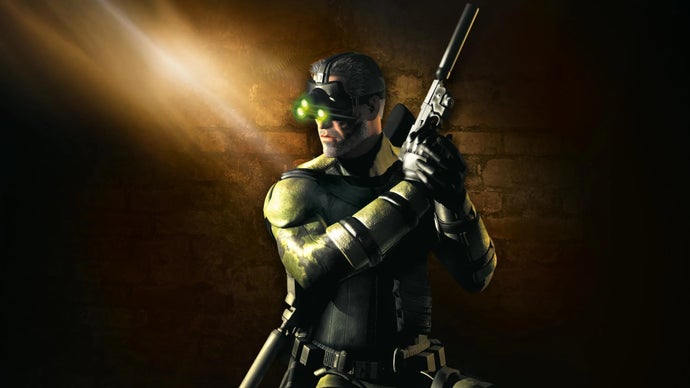

Check out the great enhancement patch for the original Splinter Cell
.
Read the full article on GamingOnLinux.
.
Read the full article on GamingOnLinux.
A banner for The Division: Definitive Edition was seen at the FPS Day X event in Japan recently, confirming some game rumours.
Coming hot off of last year’s success with Assassin’s Creed: Shadows, Ubisoft could be looking to another franchise to focus its efforts this year. Recently, a banner at the FPS Day X event in Japan featured poster art for The Division: Definitive Edition, along with Division 2 updates. While The Division 3 is still in development, the original game may still have a lot to offer its players.
Tom Clancy’s The Division is a 2016 online-only action RPG featuring multiplayer co-op and PvP. Some credit the game with pioneering and influencing the extraction shooter genre through core mechanics such as looting, crafting, PvPvE, survival elements (hunger, cold), and the tense goal of extracting a specific item. Although many would say Escape From Tarkov is the first true extraction shooter.
Spotted by domen0204 on X, the banner featured the poster for the upcoming Definitive Edition, with many visitors hoping the developers would finally make an official announcement during its 10th Anniversary celebrations. Another image by the X user showed that The Division 2‘s devs confirmed a ‘Realism mode’ coming in March 2026. It also contains some merch of some kind for the game.
#FPSDayX #TheDivision2#ディビジョン2 pic.twitter.com/1ySkfSb98B
— DomenGaming | ドウメン (@domen0204) January 11, 2026
Here is what we already know about The Division 2’s Realism Mode: it will feature action-focused gameplay, reduced time to kill, and realistic weapon damage based on bullet calibre. These changes allow players to immerse themselves in the game in a brand new way. In game-changing fashion, the mode will also introduce a reduced user interface, a limited HUD, no health regeneration, reduced cooldowns, and more. Developers also confirmed this is only the “first glimpse of the celebrations ahead,” with “more surprises” still to come.
FPS Day X attendees were able to try the new Realism Mode, and the Ubisoft Japan channel also posted a video outlining the feature. Creative director Yannick Banchereau said in the video: “Realism Mode is your chance to experience The Division 2 like never before, raw and unforgiving.” The only catch is that the mode will be available only during a special anniversary mini-season beginning in March. Players must also own the Warlords of New York expansion to access it.

Something all players can enjoy is the new anniversary crossover taking place with three other Tom Clancy series. The outfits, based on characters from Rainbow Six Siege X, Splinter Cell, and Ghost Recon, can be unlocked through the Anniversary Pass, although full details have not yet been revealed. However, as with last year’s Payday collaboration, the content could be free and progression-based through the Anniversary Pass.
Ubisoft series such as Far Cry, Assassin’s Creed, and Rainbow Six Siege have carried the publisher for some time. However, The Division series should not be overlooked. As noted earlier, the first game incorporated many extraction shooter elements, helping pave the way for more recent titles such as Escape From Tarkov and Arc Raiders.


Former Assassin's Creed director Alexandre Amancio has shared his thoughts about AAA development, suggesting we need "smaller teams" and admitting that big-budget developers cannot "solve a problem by throwing people at it".


January is the month that, where I live, in the south of England, everyone gets serious again. All the paraphernalia of Christmas - all the merriment and cheer and colourful lighting - is cleared away in favour of sobering goals for the year ahead. It's never something that's appealed strongly to me, making goals, but I do feel the allure of wiping a slate clean and starting again. It's like a run in a roguelike game, I like to think. Time for a new me.
It's been another strange, difficult, and yet somehow also brilliant year for video games in 2025. Triple-A releases have been sparse again, compared to the boom times of old, with a great big GTA 6-shaped hole left in the final few months of the year. And yet once again, every gap left by the established order has been filled twice over with something brilliantly new.

Rainbow Six Siege is still struggling today after hackers gave out "billions" in in-game currency, forcing Ubisoft to briefly "intentionally" shut down the game.

We love a biome in video games. Even the word is one I inherently associate with video games, in spite of its origins as a piece of proper grown-up geographical terminology. Within that gloriously over-the-top thematic pantheon… is there anything better than a good old fashioned Christmas level?

Ubisoft just spent the tail end of December 2025 in a total defensive crouch. What started as a weird glitch in Tom Clancy’s Rainbow Six Siege turned into a full-blown backend catastrophe that forced the publisher to pull the plug on global servers for over 24 hours.1 This wasn’t a standard “the servers are acting up” situation; this was a fundamental compromise of their internal logic.

The chaos became undeniable on December 27, 2025. Players logging in were greeted with a surreal scene: their accounts were suddenly flush with approximately 2 billion R6 Credits—the game’s premium currency—and virtually every cosmetic item in the game was unlocked. For context, 15,000 credits usually retail for about $100, making the injected value per player essentially infinite.

Beyond the “Christmas come early” vibes, the attackers gained administrative control over the game’s moderation tools. They didn’t stop at credits:
While Ubisoft has been tight-lipped about the exact entry point, security researchers have pointed to a critical vulnerability tracked as CVE-2025-14847, colloquially known as MongoBleed. This exploit allowed threat actors to infiltrate internal databases and Git repositories.
| Vector | Impact |
| CVE-2025-14847 | Deep access to internal source code and database functions. |
| API Vulnerabilities | Broken authentication on endpoints allowed unauthorized administrative calls. |
| Backend Audit | Attackers essentially had the keys to the kingdom, including the ability to gift currency and modify account states. |
The consensus among the technical crowd is that Ubisoft’s backend infrastructure lacked the necessary authorization checks on key API endpoints, allowing the attackers to masquerade as high-level administrators.
Ubisoft’s solution was a scorched-earth policy. They initiated a global rollback of all player data to its state before December 27, 10:49 UTC.
The reality here is pretty grim for a triple-A studio. Managing a live-service game for a decade only to have the entire backend subverted by a known database vulnerability suggests a massive gap in their security-aware culture. It’s a reminder that even the biggest players in the industry are often running on legacy systems held together by duct tape and hope.
The post End of the Year: Ubisoft MongoDB Meltdown appeared first on Game Reviews, News, Videos & More for Every Gamer – PC, PlayStation, Xbox in 2026.
Ubisoft, which received €1.16bn investment in 2025 from Tencent, have closed its studio in Halifax, Canada, with the shutdown coming just a few weeks after the employees voted to unionise. The studio had been running for over ten years.
“Over the past 24 months, Ubisoft has undertaken company-wide actions to streamline operations, improve efficiency, and reduce costs,” said a Ubisoft spokesperson. “As part of this, Ubisoft has made the difficult decision to close its Halifax studio. 71 positions will be affected. We are committed to supporting all impacted team members during this transition with resources, including comprehensive severance packages and additional career assistance.”
Employees at Ubisoft Halifax formed a union under CWA Canada, which also includes employees from Bethesda Montreal, on December 18th, 2025. 74% of the staff voted in favour of the move.
“In an era marked by industry-wide uncertainty, studio closures, layoffs, and increasing instability, we want to make clear our commitment to one another and to our craft,” they stated at the time.
CWA Canada has not made any official comment about the timing of the two events, but is “demanding information”. “Today’s news is devastating,” commented CWA Canada president, Carmel Smyth. “We will pursue every legal recourse to ensure that the rights of these workers are respected and not infringed in any way.”
Rockstar Games was recently accused of ‘union busting’ after firing 30 employees who belonged to a union, stating that the employees were fired for sharing company information in a public forum. This has been denied by the staff.
Following the dismissals last week, the IWGB branded it as “a brazen act of illegal union busting”, with IWGB president Alex Marshall calling it “a calculated attack on workers organising for a collective voice and to improve their difficult working conditions.”
Source: GameDeveloper
Update 30/12/25 – A Ubisoft spokesperson has issued a statement with some further details and reassurances over the reports of hacking affecting Rainbow Six Siege X over the weekend.
With the game back online, Ubisoft’s investigation is ongoing, but notes that actual effects were able to be rolled back and that neither personal data or game source code was compromised.
Here’s the statement:
Rainbow Six Siege recently experienced a cyberattack causing limited disruptions, including fake ban notifications and unauthorized credit grants. While we are continuing our investigation, as of this time, there is no indication that any personal data nor source code was compromised as a result of this incident. To help resolve the issue, we initiated a temporary server shutdown and rolled back the unauthorized credit grants. Rainbow Six Siege is currently back online and players are returning to the game.
The original story follows.
Rainbow Six Siege X is now back online after the servers were shut down for over two days while Ubisoft dealt with a massive security breach. In the evening of 26th December players began to notice billions of in-game currency being added to their accounts and super rare skins being dropping into their inventories. Other players were banned, and some were unbanned.
Ubisoft have now rolled back all the data so players should have the correct amount of in-game credit, known as Renown. They state that players may find themselves in a queue to get back in to the game.
The event has kicked off a war of words between various hacking groups who are claiming they are responsible, and also that one groups have stolen the source code for every Ubisoft game. These claims seem to be an exaggeration and probably not true.
However, there is evidence to suggest that Ubisoft were not hacked at all. It is reported that Ubisoft had outsourced helpdesk support to a company in India and that an employee there was bribed to give “Panel Access” to a third party. This then gave the third party access to user accounts, ban functions and other facilities. If this is true then Ubisoft were not hacked, it was bribery and human corruption that caused the issues.
It is also reported that another group is contacting people on Telegram claiming they have their personal details from hacking Ubisoft, and they are demanding money. This appears to be a scam and they have no connection to the group that breached the Rainbow Six servers. Ubisoft have, so far, not stated that any user data was breached.
Ubisoft overhauled the decade-old tactical shooter in June of this year, renaming it Rainbow Six Siege X, and added a whole host of technical improvements, as well as transitioning the game to a free-to-play model.
Rainbow Six is also one of three games hived off to a separate Ubisoft company, along with Assassin’s Creed and Far Cry.
Source: thecybersecguru.com
In Japan, Fallout 1st subscriptions have suddenly been stripped from accounts without any warning, and they might not be coming back.
The post Fallout 1st Removed From Player Accounts After Being ‘Mistakenly Available’ For 18 Months appeared first on Insider Gaming.

Ubisoft announced Wednesday it will close its Ubisoft Halifax studio and lay off 71 people. Ubisoft's closure of the Assassin's Creed: Rebellion and Rainbow Six Mobile studio comes just weeks after a group of 60 employees voted to unionize with Communications Workers of America's Canadian affiliate, CWA Canada. Seventy-four percent of the staff voted yes to unionize and create a wall-to-wall union including producers, designers, artists, testers, and researchers.
CWA Canada Local 30111, the chapter the Ubisoft Halifax workers joined, also includes more than a hundred workers at Bethesda Game Studios.
"Over the past 24 months, Ubisoft has undertaken company-wide actions to streamline operations, improve efficiency, and reduce costs," a Ubisoft spokesperson said in a statement to Aftermath. "As part of this, Ubisoft has made the difficult decision to close its Halifax studio. 71 positions will be affected. We are committed to supporting all impacted team members during this transition with resources, including comprehensive severance packages and additional career assistance."
The Ubisoft spokesperson did not specifically address the closure's relation—or not—to the recent union vote.
CWA Canada president Carmel Smyth said in a statement to Aftermath the union will "pursue every legal recourse to ensure that the rights of these workers are respected and not infringed in any way." The union said in a news release that it's illegal in Canada for companies to close businesses because of unionization. That’s not necessarily what happened here, according to the news release, but the union is "demanding information from Ubisoft about the reason for the sudden decision to close."
"We will be looking for Ubisoft to show us that this had nothing to do with the employees joining a union," former Ubisoft Halifax programmer and bargaining committee member Jon Huffman said in a statement. "The workers, their families, the people of Nova Scotia, and all of us who love video games made in Canada, deserve nothing less."
Ubisoft Halifax started as Longtail Studios, which was founded in the early 2000s by Ubisoft cofounder Gérard Guillemot. In 2010, several studio members were absorbed into Ubisoft, and by 2015, Ubisoft had acquired Longtail Studios entirely. That's when it became Ubisoft Halifax. Before joining Ubisoft, the studio was best known for its work on the Rocksmith franchise; under Ubisoft, it focused squarely on mobile games. Ubisoft Halifax was quickly removed from the Ubisoft website on Wednesday. IGN reported in 2023 that Longtail Studios tried to unionize in 2008, but ultimately failed.
Ubisoft has been cutting costs over the past several years: laying off staff, canceling games, and shutting down studios. In November, Ubisoft shared in its earnings report that it intends to continue to reduce its fixed costs—to reduce costs by an additional €100 million by the 2027 fiscal year—on top of the €200 million reduction it had already enacted. Part of that reduction was a decrease of roughly 1,500 employees in the 12 months prior to the November earnings report. Not all of those departures were layoffs, however.
Ubisoft required a $1.25 billion investment from Tencent last year, too, to spin off the company's most successful franchises: Rainbow Six Siege, Far Cry, and Assassin's Creed. That initiative is called Vantage Studios, led by Charlie Guillemot and Christophe Derennes. "Vantage Studios represents a first step in Ubisoft's ongoing transformation," Ubisoft said in a news release from October.

Today the overwhelming majority of workers at Doom studio id Software – 165 of around 185 total employees – announced that they’re forming a wall-to-wall union in conjunction with Communications Workers of America (CWA), the union that’s aided thousands of game workers across Microsoft in organizing.
"id Software is historically important – one of the more famous American studios that survived a length of time that few others have,” id Software producer Andrew Willis, who was part of the organizing effort from the jump and filed the initial paperwork to CWA, told Aftermath. “So it feels really awesome to get this done for something with such historical and cultural importance."
Workers at id began organizing around a year and a half ago, but things kicked into high gear following Microsoft’s unceremonious closure of several Bethesda studios in 2024.
"With Bethesda unionizing, it was a push for people [at id] to start talking, and that's when it started,” id Software lead services programmer Chris Hays told Aftermath. “But then the big push that got it rolling was the closure of Tango [Gameworks] and layoffs within Microsoft at Arkane Austin. It was a wakeup call for a lot of people. People decided that it was time that we took our future into our own hands."
"The big push that got it rolling was the closure of Tango [Gameworks] and layoffs within Microsoft at Arkane Austin. It was a wakeup call for a lot of people."
id itself, Hays said, has suffered “a few” layoffs “here and there” in recent years, but nothing comparable to the scale of Zenimax Online Studios, which lost hundreds of employees earlier this year amid Microsoft’s latest round of mass layoffs and project cancellations. Now, he believes, is the time to secure workers’ rights – before the scythe swings, as opposed to after.
"Not that we're not scared that [layoffs] will one day come," said Hays. "In fact, avoiding each of the previous rounds has made us more anxious about if the next round will be us. And the most recent round of layoffs happened after several [studios] had already organized. People [at id] can see what it was that they got. We got to see them negotiating where they didn't actually lose their jobs [for a couple months]. They were still on payroll. They still had their health insurance. ... They had the extra time to make sure they could get their lives [in order], and many have actually gotten their jobs back through negotiations on where they could place people in the company."
CWA has been able to successfully unionize so many studios within Microsoft and Activision Blizzard in large part due to a legally binding neutrality agreement it struck with the company in 2022 when it was facing regulatory scrutiny over its $68.7 billion purchase of Activision Blizzard. That deal lapsed earlier this year, but according to Hays, only on the Activision Blizzard side of things.
"For us under Zenimax, there's actually a separate neutrality agreement, and that one is still valid until May [2026]," said Hays. "But that was definitely on our minds when we were looking at when we wanted to think that we had enough support [to unionize]. … We knew that it was really special for us to have the neutrality agreement, to have the freedom to be able to talk to each other more openly and not face the kind of pushback you would have in other unionization campaigns. We wanted to make sure that we took advantage of the benefit while we had it."
While the union plans to conduct a bargaining survey before members go to the table with Microsoft to hammer out a contract, preliminary discussions have focused on a few pillars: benefits, remote work, and AI.
"There's a lot of blind spots in our benefits, and a lot of us don't know what we have and what we don't and where things are lacking,” said Hays. “When talking with a lot of people, some would say 'Oh, I think we're lacking this particular kind of benefit, or something around child care.' Personally, I'm really motivated to get protections around remote work and responsible use of AI."
"There's definitely a directive from Microsoft to use [AI] more.”
Remote work has been a sticking point at multiple Microsoft studios, with many issuing return-to-office mandates despite teams’ demonstrable success collaborating from across the country – and even the globe – in 2020 and 2021.
"We actually launched Doom Eternal during covid,” said Hays. “The month of [the launch], we started our work from home. ... We did a launch event, the whole internet fell apart, and we had to learn how to do all of that remote. And then starting a project [Doom: The Dark Ages] from the beginning, all remote, we learned a lot of lessons. On my team, we learned to change how we work, to be more remote friendly. We ended up becoming more productive as a result. So we've done this before. We've learned lessons, and I think we can continue to use that. We shouldn't just throw away all the great wins we got with remote work."
As for AI, Willis was cagey about precisely how it’s being used within id, noting that going into specifics would involve divulging secrets about proprietary tech. But he said that in his view, some of the current applications are “good,” while others are… less so.
"There's definitely a directive from Microsoft to use [AI] more,” Willis said. “In what ways and how careful they're being about implementing it within the studio to actually benefit the creation of a better game or a more efficient process, I personally don't think that's being done in a careful enough way to have it be beneficial.”
Last year, the Zenimax QA union secured AI protections that commit the company to uses of AI that "augment human ingenuity and capacities ... without causing workers harm" and require that Zenimax provides notice to the union in cases where "AI implementation may impact the work of union members and to bargain those impacts upon request." Willis and Hays hope the new union can make something similar happen under id’s roof.
"We are going to be in a fortunate position in that we have a lot of other people who've gone through this,” said Hays, “so we can look at what they have bargained for, especially around AI, and take that as a starting place, which hopefully means that it's going to be easier for us than anyone before."
Microsoft’s support of Israel’s genocide in Gaza – which continues despite a supposed ceasefire – is also potentially on the docket.
"It would be difficult to say [if we’ll make Israel a core bargaining issue] without seeing what the bargaining surveys comment on, but I can say for myself personally that, yeah, I want no part in [Israel's] usage of Microsoft tools and the deals between Israel and Microsoft," said Willis.
"The folks that are in charge of a lot of these decision-making processes, it's a lot of Ivy League MBAs, a lot of folks with zero game experience."
More broadly, Willis believes the union will allow for more input from developers, as opposed to execs who have never shipped a game and, indeed, might not play them at all.
"We see the direction the industry is headed,” said Willis. “The folks that are in charge of a lot of these decision-making processes, it's a lot of Ivy League MBAs, a lot of folks with zero game experience – not just from the management standpoint, but zero experience in actually making games. ... I find little evidence of them really enjoying games or playing games personally."
“I think the more video game studios that unionize, and the greater percentage of video game employees that are in a union, it's not just better for them as individuals or folks that are raising families or have mortgages; it keeps talent from shedding,” he added. “You get to keep people in the industry who have experience and the amount of game credits that allow them to do things and create games that a contract-only or much more volatile workforce simply couldn't.”
AftermathNathan Grayson
Greetings from the year of Linux on my desktop.
In November, I got fed up and said screw it, I'm installing Linux. Since that article was published, I have dealt with one minor catastrophe after another. None of that has anything to do with Linux, mind you. It just meant I didn't install it on my desktop until Sunday evening.
My goal here is to see how far I can get using Linux as my main OS without spending a ton of time futzing with it - or even much time researching beforehand. I am not looking for more high-maintenance hobbies at this stage. I want to see if Linux is a wingable alternative to Microsoft's increasingly annoying OS.
Ho …